Why We Need Behavior Change Models
Behavior change models provide systematic frameworks for understanding why people behave as they do and how to design effective interventions. In this sixth part of our series, we explore the major theoretical models.
Key Insight
Behavior change models help identify which factors to target and which intervention strategies will be most effective for your specific context.
Behavioral Psychology Mastery
Foundations of Behavior
Core principles, conditioning, behavioral loopHabit Formation & Breaking
Habit loops, building & breaking habitsDecision-Making Psychology
Biases, dual-system thinking, behavioral economicsMotivation & Drive
Intrinsic vs extrinsic, theories, goal psychologyNudge Theory & Choice Architecture
Defaults, framing, behavioral designBehavior Change Models
COM-B, Fogg, transtheoretical modelSocial Influence & Persuasion
Conformity, authority, Cialdini's principlesPractical Applications
Personal, workplace, business, healthBehavioral Neuroscience Basics
Dopamine, stress, habit circuitryBehavioral Research Methods
Experiments, RCTs, field studiesApplied Behavioral Therapy
CBT, exposure therapy, reinforcementCOM-B Framework
COM-B (Capability, Opportunity, Motivation → Behavior) was developed by Susan Michie and colleagues at University College London. It's the most comprehensive behavior change framework, forming the center of the Behaviour Change Wheel.
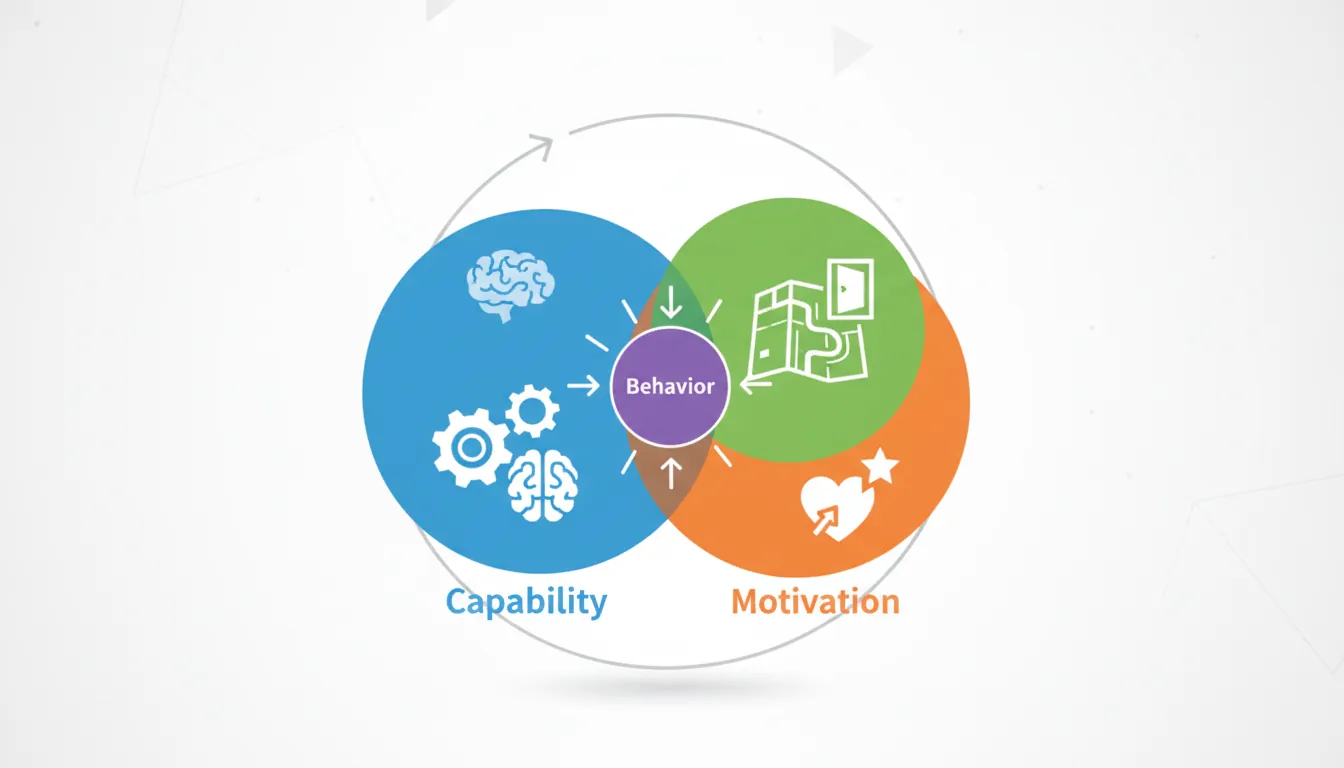
graph TD
    CAP["Capability\n(Physical & Psychological)"] --> BEH["Behavior"]
    OPP["Opportunity\n(Physical & Social)"] --> BEH
    MOT["Motivation\n(Reflective & Automatic)"] --> BEH

    BEH -->|"Feedback"| CAP
    BEH -->|"Feedback"| MOT
    CAP -.-> MOT
    OPP -.-> MOT
The Three Components
| Component | Sub-types | Examples |
|---|---|---|
| Capability | Physical: Strength, skill, stamina Psychological: Knowledge, memory, decision-making |
Can cook healthy meals, remembers to exercise, knows calorie content |
| Opportunity | Physical: Time, resources, environment Social: Norms, culture, relationships |
Gym nearby, healthy food available, supportive family, friends exercise |
| Motivation | Reflective: Goals, plans, beliefs Automatic: Habits, emotions, desires |
Wants to be healthy, believes exercise works, enjoys running, craves snacks |
Key equation: B = C × O × M. All three components must be present for behavior to occur.
COM-B Diagnosis
When behavior isn't happening, ask: Is it a Capability problem (they can't)? An Opportunity problem (the environment doesn't allow it)? Or a Motivation problem (they don't want to)? Most interventions fail because they target the wrong component.
Applying COM-B: An Example
Why People Don't Exercise
| Barrier | COM-B Component | Intervention |
|---|---|---|
| "I don't know what exercises to do" | Psychological Capability | Education, training |
| "I have a bad knee" | Physical Capability | Enablement, alternative exercises |
| "I don't have time" | Physical Opportunity | Environmental restructuring |
| "My friends don't exercise" | Social Opportunity | Modeling, social support |
| "I don't believe it will help" | Reflective Motivation | Persuasion, education |
| "I just don't feel like it" | Automatic Motivation | Incentives, habit formation |
The Behaviour Change Wheel
COM-B sits at the center of the Behaviour Change Wheel, surrounded by:
- 9 Intervention Functions: Education, Persuasion, Incentivization, Coercion, Training, Restriction, Environmental Restructuring, Modeling, Enablement
- 7 Policy Categories: Communication, Guidelines, Fiscal, Regulation, Legislation, Environmental/Social Planning, Service Provision
Fogg Behavior Model
Stanford professor BJ Fogg created a simpler model focused on moment-of-action:
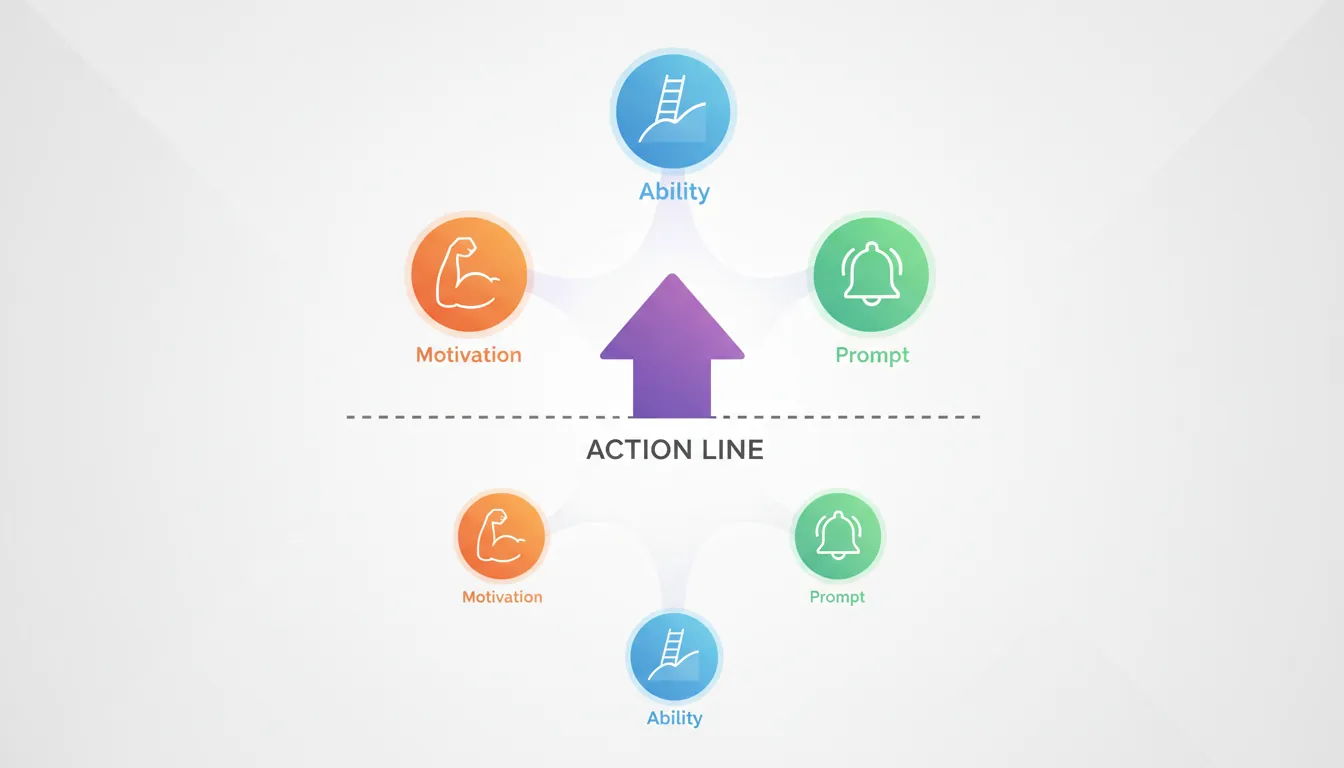
graph TD
    B["Behavior
B = MAP"]

    M["Motivation
Sensation: pleasure/pain
Anticipation: hope/fear
Social: acceptance/rejection"]
    A["Ability
Time, money, effort
Physical/mental capacity
Social deviance"]
    P["Prompt
Spark (low motivation)
Facilitator (low ability)
Signal (both high)"]

    M --> B
    A --> B
    P --> B

    B -->|"Above action line"| ACT["Action Occurs"]
    B -->|"Below action line"| NONE["No Action"]

    style B fill:#132440,stroke:#132440,color:#fff
    style M fill:#BF092F,stroke:#132440,color:#fff
    style A fill:#16476A,stroke:#132440,color:#fff
    style P fill:#3B9797,stroke:#132440,color:#fff
The Fogg Formula
B = MAP
Behavior happens when Motivation, Ability, and Prompt converge at the same moment.
The Three Elements
| Element | Description | Enhance By |
|---|---|---|
| Motivation | Desire to do the behavior | Connect to identity, show benefits, reduce fears |
| Ability | Ease of doing the behavior | Simplify, reduce time/cost/effort, build skills |
| Prompt | Trigger to act now | Add cues, reminders, anchor to existing behaviors |
The Action Line
Fogg's model includes an "action line" on a motivation-ability graph. Behaviors above the line happen; below, they don't.
Key Insight: Trade-offs
- High motivation: Can do hard things (calling 911 in emergency)
- Low motivation: Only do easy things (clicking "Like")
- Design insight: Make behaviors easy so low motivation is sufficient
Fogg's advice: "Put hot triggers in front of motivated people." Don't try to motivate unmotivated people—instead, make the behavior easier or wait for motivation to arise naturally.
Tiny Habits Method
Fogg's practical application of his model:
- Anchor: Identify an existing routine (e.g., "After I brush my teeth...")
- Make it tiny: Reduce the new behavior to 30 seconds or less
- Celebrate: Create positive emotion immediately after
Transtheoretical Model (Stages of Change)
Prochaska and DiClemente's model recognizes that behavior change is a process, not an event. People move through predictable stages:
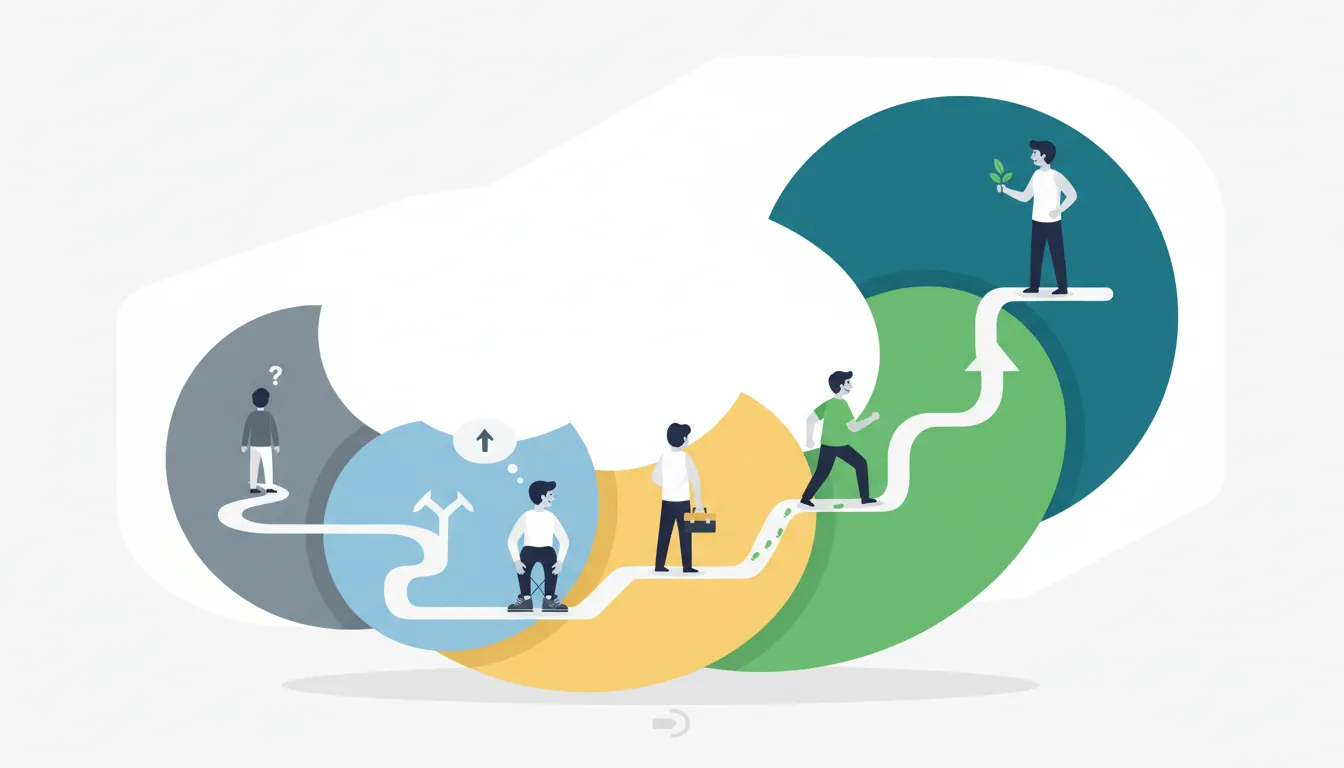
The Five (or Six) Stages
| Stage | Mindset | Appropriate Intervention |
|---|---|---|
| 1. Precontemplation | "I don't have a problem" | Raise awareness, provide information |
| 2. Contemplation | "Maybe I should change" | Explore pros/cons, build self-efficacy |
| 3. Preparation | "I'm getting ready" | Help set goals, make plans, identify resources |
| 4. Action | "I'm doing it" | Provide support, reinforce, manage temptations |
| 5. Maintenance | "I'm keeping it going" | Prevent relapse, build routines, develop identity |
| 6. Termination | "This is just who I am" | No intervention needed—change is permanent |
Critical Insight: Stage-Matched Interventions
A common mistake is giving Action-stage interventions (gym memberships, diet plans) to people still in Precontemplation or Contemplation. They're not ready. Match the intervention to the stage.
The Processes of Change
Different strategies work at different stages:
Stage-Appropriate Strategies
| Early Stages (Pre-Action) | Later Stages (Action+) |
|---|---|
| Consciousness raising (learn about problem) | Reinforcement management (rewards) |
| Emotional arousal (feel the consequences) | Helping relationships (support) |
| Self-reevaluation (values assessment) | Counter-conditioning (alternatives) |
| Environmental reevaluation (impact on others) | Stimulus control (manage triggers) |
| Social liberation (see alternatives exist) | Self-liberation (commitment) |
EAST Framework
Developed by the UK Behavioural Insights Team (BIT) for practical policy implementation:
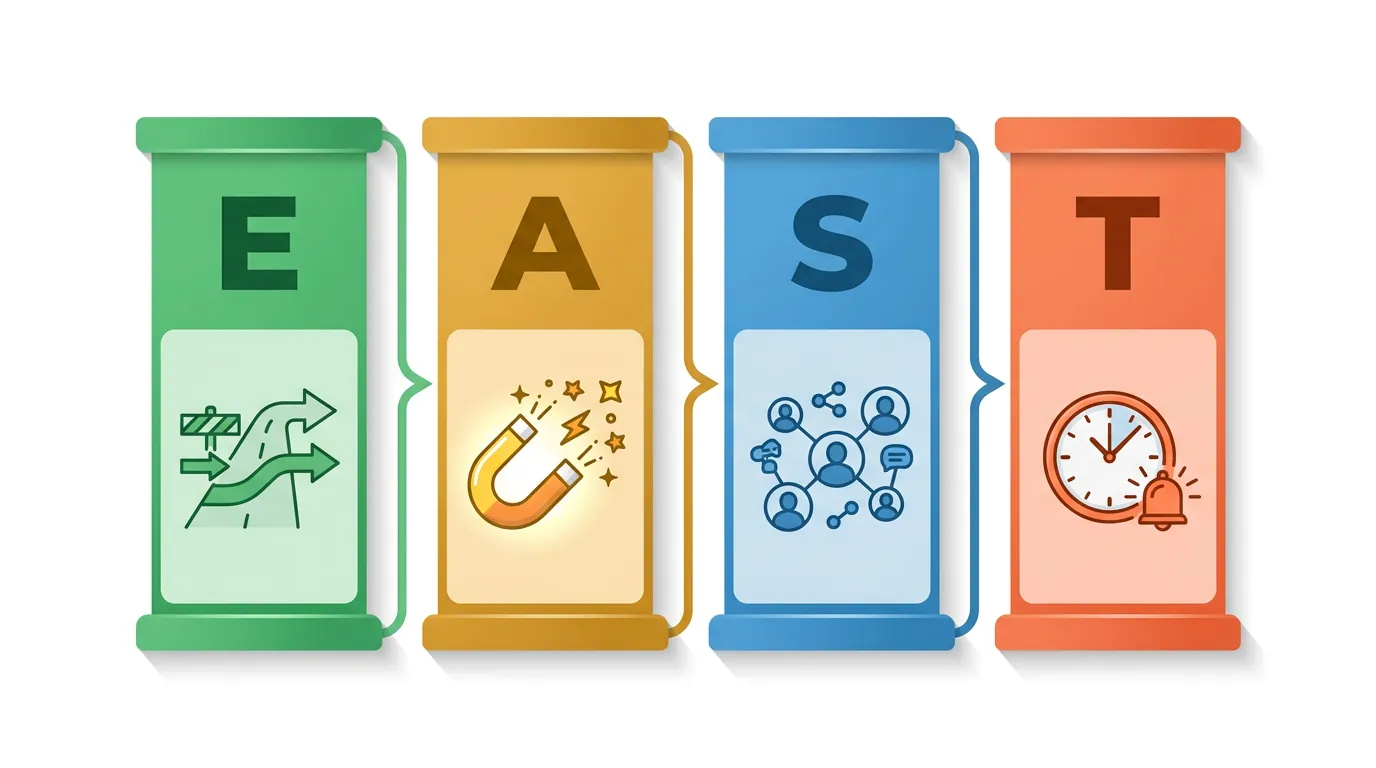
EAST Principles
| Principle | Meaning | Tactics |
|---|---|---|
| Easy | Reduce friction and hassle | Defaults, pre-population, simplification, one-click |
| Attractive | Capture attention | Personalization, salience, rewards, gamification |
| Social | Leverage social influence | Social norms, commitments, networks, reciprocity |
| Timely | Intervene at the right moment | Prompts at decision points, fresh starts, reminders |
Designing Interventions
A systematic process for creating behavior change interventions:
Intervention Design Process
| Step | Activity | Tools |
|---|---|---|
| 1. Define | Specify target behavior precisely | Behavioral definition checklist |
| 2. Diagnose | Understand why current behavior occurs | COM-B analysis, user interviews |
| 3. Design | Select intervention functions | Behaviour Change Wheel, EAST |
| 4. Develop | Create specific intervention content | BCTs (behavior change techniques) |
| 5. Test | Pilot and measure | A/B tests, RCTs |
| 6. Iterate | Refine based on results | Continuous improvement |
Practical Exercise: Behavioral Diagnosis
Try This
Pick a behavior you want to change (yours or others'). Use COM-B to diagnose:
- Capability: Do they know how? Can they physically do it?
- Opportunity: Does the environment enable it? Do social norms support it?
- Motivation: Do they believe it's worth doing? Do they want to?
The weakest component is your intervention target.
Comparing Models
When should you use which model?
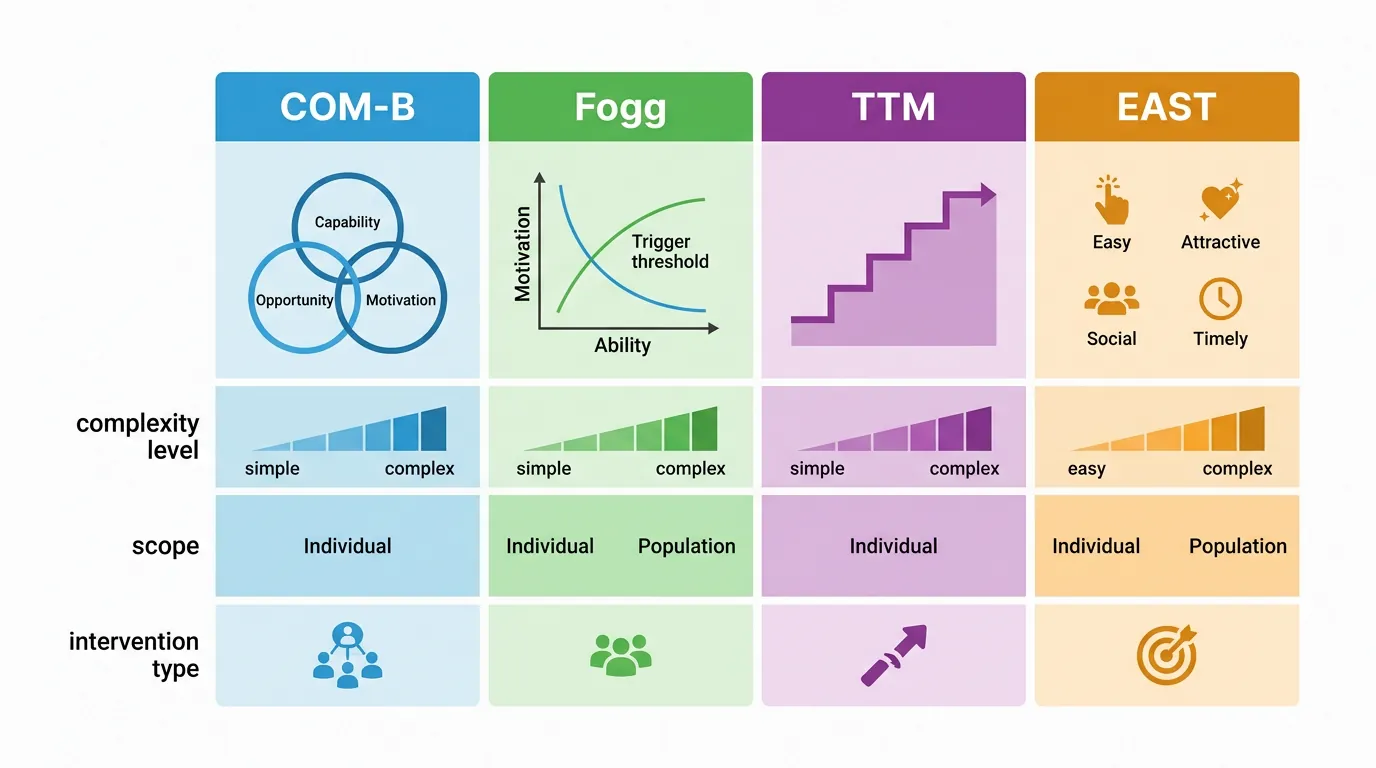
Model Selection Guide
| Model | Best For | Limitations |
|---|---|---|
| COM-B | Comprehensive diagnosis, policy design | Complex, requires expertise |
| Fogg (MAP) | Product design, habit formation | Less systematic, trigger-focused |
| Transtheoretical | Health behavior, addiction treatment | Stage definitions overlap |
| EAST | Quick nudges, policy implementation | Checklist, not diagnostic |
Integration Tip
Use COM-B to diagnose the problem, Transtheoretical to understand readiness, EAST to design the intervention, and Fogg to build the specific habit.
Conclusion & Next Steps
You've now learned the major behavior change frameworks:
- COM-B: Comprehensive model—Capability, Opportunity, Motivation all needed
- Fogg: Simple model—Behavior = Motivation × Ability × Prompt
- Transtheoretical: Stage model—match interventions to readiness stage
- EAST: Practical checklist—Easy, Attractive, Social, Timely
The key insight: diagnose before you intervene. Most behavior change fails because it targets the wrong barrier.