What Is a Nudge?
A nudge is any aspect of choice architecture that alters people's behavior predictably without forbidding options or significantly changing economic incentives. In this fifth part of our series, we explore the science of behavioral design.
Key Insight
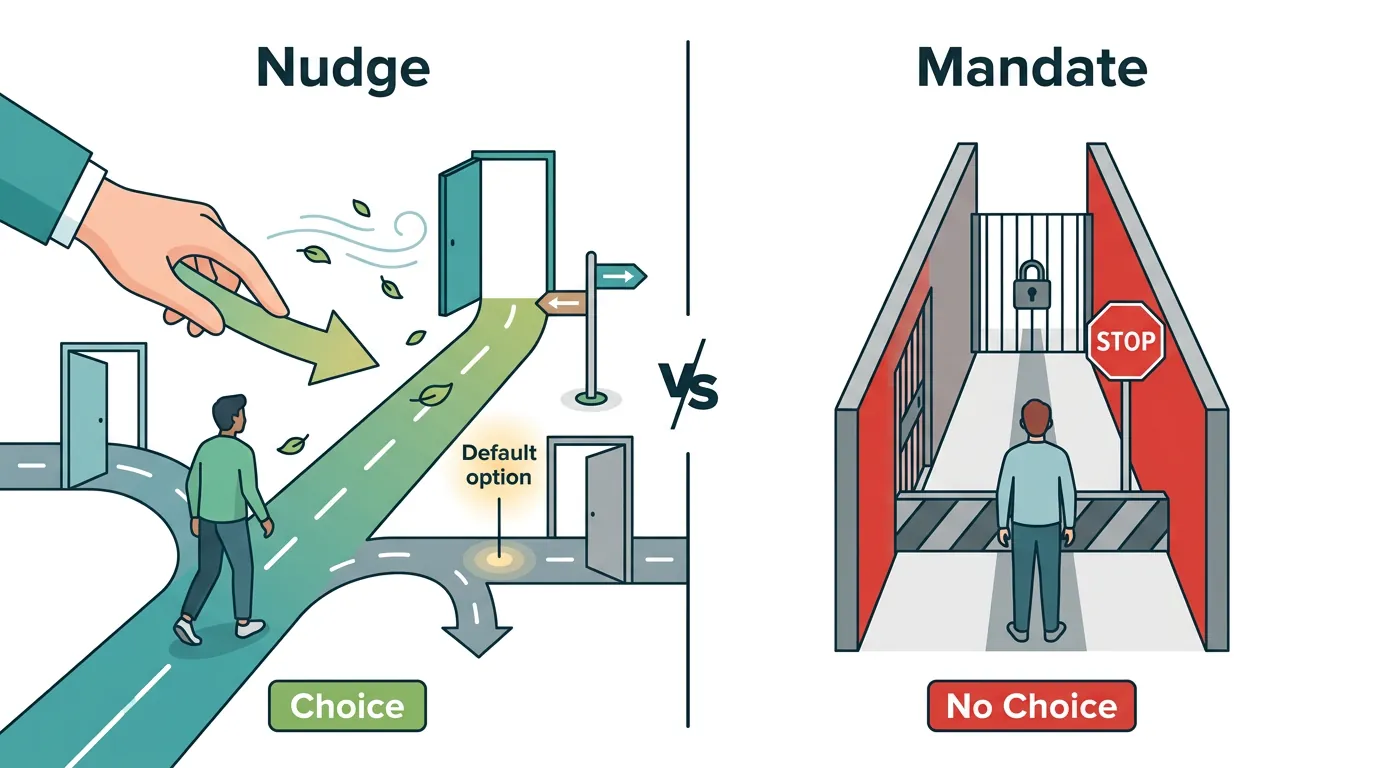
Nudges work by making desired behaviors easier, more salient, or socially normative—without mandates or bans.
Behavioral Psychology Mastery
Foundations of Behavior
Core principles, conditioning, behavioral loopHabit Formation & Breaking
Habit loops, building & breaking habitsDecision-Making Psychology
Biases, dual-system thinking, behavioral economicsMotivation & Drive
Intrinsic vs extrinsic, theories, goal psychologyNudge Theory & Choice Architecture
Defaults, framing, behavioral designBehavior Change Models
COM-B, Fogg, transtheoretical modelSocial Influence & Persuasion
Conformity, authority, Cialdini's principlesPractical Applications
Personal, workplace, business, healthBehavioral Neuroscience Basics
Dopamine, stress, habit circuitryBehavioral Research Methods
Experiments, RCTs, field studiesApplied Behavioral Therapy
CBT, exposure therapy, reinforcementNudge vs Mandate
| Nudge | Mandate |
|---|---|
| Cafeteria puts fruit at eye level | Cafeteria bans desserts |
| Organ donation is opt-out | Organ donation is mandatory |
| Stairs are prominent, elevator hidden | Elevator requires medical clearance |
| Retirement is auto-enrolled | Retirement contribution is required |
Key distinction: Nudges preserve freedom of choice. You can always take the elevator, opt-out of donation, or decline enrollment.
The Origin: Thaler and Sunstein
The concept was popularized by economist Richard Thaler (Nobel Prize 2017) and legal scholar Cass Sunstein in their 2008 book "Nudge." They argued that because there is no neutral choice architecture—someone always decides how options are presented—we should design environments that help people make better decisions.
Choice Architecture
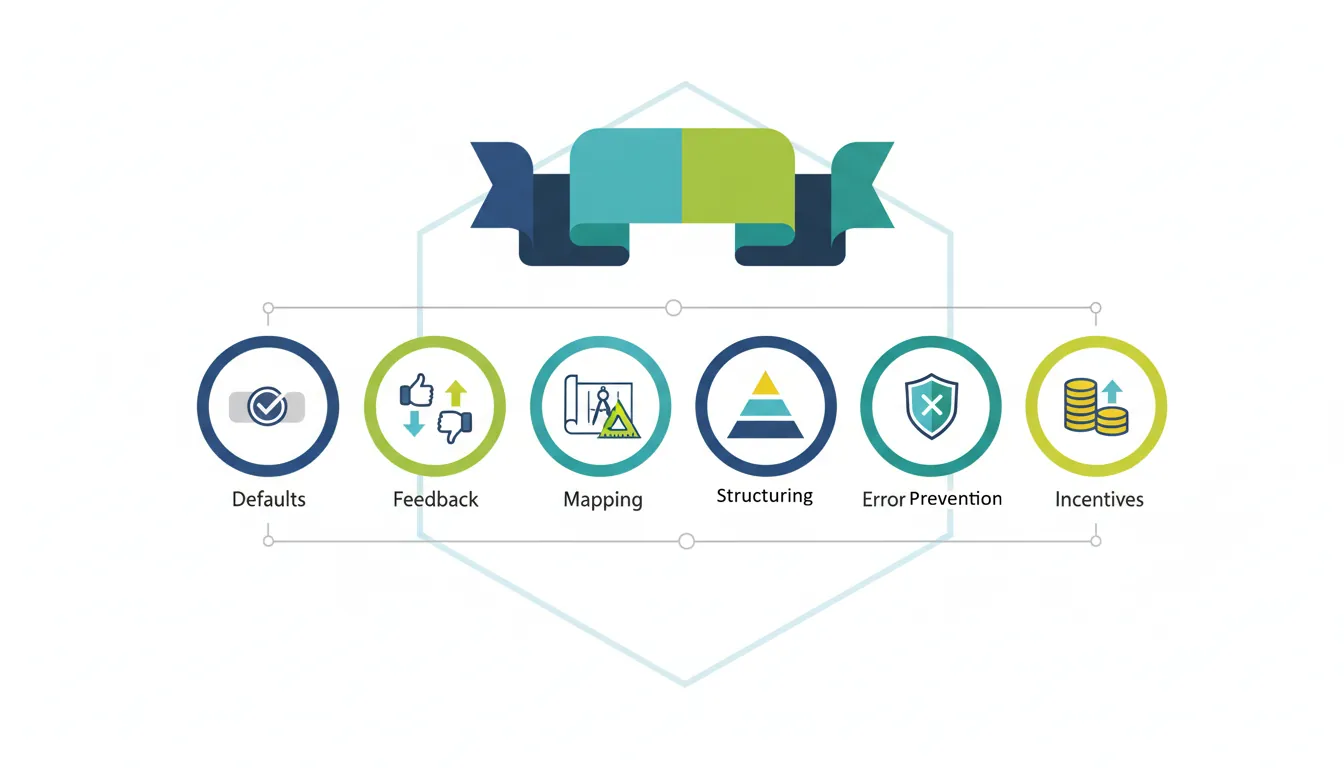
Choice architecture is the design of environments in which people make decisions. Choice architects are the people who shape these environments—from app designers to HR managers to cafeteria planners.
The Choice Architect's Responsibility
Every choice environment is designed by someone. The question isn't whether to influence decisions, but how. Thoughtful design helps; careless design hurts.
Key Elements of Choice Architecture
| Element | Description | Example |
|---|---|---|
| Defaults | What happens if you do nothing | Auto-enrollment in 401(k) |
| Feedback | Information about current behavior | Real-time energy use display |
| Mapping | Connecting choices to outcomes | Calorie counts on menus |
| Structuring | Organizing complex choices | Breaking 100 options into 10 categories |
| Error prevention | Designing for mistakes | Confirmation dialogs before deletion |
| Incentives | Who pays, who benefits, when | Immediate vs delayed rewards visible |
The NUDGES Framework
Thaler and Sunstein use the acronym NUDGES to summarize effective choice architecture:
NUDGES Acronym
| Letter | Principle | Application |
|---|---|---|
| N | iNcentives | Make costs and benefits salient at decision time |
| U | Understand mappings | Help people see how choices translate to outcomes |
| D | Defaults | Set good defaults since most people stick with them |
| G | Give feedback | Tell people what they're doing and how it compares |
| E | Expect error | Design systems that assume people will make mistakes |
| S | Structure complex choices | Break overwhelming decisions into manageable steps |
Taxonomy of Nudge Types
Not all nudges work the same way. Researchers classify nudges into distinct categories based on how they influence behavior. Understanding these types helps designers pick the right tool for each situation.
Ten Types of Nudges
| Nudge Type | Mechanism | Example |
|---|---|---|
| Default Rules | Pre-select the desired option | Auto-enroll employees in pension plans |
| Simplification | Reduce complexity and friction | Pre-filled tax forms sent by government |
| Social Norms | Reveal what most people do | "Most guests in this room reuse towels" |
| Disclosure | Make information visible | Calorie labels on restaurant menus |
| Warnings & Graphics | Highlight risks visually | Graphic warnings on cigarette packs |
| Pre-commitment | Commit to future behavior now | "Save More Tomorrow" escalating savings |
| Reminders | Prompt at the right moment | SMS reminders for overdue bill payments |
| Eliciting Intentions | Ask people to plan specifics | "What time will you vote tomorrow?" |
| Micro-incentives | Small, immediate rewards | Loyalty stamps for bringing reusable cups |
| Cool-off Periods | Insert delay before irreversible acts | 24-hour waiting period before large purchases |
Tip: The first three—defaults, simplification, and social norms—are the most widely validated and easiest to implement.
Type 1 vs Type 2 Nudges
Behavioral scientists further distinguish Type 1 nudges (target automatic, System 1 thinking—e.g., defaults, placement) from Type 2 nudges (engage reflective, System 2 thinking—e.g., disclosure, reminders). Both are valid, but Type 1 nudges tend to show larger immediate effects while Type 2 nudges support more autonomous decision-making.
The Power of Defaults
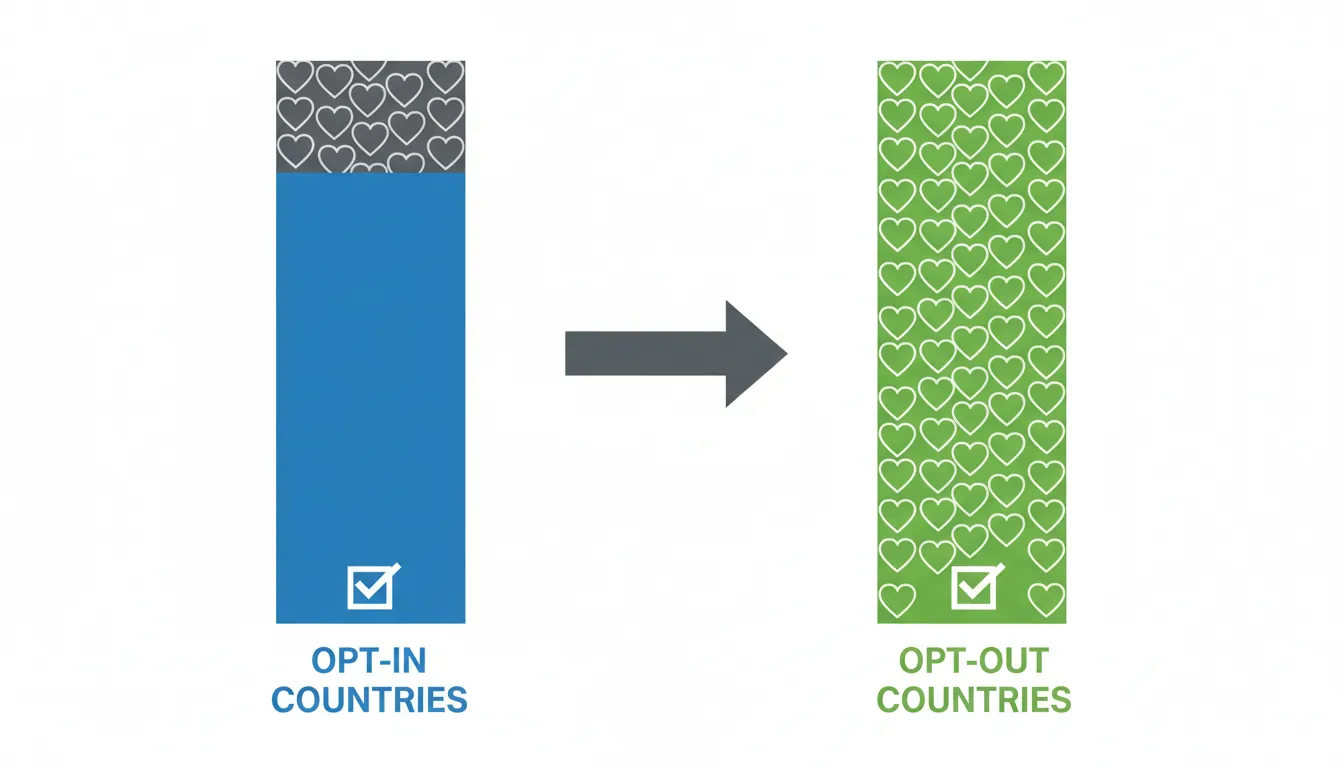
Of all nudge techniques, defaults are the most powerful. Research shows 70-90% of people stick with whatever option is pre-selected.
Classic Study: Organ Donation Rates
| Country | Default | Consent Rate |
|---|---|---|
| Germany | Opt-in | 12% |
| Austria | Opt-out | 99% |
| Denmark | Opt-in | 4% |
| Sweden | Opt-out | 86% |
| UK | Opt-in | 17% |
| France | Opt-out | 99% |
Conclusion: Cultural differences can't explain this. The default determines behavior, not deeply held preferences about donation.
Why Defaults Work
Three Reasons for Default Power
- Effort: Changing requires active decision-making (System 2 effort)
- Implied recommendation: "If this is the default, it must be what I should do"
- Status quo bias: Humans naturally prefer the current state
Defaults in Action
Real-World Default Effects
| Domain | Default Nudge | Impact |
|---|---|---|
| Retirement | Auto-enroll at 3% contribution | Participation jumps from 35% to 86% |
| Utility bills | Default to paperless | 75% reduction in paper bills |
| Subscriptions | Auto-renew enabled | Retention increases 40%+ |
| Software | Privacy settings default loose | 95%+ share more than intended |
| Healthcare | Default to generic drugs | Significant cost savings, same efficacy |
Defaults in UX & Digital Design
Digital products are among the most powerful default environments. Every checkbox, toggle, and pre-selection is a choice architecture decision that affects millions of users.
Common Digital Defaults
| Pattern | Default Setting | Behavioral Effect |
|---|---|---|
| Pre-checked checkboxes | Newsletter sign-up ticked by default | 60-80% of users remain subscribed |
| Cookie consent banners | "Accept All" button prominent; reject requires extra clicks | 90%+ accept all cookies |
| App permissions | Request all permissions on first launch | Most users grant blanket access |
| One-click ordering | Amazon's stored payment & address auto-fill | Reduces purchase friction dramatically |
| Auto-play & infinite scroll | Next video starts automatically | Users watch 30-40% more content |
| Subscription auto-renewal | Free trial converts to paid by default | 70%+ of trialists become paid subscribers |
Ethical vs Dark Defaults
Regulators increasingly scrutinize digital defaults. The EU's GDPR requires cookie consent to be genuinely opt-in (no pre-checked boxes for non-essential cookies). The FTC has acted against "negative option" subscriptions that are easy to start but hard to cancel. Ethical default design means the pre-selected option should genuinely serve the user's interest, and opting out must be equally easy and obvious.
Framing Effects
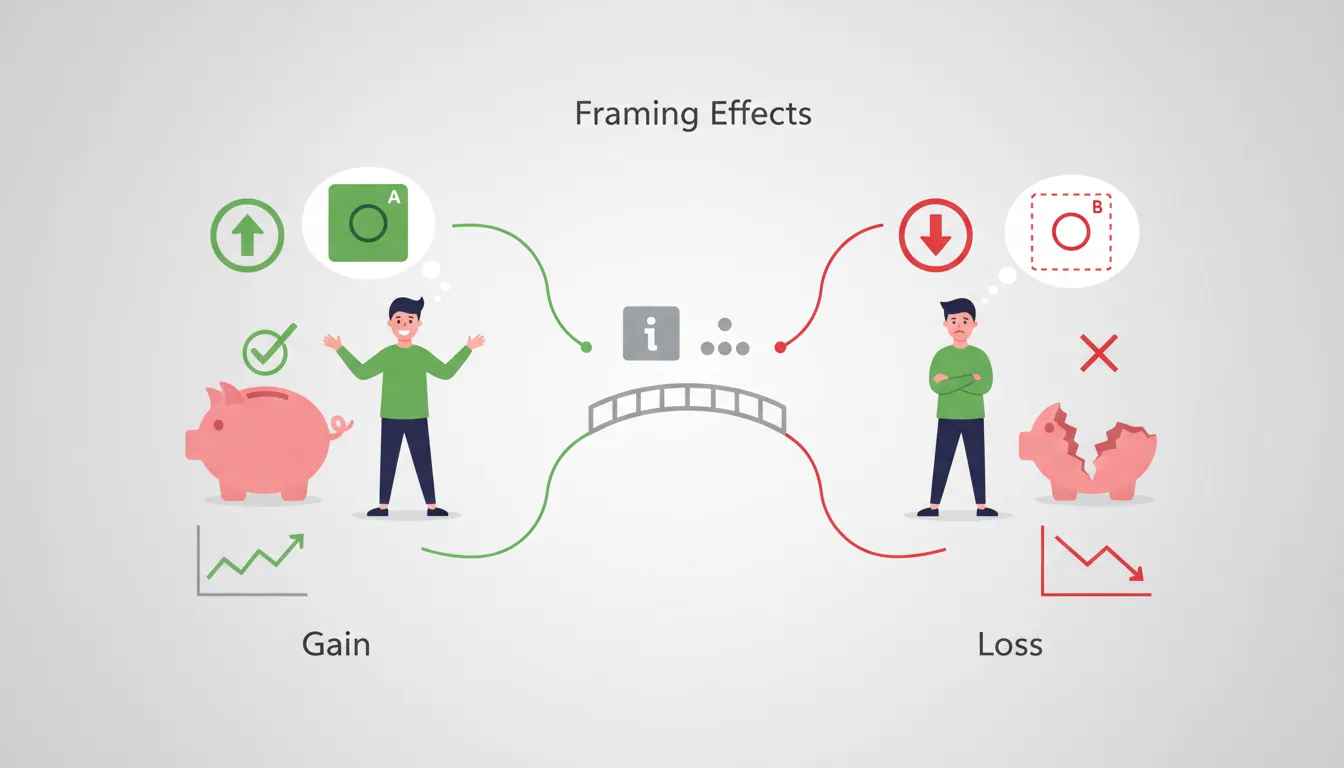
How information is presented dramatically affects decisions—even when the underlying facts are identical.
Classic Study: The Surgery Decision
Patients choosing between surgery and radiation therapy received one of two descriptions:
| Frame | Description | Choose Surgery |
|---|---|---|
| Survival | "90% survive the surgery" | 84% |
| Mortality | "10% die during surgery" | 50% |
Same statistics, different framing, vastly different choices.
Types of Framing
Common Framing Techniques
| Framing Type | Example A | Example B |
|---|---|---|
| Gain vs Loss | "Save $200 per year" | "Stop losing $200 per year" |
| Positive vs Negative | "95% fat-free" | "Contains 5% fat" |
| Absolute vs Relative | "Reduces risk by 50%" | "Reduces risk from 2% to 1%" |
| Present vs Future | "Pay $10 now" | "Pay $12 in 30 days" |
Loss Framing Is Powerful
Due to loss aversion (from Part 3), framing outcomes as losses is often more motivating than framing as gains. "Don't miss out on $500 savings" outperforms "Get $500 savings."
Social Proof Framing
Telling people what others do is a powerful nudge:
- Tax compliance: "9 out of 10 people in your area pay taxes on time" increased payment rates
- Hotel towels: "75% of guests reuse towels" increased reuse more than environmental appeals
- Energy bills: Comparing usage to "efficient neighbors" reduces consumption
Attribute-Based Choice Architecture
Beyond framing the same information differently, choice architects can influence decisions by controlling which attributes are highlighted, ordered, or made easy to compare. This is called attribute-based choice architecture.
How Attribute Presentation Shapes Choices
| Technique | Mechanism | Example |
|---|---|---|
| Attribute ordering | First-listed attributes receive disproportionate weight | Listing "safety rating" before "horsepower" on car comparison sites shifts preference toward safer vehicles |
| Evaluability | Making an attribute easy to interpret increases its influence | Energy efficiency labels with A-G grades instead of raw kWh make efficiency a top decision factor |
| Highlighting | Visual emphasis (bold, colour, size) draws attention | Highlighting sugar content in red on nutrition labels increases selection of low-sugar items |
| Option partitioning | How categories are split affects perceived variety | Splitting "healthy snacks" into 3 sub-categories makes people choose more healthy options than a single "snacks" list |
Why This Matters
Attribute-based nudges are especially useful when you cannot change defaults or restrict options. By simply reordering columns in a comparison table, placing the most important attribute first, or adding a simple A-to-F rating, you can significantly shift choices—without removing any option or manipulating wording.
Libertarian Paternalism
This is the philosophical foundation of nudge theory—a seemingly contradictory combination of two ideas:
The Two Components
| Libertarian | Paternalist |
|---|---|
| Preserve freedom of choice | Help people make better decisions |
| People should decide for themselves | Experts can identify better choices |
| No mandates or bans | Guide toward beneficial outcomes |
| Easy to opt out | Design environments thoughtfully |
The Core Argument
Since someone must design the choice environment anyway (what goes in the cafeteria line first, what's the default privacy setting), it's legitimate to design it in ways that make people better off—as judged by their own preferences.
The "As Judged by Themselves" Standard
A key test for nudges: Would people, upon reflection, agree the nudge helped them achieve their own goals?
- Auto-enrolling in retirement savings ✓ (Most people say they want to save more)
- Putting vegetables first in cafeteria ✓ (Most people say they want to eat healthier)
- Hiding the "unsubscribe" button ✗ (Not helping achieve user goals)
Designing Effective Nudges
The EAST Framework
The UK Behavioural Insights Team developed EAST as a practical guide for creating nudges:
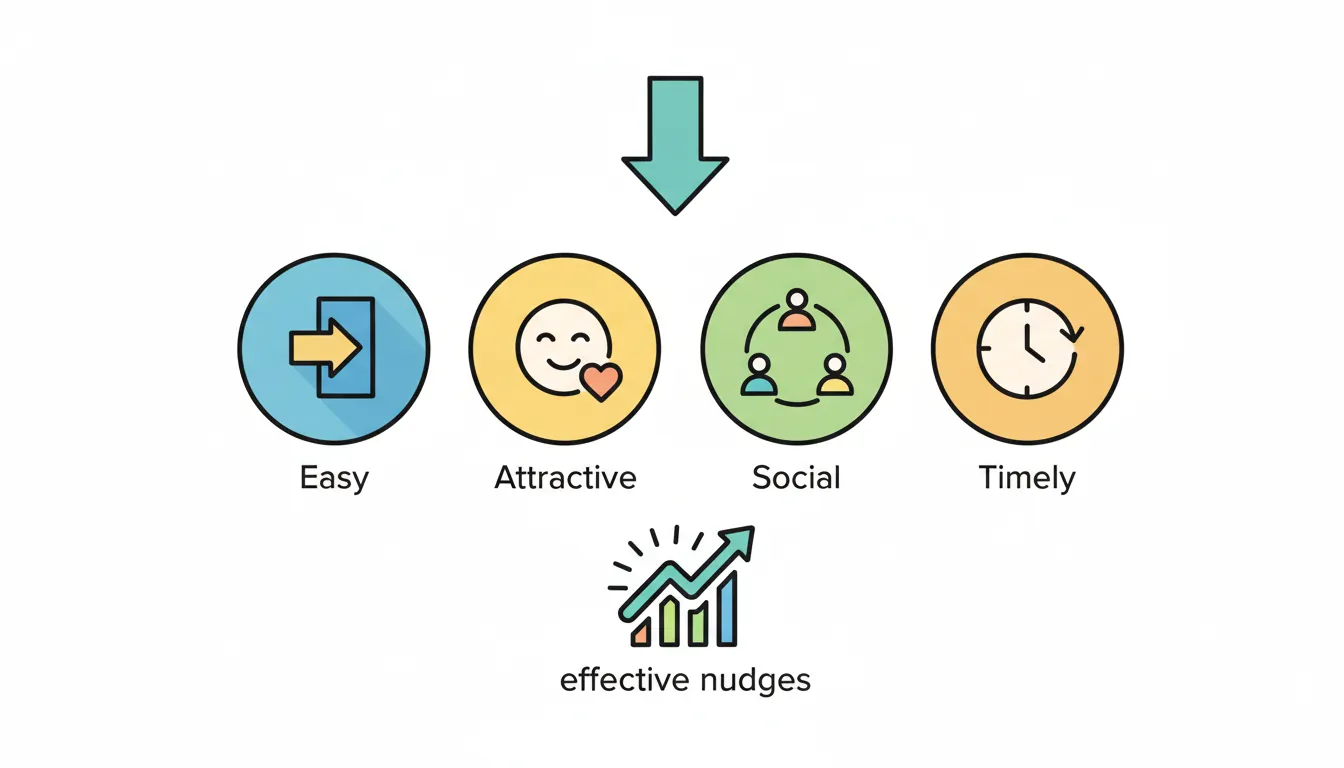
EAST Framework
| Principle | Meaning | Application |
|---|---|---|
| Easy | Reduce friction | Pre-fill forms, simplify steps, use defaults |
| Attractive | Draw attention | Use visuals, personalize, make it rewarding |
| Social | Leverage social norms | Show what others do, create commitments |
| Timely | Right moment | Prompt at decision points, use fresh starts |
Real-World Nudge Examples
Successful Nudges in Practice
| Problem | Nudge | Result |
|---|---|---|
| Low flu vaccination | Pre-scheduled appointments with specific date/time | +36% vaccination rate |
| Late tax payments | "9 out of 10 people pay on time" | +15% timely payments |
| Littering in streets | Green footprints leading to bins | -46% litter |
| Urinal spillage | Fly image etched in urinal | -80% spillage (Amsterdam airport) |
| Staircase vs escalator | Piano stairs that play music | +66% stair usage |
Practical Exercise: Design a Nudge
Try This
Pick a behavior you want to change (personal or organizational) and design a nudge:
- What's the desired behavior?
- What's the current default?
- How can you make the desired behavior the Easy option?
- What Social proof could you add?
- What's the best Timing for the nudge?
- How will you preserve choice (keep opt-out easy)?
Ethics and Criticism
Nudging isn't universally praised. Critics raise several concerns:
Common Criticisms
| Criticism | Concern | Response |
|---|---|---|
| Manipulation | Nudges bypass rational thought | All influence does; nudges are transparent |
| Autonomy | Undermines genuine choice | Choices remain; only the default changes |
| Who decides? | Gives nudgers too much power | Use "as judged by themselves" standard |
| Dark nudges | Companies use for profit, not benefit | Distinguish "sludge" from ethical nudges |
| Slippery slope | Today's nudge is tomorrow's mandate | Maintain clear principles and oversight |
Sludge: The Dark Side
What Is Sludge?
"Sludge" is friction deliberately added to make beneficial actions harder—the opposite of a helpful nudge. Examples include: hard-to-cancel subscriptions, hidden unsubscribe buttons, complex rebate forms, confusing healthcare enrollment processes. Sludge is unethical because it works against people's own interests.
Ethical Guidelines for Nudging
- Transparency: Nudges should be disclosed, not hidden
- Alignment: Must help people achieve their own stated goals
- Easy opt-out: Rejecting the nudge should be genuinely easy
- Testing: Verify nudges work as intended without side effects
- Review: Subject nudges to democratic oversight
Conclusion & Next Steps
You've now mastered the fundamentals of nudge theory and choice architecture:
- Nudges alter behavior predictably while preserving freedom of choice
- Choice architecture elements: defaults, feedback, mapping, structuring, error prevention
- Defaults are the most powerful tool—70-90% stick with pre-selected options
- Framing (gain vs loss, positive vs negative) dramatically affects decisions
- Libertarian paternalism: guide toward better choices without mandates
- EAST framework: Easy, Attractive, Social, Timely
- Distinguish ethical nudges from manipulative "sludge"