How Humans Actually Decide
Humans are not rational calculators—we use mental shortcuts and are influenced by emotions. In this third part of our series, we explore the psychology behind decision-making.
Key Insight
Bounded rationality means we make "good enough" decisions with limited information and cognitive resources—not optimal ones.
Behavioral Psychology Mastery
Foundations of Behavior
Core principles, conditioning, behavioral loopHabit Formation & Breaking
Habit loops, building & breaking habitsDecision-Making Psychology
Biases, dual-system thinking, behavioral economicsMotivation & Drive
Intrinsic vs extrinsic, theories, goal psychologyNudge Theory & Choice Architecture
Defaults, framing, behavioral designBehavior Change Models
COM-B, Fogg, transtheoretical modelSocial Influence & Persuasion
Conformity, authority, Cialdini's principlesPractical Applications
Personal, workplace, business, healthBehavioral Neuroscience Basics
Dopamine, stress, habit circuitryBehavioral Research Methods
Experiments, RCTs, field studiesApplied Behavioral Therapy
CBT, exposure therapy, reinforcementHumans make thousands of decisions daily—from what to eat to whether to change careers. Understanding how we actually decide (not how we think we decide) is essential for improving judgment and designing better choice environments.
Dual-System Thinking
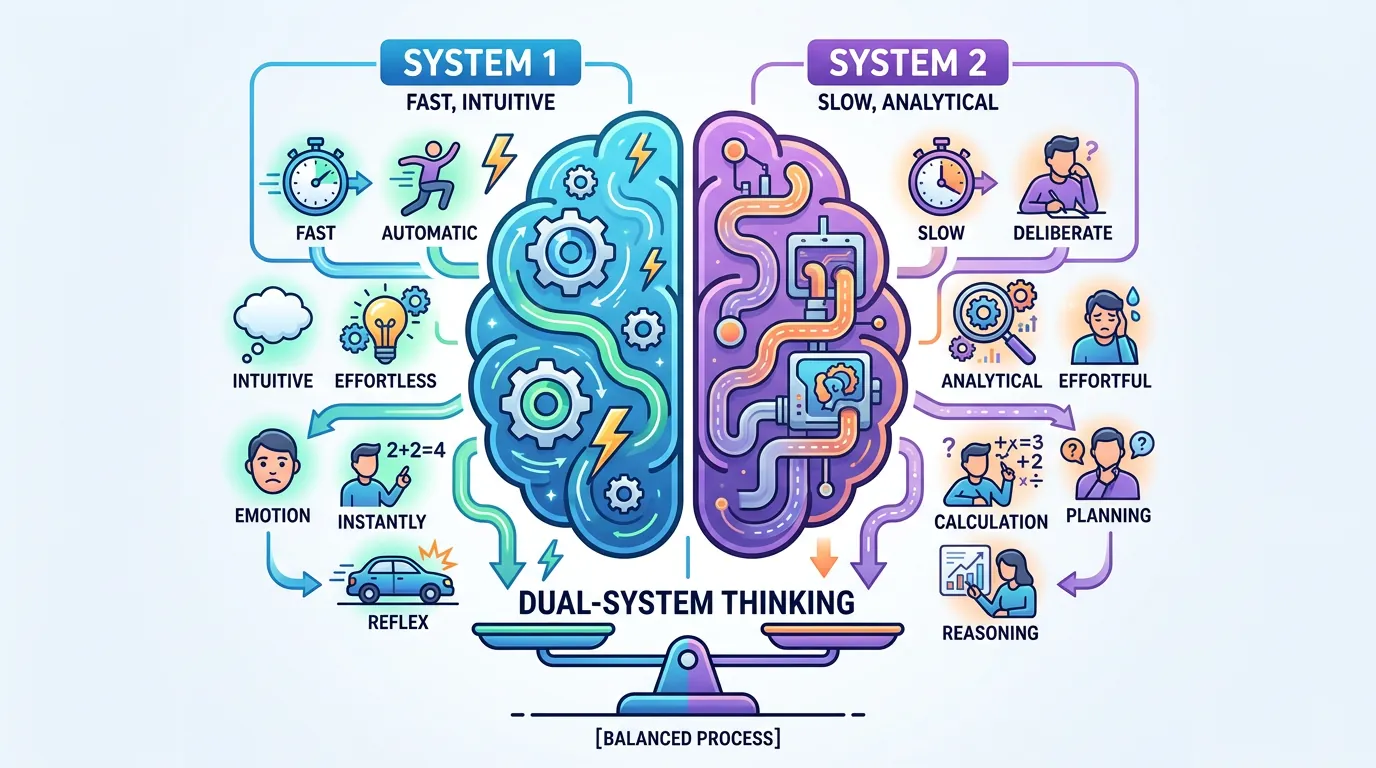
System 1 vs System 2
| System 1 (Fast) | System 2 (Slow) |
|---|---|
| Automatic, effortless | Deliberate, effortful |
| Emotional, intuitive | Logical, analytical |
| Parallel processing | Sequential processing |
| Always running | Lazy, avoids effort |
| Uses heuristics (shortcuts) | Uses rules and logic |
| "What you see is all there is" | Can consider what's missing |
graph LR
    STIM["Stimulus"] --> S1["System 1\n(Fast, Automatic)"]
    STIM --> S2["System 2\n(Slow, Deliberate)"]

    S1 -->|"Heuristics\nIntuition"| QUICK["Quick\nJudgment"]
    S2 -->|"Analysis\nLogic"| CAREFUL["Careful\nDecision"]

    S1 -.->|"Override\n(when wrong)"| S2
    QUICK --> ACTION["Action"]
    CAREFUL --> ACTION
Key insight: System 2 thinks it's in charge, but System 1 runs most of our lives. Most decisions are made automatically before we're even aware of them.
The Illusion of Rational Choice
We like to think we make decisions by carefully weighing options. In reality, System 1 makes a snap judgment, then System 2 creates a logical-sounding justification. We're not rational beings who feel—we're emotional beings who rationalize.
When Each System Dominates
System Activation
| Situation | Active System | Why |
|---|---|---|
| Driving familiar route | System 1 | Automatic, overlearned |
| Doing taxes | System 2 | Requires focus, rules |
| Shopping when tired | System 1 | System 2 depleted |
| Negotiating salary | Both | High stakes activate System 2 |
| Scrolling social media | System 1 | Designed for autopilot |
Cognitive Biases
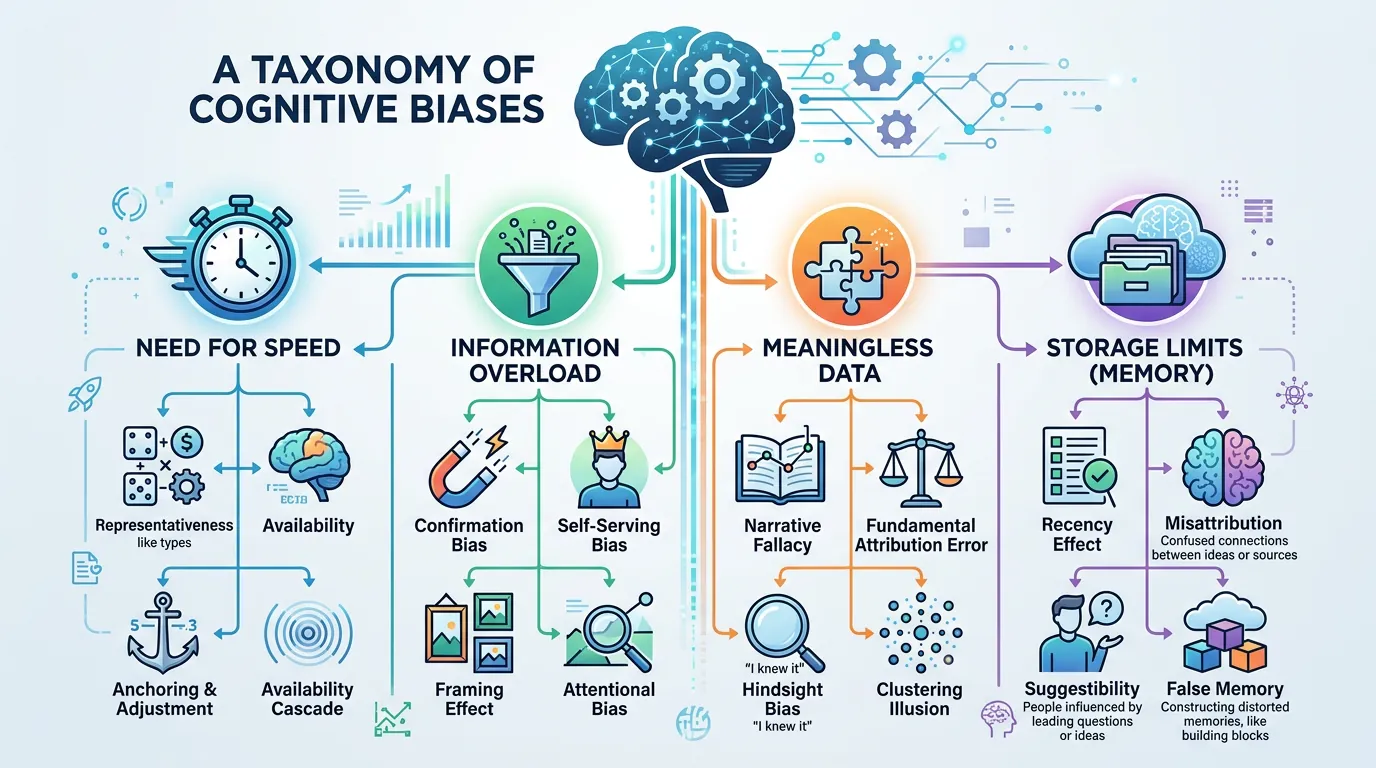
Cognitive biases are systematic errors in thinking—predictable patterns where our judgments deviate from rationality. They're not random mistakes; they're the result of mental shortcuts (heuristics) that usually work but sometimes fail spectacularly.
Essential Cognitive Biases
| Bias | Description | Example |
|---|---|---|
| Confirmation Bias | Seek info that confirms existing beliefs | Only reading news that agrees with you |
| Anchoring | Over-relying on first piece of information | Starting salary negotiation anchors final offer |
| Availability Heuristic | Judge likelihood by ease of recall | Overestimating plane crash risk after news coverage |
| Loss Aversion | Losses hurt ~2x more than gains feel good | Holding losing stocks too long |
| Sunk Cost Fallacy | Continue because of past investment | Staying in bad relationship because of time invested |
| Hindsight Bias | "I knew it all along" | Claiming you predicted election results |
| Dunning-Kruger Effect | Incompetent people overestimate ability | Beginners feeling confident; experts feeling uncertain |
| Status Quo Bias | Preference for current state | Sticking with default options |
| Inattentional Blindness | Missing visible events when attention is focused elsewhere | 50% of people fail to see a gorilla walk through a basketball game (Simons & Chabris, 1999) |
The Anchoring Effect
Classic Anchoring Study
Participants spun a rigged wheel that landed on either 10 or 65, then were asked: "What percentage of African countries are in the United Nations?"
- Those who saw 10 estimated: ~25%
- Those who saw 65 estimated: ~45%
The random number influenced their estimate—even though it was clearly irrelevant.
Behavioral Economics Foundations
Traditional economics assumes people are rational utility maximizers. Behavioral economics shows we're predictably irrational—and this predictability can be harnessed for better design.
Prospect Theory
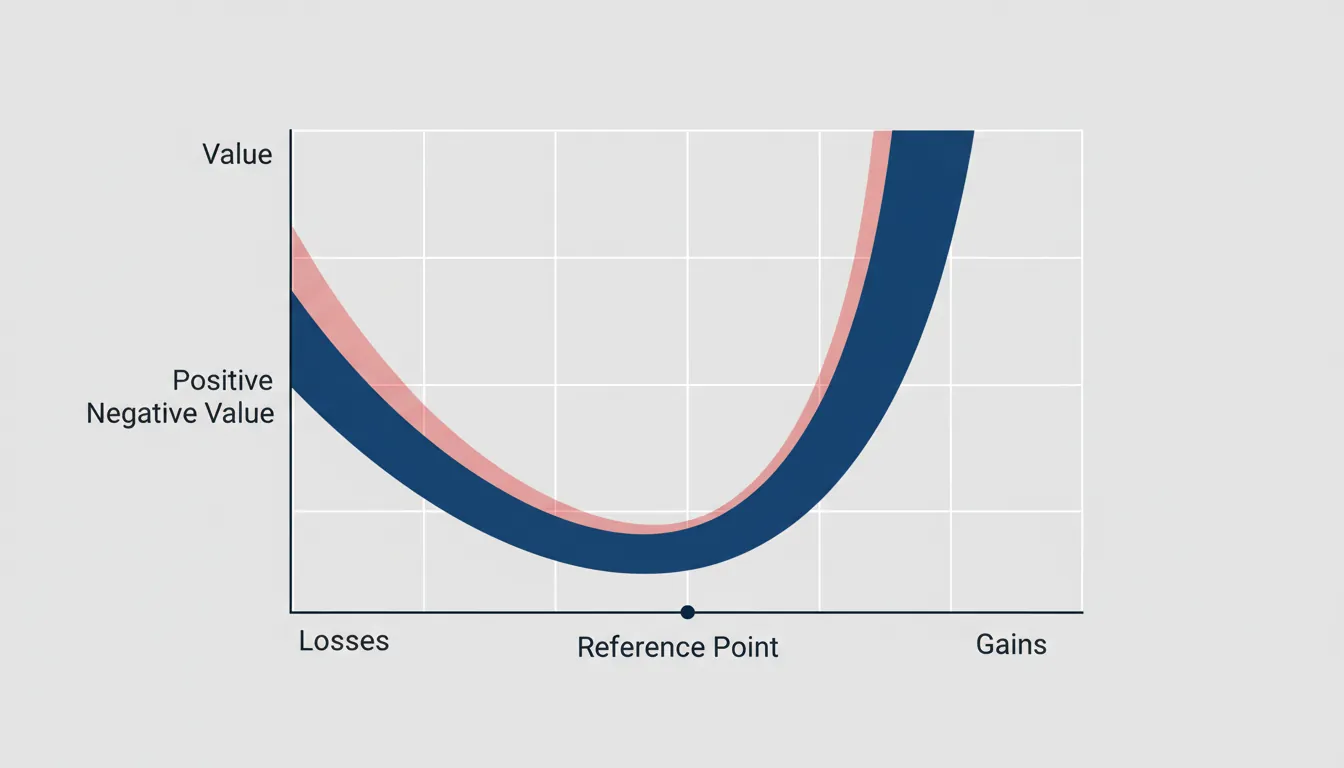
Daniel Kahneman and Amos Tversky's Nobel Prize-winning theory shows that we don't evaluate outcomes objectively—we evaluate them relative to a reference point.
Key Principles of Prospect Theory
- Reference Dependence: We evaluate gains and losses relative to a reference point, not absolute values
- Loss Aversion: Losing $100 feels about twice as bad as gaining $100 feels good
- Diminishing Sensitivity: The difference between $0 and $100 feels bigger than $900 and $1000
- Probability Weighting: We overweight small probabilities (lottery) and underweight large ones
Mental Accounting
We treat money differently depending on where it comes from and what it's labeled for—even though money is fungible.
Mental Accounting Examples
- Tax refund: Feels like "bonus money" to spend, even though it's your own money you overpaid
- Found money: More likely to gamble or splurge with $20 found vs. $20 earned
- Categories: Won't touch "vacation fund" even while paying credit card interest
- Sunk costs: Stay at bad movie because you paid for the ticket
Emotion and Decision-Making
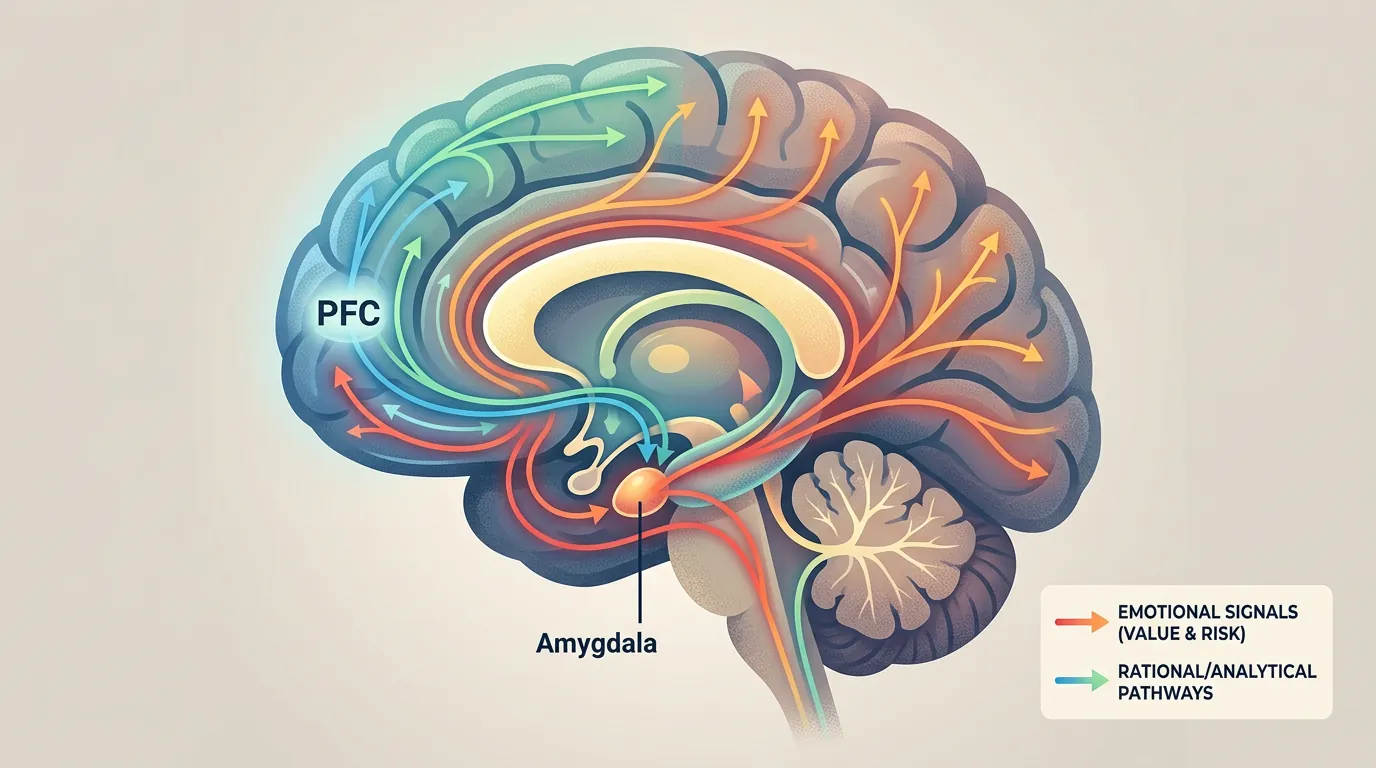
Contrary to the idea that emotions cloud judgment, neuroscience shows that emotions are essential for decision-making.
The Iowa Gambling Task
Participants with damage to emotion-processing brain regions (ventromedial prefrontal cortex) could reason logically but made catastrophically bad decisions in real life. They couldn't "feel" the weight of consequences.
Implication: Pure logic without emotional input leads to decision paralysis or poor choices. Emotions provide essential signals about value and risk.
Affect Heuristic
We use our emotional reaction as a shortcut for complex judgments. If something feels good, we perceive it as having more benefits and fewer risks.
Example
When told nuclear power has many benefits, people rate its risks lower. When told it has high risks, they rate its benefits lower. Our overall feeling colors all specific judgments.
Decision Fatigue
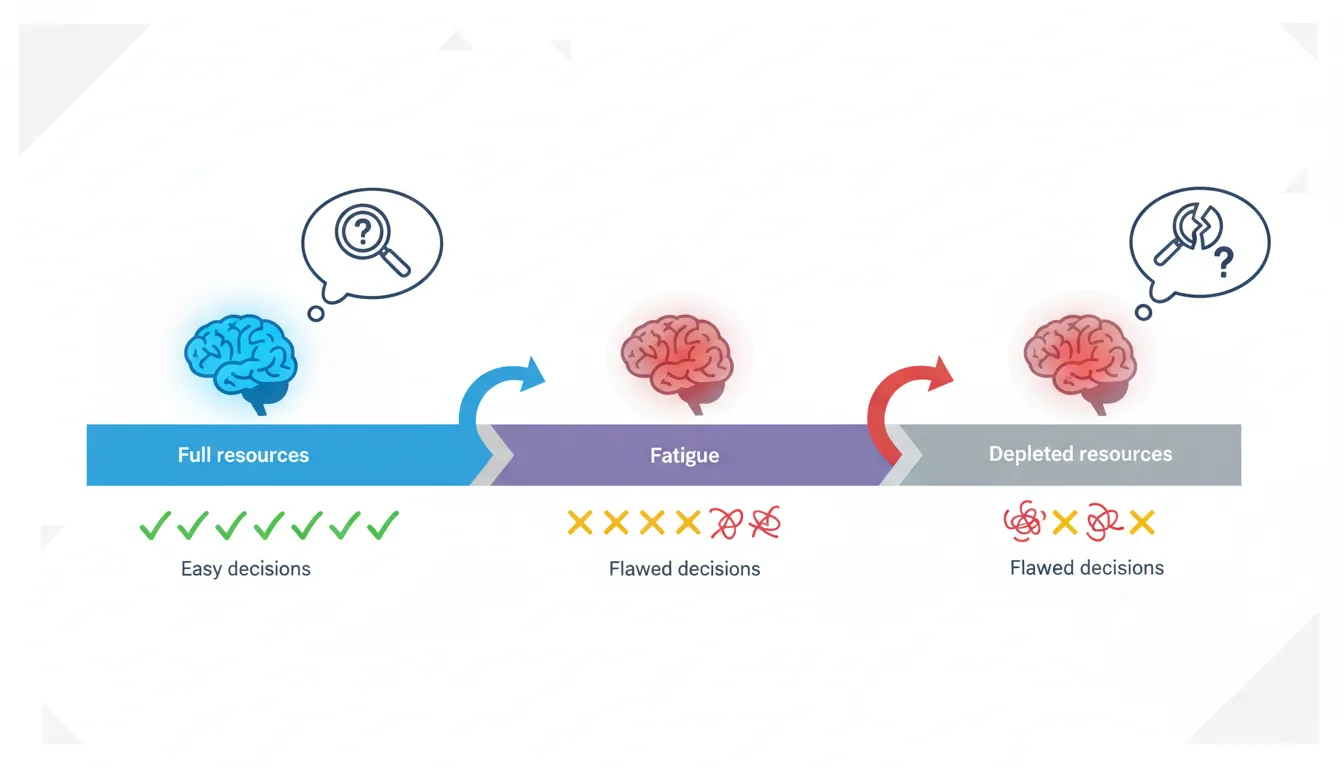
Willpower and decision-making draw from a limited mental resource. As you make decisions, your ability to make good ones degrades.
The Parole Study
Researchers analyzed 1,112 parole decisions by Israeli judges. Favorable rulings dropped from ~65% at start of session to near 0% just before breaks, then jumped back to 65% after breaks.
Implication: When mentally depleted, we default to the status quo (denial of parole). Important decisions should be made when fresh.
Protecting Against Decision Fatigue
Strategies
- Make important decisions early: Schedule critical decisions for morning
- Reduce trivial decisions: Create routines (same breakfast, standard work outfit)
- Don't decide when depleted: Sleep on it, decide after breaks
- Use defaults: Pre-commit to choices when you're fresh
- Limit options: Too many choices exhausts faster
Improving Decision Quality
Knowing about biases doesn't automatically fix them—but structured approaches can help.
Debiasing Techniques
| Technique | How It Works | Bias It Counters |
|---|---|---|
| Consider the opposite | Actively seek disconfirming evidence | Confirmation bias |
| Pre-mortem | Imagine the decision failed; list why | Overconfidence, planning fallacy |
| Reference class forecasting | Look at similar past cases, not just this one | Planning fallacy, uniqueness bias |
| Separate generation from evaluation | Generate options first, then evaluate | Anchoring, narrow framing |
| Take an outside view | Ask: "What would I advise a friend?" | Emotional bias, loss aversion |
The WRAP Framework
From Chip and Dan Heath's "Decisive" book—a structured approach to better decisions:
WRAP Framework
- Widen your options (avoid narrow framing)
- Reality-test your assumptions (seek disconfirming evidence)
- Attain distance before deciding (overcome short-term emotion)
- Prepare to be wrong (set tripwires for course correction)
Practical Exercise: Decision Journal
Try This
For important decisions, write down:
- The situation and options considered
- Your prediction of outcome (with confidence level)
- Your reasoning and what you expect to learn
- Later: What actually happened and why
Reviewing past decisions reveals your systematic errors.
Conclusion & Next Steps
You've now learned how humans actually make decisions:
- System 1 (fast, intuitive) dominates; System 2 (slow, analytical) is lazy and easily depleted
- Cognitive biases are systematic, predictable errors—not random mistakes
- Loss aversion, anchoring, and the availability heuristic shape most decisions
- Emotions are essential for good decisions, not obstacles to them
- Decision fatigue degrades judgment throughout the day
- Structured techniques (pre-mortems, outside view, WRAP) can improve decisions