We use cookies to enhance your browsing experience, serve personalized content, and analyze our traffic. By clicking "Accept All", you consent to our use of cookies. See our Privacy Policy for more information.
Logic & Critical Thinking Series Part 6: Critical Thinking Applications
January 25, 2026Wasil Zafar25 min read
Transform your logical skills into practical wisdom. Apply critical thinking to navigate media bias, make better decisions, resist manipulation, and reason clearly in everyday life. This is where theory becomes action.
Real-world applications, media literacy, decision-making
You Are Here
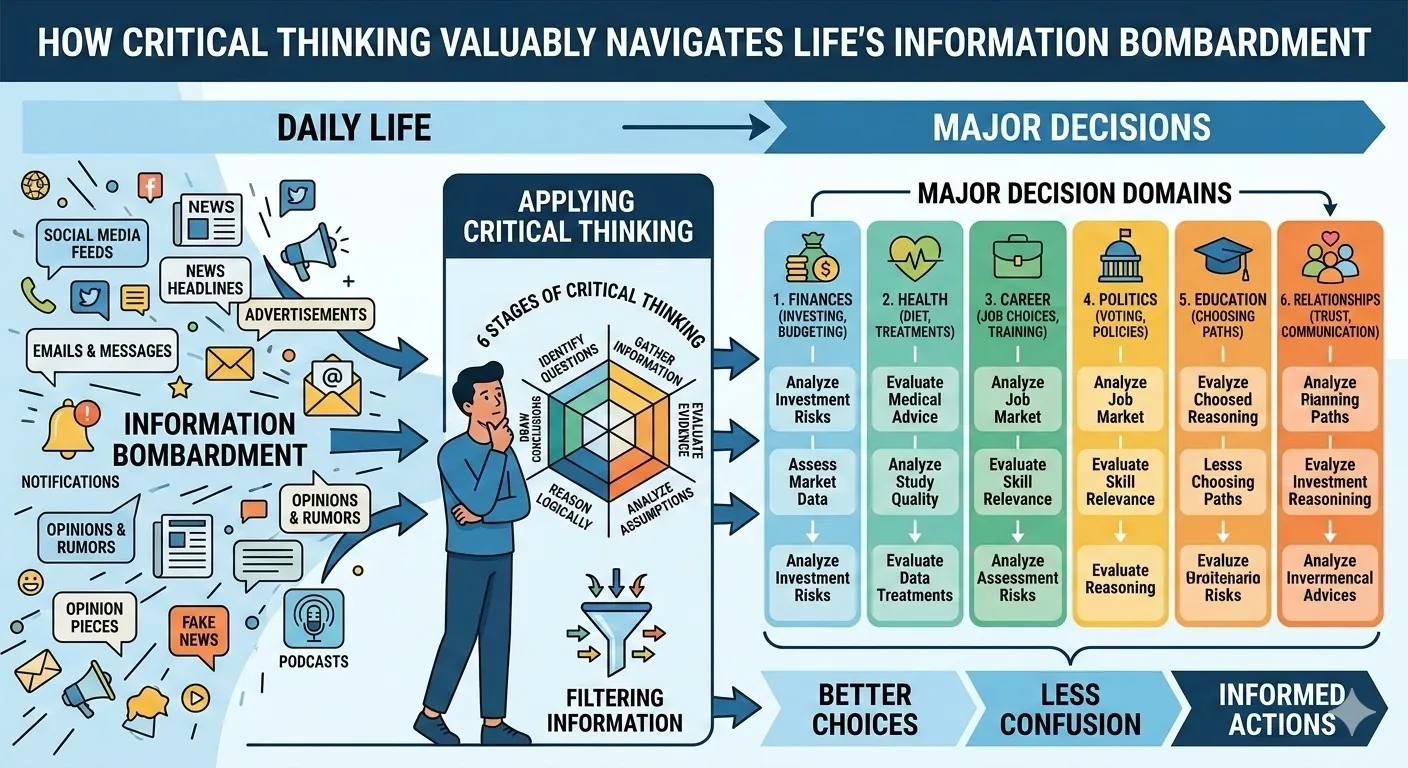
Knowing logic is one thing. Using it is another. Critical thinking only becomes valuable when you apply it to the information bombardment of daily life—news, social media, advertisements, political speeches, workplace decisions, and personal relationships.
Critical thinking becomes valuable when applied to the information bombardment of daily life across all major decision domains
Key Insight: The goal isn't to be right all the time—it's to be less wrong over time. Critical thinking is a practice, not a destination.
Daily Reasoning Challenges
Every day, we face situations requiring critical thinking:
Where Critical Thinking Matters
Health decisions: Evaluating medical claims, treatment options, wellness advice
Financial choices: Assessing investments, loan terms, big purchases
Career moves: Weighing job offers, evaluating workplace dynamics
Political engagement: Assessing candidates, understanding policies, voting
Personal relationships: Resolving conflicts, understanding perspectives
Consumer choices: Seeing through advertising, comparing products
The Stakes: Poor reasoning leads to poor decisions. Bad health choices harm your body. Bad financial choices drain your resources. Bad political choices affect your community. Critical thinking isn't academic—it's survival.
Media Literacy
In an age of information overload, separating signal from noise is essential. Media literacy means actively evaluating the information you consume rather than passively accepting it.
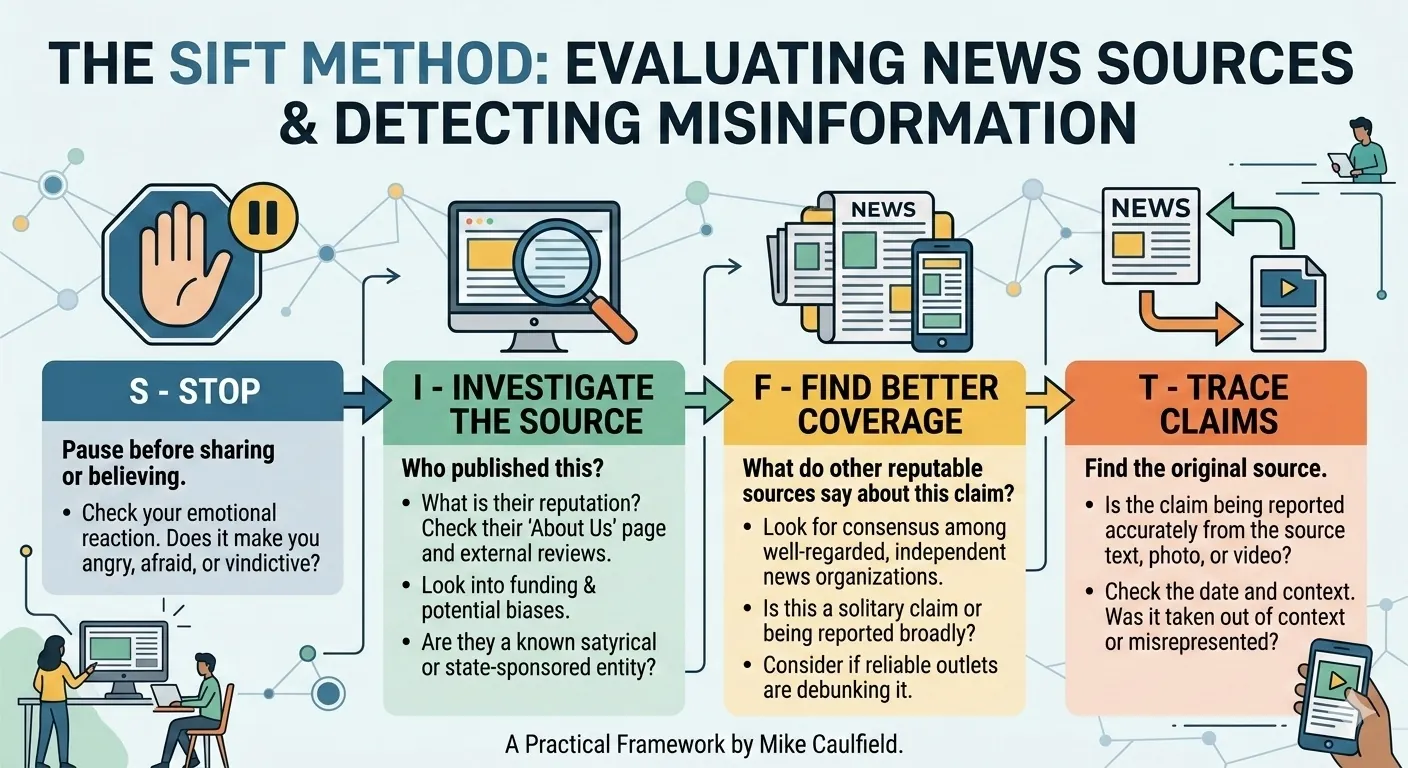
The SIFT method provides a practical framework for evaluating news sources and detecting misinformation in the media landscape
Evaluating News Sources
The SIFT Method (Mike Caulfield):
S - Stop: Pause before sharing or believing. Check your emotional reaction.
I - Investigate the source: Who published this? What's their reputation, funding, bias?
F - Find better coverage: What do other reputable sources say about this claim?
T - Trace claims: Find the original source. Is it being reported accurately?
Questions to Ask About Any News Story
Who wrote this? Are they credible? Qualified? Do they have an agenda?
What's the evidence? Are claims supported or just asserted?
When was this published? Is it current or outdated?
Why was this written? To inform? Persuade? Entertain? Sell?
Quality journalism corroborates with multiple sources
Social Media Critical Thinking
The Algorithm Problem: Social media feeds you content designed to maximize engagement—not accuracy or balance. Algorithms create filter bubbles where you only see views you already hold, reinforced by people who agree with you.
Social Media Defense Strategies
Diversify your feed: Deliberately follow credible sources from different perspectives
Check before sharing: Take 30 seconds to verify before amplifying
Notice emotional manipulation: If a post makes you furious, that's often intentional
Look beyond headlines: Read the actual article, not just the preview
Check the date: Old stories recirculate as if they're news
Reverse image search: Photos are often used out of context
Decision Making
Good decisions require structured thinking. Intuition has its place, but important choices deserve analysis.
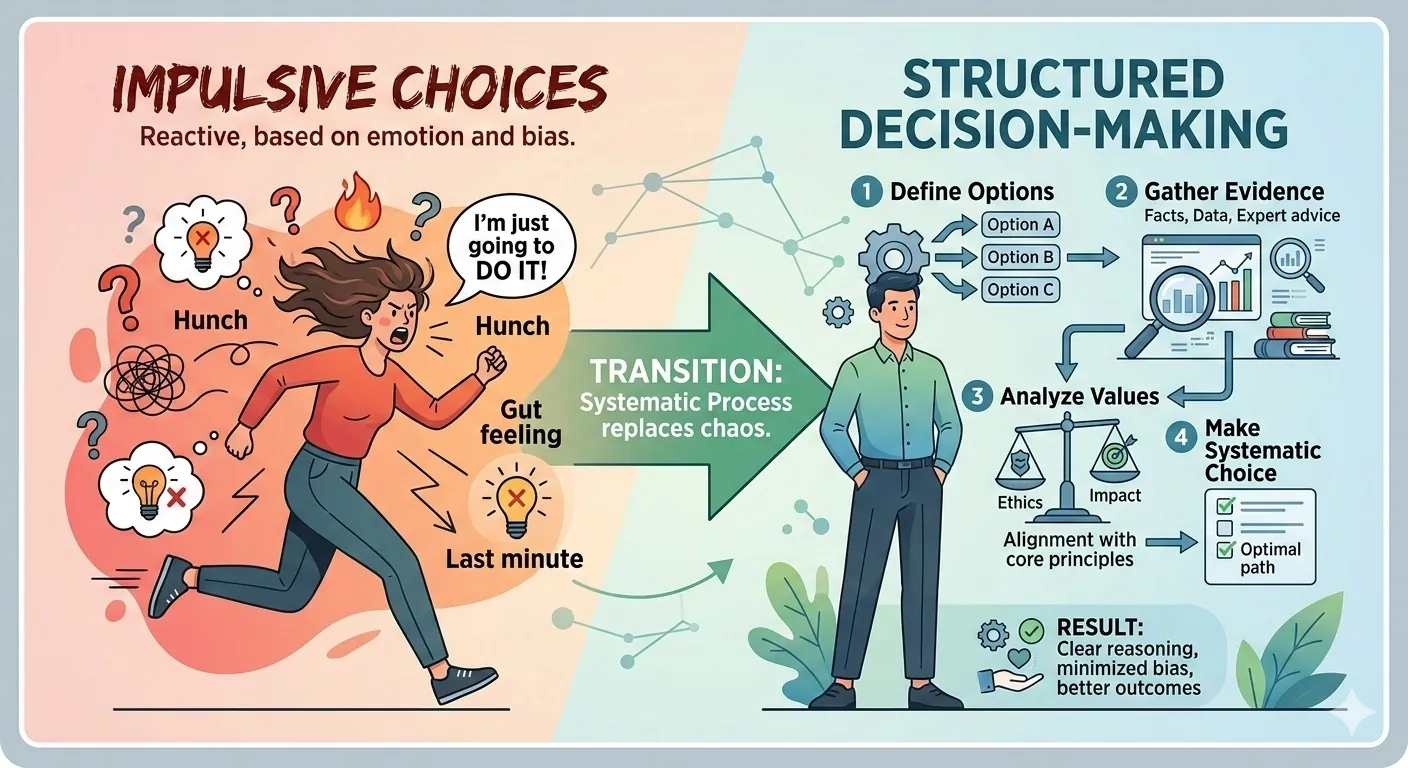
Structured decision-making replaces impulsive choices with systematic analysis of options, evidence, and values
Decision Framework
Define the decision: What exactly are you deciding? What outcomes matter?
Gather information: What do you know? What do you need to find out?
Identify options: What are the alternatives? (Always have more than two)
Weigh pros and cons: For each option, what are likely outcomes?
Consider values: What matters most to you in this situation?
Make the choice: Decide based on evidence and values
Review and learn: After outcomes are known, what can you learn?
Overcoming Biases
Our brains take shortcuts that often mislead us. Knowing these biases helps you catch yourself:
Key Cognitive Biases
Bias
Description
Countermeasure
Confirmation Bias
Seeking information that supports existing beliefs
Actively seek disconfirming evidence
Sunk Cost Fallacy
Continuing because of past investment, not future value
Evaluate based only on future costs/benefits
Anchoring
Over-relying on the first piece of information
Generate your own estimate before seeing others'
Availability Heuristic
Overweighting recent or vivid examples
Look at actual statistics, not memorable cases
Dunning-Kruger Effect
Overestimating competence in areas of ignorance
Seek feedback, assume you're missing something
Pre-Mortem Technique: Before making a decision, imagine it failed spectacularly. Ask: "Why did this go wrong?" This surfaces risks you might overlook when focused on success.
Resisting Manipulation
Advertisers, politicians, and influencers are trained to bypass your rational defenses. Knowing their techniques helps you resist.
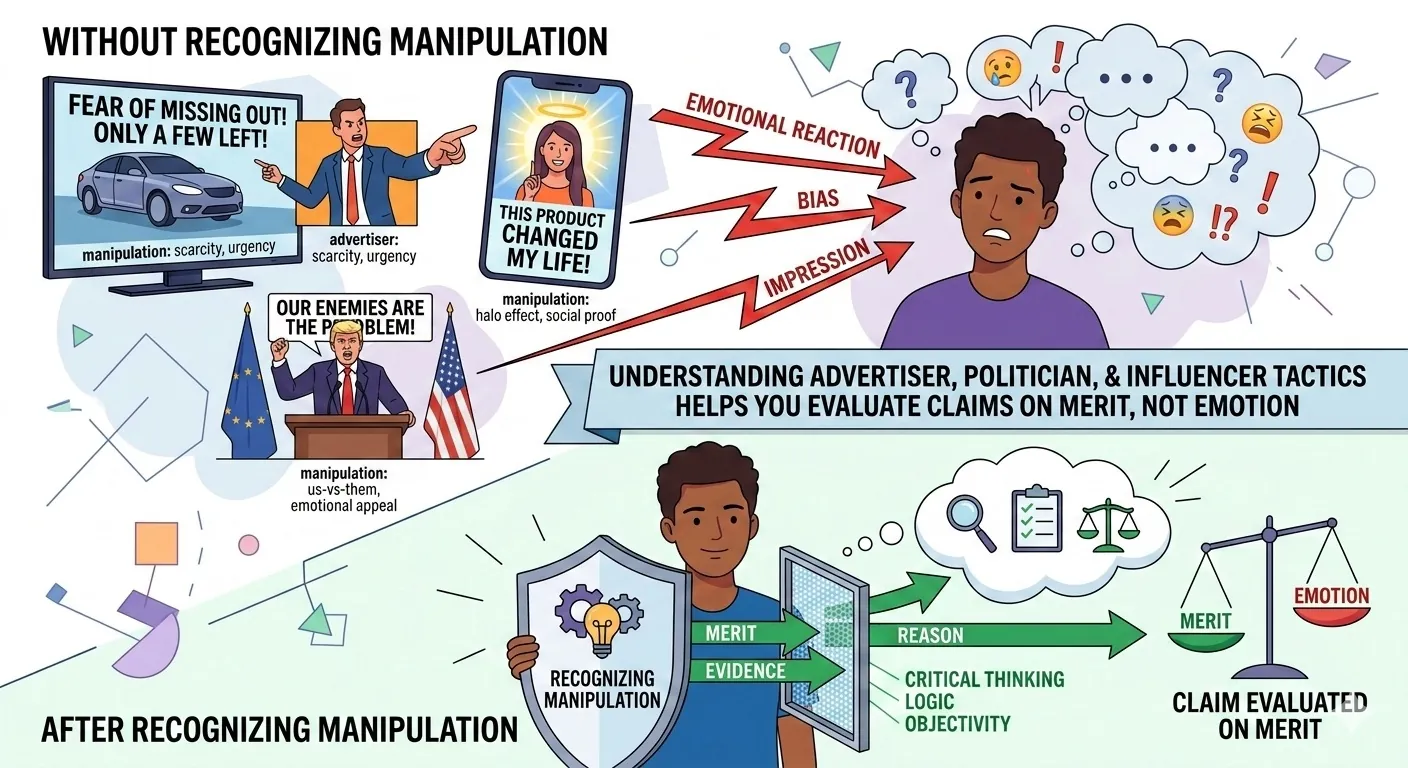
Recognizing manipulation techniques from advertisers, politicians, and influencers helps you evaluate claims on merit rather than emotional reaction
Common Advertising Tactics
Scarcity: "Only 3 left!" creates urgency to bypass deliberation
Social proof: "10 million sold!" appeals to herd instinct
Authority: "Doctors recommend..." exploits deference to experts
Emotional appeal: Images of happy families, cute animals bypass logic
Fear: "Without this, terrible things happen" triggers protective instincts
Bandwagon: "Everyone's doing it" exploits fear of missing out
Anchoring: "Was $500, now $199!" makes the price seem like a bargain
These techniques aren't inherently deceptive—but recognizing them helps you evaluate claims on merit rather than emotional reaction.
Political Rhetoric
Recognizing Political Manipulation
Loaded language: "Pro-life" vs. "anti-choice"—framing shapes perception
False equivalence: Treating fringe views as equal to expert consensus
Dog whistles: Coded language with hidden meanings to specific audiences
Whataboutism: Deflecting criticism by pointing to others' faults
Gish gallop: Overwhelming with many weak arguments faster than they can be rebutted
Moving goalposts: Changing standards when evidence meets original criteria
Evaluate Arguments, Not Sources: Both "sides" use manipulation. The answer isn't to trust one side blindly—it's to evaluate each claim on its own merits using the skills you've learned in this series.
Everyday Applications
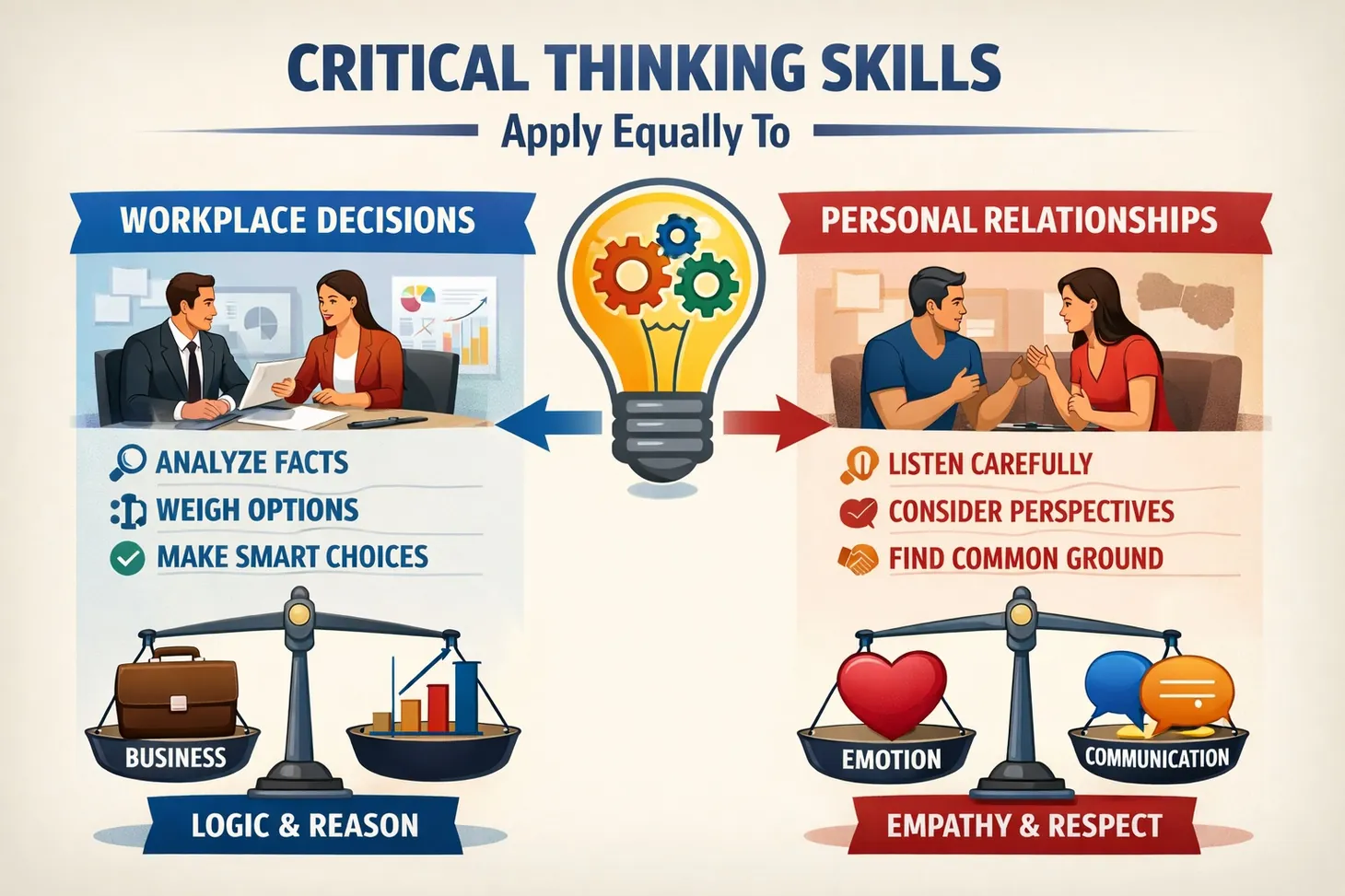
Critical thinking isn't just for evaluating news—it's for navigating workplace dynamics and personal relationships.
Critical thinking skills apply equally to professional decisions in the workplace and productive disagreements in personal relationships
Workplace Reasoning
Professional Critical Thinking
In meetings:
Ask for evidence behind proposals, not just enthusiasm
Identify hidden assumptions in business plans
Distinguish between correlation and causation in data presentations
Evaluating proposals:
What problem does this solve? Is that actually a problem?
What are the alternatives? Why is this the best option?
What could go wrong? What's the downside risk?
Who benefits? Are their incentives aligned with the organization's?
Interpersonal Communication
Productive Disagreement
Principles for constructive dialogue:
Listen to understand, not to rebut: Ask clarifying questions before responding
Steelman their position: Show you understand the strongest version of their view
Find common ground: What do you both agree on? Start there.
Disagree with ideas, not people: Attack arguments, not character
Be willing to change: If their argument is better, update your view
Know when to stop: Not every disagreement needs resolution
Intellectual Humility: The wisest people know what they don't know. Being confident in your reasoning doesn't mean being certain in your conclusions. Leave room for being wrong—it's how we grow.
Series Conclusion
Congratulations on completing the Logic & Critical Thinking Series! You've built a comprehensive toolkit:
Foundations from Part 1 - What logic is and why it matters
Deductive skills from Part 2 - Constructing airtight arguments
Inductive reasoning from Part 3 - Drawing conclusions from evidence
Fallacy detection from Part 4 - Spotting reasoning errors
Analysis methods from Part 5 - Systematically evaluating arguments
Practical application from Part 6 - Using these skills in real life
Critical thinking is a lifelong practice. Keep questioning, keep learning, and keep applying what you've learned.
Review the Full Series
Part 1: Introduction to Logic
Where it all began—understand what logic is and why it matters for everyday thinking.