We use cookies to enhance your browsing experience, serve personalized content, and analyze our traffic. By clicking "Accept All", you consent to our use of cookies. See our Privacy Policy for more information.
Logic & Critical Thinking Series Part 2: Deductive Reasoning
January 25, 2026Wasil Zafar25 min read
Master deductive reasoning—the gold standard of logical inference. Learn how to construct arguments where the conclusion necessarily follows from the premises, understand validity and soundness, and explore formal logic structures from syllogisms to propositional calculus.
Deductive reasoning is a form of logical inference where the conclusion necessarily follows from the premises. If the premises are true and the argument is valid, the conclusion must be true—there's no escape.
Key Insight: Deduction is truth-preserving. It doesn't create new information—it makes explicit what was already implicit in the premises. The conclusion is "contained within" the premises.
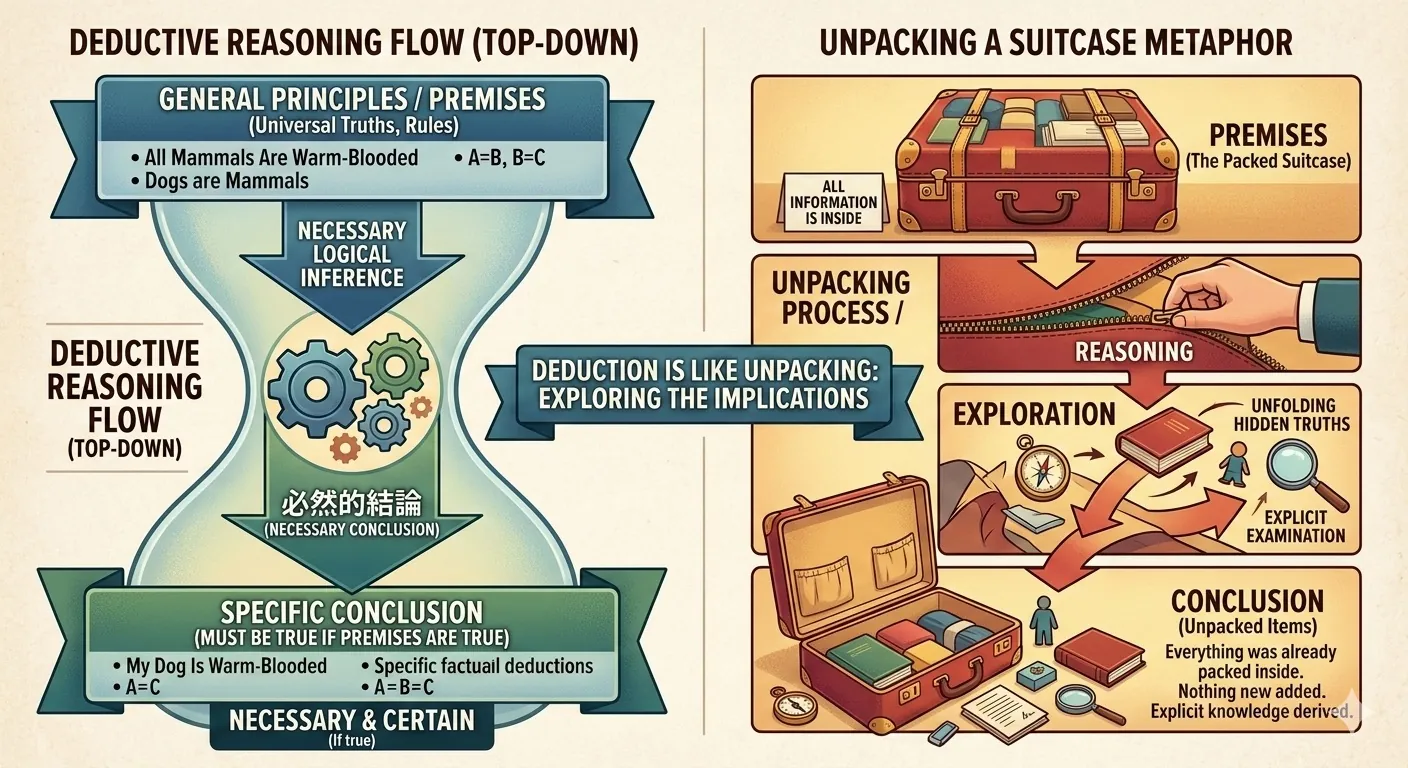
Think of deduction like unpacking a suitcase. Everything in the conclusion was already packed into the premises—you're just taking it out and examining it explicitly.
Deductive reasoning flows top-down from general principles to specific, necessarily true conclusions
Classic example:
Premise 1: All humans are mortal.
Premise 2: Socrates is a human.
Conclusion: Therefore, Socrates is mortal.
If both premises are true, the conclusion cannot be false. The mortality of Socrates was already guaranteed the moment we accepted the two premises—the conclusion just makes this explicit.
Deductive vs. Inductive Reasoning
Deductive and inductive reasoning are complementary approaches, each with different strengths:
Deductive (Top-Down)
General ? Specific
Movement: From general principles to specific conclusions
Certainty: If valid and premises true, conclusion is certain
Risk: If any premise is false, the conclusion fails
Example: "All mammals have hearts. Whales are mammals. Therefore, whales have hearts."
Inductive (Bottom-Up)
Specific ? General
Movement: From specific observations to general conclusions
Certainty: Conclusion is probable, never certain
Risk: New evidence can always overturn the conclusion
Example: "Every swan I've seen is white. Therefore, all swans are probably white."
When to Use Which: Use deduction when you have reliable general principles and want certain conclusions. Use induction when you're building knowledge from observations and can tolerate uncertainty. Science uses both—induction to discover patterns, deduction to derive predictions from theories.
Syllogisms: The Classic Form
A syllogism is a deductive argument with exactly two premises and one conclusion, each containing categorical propositions. Invented by Aristotle, syllogisms dominated logical analysis for over two thousand years.
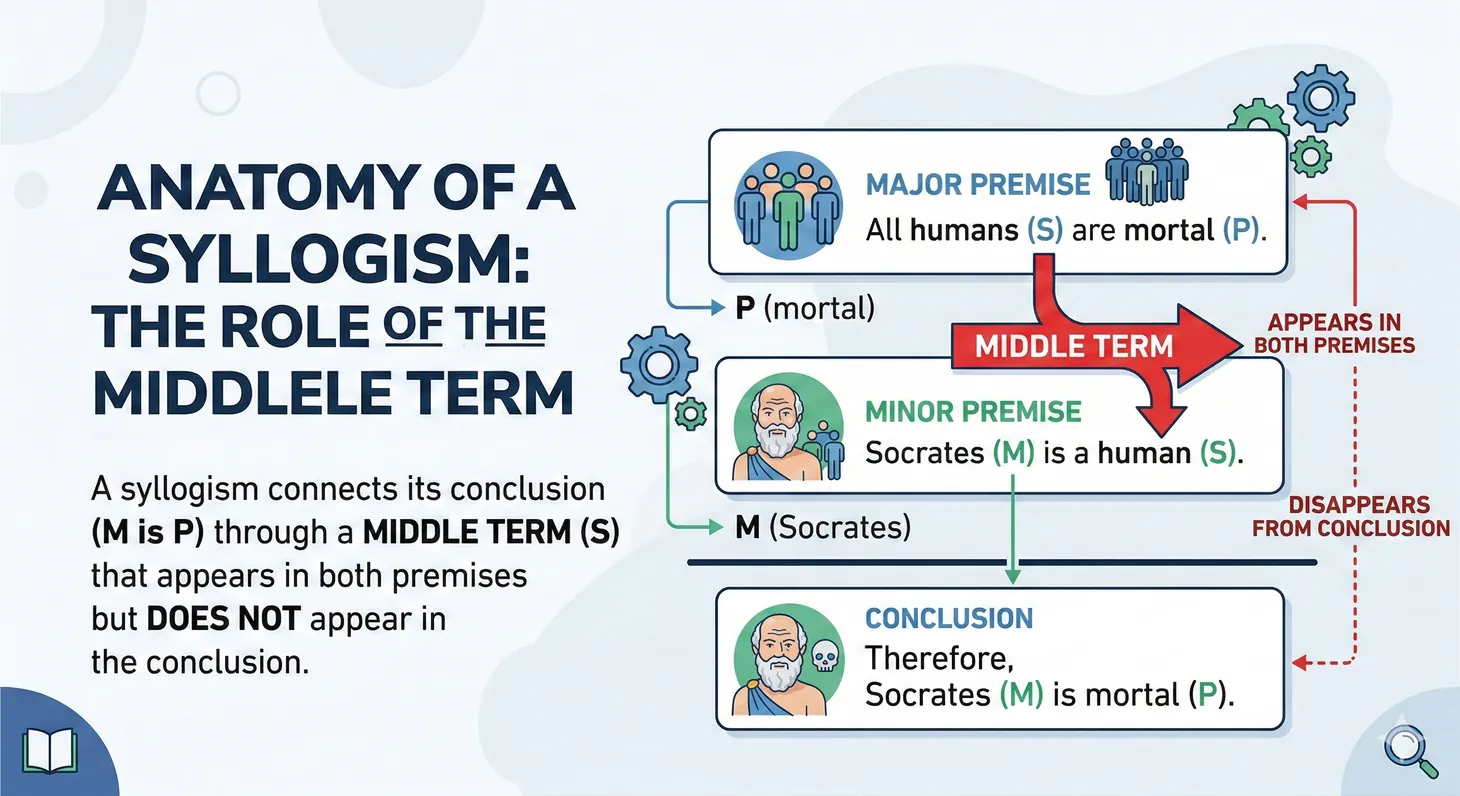
A syllogism connects its conclusion through a middle term that appears in both premises but disappears from the conclusion
Categorical Propositions
Syllogisms use four types of categorical propositions:
The Four Categorical Forms
Type
Form
Example
Meaning
A (Universal Affirmative)
All S are P
All dogs are mammals
Every member of S is in P
E (Universal Negative)
No S are P
No dogs are reptiles
No member of S is in P
I (Particular Affirmative)
Some S are P
Some dogs are large
At least one S is in P
O (Particular Negative)
Some S are not P
Some dogs are not trained
At least one S is not in P
The letters A, E, I, O come from the Latin words "Affirmo" (I affirm) and "nEgO" (I deny).
The Structure of a Syllogism
Every syllogism has three terms:
Major term (P): The predicate of the conclusion
Minor term (S): The subject of the conclusion
Middle term (M): Appears in both premises but not the conclusion—it's the "link"
Major premise: All mammals (M) are warm-blooded (P).
Minor premise: All dogs (S) are mammals (M).
Conclusion: Therefore, all dogs (S) are warm-blooded (P).
The middle term "mammals" connects dogs to warm-blooded things, then disappears from the conclusion.
Figures & Moods
The figure of a syllogism describes the position of the middle term:
The Four Figures
Figure 1
Figure 2
Figure 3
Figure 4
M — P
P — M
M — P
P — M
S — M
S — M
M — S
M — S
? S — P
The mood is the combination of proposition types (A, E, I, O). For example, "AAA" means both premises and the conclusion are universal affirmatives.
Valid mood-figure combinations (there are only 15 unconditionally valid forms):
The medieval names (Barbara, Celarent, etc.) encode the mood in their vowels—a mnemonic device from scholastic logic.
Testing Validity with Venn Diagrams
Venn diagrams provide a visual method for testing syllogism validity:
The Venn Diagram Method
Draw three overlapping circles for S, P, and M
Diagram the premises:
For universal propositions: shade out the empty regions
For particular propositions: place an X where something exists
Check the conclusion: If diagramming the premises automatically diagrams the conclusion, the syllogism is valid
Example (Barbara - AAA-1):
All M are P (shade M outside P) ? All S are M (shade S outside M) ? Result: All of S is inside P ?
Common Invalid Syllogisms
Watch out for these frequent errors:
Undistributed Middle
Invalid Form
All P are M. All S are M. Therefore, all S are P.
Counterexample:
All dogs are animals.
All cats are animals.
Therefore, all cats are dogs. ?
The middle term "animals" isn't distributed (we never talk about all animals), so it fails to connect S and P.
Illicit Major/Minor
Invalid Form
A term distributed in the conclusion must be distributed in the premises.
Illicit major example:
All cats are mammals.
No dogs are cats.
Therefore, no dogs are mammals. ?
The conclusion says something about all mammals (no dogs are in that group), but the premise only mentioned some mammals (the ones that are cats).
Validity & Soundness: The Critical Distinction
These two concepts are the most important in evaluating deductive arguments. Master them, and you'll never be confused about what makes an argument good or bad.
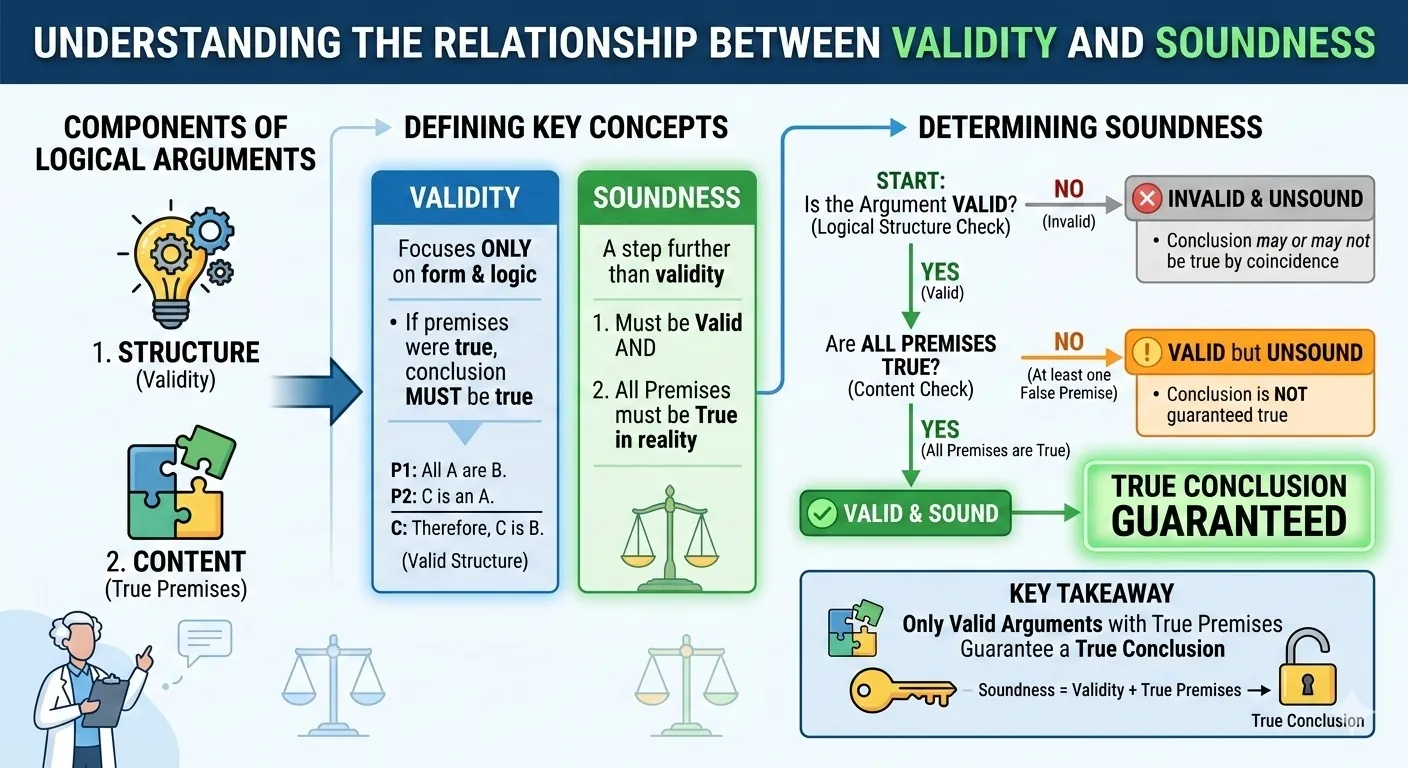
The relationship between validity and soundness: only arguments that are both valid and have true premises guarantee true conclusions
Validity (Structure)
Logical Form
Definition: An argument is valid if and only if it's impossible for the premises to be true and the conclusion false simultaneously.
Validity is about form, not content. A valid argument preserves truth—if you feed in true premises, you'll get a true conclusion.
Test: "If I assume the premises are true, can I possibly deny the conclusion?"
Soundness (Structure + Truth)
The Gold Standard
Definition: An argument is sound if and only if (1) it's valid AND (2) all its premises are actually true.
Soundness guarantees a true conclusion. It's what we ultimately want in arguments about the real world.
Test: "Is this argument valid? AND Are all premises true?"
The Four Combinations
Every deductive argument falls into one of four categories:
Valid + True Premises = SOUND
All men are mortal. (TRUE)
Socrates is a man. (TRUE)
? Socrates is mortal. (GUARANTEED TRUE)
This is what we want! The conclusion must be true.
Valid + False Premise = UNSOUND (but valid)
All birds can fly. (FALSE—penguins, ostriches)
Penguins are birds. (TRUE)
? Penguins can fly. (FALSE)
The logic is fine, but the false premise poisons the conclusion. This is why soundness requires both validity and true premises.
Invalid (doesn't matter if premises are true)
Some politicians are dishonest. (TRUE)
John is a politician. (TRUE)
? John is dishonest. (DOESN'T FOLLOW)
Invalid argument! The premises don't support the conclusion—John could be one of the honest politicians. True premises don't save bad logic.
Wait, this doesn't fit the pattern! This is actually invalid—the form is broken (affirming the consequent). Sometimes invalid arguments happen to have true conclusions by accident, but the logic still fails.
The Crucial Point: Validity is necessary but not sufficient for a good argument. You need both valid structure AND true premises. When evaluating arguments, check both—separately.
The Counterexample Method
To prove an argument form is invalid, find a counterexample: an argument with the same form where the premises are obviously true and the conclusion obviously false.
Example: Is this valid?
If it's raining, the ground is wet.
The ground is wet.
? It's raining.
Counterexample with same form:
If I'm in Paris, I'm in France. (TRUE)
I'm in France. (TRUE)
? I'm in Paris. (FALSE—I could be in Lyon)
The counterexample proves the argument form is invalid. This fallacy is called "affirming the consequent."
Propositional Logic
Propositional logic studies how simple propositions combine with logical connectives to form complex statements. It's the foundation of modern symbolic logic and computer science.
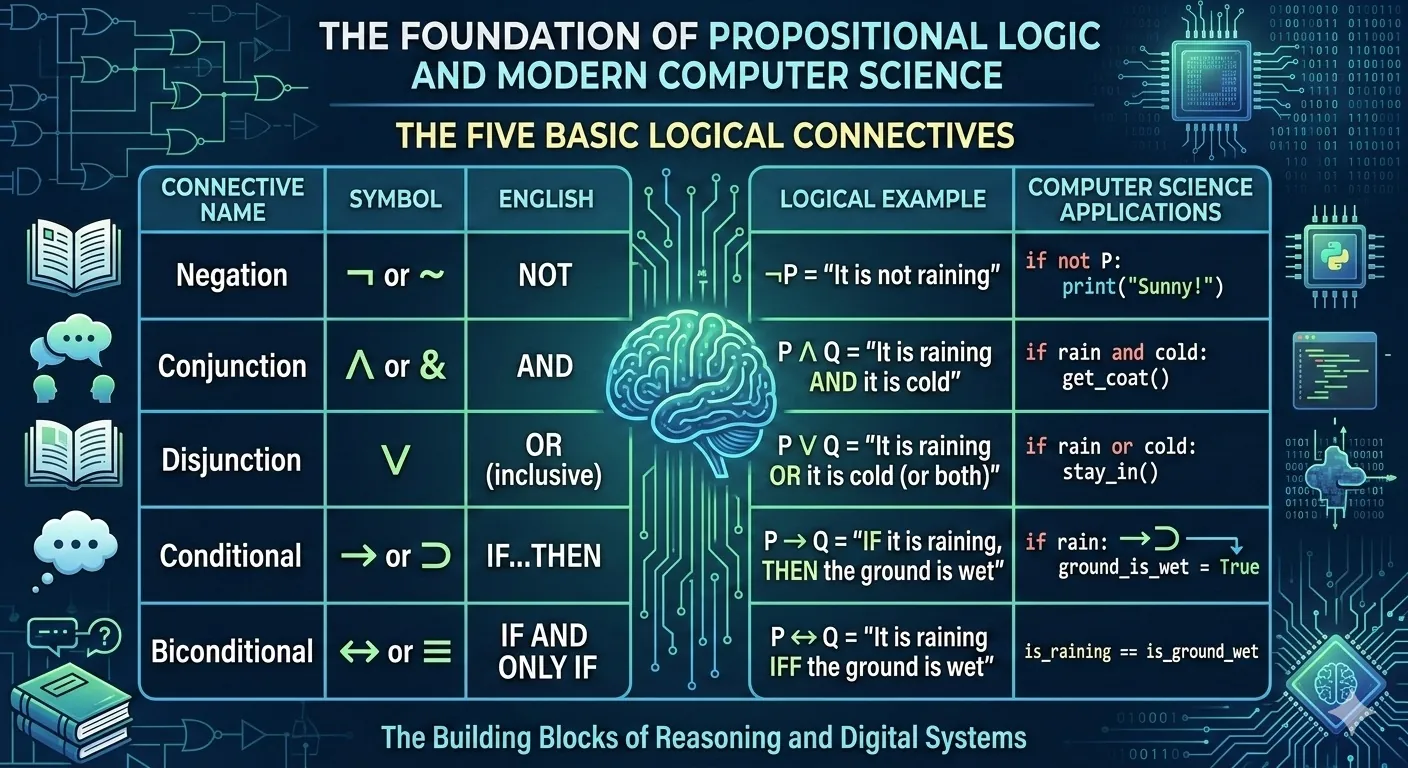
The five basic logical connectives form the foundation of propositional logic and modern computer science
Logical Connectives
Propositions are combined using five basic connectives:
The Five Connectives
Name
Symbol
English
Example
Negation
¬ or ~
NOT
¬P = "It is not raining"
Conjunction
? or &
AND
P ? Q = "It's raining AND cold"
Disjunction
?
OR (inclusive)
P ? Q = "It's raining OR cold (or both)"
Conditional
? or ?
IF...THEN
P ? Q = "IF it's raining, THEN the ground is wet"
Biconditional
? or =
IF AND ONLY IF
P ? Q = "It's raining IFF the ground is wet"
Truth Tables
Truth tables systematically show how compound propositions relate to their components:
Truth Table for Connectives
P
Q
¬P
P ? Q
P ? Q
P ? Q
P ? Q
T
T
F
T
T
T
T
T
F
F
F
T
F
F
F
T
T
F
T
T
F
F
F
T
F
F
T
T
The Tricky Conditional: Notice that P ? Q is true whenever P is false—regardless of Q! This is called "material implication" and trips up many students. "If pigs fly, then the moon is cheese" is technically TRUE because pigs don't fly.
Essential Rules of Inference
These are the valid argument forms you can use to construct airtight deductions:
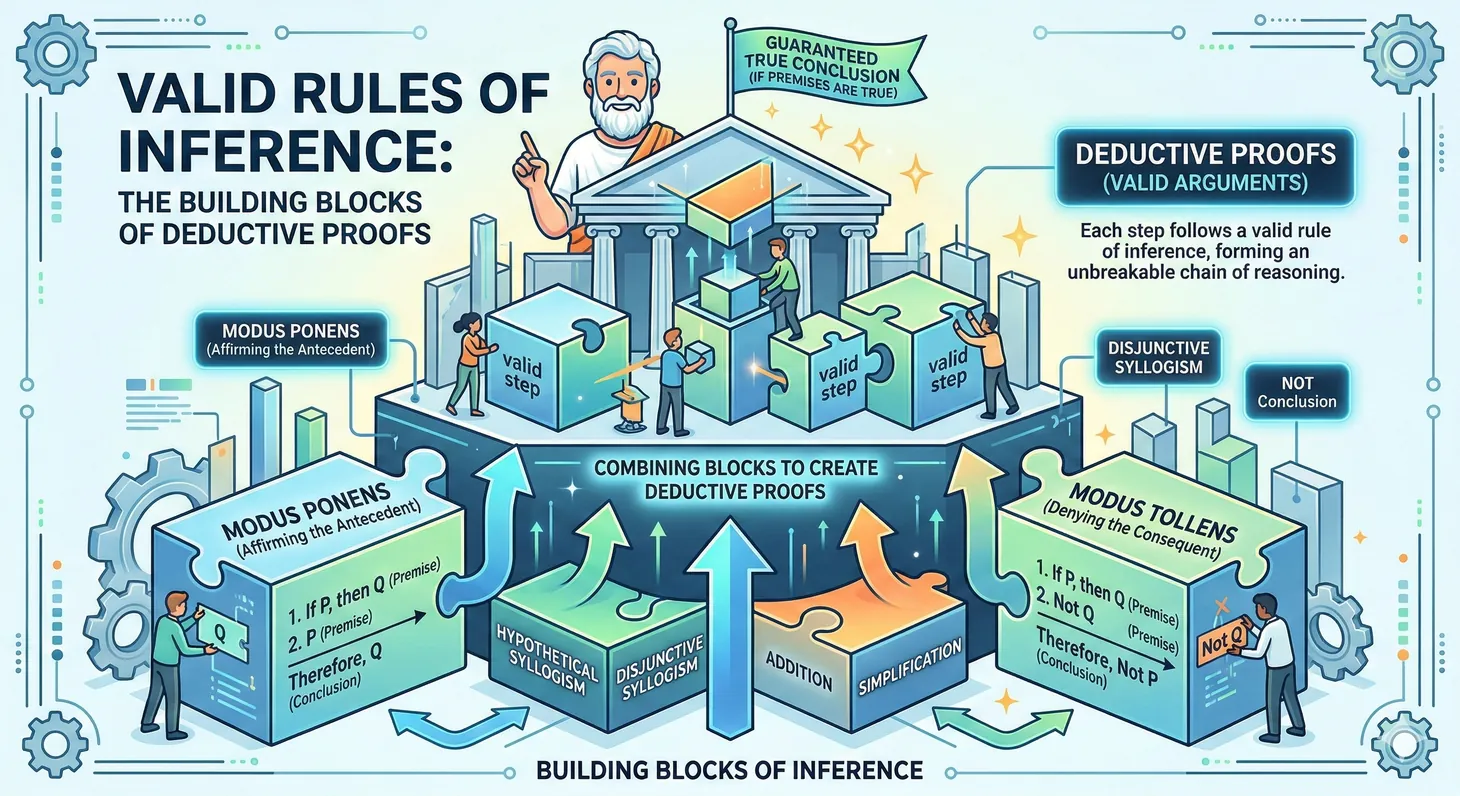
Valid rules of inference like modus ponens and modus tollens are the building blocks of deductive proofs
Modus Ponens
Affirming the Antecedent
Form:
If P, then Q
P
? Q
Example: If it rains, the ground gets wet. It's raining. Therefore, the ground is wet.
Modus Tollens
Denying the Consequent
Form:
If P, then Q
Not Q
? Not P
Example: If it rains, the ground gets wet. The ground is dry. Therefore, it's not raining.
Disjunctive Syllogism
Process of Elimination
Form:
P or Q
Not P
? Q
Example: Either the butler or the maid did it. The butler didn't do it. Therefore, the maid did it.
Hypothetical Syllogism
Chain of Conditionals
Form:
If P, then Q
If Q, then R
? If P, then R
Example: If it rains, the ground gets wet. If the ground is wet, it's slippery. Therefore, if it rains, it's slippery.
Common Invalid Forms (Fallacies)
These look similar to valid forms but fail:
Affirming the Consequent
INVALID
If P, then Q
Q
? P ?
Counterexample: If it rains, the ground is wet. The ground is wet. ? It's raining. (The sprinkler could have caused it!)
Denying the Antecedent
INVALID
If P, then Q
Not P
? Not Q ?
Counterexample: If it rains, the ground is wet. It's not raining. ? The ground isn't wet. (The sprinkler!)
Next Steps in the Series
Now that you understand deductive reasoning, you're ready to explore its complement—inductive reasoning.