We use cookies to enhance your browsing experience, serve personalized content, and analyze our traffic. By clicking "Accept All", you consent to our use of cookies. See our Privacy Policy for more information.
Logic & Critical Thinking Series Part 4: Logical Fallacies
January 25, 2026Wasil Zafar30 min read
Learn to recognize and avoid logical fallacies—the reasoning errors that undermine arguments. From formal fallacies that violate logical structure to informal fallacies that exploit psychology, master the art of spotting flawed reasoning in everyday discourse.
A logical fallacy is an error in reasoning that undermines the logic of an argument. Fallacies can be intentionally used to deceive or may occur unintentionally due to careless reasoning.
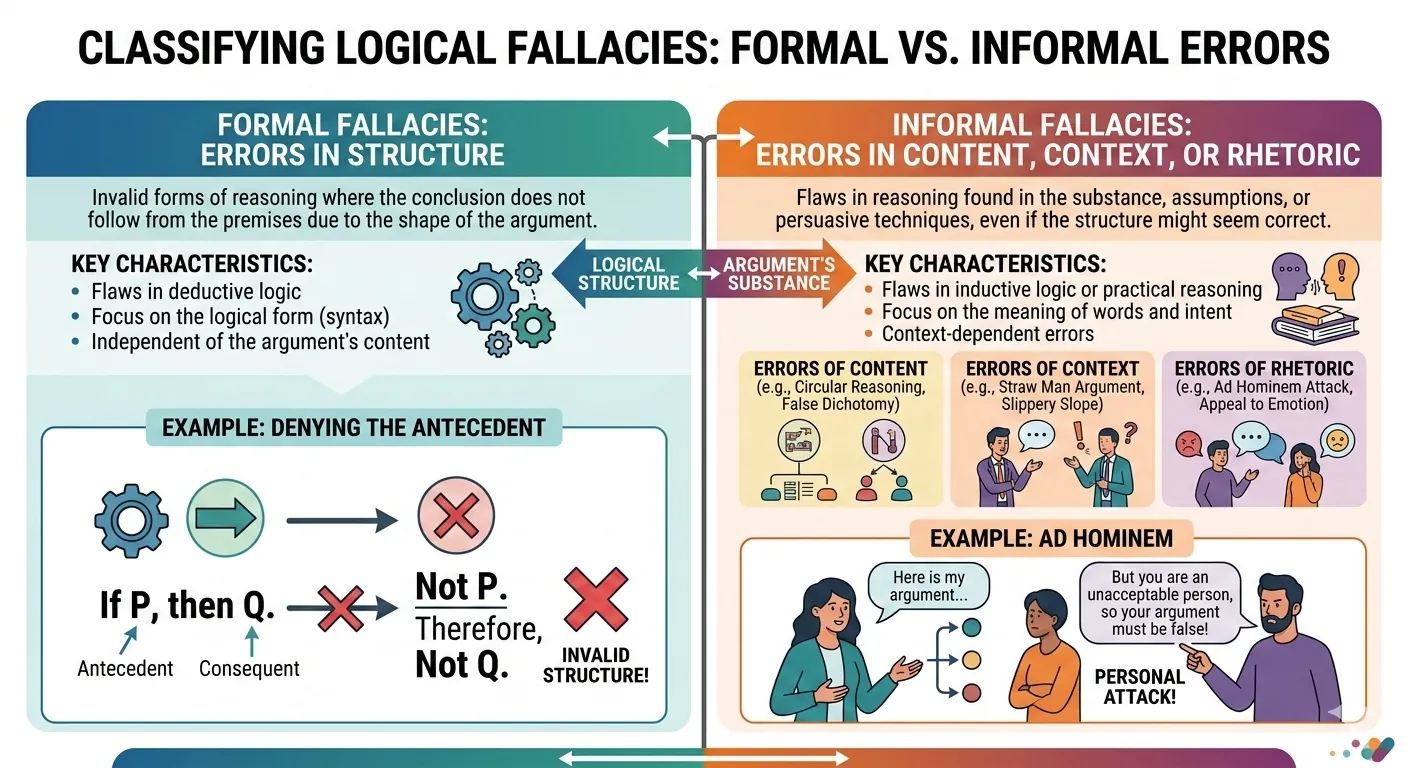
Logical fallacies divide into formal errors of structure and informal errors of content, context, or rhetoric
Key Insight: An argument can contain a fallacy and still have a true conclusion—fallacies don't prove conclusions false; they just mean the argument doesn't properly support the conclusion.
Formal vs. Informal Fallacies
Formal Fallacies
Structure Errors
Errors in the logical form of an argument. The structure is invalid regardless of content.
Detectable by form alone
Always render argument invalid
Common in deductive reasoning
Example: Affirming the consequent
Logical Fallacy Taxonomy
graph TD
    F["Logical Fallacies"]

    FORM["Formal Fallacies
(Invalid logical structure)"]
    INF["Informal Fallacies
(Content/context errors)"]

    F --> FORM
    F --> INF

    FORM --> AF["Affirming the
Consequent"]
    FORM --> DA["Denying the
Antecedent"]
    FORM --> UD["Undistributed
Middle"]

    INF --> REL["Relevance"]
    INF --> AMB["Ambiguity"]
    INF --> PRES["Presumption"]

    REL --> AH["Ad Hominem"]
    REL --> SM["Straw Man"]
    AMB --> EQ["Equivocation"]
    PRES --> BQ["Begging the
Question"]
    PRES --> FD["False Dilemma"]

    style F fill:#132440,stroke:#132440,color:#fff
    style FORM fill:#BF092F,stroke:#132440,color:#fff
    style INF fill:#16476A,stroke:#132440,color:#fff
Informal Fallacies
Content Errors
Errors in the content, context, or rhetoric of an argument. Valid form, but flawed reasoning.
Require understanding content
Often psychologically persuasive
More common in everyday discourse
Example: Ad hominem attacks
Why Fallacies Persist: Fallacious arguments often "feel" convincing because they exploit cognitive shortcuts, emotional responses, or social pressures. Learning to recognize them takes practice and conscious effort.
Formal Fallacies
These fallacies violate the rules of valid deductive inference. Once you know the patterns, they're easy to spot.
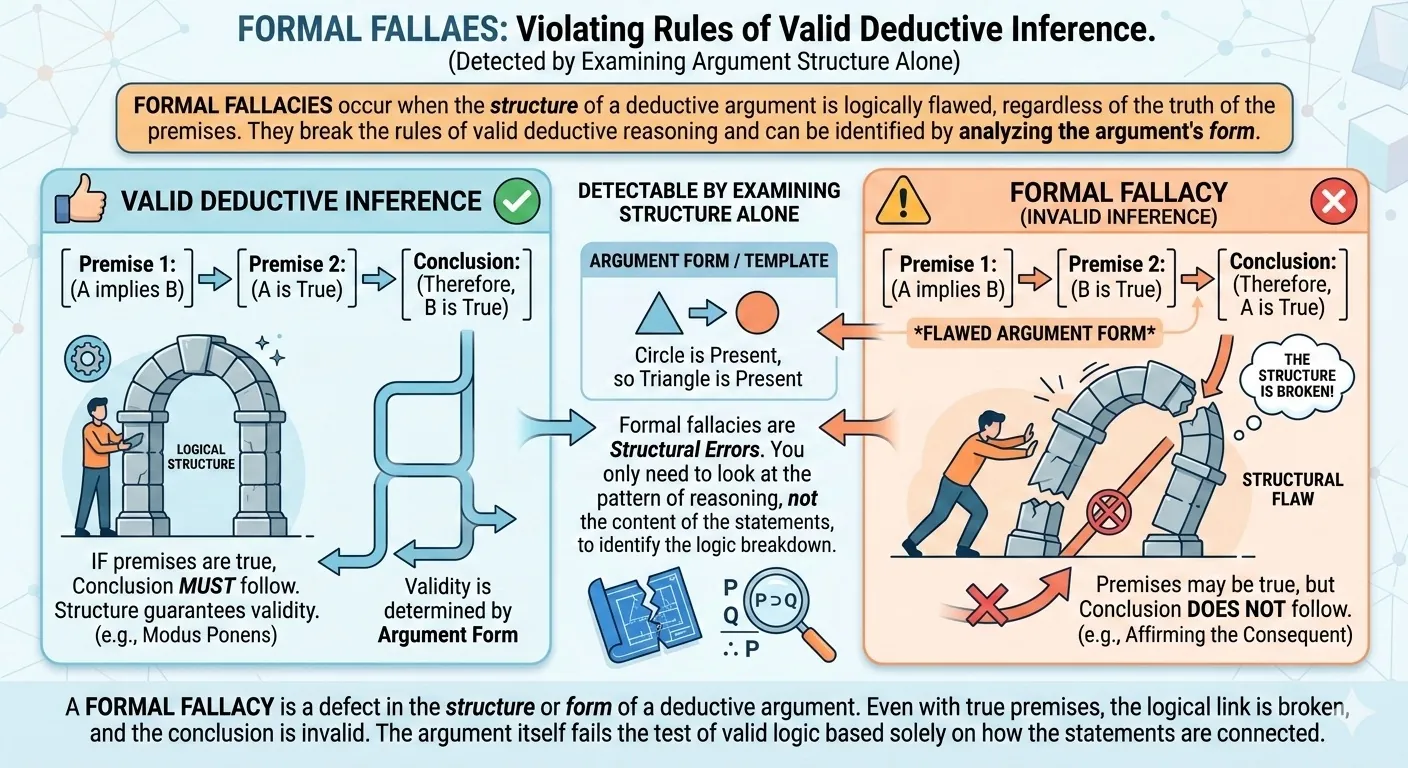
Formal fallacies violate the rules of valid deductive inference and can be detected by examining argument structure alone
Affirming the Consequent
INVALID
Form:
If P, then Q
Q
? P ?
Example:
"If she's a doctor, she has a medical degree."
"She has a medical degree."
"Therefore, she's a doctor."
Why it fails: She could be a researcher, professor, or retired. Having a degree doesn't mean she's practicing medicine.
Denying the Antecedent
Denying the Antecedent
INVALID
Form:
If P, then Q
Not P
? Not Q ?
Example:
"If it's raining, the streets are wet."
"It's not raining."
"Therefore, the streets aren't wet."
Why it fails: The streets could be wet from sprinklers, a burst pipe, or car washing. Rain isn't the only cause.
Undistributed Middle
Undistributed Middle
INVALID
Form:
All A are B
All C are B
? All A are C ?
Example:
"All cats are mammals."
"All dogs are mammals."
"Therefore, all cats are dogs."
Why it fails: The middle term "mammals" isn't distributed (discussed in full). Cats and dogs share a category but aren't identical.
Fallacies of Relevance
These fallacies distract from the actual argument by introducing irrelevant considerations. They're psychologically powerful but logically empty.
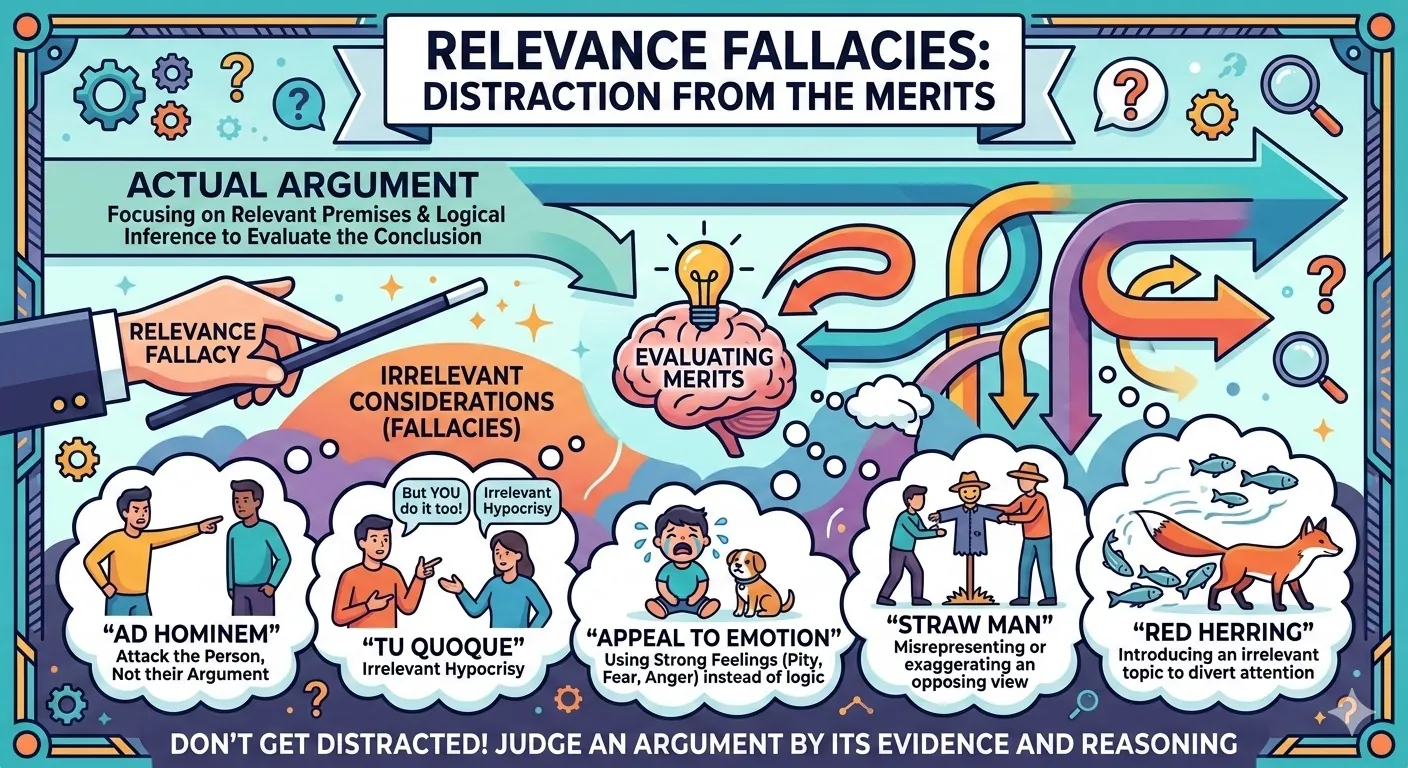
Relevance fallacies introduce irrelevant considerations to distract from evaluating the actual argument on its merits
Ad Hominem (Attack on the Person)
Types of Ad Hominem
Abusive: Directly attacking the person's character.
"You can't trust John's argument about tax policy—he's a college dropout."
Circumstantial: Claiming someone's position is biased by their circumstances.
"Of course she supports higher teacher salaries—she's a teacher!"
Tu Quoque (You Too): Deflecting criticism by pointing to the critic's behavior.
"You criticize my smoking? You used to smoke yourself!"
When It's Not Fallacious: Attacking credibility is relevant when credibility is the issue—like when evaluating eyewitness testimony or expert qualifications. The key is distinguishing between "this person is untrustworthy" and "this argument is unsound."
Straw Man
Straw Man Fallacy
Misrepresentation
Pattern: Misrepresent your opponent's argument, then attack the weaker version.
Example:
Person A: "We should have stricter food safety regulations." Person B: "So you want the government to control everything we eat? Next they'll be telling us we can only eat vegetables!"
The Distortion: Person A argued for food safety, not total government control. Person B attacks an extreme position Person A never held.
Red Herring
Red Herring Fallacy
Topic Diversion
Pattern: Introduce an unrelated topic to divert attention from the original issue.
Example:
Q: "Senator, what about your voting record on environmental issues?" A: "I'm glad you asked about my record. You know, I've always supported our troops and believe strongly in national defense..."
The name comes from the practice of using smoked fish to train hunting dogs—the strong scent would lead them off the trail.
Appeal to Emotion
Emotional Appeals
Substituting emotional manipulation for logical argument:
Appeal to Fear (Ad Metum): "Vote for me or disaster will strike!"
Appeal to Pity (Ad Misericordiam): "He shouldn't go to prison—think of his children!"
Appeal to Flattery: "A sophisticated person like you surely agrees..."
Appeal to Spite: "They look down on you—show them they're wrong!"
Emotions are legitimate parts of moral and practical reasoning, but they can't substitute for evidence and logic.
Fallacies of Ambiguity
These fallacies exploit unclear language—shifting meanings, ambiguous references, or confusing parts with wholes.
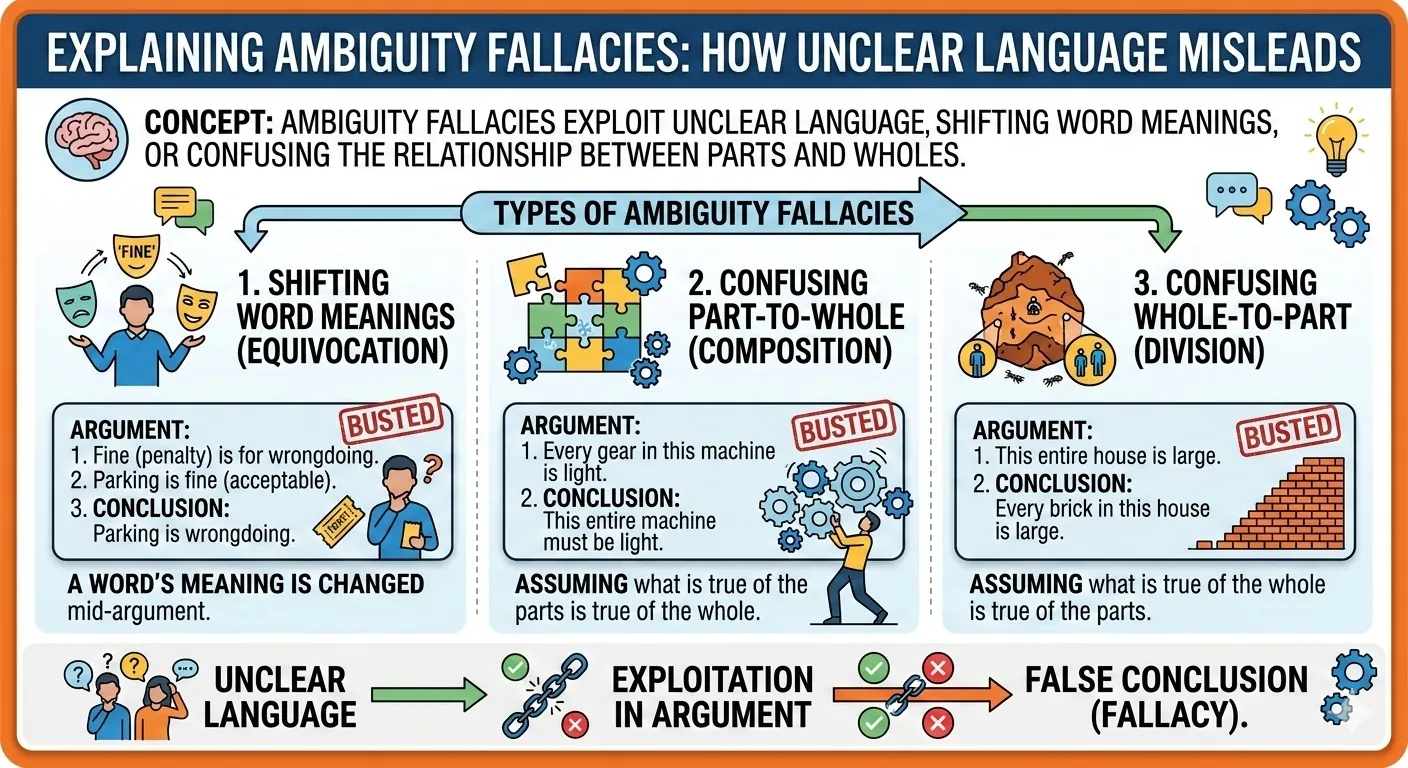
Ambiguity fallacies exploit unclear language, shifting word meanings or confusing the relationship between parts and wholes
Equivocation
Equivocation Fallacy
Shifting Meanings
Pattern: Using a word with different meanings in the same argument.
Classic Example:
"The end of a thing is its perfection."
"Death is the end of life."
"Therefore, death is the perfection of life."
The Trick: "End" means "purpose/goal" in premise 1 but "termination" in premise 2. The argument equivocates on this word.
Modern Example:
"I have the right to watch whatever I want on TV."
"Therefore, I am right to watch whatever I want on TV."
"Right" (entitlement) ? "right" (correct/moral).
Composition & Division
Composition
Parts ? Whole
Pattern: Assuming what's true of parts is true of the whole.
"Every player on the team is outstanding."
"Therefore, the team is outstanding."
Why it fails: A team of stars may lack chemistry, coordination, or teamwork.
Division
Whole ? Parts
Pattern: Assuming what's true of the whole is true of each part.
"This company is very profitable."
"Therefore, every division is profitable."
Why it fails: Some divisions may be losing money while others compensate.
Fallacies of Presumption
These fallacies assume something that hasn't been established or present false choices.
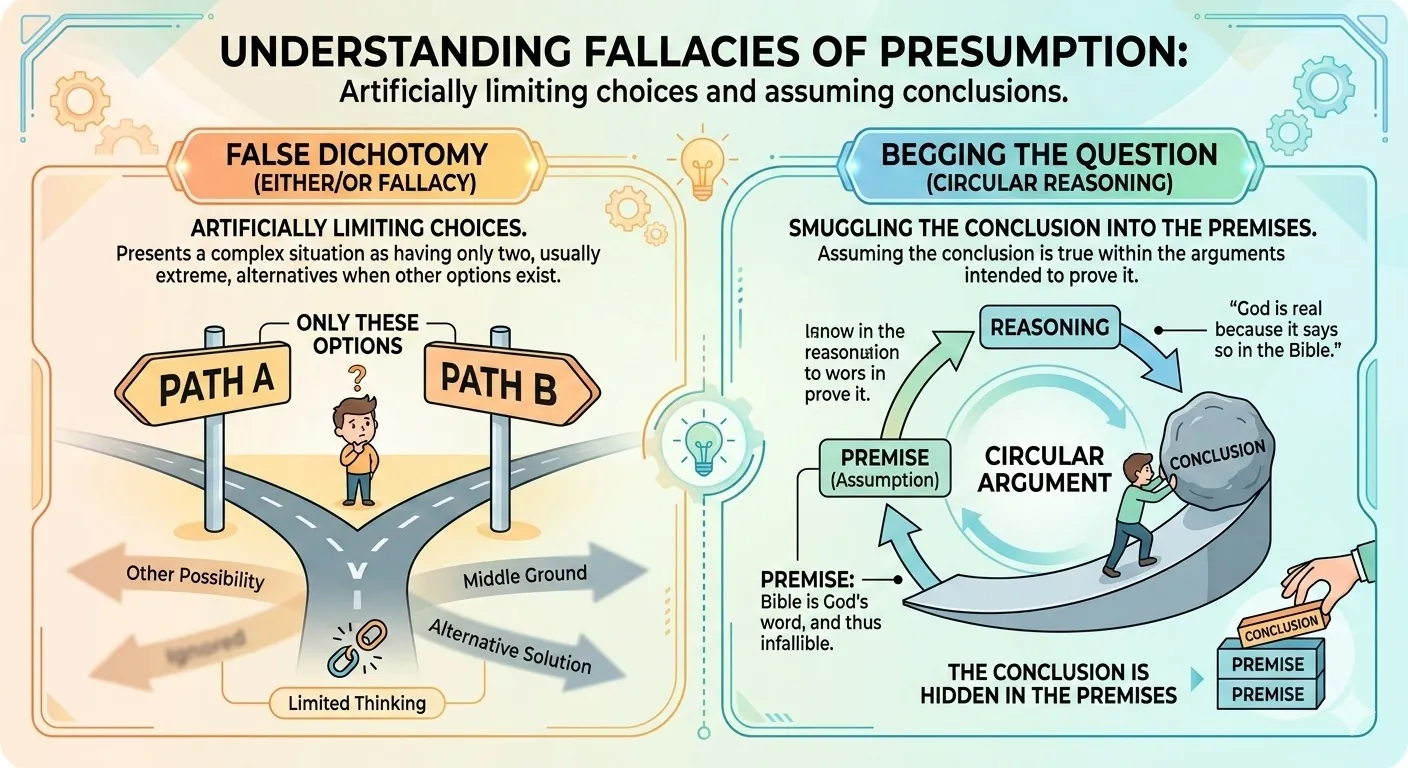
Presumption fallacies like false dichotomy artificially limit choices while begging the question smuggles the conclusion into the premises
False Dichotomy (False Dilemma)
False Dichotomy
Artificial Limitation
Pattern: Presenting only two options when more exist.
"You're either with us or against us."
"America: love it or leave it."
"Either we ban all cars or accept traffic deaths."
The Reality: Most issues have a spectrum of positions—neutrality, partial agreement, qualified support, etc. Black-and-white thinking oversimplifies complex issues.
Begging the Question (Circular Reasoning)
Begging the Question
Circular Logic
Pattern: The conclusion is assumed (often disguised) in the premises.
Example:
"God exists because the Bible says so."
"The Bible is true because it's God's word."
Subtle Example:
"Free markets are best because they're unregulated, and unregulated markets are most efficient."
Note: The phrase "begs the question" is often misused to mean "raises the question." Technically, it refers specifically to this circular fallacy.
Slippery Slope
Slippery Slope Fallacy
Unwarranted Chain
Pattern: Claiming that one step will inevitably lead to extreme consequences without justifying the causal chain.
Example:
"If we legalize marijuana, next people will want to legalize cocaine, then heroin, and soon all drugs will be legal and society will collapse."
When It's Not Fallacious:
When there's evidence for the causal chain
When institutional/psychological mechanisms make progression likely
When historical examples support the pattern
The slippery slope is fallacious only when the chain of causation is assumed rather than demonstrated.
Appeal to Authority (Ad Verecundiam)
False Appeal to Authority
Fallacious when the authority is:
Unqualified: "A celebrity endorses this vitamin—it must work!"
Outside expertise: "A physicist says the economy will crash."
Biased: "The tobacco company's scientist says smoking is safe."
Speaking against consensus: A lone expert against thousands.
Legitimate Appeal: Citing experts within their field of expertise, especially when there's consensus. We can't verify everything ourselves—reasonable reliance on qualified authorities is rational.
Next Steps in the Series
Now that you can identify fallacies, you're ready to learn systematic methods for analyzing arguments as a whole.