We use cookies to enhance your browsing experience, serve personalized content, and analyze our traffic. By clicking "Accept All", you consent to our use of cookies. See our Privacy Policy for more information.
Logic & Critical Thinking Series Part 3: Inductive Reasoning
January 25, 2026Wasil Zafar25 min read
Explore inductive reasoning—how we draw probable conclusions from evidence. Unlike deduction, induction deals with likelihood rather than certainty. Master generalizations, statistical inference, analogical reasoning, and understand the scientific method as applied logic.
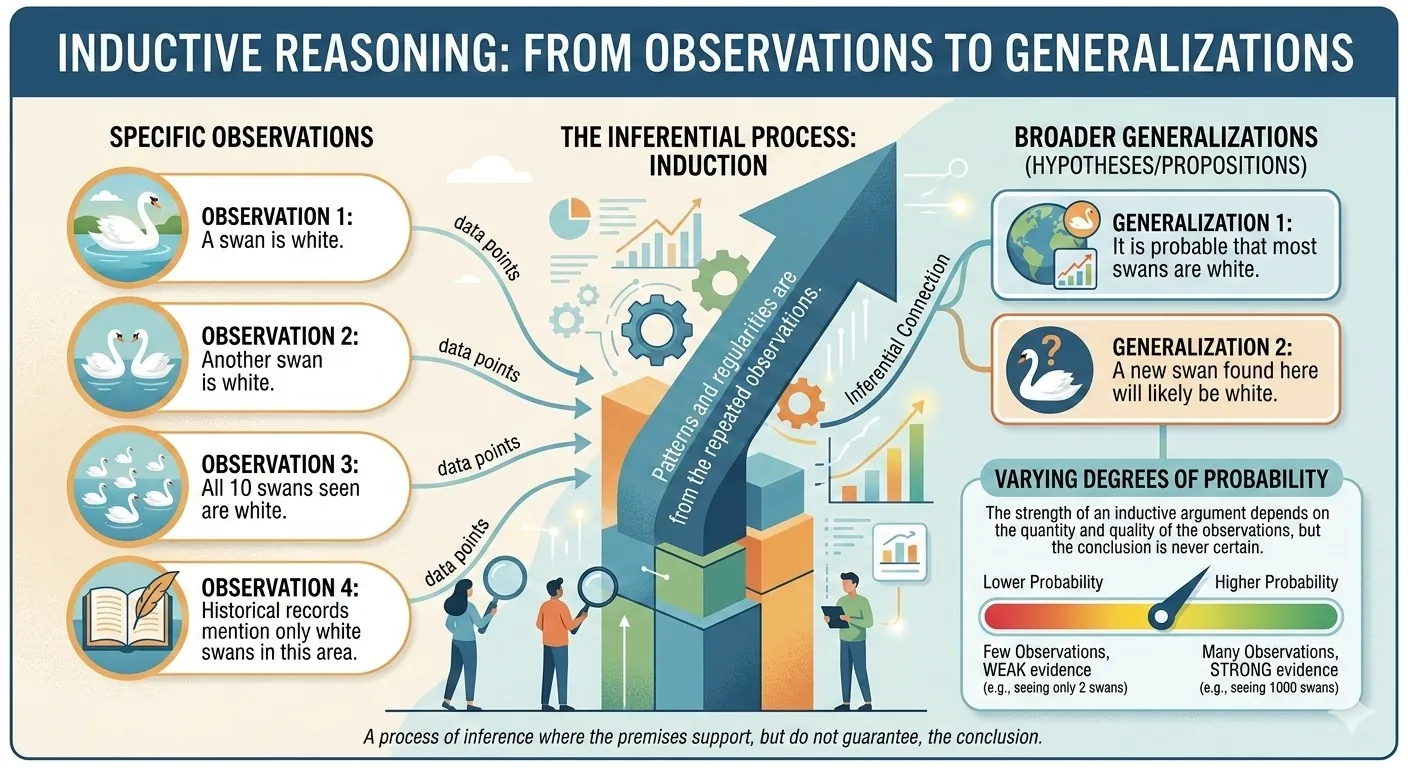
Inductive reasoning moves from specific observations to broader generalizations. Unlike deduction, where valid arguments guarantee their conclusions, induction provides conclusions that are probably, but not necessarily, true.
Inductive reasoning builds from specific observations to broader generalizations with varying degrees of probability
Key Insight: Induction is ampliative—it goes beyond the information contained in the premises, generating new knowledge at the cost of certainty.
Strength vs. Probability
Unlike deductive arguments that are either valid or invalid, inductive arguments come in degrees of strength:
Strong Induction
High Probability
Definition: If the premises are true, the conclusion is probably true.
Example:
All observed crows have been black. (Millions of observations)
? The next crow I see will be black.
Strong! Massive evidence supports this conclusion.
Weak Induction
Low Probability
Definition: Even if the premises are true, the conclusion doesn't follow well.
Example:
I met three rude New Yorkers.
? All New Yorkers are rude.
Weak! The sample is far too small to generalize.
Critical Difference from Deduction: A strong inductive argument with true premises can still have a false conclusion. Strength indicates probability, not guarantee. Even the strongest induction leaves room for surprises.
Factors Affecting Inductive Strength
Sample size: More observations ? stronger inference
Sample diversity: Varied samples ? more reliable generalizations
Relevance: Premises should relate to the conclusion in relevant ways
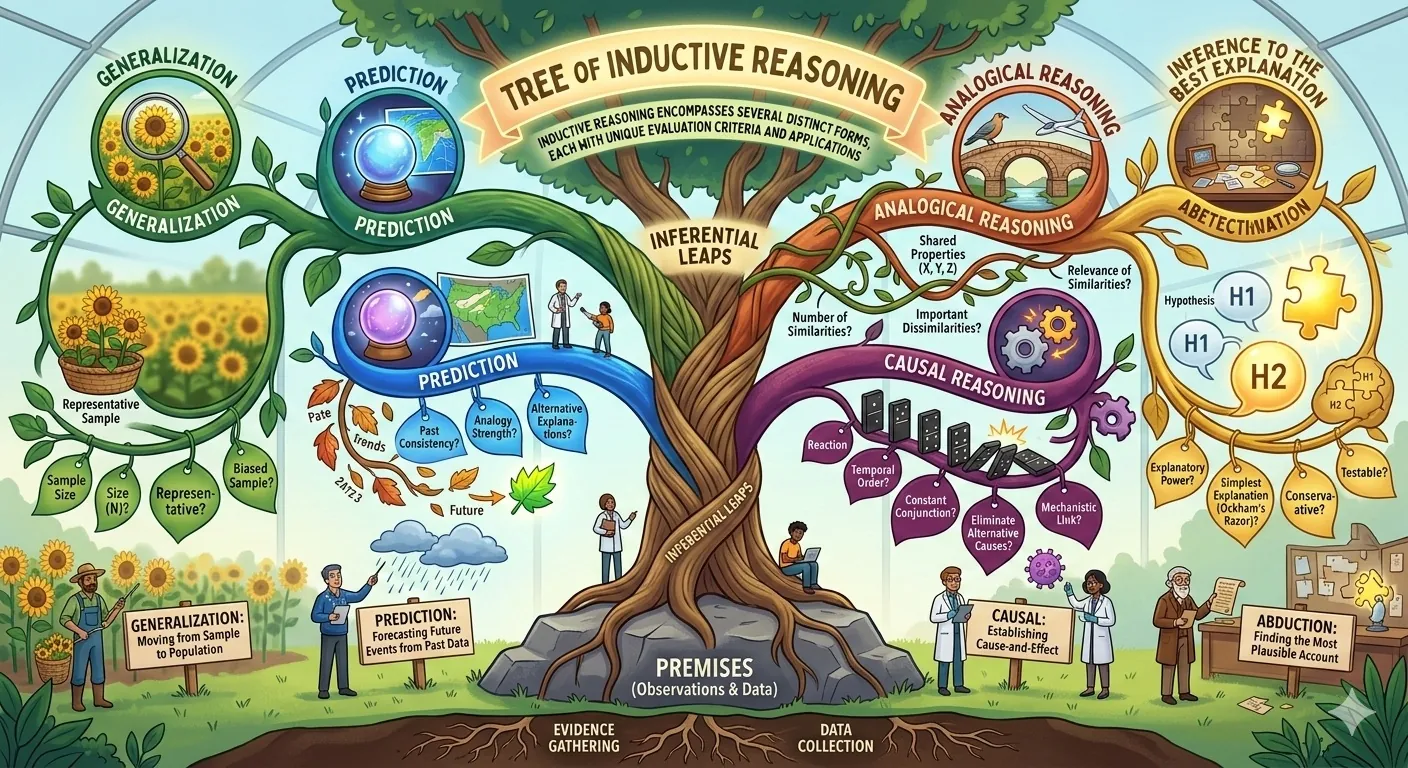
Inductive reasoning takes several distinct forms, each with its own structure and evaluation criteria:
Inductive reasoning encompasses several distinct forms, each with unique evaluation criteria and applications
Enumerative Induction (Generalization)
The most basic form: inferring a general rule from specific instances.
Enumerative Induction Pattern
Instance 1 of F is G
Instance 2 of F is G
Instance 3 of F is G
... (many more instances)
? All F are G (or: The next F will be G)
Example:
Swan 1 is white. Swan 2 is white. Swan 3 is white... Swan 10,000 is white.
? All swans are white.
This was believed in Europe for centuries—until black swans were discovered in Australia!
Statistical Inference
Drawing conclusions about populations from samples using probability:
Statistical Syllogism
Form:
X% of F are G
a is an F
? (Probably) a is G
Example:
90% of college graduates are employed.
John is a college graduate.
? John is probably employed.
The Reference Class Problem: John belongs to many groups—college graduates, philosophy majors, residents of rural areas, etc.—each with different employment rates. Which reference class should we use? This is a fundamental challenge in statistical reasoning.
Key Concepts in Statistical Inference
Sampling & Representation
Concept
Definition
Example
Random Sample
Every member has equal chance of selection
Drawing names from a hat
Stratified Sample
Proportional representation of subgroups
Polling that matches demographic %
Margin of Error
Range of uncertainty (typically ±3-5%)
"Support at 52% ± 3%"
Confidence Level
Probability the true value is in range
"95% confident"
Selection Bias
Sample systematically differs from population
Online polls (exclude non-internet users)
Analogical Reasoning
Inferring that because two things are similar in known ways, they're similar in unknown ways:
Argument from Analogy
Form:
Object A has properties P, Q, R, and S
Object B has properties P, Q, and R
? Object B probably has property S
Example (Drug Testing):
Rats have nervous systems, circulatory systems, and similar organ structures to humans.
This drug reduces blood pressure in rats.
? This drug will probably reduce blood pressure in humans.
Evaluating Analogies
Not all analogies are created equal. Evaluate them with these criteria:
Number of similarities: More shared properties ? stronger analogy
Relevance of similarities: Similarities should be related to the property being inferred
Number of known differences: Significant differences weaken the analogy
Diversity of compared cases: If A works in many contexts, it's more likely to work in B
Weak Analogy Warning: "The economy is like a household budget—we can't spend more than we earn." This analogy fails because governments can print currency, borrow differently than households, and have infinite lifespans. The superficial similarity hides fundamental differences.
Causal Reasoning
Inferring cause-and-effect relationships from observations:
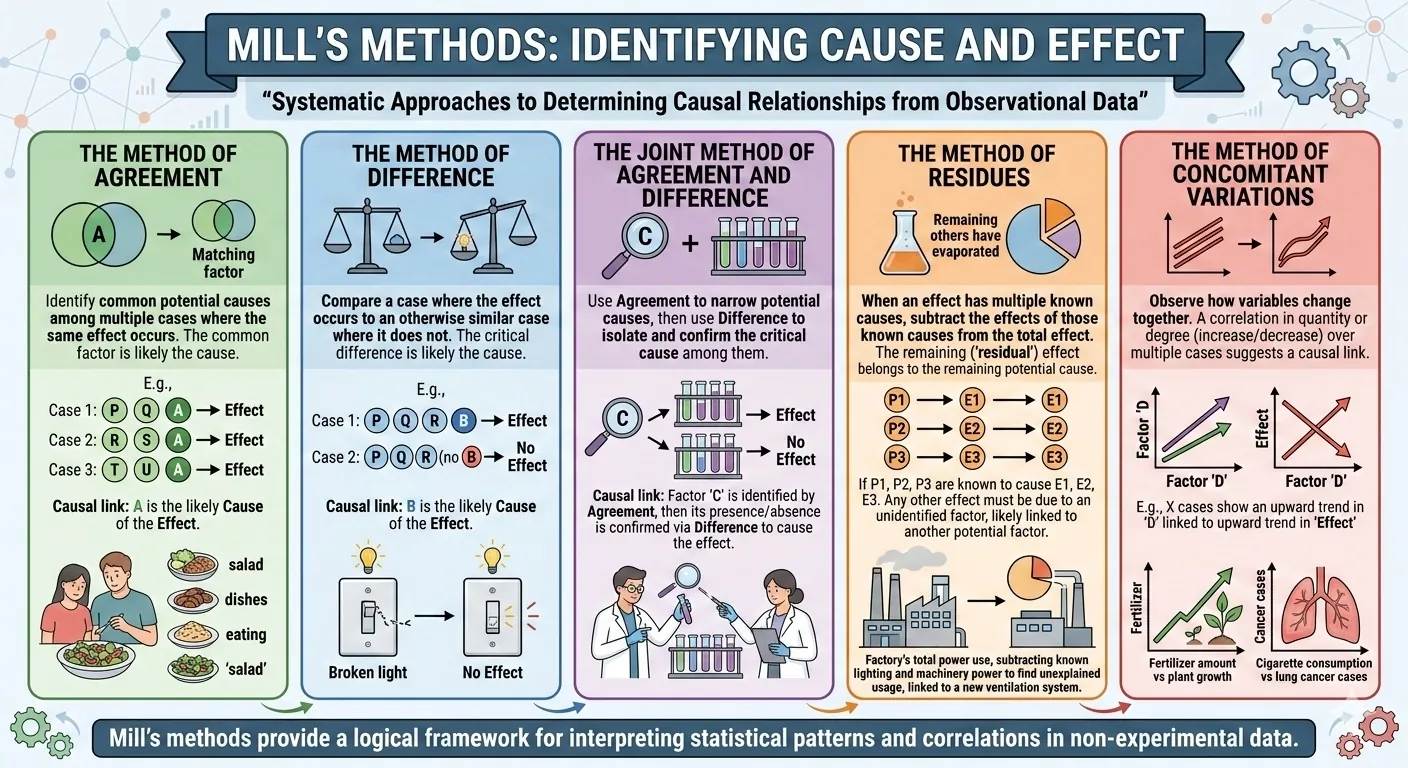
Mill's methods provide systematic approaches to identifying cause-and-effect relationships from observational data
Mill's Methods
John Stuart Mill (1843)
Method of Agreement: If two instances of a phenomenon share only one circumstance, that's likely the cause.
A, B, C ? Effect | A, D, E ? Effect | ? A causes Effect
Method of Difference: If a case with the effect and a case without differ in only one circumstance, that's the cause.
A, B, C ? Effect | B, C ? No Effect | ? A causes Effect
Method of Concomitant Variation: If two things vary together, they're likely causally related.
More A ? More Effect | Less A ? Less Effect | ? A causes Effect
Correlation ? Causation! Ice cream sales and drowning deaths both increase in summer. Does ice cream cause drowning? No—both are caused by a third factor (warm weather). Always check for confounding variables.
The Scientific Method
Science is the most sophisticated application of inductive reasoning. The scientific method systematically generates knowledge through observation, hypothesis, and testing.
The scientific method is the most rigorous application of inductive reasoning, systematically generating knowledge through observation and experimentation
The Scientific Cycle
Stage
Description
Example (Semmelweis & Childbed Fever)
1. Observation
Notice a pattern or anomaly
Women in doctor-attended wards die more than midwife-attended wards
2. Question
Formulate a specific question
Why is the mortality rate so different?
3. Hypothesis
Propose a testable explanation
"Cadaverous particles" from autopsies cause infection
4. Prediction
If hypothesis is true, what should happen?
Handwashing with chlorine solution will reduce deaths
5. Experiment
Test the prediction
Implemented mandatory handwashing
6. Analysis
Evaluate results
Mortality dropped from ~18% to ~2%
7. Conclusion
Accept, reject, or modify hypothesis
Hypothesis supported—hygiene prevents infection
Testing & Confirmation
Confirmation
Supporting Evidence
Evidence that confirms predictions supports the hypothesis.
But confirmation has limits:
Multiple hypotheses may make the same prediction
No finite amount of confirmation proves a universal claim
Confirmation can be misleading with biased tests
Falsification
Karl Popper's Criterion
A single counterexample can refute a universal claim.
Popper's insight: Good science makes risky predictions that could be proven wrong.
Scientific: "All electrons have charge -1" (testable, falsifiable)
Pseudo-scientific: "Fate guides us all" (unfalsifiable)
The Asymmetry of Evidence: Popper showed that confirmation and refutation aren't symmetric. No number of white swans proves "all swans are white," but one black swan disproves it. Science progresses primarily through eliminating false theories, not proving true ones.
Inference to the Best Explanation (Abduction)
Often called "abduction," this form of reasoning selects the hypothesis that best explains the evidence:
Coherence: Does it fit with established knowledge?
Fruitfulness: Does it suggest new discoveries?
Problems of Induction
Inductive reasoning faces a fundamental philosophical challenge that has puzzled thinkers for centuries.
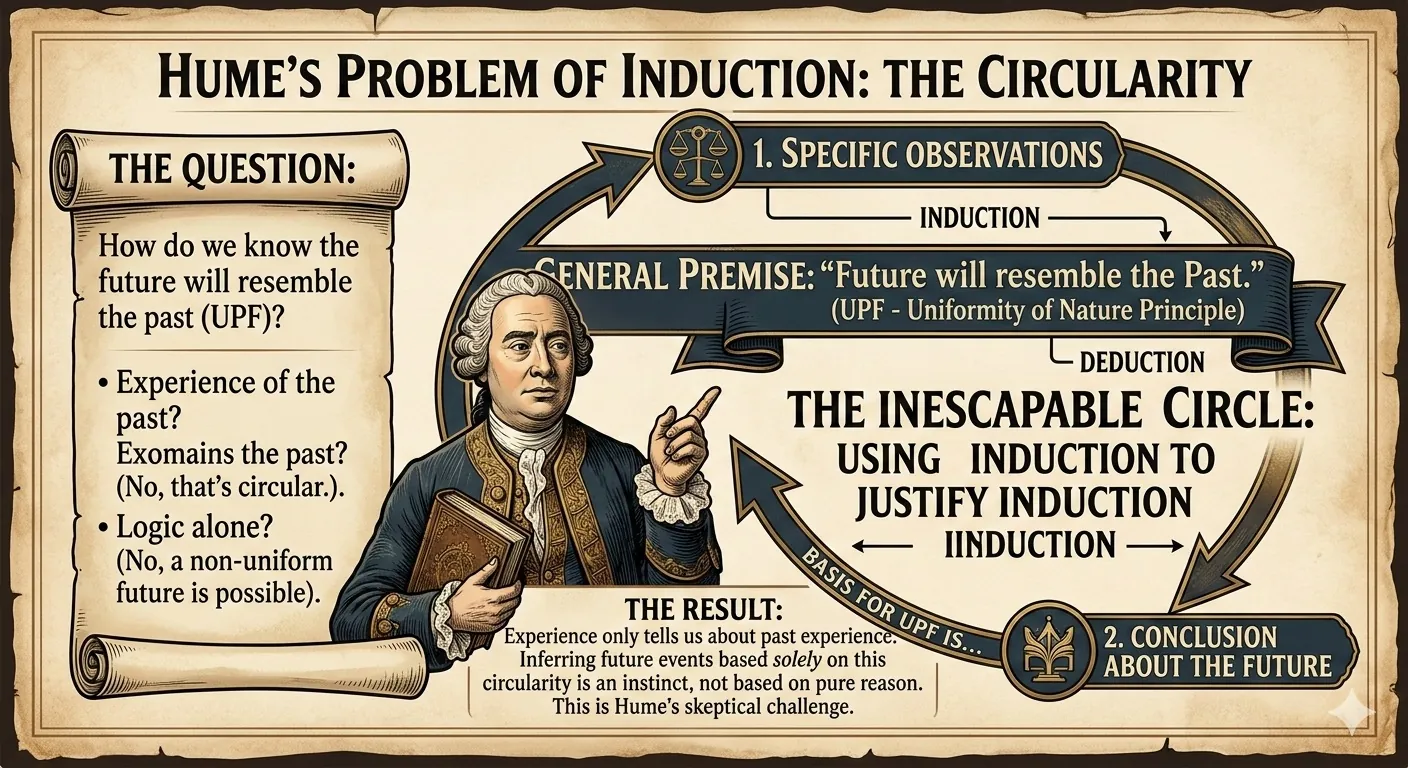
Hume's problem reveals that using induction to justify induction creates an inescapable circle of reasoning
Hume's Problem of Induction
David Hume (1739)
The Challenge: What justifies our belief that the future will resemble the past?
Hume's Argument:
Inductive reasoning assumes the Uniformity of Nature—that patterns observed in the past will continue.
But this assumption can only be justified by induction ("It worked before, so it'll work again").
Using induction to justify induction is circular.
? Induction has no rational foundation.
"Even after the observation of the frequent or constant conjunction of objects, we have no reason to draw any inference concerning any object beyond those of which we have had experience." — David Hume, A Treatise of Human Nature
The Riddle: Every time you assume the sun will rise tomorrow because it always has, you're using induction. But that justification itself is inductive. It's turtles all the way down.
Nelson Goodman's "New Riddle"
Goodman (1955) showed that induction is even more troubled than Hume suggested:
The Grue Paradox
Define a new predicate: Grue = green if examined before Jan 1, 2100, blue otherwise.
Problem:
All observed emeralds are green.
All observed emeralds are grue (examined before 2100, so green).
Both "all emeralds are green" and "all emeralds are grue" are equally supported by the evidence.
But they make opposite predictions about emeralds examined after 2100!
This shows that not all predicates are "projectible"—but how do we know which ones are? The problem remains unresolved.
Modern Responses
Philosophers have proposed various solutions—none universally accepted:
Response Strategies
Approach
Strategy
Limitation
Pragmatic
Induction works in practice; that's enough
Doesn't answer the theoretical challenge
Reliabilism
Induction is justified because it reliably produces truth
How do we know it's reliable? By induction!
Bayesianism
Use probability theory to update beliefs rationally
Where do prior probabilities come from?
Ordinary Language
"Rational" just means using induction
Definitional move, doesn't justify the practice
Evolutionary
Evolution selected for inductive reasoning because it works
Evolution selects for survival, not truth
Living with Uncertainty: Despite the problem of induction, we continue using inductive reasoning—because we have no better alternative. Hume himself admitted we rely on "custom and habit." The challenge isn't to stop using induction, but to use it wisely, understanding its limitations.
Next Steps in the Series
Now that you understand both deductive and inductive reasoning, you're ready to learn about their dark side—logical fallacies.