We use cookies to enhance your browsing experience, serve personalized content, and analyze our traffic. By clicking "Accept All", you consent to our use of cookies. See our Privacy Policy for more information.
Logic & Critical Thinking Series Part 5: Argument Analysis
January 25, 2026Wasil Zafar25 min read
Master systematic argument analysis—the practical skill of deconstructing arguments to their essential components. Learn to identify premises, conclusions, hidden assumptions, and evaluate the quality of evidence supporting any claim.
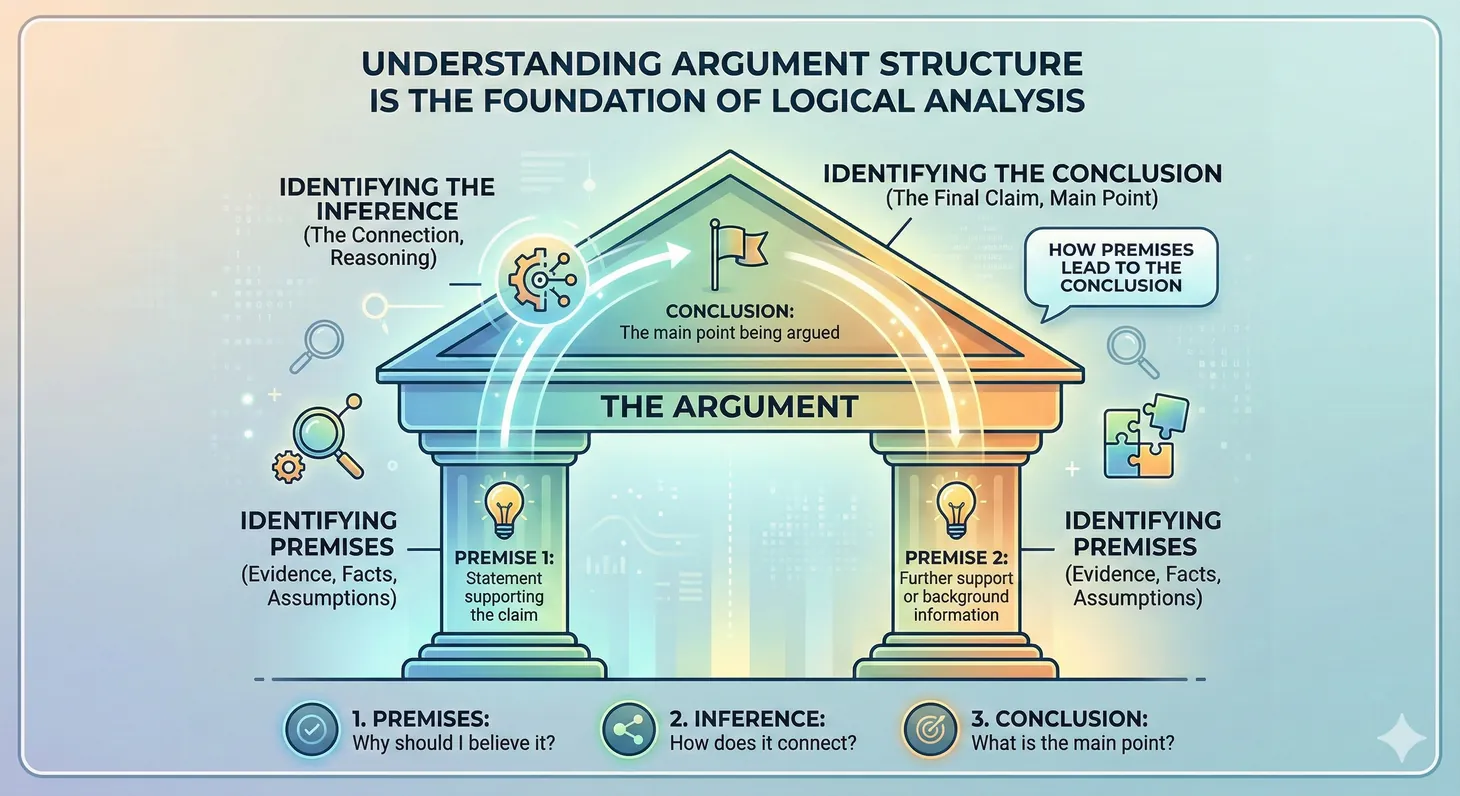
An argument in logic isn't a heated exchange—it's a structured set of statements where some (premises) are offered as reasons to support another (the conclusion).
Understanding argument structure is the foundation of logical analysis—identifying premises, conclusions, and the inference connecting them
Key Insight: Every argument can be broken down into its building blocks. Once you see the structure, you can evaluate whether the reasoning actually works.
Premises & Conclusions
Premises
The Foundation
Definition: Statements offered as evidence or reasons to support the conclusion.
Can be facts, observations, or assumptions
Multiple premises can work together
Some may be stated, others implied
Conclusions
The Claim
Definition: The statement that the premises are meant to support.
What the arguer wants you to accept
May appear first, last, or in the middle
One argument = one main conclusion
The Key Question: "What is this person trying to get me to believe, and what reasons are they giving?" The answer to the first part is the conclusion; the reasons are the premises.
Simple vs. Complex Arguments
Argument Types
Simple Argument: One or more premises directly supporting one conclusion.
"The soup is cold. Therefore, I should send it back."
Complex Argument (Chain): The conclusion of one argument becomes a premise for another.
"The soup is cold. ? Therefore, it wasn't prepared properly. ? Therefore, the chef is incompetent. ? Therefore, I shouldn't eat here again."
Each arrow represents an inference. Complex arguments require evaluating each step.
Identifying Components
In everyday language, arguments rarely come labeled. Learning to spot indicator words helps you parse even the most convoluted reasoning.
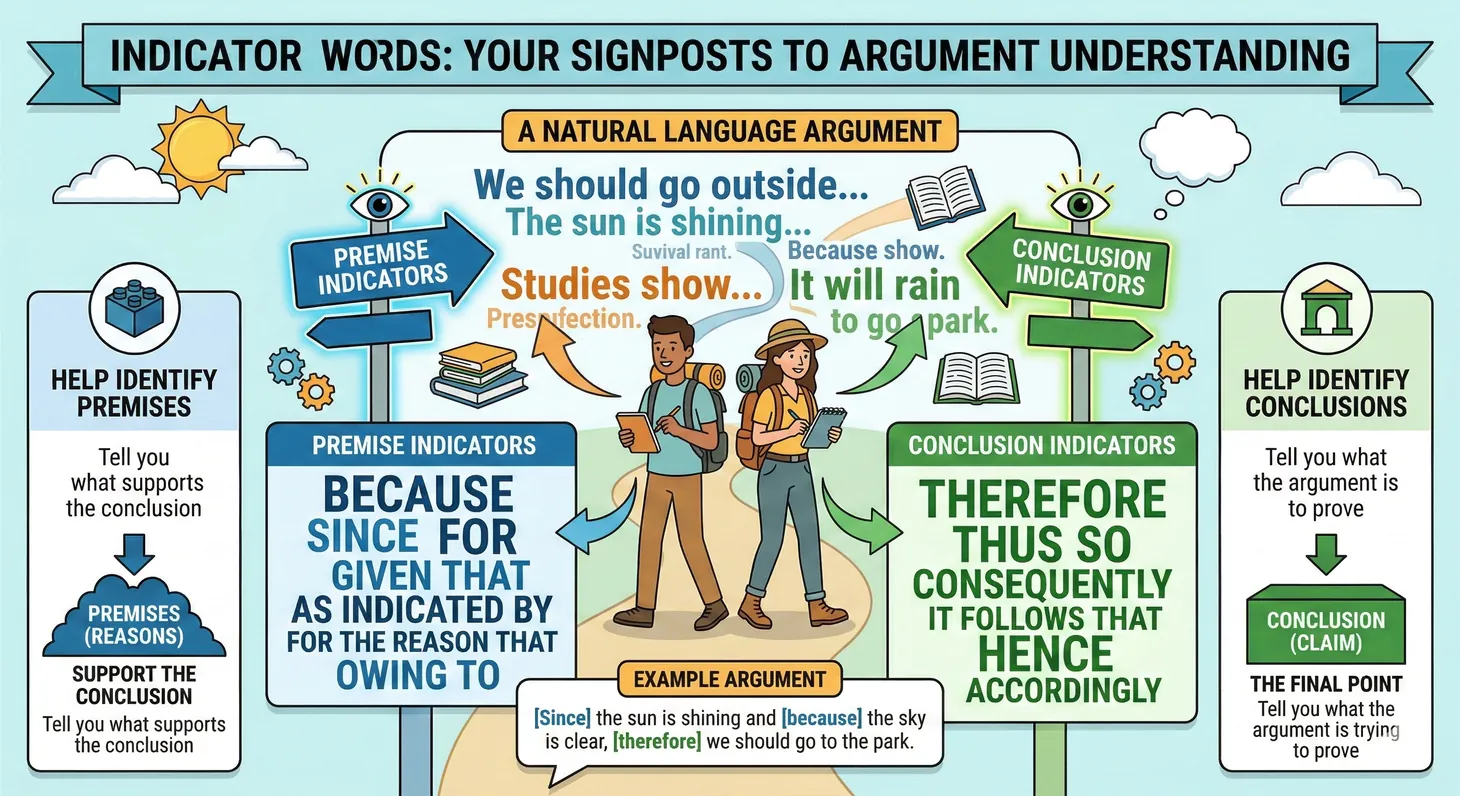
Indicator words serve as signposts that help identify premises and conclusions in natural language arguments
Indicator Words
Premise Indicators
Conclusion Indicators
because, since, for, given that, as, in view of, assuming that, seeing that, inasmuch as
therefore, thus, hence, so, consequently, it follows that, we may conclude, accordingly, for this reason
Example Analysis:
"Since all humans are mortal, and given that Socrates is human, it follows that Socrates is mortal."
Premise 1: All humans are mortal (indicated by "Since")
Premise 2: Socrates is human (indicated by "given that")
Conclusion: Socrates is mortal (indicated by "it follows that")
Warning: Not all "therefore"s indicate conclusions—and not all conclusions have indicators. Context matters. "I'm cold, so I'll close the window" uses "so" to indicate conclusion. "I went to the store so I could buy milk" uses "so" to indicate purpose—not a conclusion.
Argument Diagramming
Visual diagrams reveal how premises relate to each other and to the conclusion.
P1: All mammals are warm-blooded. P2: All whales are mammals. ? C: All whales are warm-blooded.
Linked vs. Convergent Premises
Linked Premises
Work Together
Premises that must work together to support the conclusion. Alone, neither is sufficient.
Example:
P1: If it rains, the game is canceled.
P2: It's raining.
? The game is canceled.
Neither premise alone supports the conclusion—you need both.
Convergent Premises
Independent Support
Premises that independently support the conclusion. Each provides separate reason to believe it.
Example:
P1: She has a law degree.
P2: She passed the bar exam.
P3: She's been practicing for 10 years.
? She's a qualified lawyer.
Each premise separately supports the conclusion.
Hidden Assumptions
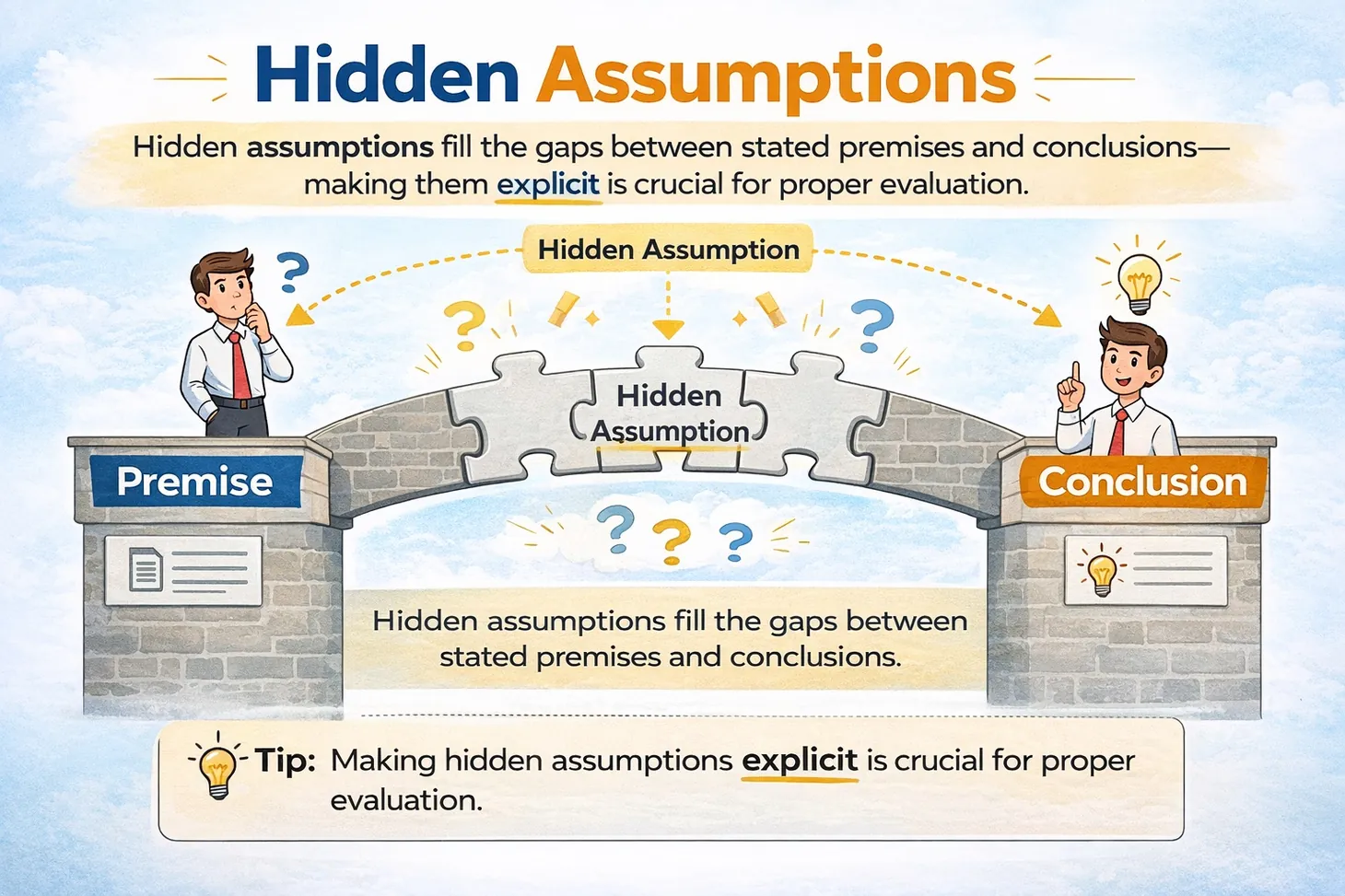
The most powerful premises are often the ones never stated. Every argument rests on assumptions—making them explicit is crucial for evaluation.
Hidden assumptions fill the gaps between stated premises and conclusions—making them explicit is crucial for proper evaluation
Why Assumptions Stay Hidden: They seem too obvious, the arguer is unaware of them, or revealing them would weaken the argument. Skilled persuaders often rely on audiences accepting unstated premises.
Types of Hidden Assumptions
1. Factual Assumptions: Unstated claims about facts.
"We should ban pesticide X because it causes cancer." Hidden: Pesticide X does in fact cause cancer.
2. Value Assumptions: Unstated ethical or priority claims.
"We should invest in public transit because it reduces traffic." Hidden: Reducing traffic is more important than other uses of funds.
3. Connecting Assumptions: Unstated premises that link stated premises to conclusion.
"John is from Texas. He must love football." Hidden: All Texans love football.
Revealing Hidden Premises
Use these techniques to surface assumptions:
Assumption-Finding Techniques
Gap Analysis: What premise, if added, would make this argument valid?
Why Test: Keep asking "Why?" until you hit bedrock assumptions.
Devil's Advocate: What would someone who disagrees need to deny?
Reverse Engineering: Work backward from the conclusion—what must be true for this to follow?
The Principle of Charity: When reconstructing arguments, assume the most reasonable interpretation. Don't attribute obvious errors or extreme claims if a more sensible reading exists. This ensures you're engaging with the strongest version of the argument.
Evaluating Evidence
Premises often rely on evidence. Not all evidence is created equal—learning to assess it is essential for good reasoning.
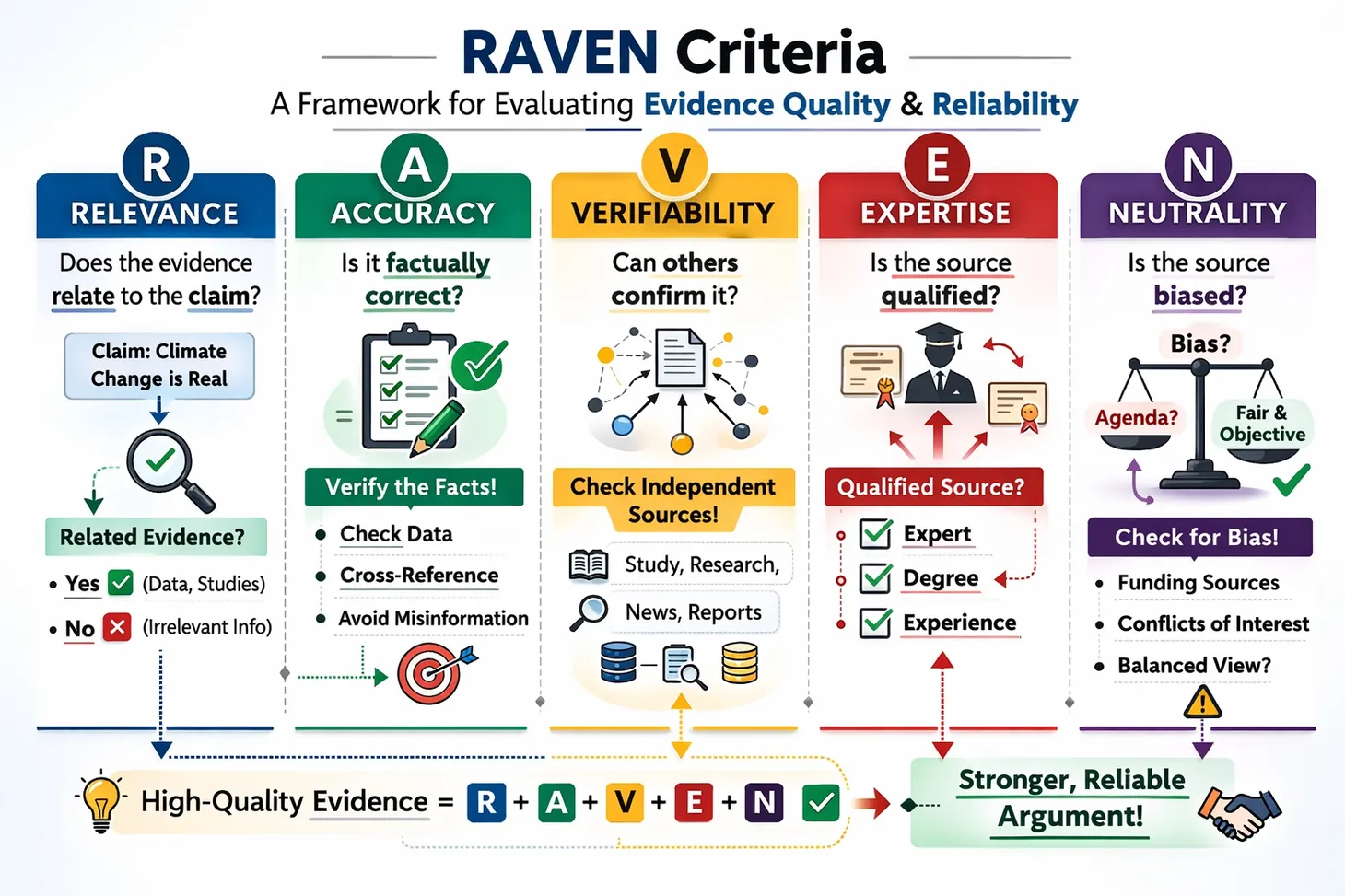
The RAVEN criteria provide a systematic framework for assessing the quality and reliability of evidence supporting an argument
Types of Evidence
Type
Description
Strengths
Weaknesses
Statistical
Numbers, percentages, studies
Quantifiable, replicable
Can be manipulated, sampling issues
Testimonial
Eyewitness accounts, personal reports
Direct experience
Memory errors, bias, limited scope
Anecdotal
Individual stories, specific cases
Memorable, relatable
Not generalizable, cherry-picked
Expert Opinion
Professional/specialist testimony
Informed, credible (if genuine)
Conflicts of interest, expertise limits
Documentary
Records, historical documents
Verifiable, contemporaneous
Forgery, incomplete record
Evidence Quality Criteria
Ask these questions to evaluate evidence:
The RAVEN Criteria
R - Relevance: Does this evidence actually relate to the claim?
A - Accuracy: Is it factually correct? Can it be verified?
V - Verifiability: Can independent sources confirm it?
E - Expertise: Is the source qualified on this topic?
N - Neutrality: Is the source unbiased, or do they have stakes?
Sufficiency: Even good evidence may not be enough. Ask: "Does the quantity of evidence match the weight of the claim?" Extraordinary claims require extraordinary evidence.
Building & Critiquing Arguments
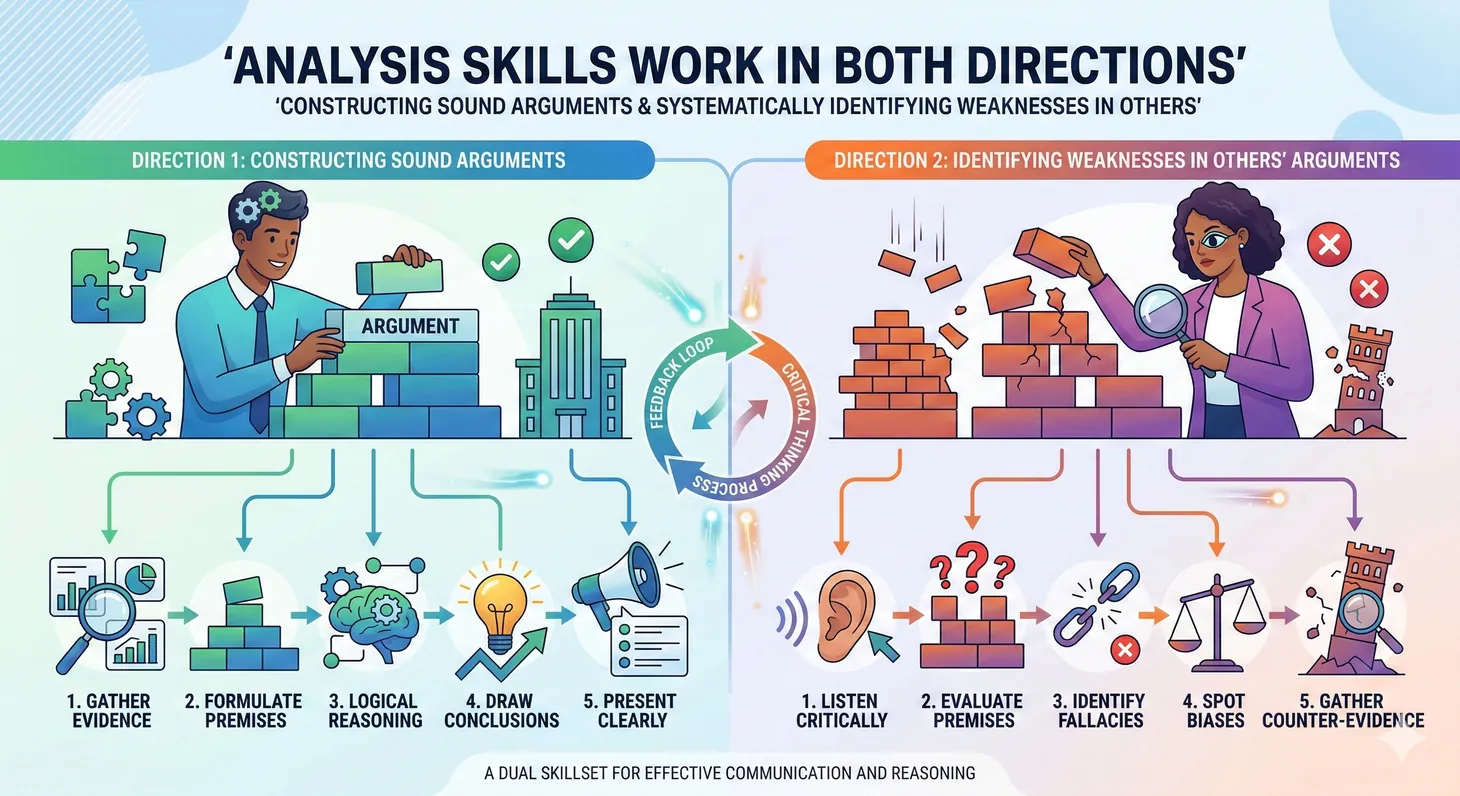
Analysis skills work both ways—use them to construct strong arguments and to identify weaknesses in others'.
Analysis skills work in both directions—constructing sound arguments and systematically identifying weaknesses in others'
Steps for Constructing Arguments
Building Strong Arguments
Clarify your conclusion: What exactly do you want to establish?
Identify support: What evidence or reasons support this?
Check the structure: Do your premises actually lead to the conclusion?
Make assumptions explicit: What are you taking for granted?
Anticipate objections: What would critics say? Address them.
Test for fallacies: Does your argument commit any reasoning errors?
Generating Counterarguments
Attacking Premises
Challenge the truth of individual premises:
Show a premise is false with evidence
Demonstrate a premise is questionable
Reveal hidden assumptions that are dubious
Provide counterexamples
Attacking Structure
Challenge the connection between premises and conclusion:
Show the inference is invalid
Identify fallacies in reasoning
Demonstrate premises don't support conclusion
Show alternative conclusions are possible
The Steel Man Technique
Steel-Manning: The opposite of straw-manning. Before critiquing an argument, make it as strong as possible. Add unstated but reasonable premises, choose the most charitable interpretation, and address the best version of the opposing view. If you can defeat the steel man, you've truly engaged with the position.
Dialectical Thinking
Strong thinkers engage in internal debate:
Thesis: What's the argument?
Antithesis: What's the strongest objection?
Synthesis: How can we reconcile or move beyond both?
This process, borrowed from Hegel, drives intellectual progress by forcing you to confront opposing views seriously.
Next Steps in the Series
Now that you can systematically analyze arguments, you're ready to apply these skills to real-world scenarios in the final part of our series.