Ethics & Moral Philosophy Series Part 6: Applied Ethics & Case Studies
January 25, 2026Wasil Zafar28 min read
Apply ethical principles to real-world moral dilemmas. Explore bioethics, environmental ethics, business ethics, AI ethics, and work through contemporary case studies that challenge our moral reasoning.
Series Finale: This is Part 6 (Final Part) of our 6-part Ethics & Moral Philosophy Series. Having explored the foundations and major theories, we now apply ethics to real-world problems.
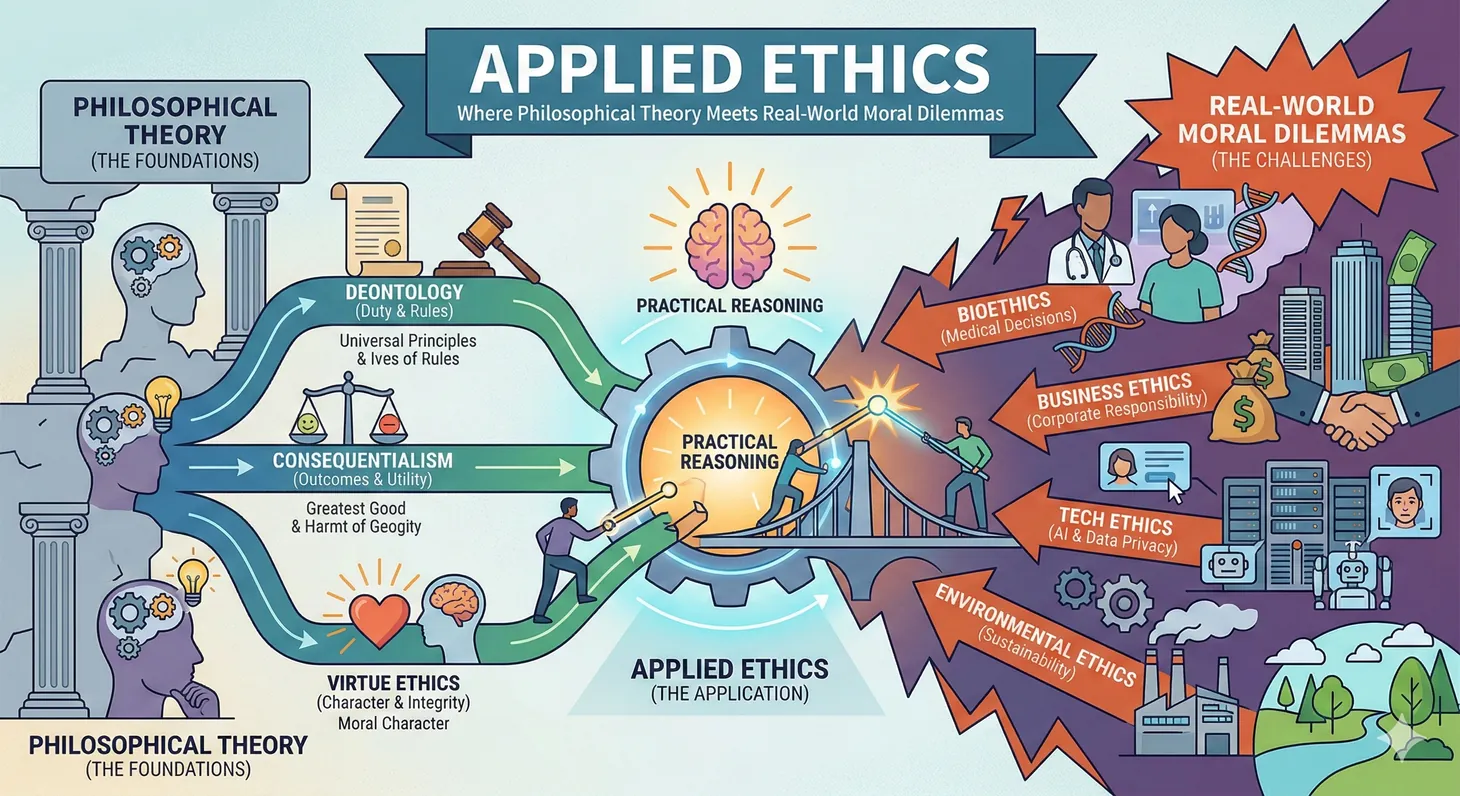
Applied ethics takes the normative theories we've studied and brings them to bear on specific moral problems. It's where philosophy meets the real world—in hospitals, boardrooms, laboratories, courtrooms, and legislatures.
Applied ethics: where philosophical theory meets real-world moral dilemmas
Key Insight: Applied ethics isn't just about "applying" theory mechanically. Real-world cases often reveal tensions between theories, expose hidden assumptions, and force us to refine our ethical thinking. The relationship between theory and practice goes both ways.
Methods in Applied Ethics
Applied ethicists use several methodological approaches:
Three Methodological Approaches
Methodology
Approach
Description
Strengths & Weaknesses
Top-Down
Start with ethical theory, deduce conclusions for specific cases
Systematic, but may ignore case-specific features
Bottom-Up (Casuistry)
Start with particular cases, look for analogies and precedents
Sensitive to particulars, but may lack principled basis
Reflective Equilibrium
Move back and forth between principles and intuitions, adjusting both until coherent
Utilitarianism: Calculate consequences. What produces the greatest overall good?
Deontology: Identify duties. What does the moral law require? What would respect persons?
Virtue Ethics: Consider character. What would a virtuous person do? What does practical wisdom advise?
In Practice: Most ethicists draw on multiple approaches. Different theories illuminate different aspects of complex cases.
Bioethics & Medical Ethics
Bioethics is one of the most developed areas of applied ethics, emerging in the 1960s-70s in response to advances in medical technology and notorious research scandals (e.g., the Tuskegee syphilis study).
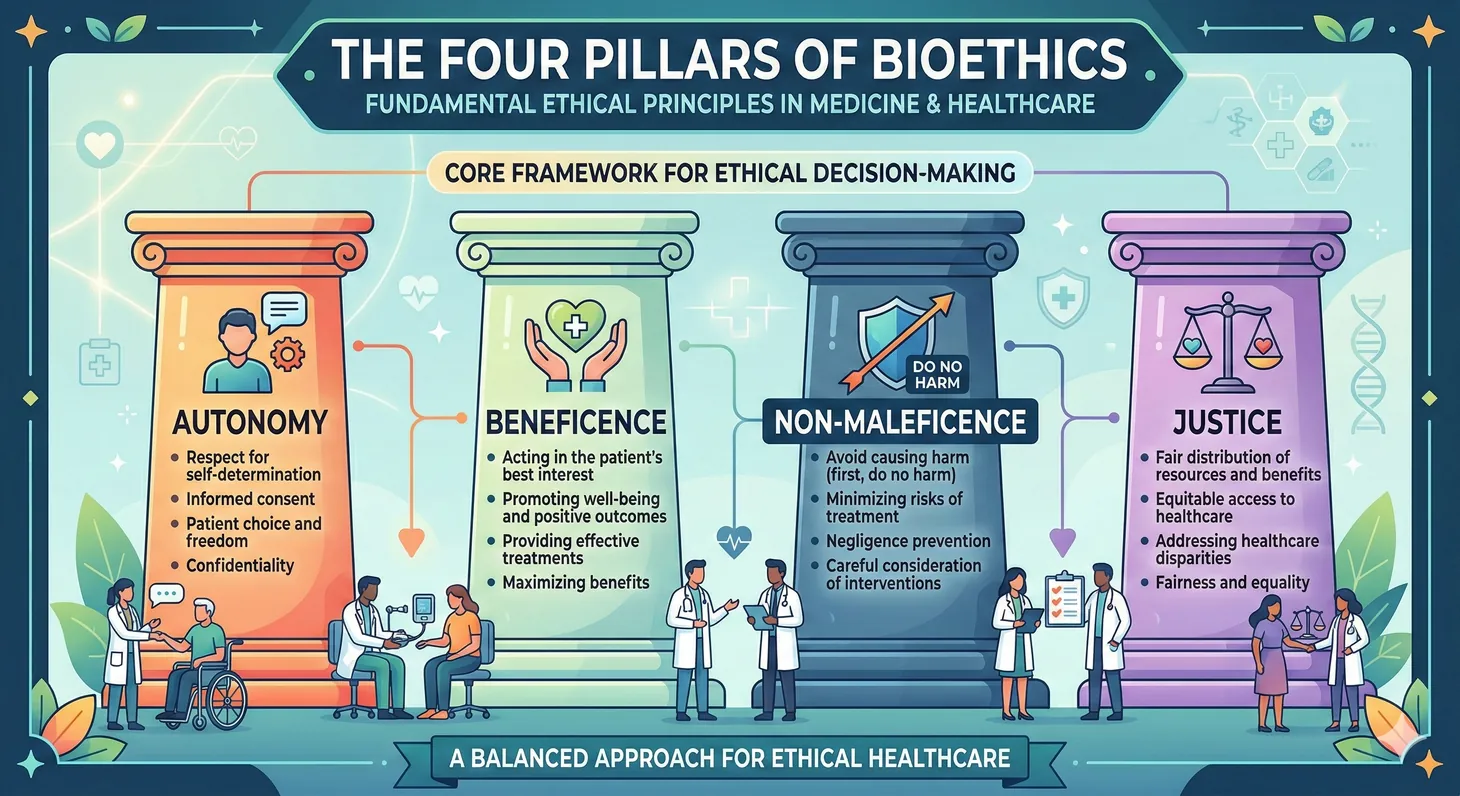
The four pillars of bioethics: autonomy, beneficence, non-maleficence, and justice
The Four Principles (Beauchamp & Childress): The dominant framework in bioethics uses four mid-level principles:
Autonomy: Respect patient's right to make their own decisions
Beneficence: Act in the patient's best interest
Non-maleficence: Do no harm
Justice: Distribute benefits and burdens fairly
Patient Autonomy & Informed Consent
The Principle of Autonomy
Core Concept
Informed Consent requires that patients:
Understand the nature of their condition and proposed treatment
Know the risks, benefits, and alternatives
Voluntarily agree without coercion
Have capacity to make the decision
Paternalism Debate: When, if ever, may doctors override patient wishes "for their own good"? Strong autonomy views say almost never; moderate views allow exceptions (e.g., psychiatric emergencies).
Euthanasia & End-of-Life Care
The Euthanasia Debate
Key Distinctions
Voluntary
Non-Voluntary
Involuntary
Active
Patient requests death; doctor administers lethal agent
Patient can't consent; doctor causes death
Patient refuses; doctor kills anyway (murder)
Passive
Patient refuses treatment; death follows naturally
Withdrawing life support from unconscious patient
Withdrawing treatment against patient's wishes
The Doctrine of Double Effect: An action with a bad effect (death) may be permissible if the bad effect is foreseen but not intended, and the good effect (relief of suffering) is the aim.
Informed consent for future generations (who can't consent)
Environmental Ethics
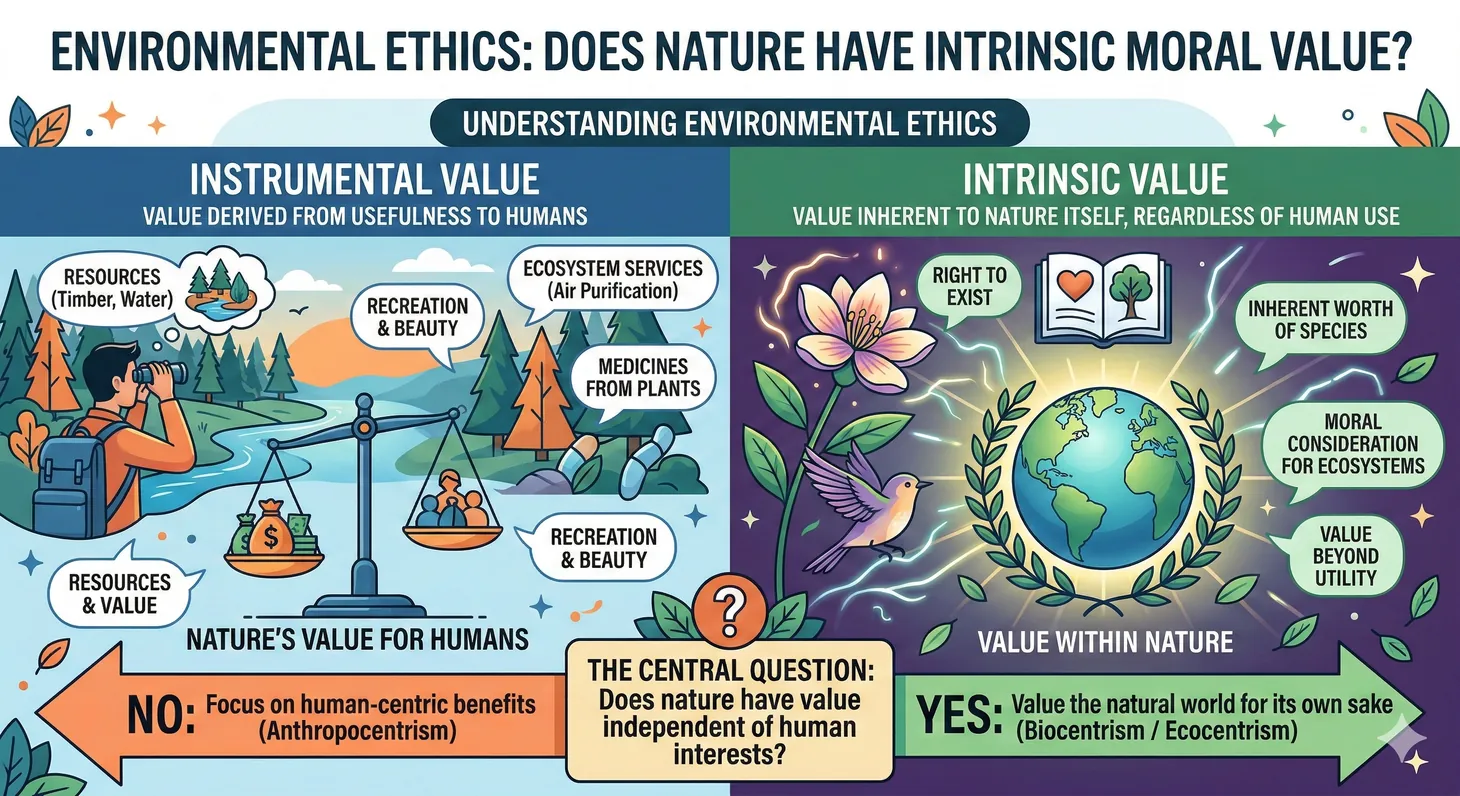
Environmental ethics examines our moral relationship with the natural world. Should we care about nature only because it benefits humans, or does nature have value in itself?
Environmental ethics: questioning whether nature has from intrinsic moral value
Climate Change Ethics
The Ethics of Climate Change
Global Challenge
Key Ethical Issues:
Intergenerational Justice: What do we owe future generations? How much should we sacrifice now for people who don't yet exist?
Global Justice: Rich countries caused most emissions but poor countries suffer most. Who should bear the costs?
Collective Action: Individual actions seem trivial, but collective impact is huge. What are individual vs. collective responsibilities?
Discounting the Future: Should future harms count less than present harms? If so, how much less?
Animal Rights & Welfare
Two Major Approaches
Animal Ethics
Peter Singer's Utilitarian View:
Sentience (capacity to suffer) is what matters morally
Equal consideration of interests—animal pain counts like human pain
"Speciesism" (favoring humans just because they're human) is like racism or sexism
Tom Regan's Rights View:
Animals are "subjects of a life" with inherent value
This gives them moral rights—not to be used merely as means
Stronger protections than utilitarianism provides
Business Ethics
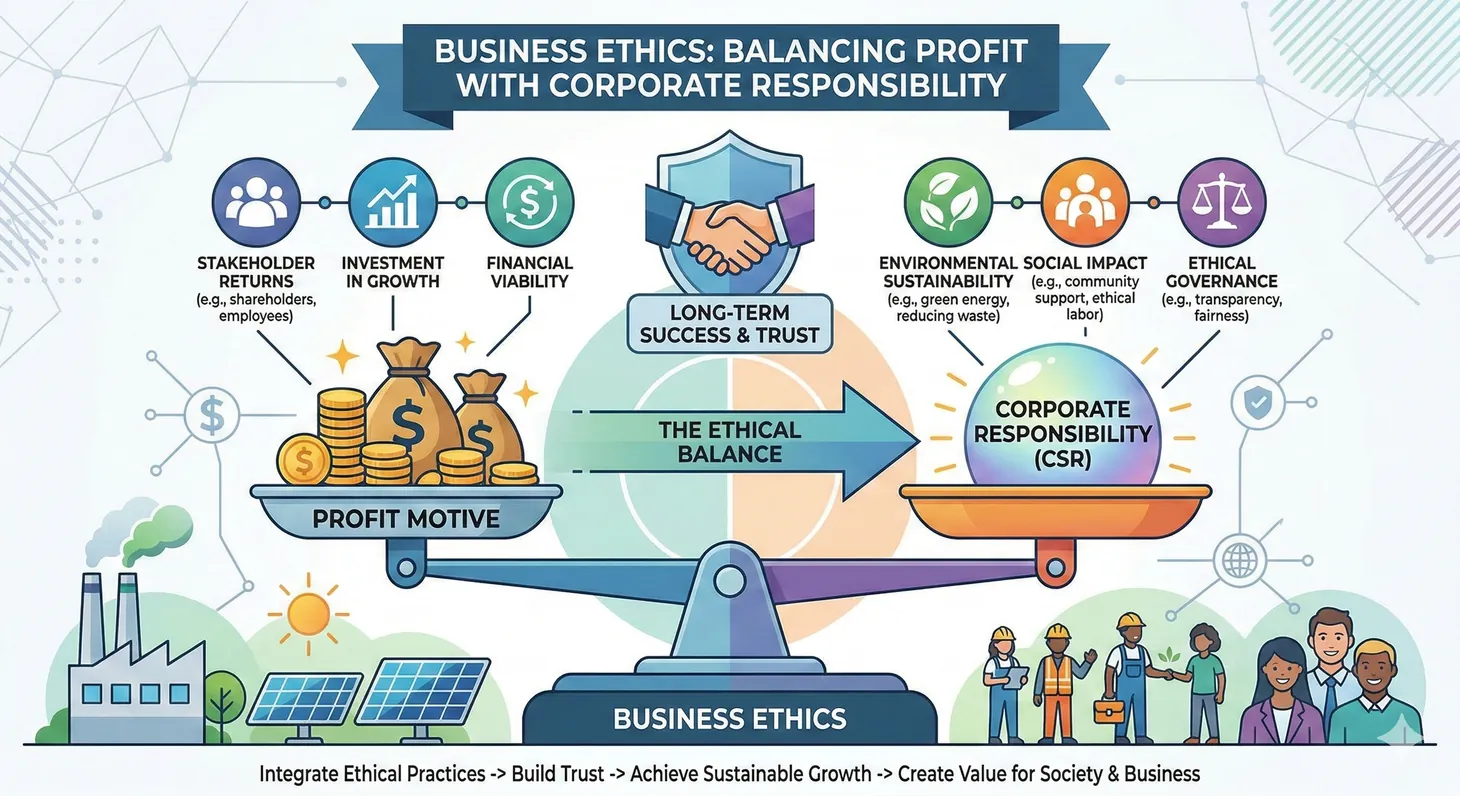
Business ethics examines moral issues in commercial activity—corporate responsibility, fair dealing, and the ethics of profit-seeking.
Business ethics: balancing profit with corporate responsibility
Corporate Social Responsibility
What Do Corporations Owe Society?
CSR Debate
Milton Friedman's View (Shareholder Theory):
"The social responsibility of business is to increase its profits" (within legal bounds)
Managers are agents of shareholders—spending on CSR is "stealing" from owners
Let the market work; government handles social problems
Stakeholder Theory:
Corporations have obligations to all stakeholders: employees, customers, communities, environment—not just shareholders
The Tension: Loyalty to employer vs. duty to public interest
Conditions for Justified Whistleblowing (DeGeorge):
The harm is serious and considerable
You've reported concerns through internal channels first
There's documented evidence, not just suspicion
There's reasonable chance that blowing the whistle will prevent the harm
When does it become obligatory? When you can prevent serious harm at relatively low cost to yourself.
Technology & AI Ethics
Technology ethics addresses moral issues raised by new technologies—increasingly dominated by artificial intelligence.
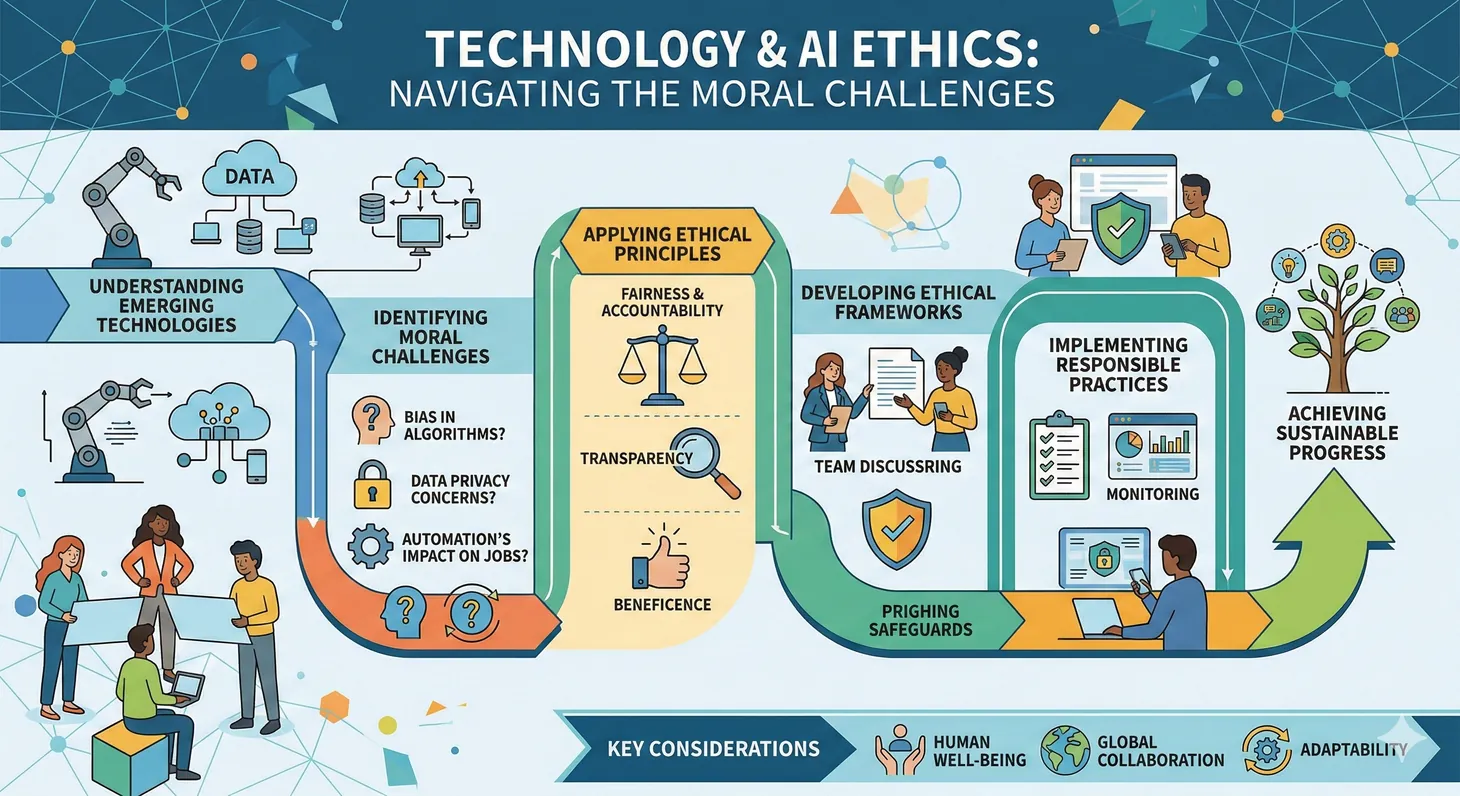
Technology and AI ethics: navigating the moral challenges of emerging technologies
Artificial Intelligence Ethics
Key AI Ethics Issues
Emerging Field
Algorithmic Bias: AI systems can encode and amplify human biases (racial, gender, etc.). Who's responsible?
Autonomous Weapons: Should we allow lethal decisions without human oversight?
The Alignment Problem: How do we ensure AI systems pursue goals we actually want?
AI Rights: If AI becomes conscious, would it have moral status?
Job Displacement: What do we owe workers displaced by automation?
Privacy & Surveillance
Digital Privacy Ethics
Contemporary Issues
Surveillance Capitalism: Is the business model of harvesting personal data for profit ethical?
Government Surveillance: How do we balance security and liberty?
The Right to Privacy: What privacy expectations are reasonable in a digital age?
Data Ownership: Who owns your personal data? What rights should you have over it?
Case Studies
Let's apply our ethical frameworks to classic cases that illuminate how different theories approach real dilemmas.
Case Study 1: The Trolley Problem in Autonomous Vehicles
Applied EthicsReal-World Application
The Scenario: A self-driving car must choose between swerving (killing its passenger) or staying course (killing five pedestrians). How should it be programmed?
Analysis:
Utilitarian: Minimize deaths—swerve. But then who would buy such a car?
Deontological: There's a difference between killing and letting die. Actively swerving to kill is worse.
Virtue Ethics: What would a wise person do? Perhaps: build cars that rarely face such choices.
Real-World Complication: Survey shows people want others' cars programmed utilitarian, but their own cars programmed to protect them.
Case Study 2: Heinz's Dilemma
KohlbergMoral Development
The Scenario: Heinz's wife is dying. A druggist has a cure but charges $2,000 (10x his cost). Heinz can only raise $1,000. The druggist refuses to sell cheaper or let Heinz pay later. Should Heinz steal the drug?
Analysis:
Utilitarian: Probably yes—a life outweighs property rights and minor harm to the druggist
Deontological: Tricky. Stealing violates duty, but so does letting someone die when you can save them
Virtue Ethics: A compassionate, just person might steal. But also: a just society wouldn't create such dilemmas
Kohlberg's Point: What matters for moral development isn't the answer but the reasoning—are you thinking about punishment, social rules, or universal principles?
Case Study 3: The Ford Pinto Case
Business EthicsCost-Benefit Analysis Gone Wrong
The Facts: In the 1970s, Ford knew the Pinto's fuel tank was vulnerable to rupture in rear-end collisions. An $11 fix per car would prevent an estimated 180 burn deaths, 180 serious injuries, and 2,100 burned vehicles.
Ford's Analysis:
Cost of fix: $11 × 12.5 million cars = $137.5 million
Discuss: Engage others in ethical conversation. Test your views against objections.
Reflect: Notice your moral intuitions. When do they conflict with theory? What does that tell you?
Act: Ethics isn't just theoretical—it's about how we live. Practice the virtues.
Socrates: "The unexamined life is not worth living." You've begun the examination. The goal isn't to arrive at final answers but to think more carefully, act more wisely, and live more deliberately. Ethics is a lifelong practice.