We use cookies to enhance your browsing experience, serve personalized content, and analyze our traffic. By clicking "Accept All", you consent to our use of cookies. See our Privacy Policy for more information.
Ethics & Moral Philosophy Series Part 3: Deontology & Kant
January 25, 2026Wasil Zafar24 min read
Master Kant's deontological ethics and the categorical imperative. Learn about duty-based morality, the moral law, and why we must treat humanity as an end in itself, never merely as a means.
Series Overview: This is Part 3 of our 6-part Ethics & Moral Philosophy Series. After exploring consequentialism, we now turn to its major rival: deontology—the ethics of duty.
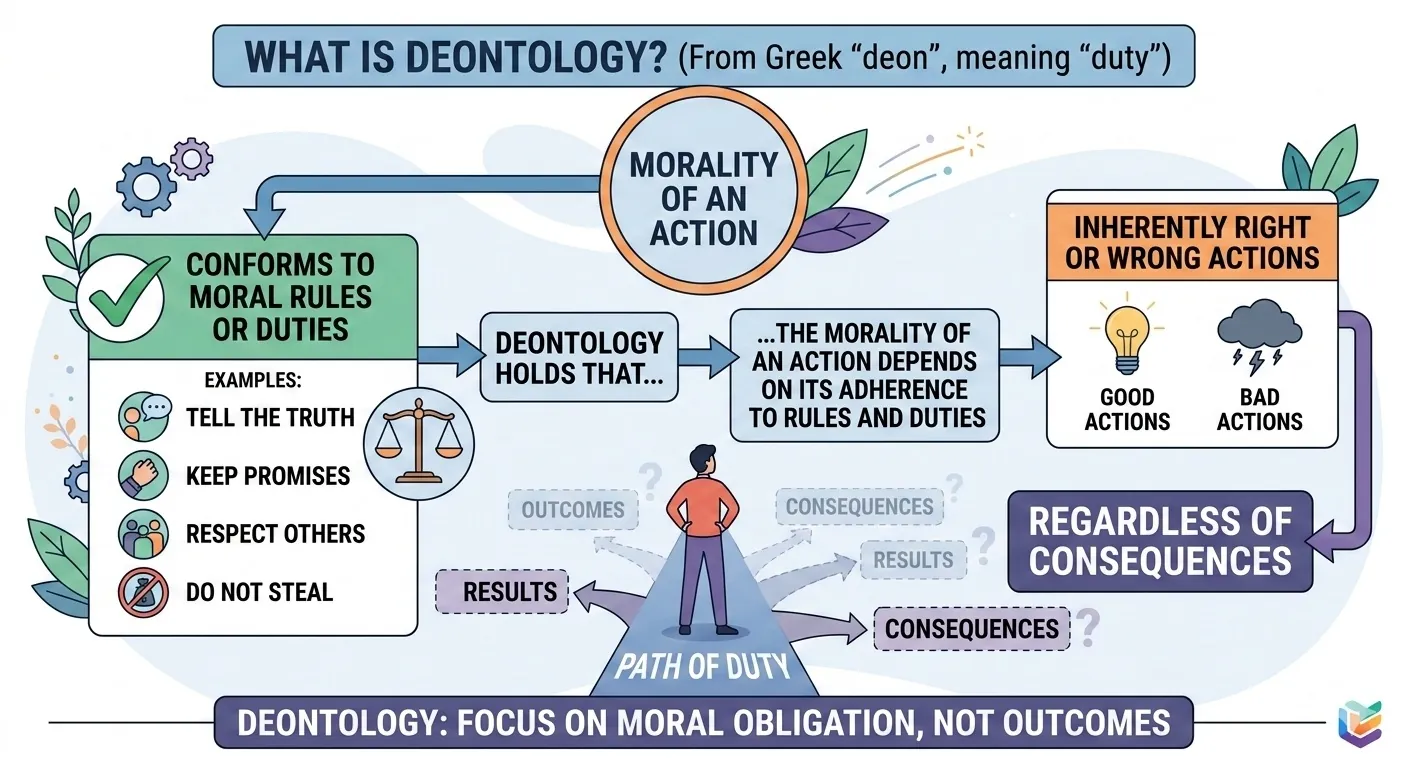
Deontology (from Greek deon, meaning "duty") holds that the morality of an action depends on whether it conforms to moral rules or duties, regardless of consequences. Some actions are inherently right or wrong, no matter what outcomes they produce.
Deontology: ethics grounded in moral duty and universal rules
Key Insight: For deontologists, there are moral constraints—things we must never do, even if violating them would produce better outcomes. Lying, killing the innocent, and breaking promises are wrong in themselves, not just because of their effects.
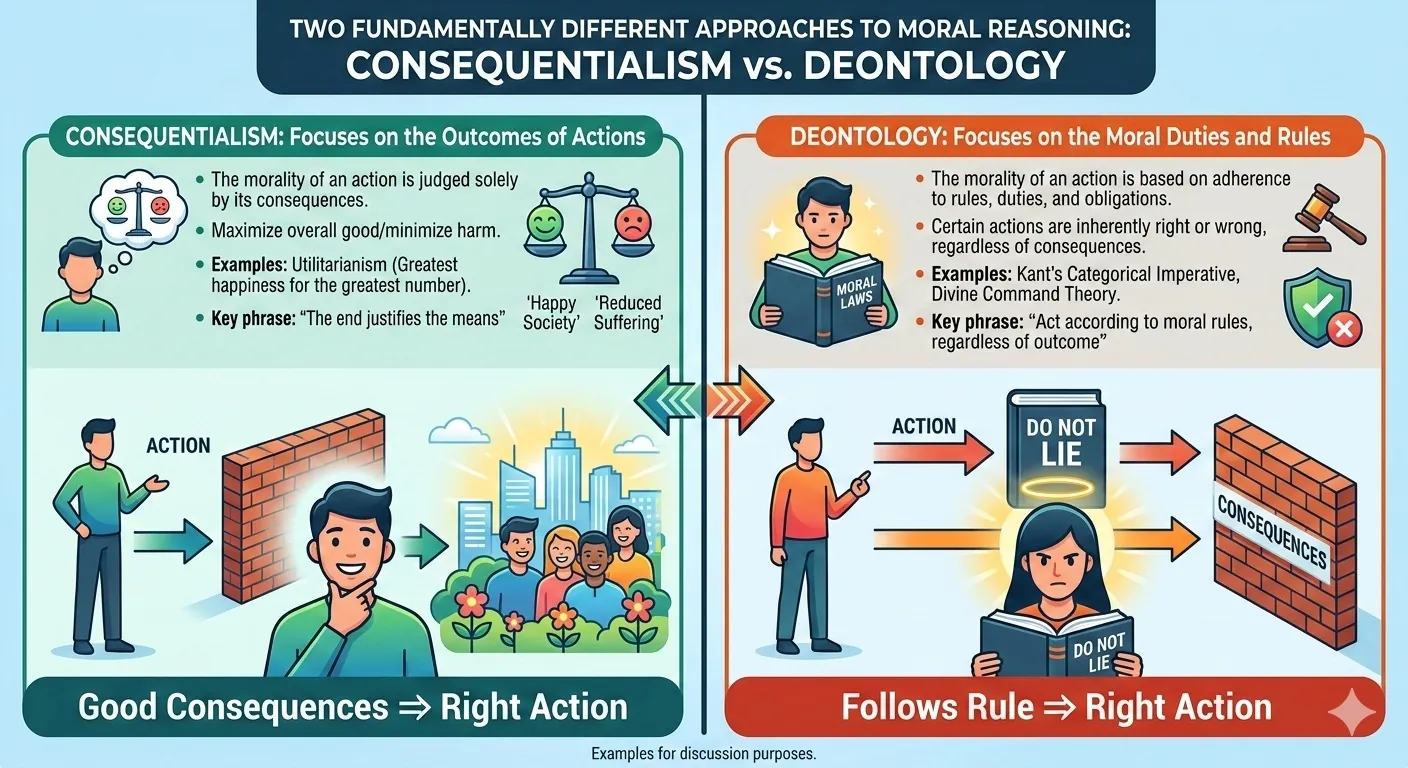
Where consequentialism asks "What action will produce the best results?", deontology asks "What is my duty?" The focus shifts from outcomes to the intrinsic nature of the act itself and the agent's intentions.
Consequentialism vs. deontology: two fundamentally different approaches to moral reasoning
The Transplant Surgeon
Thought Experiment
A surgeon has five patients dying from organ failure. A healthy patient comes in for a routine checkup. The surgeon realizes she could kill this one patient and harvest his organs to save the five.
Consequentialist Analysis: If five lives outweigh one, should she do it?
Deontological Response: Absolutely not. Killing an innocent person is wrong in itself, regardless of how many might be saved. Using someone merely as a means to an end violates their dignity as a person.
The Intuition: Most people share the deontological intuition here—this would be murder, even if it saved lives. Some things are simply forbidden.
Duty-Based Ethics
Deontology centers on the concept of moral duty—obligations that bind us regardless of our desires or the consequences. These duties are:
Characteristics of Moral Duties
Core Concepts
Categorical: They apply unconditionally, not just if you want something. "Don't lie" doesn't mean "Don't lie if you want to be trusted."
Universal: They apply to all rational beings in similar situations.
Binding: They are not mere recommendations but requirements. Violating them is morally wrong.
Override Consequences: Good outcomes don't justify violating duties. You can't torture one child to save a thousand.
Kant distinguished between acting from duty and acting merely in accordance with duty:
The Shopkeeper Example: A shopkeeper who doesn't cheat customers because it's bad for business acts "in accordance with duty" but not "from duty." Only the shopkeeper who doesn't cheat because it would be wrong acts with genuine moral worth.
Deontology vs. Consequentialism
Key Differences
Comparison
Consequentialism
Deontology
Focus
Outcomes/Results
Duties/Rules
Question
"What will produce the most good?"
"What is my duty?"
Ends vs. Means
Good ends can justify means
Some means are forbidden regardless
Agent-Centered?
No—maximize overall good
Yes—what I do matters specially
Moral Constraints
None that are absolute
Some actions are absolutely prohibited
Immanuel Kant (1724-1804)
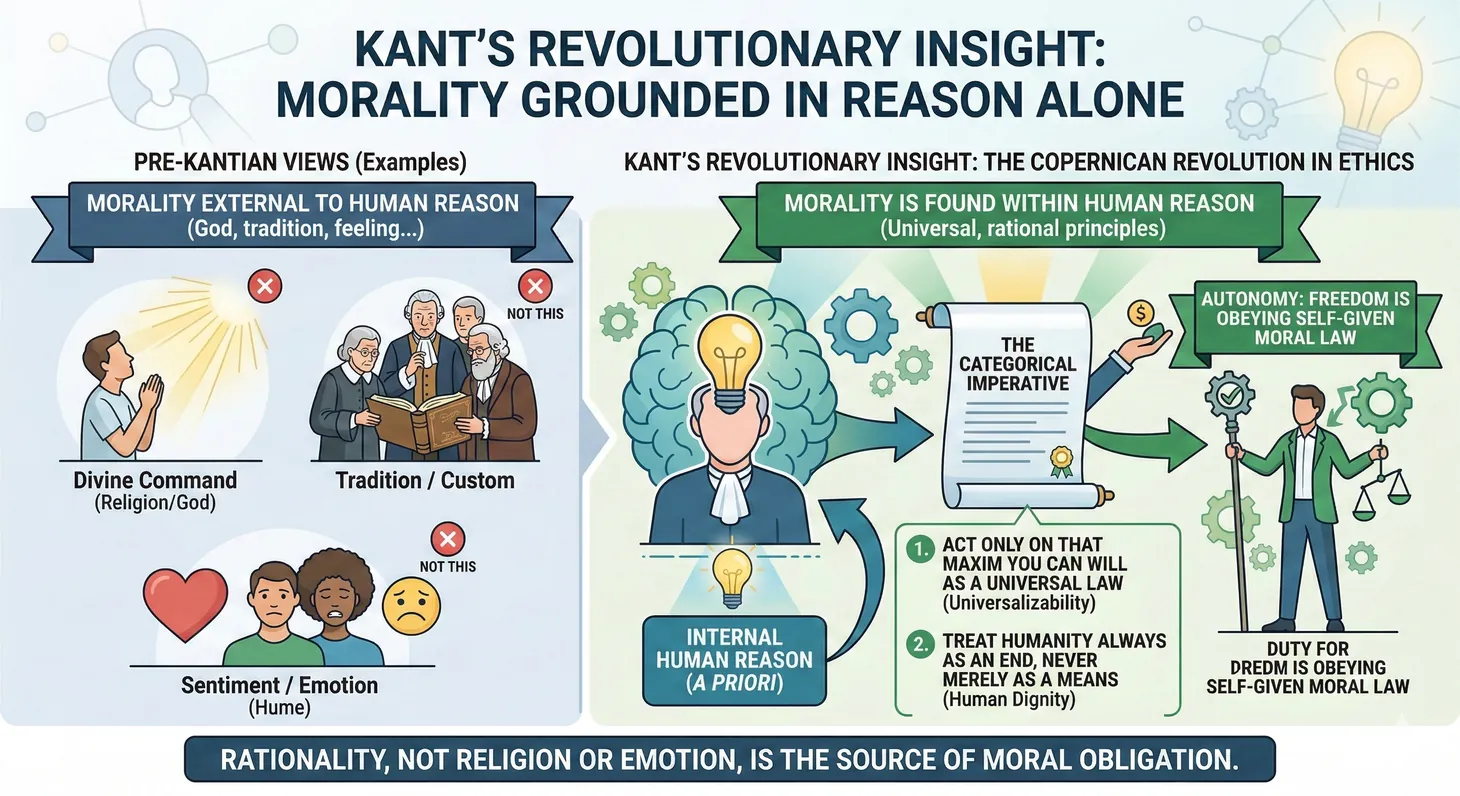
Immanuel Kant is the most influential deontologist in history. His ethical theory, developed in the Groundwork of the Metaphysics of Morals (1785) and the Critique of Practical Reason (1788), grounds morality in reason alone, independent of religion, sentiment, or consequences.
Kant's revolutionary insight: morality grounded in reason alone
Kant's Revolutionary Claim: Morality is not about happiness, divine commands, or social utility—it's about what reason requires. Rational beings can discover moral truths through pure thought, just as they can discover mathematical truths.
The Good Will
Kant's Groundwork opens with one of philosophy's most famous lines:
The Unconditional Good
Foundation of Kant's Ethics
"Nothing in the world—indeed nothing even beyond the world—can possibly be conceived which could be called good without qualification except a good will."
Kant's Argument:
Talents (intelligence, wit, courage) can be used for evil
Gifts of fortune (wealth, power, health) can corrupt
Even happiness can be bad if enjoyed by someone undeserving
Only a good will—the intention to do right because it's right—is unconditionally good
Implication: Moral worth doesn't come from what you accomplish, but from your will—your intention and motivation. A failed attempt to help, if done from genuine good will, has full moral worth.
Duty vs. Inclination
Kant distinguishes between acting from duty and acting from inclination:
The Source of Moral Worth
Kantian Analysis
Acting from Inclination: You do the right thing because you want to, because it makes you happy, or because it serves your interests.
Helping a friend because you enjoy their company
Being honest because you fear getting caught lying
Giving to charity because it makes you feel good
Acting from Duty: You do the right thing because it's right, regardless of whether you want to or whether it benefits you.
Helping someone you dislike because they need help
Being honest when lying would benefit you
Keeping a promise when breaking it would be easier
Kant's Verdict: Only actions done from duty have genuine moral worth. Acting from inclination is morally neutral—you just happen to want what's right.
Controversial Implication: The philanthropist who helps others because she genuinely loves humanity has less moral worth than someone who helps despite not caring, purely because it's their duty. Many find this counterintuitive. Kant might respond that the ideal is to cultivate inclinations that align with duty—but the duty remains primary.
The Categorical Imperative
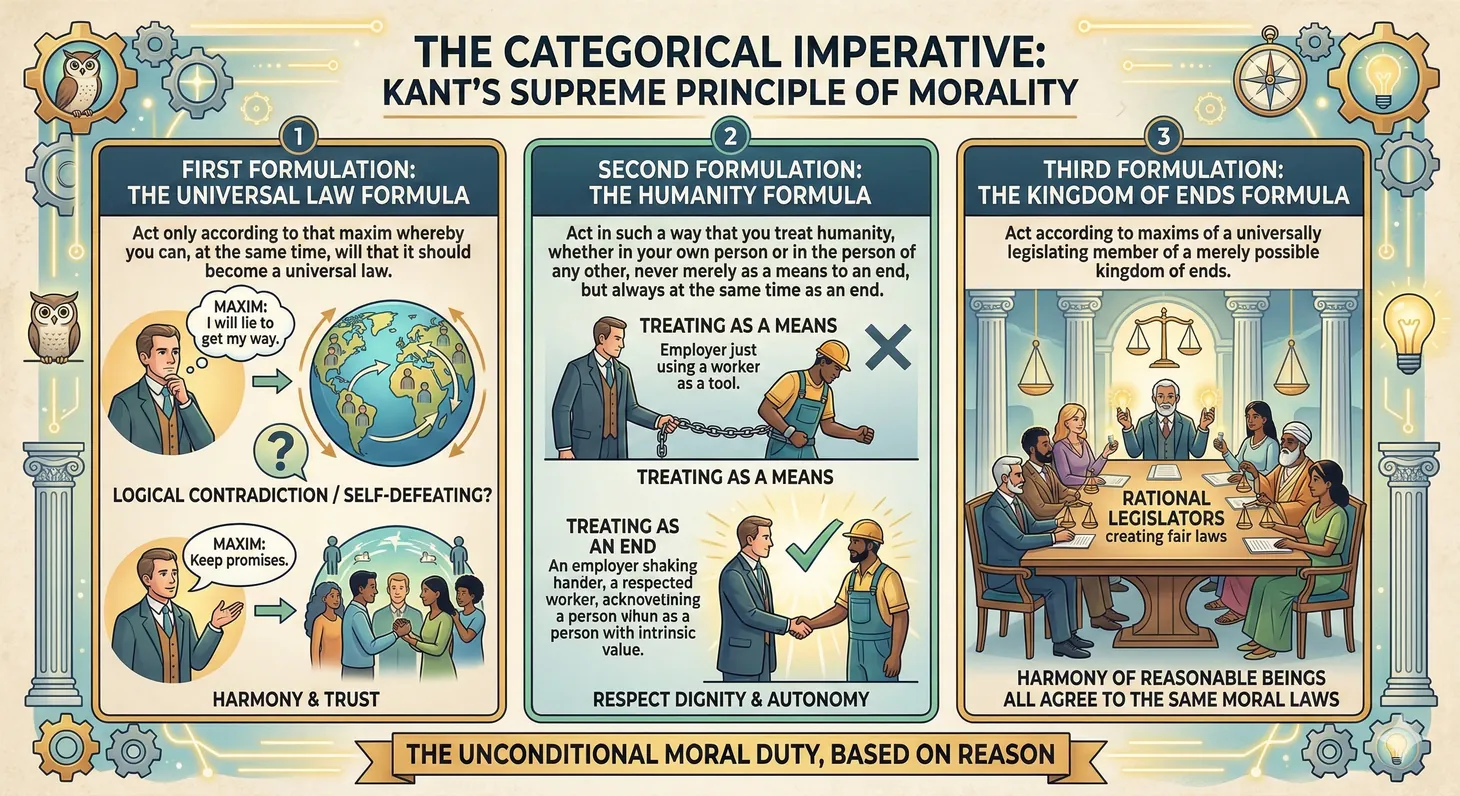
The heart of Kant's ethics is the categorical imperative—the supreme principle of morality. Kant formulates it in several ways, which he claims are equivalent.
The categorical imperative: Kant's supreme principle of morality in three formulations
Categorical vs. Hypothetical Imperatives:
Hypothetical: "If you want X, do Y" (conditional on your desires)
Categorical: "Do Y, period" (applies unconditionally to all rational beings)
Moral imperatives are categorical—they don't depend on what you happen to want.
Formula of Universal Law (Universalizability)
The First Formulation
Core Principle
The Formula: "Act only according to that maxim by which you can at the same time will that it should become a universal law."
Translation: Before acting, ask: "What if everyone did this?" Can your principle of action be consistently universalized?
The Test:
Formulate your maxim: "I will [do X] in order to [achieve Y]"
Universalize: "Everyone will [do X] in order to [achieve Y]"
Check for contradiction: Can this universal law be conceived? Can you will it?
Example: False Promises
Kant's Application
Maxim: "When in financial need, I will make a false promise to get money."
Universalized: "Everyone in financial need makes false promises to get money."
Contradiction: If everyone made false promises, no one would believe promises. The very institution of promising would collapse. You can't even conceive of a world where your maxim is universal law—false promising would be impossible if universal.
Conclusion: False promising fails the universalizability test and is therefore wrong.
Formula of Humanity (Respect for Persons)
The Second Formulation
Core Principle
The Formula: "Act so that you treat humanity, whether in your own person or in that of another, always as an end and never as a means only."
Translation: Respect the dignity of all rational beings. Never use people merely as tools for your own purposes.
Key Distinction:
Treating as a mere means: Using someone without regard for their interests, without their consent, or through deception/coercion
Treating as an end: Respecting their autonomy, acknowledging their rational capacity to set their own goals
Note: You can use people as means—you use a taxi driver to get somewhere. What's wrong is using them merely as means, ignoring their status as rational agents with their own ends.
Applications of the Humanity Formula
Practical Guidance
Lying: Violates someone's rational agency by manipulating their beliefs
Coercion: Bypasses someone's capacity to make their own choices
Exploitation: Uses someone's vulnerability to benefit yourself at their expense
Self-destruction: Treats your own humanity as a mere means (e.g., suicide to escape problems)
Slavery: The ultimate violation—treating humans as property, mere instruments
Formula of the Kingdom of Ends
The Third Formulation
Core Principle
The Formula: "Act according to maxims of a universally legislating member of a merely possible kingdom of ends."
Translation: Imagine a community where everyone is both a legislator and a subject of the moral law. Act as if your principles were creating the laws for this ideal moral community.
The Vision: A "kingdom of ends" is an ideal community of rational beings, each respecting the others' autonomy, all bound by laws they've given themselves through reason. Your actions should be fit for this moral utopia.
Perfect and Imperfect Duties
Kant distinguishes two types of duties:
Types of Kantian Duties
Classification
Perfect Duties
Imperfect Duties
Absolute prohibitions—never violate
General requirements—leave latitude in how/when
Don't lie, don't kill innocents, keep promises
Develop your talents, help others in need
Specify exactly what not to do
Require pursuing a goal but not a specific action
No exceptions
You choose how and when to fulfill them
Objections & Responses
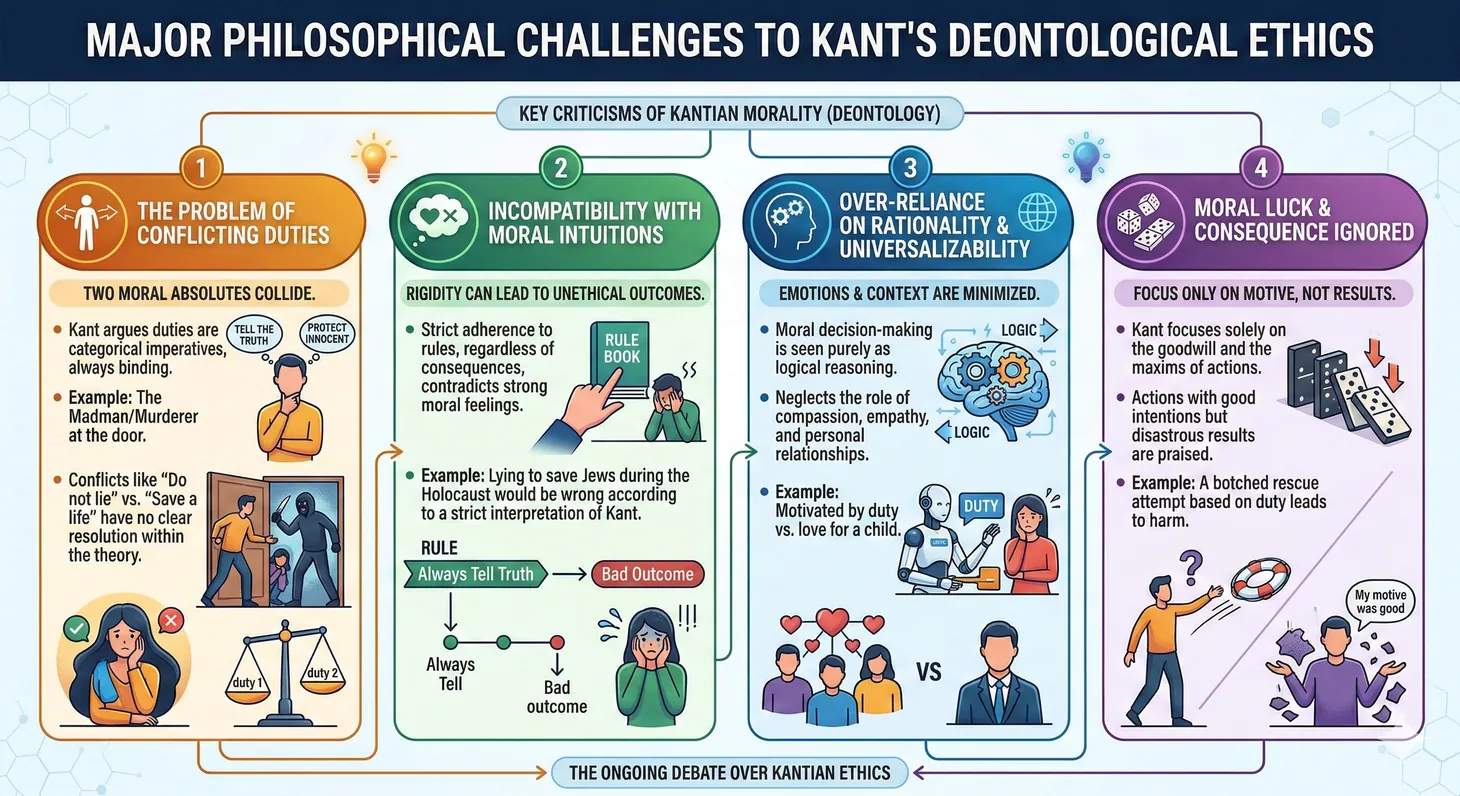
Despite its influence, Kantian ethics faces serious challenges that have driven ongoing philosophical debate.
Major philosophical challenges to Kant's deontological ethics
Conflicting Duties
When Duties Collide
Major Objection
The Problem: What happens when perfect duties conflict?
Example: Nazis come to your door asking if you're hiding Jews. You are. You have a duty not to lie, but also a duty not to aid murder. What should you do?
Kant's Troubling Answer: In his essay "On a Supposed Right to Lie," Kant seemingly said you must tell the truth—even to murderers. You're not responsible for what they do with the information.
Responses:
Reinterpret Kant: Perhaps the duty is not to make "lying assertions"—refusing to answer or misleading statements might be permitted.
Hierarchy of Duties: Some contemporary Kantians argue duties can be ranked, with the duty not to aid murder trumping truthfulness.
W.D. Ross's Prima Facie Duties: Duties are "prima facie"—they hold unless overridden by stronger duties in particular contexts.
The Rigidity Objection
Is Kant Too Inflexible?
Common Criticism
The Charge: Kantian ethics is too rigid. Surely lying to save innocent lives is permissible? Surely consequences sometimes matter?
Kant's Defense:
We can't predict consequences reliably—the lied-to murderer might have changed his mind
Making exceptions erodes the moral law—where do we stop?
We're responsible only for our own actions, not for what others do
Critics Respond: This seems to prioritize moral purity over actually helping people. Ethics should sometimes be about what works.
The Formalism Objection
Hegel's Critique: The categorical imperative is merely formal—it provides a test for maxims but no content. Many wicked maxims might pass the universalizability test if cleverly formulated. "I will steal from anyone whose name begins with Q" is universalizable but obviously wrong.
Kantian Response: The formulations must be used together. The humanity formula provides content—any maxim that treats persons merely as means is ruled out, regardless of whether it can be universalized.
Contemporary Developments
Modern Deontological Theories
Post-Kantian Ethics
W.D. Ross's Prima Facie Duties: Multiple duties (fidelity, reparation, gratitude, non-maleficence, justice, beneficence, self-improvement) that hold "other things being equal" but can be overridden.
Contractualism (T.M. Scanlon): Actions are wrong if they violate principles no one could reasonably reject as a basis for informed, unforced agreement.
Rights-Based Theories (Nozick): Individuals have inviolable rights that function as "side constraints" on action.
Korsgaard's Constructivism: Moral obligations arise from our nature as rational agents who must treat our own humanity as an end.
Next Steps in the Series
What You've Learned:
Deontology focuses on duties and rules, not consequences
Kant grounds morality in reason alone—the good will and acting from duty
The categorical imperative in its three formulations: universalizability, humanity as end, kingdom of ends
The distinction between perfect and imperfect duties
Major objections: conflicting duties, rigidity, formalism
We've now examined two dominant approaches: consequentialism (judge by outcomes) and deontology (judge by duties). But both focus on actions. The third major tradition—virtue ethics—shifts focus to the agent: What kind of person should you be?