Ethics & Moral Philosophy Series Part 5: Moral Relativism & Nihilism
January 25, 2026Wasil Zafar20 min read
Explore moral relativism, cultural relativism, and moral nihilism. Examine the profound challenges to objective morality and whether ethics can truly be universal or is inevitably culturally determined.
Series Overview: This is Part 5 of our 6-part Ethics & Moral Philosophy Series. Having explored the major normative theories, we now examine challenges to the very foundations of ethics.
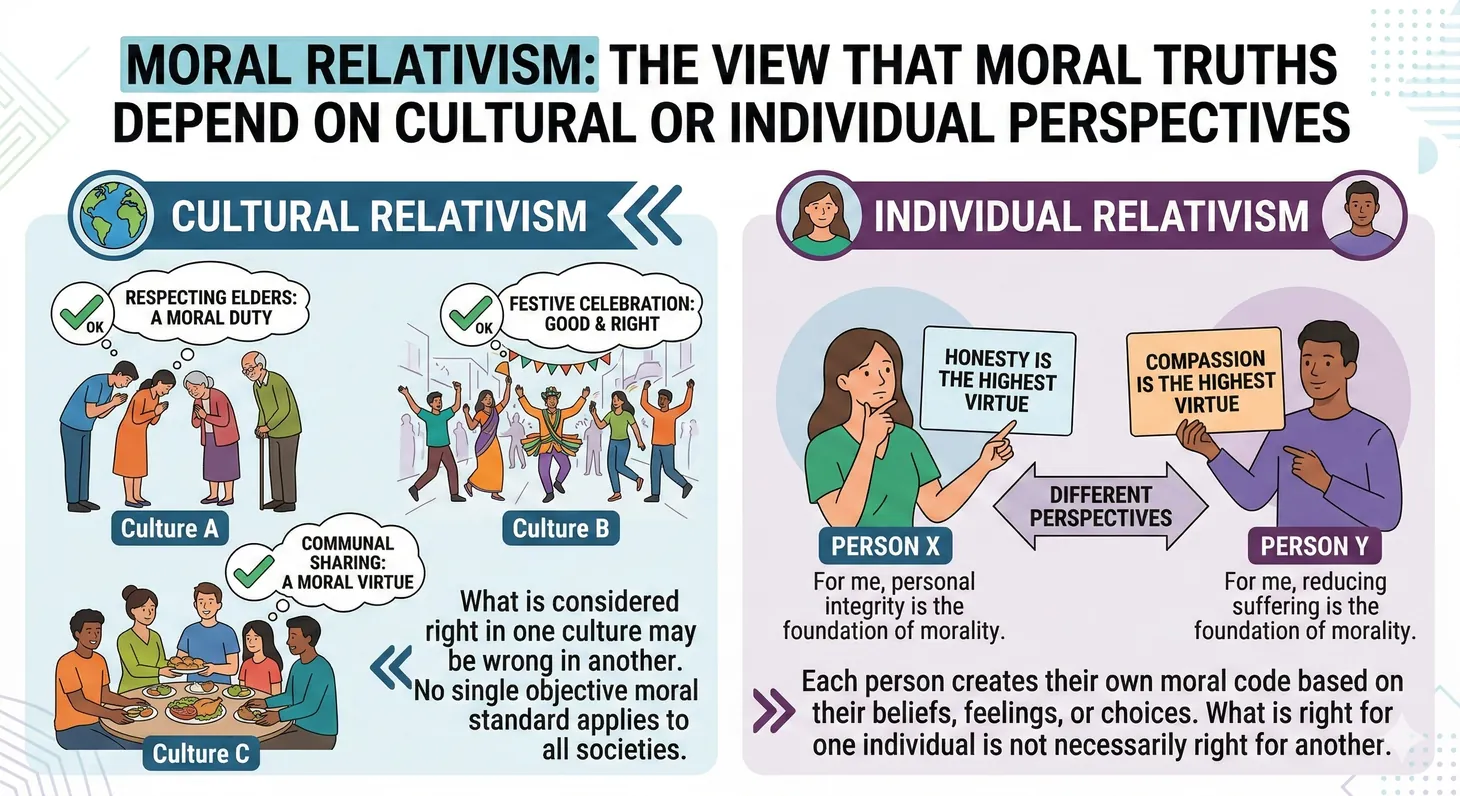
Moral relativism is the view that moral judgments are not objectively true or false, but are relative to something—usually to cultures or individuals. What's morally right for one society or person may be wrong for another, with no objective standard to adjudicate between them.
Moral relativism: the view that moral truths depend on cultural or individual perspectives
Key Insight: Moral relativism doesn't simply say that people disagree about morality (that's just a fact). It claims there are no objective moral truths that could resolve such disagreements. One culture's "right" isn't better than another's—just different.
The Anthropologist's Puzzle
Thought Experiment
An anthropologist studies a culture where ritual human sacrifice is practiced. The participants believe they're doing what's morally required—honoring the gods and ensuring good harvests.
Questions:
Are they morally wrong? By whose standard?
Do we have the right to impose our values on them?
Is there any objective fact that makes our view correct and theirs incorrect?
Relativist Response: There are no culture-independent moral truths. Both moral codes are valid relative to their respective cultures. Neither is objectively "correct."
Descriptive Relativism
Descriptive relativism is the empirical observation that different cultures have different moral beliefs and practices. This is relatively uncontroversial—anthropologists have documented wide variation in:
Cross-Cultural Moral Variation
Empirical Facts
Marriage: Monogamy, polygyny, polyandry
Gender roles: Dramatic variation in expectations and rights
End-of-life: Euthanasia, ritual suicide, treatment of the elderly
Property: Private ownership vs. communal possession
Diet: Cannibalism, animal rights, food taboos
Sexuality: Vastly different norms about acceptable conduct
Important: Descriptive relativism is just a claim about what people believe. It says nothing about whether any beliefs are correct.
Normative (Metaethical) Relativism
Normative relativism is the philosophical thesis that what is morally right is determined by cultural (or individual) standards, with no higher standpoint from which to judge. This is the controversial philosophical claim.
The Inference Problem: You can't validly infer normative relativism from descriptive relativism. The fact that cultures disagree doesn't mean there's no right answer. Scientists disagree about many things, but that doesn't mean there's no objective truth in science.
Cultural Relativism
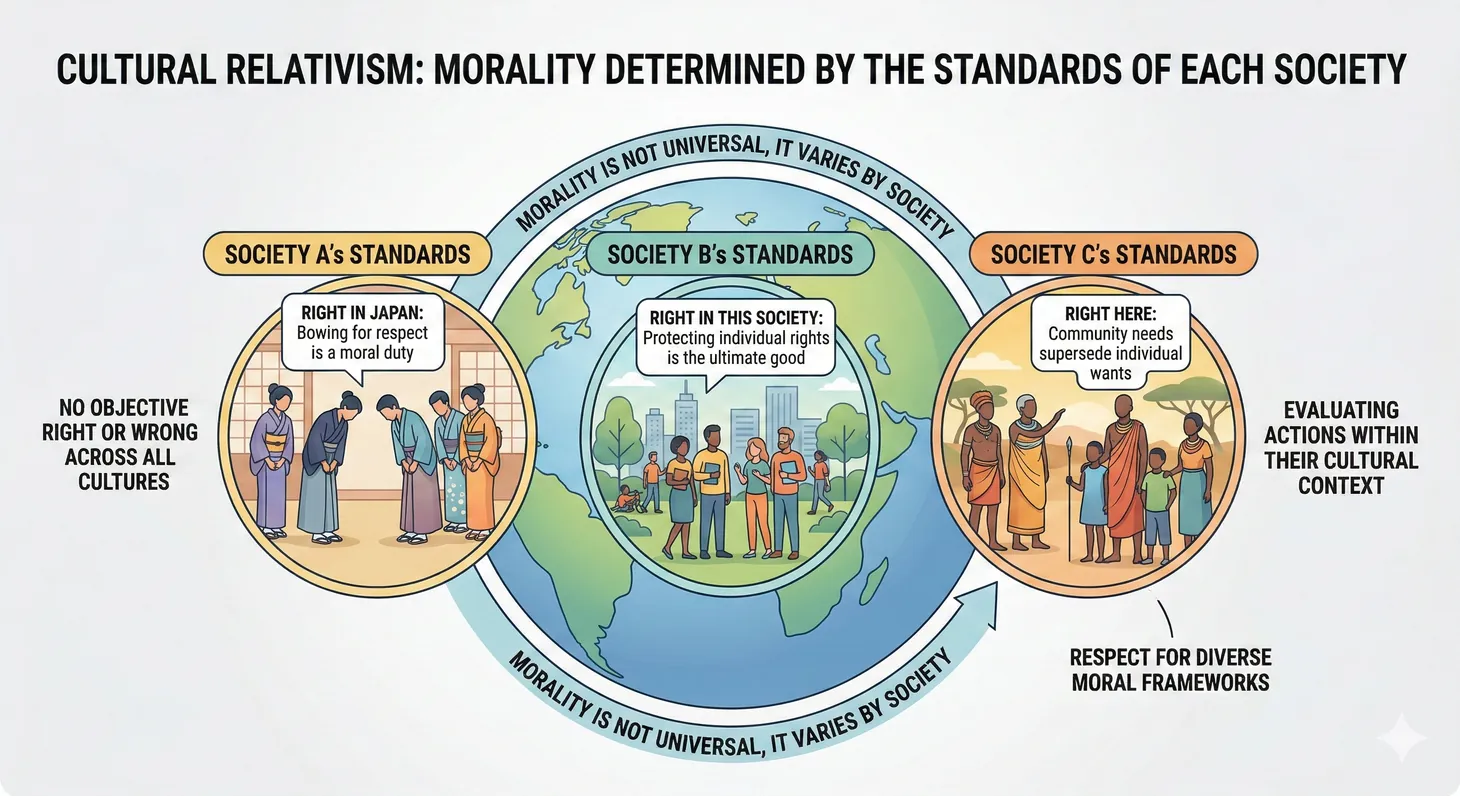
Cultural relativism holds that moral truths are relative to cultures. What's morally right or wrong depends on the cultural standards of the society in question.
Cultural relativism: morality determined by the standards of each society
Arguments For Cultural Relativism
The Argument from Disagreement
Common Argument
Different cultures have radically different moral beliefs
There's no way to prove one culture right and another wrong
Therefore, there are no objective moral truths
Problem: Disagreement doesn't entail no truth. Ancient astronomers disagreed about whether the Earth moves, but there's still an objective fact about it.
The Argument from Tolerance
Practical Argument
We should be tolerant of other cultures
To be tolerant, we must not judge other cultures by our standards
Therefore, moral standards are culture-relative
Problem: This is self-undermining. If tolerance is objectively required, that contradicts relativism. If tolerance is just our cultural value, why should other cultures adopt it?
The Anti-Imperialism Argument
Historical Argument
Argument: Claims to objective moral truth have been used to justify colonialism, forced conversion, and cultural destruction. Relativism protects against such moral imperialism.
Response: The evils of imperialism can be condemned on objective moral grounds (imperialism is objectively wrong). Relativism can't condemn it—if the imperialist culture approves, it's right for them.
Problems & Objections
The Reformer's Dilemma
Serious Problem
If cultural relativism is true, moral reformers are always wrong by definition:
Martin Luther King Jr. was wrong to oppose segregation (because his culture approved it)
Abolitionists were wrong to oppose slavery (because their society practiced it)
Suffragettes were wrong to demand women's voting rights
The Problem: Anyone who challenges their society's moral code is automatically in the wrong. "Right" just means "what my culture currently believes."
The Boundary Problem
Definitional Problem
Question: What counts as "a culture"?
Nations? (But nations contain many subcultures)
Ethnic groups? Religious groups? Cities?
Can I form my own one-person culture?
The smaller we draw the circle, the more cultural relativism collapses into individual subjectivism.
The Problem of Moral Progress
Historical Challenge
Cultural relativism makes moral progress impossible to explain:
Abolishing slavery wasn't moral progress—just moral change
We can't say society is "better" now than when it practiced slavery
"Progress" requires a standard beyond culture—which relativism denies
Most people believe societies can genuinely improve morally. Relativism denies this possibility.
Moral Subjectivism
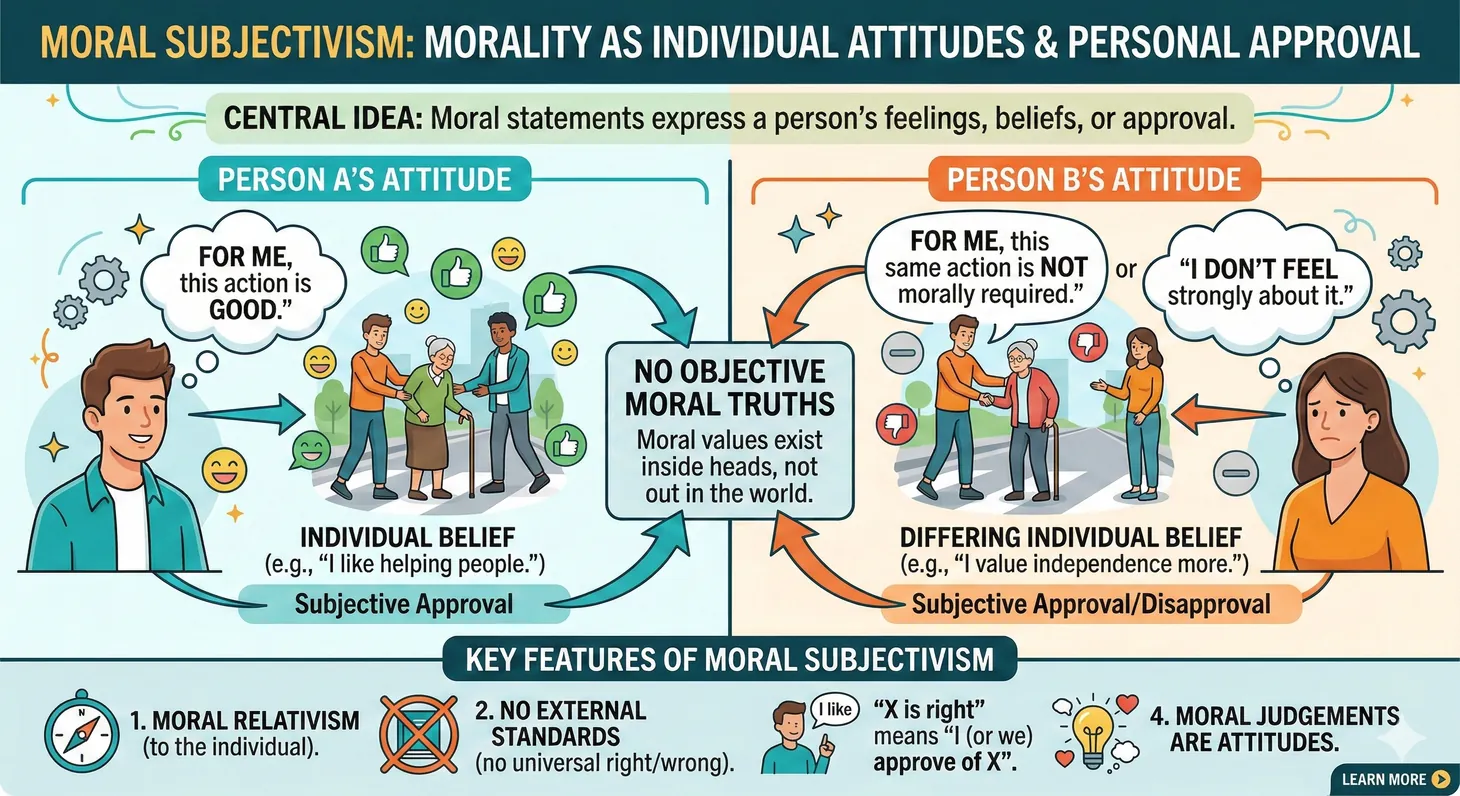
Where cultural relativism makes morality relative to cultures, moral subjectivism makes it relative to individuals. "X is right" means "I approve of X."
Moral subjectivism: morality as individual attitudes and personal approval
Individual Subjectivism
Simple Subjectivism
Theory
The View: Moral statements report the speaker's personal attitudes.
"Murder is wrong" = "I disapprove of murder"
"Charity is good" = "I approve of charity"
Implications:
Everyone's moral views are equally "valid" (for them)
Moral disagreement is impossible—we're just reporting different feelings
Hitler wasn't wrong—he just had different preferences
Problem: If "torture is wrong" just means "I disapprove of torture," then moral disagreement is impossible. If I say "torture is wrong" and you say "torture is right," we're not disagreeing—we're just reporting different feelings, like one person preferring chocolate and another vanilla.
Emotivism
Moral Utterances as Expressions of Emotion
A.J. Ayer & C.L. Stevenson
The View: Moral statements don't report attitudes—they express them (like exclamations).
"Murder is wrong" ˜ "Murder—boo!" or "Ugh!"
"Charity is good" ˜ "Charity—hooray!"
Ayer (1936): Moral statements are "expressions of emotion which can be neither true nor false." They're like cheers and jeers, not truth-claims.
Stevenson: Added that moral language also has a prescriptive function—we use it to influence others' attitudes ("Do this!" "Don't do that!").
Advantage over Simple Subjectivism: Emotivism better explains moral disagreement. When I say "Murder—boo!" and you say "Murder—hooray!", we're not just reporting different feelings—we're actively disagreeing about how to respond to murder.
Moral Nihilism
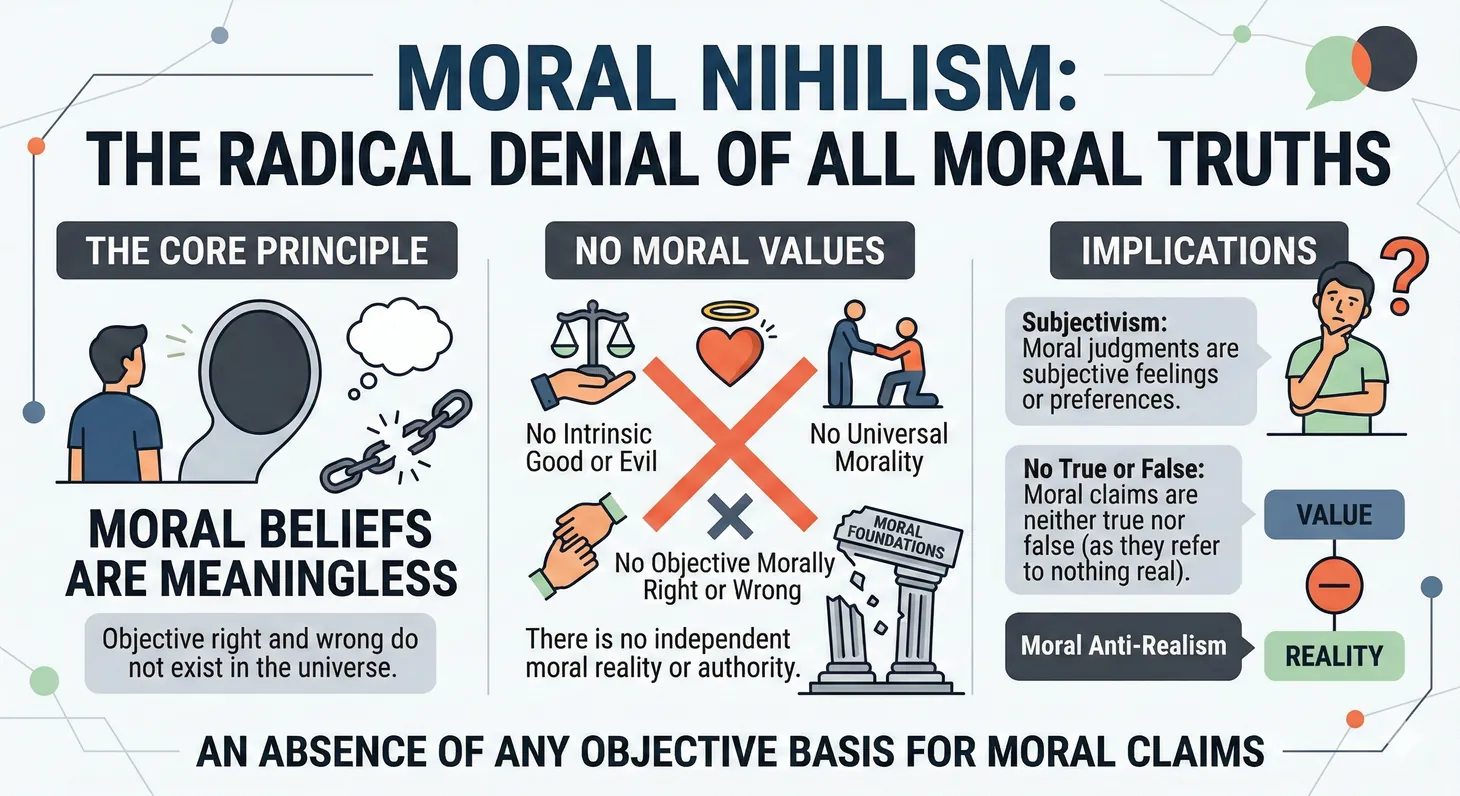
Moral nihilism goes further than relativism: it denies that there are any moral truths at all. It's not that morality varies—it's that there is no morality, objectively speaking.
Moral nihilism: the radical denial of all moral truths
Error Theory
J.L. Mackie's Moral Error Theory
Mackie (1977)
The View: All positive moral claims are false because there are no moral facts to make them true.
Mackie's Arguments:
Argument from Queerness: Moral facts would be utterly unlike anything else in the universe:
Metaphysically queer: What kind of thing is a "moral fact"? It's not physical, not mental—what is it?
Epistemologically queer: How would we perceive moral facts? We'd need some special moral sense—but there's no evidence for one.
Argument from Disagreement: Widespread moral disagreement is best explained by there being no facts to discover.
Key Point: Error theory accepts that moral statements are truth-apt (they try to state facts)—but they all fail because there are no moral facts.
Analogy: Error theory treats moral statements like statements about unicorns or witches. "That unicorn is white" is false—not because unicorns are some other color, but because there are no unicorns. Similarly, "murder is wrong" is false because there are no moral facts.
Non-Cognitivism
Moral Statements Aren't Beliefs
Alternative to Error Theory
The View: Moral statements don't express beliefs about the world and therefore can't be true or false. They're more like imperatives or expressions of attitude.
Types:
Emotivism: "X is wrong" = expressing disapproval of X
Prescriptivism (Hare): "X is wrong" = commanding "Don't do X!"
Expressivism: Moral judgments express non-cognitive attitudes like desires, plans, or norms
Key Difference from Error Theory: Error theorists say moral statements are false. Non-cognitivists say they're not the kind of thing that can be true or false.
The Frege-Geach Problem
Major Challenge
The Problem: How can non-cognitivism explain moral reasoning?
Consider this argument:
If lying is wrong, then getting your little brother to lie is wrong.
Lying is wrong.
Therefore, getting your little brother to lie is wrong.
This seems like valid logical inference. But if "lying is wrong" in premise 2 just means "Boo lying!", what does "lying is wrong" mean in premise 1? The if-then structure requires a proposition, not an exclamation.
Responses to Anti-Realism
Moral philosophers have developed sophisticated responses to relativism and nihilism.
Defending objective morality: realism and constructivism respond to anti-realist challenges
Moral Realism
Objectivist Response
The View: There are objective moral facts, independent of what anyone believes.
Arguments:
Moral phenomenology: We experience moral truths as objective—torture seems genuinely wrong, not just disliked
Moral progress: Realism explains why abolishing slavery was progress, not just change
Convergence: Despite disagreement, moral views have converged over time (against slavery, for human rights)
Varieties:
Naturalism: Moral facts are natural facts (about well-being, flourishing, etc.)
Non-naturalism: Moral facts are sui generis—a distinct category
Constructivism
Middle Ground
The View: Moral truths are "constructed" by rational procedures rather than discovered.
Variants:
Kantian Constructivism (Korsgaard): Morality is what rational agents must commit to given their nature as choosers
Contractualism (Scanlon): An action is wrong if its principle could be reasonably rejected by anyone affected
Rawlsian Constructivism: Justice principles emerge from hypothetical agreement behind a "veil of ignorance"
Advantage: Constructivism grounds morality in reason without positing mysterious moral facts.
Quasi-Realism
Simon Blackburn
The View: Start with expressivism (moral statements express attitudes), then show how we can "earn the right" to speak as if realism were true.
We can have genuine moral reasoning
We can call moral judgments "true" or "false"
We can talk about moral "facts" and "knowledge"
All this without positing mysterious metaphysical entities. The "quasi-realist" mimics realism using only expressivist resources.
Where Does This Leave Us? The debate continues. Moral relativism and nihilism raise profound challenges, but most philosophers believe there are resources to answer them. The normative theories we've studied (utilitarianism, deontology, virtue ethics) assume morality is objective enough to be worth theorizing about.
Next Steps in the Series
What You've Learned:
The difference between descriptive and normative relativism
Cultural relativism and its serious problems (reformer's dilemma, moral progress)
Moral subjectivism and emotivism—morality as attitude or expression
Moral nihilism: error theory says all moral claims are false; non-cognitivism says they're not truth-apt
Responses: moral realism, constructivism, and quasi-realism
We've now examined both normative ethical theories and metaethical challenges to ethics itself. In our final installment, we'll put all this to work, applying ethical frameworks to real-world moral dilemmas in bioethics, environmental ethics, business ethics, and more.
Continue Learning
Final Part
Part 6: Applied Ethics & Case Studies - Apply ethical principles to real-world dilemmas including bioethics, environmental ethics, and business ethics.
Continue the Series
Part 4: Virtue Ethics & Aristotle
Review Aristotle's ethics of character and flourishing.