We use cookies to enhance your browsing experience, serve personalized content, and analyze our traffic. By clicking "Accept All", you consent to our use of cookies. See our Privacy Policy for more information.
Ethics & Moral Philosophy Series Part 2: Utilitarianism & Consequentialism
January 25, 2026Wasil Zafar22 min read
Master utilitarianism and consequentialist ethics. Learn about Bentham, Mill, and the principle of maximizing happiness. Understand how to evaluate actions by their consequences and apply utilitarian reasoning to real-world dilemmas.
Series Overview: This is Part 2 of our 6-part Ethics & Moral Philosophy Series. Building on the foundations from Part 1, we now explore the first major normative theory: utilitarianism and its broader family, consequentialism.
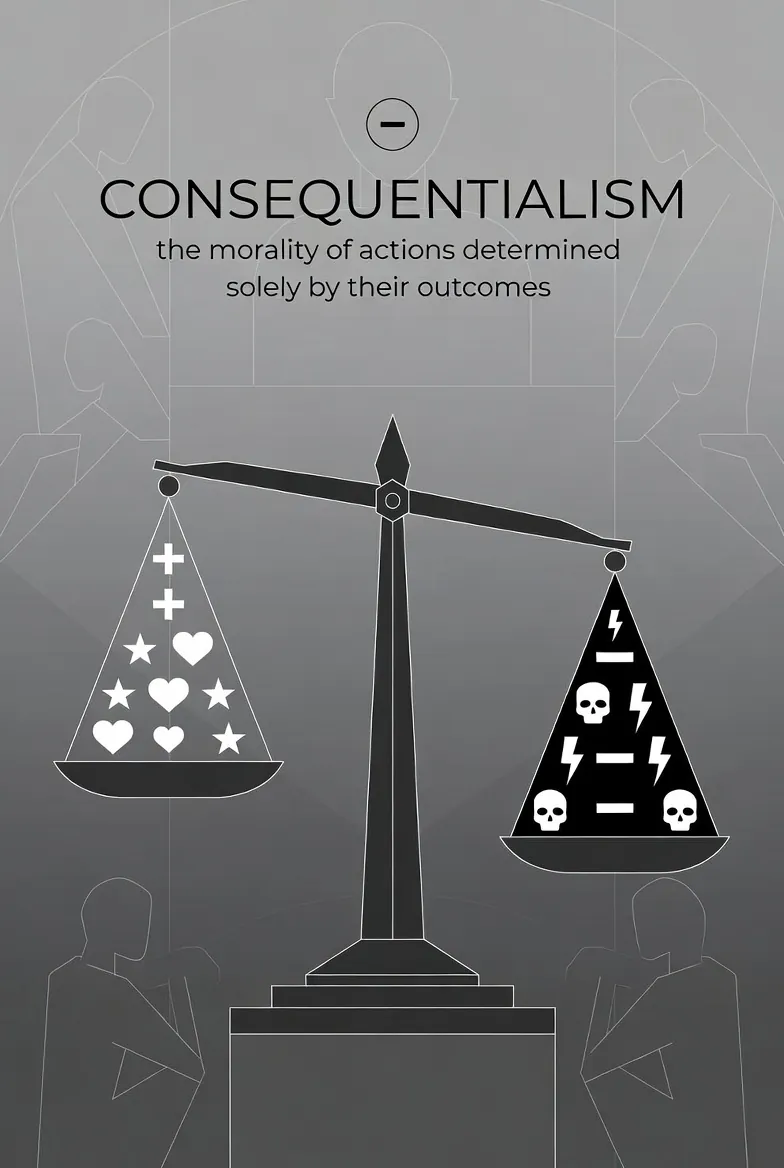
Consequentialism is the family of ethical theories holding that the morality of an action depends solely on its consequences. The right action is the one that produces the best overall outcomes.
Consequentialism: the morality of actions determined solely by their outcomes
Key Insight: For consequentialists, intentions don't ultimately matter—only results do. A well-intentioned action that causes harm is wrong; an action done from bad motives that helps people is right.
This might seem counterintuitive. Don't we care about people's intentions? Consequentialists respond that we care about intentions only because they usually correlate with good outcomes. Bad intentions typically lead to bad actions. But when they diverge, consequences are what truly matter morally.
The trolley problem: a foundational thought experiment in consequentialist ethics
The Runaway Trolley: A Classic Dilemma
Thought ExperimentPhilippa Foot, 1967
A runaway trolley is heading toward five workers on the track who will certainly die. You stand next to a lever that can divert the trolley to a side track—but one worker stands there.
Option A: Do nothing. Five people die.
Option B: Pull the lever. One person dies.
The Consequentialist Answer: Pull the lever. One death is better than five deaths. The numbers count.
The Challenge: But what about the fat man variant? Would you push a large bystander onto the tracks to stop the trolley and save five? The consequences are identical, but most people's intuitions differ dramatically.
The Core Idea
All consequentialist theories share a simple structure:
The Consequentialist Formula:
1. Define what is good (the theory of value)
2. Right actions are those that maximize that good
Different consequentialist theories differ on step 1—what counts as good. But they all agree that once we've identified the good, the right action is simply the one that produces the most of it.
This has a remarkable implication: morality becomes a kind of optimization problem. Ethics is about efficiently promoting whatever is valuable. This makes consequentialism feel systematic, even scientific.
Types of Consequentialism
The most famous consequentialist theory is utilitarianism, which identifies the good with happiness or well-being. But there are other options:
Items on an objective list of goods (health, friendship, achievement, etc.)
There's also a crucial distinction between act consequentialism and rule consequentialism:
Act vs. Rule Consequentialism
Key Distinction
Act Consequentialism
Judge each individual action by its consequences. "What would maximize good in this particular case?"
Problem: Might justify lying, promise-breaking, or even murder if it produces better consequences in that instance.
Rule Consequentialism
Follow rules that, if generally adopted, would maximize good. "What rules would lead to the best outcomes if everyone followed them?"
Advantage: Rules like "don't lie" and "keep promises" have good consequences overall, even if individual violations might sometimes help.
Rule consequentialism is often seen as a compromise between consequentialist and deontological intuitions. It respects the importance of rules while grounding them in consequences.
Jeremy Bentham (1748-1832)
Jeremy Bentham was the founder of modern utilitarianism. A radical social reformer, he applied utilitarian principles to advocate for prison reform, animal rights, decriminalization of homosexuality, and the abolition of slavery—positions far ahead of his time.
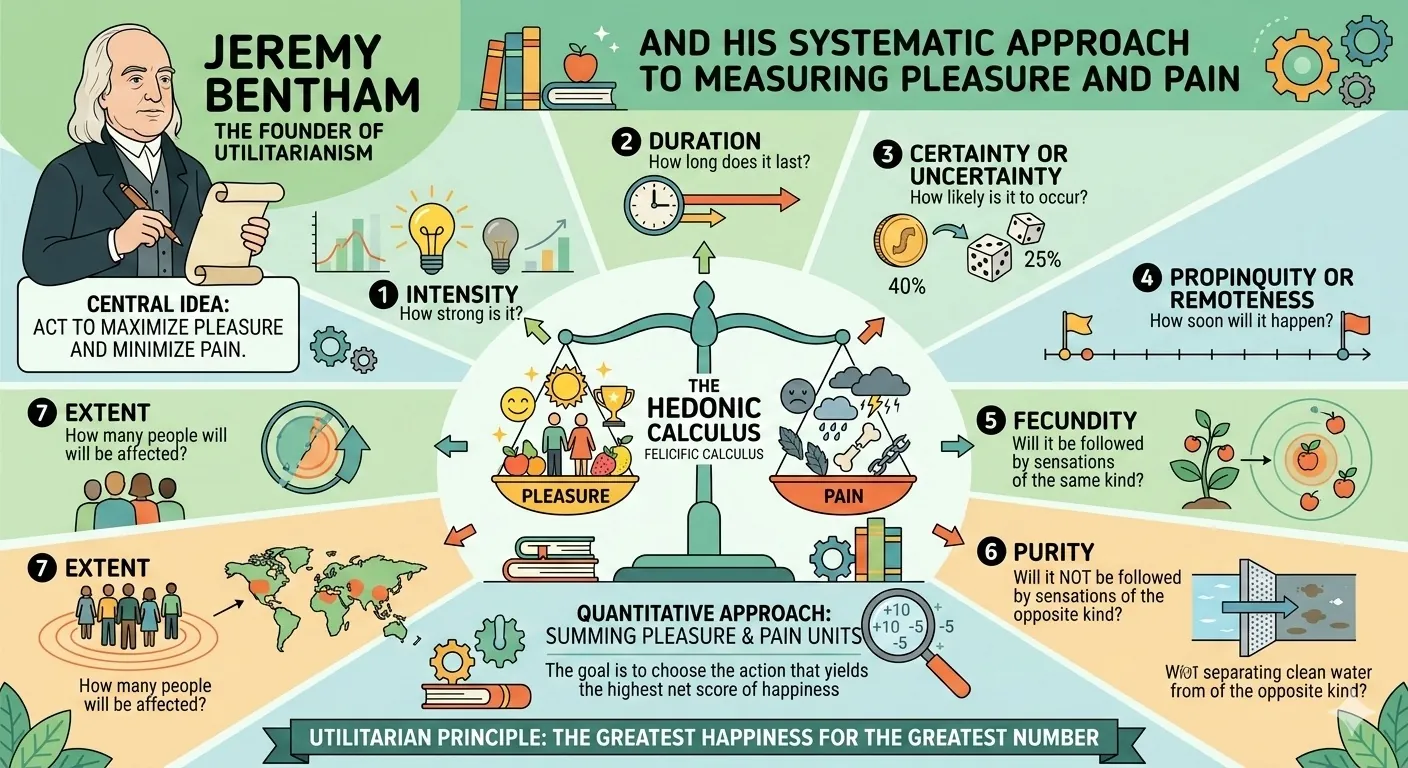
Jeremy Bentham and his systematic approach to measuring pleasure and pain
Bentham's Core Claim: "Nature has placed mankind under the governance of two sovereign masters, pain and pleasure. It is for them alone to point out what we ought to do, as well as to determine what we shall do."
Bentham's utilitarianism is hedonistic—it identifies the good exclusively with pleasure and the bad with pain. This might sound crude, but Bentham intended it as democratizing: everyone's pleasure counts equally, whether king or peasant.
The Principle of Utility
Bentham formulated the principle of utility (also called "the greatest happiness principle"):
The Principle of Utility
Core Principle
Definition: Actions are right insofar as they tend to promote happiness (pleasure), wrong insofar as they tend to produce the opposite (pain).
Scope: Consider the happiness of all affected parties—not just yourself, your family, or your nation, but everyone. "Each to count for one, and none for more than one."
Implication: Morality becomes a matter of calculation. We should perform the action that produces the greatest net balance of pleasure over pain for all affected.
The Hedonistic Calculus
To make utilitarianism practical, Bentham developed the felicific calculus (or hedonistic calculus)—a method for measuring and comparing pleasures and pains. He identified seven dimensions:
Bentham's Seven Dimensions of Pleasure
The Hedonistic Calculus
Intensity: How strong is the pleasure or pain?
Duration: How long will it last?
Certainty: How likely is it to occur?
Propinquity: How soon will it occur? (Nearness in time)
Fecundity: Will it lead to more pleasures? (Fruitfulness)
Purity: Is it free from pain? (Not mixed with opposite feelings)
Extent: How many people are affected?
Bentham even composed a mnemonic verse:
"Intense, long, certain, speedy, fruitful, pure—
Such marks in pleasures and in pains endure.
Such pleasures seek, if private be thy end:
If it be public, wide let them extend."
Using this calculus, one could theoretically assign numerical values to different pleasures and pains, sum them up, and determine the right action mathematically. In practice, this is extremely difficult—but Bentham saw it as an ideal to aspire toward.
Practical Limitation: How do you actually measure the "intensity" of a pleasure, or compare your joy to someone else's? Critics argue the calculus is impossible to apply precisely. Defenders respond that we make rough comparisons constantly—we know a headache is worse than an itchy nose.
Bentham's Revolutionary Applications
Bentham applied utilitarian reasoning to advocate for reforms that were radical for his era:
Bentham the Reformer
Historical Impact
Animal Rights: "The question is not, Can they reason? nor, Can they talk? but, Can they suffer?" Animals feel pain, so their interests count morally.
Prison Reform: Designed the Panopticon—a prison allowing constant surveillance—to reform criminals through discipline rather than brutality.
Legal Reform: Argued against "natural rights" as "nonsense on stilts," but advocated for legal rights that promote general welfare.
LGBTQ+ Rights: Argued for decriminalizing homosexuality—pleasure between consenting adults harms no one.
John Stuart Mill (1806-1873)
John Stuart Mill was the most influential philosopher of the Victorian era. Rigorously educated from infancy by his father (a Benthamite), Mill refined utilitarianism to address criticisms that it was a "pig philosophy" suitable only for swine.
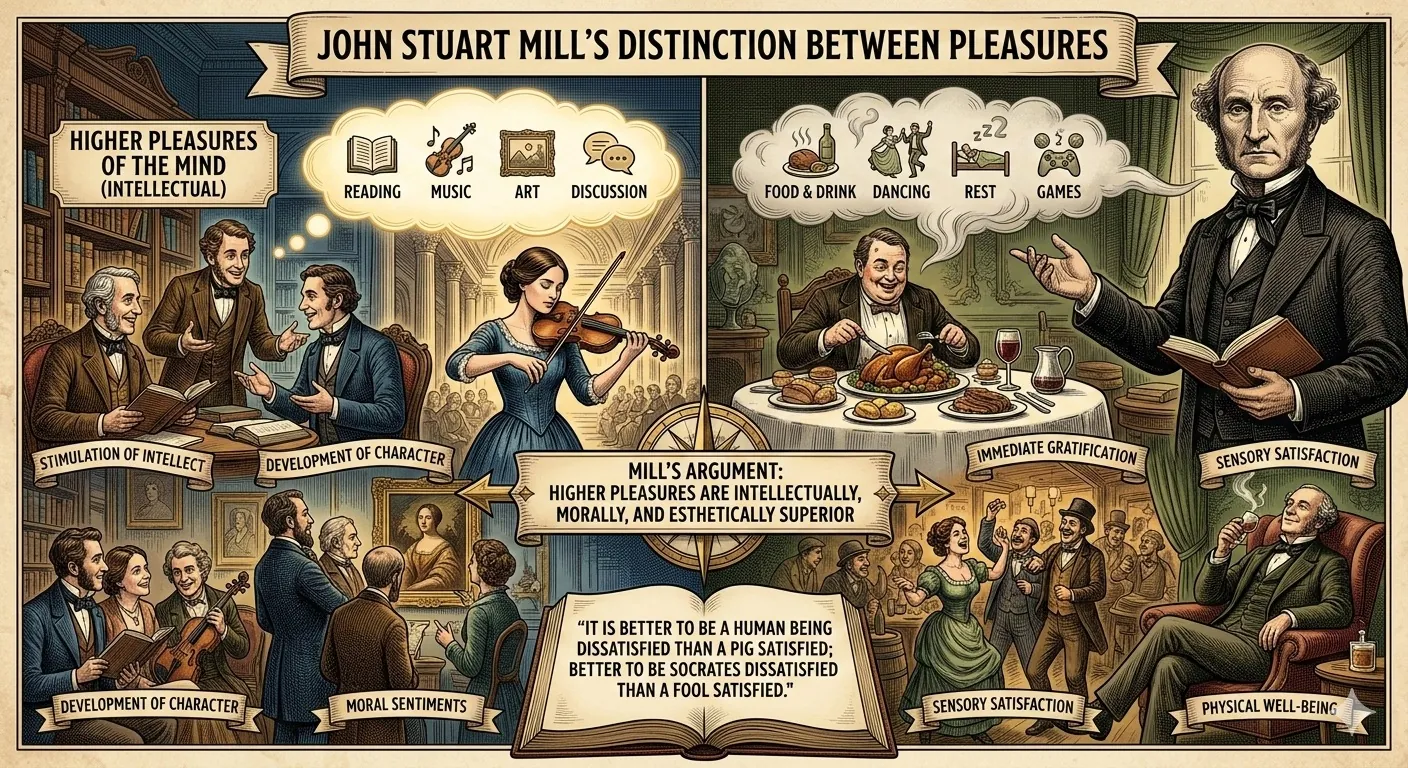
Mill's distinction between higher pleasures of the mind and lower pleasures of the body
Mill's Refinement: "It is better to be Socrates dissatisfied than a fool satisfied."
Higher and Lower Pleasures
Bentham treated all pleasures as equal in kind—only intensity, duration, etc. mattered. Mill disagreed profoundly:
Mill's Qualitative Hedonism
Key Innovation
Higher Pleasures: Pleasures of the intellect, feelings, imagination, moral sentiments
Reading poetry, philosophical contemplation
Appreciation of art and music
Deep friendship and love
Moral accomplishment
Lower Pleasures: Bodily and sensory pleasures
Eating, drinking
Physical comfort
Simple amusements
Mill's Test: Who decides which pleasures are higher? Those who have experienced both. "Of two pleasures, if there be one to which all or almost all who have experience of both give a decided preference, irrespective of any feeling of moral obligation to prefer it, that is the more desirable pleasure."
Mill argued that anyone who has experienced both kinds of pleasure would never trade the higher for the lower, even if the lower pleasure were more intense. A human with higher faculties requires more to be satisfied, but wouldn't want to become a pig, even a very happy pig.
The Problem: Doesn't this reintroduce non-hedonistic values? If we prefer philosophy to pleasure because it's "higher," not just more pleasant, haven't we abandoned pure hedonism? Mill's position is debated.
The Harm Principle
In his essay On Liberty (1859), Mill articulated one of the most influential principles in political philosophy:
The Harm Principle
Political Philosophy
The Principle: "The only purpose for which power can be rightfully exercised over any member of a civilized community, against his will, is to prevent harm to others. His own good, either physical or moral, is not a sufficient warrant."
Implications:
Freedom of Speech: Even offensive speech should be permitted unless it directly incites violence.
Individual Liberty: Adults should be free to make their own choices about their own lives, even "bad" choices.
Paternalism Rejected: We shouldn't force people to do what's "good for them" against their will.
Utilitarian Justification: Liberty maximizes happiness in the long run. Suppressing ideas prevents discovery of truth; allowing experiments in living teaches us how to flourish.
Mill's Defense of Utilitarianism
In Utilitarianism (1863), Mill addressed common objections:
Mill's Responses to Critics
Objections & Replies
Objection: "Utilitarianism is a doctrine worthy only of swine."
Mill's Reply: That's Bentham's version, not mine. I distinguish higher pleasures that elevate humans above animals.
Objection: "Happiness is unattainable as a goal."
Mill's Reply: Perfect happiness may be unattainable, but we can still increase happiness and reduce suffering. The goal is "not a life of rapture; but moments of such, in an existence made up of few and transitory pains, many and various pleasures."
Objection: "We can't calculate consequences before acting."
Mill's Reply: We rely on accumulated human experience encoded in rules of thumb. We don't calculate from scratch each time—we follow rules like "don't lie" that have been proven to produce good results.
Major Objections to Utilitarianism
Despite its intuitive appeal, utilitarianism faces serious challenges. Understanding these objections is essential for evaluating the theory—and they set the stage for alternative approaches in Parts 3 and 4.
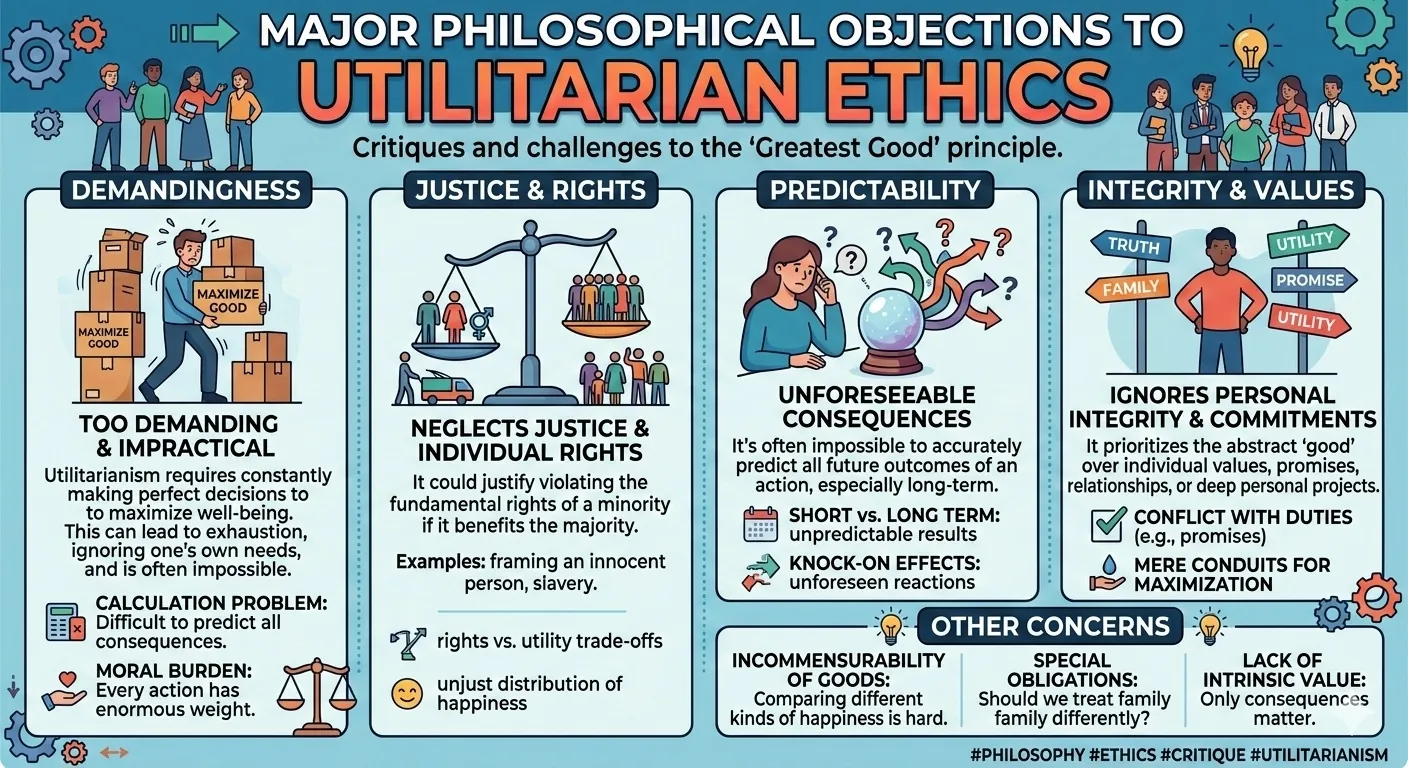
The four major philosophical objections to utilitarian ethics
The Justice Objection
Punishing the Innocent
Classic Objection
The Scenario: A sheriff in a small town faces a violent mob demanding the lynching of a suspect. If the suspect isn't delivered, the mob will riot and many innocent people will die. The sheriff knows the suspect is innocent, but framing and executing him would prevent the riot.
Utilitarian Analysis: If the numbers favor it (one death vs. many), utilitarianism seems to require sacrificing the innocent man.
The Problem: This violates our deep intuition that justice forbids punishing the innocent, regardless of consequences. Rights seem to matter independently of outcomes.
Utilitarian Responses:
Rule Utilitarianism: A rule permitting punishment of innocents would have terrible consequences if generally followed—undermining trust in the justice system.
Hidden Costs: In practice, such injustices rarely stay hidden. The long-term consequences of corruption are worse than they seem.
Bite the Bullet: Some utilitarians simply accept that in extreme cases, sacrificing one innocent might be justified. Our intuitions aren't infallible guides to morality.
The Integrity Objection
Bernard Williams' Critique
Philosophical Objection1973
Jim in the Jungle: Jim, a botanist, stumbles upon a captain about to execute twenty indigenous people. The captain offers Jim a "guest's privilege"—if Jim personally kills one, the other nineteen will be freed. If Jim refuses, all twenty die.
Utilitarian Analysis: Jim should kill one to save nineteen. The math is clear.
Williams' Objection: This treats Jim's deepest moral commitments as mere inputs to a calculation. It ignores the difference between what I do and what happens. It would "alienate him from his actions and the source of his action in his own convictions."
The Point: We have integrity—a coherent self with projects and commitments. Utilitarianism makes our values infinitely overridable by circumstances, turning us into mere conduits for producing utility.
The Demandingness Objection
If we should always maximize good consequences, where does the obligation stop?
Peter Singer's Challenge
Effective Altruism
Singer's Argument: If you walk past a drowning child, you should save them—even if it ruins your expensive suit. But children are dying from poverty-related causes constantly. Shouldn't you donate most of your income to save them?
The Problem: Strict utilitarianism seems to demand that we sacrifice our own projects, relationships, and well-being until we're reduced to the point where further sacrifice would decrease overall utility. This seems too demanding.
Implications: Is buying coffee immoral when that money could save lives? Should you never pursue hobbies while suffering exists?
The Measurement Problem
The Challenge: Utilitarianism requires comparing utilities across different people and different types of goods. But how do we measure and compare subjective experiences? Is your happiness from music comparable to my happiness from philosophy? Can we add them?
This problem has led some philosophers to abandon hedonistic utilitarianism for preference utilitarianism (maximize preference satisfaction) or objective list theories (maximize items on an objective list of goods).
Contemporary Developments
Modern utilitarians have developed sophisticated responses to these objections:
Neo-Utilitarian Refinements
Contemporary Philosophy
Two-Level Utilitarianism (R.M. Hare): Use intuitive moral rules for everyday decisions, but resort to utilitarian calculation for conflicts between rules or unusual cases.
Satisficing Consequentialism: Actions are right if they produce "good enough" outcomes—we don't always need to maximize.
Motive Utilitarianism: Cultivate dispositions (like keeping promises) that generally produce good consequences, even when individual acts might not.
Effective Altruism: Apply utilitarian thinking systematically to charity—do the most good per dollar. Peter Singer, William MacAskill.
Next Steps in the Series
What You've Learned:
The consequentialist approach: judge actions by their outcomes
Bentham's hedonistic calculus and the principle of utility
Mill's refinements: higher pleasures and the harm principle
Major objections: justice, integrity, demandingness, measurement
Distinctions: act vs. rule consequentialism, hedonism vs. preference utilitarianism
Utilitarianism's focus on consequences is compelling, but its critics argue it fails to capture something essential about morality—that some things are simply wrong, regardless of outcomes. This intuition drives the next major ethical theory: deontology.
Continue Learning
4 More Parts
Part 3: Deontology & Kant - Discover why some actions are wrong regardless of consequences. Learn the categorical imperative.