We use cookies to enhance your browsing experience, serve personalized content, and analyze our traffic.
By clicking "Accept All", you consent to our use of cookies. See our
Privacy Policy
for more information.
Ethics & Moral Philosophy Series Part 1: Foundations of Ethics
January 25, 2026Wasil Zafar20 min read
Explore the foundations of ethics and moral philosophy. Learn what ethics is, why it matters, and the fundamental questions that have guided moral thinking for millennia. This comprehensive guide will transform how you think about right and wrong.
Series Overview: This is Part 1 of our 6-part Ethics & Moral Philosophy Series. We'll cover everything from foundational concepts to applied ethics, giving you the intellectual tools to think more clearly about moral questions and make better ethical decisions.
Moral Philosophy Mastery
Your 6-step learning path • Currently on Step 1
1
Foundations of Ethics
What ethics is, why it matters, fundamental questions
Ethics is the branch of philosophy that investigates questions about right and wrong, good and evil, virtue and vice. It asks: How should we live? What makes an action morally right or wrong? What kind of person should I be?
At its core, ethics seeks to provide rational foundations for our moral beliefs and practices. Unlike merely following customs or laws, ethical thinking demands that we justify our moral judgments with reasons that can withstand critical scrutiny.
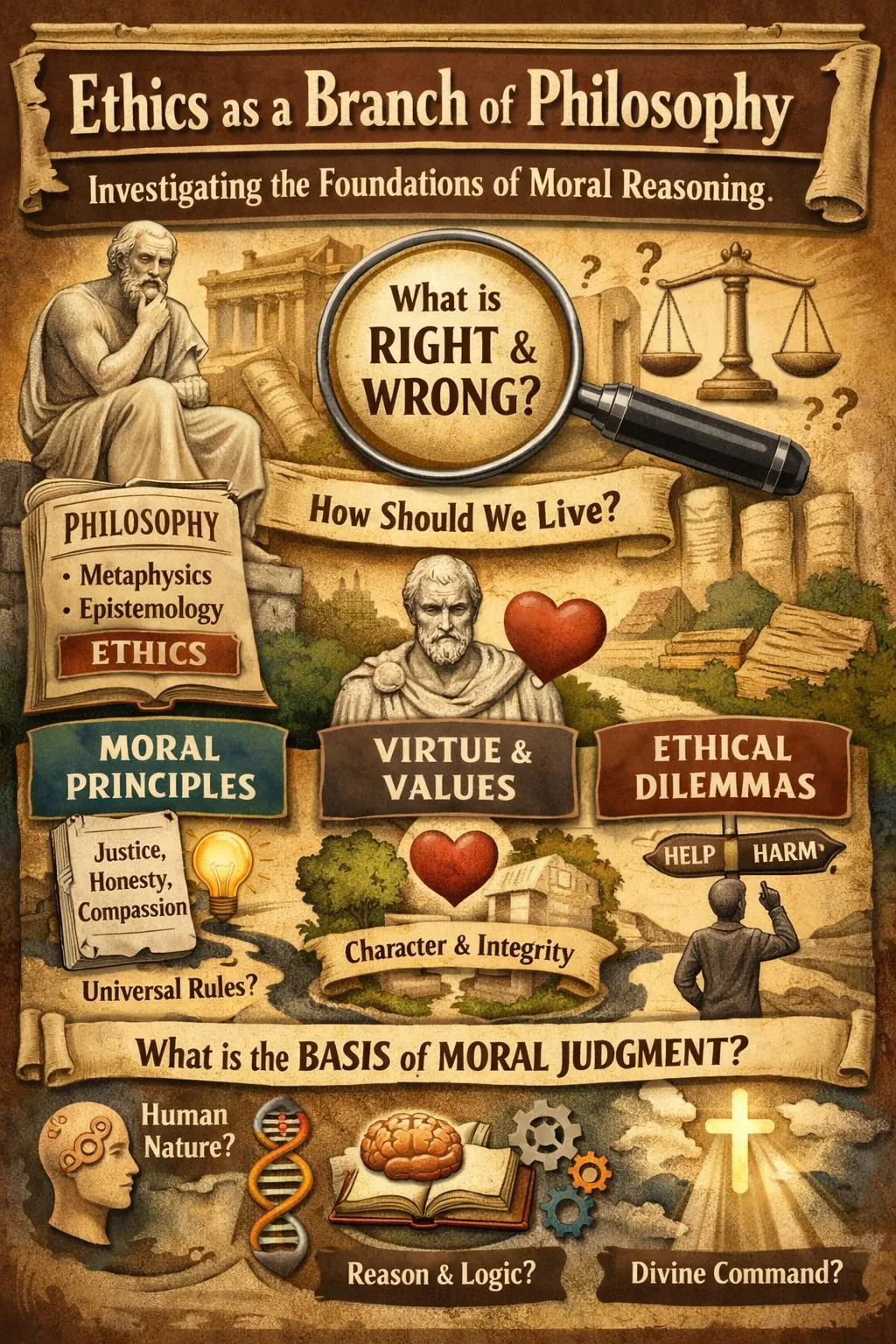
Ethics as a branch of philosophy: investigating the foundations of moral reasoning
Key Insight: Ethics isn't about finding simple rules to follow blindly—it's about developing the wisdom to navigate moral complexity. The goal is not to be "righteous" but to understand what truly matters and why.
The word "ethics" comes from the Greek word ethos (????), meaning "character" or "custom." For the ancient Greeks, ethics was fundamentally about character—the kind of person you should become. This etymology reveals something important: ethics is not just about isolated actions but about the whole shape of a human life.
The Greek concept of ethos: ethics as the study of character and the good life
Consider a situation we've all faced: you find a wallet containing cash and identification. You could keep the money—no one would ever know. But something stops you. That "something" is ethical awareness, the recognition that certain actions are right regardless of whether we benefit from them.
The Lost Wallet Thought Experiment
Moral ReasoningEveryday Ethics
You find a wallet with $500 cash and the owner's ID. Consider your reasoning:
Self-interest: "I could use this money. No one would know."
Empathy: "I'd want someone to return my wallet."
Duty: "Taking what isn't mine is theft, period."
Virtue: "An honest person would return it."
Consequences: "The owner might desperately need this money."
Notice how different ethical frameworks lead to the same conclusion through different paths. This illustrates that ethics isn't arbitrary—multiple traditions converge on similar moral truths.
Ethics vs. Morality
While often used interchangeably, "ethics" and "morality" have distinct technical meanings in philosophy:
Ethics vs. Morality: Key Distinctions
Conceptual Clarity
Morality
Ethics
First-order beliefs and practices
Second-order reflection on those beliefs
The moral code we live by
The philosophical study of morality
Often absorbed from culture/upbringing
Systematically examined and justified
"Don't lie" (a moral rule)
"Why is lying wrong?" (ethical inquiry)
Lived experience of right and wrong
Theoretical framework for moral thinking
Morality refers to the actual beliefs, values, and practices concerning right and wrong that people hold and follow. Your morality includes beliefs like "keeping promises is important" and "hurting innocent people is wrong."
Ethics (or moral philosophy) is the systematic study of morality—it examines, critiques, and attempts to justify moral beliefs. Ethics asks questions like: Are moral truths objective or subjective? What makes something good? How should we resolve moral conflicts?
Key Distinction: Morality is living by values; ethics is thinking about values. You can be moral without being an ethicist, but ethical study aims to make your morality more coherent, consistent, and well-founded.
This distinction matters because sometimes our inherited moral beliefs conflict or prove inadequate for new situations. Ethics gives us tools to critically examine our assumptions and develop more thoughtful moral positions.
Why Ethics Matters
Ethics might seem like abstract philosophizing, but it profoundly affects every aspect of human life:
Personal Life
Every day you face moral choices—whether to keep a promise, how to treat difficult people, what causes to support, how to balance personal desires with obligations to others. Ethical thinking helps you navigate these decisions with greater clarity and consistency.
Daily Ethical Moments
Personal Ethics
Should I tell a white lie to avoid hurting someone's feelings?
Is it okay to download pirated content if I couldn't afford to buy it anyway?
Do I have obligations to strangers in distant countries?
How should I balance my career ambitions with family responsibilities?
What do I owe my parents as they age?
These aren't just practical questions—they're ethical ones. The answers depend on your values and how you reason about competing moral claims.
Professional Life
Every profession faces unique ethical challenges. Doctors must navigate informed consent and end-of-life decisions. Lawyers balance client advocacy with truth. Engineers must consider safety versus cost. Business leaders weigh profit against social responsibility. Without ethical frameworks, professionals lack guidance for their hardest decisions.
Social and Political Life
Democracy requires citizens who can reason about justice, rights, and the common good. Questions about taxation, healthcare, criminal justice, immigration, and environmental policy are fundamentally ethical questions. Informed citizenship requires ethical literacy.
The Cost of Ethical Negligence: History's greatest atrocities—slavery, genocide, colonialism—weren't committed by monsters but by ordinary people who failed to think critically about the moral frameworks they inherited. Ethical reflection is a safeguard against moral complacency.
The Examined Life
Socrates famously declared that "the unexamined life is not worth living." Ethics invites us to examine our lives—to ask whether we're living according to values we've chosen or merely inherited, whether our actions align with our professed beliefs, whether we're becoming the people we want to be.
A Brief History of Ethics
Ethical thinking is as old as human civilization, but Western philosophical ethics began with the ancient Greeks and has evolved through several distinct periods:
Ancient Ethics (600 BCE – 500 CE)
Greek & RomanVirtue-Centered
Central Question: What is the good life, and what kind of character leads to it?
Key Figures:
Socrates (470-399 BCE): Pioneered ethical questioning through dialogue. Believed virtue is knowledge—we do wrong through ignorance.
Plato (428-348 BCE): Connected ethics to metaphysics through the Form of the Good. Justice in the soul mirrors justice in the state.
Aristotle (384-322 BCE): Developed virtue ethics centered on eudaimonia (flourishing). Ethics is about developing excellent character through habituation.
Epicurus (341-270 BCE): Identified the good with pleasure—but a refined, sustainable pleasure focused on friendship, wisdom, and simple living.
The Stoics (Zeno, Seneca, Marcus Aurelius): Emphasized living according to nature and reason, accepting what we cannot control.
Key Insight: Ancient ethics was primarily about character and the art of living well, not rules for specific actions.
Medieval Ethics (500 – 1500 CE)
Religious FrameworkDivine Command
Central Question: How do we live according to God's will?
Key Figures:
Augustine (354-430): Integrated Christian thought with Platonism. Evil is privation of good; humans need divine grace to act morally.
Thomas Aquinas (1225-1274): Synthesized Aristotelian ethics with Christian theology. Developed natural law theory—moral principles discoverable through reason.
Key Insight: Medieval ethics grounded morality in divine will and natural law, seeing ethics and religion as inseparable.
Modern Ethics (1500 – 1900)
EnlightenmentRule-Based
Central Question: What rational principles should govern moral action?
Key Figures:
Thomas Hobbes (1588-1679): Grounded ethics in self-interest and social contract. Morality emerges from agreements for mutual benefit.
David Hume (1711-1776): Emphasized the role of sentiment in moral judgment. Is-ought distinction—you can't derive values from facts.
Immanuel Kant (1724-1804): Developed deontological ethics based on the categorical imperative. Morality grounded in reason and duty.
Jeremy Bentham (1748-1832): Founded utilitarianism. Actions are right insofar as they maximize pleasure and minimize pain.
John Stuart Mill (1806-1873): Refined utilitarianism, distinguishing higher and lower pleasures. Defended liberty and women's rights.
Key Insight: Modern ethics sought universal rational principles independent of religious authority, developing the major frameworks we'll explore in this series.
Contemporary Ethics (1900 – Present)
Diverse ApproachesApplied Focus
Central Question: How do we apply ethical thinking to complex real-world problems?
Key Developments:
Metaethics: Rigorous analysis of the nature and status of moral claims (G.E. Moore, emotivism, moral realism debates).
Virtue Ethics Revival: Alasdair MacIntyre and others renewed interest in character-based ethics.
Applied Ethics Explosion: Bioethics, business ethics, environmental ethics, technology ethics emerged as distinct fields.
Feminist Ethics: Carol Gilligan's ethics of care, challenges to male-centered moral philosophy.
Global Ethics: Questions of international justice, climate ethics, global poverty (Peter Singer, Thomas Pogge).
Key Insight: Contemporary ethics is pluralistic—multiple frameworks coexist and compete, with increasing focus on practical application.
Philosophical Continuity: Despite 2,500 years of development, the fundamental questions remain remarkably consistent: What is good? What should we do? What kind of people should we be? Each era brings new perspectives, but the conversation continues.
Branches of Ethics
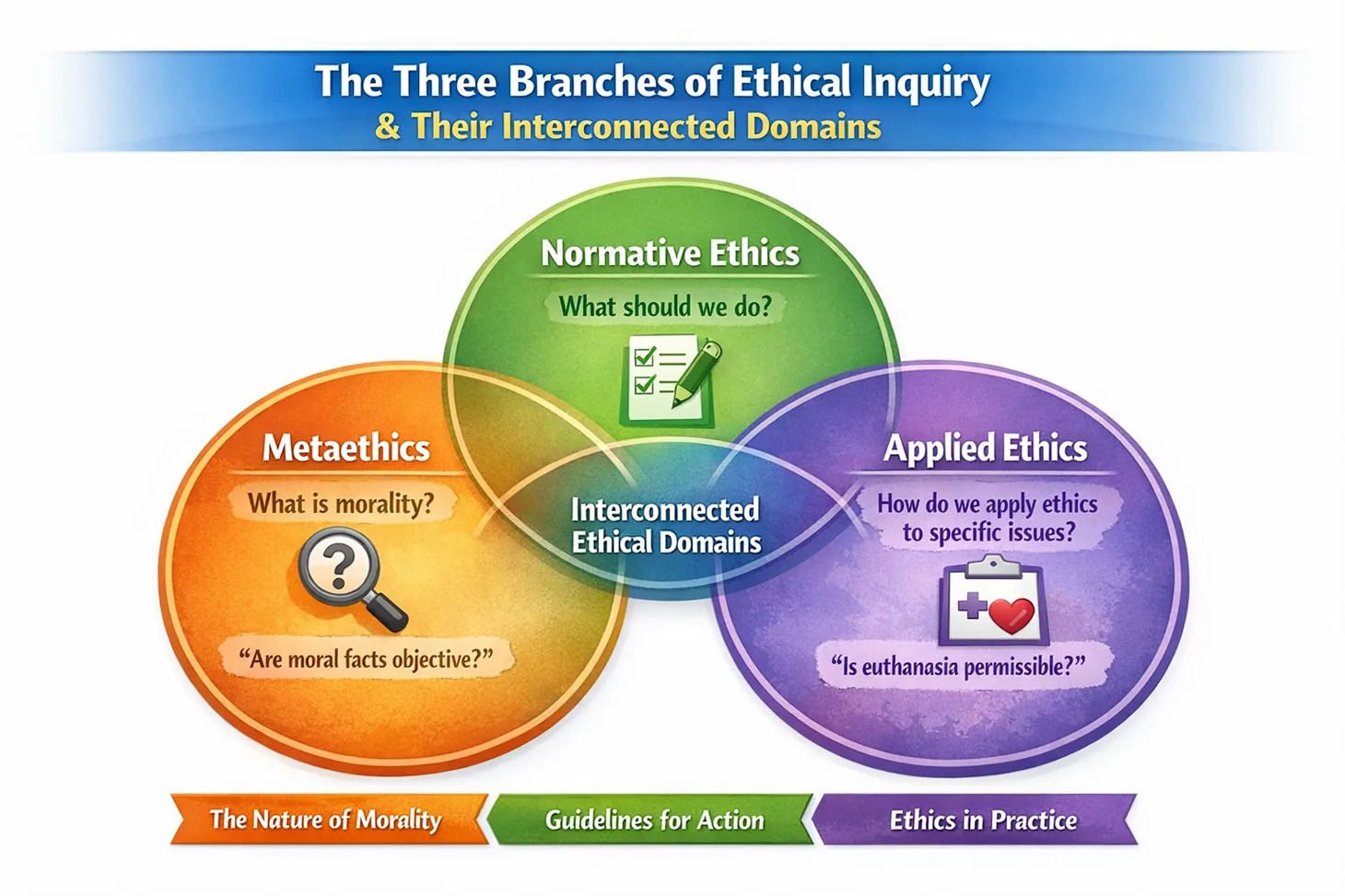
Ethics is traditionally divided into three main branches, each addressing different types of questions:
The three branches of ethical inquiry and their interconnected domains
The Three Branches Overview
Framework
Branch
Central Question
Example
Metaethics
What is morality?
"Are moral facts objective?"
Normative Ethics
What should we do?
"Is lying always wrong?"
Applied Ethics
How do we apply ethics to specific issues?
"Is euthanasia permissible?"
Metaethics: The Philosophy of Morality
Metaethics is the most abstract branch, examining the nature, foundation, and status of moral claims themselves. It asks not "What is right?" but "What kind of thing is rightness?"
Metaethical Questions: Are there objective moral facts? What do moral terms like "good" and "wrong" mean? How can we know moral truths? Why should we care about being moral?
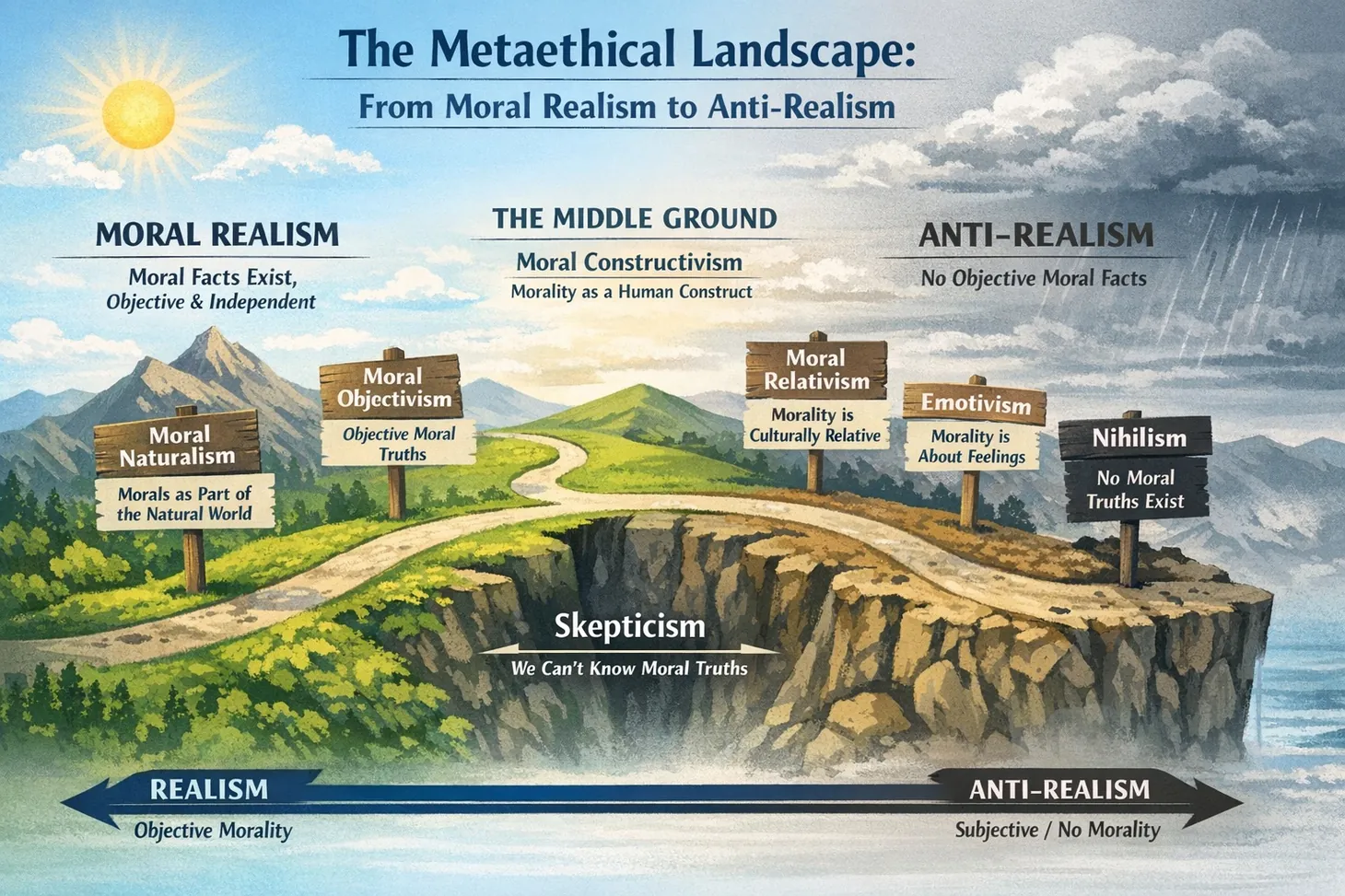
Major metaethical positions include:
Moral Realism vs. Anti-Realism
MetaethicsFundamental Debate
Moral Realism
Moral facts exist independently of human beliefs or preferences. "Murder is wrong" is true in the same way "water is H2O" is true—it describes an objective reality.
Naturalism: Moral facts are natural facts (e.g., "good" means "what promotes well-being")
Non-naturalism: Moral properties are real but unique—not reducible to natural properties
Moral Anti-Realism
Moral statements don't describe objective facts. Various versions include:
Subjectivism: Moral claims express personal preferences ("Murder is wrong" means "I disapprove of murder")
Emotivism: Moral claims express emotions, not propositions ("Boo murder!")
Error Theory: Moral claims purport to be objective but are all false—there are no moral facts
Metaethics also examines moral psychology—the nature of moral motivation, the relationship between reason and emotion in moral judgment, and whether moral knowledge is possible. We'll explore the key metaethical question of whether moral facts exist in the "Fundamental Questions" section below.
The metaethical landscape: from moral realism to anti-realism
Normative Ethics: What Should We Do?
Normative ethics develops and defends theories about what makes actions right or wrong, good or bad. This is the branch most people think of when they hear "ethics." The remainder of this series (Parts 2-5) will explore normative theories in depth.
The Normative Question: What principles should guide our actions? What makes an act morally obligatory, permissible, or forbidden?
Three major normative theories have dominated Western ethics:
1. Consequentialism
Part 2 Preview
Core Idea: The morality of an action depends entirely on its consequences. Right actions produce the best outcomes.
Main Version: Utilitarianism—maximize overall happiness or well-being.
Famous Advocates: Jeremy Bentham, John Stuart Mill, Peter Singer
Slogan: "The greatest good for the greatest number"
We'll explore consequentialism in detail in Part 2.
2. Deontology
Part 3 Preview
Core Idea: Some actions are intrinsically right or wrong, regardless of consequences. Morality is about duty and rules.
Main Version: Kantian ethics—act only according to principles you could will to be universal laws.
Famous Advocates: Immanuel Kant, W.D. Ross, Christine Korsgaard
Slogan: "Do your duty, whatever the consequences"
We'll explore deontology in detail in Part 3.
3. Virtue Ethics
Part 4 Preview
Core Idea: Focus not on acts but on the agent. What matters is developing virtuous character—becoming a good person.
Main Version: Aristotelian ethics—cultivate virtues (courage, justice, wisdom) to achieve eudaimonia (human flourishing).
Famous Advocates: Aristotle, Alasdair MacIntyre, Martha Nussbaum
Slogan: "Be good, and you will do good"
We'll explore virtue ethics in detail in Part 4.
Important: These theories often converge on the same conclusions through different reasoning. The difference matters most in hard cases where duties conflict or consequences are uncertain.
Applied Ethics: Ethics in Practice
Applied ethics takes normative principles and applies them to specific domains and real-world issues. This is where philosophical abstraction meets the messy realities of human life.
Major Fields of Applied Ethics
Part 6 Preview
Bioethics: Abortion, euthanasia, genetic engineering, human experimentation, allocation of scarce medical resources
Environmental Ethics: Climate change, animal rights, obligations to future generations, nature's intrinsic value
Technology Ethics: AI ethics, data privacy, autonomous weapons, digital manipulation
Legal Ethics: Attorney-client privilege limits, zealous advocacy vs. truth, confidentiality
Media Ethics: Journalistic integrity, privacy, propaganda, social media moderation
Sexual Ethics: Consent, marriage, pornography, reproductive ethics
Political Ethics: War, capital punishment, distributive justice, civil disobedience
We'll examine applied ethics with case studies in Part 6.
Applied ethics isn't merely "applying" abstract theories mechanically. Real cases often reveal tensions within and between ethical frameworks, forcing us to refine our thinking. The case studies in Part 6 will demonstrate this dynamic interplay.
Fundamental Questions in Ethics
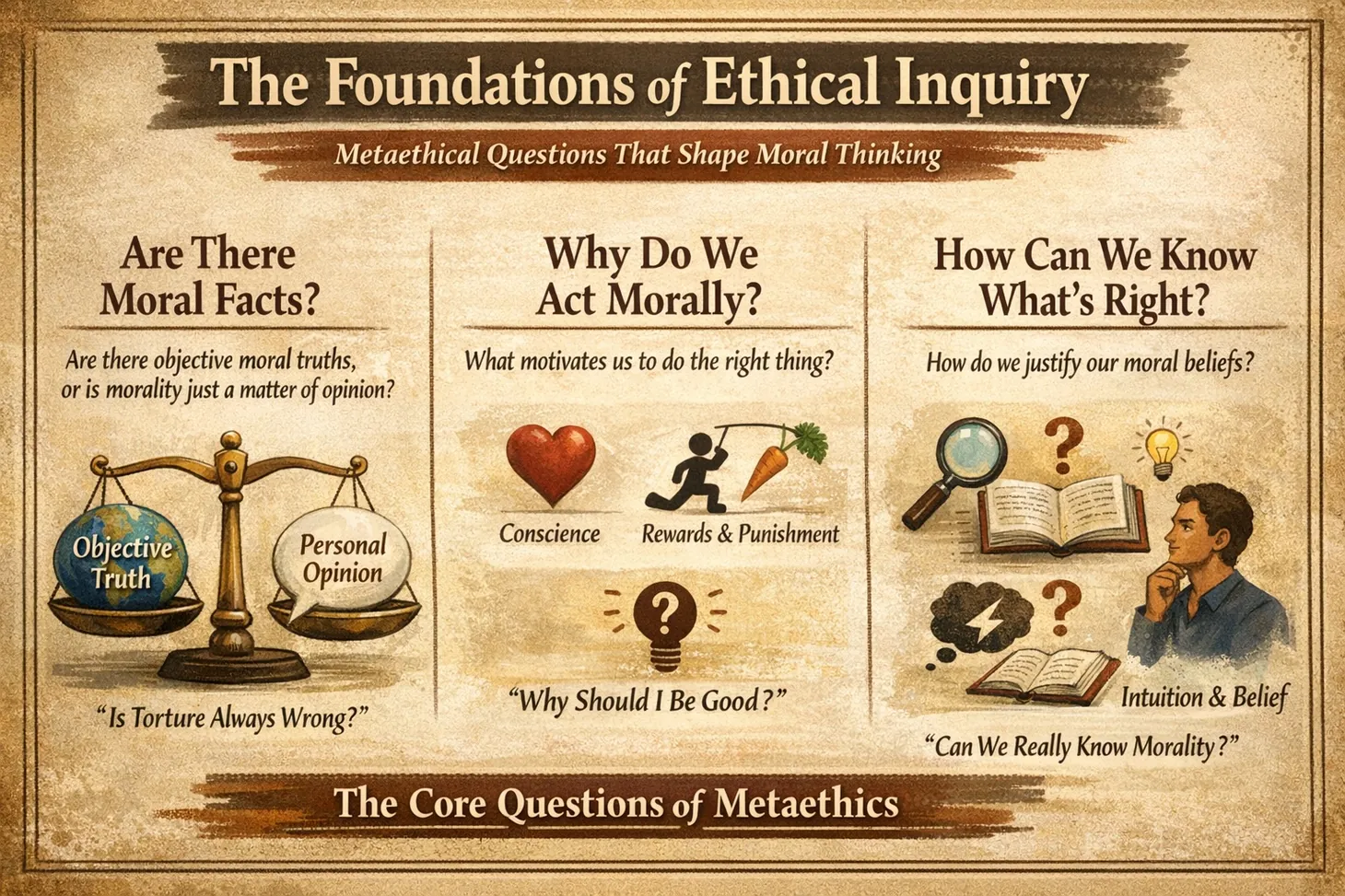
Before we can confidently engage in ethical reasoning, we must address foundational questions that have puzzled philosophers for millennia. These metaethical questions shape how we approach moral thinking itself.
The foundational metaethical questions that underpin all ethical inquiry
Are There Moral Facts?
When you say "torture is wrong," are you stating a fact about the world, or merely expressing your personal opinion? This question—whether objective moral truths exist—is perhaps the most fundamental in ethics.
The Objectivity Debate
MetaethicsCentral Controversy
Arguments FOR Objective Moral Facts
Moral Intuition: Torturing babies for fun seems objectively, not merely subjectively, wrong. Our strongest moral convictions feel like discoveries, not inventions.
Cross-Cultural Convergence: Despite variations, basic moral principles (don't murder, keep promises, care for children) appear across cultures.
Moral Progress: We believe slavery's abolition was genuinely better, not just different—implying objective standards.
Moral Reasoning: We argue about ethics, trying to convince others. This presupposes something to be right or wrong about.
Arguments AGAINST Objective Moral Facts
Cultural Variation: Moral codes differ dramatically across societies. If morality were objective, wouldn't everyone agree?
The Queerness Argument (J.L. Mackie): Objective moral facts would be metaphysically "queer"—utterly unlike anything else in nature.
Evolutionary Explanation: Our moral intuitions can be explained by evolution—they helped ancestors cooperate and reproduce—without positing moral facts.
The Is-Ought Gap (Hume): You can't derive normative conclusions ("ought") from purely factual premises ("is"). Moral facts seem impossible to ground.
Practical Upshot: Even if we can't definitively settle whether moral facts are "objective," we can still do ethics. Most ethicists agree that some moral views are better justified than others, even if "objective truth" remains philosophically contested.
The objectivity question connects to how we approach moral disagreement. If morality is objective, persistent disagreement suggests someone is mistaken. If subjective, there may be no fact of the matter to disagree about—only different preferences.
Why Be Moral?
Even if we know what's right, why should we do it, especially when being immoral might benefit us? This is the ancient question of moral motivation—the relationship between self-interest and morality.
Plato's Ring of Gyges
Thought ExperimentFrom The Republic
In Plato's Republic, Glaucon tells the story of a shepherd who discovers a ring that makes him invisible. With this power, he seduces the queen, kills the king, and takes the throne.
Glaucon's Challenge: "Given invisibility—given that you could commit any injustice without consequences—would you still be moral? If not, doesn't that prove we're only moral out of fear, not genuine virtue?"
The Question: Is morality merely a constraint we tolerate, or something we should embrace for its own sake?
Philosophers have offered various answers to why we should be moral:
Why Be Moral? Five Answers
Philosophical Responses
Enlightened Self-Interest: Immorality is self-defeating in the long run. Trust, relationships, and society all depend on morality. Even invisible, you'd harm yourself psychologically.
It's Constitutive of the Good Life (Aristotle): Virtue isn't a sacrifice but a component of flourishing. You can't be truly happy while being unjust.
Rationality Requires It (Kant): Being moral isn't separate from rationality—it's what rationality demands. Immorality is a form of irrationality.
Because You Care About Others: For most of us, concern for others is genuine, not pretense. We're moral because we actually care about people's welfare.
The Question Is Confused: Asking "why be moral?" presupposes self-interest is the default. But morality isn't an optional add-on—it's woven into human identity and social existence.
Plato's Answer: In the Republic, Socrates argues that justice is intrinsically valuable—the just soul is harmonious and happy, while the unjust soul is disordered and miserable. Even invisible, the unjust person corrupts their own soul.
How Do We Know Right from Wrong?
If there are moral truths, how do we access them? What is the source and method of moral knowledge? This is the question of moral epistemology.
Sources of Moral Knowledge
Moral Epistemology
1. Reason
Kant and rationalists hold that moral truths are known through pure reason, like mathematical truths. We can deduce moral principles through logical analysis.
Strength: Reason is universal—moral conclusions reached through logic apply to everyone.
Weakness: Pure reason seems "cold"—can it capture the full richness of moral life?
2. Emotion and Sentiment
Hume argued that reason alone cannot motivate action—emotions must be involved. Moral sense theorists held that we perceive right and wrong through a special moral faculty.
Strength: Explains why moral judgments move us to action—they're tied to feelings like sympathy and indignation.
Weakness: Emotions can mislead. Our immediate feelings may reflect prejudice rather than moral truth.
3. Intuition
Some moral truths seem self-evident upon reflection. That "torturing innocents is wrong" requires no further argument—it's a basic intuition.
Strength: Captures how we actually form moral beliefs. Some things just seem obviously right or wrong.
Weakness: Intuitions conflict, both between people and within individuals. Which intuitions should we trust?
4. Experience and Observation
Empiricists suggest moral knowledge comes from observing the consequences of actions—we learn what helps and harms through experience.
Strength: Grounds ethics in observable reality.
Weakness: How do we get from "is" to "ought"? Observing harm doesn't automatically tell us we shouldn't cause it.
Approaches to Moral Knowledge
graph TD
    MK["How Do We Know
Right from Wrong?"]

    INT["Moral Intuitionism
Self-evident moral truths
Known directly by reason"]
    EMP["Moral Empiricism
Moral knowledge from
experience & observation"]
    RAT["Moral Rationalism
Pure reason discovers
universal moral laws"]

    MK --> INT
    MK --> EMP
    MK --> RAT

    INT --> I1["G.E. Moore, W.D. Ross
Prima facie duties"]
    EMP --> E1["Hume, Sentimentalists
Moral sense theory"]
    RAT --> R1["Kant
Categorical Imperative"]

    style MK fill:#132440,stroke:#132440,color:#fff
    style INT fill:#e8f4f4,stroke:#3B9797
    style EMP fill:#f0f4f8,stroke:#16476A
    style RAT fill:#fff5f5,stroke:#BF092F
Most contemporary ethicists adopt a reflective equilibrium approach: we move back and forth between moral intuitions and moral principles, adjusting each in light of the other until we reach a coherent whole. Neither pure reason nor raw intuition alone suffices—moral knowledge emerges from their interplay.
Reflective Equilibrium
MethodJohn Rawls
Developed by John Rawls, reflective equilibrium is a method for arriving at justified moral beliefs:
Begin with your considered moral judgments—intuitions formed under good conditions (calm, informed, impartial)
Formulate moral principles that systematize and explain these judgments
Check whether the principles match your judgments. Where they conflict:
Sometimes revise the principle
Sometimes revise the judgment (realizing it was based on bias or error)
Continue until your principles and judgments form a coherent system
This process never fully "ends"—moral inquiry is ongoing as we encounter new cases and perspectives.
The Interplay: Good ethical reasoning integrates emotion (moral concern), reason (logical consistency), intuition (basic moral judgments), and experience (consequences of actions). Ethics is not purely intellectual—it engages the whole person.
Next Steps in the Series
Congratulations! You've now established the foundational concepts of ethics and moral philosophy:
What You've Learned:
What ethics is and how it differs from mere custom or inherited morality
The three main branches of ethical study: metaethics, normative ethics, and applied ethics
A brief history of Western ethical thought from ancient Greece to the present
Fundamental questions: Are there moral facts? Why be moral? How do we know right from wrong?
The method of reflective equilibrium for moral reasoning
With these foundations in place, you're ready to explore the major normative ethical theories that attempt to answer the question: What makes an action right or wrong?
Your Learning Path Continues
5 More PartsNormative Theories & Applications
Part 2: Utilitarianism & Consequentialism Learn how Bentham and Mill judge actions by their consequences. Master the principle of utility and grapple with challenging objections.
Part 3: Deontology & Kant Explore Kant's revolutionary duty-based ethics. Understand the categorical imperative and why some things are wrong regardless of consequences.
Part 4: Virtue Ethics & Aristotle Discover Aristotle's ethics of character. Learn what virtues are, why they matter, and how they lead to eudaimonia—human flourishing.
Part 5: Moral Relativism & Nihilism Examine the most radical challenges to ethics itself. Assess arguments for relativism and nihilism, and consider how we might respond.
Part 6: Applied Ethics & Case Studies Apply ethical frameworks to real-world dilemmas. Work through cases in bioethics, business ethics, technology ethics, and more.
Further Resources
To deepen your understanding of ethical foundations, consider these resources:
Recommended Reading
Books
Ethics: Inventing Right and Wrong - J.L. Mackie (classic defense of moral anti-realism)
The Elements of Moral Philosophy - James Rachels (accessible introduction)
After Virtue - Alasdair MacIntyre (critique of modern ethics, virtue ethics revival)
Practical Ethics - Peter Singer (consequentialist approach to applied ethics)
The Moral Landscape - Sam Harris (scientific approach to morality)
Being Good - Simon Blackburn (concise, engaging introduction)
Practice Exercises
Application
Moral Intuition Journal: For one week, note situations that triggered moral reactions. What made something feel "right" or "wrong"?
Ethical Autobiography: Trace how your moral views have developed. What shaped them? Which have changed?
Debate Both Sides: Pick a controversial issue and argue for both positions as persuasively as possible.
Reflective Equilibrium Exercise: Take a strong moral intuition and ask what principles could justify it. Then check if those principles lead to conclusions you accept.
Final Thought: "The unexamined life is not worth living." — Socrates. Ethical thinking isn't a burden but an essential part of human flourishing. By engaging with these questions, you're already living more fully.
Continue the Series
Part 2: Utilitarianism & Consequentialism
Learn about the influential ethical theory that judges actions by their consequences and aims to maximize overall happiness.