1. Introduction
The future of data-driven decision making is automation. As organizations mature, they move from humans making all decisions with data to AI/ML systems making many decisions automatically—with human oversight for high-stakes choices.
Data-Driven Decisions
Introduction to Business Analytics & DDDM
Analytics maturity, data-driven culture, business valueDefining & Tracking KPIs
OKRs, leading/lagging indicators, scorecard designDashboard Design & BI Tools
Tableau, Power BI, dashboard best practices, data vizExperimentation & A/B Testing
Hypothesis testing, control groups, sample sizingStatistical Significance & Interpretation
P-values, confidence intervals, effect size, power analysisDecision Frameworks & Structured Decision Making
Decision matrices, Bayesian thinking, risk analysisData Collection & Quality Management
Surveys, ETL, data governance, cleaning pipelinesBusiness Storytelling & Visualization
Narrative structure, chart selection, audience designPredictive Analytics & Forecasting
Regression, time series, ML models, forecasting methodsData-Driven Culture & Organizational Adoption
Change management, data literacy, organizational buy-inFunction-Specific Data Applications
Marketing, finance, operations, HR analyticsCapstone Projects (Portfolio-Ready)
End-to-end analytics projects, portfolio buildingAdvanced Analytics & Automation
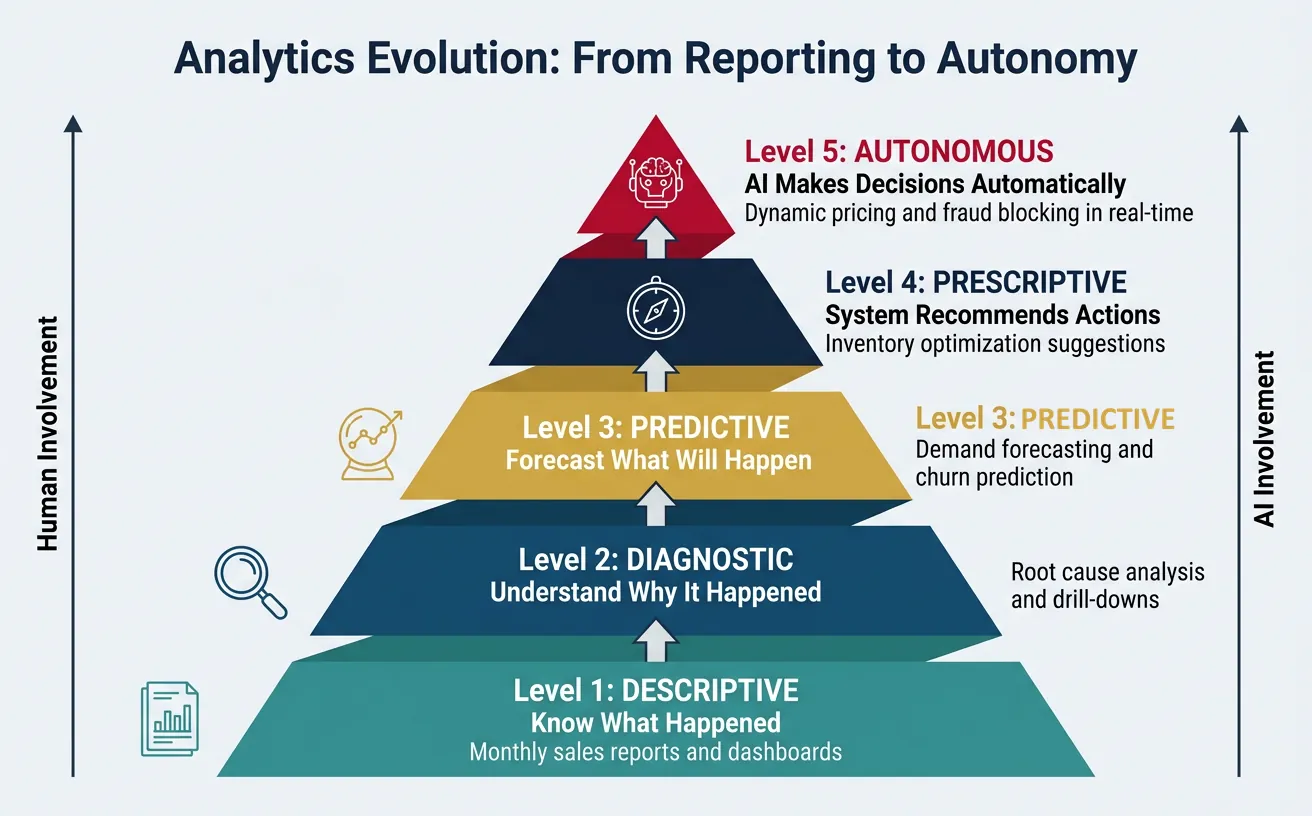
ML pipelines, AutoML, real-time analytics, AI integrationAnalytics Evolution
Analytics Maturity Progression
Level 5: AUTONOMOUS       → AI makes decisions automatically
          ↑
Level 4: PRESCRIPTIVE     → System recommends actions
          ↑
Level 3: PREDICTIVE       → Forecast what will happen
          ↑
Level 2: DIAGNOSTIC       → Understand why it happened
          ↑
Level 1: DESCRIPTIVE      → Know what happened
Automation Landscape
| Automation Type | Description | Example |
|---|---|---|
| Data pipelines | Automated ETL, data quality checks | Daily refresh of dashboards |
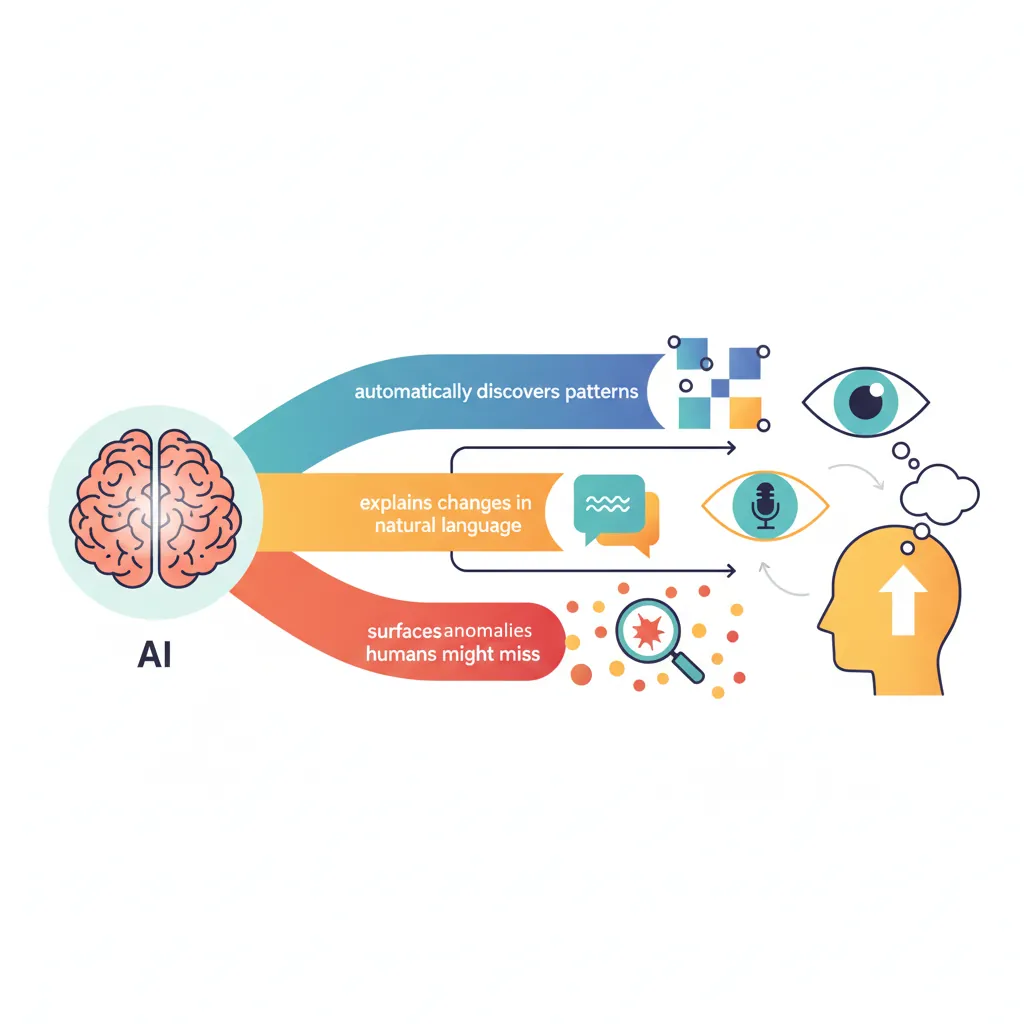
| Insight generation | AI surfaces anomalies and trends | "Revenue spiked 40% in Region X" |
| Recommendations | System suggests actions | "Increase inventory for SKU 123" |
| Autonomous decisions | System acts without human approval | Dynamic pricing, fraud blocking |
2. AI/ML Integration
Machine learning moves analytics from "what happened" to "what will happen" and "what to do."
Machine Learning Use Cases
- Churn prediction: Identify at-risk customers before they leave
- Demand forecasting: Predict product demand for inventory planning
- Lead scoring: Rank prospects by purchase likelihood
- Fraud detection: Flag suspicious transactions in real-time
- Dynamic pricing: Adjust prices based on demand and competition
- Customer segmentation: Automatically group customers by behavior
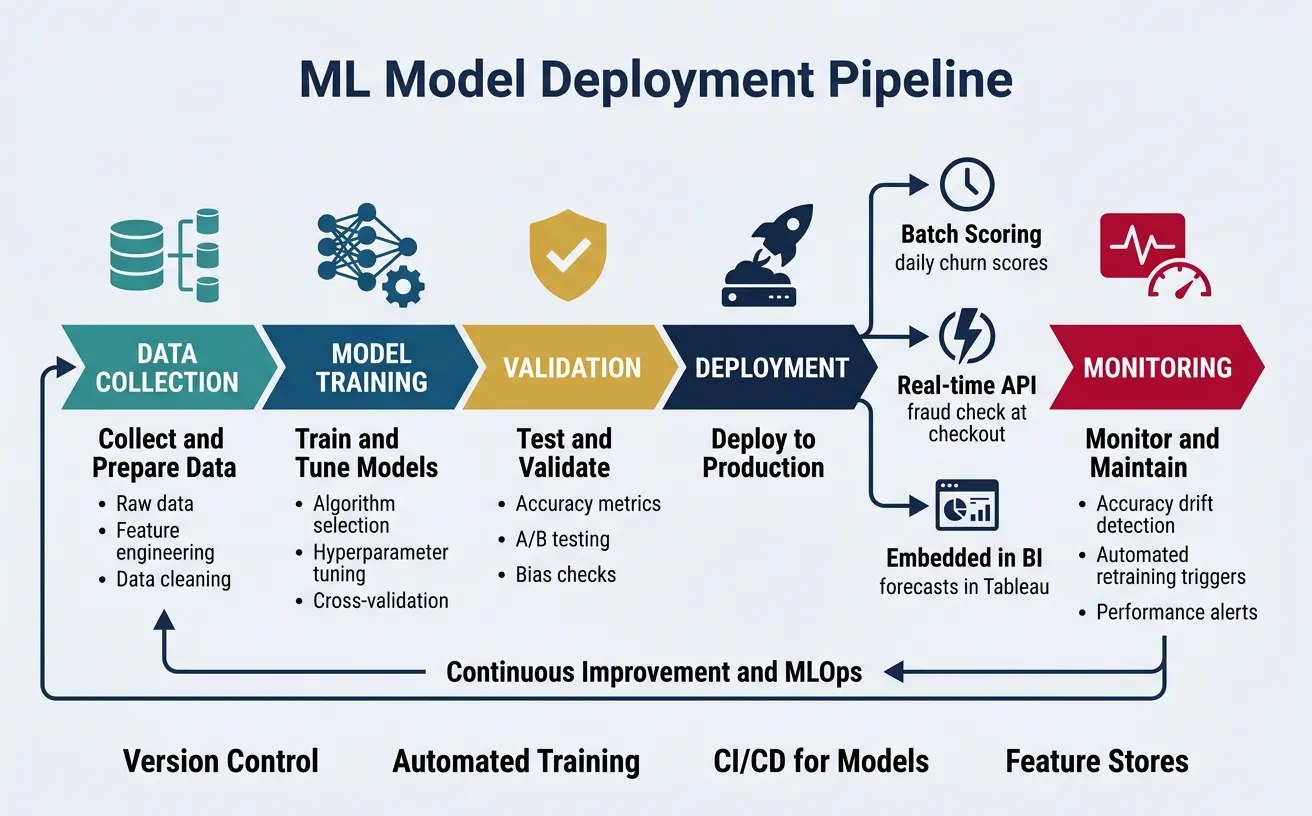
Model Deployment
Getting ML models into production:
- Batch scoring: Run predictions periodically (daily churn scores)
- Real-time APIs: Predict on-demand (fraud check at checkout)
- Embedded in BI: Predictions in dashboards (forecasts in Tableau)
- Edge deployment: Run models on devices (IoT sensors)
MLOps Basics
MLOps = DevOps for machine learning. Key practices:
- Version control: Track model code, data, and parameters
- Automated training: Retrain models on schedule or data triggers
- Model monitoring: Track accuracy drift over time
- CI/CD for models: Automated testing and deployment pipelines
- Feature stores: Centralized, reusable feature engineering
3. Automated Insights
AI can now generate insights without human analysts.
Augmented Analytics
Tools that use AI to assist human analysts:
- Auto-discovery: AI finds interesting patterns you didn't ask for
- Smart data prep: Automatic cleaning, joining, transforming
- Natural language queries: Ask questions in plain English
- Explain changes: "Revenue dropped because of X, Y, Z"
Natural Language Generation (NLG)
AI writes narratives from data:
- Automated reports: "Sales increased 12% MoM, driven by..."
- Personalized summaries: Different narratives for different audiences
- Alert explanations: "Anomaly detected: unusually high returns..."
AutoML Platforms
Automated machine learning for non-data scientists:
| Platform | Strengths |
|---|---|
| Google AutoML | Tight GCP integration, vision/NLP focus |
| Azure ML | Enterprise features, MLOps integration |
| DataRobot | End-to-end automation, explainability |
| H2O.ai | Open source option, strong community |
4. Decision Automation
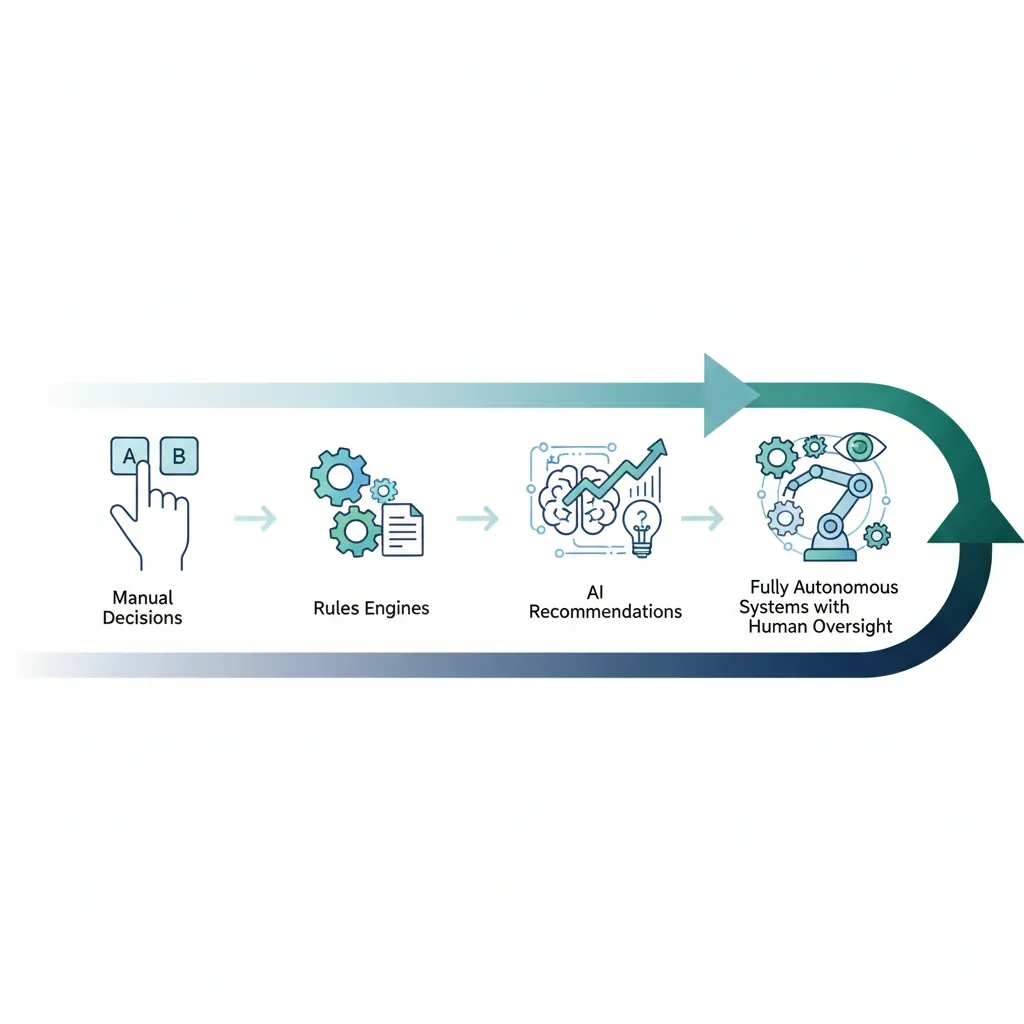
Moving from "data informs decisions" to "systems make decisions."
Rules Engines
Codify business logic for automated decisions:
- IF-THEN rules: "If order > $500, apply 10% discount"
- Decision tables: Map combinations of conditions to actions
- Use cases: Pricing, approvals, routing, eligibility
Real-Time Decisions
Decisions made in milliseconds:
- Ad bidding: Decide bid price for each impression
- Fraud scoring: Approve/decline transactions instantly
- Personalization: Choose content/offers in real-time
- Dynamic pricing: Adjust prices based on demand signals
Human-in-the-Loop
When Humans Must Stay in the Loop
- High-stakes decisions: Hiring, lending, medical
- Novel situations: Unprecedented scenarios
- Ethical judgments: Fairness, bias concerns
- Reputation risk: Public-facing decisions
- Regulatory requirements: Some decisions require human review
5. Emerging Trends
Generative AI for Analytics
- Chat with your data: "Why did revenue drop in Q3?"
- Auto-generate SQL: Natural language to query
- Create visualizations: "Show me a trend chart of..."
- Summarize reports: AI-written executive summaries
Edge Analytics
Processing data where it's generated (IoT, devices):
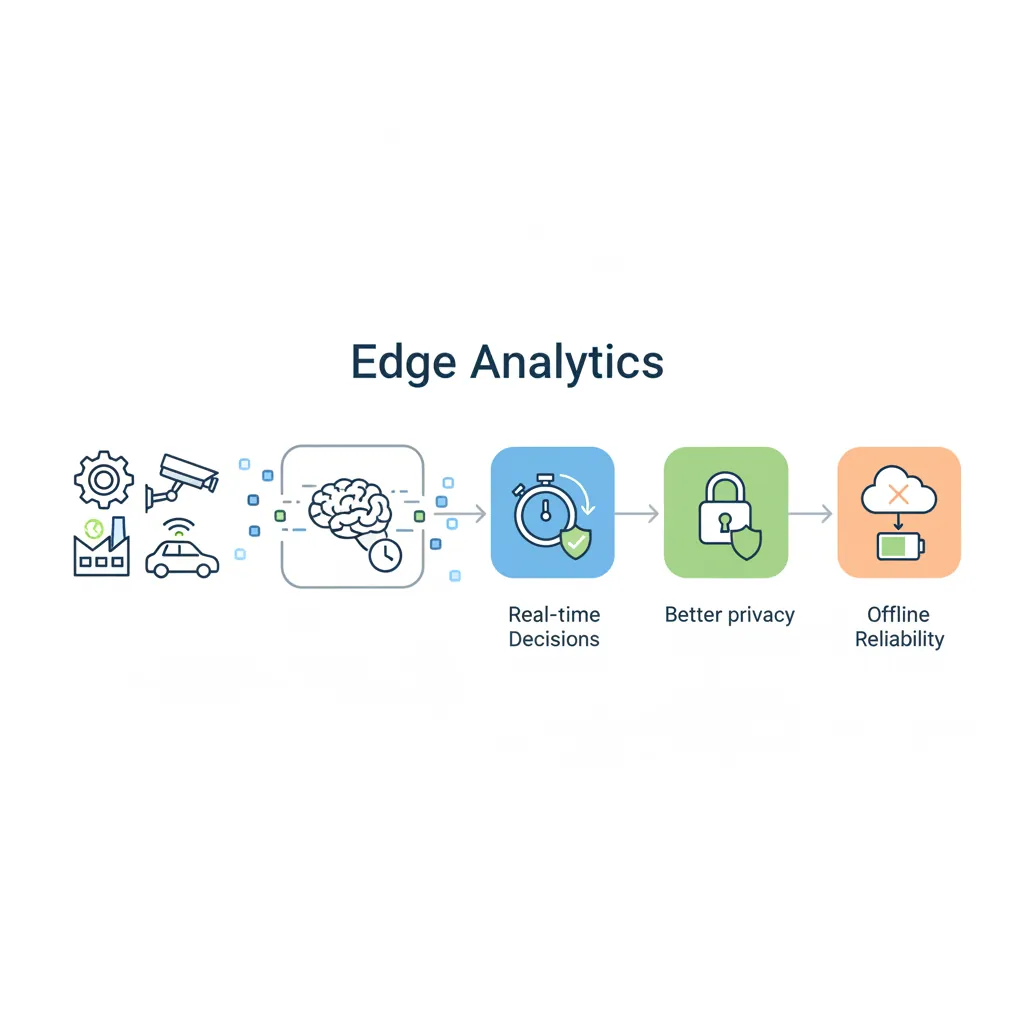
- Lower latency: Real-time decisions without cloud round-trip
- Privacy: Sensitive data stays on device
- Reliability: Works offline
Responsible AI
- Explainability: Understand why AI made a decision
- Fairness: Detect and mitigate bias
- Privacy: Federated learning, differential privacy
- Governance: Model risk management, audit trails
6. Series Conclusion
Congratulations! You've completed the DDDM series—from foundational concepts to advanced automation.
Key Takeaways from the Series
- Start with questions: What decision are you trying to make?
- Data quality is foundational: Bad data → bad decisions
- KPIs drive focus: Measure what matters
- Experiment to learn: A/B tests beat opinions
- Tell stories with data: Insights without action are useless
- Culture enables technology: People must use the tools
- Automate where appropriate: But keep humans in the loop
Next Steps
- Complete capstone projects: Apply what you've learned
- Build a portfolio: Document your work for career advancement
- Keep learning: Analytics evolves rapidly
- Share knowledge: Teach others to multiply impact