Introduction to Stack
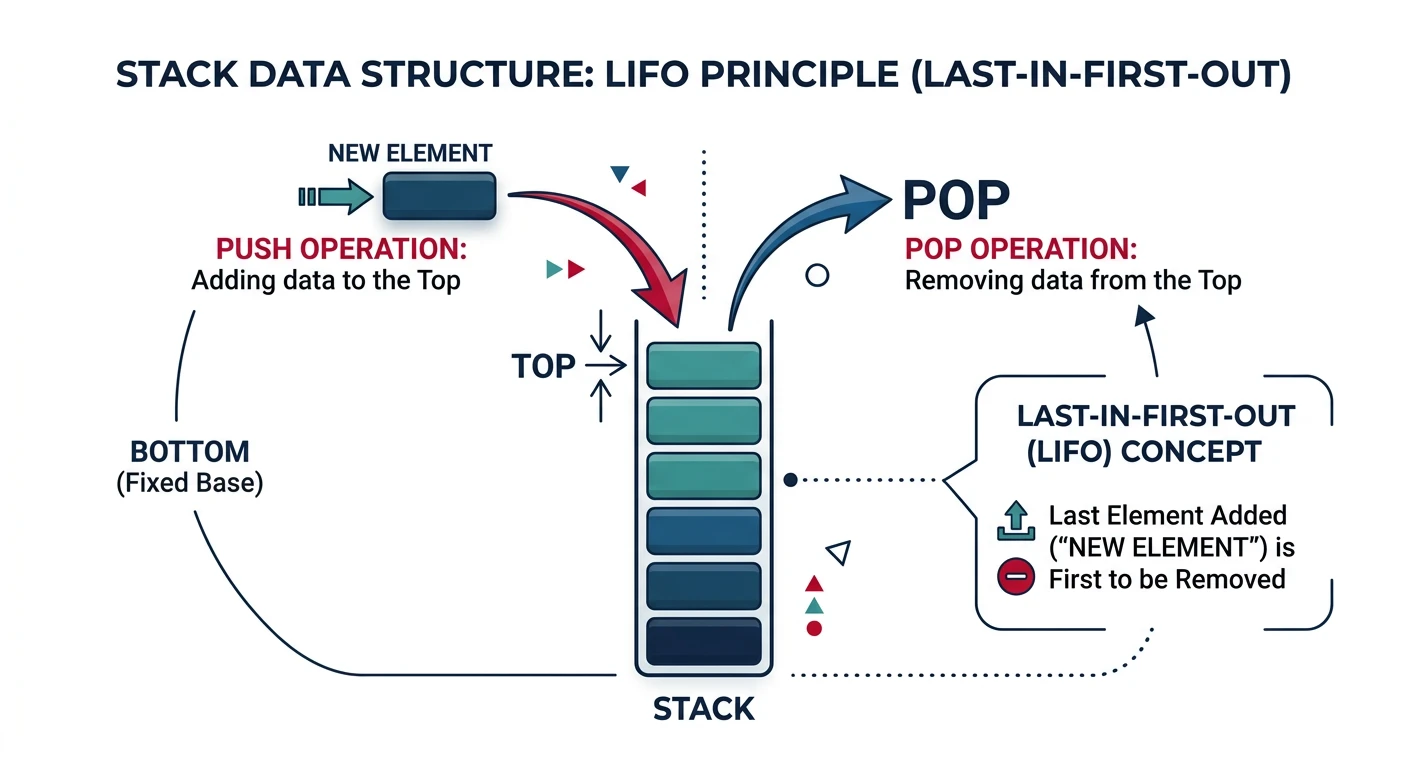
A stack is a linear data structure that follows the Last-In-First-Out (LIFO) principle. Think of it like a stack of plates - you can only add or remove plates from the top. Stacks are fundamental in computer science, used in function calls, expression parsing, undo mechanisms, and many algorithms.
FAANG Interview Prep
Stack Operations
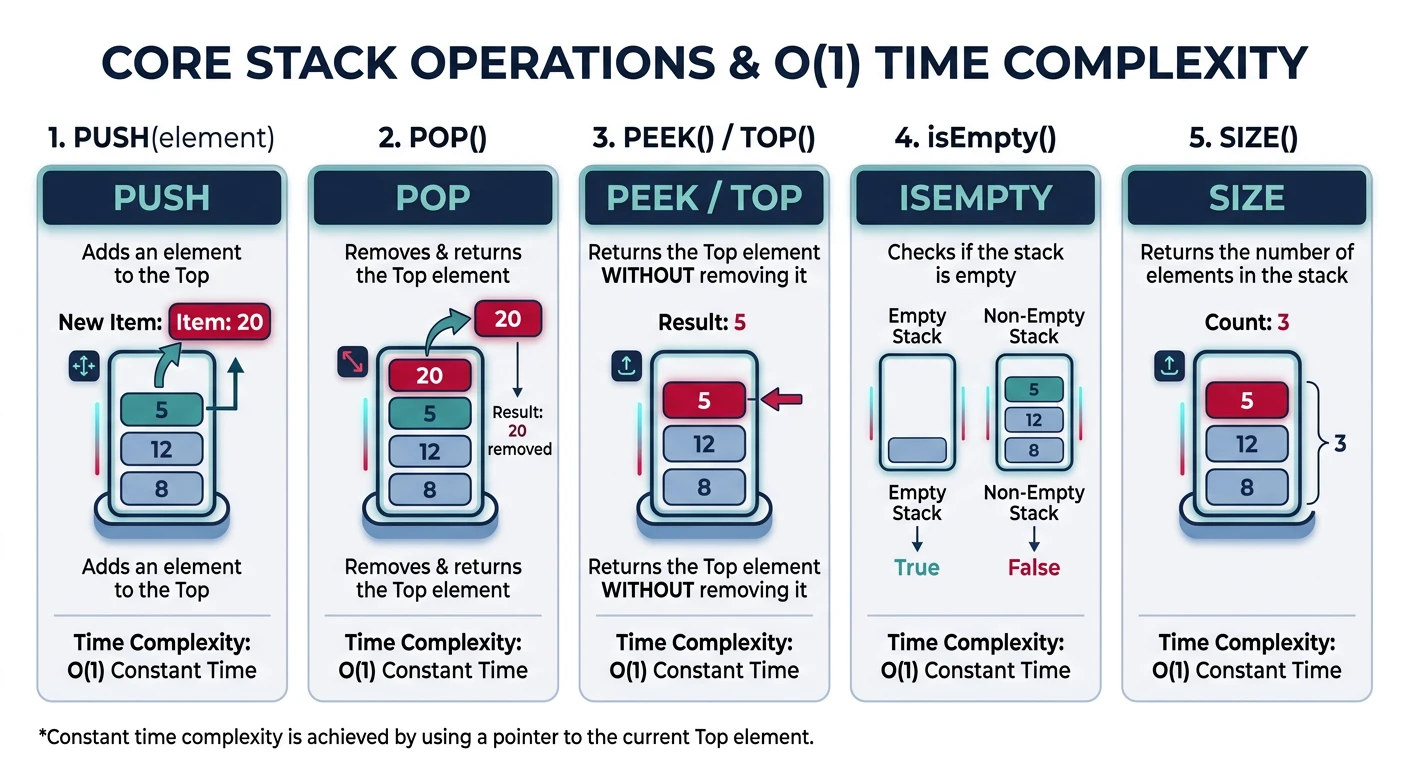
Core Stack Operations
| Operation | Description | Time |
|---|---|---|
| push(item) | Add item to top | O(1) |
| pop() | Remove and return top item | O(1) |
| peek()/top() | Return top item without removing | O(1) |
| isEmpty() | Check if stack is empty | O(1) |
| size() | Return number of items | O(1) |
Stack Implementations
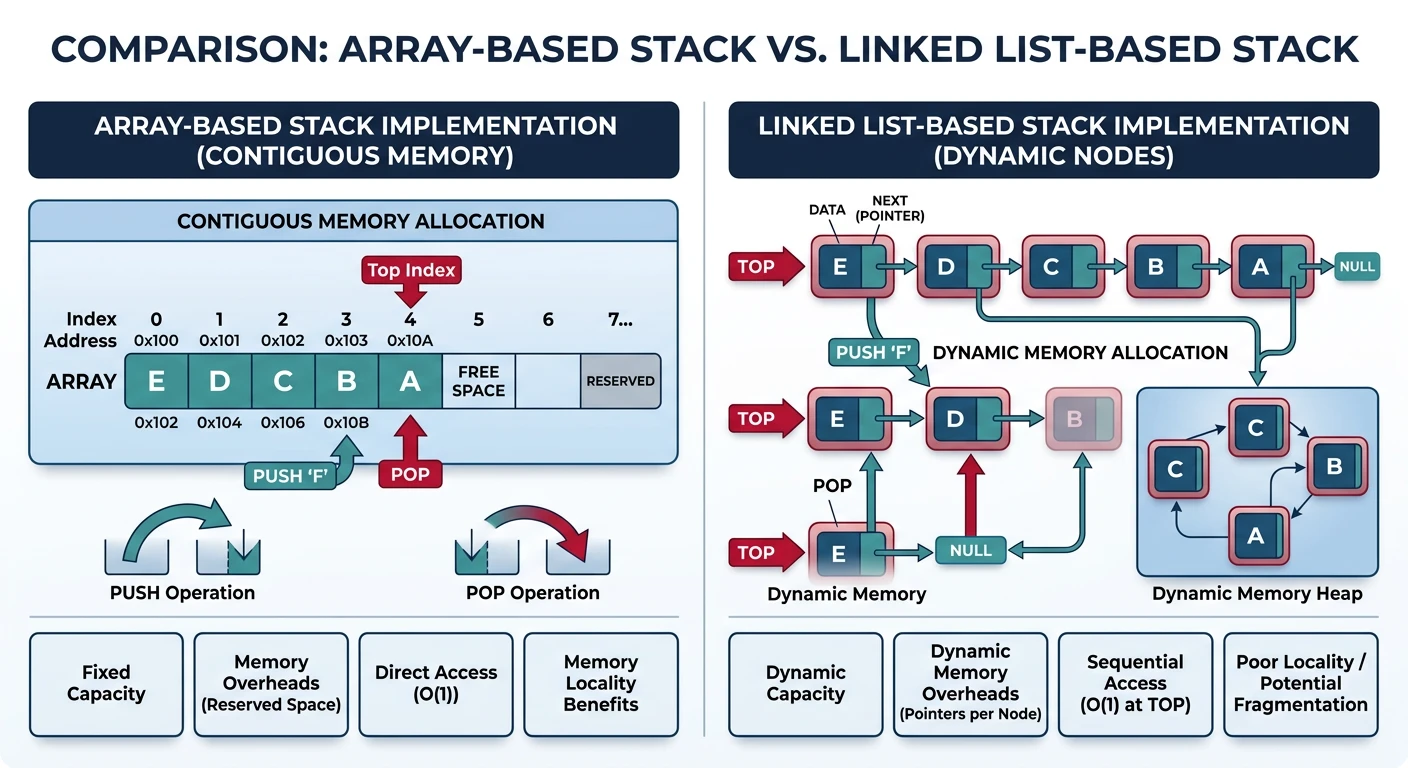
Array-Based Stack
Python
# Stack Implementation using Array (Python List)
# All operations O(1) amortized
class ArrayStack:
def __init__(self, capacity=None):
"""Initialize stack with optional fixed capacity"""
self.capacity = capacity
self.items = []
def push(self, item):
"""Add item to top - O(1) amortized"""
if self.capacity and len(self.items) >= self.capacity:
raise OverflowError("Stack is full")
self.items.append(item)
def pop(self):
"""Remove and return top item - O(1)"""
if self.is_empty():
raise IndexError("Stack is empty")
return self.items.pop()
def peek(self):
"""Return top item without removing - O(1)"""
if self.is_empty():
raise IndexError("Stack is empty")
return self.items[-1]
def is_empty(self):
return len(self.items) == 0
def size(self):
return len(self.items)
# Test
stack = ArrayStack()
stack.push(1)
stack.push(2)
stack.push(3)
print(f"Peek: {stack.peek()}") # 3
print(f"Pop: {stack.pop()}") # 3
print(f"Size: {stack.size()}") # 2
C++
// Stack Implementation using Array (Vector)
#include <iostream>
#include <vector>
#include <stdexcept>
using namespace std;
template <typename T>
class ArrayStack {
private:
vector<T> items;
int maxCapacity;
public:
ArrayStack(int capacity = -1) : maxCapacity(capacity) {}
void push(T item) {
if (maxCapacity > 0 && items.size() >= maxCapacity)
throw overflow_error("Stack is full");
items.push_back(item);
}
T pop() {
if (isEmpty()) throw runtime_error("Stack is empty");
T item = items.back();
items.pop_back();
return item;
}
T peek() {
if (isEmpty()) throw runtime_error("Stack is empty");
return items.back();
}
bool isEmpty() { return items.empty(); }
int size() { return items.size(); }
};
int main() {
ArrayStack<int> stack;
stack.push(1);
stack.push(2);
stack.push(3);
cout << "Peek: " << stack.peek() << endl; // 3
cout << "Pop: " << stack.pop() << endl; // 3
cout << "Size: " << stack.size() << endl; // 2
return 0;
}
Java
// Stack Implementation using ArrayList
import java.util.ArrayList;
public class ArrayStack<T> {
private ArrayList<T> items;
private int maxCapacity;
public ArrayStack() { this(-1); }
public ArrayStack(int capacity) {
this.items = new ArrayList<>();
this.maxCapacity = capacity;
}
public void push(T item) {
if (maxCapacity > 0 && items.size() >= maxCapacity)
throw new RuntimeException("Stack is full");
items.add(item);
}
public T pop() {
if (isEmpty()) throw new RuntimeException("Stack is empty");
return items.remove(items.size() - 1);
}
public T peek() {
if (isEmpty()) throw new RuntimeException("Stack is empty");
return items.get(items.size() - 1);
}
public boolean isEmpty() { return items.isEmpty(); }
public int size() { return items.size(); }
public static void main(String[] args) {
ArrayStack<Integer> stack = new ArrayStack<>();
stack.push(1);
stack.push(2);
stack.push(3);
System.out.println("Peek: " + stack.peek()); // 3
System.out.println("Pop: " + stack.pop()); // 3
System.out.println("Size: " + stack.size()); // 2
}
}
Fixed-Size Array Stack (Lower Level)
Python
# Fixed-Size Array Stack Implementation
class FixedArrayStack:
def __init__(self, capacity):
self.capacity = capacity
self.array = [None] * capacity
self.top = -1 # Index of top element
def push(self, item):
if self.is_full():
raise OverflowError("Stack overflow")
self.top += 1
self.array[self.top] = item
def pop(self):
if self.is_empty():
raise IndexError("Stack underflow")
item = self.array[self.top]
self.array[self.top] = None
self.top -= 1
return item
def peek(self):
if self.is_empty():
raise IndexError("Stack is empty")
return self.array[self.top]
def is_empty(self):
return self.top == -1
def is_full(self):
return self.top == self.capacity - 1
def size(self):
return self.top + 1
# Test
fixed_stack = FixedArrayStack(5)
for i in range(1, 6):
fixed_stack.push(i * 10)
print(f"Is full: {fixed_stack.is_full()}") # True
print(f"Pop: {fixed_stack.pop()}") # 50
C++
// Fixed-Size Array Stack Implementation
#include <iostream>
#include <stdexcept>
using namespace std;
template <typename T>
class FixedArrayStack {
private:
T* array;
int capacity;
int topIndex;
public:
FixedArrayStack(int cap) : capacity(cap), topIndex(-1) {
array = new T[capacity];
}
~FixedArrayStack() { delete[] array; }
void push(T item) {
if (isFull()) throw overflow_error("Stack overflow");
array[++topIndex] = item;
}
T pop() {
if (isEmpty()) throw runtime_error("Stack underflow");
return array[topIndex--];
}
T peek() {
if (isEmpty()) throw runtime_error("Stack is empty");
return array[topIndex];
}
bool isEmpty() { return topIndex == -1; }
bool isFull() { return topIndex == capacity - 1; }
int size() { return topIndex + 1; }
};
int main() {
FixedArrayStack<int> stack(5);
for (int i = 1; i <= 5; i++) stack.push(i * 10);
cout << "Is full: " << (stack.isFull() ? "true" : "false") << endl; // true
cout << "Pop: " << stack.pop() << endl; // 50
return 0;
}
Java
// Fixed-Size Array Stack Implementation
public class FixedArrayStack<T> {
private Object[] array;
private int capacity;
private int topIndex;
public FixedArrayStack(int capacity) {
this.capacity = capacity;
this.array = new Object[capacity];
this.topIndex = -1;
}
public void push(T item) {
if (isFull()) throw new RuntimeException("Stack overflow");
array[++topIndex] = item;
}
@SuppressWarnings("unchecked")
public T pop() {
if (isEmpty()) throw new RuntimeException("Stack underflow");
T item = (T) array[topIndex];
array[topIndex--] = null;
return item;
}
@SuppressWarnings("unchecked")
public T peek() {
if (isEmpty()) throw new RuntimeException("Stack is empty");
return (T) array[topIndex];
}
public boolean isEmpty() { return topIndex == -1; }
public boolean isFull() { return topIndex == capacity - 1; }
public int size() { return topIndex + 1; }
public static void main(String[] args) {
FixedArrayStack<Integer> stack = new FixedArrayStack<>(5);
for (int i = 1; i <= 5; i++) stack.push(i * 10);
System.out.println("Is full: " + stack.isFull()); // true
System.out.println("Pop: " + stack.pop()); // 50
}
}
Linked List-Based Stack
Python
# Stack Implementation using Linked List
# True O(1) for all operations
class Node:
def __init__(self, data):
self.data = data
self.next = None
class LinkedListStack:
def __init__(self):
self.head = None
self._size = 0
def push(self, item):
new_node = Node(item)
new_node.next = self.head
self.head = new_node
self._size += 1
def pop(self):
if self.is_empty():
raise IndexError("Stack is empty")
item = self.head.data
self.head = self.head.next
self._size -= 1
return item
def peek(self):
if self.is_empty():
raise IndexError("Stack is empty")
return self.head.data
def is_empty(self):
return self.head is None
def size(self):
return self._size
# Test
ll_stack = LinkedListStack()
ll_stack.push(1)
ll_stack.push(2)
ll_stack.push(3)
print(f"Peek: {ll_stack.peek()}") # 3
print(f"Pop: {ll_stack.pop()}") # 3
print(f"Size: {ll_stack.size()}") # 2
C++
// Stack Implementation using Linked List
#include <iostream>
#include <stdexcept>
using namespace std;
template <typename T>
class LinkedListStack {
private:
struct Node {
T data;
Node* next;
Node(T d) : data(d), next(nullptr) {}
};
Node* head;
int _size;
public:
LinkedListStack() : head(nullptr), _size(0) {}
~LinkedListStack() {
while (!isEmpty()) pop();
}
void push(T item) {
Node* newNode = new Node(item);
newNode->next = head;
head = newNode;
_size++;
}
T pop() {
if (isEmpty()) throw runtime_error("Stack is empty");
T item = head->data;
Node* temp = head;
head = head->next;
delete temp;
_size--;
return item;
}
T peek() {
if (isEmpty()) throw runtime_error("Stack is empty");
return head->data;
}
bool isEmpty() { return head == nullptr; }
int size() { return _size; }
};
int main() {
LinkedListStack<int> stack;
stack.push(1);
stack.push(2);
stack.push(3);
cout << "Peek: " << stack.peek() << endl; // 3
cout << "Pop: " << stack.pop() << endl; // 3
cout << "Size: " << stack.size() << endl; // 2
return 0;
}
Java
// Stack Implementation using Linked List
public class LinkedListStack<T> {
private class Node {
T data;
Node next;
Node(T data) { this.data = data; }
}
private Node head;
private int size;
public LinkedListStack() {
head = null;
size = 0;
}
public void push(T item) {
Node newNode = new Node(item);
newNode.next = head;
head = newNode;
size++;
}
public T pop() {
if (isEmpty()) throw new RuntimeException("Stack is empty");
T item = head.data;
head = head.next;
size--;
return item;
}
public T peek() {
if (isEmpty()) throw new RuntimeException("Stack is empty");
return head.data;
}
public boolean isEmpty() { return head == null; }
public int size() { return size; }
public static void main(String[] args) {
LinkedListStack<Integer> stack = new LinkedListStack<>();
stack.push(1);
stack.push(2);
stack.push(3);
System.out.println("Peek: " + stack.peek()); // 3
System.out.println("Pop: " + stack.pop()); // 3
System.out.println("Size: " + stack.size()); // 2
}
}
Array vs Linked List Stack
| Aspect | Array Stack | Linked List Stack |
|---|---|---|
| Push | O(1) amortized* | O(1) |
| Pop | O(1) | O(1) |
| Memory | Contiguous, less overhead | Scattered, pointer overhead |
| Cache | Better locality | Poor locality |
| Size | Fixed or resize needed | Dynamic |
* O(n) worst case when resizing, but amortized O(1)
Stack Applications
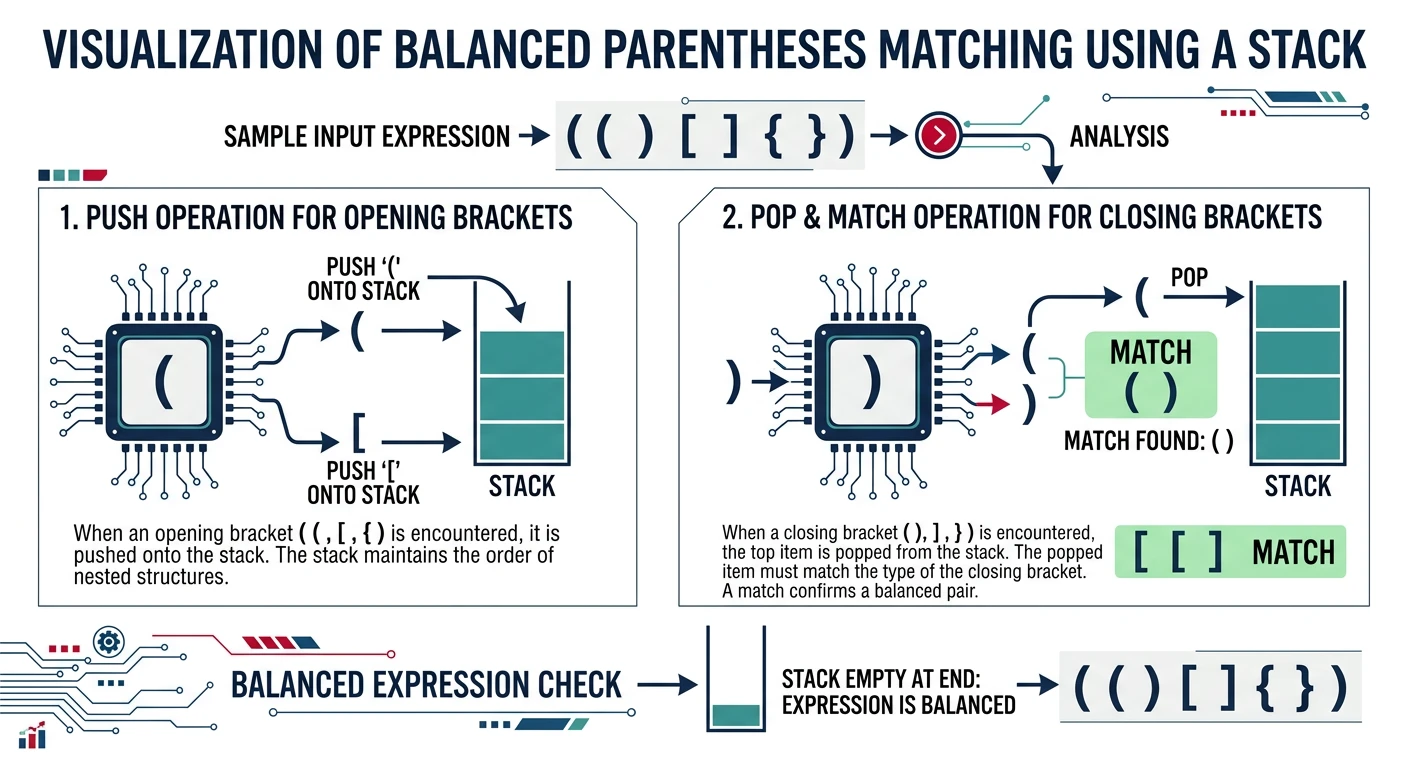
Parentheses Matching
Python
# Balanced Parentheses Check
# Time: O(n), Space: O(n)
def is_balanced(expression):
stack = []
matching = {')': '(', ']': '[', '}': '{'}
for char in expression:
if char in '([{':
stack.append(char)
elif char in ')]}':
if not stack or stack[-1] != matching[char]:
return False
stack.pop()
return len(stack) == 0
# Test
print(is_balanced("((a+b)*(c-d))")) # True
print(is_balanced("[(a+b)*{c-d}]")) # True
print(is_balanced("((a+b)")) # False
print(is_balanced("([)]")) # False
C++
// Balanced Parentheses Check
#include <iostream>
#include <stack>
#include <unordered_map>
using namespace std;
bool isBalanced(string expression) {
stack<char> stk;
unordered_map<char, char> matching = {
{')', '('}, {']', '['}, {'}', '{'}
};
for (char ch : expression) {
if (ch == '(' || ch == '[' || ch == '{') {
stk.push(ch);
} else if (ch == ')' || ch == ']' || ch == '}') {
if (stk.empty() || stk.top() != matching[ch])
return false;
stk.pop();
}
}
return stk.empty();
}
int main() {
cout << boolalpha;
cout << isBalanced("((a+b)*(c-d))") << endl; // true
cout << isBalanced("[(a+b)*{c-d}]") << endl; // true
cout << isBalanced("((a+b)") << endl; // false
cout << isBalanced("([)]") << endl; // false
return 0;
}
Java
// Balanced Parentheses Check
import java.util.*;
public class ParenthesesMatching {
public static boolean isBalanced(String expression) {
Stack<Character> stack = new Stack<>();
Map<Character, Character> matching = Map.of(
')', '(', ']', '[', '}', '{'
);
for (char ch : expression.toCharArray()) {
if (ch == '(' || ch == '[' || ch == '{') {
stack.push(ch);
} else if (ch == ')' || ch == ']' || ch == '}') {
if (stack.isEmpty() || stack.peek() != matching.get(ch))
return false;
stack.pop();
}
}
return stack.isEmpty();
}
public static void main(String[] args) {
System.out.println(isBalanced("((a+b)*(c-d))")); // true
System.out.println(isBalanced("[(a+b)*{c-d}]")); // true
System.out.println(isBalanced("((a+b)")); // false
System.out.println(isBalanced("([)]")); // false
}
}
Expression Evaluation
Python - Postfix Evaluation
# Postfix (Reverse Polish Notation) Expression Evaluation
# Example: "3 4 + 5 *" means (3 + 4) * 5 = 35
def evaluate_postfix(expression):
stack = []
operators = {'+', '-', '*', '/', '^'}
tokens = expression.split()
for token in tokens:
if token not in operators:
stack.append(float(token))
else:
b = stack.pop() # Second operand
a = stack.pop() # First operand
if token == '+': stack.append(a + b)
elif token == '-': stack.append(a - b)
elif token == '*': stack.append(a * b)
elif token == '/': stack.append(a / b)
elif token == '^': stack.append(a ** b)
return stack[0]
# Test
print(evaluate_postfix("3 4 +")) # 7
print(evaluate_postfix("3 4 + 5 *")) # 35
print(evaluate_postfix("2 3 ^ 4 +")) # 12
C++ - Postfix Evaluation
// Postfix Expression Evaluation
#include <iostream>
#include <stack>
#include <sstream>
#include <cmath>
using namespace std;
double evaluatePostfix(string expression) {
stack<double> stk;
istringstream iss(expression);
string token;
while (iss >> token) {
if (token == "+" || token == "-" || token == "*" ||
token == "/" || token == "^") {
double b = stk.top(); stk.pop();
double a = stk.top(); stk.pop();
if (token == "+") stk.push(a + b);
else if (token == "-") stk.push(a - b);
else if (token == "*") stk.push(a * b);
else if (token == "/") stk.push(a / b);
else if (token == "^") stk.push(pow(a, b));
} else {
stk.push(stod(token));
}
}
return stk.top();
}
int main() {
cout << evaluatePostfix("3 4 +") << endl; // 7
cout << evaluatePostfix("3 4 + 5 *") << endl; // 35
cout << evaluatePostfix("2 3 ^ 4 +") << endl; // 12
return 0;
}
Java - Postfix Evaluation
// Postfix Expression Evaluation
import java.util.*;
public class PostfixEvaluator {
public static double evaluatePostfix(String expression) {
Stack<Double> stack = new Stack<>();
String[] tokens = expression.split(" ");
Set<String> operators = Set.of("+", "-", "*", "/", "^");
for (String token : tokens) {
if (operators.contains(token)) {
double b = stack.pop();
double a = stack.pop();
switch (token) {
case "+": stack.push(a + b); break;
case "-": stack.push(a - b); break;
case "*": stack.push(a * b); break;
case "/": stack.push(a / b); break;
case "^": stack.push(Math.pow(a, b)); break;
}
} else {
stack.push(Double.parseDouble(token));
}
}
return stack.pop();
}
public static void main(String[] args) {
System.out.println(evaluatePostfix("3 4 +")); // 7
System.out.println(evaluatePostfix("3 4 + 5 *")); // 35
System.out.println(evaluatePostfix("2 3 ^ 4 +")); // 12
}
}
Python - Prefix Evaluation
# Prefix Expression Evaluation
# Process right to left
def evaluate_prefix(expression):
stack = []
operators = {'+', '-', '*', '/', '^'}
tokens = expression.split()[::-1] # Reverse
for token in tokens:
if token not in operators:
stack.append(float(token))
else:
a = stack.pop() # First operand
b = stack.pop() # Second operand
if token == '+': stack.append(a + b)
elif token == '-': stack.append(a - b)
elif token == '*': stack.append(a * b)
elif token == '/': stack.append(a / b)
elif token == '^': stack.append(a ** b)
return stack[0]
# Test
print(evaluate_prefix("+ 3 4")) # 7
print(evaluate_prefix("* + 3 4 5")) # 35
Infix to Postfix Conversion
Python
# Infix to Postfix Conversion (Shunting Yard Algorithm)
def infix_to_postfix(expression):
precedence = {'+': 1, '-': 1, '*': 2, '/': 2, '^': 3}
right_associative = {'^'}
output = []
operator_stack = []
tokens = expression.replace('(', ' ( ').replace(')', ' ) ').split()
for token in tokens:
if token.replace('.', '').lstrip('-').isdigit():
output.append(token)
elif token == '(':
operator_stack.append(token)
elif token == ')':
while operator_stack and operator_stack[-1] != '(':
output.append(operator_stack.pop())
if operator_stack:
operator_stack.pop()
elif token in precedence:
while (operator_stack and operator_stack[-1] != '(' and
operator_stack[-1] in precedence and
(precedence[operator_stack[-1]] > precedence[token] or
(precedence[operator_stack[-1]] == precedence[token] and
token not in right_associative))):
output.append(operator_stack.pop())
operator_stack.append(token)
while operator_stack:
output.append(operator_stack.pop())
return ' '.join(output)
# Test
print(infix_to_postfix("3 + 4")) # 3 4 +
print(infix_to_postfix("3 + 4 * 5")) # 3 4 5 * +
print(infix_to_postfix("(3 + 4) * 5")) # 3 4 + 5 *
C++
// Infix to Postfix Conversion (Shunting Yard)
#include <iostream>
#include <stack>
#include <sstream>
#include <unordered_map>
#include <set>
using namespace std;
int precedence(char op) {
if (op == '+' || op == '-') return 1;
if (op == '*' || op == '/') return 2;
if (op == '^') return 3;
return 0;
}
string infixToPostfix(string expression) {
stack<char> opStack;
string output;
set<char> rightAssoc = {'^'};
for (char ch : expression) {
if (isdigit(ch)) {
output += ch;
output += ' ';
} else if (ch == '(') {
opStack.push(ch);
} else if (ch == ')') {
while (!opStack.empty() && opStack.top() != '(') {
output += opStack.top();
output += ' ';
opStack.pop();
}
if (!opStack.empty()) opStack.pop();
} else if (ch == '+' || ch == '-' || ch == '*' || ch == '/' || ch == '^') {
while (!opStack.empty() && opStack.top() != '(' &&
(precedence(opStack.top()) > precedence(ch) ||
(precedence(opStack.top()) == precedence(ch) &&
rightAssoc.find(ch) == rightAssoc.end()))) {
output += opStack.top();
output += ' ';
opStack.pop();
}
opStack.push(ch);
}
}
while (!opStack.empty()) {
output += opStack.top();
output += ' ';
opStack.pop();
}
return output;
}
int main() {
cout << infixToPostfix("3+4") << endl; // 3 4 +
cout << infixToPostfix("3+4*5") << endl; // 3 4 5 * +
cout << infixToPostfix("(3+4)*5") << endl; // 3 4 + 5 *
return 0;
}
Java
// Infix to Postfix Conversion (Shunting Yard)
import java.util.*;
public class InfixToPostfix {
private static int precedence(char op) {
if (op == '+' || op == '-') return 1;
if (op == '*' || op == '/') return 2;
if (op == '^') return 3;
return 0;
}
public static String convert(String expression) {
Stack<Character> opStack = new Stack<>();
StringBuilder output = new StringBuilder();
Set<Character> rightAssoc = Set.of('^');
for (char ch : expression.toCharArray()) {
if (Character.isDigit(ch)) {
output.append(ch).append(' ');
} else if (ch == '(') {
opStack.push(ch);
} else if (ch == ')') {
while (!opStack.isEmpty() && opStack.peek() != '(') {
output.append(opStack.pop()).append(' ');
}
if (!opStack.isEmpty()) opStack.pop();
} else if ("+-*/^".indexOf(ch) != -1) {
while (!opStack.isEmpty() && opStack.peek() != '(' &&
(precedence(opStack.peek()) > precedence(ch) ||
(precedence(opStack.peek()) == precedence(ch) &&
!rightAssoc.contains(ch)))) {
output.append(opStack.pop()).append(' ');
}
opStack.push(ch);
}
}
while (!opStack.isEmpty()) {
output.append(opStack.pop()).append(' ');
}
return output.toString().trim();
}
public static void main(String[] args) {
System.out.println(convert("3+4")); // 3 4 +
System.out.println(convert("3+4*5")); // 3 4 5 * +
System.out.println(convert("(3+4)*5")); // 3 4 + 5 *
}
}
Monotonic Stack
A monotonic stack maintains elements in either increasing or decreasing order. It's a powerful technique for solving problems involving "next greater/smaller element" patterns.
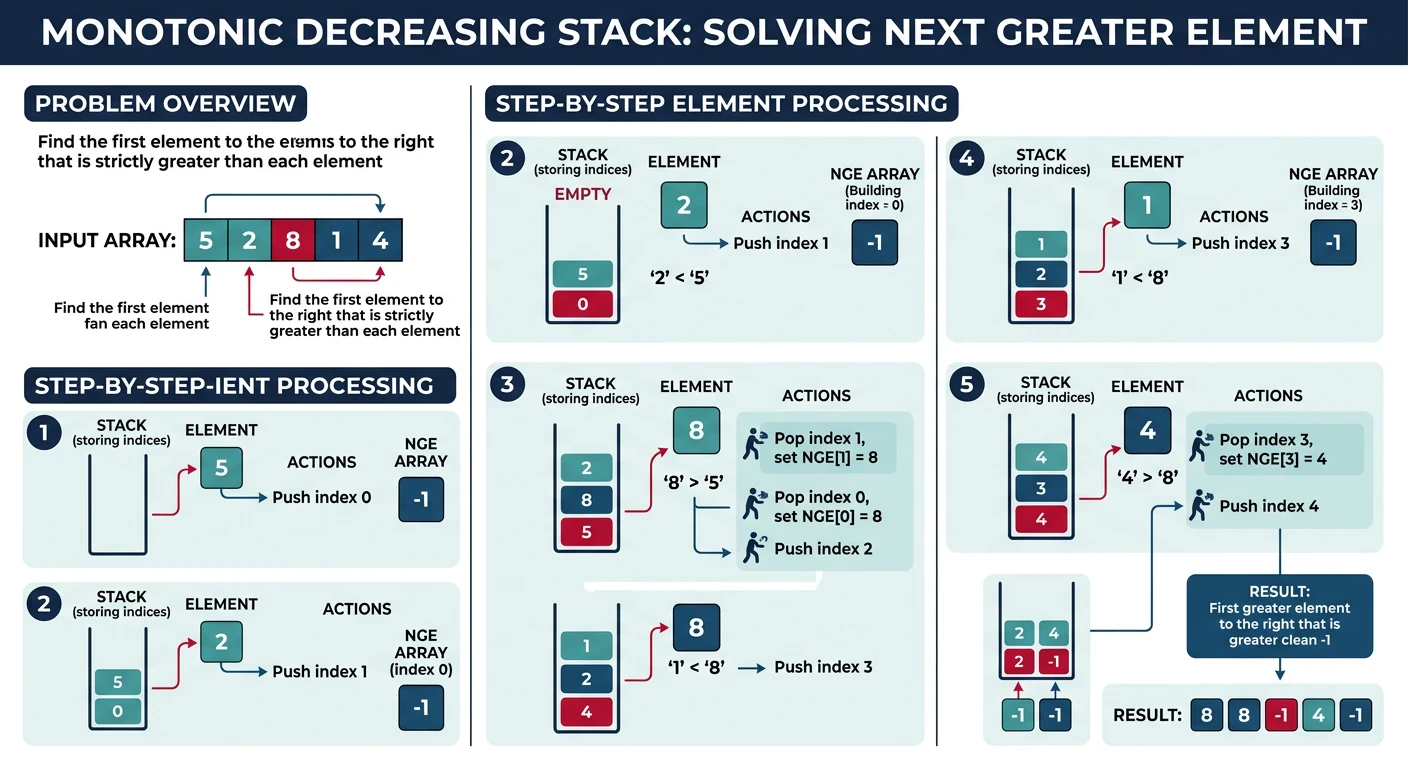
Next Greater Element
Python
# Next Greater Element - Monotonic Decreasing Stack
# Time: O(n), Space: O(n)
def next_greater_element(nums):
n = len(nums)
result = [-1] * n
stack = [] # Stack of indices
for i in range(n):
while stack and nums[stack[-1]] < nums[i]:
result[stack.pop()] = nums[i]
stack.append(i)
return result
# Test
nums = [4, 5, 2, 10, 8]
print(next_greater_element(nums)) # [5, 10, 10, -1, -1]
C++
// Next Greater Element - Monotonic Stack
#include <iostream>
#include <vector>
#include <stack>
using namespace std;
vector<int> nextGreaterElement(vector<int>& nums) {
int n = nums.size();
vector<int> result(n, -1);
stack<int> stk; // Stack of indices
for (int i = 0; i < n; i++) {
while (!stk.empty() && nums[stk.top()] < nums[i]) {
result[stk.top()] = nums[i];
stk.pop();
}
stk.push(i);
}
return result;
}
int main() {
vector<int> nums = {4, 5, 2, 10, 8};
vector<int> nge = nextGreaterElement(nums);
// Output: [5, 10, 10, -1, -1]
for (int x : nge) cout << x << " ";
return 0;
}
Java
// Next Greater Element - Monotonic Stack
import java.util.*;
public class NextGreaterElement {
public static int[] nextGreater(int[] nums) {
int n = nums.length;
int[] result = new int[n];
Arrays.fill(result, -1);
Stack<Integer> stack = new Stack<>(); // Stack of indices
for (int i = 0; i < n; i++) {
while (!stack.isEmpty() && nums[stack.peek()] < nums[i]) {
result[stack.pop()] = nums[i];
}
stack.push(i);
}
return result;
}
public static void main(String[] args) {
int[] nums = {4, 5, 2, 10, 8};
int[] nge = nextGreater(nums);
System.out.println(Arrays.toString(nge)); // [5, 10, 10, -1, -1]
}
}
Python - Circular Array
# Next Greater Element (Circular Array)
def next_greater_circular(nums):
n = len(nums)
result = [-1] * n
stack = []
# Process array twice to handle circular nature
for i in range(2 * n):
idx = i % n
while stack and nums[stack[-1]] < nums[idx]:
result[stack.pop()] = nums[idx]
if i < n:
stack.append(idx)
return result
# Test
print(next_greater_circular([1, 2, 1])) # [2, -1, 2]
Python - Next Smaller Element
# Next Smaller Element - Monotonic Increasing Stack
def next_smaller_element(nums):
n = len(nums)
result = [-1] * n
stack = []
for i in range(n):
while stack and nums[stack[-1]] > nums[i]:
result[stack.pop()] = nums[i]
stack.append(i)
return result
# Test
nums = [4, 5, 2, 10, 8]
print(next_smaller_element(nums)) # [2, 2, -1, 8, -1]
Daily Temperatures
Python
# Daily Temperatures - Classic Monotonic Stack Problem
def daily_temperatures(temperatures):
n = len(temperatures)
result = [0] * n
stack = [] # Stack of indices
for i in range(n):
while stack and temperatures[stack[-1]] < temperatures[i]:
prev_idx = stack.pop()
result[prev_idx] = i - prev_idx
stack.append(i)
return result
# Test
temps = [73, 74, 75, 71, 69, 72, 76, 73]
print(daily_temperatures(temps)) # [1, 1, 4, 2, 1, 1, 0, 0]
C++
// Daily Temperatures - Monotonic Stack
#include <iostream>
#include <vector>
#include <stack>
using namespace std;
vector<int> dailyTemperatures(vector<int>& temps) {
int n = temps.size();
vector<int> result(n, 0);
stack<int> stk;
for (int i = 0; i < n; i++) {
while (!stk.empty() && temps[stk.top()] < temps[i]) {
int prevIdx = stk.top();
stk.pop();
result[prevIdx] = i - prevIdx;
}
stk.push(i);
}
return result;
}
int main() {
vector<int> temps = {73, 74, 75, 71, 69, 72, 76, 73};
vector<int> days = dailyTemperatures(temps);
// Output: [1, 1, 4, 2, 1, 1, 0, 0]
for (int d : days) cout << d << " ";
return 0;
}
Java
// Daily Temperatures - Monotonic Stack
import java.util.*;
public class DailyTemperatures {
public static int[] dailyTemperatures(int[] temps) {
int n = temps.length;
int[] result = new int[n];
Stack<Integer> stack = new Stack<>();
for (int i = 0; i < n; i++) {
while (!stack.isEmpty() && temps[stack.peek()] < temps[i]) {
int prevIdx = stack.pop();
result[prevIdx] = i - prevIdx;
}
stack.push(i);
}
return result;
}
public static void main(String[] args) {
int[] temps = {73, 74, 75, 71, 69, 72, 76, 73};
int[] days = dailyTemperatures(temps);
System.out.println(Arrays.toString(days)); // [1, 1, 4, 2, 1, 1, 0, 0]
}
}
LeetCode Practice Problems
Easy 20. Valid Parentheses
Determine if the input string has valid bracket pairs.
Python
# LeetCode 20 - Valid Parentheses
# Time: O(n), Space: O(n)
def isValid(s):
stack = []
mapping = {')': '(', ']': '[', '}': '{'}
for char in s:
if char in mapping:
if not stack or stack[-1] != mapping[char]:
return False
stack.pop()
else:
stack.append(char)
return len(stack) == 0
# Test
print(isValid("()[]{}")) # True
print(isValid("([)]")) # False
C++
bool isValid(string s) {
stack<char> stk;
unordered_map<char, char> mapping = {{')', '('}, {']', '['}, {'}', '{'}};
for (char c : s) {
if (mapping.count(c)) {
if (stk.empty() || stk.top() != mapping[c])
return false;
stk.pop();
} else {
stk.push(c);
}
}
return stk.empty();
}
Java
public boolean isValid(String s) {
Stack<Character> stack = new Stack<>();
Map<Character, Character> map = Map.of(')', '(', ']', '[', '}', '{');
for (char c : s.toCharArray()) {
if (map.containsKey(c)) {
if (stack.isEmpty() || stack.peek() != map.get(c))
return false;
stack.pop();
} else {
stack.push(c);
}
}
return stack.isEmpty();
}
Easy 155. Min Stack
Design a stack that supports getMin() in O(1).
Python
# LeetCode 155 - Min Stack
class MinStack:
def __init__(self):
self.stack = []
self.min_stack = []
def push(self, val):
self.stack.append(val)
if not self.min_stack or val <= self.min_stack[-1]:
self.min_stack.append(val)
def pop(self):
val = self.stack.pop()
if val == self.min_stack[-1]:
self.min_stack.pop()
def top(self):
return self.stack[-1]
def getMin(self):
return self.min_stack[-1]
C++
class MinStack {
stack<int> stk;
stack<int> minStk;
public:
void push(int val) {
stk.push(val);
if (minStk.empty() || val <= minStk.top())
minStk.push(val);
}
void pop() {
if (stk.top() == minStk.top())
minStk.pop();
stk.pop();
}
int top() { return stk.top(); }
int getMin() { return minStk.top(); }
};
Java
class MinStack {
Stack<Integer> stack = new Stack<>();
Stack<Integer> minStack = new Stack<>();
public void push(int val) {
stack.push(val);
if (minStack.isEmpty() || val <= minStack.peek())
minStack.push(val);
}
public void pop() {
if (stack.pop().equals(minStack.peek()))
minStack.pop();
}
public int top() { return stack.peek(); }
public int getMin() { return minStack.peek(); }
}
Medium 150. Evaluate Reverse Polish Notation
Evaluate postfix expression given as array of tokens.
Python
# LeetCode 150 - Evaluate Reverse Polish Notation
def evalRPN(tokens):
stack = []
for token in tokens:
if token in {'+', '-', '*', '/'}:
b, a = stack.pop(), stack.pop()
if token == '+': stack.append(a + b)
elif token == '-': stack.append(a - b)
elif token == '*': stack.append(a * b)
elif token == '/': stack.append(int(a / b))
else:
stack.append(int(token))
return stack[0]
print(evalRPN(["2","1","+","3","*"])) # 9
C++
int evalRPN(vector<string>& tokens) {
stack<int> stk;
for (const string& token : tokens) {
if (token == "+" || token == "-" || token == "*" || token == "/") {
int b = stk.top(); stk.pop();
int a = stk.top(); stk.pop();
if (token == "+") stk.push(a + b);
else if (token == "-") stk.push(a - b);
else if (token == "*") stk.push(a * b);
else stk.push(a / b);
} else {
stk.push(stoi(token));
}
}
return stk.top();
}
Java
public int evalRPN(String[] tokens) {
Stack<Integer> stack = new Stack<>();
Set<String> ops = Set.of("+", "-", "*", "/");
for (String token : tokens) {
if (ops.contains(token)) {
int b = stack.pop(), a = stack.pop();
switch (token) {
case "+": stack.push(a + b); break;
case "-": stack.push(a - b); break;
case "*": stack.push(a * b); break;
case "/": stack.push(a / b); break;
}
} else {
stack.push(Integer.parseInt(token));
}
}
return stack.pop();
}
Medium 739. Daily Temperatures
Find how many days to wait for warmer temperature.
Python
# LeetCode 739 - Daily Temperatures
def dailyTemperatures(temperatures):
n = len(temperatures)
result = [0] * n
stack = []
for i in range(n):
while stack and temperatures[stack[-1]] < temperatures[i]:
prev = stack.pop()
result[prev] = i - prev
stack.append(i)
return result
C++
vector<int> dailyTemperatures(vector<int>& temps) {
int n = temps.size();
vector<int> result(n, 0);
stack<int> stk;
for (int i = 0; i < n; i++) {
while (!stk.empty() && temps[stk.top()] < temps[i]) {
result[stk.top()] = i - stk.top();
stk.pop();
}
stk.push(i);
}
return result;
}
Java
public int[] dailyTemperatures(int[] temps) {
int n = temps.length;
int[] result = new int[n];
Stack<Integer> stack = new Stack<>();
for (int i = 0; i < n; i++) {
while (!stack.isEmpty() && temps[stack.peek()] < temps[i]) {
int prev = stack.pop();
result[prev] = i - prev;
}
stack.push(i);
}
return result;
}
Medium 84. Largest Rectangle in Histogram
Find the largest rectangle in a histogram.
Python
# LeetCode 84 - Largest Rectangle in Histogram
def largestRectangleArea(heights):
stack = [] # (index, height)
max_area = 0
for i, h in enumerate(heights):
start = i
while stack and stack[-1][1] > h:
idx, height = stack.pop()
max_area = max(max_area, height * (i - idx))
start = idx
stack.append((start, h))
for idx, height in stack:
max_area = max(max_area, height * (len(heights) - idx))
return max_area
print(largestRectangleArea([2,1,5,6,2,3])) # 10
C++
int largestRectangleArea(vector<int>& heights) {
stack<pair<int, int>> stk; // (index, height)
int maxArea = 0;
for (int i = 0; i < heights.size(); i++) {
int start = i;
while (!stk.empty() && stk.top().second > heights[i]) {
auto [idx, h] = stk.top();
stk.pop();
maxArea = max(maxArea, h * (i - idx));
start = idx;
}
stk.push({start, heights[i]});
}
while (!stk.empty()) {
auto [idx, h] = stk.top();
stk.pop();
maxArea = max(maxArea, h * ((int)heights.size() - idx));
}
return maxArea;
}
Java
public int largestRectangleArea(int[] heights) {
Stack<int[]> stack = new Stack<>(); // [index, height]
int maxArea = 0;
for (int i = 0; i < heights.length; i++) {
int start = i;
while (!stack.isEmpty() && stack.peek()[1] > heights[i]) {
int[] top = stack.pop();
maxArea = Math.max(maxArea, top[1] * (i - top[0]));
start = top[0];
}
stack.push(new int[]{start, heights[i]});
}
while (!stack.isEmpty()) {
int[] top = stack.pop();
maxArea = Math.max(maxArea, top[1] * (heights.length - top[0]));
}
return maxArea;
}
Hard 32. Longest Valid Parentheses
Find the length of the longest valid parentheses substring.
Python
# LeetCode 32 - Longest Valid Parentheses
def longestValidParentheses(s):
stack = [-1] # Base index
max_len = 0
for i, char in enumerate(s):
if char == '(':
stack.append(i)
else:
stack.pop()
if not stack:
stack.append(i) # New base
else:
max_len = max(max_len, i - stack[-1])
return max_len
print(longestValidParentheses(")()())")) # 4
C++
int longestValidParentheses(string s) {
stack<int> stk;
stk.push(-1); // Base index
int maxLen = 0;
for (int i = 0; i < s.length(); i++) {
if (s[i] == '(') {
stk.push(i);
} else {
stk.pop();
if (stk.empty()) {
stk.push(i); // New base
} else {
maxLen = max(maxLen, i - stk.top());
}
}
}
return maxLen;
}
Java
public int longestValidParentheses(String s) {
Stack<Integer> stack = new Stack<>();
stack.push(-1); // Base index
int maxLen = 0;
for (int i = 0; i < s.length(); i++) {
if (s.charAt(i) == '(') {
stack.push(i);
} else {
stack.pop();
if (stack.isEmpty()) {
stack.push(i); // New base
} else {
maxLen = Math.max(maxLen, i - stack.peek());
}
}
}
return maxLen;
}