String Fundamentals
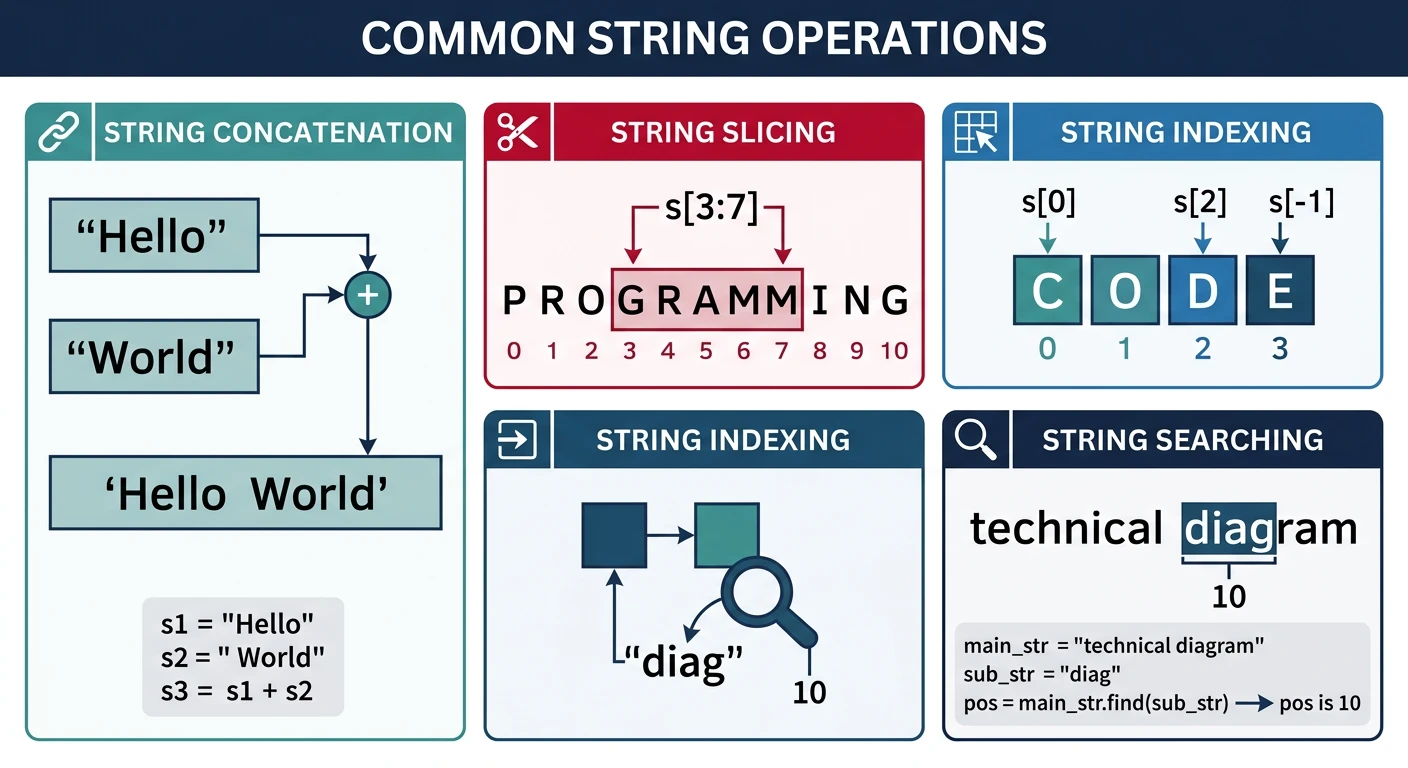
Strings are one of the most common data types in programming and appear in nearly every FAANG interview. A string is a sequence of characters—understanding their internal representation and common operations is essential.
FAANG Interview Prep
String Representation
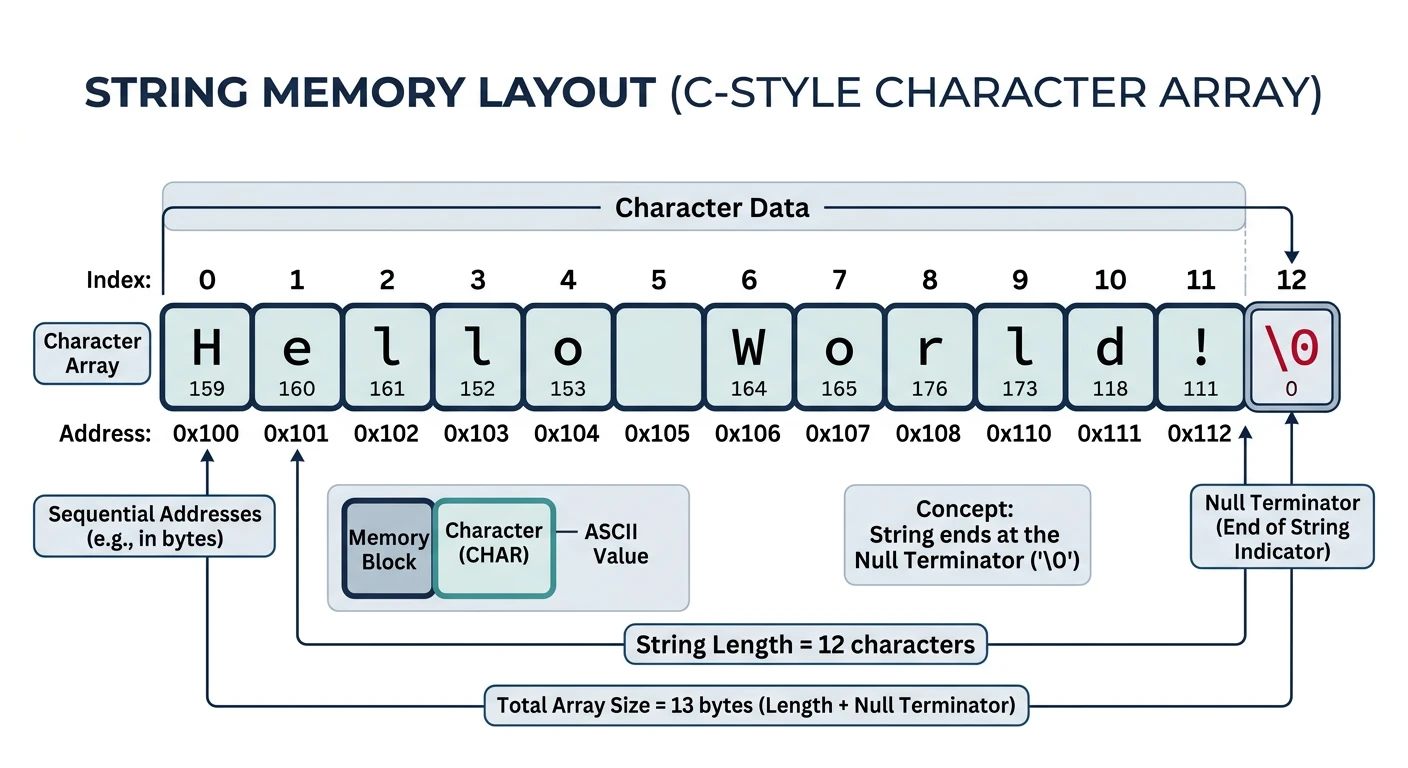
Understanding how strings are stored in memory helps optimize string-heavy algorithms.
Python
# String Representation and Character Encoding
# ASCII: 7-bit (128 chars), Extended ASCII: 8-bit (256 chars)
# Unicode: Up to 1,114,112 code points
# Character to ASCII
char = 'A'
print(f"'{char}' ? ASCII: {ord(char)}") # 65
# ASCII to Character
ascii_val = 97
print(f"{ascii_val} ? Character: {chr(ascii_val)}") # 'a'
# String to list of ASCII values
text = "Hello"
ascii_list = [ord(c) for c in text]
print(f"'{text}' ? ASCII: {ascii_list}") # [72, 101, 108, 108, 111]
# Memory demonstration
import sys
s1 = "Hello"
s2 = "Hello World"
s3 = "Hello" * 100
print(f"\nString Memory Usage:")
print(f"'{s1}' (5 chars): {sys.getsizeof(s1)} bytes")
print(f"'{s2}' (11 chars): {sys.getsizeof(s2)} bytes")
print(f"'Hello' * 100 (500 chars): {sys.getsizeof(s3)} bytes")
# String interning (Python optimizes small strings)
a = "hello"
b = "hello"
print(f"\nString Interning:")
print(f"a = 'hello', b = 'hello'")
print(f"a is b: {a is b}") # True - same object!
C++
#include <iostream>
#include <string>
#include <vector>
using namespace std;
int main() {
// Character to ASCII
char c = 'A';
cout << "'" << c << "' ? ASCII: " << (int)c << endl; // 65
// ASCII to Character
int asciiVal = 97;
cout << asciiVal << " ? Character: " << (char)asciiVal << endl; // 'a'
// String to vector of ASCII values
string text = "Hello";
vector<int> asciiList;
cout << "'" << text << "' ? ASCII: [";
for (int i = 0; i < text.length(); i++) {
asciiList.push_back((int)text[i]);
cout << (int)text[i];
if (i < text.length() - 1) cout << ", ";
}
cout << "]" << endl; // [72, 101, 108, 108, 111]
// String memory - C++ strings are mutable!
string s1 = "Hello";
string s2 = "Hello World";
cout << "\nString Sizes (C++ strings are mutable):" << endl;
cout << "'" << s1 << "': capacity=" << s1.capacity()
<< ", size=" << s1.size() << endl;
cout << "'" << s2 << "': capacity=" << s2.capacity()
<< ", size=" << s2.size() << endl;
// No interning in C++ - each string is separate
string a = "hello";
string b = "hello";
cout << "\nNo String Interning in C++:" << endl;
cout << "a == b: " << (a == b ? "true" : "false") << endl; // true (value)
cout << "&a == &b: " << (&a == &b ? "true" : "false") << endl; // false (different objects)
return 0;
}
Java
public class StringRepresentation {
public static void main(String[] args) {
// Character to ASCII
char c = 'A';
System.out.println("'" + c + "' ? ASCII: " + (int)c); // 65
// ASCII to Character
int asciiVal = 97;
System.out.println(asciiVal + " ? Character: " + (char)asciiVal); // 'a'
// String to array of ASCII values
String text = "Hello";
int[] asciiList = new int[text.length()];
System.out.print("'" + text + "' ? ASCII: [");
for (int i = 0; i < text.length(); i++) {
asciiList[i] = (int)text.charAt(i);
System.out.print(asciiList[i]);
if (i < text.length() - 1) System.out.print(", ");
}
System.out.println("]"); // [72, 101, 108, 108, 111]
// Java strings are immutable like Python
String s1 = "Hello";
String s2 = "Hello World";
StringBuilder s3 = new StringBuilder();
for (int i = 0; i < 100; i++) s3.append("Hello");
System.out.println("\nString Memory (Java strings are immutable):");
System.out.println("'" + s1 + "' (5 chars): " + s1.length() + " chars");
System.out.println("'" + s2 + "' (11 chars): " + s2.length() + " chars");
// String interning (Java pools literal strings)
String a = "hello";
String b = "hello";
String c2 = new String("hello");
System.out.println("\nString Interning in Java:");
System.out.println("a == b: " + (a == b)); // true - same pooled object
System.out.println("a == c (new String): " + (a == c2)); // false - different objects
System.out.println("a.equals(c): " + a.equals(c2)); // true - same value
}
}
Basic String Operations
Python
# Common String Operations and Their Complexities
# 1. Length - O(1) in Python (stored as attribute)
s = "Hello World"
print(f"Length: {len(s)}") # 11
# 2. Indexing - O(1)
print(f"First char: {s[0]}") # 'H'
print(f"Last char: {s[-1]}") # 'd'
# 3. Slicing - O(k) where k is slice length
print(f"Slice [0:5]: {s[0:5]}") # 'Hello'
print(f"Slice [6:]: {s[6:]}") # 'World'
print(f"Reverse: {s[::-1]}") # 'dlroW olleH'
# 4. Concatenation - O(n+m) creates new string
s1 = "Hello"
s2 = "World"
s3 = s1 + " " + s2 # O(len(s1) + len(s2))
print(f"Concatenation: {s3}")
# 5. Membership testing - O(n)
print(f"'World' in s: {'World' in s}") # True
# 6. Find/Index - O(n*m) worst case
text = "Hello World"
print(f"Find 'World': {text.find('World')}") # 6
print(f"Find 'xyz': {text.find('xyz')}") # -1
# 7. Count - O(n)
print(f"Count 'l': {text.count('l')}") # 3
# 8. Split - O(n)
words = text.split()
print(f"Split: {words}") # ['Hello', 'World']
# 9. Join - O(total_length)
joined = "-".join(words)
print(f"Join: {joined}") # 'Hello-World'
# 10. Replace - O(n)
replaced = text.replace("World", "Python")
print(f"Replace: {replaced}") # 'Hello Python'
C++
#include <iostream>
#include <string>
#include <vector>
#include <sstream>
#include <algorithm>
using namespace std;
int main() {
// 1. Length - O(1)
string s = "Hello World";
cout << "Length: " << s.length() << endl; // 11
// 2. Indexing - O(1)
cout << "First char: " << s[0] << endl; // 'H'
cout << "Last char: " << s[s.length()-1] << endl; // 'd'
// 3. Substring - O(k)
cout << "Substr [0,5): " << s.substr(0, 5) << endl; // 'Hello'
cout << "Substr [6,]: " << s.substr(6) << endl; // 'World'
// Reverse string
string reversed = s;
reverse(reversed.begin(), reversed.end());
cout << "Reverse: " << reversed << endl; // 'dlroW olleH'
// 4. Concatenation - O(n+m), but C++ strings are mutable
string s1 = "Hello";
string s2 = "World";
string s3 = s1 + " " + s2;
cout << "Concatenation: " << s3 << endl;
// 5. Find substring - O(n*m) worst
string text = "Hello World";
size_t pos = text.find("World");
cout << "Find 'World': " << pos << endl; // 6
pos = text.find("xyz");
cout << "Find 'xyz': " << (pos == string::npos ? -1 : (int)pos) << endl; // -1
// 6. Count occurrences - O(n)
int count = 0;
for (char c : text) if (c == 'l') count++;
cout << "Count 'l': " << count << endl; // 3
// 7. Split - O(n) using stringstream
vector<string> words;
istringstream iss(text);
string word;
while (iss >> word) words.push_back(word);
cout << "Split: [";
for (int i = 0; i < words.size(); i++) {
cout << "'" << words[i] << "'";
if (i < words.size()-1) cout << ", ";
}
cout << "]" << endl; // ['Hello', 'World']
// 8. Join - O(total_length)
string joined;
for (int i = 0; i < words.size(); i++) {
joined += words[i];
if (i < words.size()-1) joined += "-";
}
cout << "Join: " << joined << endl; // 'Hello-World'
// 9. Replace - using algorithm
string replaced = text;
size_t start = replaced.find("World");
if (start != string::npos) {
replaced.replace(start, 5, "C++");
}
cout << "Replace: " << replaced << endl; // 'Hello C++'
return 0;
}
Java
import java.util.*;
public class StringOperations {
public static void main(String[] args) {
// 1. Length - O(1)
String s = "Hello World";
System.out.println("Length: " + s.length()); // 11
// 2. Indexing - O(1)
System.out.println("First char: " + s.charAt(0)); // 'H'
System.out.println("Last char: " + s.charAt(s.length()-1)); // 'd'
// 3. Substring - O(k)
System.out.println("Substring [0,5): " + s.substring(0, 5)); // 'Hello'
System.out.println("Substring [6,]: " + s.substring(6)); // 'World'
// Reverse string
String reversed = new StringBuilder(s).reverse().toString();
System.out.println("Reverse: " + reversed); // 'dlroW olleH'
// 4. Concatenation - O(n+m), use StringBuilder for efficiency
String s1 = "Hello";
String s2 = "World";
String s3 = s1 + " " + s2;
System.out.println("Concatenation: " + s3);
// 5. Find substring - O(n*m) worst
String text = "Hello World";
System.out.println("Find 'World': " + text.indexOf("World")); // 6
System.out.println("Find 'xyz': " + text.indexOf("xyz")); // -1
// 6. Count occurrences - O(n)
int count = 0;
for (char c : text.toCharArray()) {
if (c == 'l') count++;
}
System.out.println("Count 'l': " + count); // 3
// 7. Split - O(n)
String[] words = text.split(" ");
System.out.println("Split: " + Arrays.toString(words)); // [Hello, World]
// 8. Join - O(total_length)
String joined = String.join("-", words);
System.out.println("Join: " + joined); // 'Hello-World'
// 9. Replace - O(n)
String replaced = text.replace("World", "Java");
System.out.println("Replace: " + replaced); // 'Hello Java'
}
}
Efficient String Building
Python
# String Building: Wrong vs Right Way
import time
# WRONG: String concatenation in loop - O(n²)
def build_string_wrong(n):
result = ""
for i in range(n):
result += str(i) # Creates new string each time!
return result
# RIGHT: Using list and join - O(n)
def build_string_right(n):
parts = []
for i in range(n):
parts.append(str(i))
return "".join(parts)
# ALSO RIGHT: List comprehension + join - O(n)
def build_string_comprehension(n):
return "".join(str(i) for i in range(n))
# Performance comparison
n = 10000
start = time.time()
build_string_wrong(n)
wrong_time = time.time() - start
start = time.time()
build_string_right(n)
right_time = time.time() - start
start = time.time()
build_string_comprehension(n)
comp_time = time.time() - start
print(f"String Building Performance (n={n}):")
print(f" Concatenation (wrong): {wrong_time:.4f}s")
print(f" List + join (right): {right_time:.4f}s")
print(f" Comprehension + join: {comp_time:.4f}s")
print(f" Speedup: {wrong_time/right_time:.1f}x faster!")
C++
#include <iostream>
#include <string>
#include <sstream>
#include <chrono>
using namespace std;
using namespace std::chrono;
// SLOWER: String concatenation (still O(n) due to mutable strings, but less efficient)
string buildStringConcat(int n) {
string result = "";
for (int i = 0; i < n; i++) {
result += to_string(i); // Repeated reallocations
}
return result;
}
// BETTER: Reserve capacity first
string buildStringReserve(int n) {
string result;
result.reserve(n * 4); // Pre-allocate space
for (int i = 0; i < n; i++) {
result += to_string(i);
}
return result;
}
// BEST: Use stringstream
string buildStringStream(int n) {
stringstream ss;
for (int i = 0; i < n; i++) {
ss << i;
}
return ss.str();
}
int main() {
int n = 100000;
auto start = high_resolution_clock::now();
buildStringConcat(n);
auto concatTime = duration_cast<milliseconds>(
high_resolution_clock::now() - start).count();
start = high_resolution_clock::now();
buildStringReserve(n);
auto reserveTime = duration_cast<milliseconds>(
high_resolution_clock::now() - start).count();
start = high_resolution_clock::now();
buildStringStream(n);
auto streamTime = duration_cast<milliseconds>(
high_resolution_clock::now() - start).count();
cout << "String Building Performance (n=" << n << "):" << endl;
cout << " Concatenation: " << concatTime << "ms" << endl;
cout << " With reserve(): " << reserveTime << "ms" << endl;
cout << " StringStream: " << streamTime << "ms" << endl;
return 0;
}
Java
public class StringBuilding {
// WRONG: String concatenation in loop - O(n²) due to immutable strings
static String buildStringWrong(int n) {
String result = "";
for (int i = 0; i < n; i++) {
result += i; // Creates new String each time!
}
return result;
}
// RIGHT: Using StringBuilder - O(n)
static String buildStringRight(int n) {
StringBuilder sb = new StringBuilder();
for (int i = 0; i < n; i++) {
sb.append(i);
}
return sb.toString();
}
// ALSO RIGHT: With initial capacity for better performance
static String buildStringCapacity(int n) {
StringBuilder sb = new StringBuilder(n * 4); // Pre-allocate
for (int i = 0; i < n; i++) {
sb.append(i);
}
return sb.toString();
}
public static void main(String[] args) {
int n = 10000;
long start = System.nanoTime();
buildStringWrong(n);
long wrongTime = (System.nanoTime() - start) / 1_000_000;
start = System.nanoTime();
buildStringRight(n);
long rightTime = (System.nanoTime() - start) / 1_000_000;
start = System.nanoTime();
buildStringCapacity(n);
long capTime = (System.nanoTime() - start) / 1_000_000;
System.out.println("String Building Performance (n=" + n + "):");
System.out.println(" Concatenation (wrong): " + wrongTime + "ms");
System.out.println(" StringBuilder (right): " + rightTime + "ms");
System.out.println(" With capacity: " + capTime + "ms");
if (rightTime > 0) {
System.out.println(" Speedup: " + (wrongTime/rightTime) + "x faster!");
}
}
}
Pattern Matching Algorithms
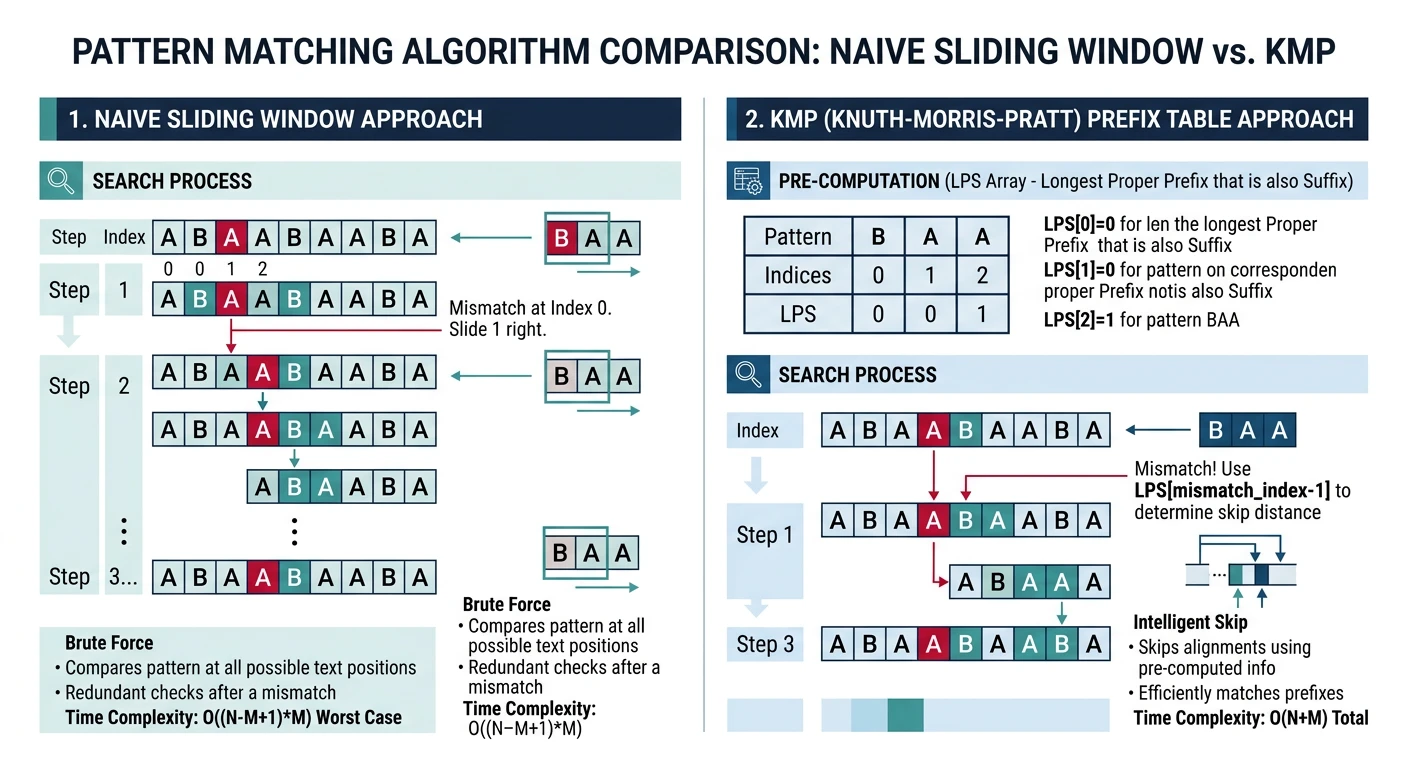
Pattern matching—finding a pattern within a text—is a fundamental problem with applications in text editors, search engines, and bioinformatics.
Naive (Brute Force) Algorithm
Python
# Naive Pattern Matching
# Time: O((n-m+1) × m) where n=text length, m=pattern length
# Space: O(1)
def naive_search(text, pattern):
"""
Find all occurrences of pattern in text.
Returns list of starting indices.
"""
n = len(text)
m = len(pattern)
occurrences = []
# Slide pattern over text
for i in range(n - m + 1):
match = True
# Check each character
for j in range(m):
if text[i + j] != pattern[j]:
match = False
break
if match:
occurrences.append(i)
return occurrences
# Test
text = "AABAACAADAABAAABAA"
pattern = "AABA"
result = naive_search(text, pattern)
print(f"Text: {text}")
print(f"Pattern: {pattern}")
print(f"Found at indices: {result}") # [0, 9, 13]
# Visualize matches
for idx in result:
print(f" Position {idx}: {text[idx:idx+len(pattern)]}")
C++
#include <iostream>
#include <string>
#include <vector>
using namespace std;
// Naive Pattern Matching
// Time: O((n-m+1) × m), Space: O(1)
vector<int> naiveSearch(const string& text, const string& pattern) {
int n = text.length();
int m = pattern.length();
vector<int> occurrences;
// Slide pattern over text
for (int i = 0; i <= n - m; i++) {
bool match = true;
// Check each character
for (int j = 0; j < m; j++) {
if (text[i + j] != pattern[j]) {
match = false;
break;
}
}
if (match) {
occurrences.push_back(i);
}
}
return occurrences;
}
int main() {
string text = "AABAACAADAABAAABAA";
string pattern = "AABA";
vector<int> result = naiveSearch(text, pattern);
cout << "Text: " << text << endl;
cout << "Pattern: " << pattern << endl;
cout << "Found at indices: [";
for (int i = 0; i < result.size(); i++) {
cout << result[i];
if (i < result.size() - 1) cout << ", ";
}
cout << "]" << endl; // [0, 9, 13]
// Visualize matches
for (int idx : result) {
cout << " Position " << idx << ": "
<< text.substr(idx, pattern.length()) << endl;
}
return 0;
}
Java
import java.util.*;
public class NaivePatternMatch {
// Naive Pattern Matching
// Time: O((n-m+1) × m), Space: O(1)
static List<Integer> naiveSearch(String text, String pattern) {
int n = text.length();
int m = pattern.length();
List<Integer> occurrences = new ArrayList<>();
// Slide pattern over text
for (int i = 0; i <= n - m; i++) {
boolean match = true;
// Check each character
for (int j = 0; j < m; j++) {
if (text.charAt(i + j) != pattern.charAt(j)) {
match = false;
break;
}
}
if (match) {
occurrences.add(i);
}
}
return occurrences;
}
public static void main(String[] args) {
String text = "AABAACAADAABAAABAA";
String pattern = "AABA";
List<Integer> result = naiveSearch(text, pattern);
System.out.println("Text: " + text);
System.out.println("Pattern: " + pattern);
System.out.println("Found at indices: " + result); // [0, 9, 13]
// Visualize matches
for (int idx : result) {
System.out.println(" Position " + idx + ": " +
text.substring(idx, idx + pattern.length()));
}
}
}
KMP (Knuth-Morris-Pratt) Algorithm
KMP improves on naive search by avoiding re-examination of matched characters. It preprocesses the pattern to build a "failure function" (LPS array).
Python
# KMP Pattern Matching Algorithm
# Time: O(n + m) - linear!
# Space: O(m) for LPS array
def compute_lps(pattern):
"""
Compute Longest Proper Prefix which is also Suffix (LPS) array.
LPS[i] = length of longest proper prefix of pattern[0..i]
which is also a suffix of pattern[0..i]
"""
m = len(pattern)
lps = [0] * m
length = 0 # Length of previous longest prefix suffix
i = 1
while i < m:
if pattern[i] == pattern[length]:
length += 1
lps[i] = length
i += 1
else:
if length != 0:
# Try shorter prefix
length = lps[length - 1]
else:
lps[i] = 0
i += 1
return lps
def kmp_search(text, pattern):
"""
KMP pattern matching algorithm.
Returns list of starting indices where pattern is found.
"""
n = len(text)
m = len(pattern)
if m == 0:
return []
# Compute LPS array
lps = compute_lps(pattern)
occurrences = []
i = 0 # Index for text
j = 0 # Index for pattern
while i < n:
if pattern[j] == text[i]:
i += 1
j += 1
if j == m:
# Found pattern
occurrences.append(i - j)
j = lps[j - 1] # Use LPS to skip
elif i < n and pattern[j] != text[i]:
if j != 0:
j = lps[j - 1] # Use LPS to skip
else:
i += 1
return occurrences
# Test KMP
text = "AABAACAADAABAAABAA"
pattern = "AABA"
lps = compute_lps(pattern)
print(f"Pattern: {pattern}")
print(f"LPS array: {lps}")
result = kmp_search(text, pattern)
print(f"\nText: {text}")
print(f"Pattern found at: {result}") # [0, 9, 13]
# Step-by-step LPS example
pattern2 = "AABAACAAB"
lps2 = compute_lps(pattern2)
print(f"\nPattern: {pattern2}")
print(f"Index: {list(range(len(pattern2)))}")
print(f"LPS: {lps2}")
C++
#include <iostream>
#include <string>
#include <vector>
using namespace std;
// Compute LPS (Longest Proper Prefix which is also Suffix) array
vector<int> computeLPS(const string& pattern) {
int m = pattern.length();
vector<int> lps(m, 0);
int length = 0; // Length of previous longest prefix suffix
int i = 1;
while (i < m) {
if (pattern[i] == pattern[length]) {
length++;
lps[i] = length;
i++;
} else {
if (length != 0) {
// Try shorter prefix
length = lps[length - 1];
} else {
lps[i] = 0;
i++;
}
}
}
return lps;
}
// KMP Pattern Matching - O(n + m)
vector<int> kmpSearch(const string& text, const string& pattern) {
int n = text.length();
int m = pattern.length();
vector<int> occurrences;
if (m == 0) return occurrences;
vector<int> lps = computeLPS(pattern);
int i = 0; // Index for text
int j = 0; // Index for pattern
while (i < n) {
if (pattern[j] == text[i]) {
i++;
j++;
}
if (j == m) {
// Found pattern
occurrences.push_back(i - j);
j = lps[j - 1]; // Use LPS to skip
} else if (i < n && pattern[j] != text[i]) {
if (j != 0) {
j = lps[j - 1]; // Use LPS to skip
} else {
i++;
}
}
}
return occurrences;
}
int main() {
string text = "AABAACAADAABAAABAA";
string pattern = "AABA";
vector<int> lps = computeLPS(pattern);
cout << "Pattern: " << pattern << endl;
cout << "LPS array: [";
for (int i = 0; i < lps.size(); i++) {
cout << lps[i];
if (i < lps.size() - 1) cout << ", ";
}
cout << "]" << endl;
vector<int> result = kmpSearch(text, pattern);
cout << "\nText: " << text << endl;
cout << "Pattern found at: [";
for (int i = 0; i < result.size(); i++) {
cout << result[i];
if (i < result.size() - 1) cout << ", ";
}
cout << "]" << endl; // [0, 9, 13]
return 0;
}
Java
import java.util.*;
public class KMPAlgorithm {
// Compute LPS (Longest Proper Prefix which is also Suffix) array
static int[] computeLPS(String pattern) {
int m = pattern.length();
int[] lps = new int[m];
int length = 0; // Length of previous longest prefix suffix
int i = 1;
while (i < m) {
if (pattern.charAt(i) == pattern.charAt(length)) {
length++;
lps[i] = length;
i++;
} else {
if (length != 0) {
// Try shorter prefix
length = lps[length - 1];
} else {
lps[i] = 0;
i++;
}
}
}
return lps;
}
// KMP Pattern Matching - O(n + m)
static List<Integer> kmpSearch(String text, String pattern) {
int n = text.length();
int m = pattern.length();
List<Integer> occurrences = new ArrayList<>();
if (m == 0) return occurrences;
int[] lps = computeLPS(pattern);
int i = 0; // Index for text
int j = 0; // Index for pattern
while (i < n) {
if (pattern.charAt(j) == text.charAt(i)) {
i++;
j++;
}
if (j == m) {
// Found pattern
occurrences.add(i - j);
j = lps[j - 1]; // Use LPS to skip
} else if (i < n && pattern.charAt(j) != text.charAt(i)) {
if (j != 0) {
j = lps[j - 1]; // Use LPS to skip
} else {
i++;
}
}
}
return occurrences;
}
public static void main(String[] args) {
String text = "AABAACAADAABAAABAA";
String pattern = "AABA";
int[] lps = computeLPS(pattern);
System.out.println("Pattern: " + pattern);
System.out.println("LPS array: " + Arrays.toString(lps));
List<Integer> result = kmpSearch(text, pattern);
System.out.println("\nText: " + text);
System.out.println("Pattern found at: " + result); // [0, 9, 13]
}
}
Rabin-Karp Algorithm
Rabin-Karp uses hashing to find pattern matches. It's particularly useful for multiple pattern search and plagiarism detection.
Python
# Rabin-Karp Algorithm with Rolling Hash
# Average Time: O(n + m)
# Worst Time: O(n × m) - many hash collisions
# Space: O(1)
def rabin_karp(text, pattern, base=256, prime=101):
"""
Rabin-Karp pattern matching using rolling hash.
Hash function: h = (c[0]*base^(m-1) + c[1]*base^(m-2) + ... + c[m-1]) % prime
Rolling hash: Remove first char, add new char
new_hash = (base * (old_hash - text[i-1] * base^(m-1)) + text[i+m-1]) % prime
"""
n = len(text)
m = len(pattern)
occurrences = []
if m > n:
return occurrences
# Precompute base^(m-1) % prime
h = pow(base, m - 1, prime)
# Calculate hash of pattern and first window of text
pattern_hash = 0
text_hash = 0
for i in range(m):
pattern_hash = (base * pattern_hash + ord(pattern[i])) % prime
text_hash = (base * text_hash + ord(text[i])) % prime
# Slide pattern over text
for i in range(n - m + 1):
# Check hash match
if pattern_hash == text_hash:
# Verify character by character (avoid false positives)
if text[i:i+m] == pattern:
occurrences.append(i)
# Calculate hash for next window using rolling hash
if i < n - m:
# Remove leading digit, add trailing digit
text_hash = (base * (text_hash - ord(text[i]) * h) + ord(text[i + m])) % prime
# Handle negative hash
if text_hash < 0:
text_hash += prime
return occurrences
# Test Rabin-Karp
text = "AABAACAADAABAAABAA"
pattern = "AABA"
result = rabin_karp(text, pattern)
print(f"Text: {text}")
print(f"Pattern: {pattern}")
print(f"Found at indices: {result}") # [0, 9, 13]
# Hash collision demonstration
print("\nHash values during search:")
m = len(pattern)
for i in range(len(text) - m + 1):
window = text[i:i+m]
h = sum(ord(c) * (256 ** (m-1-j)) for j, c in enumerate(window)) % 101
match = "? MATCH!" if window == pattern else ""
print(f" Window '{window}': hash={h} {match}")
C++
#include <iostream>
#include <string>
#include <vector>
using namespace std;
// Rabin-Karp Algorithm with Rolling Hash
// Average Time: O(n + m), Worst: O(n × m)
vector<int> rabinKarp(const string& text, const string& pattern,
int base = 256, int prime = 101) {
int n = text.length();
int m = pattern.length();
vector<int> occurrences;
if (m > n) return occurrences;
// Precompute base^(m-1) % prime
long long h = 1;
for (int i = 0; i < m - 1; i++) {
h = (h * base) % prime;
}
// Calculate hash of pattern and first window of text
long long patternHash = 0;
long long textHash = 0;
for (int i = 0; i < m; i++) {
patternHash = (base * patternHash + pattern[i]) % prime;
textHash = (base * textHash + text[i]) % prime;
}
// Slide pattern over text
for (int i = 0; i <= n - m; i++) {
// Check hash match
if (patternHash == textHash) {
// Verify character by character
bool match = true;
for (int j = 0; j < m; j++) {
if (text[i + j] != pattern[j]) {
match = false;
break;
}
}
if (match) {
occurrences.push_back(i);
}
}
// Calculate hash for next window (rolling hash)
if (i < n - m) {
textHash = (base * (textHash - text[i] * h) + text[i + m]) % prime;
// Handle negative hash
if (textHash < 0) {
textHash += prime;
}
}
}
return occurrences;
}
int main() {
string text = "AABAACAADAABAAABAA";
string pattern = "AABA";
vector<int> result = rabinKarp(text, pattern);
cout << "Text: " << text << endl;
cout << "Pattern: " << pattern << endl;
cout << "Found at indices: [";
for (int i = 0; i < result.size(); i++) {
cout << result[i];
if (i < result.size() - 1) cout << ", ";
}
cout << "]" << endl; // [0, 9, 13]
return 0;
}
Java
import java.util.*;
public class RabinKarpAlgorithm {
// Rabin-Karp Algorithm with Rolling Hash
// Average Time: O(n + m), Worst: O(n × m)
static List<Integer> rabinKarp(String text, String pattern,
int base, int prime) {
int n = text.length();
int m = pattern.length();
List<Integer> occurrences = new ArrayList<>();
if (m > n) return occurrences;
// Precompute base^(m-1) % prime
long h = 1;
for (int i = 0; i < m - 1; i++) {
h = (h * base) % prime;
}
// Calculate hash of pattern and first window of text
long patternHash = 0;
long textHash = 0;
for (int i = 0; i < m; i++) {
patternHash = (base * patternHash + pattern.charAt(i)) % prime;
textHash = (base * textHash + text.charAt(i)) % prime;
}
// Slide pattern over text
for (int i = 0; i <= n - m; i++) {
// Check hash match
if (patternHash == textHash) {
// Verify character by character
if (text.substring(i, i + m).equals(pattern)) {
occurrences.add(i);
}
}
// Calculate hash for next window (rolling hash)
if (i < n - m) {
textHash = (base * (textHash - text.charAt(i) * h)
+ text.charAt(i + m)) % prime;
// Handle negative hash
if (textHash < 0) {
textHash += prime;
}
}
}
return occurrences;
}
public static void main(String[] args) {
String text = "AABAACAADAABAAABAA";
String pattern = "AABA";
List<Integer> result = rabinKarp(text, pattern, 256, 101);
System.out.println("Text: " + text);
System.out.println("Pattern: " + pattern);
System.out.println("Found at indices: " + result); // [0, 9, 13]
}
}
Pattern Matching Comparison
| Algorithm | Preprocessing | Search Time | Best For |
|---|---|---|---|
| Naive | None | O(n×m) | Short patterns, simple cases |
| KMP | O(m) | O(n) | Single pattern, guaranteed linear |
| Rabin-Karp | O(m) | O(n) average | Multiple patterns, plagiarism detection |
Palindrome Algorithms
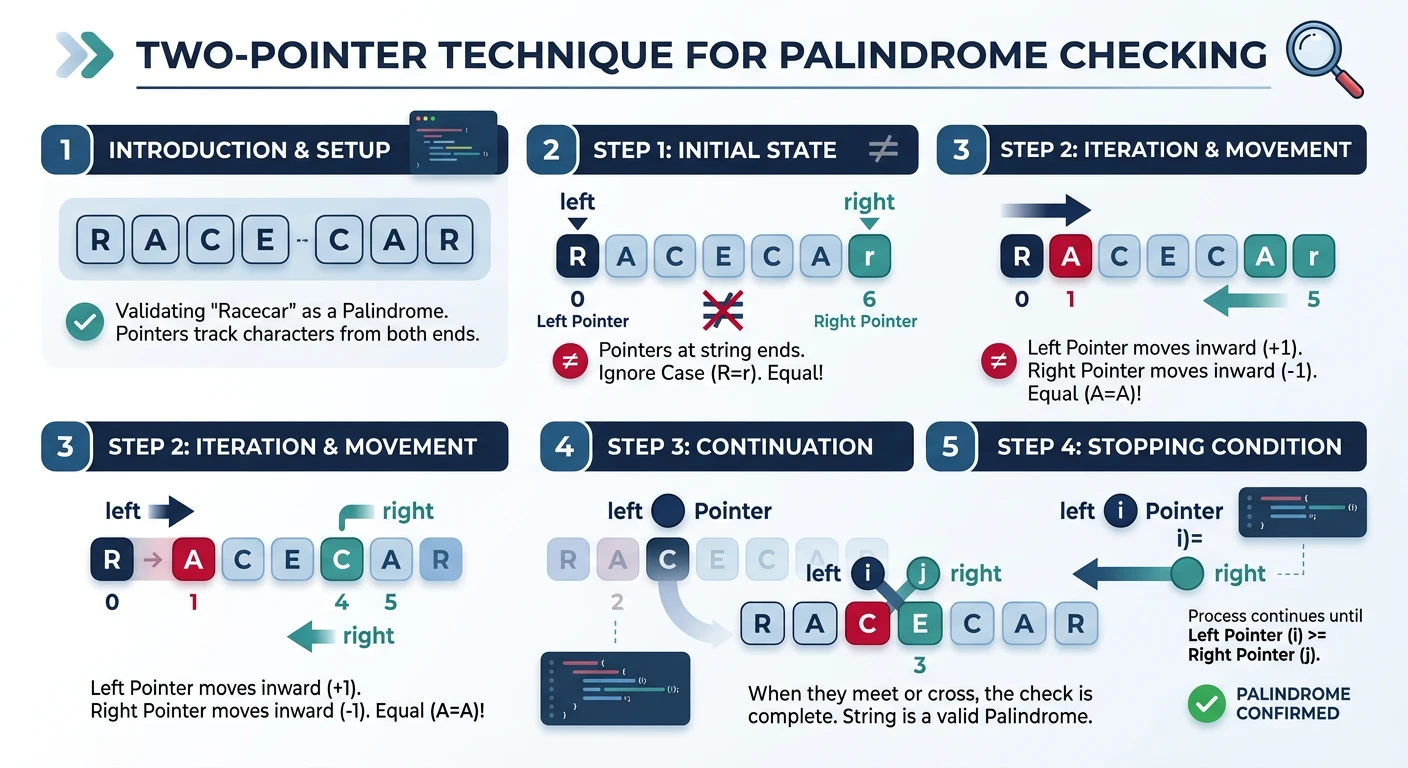
Palindromes read the same forwards and backwards. They appear frequently in interviews!
Python
# Palindrome Checking Methods
def is_palindrome_two_pointer(s):
"""
Two-pointer approach.
Time: O(n), Space: O(1)
"""
left, right = 0, len(s) - 1
while left < right:
if s[left] != s[right]:
return False
left += 1
right -= 1
return True
def is_palindrome_reverse(s):
"""
Reverse and compare.
Time: O(n), Space: O(n)
"""
return s == s[::-1]
def is_palindrome_recursive(s):
"""
Recursive approach.
Time: O(n), Space: O(n) - call stack
"""
if len(s) <= 1:
return True
if s[0] != s[-1]:
return False
return is_palindrome_recursive(s[1:-1])
def is_valid_palindrome(s):
"""
Check palindrome ignoring non-alphanumeric and case.
LeetCode 125 - Valid Palindrome
Time: O(n), Space: O(1)
"""
left, right = 0, len(s) - 1
while left < right:
# Skip non-alphanumeric from left
while left < right and not s[left].isalnum():
left += 1
# Skip non-alphanumeric from right
while left < right and not s[right].isalnum():
right -= 1
if s[left].lower() != s[right].lower():
return False
left += 1
right -= 1
return True
# Test palindrome functions
test_strings = ["racecar", "hello", "A man a plan a canal Panama", "12321"]
print("Palindrome Tests:")
for s in test_strings:
clean = ''.join(c.lower() for c in s if c.isalnum())
result = is_palindrome_two_pointer(clean)
print(f" '{s}' ? {result}")
# Valid palindrome (with special chars)
print("\nValid Palindrome (ignoring case/special chars):")
print(f" 'A man, a plan, a canal: Panama' ? {is_valid_palindrome('A man, a plan, a canal: Panama')}")
print(f" 'race a car' ? {is_valid_palindrome('race a car')}")
C++
#include <iostream>
#include <string>
#include <algorithm>
#include <cctype>
using namespace std;
// Two-pointer approach - O(n), O(1)
bool isPalindromeTwoPointer(const string& s) {
int left = 0, right = s.length() - 1;
while (left < right) {
if (s[left] != s[right]) {
return false;
}
left++;
right--;
}
return true;
}
// Reverse and compare - O(n), O(n)
bool isPalindromeReverse(const string& s) {
string reversed = s;
reverse(reversed.begin(), reversed.end());
return s == reversed;
}
// Recursive approach - O(n), O(n) stack
bool isPalindromeRecursive(const string& s, int left, int right) {
if (left >= right) return true;
if (s[left] != s[right]) return false;
return isPalindromeRecursive(s, left + 1, right - 1);
}
// Valid palindrome ignoring non-alphanumeric - LeetCode 125
bool isValidPalindrome(const string& s) {
int left = 0, right = s.length() - 1;
while (left < right) {
// Skip non-alphanumeric from left
while (left < right && !isalnum(s[left])) left++;
// Skip non-alphanumeric from right
while (left < right && !isalnum(s[right])) right--;
if (tolower(s[left]) != tolower(s[right])) {
return false;
}
left++;
right--;
}
return true;
}
int main() {
// Test cases
string tests[] = {"racecar", "hello", "12321"};
cout << "Palindrome Tests:" << endl;
for (const string& s : tests) {
cout << " '" << s << "' ? "
<< (isPalindromeTwoPointer(s) ? "true" : "false") << endl;
}
cout << "\nValid Palindrome (ignoring case/special chars):" << endl;
cout << " 'A man, a plan, a canal: Panama' ? "
<< (isValidPalindrome("A man, a plan, a canal: Panama") ? "true" : "false")
<< endl;
cout << " 'race a car' ? "
<< (isValidPalindrome("race a car") ? "true" : "false") << endl;
return 0;
}
Java
public class PalindromeCheck {
// Two-pointer approach - O(n), O(1)
static boolean isPalindromeTwoPointer(String s) {
int left = 0, right = s.length() - 1;
while (left < right) {
if (s.charAt(left) != s.charAt(right)) {
return false;
}
left++;
right--;
}
return true;
}
// Reverse and compare - O(n), O(n)
static boolean isPalindromeReverse(String s) {
String reversed = new StringBuilder(s).reverse().toString();
return s.equals(reversed);
}
// Recursive approach - O(n), O(n) stack
static boolean isPalindromeRecursive(String s, int left, int right) {
if (left >= right) return true;
if (s.charAt(left) != s.charAt(right)) return false;
return isPalindromeRecursive(s, left + 1, right - 1);
}
// Valid palindrome ignoring non-alphanumeric - LeetCode 125
static boolean isValidPalindrome(String s) {
int left = 0, right = s.length() - 1;
while (left < right) {
// Skip non-alphanumeric from left
while (left < right && !Character.isLetterOrDigit(s.charAt(left))) {
left++;
}
// Skip non-alphanumeric from right
while (left < right && !Character.isLetterOrDigit(s.charAt(right))) {
right--;
}
if (Character.toLowerCase(s.charAt(left)) !=
Character.toLowerCase(s.charAt(right))) {
return false;
}
left++;
right--;
}
return true;
}
public static void main(String[] args) {
String[] tests = {"racecar", "hello", "12321"};
System.out.println("Palindrome Tests:");
for (String s : tests) {
System.out.println(" '" + s + "' ? " + isPalindromeTwoPointer(s));
}
System.out.println("\nValid Palindrome (ignoring case/special chars):");
System.out.println(" 'A man, a plan, a canal: Panama' ? " +
isValidPalindrome("A man, a plan, a canal: Panama"));
System.out.println(" 'race a car' ? " +
isValidPalindrome("race a car"));
}
}
Longest Palindromic Substring
Finding the longest palindromic substring is a classic interview question. The expand-around-center approach is optimal for interviews.
Python
# Longest Palindromic Substring
# Expand Around Center Approach
# Time: O(n²), Space: O(1)
def longest_palindrome(s):
"""
Find longest palindromic substring using expand around center.
Key insight: A palindrome mirrors around its center.
There are 2n-1 such centers (n single chars + n-1 between chars).
"""
if not s:
return ""
def expand_around_center(left, right):
"""Expand outward while characters match."""
while left >= 0 and right < len(s) and s[left] == s[right]:
left -= 1
right += 1
# Return the palindrome (left+1 to right-1 inclusive)
return s[left + 1:right]
result = ""
for i in range(len(s)):
# Odd length palindrome (single center)
odd = expand_around_center(i, i)
if len(odd) > len(result):
result = odd
# Even length palindrome (two centers)
even = expand_around_center(i, i + 1)
if len(even) > len(result):
result = even
return result
# Test
test_strings = ["babad", "cbbd", "abcba", "ac", "a", "racecar"]
print("Longest Palindromic Substring:")
for s in test_strings:
result = longest_palindrome(s)
print(f" '{s}' ? '{result}' (length {len(result)})")
# Trace example
s = "babad"
print(f"\nTrace for '{s}':")
for i in range(len(s)):
print(f" Center at index {i} ('{s[i]}'):")
# Odd expansion
l, r = i, i
while l >= 0 and r < len(s) and s[l] == s[r]:
print(f" Odd: '{s[l:r+1]}'")
l -= 1
r += 1
# Even expansion
l, r = i, i + 1
while l >= 0 and r < len(s) and s[l] == s[r]:
print(f" Even: '{s[l:r+1]}'")
l -= 1
r += 1
C++
#include <iostream>
#include <string>
using namespace std;
// Longest Palindromic Substring - Expand Around Center
// Time: O(n²), Space: O(1)
string longestPalindrome(const string& s) {
if (s.empty()) return "";
int start = 0, maxLen = 1;
// Helper to expand around center
auto expandAroundCenter = [&](int left, int right) {
while (left >= 0 && right < s.length() && s[left] == s[right]) {
if (right - left + 1 > maxLen) {
start = left;
maxLen = right - left + 1;
}
left--;
right++;
}
};
for (int i = 0; i < s.length(); i++) {
// Odd length palindrome
expandAroundCenter(i, i);
// Even length palindrome
expandAroundCenter(i, i + 1);
}
return s.substr(start, maxLen);
}
int main() {
string tests[] = {"babad", "cbbd", "abcba", "ac", "a", "racecar"};
cout << "Longest Palindromic Substring:" << endl;
for (const string& s : tests) {
string result = longestPalindrome(s);
cout << " '" << s << "' ? '" << result
<< "' (length " << result.length() << ")" << endl;
}
return 0;
}
Java
public class LongestPalindrome {
// Longest Palindromic Substring - Expand Around Center
// Time: O(n²), Space: O(1)
static int start = 0, maxLen = 1;
static void expandAroundCenter(String s, int left, int right) {
while (left >= 0 && right < s.length() &&
s.charAt(left) == s.charAt(right)) {
if (right - left + 1 > maxLen) {
start = left;
maxLen = right - left + 1;
}
left--;
right++;
}
}
static String longestPalindrome(String s) {
if (s == null || s.isEmpty()) return "";
start = 0;
maxLen = 1;
for (int i = 0; i < s.length(); i++) {
// Odd length palindrome
expandAroundCenter(s, i, i);
// Even length palindrome
expandAroundCenter(s, i, i + 1);
}
return s.substring(start, start + maxLen);
}
public static void main(String[] args) {
String[] tests = {"babad", "cbbd", "abcba", "ac", "a", "racecar"};
System.out.println("Longest Palindromic Substring:");
for (String s : tests) {
String result = longestPalindrome(s);
System.out.println(" '" + s + "' ? '" + result +
"' (length " + result.length() + ")");
}
}
}
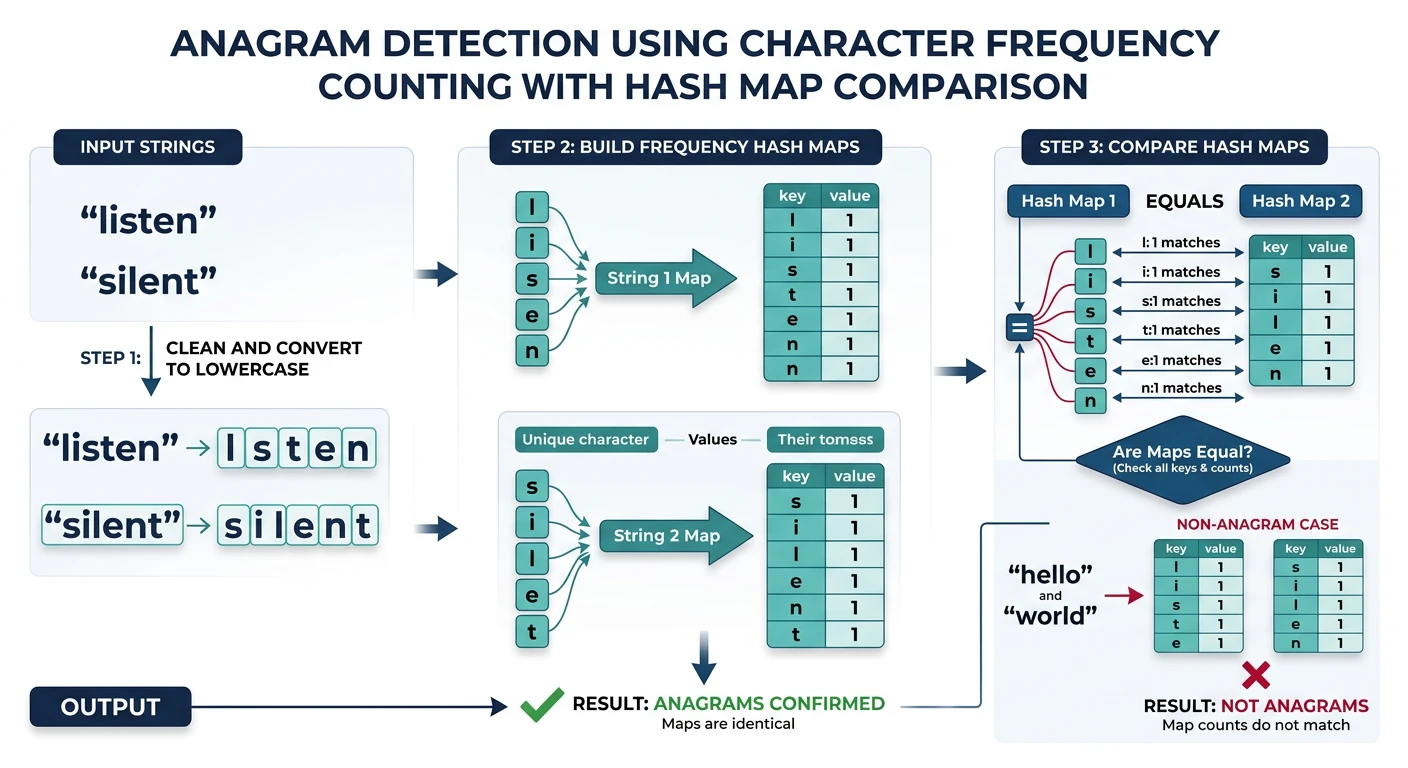
Anagram Algorithms
Anagrams are words formed by rearranging letters of another word. They're common in interview questions!
Python
# Anagram Detection Methods
from collections import Counter
def is_anagram_sort(s1, s2):
"""
Check anagram by sorting.
Time: O(n log n), Space: O(n)
"""
return sorted(s1) == sorted(s2)
def is_anagram_count(s1, s2):
"""
Check anagram using character count.
Time: O(n), Space: O(1) - fixed alphabet
"""
if len(s1) != len(s2):
return False
# Count characters
count = [0] * 26 # Assuming lowercase a-z
for c1, c2 in zip(s1, s2):
count[ord(c1) - ord('a')] += 1
count[ord(c2) - ord('a')] -= 1
return all(c == 0 for c in count)
def is_anagram_counter(s1, s2):
"""
Check anagram using Counter.
Time: O(n), Space: O(n)
"""
return Counter(s1) == Counter(s2)
# Test anagram detection
pairs = [
("listen", "silent"),
("hello", "world"),
("anagram", "nagaram"),
("rat", "car")
]
print("Anagram Detection:")
for s1, s2 in pairs:
result = is_anagram_count(s1, s2)
print(f" '{s1}' vs '{s2}': {result}")
C++
#include <iostream>
#include <string>
#include <algorithm>
#include <vector>
using namespace std;
// Check anagram by sorting - O(n log n), O(n)
bool isAnagramSort(string s1, string s2) {
sort(s1.begin(), s1.end());
sort(s2.begin(), s2.end());
return s1 == s2;
}
// Check anagram using character count - O(n), O(1)
bool isAnagramCount(const string& s1, const string& s2) {
if (s1.length() != s2.length()) return false;
int count[26] = {0}; // Assuming lowercase a-z
for (int i = 0; i < s1.length(); i++) {
count[s1[i] - 'a']++;
count[s2[i] - 'a']--;
}
for (int i = 0; i < 26; i++) {
if (count[i] != 0) return false;
}
return true;
}
int main() {
vector<pair<string, string>> pairs = {
{"listen", "silent"},
{"hello", "world"},
{"anagram", "nagaram"},
{"rat", "car"}
};
cout << "Anagram Detection:" << endl;
for (const auto& p : pairs) {
bool result = isAnagramCount(p.first, p.second);
cout << " '" << p.first << "' vs '" << p.second
<< "': " << (result ? "true" : "false") << endl;
}
return 0;
}
Java
import java.util.*;
public class AnagramDetection {
// Check anagram by sorting - O(n log n), O(n)
static boolean isAnagramSort(String s1, String s2) {
char[] arr1 = s1.toCharArray();
char[] arr2 = s2.toCharArray();
Arrays.sort(arr1);
Arrays.sort(arr2);
return Arrays.equals(arr1, arr2);
}
// Check anagram using character count - O(n), O(1)
static boolean isAnagramCount(String s1, String s2) {
if (s1.length() != s2.length()) return false;
int[] count = new int[26]; // Assuming lowercase a-z
for (int i = 0; i < s1.length(); i++) {
count[s1.charAt(i) - 'a']++;
count[s2.charAt(i) - 'a']--;
}
for (int c : count) {
if (c != 0) return false;
}
return true;
}
public static void main(String[] args) {
String[][] pairs = {
{"listen", "silent"},
{"hello", "world"},
{"anagram", "nagaram"},
{"rat", "car"}
};
System.out.println("Anagram Detection:");
for (String[] p : pairs) {
boolean result = isAnagramCount(p[0], p[1]);
System.out.println(" '" + p[0] + "' vs '" + p[1] + "': " + result);
}
}
}
Group Anagrams
Python
# Group Anagrams - LeetCode 49
# Time: O(n × k log k) where n=words, k=max word length
# Space: O(n × k)
from collections import defaultdict
def group_anagrams_sort(strs):
"""
Group anagrams using sorted string as key.
"""
groups = defaultdict(list)
for s in strs:
# Sorted string is the key
key = tuple(sorted(s))
groups[key].append(s)
return list(groups.values())
def group_anagrams_count(strs):
"""
Group anagrams using character count as key.
Time: O(n × k) - no sorting needed
"""
groups = defaultdict(list)
for s in strs:
# Character count tuple as key
count = [0] * 26
for c in s:
count[ord(c) - ord('a')] += 1
key = tuple(count)
groups[key].append(s)
return list(groups.values())
# Test group anagrams
words = ["eat", "tea", "tan", "ate", "nat", "bat"]
print(f"Words: {words}")
print(f"\nGrouped (sort method):")
for group in group_anagrams_sort(words):
print(f" {group}")
print(f"\nGrouped (count method):")
for group in group_anagrams_count(words):
print(f" {group}")
C++
#include <iostream>
#include <string>
#include <vector>
#include <unordered_map>
#include <algorithm>
using namespace std;
// Group Anagrams - LeetCode 49
// Using sorted string as key - O(n × k log k)
vector<vector<string>> groupAnagramsSort(vector<string>& strs) {
unordered_map<string, vector<string>> groups;
for (const string& s : strs) {
string key = s;
sort(key.begin(), key.end());
groups[key].push_back(s);
}
vector<vector<string>> result;
for (auto& p : groups) {
result.push_back(move(p.second));
}
return result;
}
// Using character count as key - O(n × k)
vector<vector<string>> groupAnagramsCount(vector<string>& strs) {
unordered_map<string, vector<string>> groups;
for (const string& s : strs) {
// Create count key
int count[26] = {0};
for (char c : s) {
count[c - 'a']++;
}
// Convert count to string key
string key = "";
for (int i = 0; i < 26; i++) {
key += "#" + to_string(count[i]);
}
groups[key].push_back(s);
}
vector<vector<string>> result;
for (auto& p : groups) {
result.push_back(move(p.second));
}
return result;
}
int main() {
vector<string> words = {"eat", "tea", "tan", "ate", "nat", "bat"};
cout << "Words: [";
for (int i = 0; i < words.size(); i++) {
cout << "\"" << words[i] << "\"";
if (i < words.size() - 1) cout << ", ";
}
cout << "]" << endl;
cout << "\nGrouped (sort method):" << endl;
auto result = groupAnagramsSort(words);
for (const auto& group : result) {
cout << " [";
for (int i = 0; i < group.size(); i++) {
cout << "\"" << group[i] << "\"";
if (i < group.size() - 1) cout << ", ";
}
cout << "]" << endl;
}
return 0;
}
Java
import java.util.*;
public class GroupAnagrams {
// Group Anagrams - LeetCode 49
// Using sorted string as key - O(n × k log k)
static List<List<String>> groupAnagramsSort(String[] strs) {
Map<String, List<String>> groups = new HashMap<>();
for (String s : strs) {
char[] arr = s.toCharArray();
Arrays.sort(arr);
String key = new String(arr);
groups.computeIfAbsent(key, k -> new ArrayList<>()).add(s);
}
return new ArrayList<>(groups.values());
}
// Using character count as key - O(n × k)
static List<List<String>> groupAnagramsCount(String[] strs) {
Map<String, List<String>> groups = new HashMap<>();
for (String s : strs) {
// Create count key
int[] count = new int[26];
for (char c : s.toCharArray()) {
count[c - 'a']++;
}
// Convert count to string key
StringBuilder key = new StringBuilder();
for (int i = 0; i < 26; i++) {
key.append("#").append(count[i]);
}
groups.computeIfAbsent(key.toString(), k -> new ArrayList<>()).add(s);
}
return new ArrayList<>(groups.values());
}
public static void main(String[] args) {
String[] words = {"eat", "tea", "tan", "ate", "nat", "bat"};
System.out.println("Words: " + Arrays.toString(words));
System.out.println("\nGrouped (sort method):");
List<List<String>> result = groupAnagramsSort(words);
for (List<String> group : result) {
System.out.println(" " + group);
}
}
}
LeetCode Practice Problems
Master these string problems for FAANG interviews:
Easy 344. Reverse String
Reverse a string in-place using O(1) extra memory.
Python
# LeetCode 344 - Reverse String
# Time: O(n), Space: O(1)
def reverseString(s):
"""
Reverse string in-place using two pointers.
s is a list of characters.
"""
left, right = 0, len(s) - 1
while left < right:
s[left], s[right] = s[right], s[left]
left += 1
right -= 1
s = list("hello")
reverseString(s)
print("".join(s)) # "olleh"
s = list("Hannah")
reverseString(s)
print("".join(s)) # "hannaH"
C++
#include <iostream>
#include <vector>
#include <algorithm>
using namespace std;
// LeetCode 344 - Reverse String
// Time: O(n), Space: O(1)
void reverseString(vector<char>& s) {
int left = 0, right = s.size() - 1;
while (left < right) {
swap(s[left], s[right]);
left++;
right--;
}
}
int main() {
vector<char> s = {'h', 'e', 'l', 'l', 'o'};
reverseString(s);
for (char c : s) cout << c; // "olleh"
cout << endl;
return 0;
}
Java
// LeetCode 344 - Reverse String
// Time: O(n), Space: O(1)
class Solution {
public void reverseString(char[] s) {
int left = 0, right = s.length - 1;
while (left < right) {
char temp = s[left];
s[left] = s[right];
s[right] = temp;
left++;
right--;
}
}
}
// Test: char[] s = {'h','e','l','l','o'};
// Result: ['o','l','l','e','h']
Easy 125. Valid Palindrome
Check if string is palindrome considering only alphanumeric characters.
Python
# LeetCode 125 - Valid Palindrome
# Time: O(n), Space: O(1)
def isPalindrome(s):
left, right = 0, len(s) - 1
while left < right:
while left < right and not s[left].isalnum():
left += 1
while left < right and not s[right].isalnum():
right -= 1
if s[left].lower() != s[right].lower():
return False
left += 1
right -= 1
return True
print(isPalindrome("A man, a plan, a canal: Panama")) # True
print(isPalindrome("race a car")) # False
print(isPalindrome(" ")) # True
C++
#include <iostream>
#include <string>
#include <cctype>
using namespace std;
// LeetCode 125 - Valid Palindrome
// Time: O(n), Space: O(1)
bool isPalindrome(string s) {
int left = 0, right = s.length() - 1;
while (left < right) {
while (left < right && !isalnum(s[left])) left++;
while (left < right && !isalnum(s[right])) right--;
if (tolower(s[left]) != tolower(s[right])) {
return false;
}
left++;
right--;
}
return true;
}
int main() {
cout << boolalpha;
cout << isPalindrome("A man, a plan, a canal: Panama") << endl; // true
cout << isPalindrome("race a car") << endl; // false
return 0;
}
Java
// LeetCode 125 - Valid Palindrome
// Time: O(n), Space: O(1)
class Solution {
public boolean isPalindrome(String s) {
int left = 0, right = s.length() - 1;
while (left < right) {
while (left < right && !Character.isLetterOrDigit(s.charAt(left))) {
left++;
}
while (left < right && !Character.isLetterOrDigit(s.charAt(right))) {
right--;
}
if (Character.toLowerCase(s.charAt(left)) !=
Character.toLowerCase(s.charAt(right))) {
return false;
}
left++;
right--;
}
return true;
}
}
// Test: "A man, a plan, a canal: Panama" ? true
// Test: "race a car" ? false
Medium 5. Longest Palindromic Substring
Find the longest palindromic substring in s.
Python
# LeetCode 5 - Longest Palindromic Substring
# Time: O(n²), Space: O(1)
def longestPalindrome(s):
def expand(left, right):
while left >= 0 and right < len(s) and s[left] == s[right]:
left -= 1
right += 1
return s[left + 1:right]
result = ""
for i in range(len(s)):
# Odd length
odd = expand(i, i)
if len(odd) > len(result):
result = odd
# Even length
even = expand(i, i + 1)
if len(even) > len(result):
result = even
return result
print(longestPalindrome("babad")) # "bab" or "aba"
print(longestPalindrome("cbbd")) # "bb"
C++
#include <iostream>
#include <string>
using namespace std;
// LeetCode 5 - Longest Palindromic Substring
// Time: O(n²), Space: O(1)
class Solution {
public:
string longestPalindrome(string s) {
int start = 0, maxLen = 1;
for (int i = 0; i < s.length(); i++) {
// Odd length
expand(s, i, i, start, maxLen);
// Even length
expand(s, i, i + 1, start, maxLen);
}
return s.substr(start, maxLen);
}
private:
void expand(const string& s, int left, int right, int& start, int& maxLen) {
while (left >= 0 && right < s.length() && s[left] == s[right]) {
if (right - left + 1 > maxLen) {
start = left;
maxLen = right - left + 1;
}
left--;
right++;
}
}
};
// Test: "babad" ? "bab" or "aba"
// Test: "cbbd" ? "bb"
Java
// LeetCode 5 - Longest Palindromic Substring
// Time: O(n²), Space: O(1)
class Solution {
int start = 0, maxLen = 1;
public String longestPalindrome(String s) {
for (int i = 0; i < s.length(); i++) {
// Odd length
expand(s, i, i);
// Even length
expand(s, i, i + 1);
}
return s.substring(start, start + maxLen);
}
private void expand(String s, int left, int right) {
while (left >= 0 && right < s.length() &&
s.charAt(left) == s.charAt(right)) {
if (right - left + 1 > maxLen) {
start = left;
maxLen = right - left + 1;
}
left--;
right++;
}
}
}
// Test: "babad" ? "bab" or "aba"
// Test: "cbbd" ? "bb"
Medium 49. Group Anagrams
Group strings that are anagrams of each other.
Python
# LeetCode 49 - Group Anagrams
# Time: O(n × k), Space: O(n × k)
from collections import defaultdict
def groupAnagrams(strs):
groups = defaultdict(list)
for s in strs:
# Use character count as key
count = [0] * 26
for c in s:
count[ord(c) - ord('a')] += 1
groups[tuple(count)].append(s)
return list(groups.values())
result = groupAnagrams(["eat","tea","tan","ate","nat","bat"])
print(result) # [["eat","tea","ate"],["tan","nat"],["bat"]]
C++
#include <iostream>
#include <vector>
#include <string>
#include <unordered_map>
using namespace std;
// LeetCode 49 - Group Anagrams
// Time: O(n × k), Space: O(n × k)
vector<vector<string>> groupAnagrams(vector<string>& strs) {
unordered_map<string, vector<string>> groups;
for (const string& s : strs) {
int count[26] = {0};
for (char c : s) {
count[c - 'a']++;
}
// Create key from count
string key = "";
for (int i = 0; i < 26; i++) {
key += "#" + to_string(count[i]);
}
groups[key].push_back(s);
}
vector<vector<string>> result;
for (auto& p : groups) {
result.push_back(move(p.second));
}
return result;
}
// Test: ["eat","tea","tan","ate","nat","bat"]
// Result: [["eat","tea","ate"],["tan","nat"],["bat"]]
Java
import java.util.*;
// LeetCode 49 - Group Anagrams
// Time: O(n × k), Space: O(n × k)
class Solution {
public List<List<String>> groupAnagrams(String[] strs) {
Map<String, List<String>> groups = new HashMap<>();
for (String s : strs) {
int[] count = new int[26];
for (char c : s.toCharArray()) {
count[c - 'a']++;
}
// Create key from count
StringBuilder key = new StringBuilder();
for (int i = 0; i < 26; i++) {
key.append("#").append(count[i]);
}
groups.computeIfAbsent(key.toString(), k -> new ArrayList<>()).add(s);
}
return new ArrayList<>(groups.values());
}
}
// Test: ["eat","tea","tan","ate","nat","bat"]
// Result: [["eat","tea","ate"],["tan","nat"],["bat"]]
Medium 3. Longest Substring Without Repeating
Find length of longest substring without repeating characters.
Python
# LeetCode 3 - Longest Substring Without Repeating Characters
# Sliding Window approach
# Time: O(n), Space: O(min(n, m)) where m is charset size
def lengthOfLongestSubstring(s):
char_index = {} # Character -> last index
max_length = 0
start = 0
for end, char in enumerate(s):
# If char seen and in current window
if char in char_index and char_index[char] >= start:
start = char_index[char] + 1
char_index[char] = end
max_length = max(max_length, end - start + 1)
return max_length
print(lengthOfLongestSubstring("abcabcbb")) # 3 ("abc")
print(lengthOfLongestSubstring("bbbbb")) # 1 ("b")
print(lengthOfLongestSubstring("pwwkew")) # 3 ("wke")
C++
#include <iostream>
#include <string>
#include <unordered_map>
#include <algorithm>
using namespace std;
// LeetCode 3 - Longest Substring Without Repeating Characters
// Sliding Window - Time: O(n), Space: O(min(n, m))
int lengthOfLongestSubstring(string s) {
unordered_map<char, int> charIndex; // Character -> last index
int maxLength = 0;
int start = 0;
for (int end = 0; end < s.length(); end++) {
char c = s[end];
// If char seen and in current window
if (charIndex.count(c) && charIndex[c] >= start) {
start = charIndex[c] + 1;
}
charIndex[c] = end;
maxLength = max(maxLength, end - start + 1);
}
return maxLength;
}
int main() {
cout << lengthOfLongestSubstring("abcabcbb") << endl; // 3
cout << lengthOfLongestSubstring("bbbbb") << endl; // 1
cout << lengthOfLongestSubstring("pwwkew") << endl; // 3
return 0;
}
Java
import java.util.*;
// LeetCode 3 - Longest Substring Without Repeating Characters
// Sliding Window - Time: O(n), Space: O(min(n, m))
class Solution {
public int lengthOfLongestSubstring(String s) {
Map<Character, Integer> charIndex = new HashMap<>();
int maxLength = 0;
int start = 0;
for (int end = 0; end < s.length(); end++) {
char c = s.charAt(end);
// If char seen and in current window
if (charIndex.containsKey(c) && charIndex.get(c) >= start) {
start = charIndex.get(c) + 1;
}
charIndex.put(c, end);
maxLength = Math.max(maxLength, end - start + 1);
}
return maxLength;
}
}
// Test: "abcabcbb" ? 3 ("abc")
// Test: "bbbbb" ? 1 ("b")
// Test: "pwwkew" ? 3 ("wke")
Hard 76. Minimum Window Substring
Find minimum window in s containing all characters of t.
Python
# LeetCode 76 - Minimum Window Substring
# Sliding Window with two pointers
# Time: O(n + m), Space: O(m)
from collections import Counter
def minWindow(s, t):
if not t or not s:
return ""
# Count characters needed from t
need = Counter(t)
required = len(need)
# Sliding window
left = 0
formed = 0
window_counts = {}
# Result: (window_length, left, right)
result = float('inf'), None, None
for right in range(len(s)):
char = s[right]
window_counts[char] = window_counts.get(char, 0) + 1
# Check if current char satisfies requirement
if char in need and window_counts[char] == need[char]:
formed += 1
# Contract window until it's no longer valid
while left <= right and formed == required:
char = s[left]
# Update result
if right - left + 1 < result[0]:
result = (right - left + 1, left, right)
# Remove left char
window_counts[char] -= 1
if char in need and window_counts[char] < need[char]:
formed -= 1
left += 1
return "" if result[0] == float('inf') else s[result[1]:result[2] + 1]
print(minWindow("ADOBECODEBANC", "ABC")) # "BANC"
print(minWindow("a", "a")) # "a"
print(minWindow("a", "aa")) # ""
C++
#include <iostream>
#include <string>
#include <unordered_map>
#include <climits>
using namespace std;
// LeetCode 76 - Minimum Window Substring
// Sliding Window - Time: O(n + m), Space: O(m)
string minWindow(string s, string t) {
if (s.empty() || t.empty()) return "";
unordered_map<char, int> need, window;
for (char c : t) need[c]++;
int required = need.size();
int formed = 0;
int left = 0;
int minLen = INT_MAX;
int minLeft = 0;
for (int right = 0; right < s.length(); right++) {
char c = s[right];
window[c]++;
if (need.count(c) && window[c] == need[c]) {
formed++;
}
// Contract window
while (left <= right && formed == required) {
c = s[left];
if (right - left + 1 < minLen) {
minLen = right - left + 1;
minLeft = left;
}
window[c]--;
if (need.count(c) && window[c] < need[c]) {
formed--;
}
left++;
}
}
return minLen == INT_MAX ? "" : s.substr(minLeft, minLen);
}
int main() {
cout << minWindow("ADOBECODEBANC", "ABC") << endl; // "BANC"
cout << minWindow("a", "a") << endl; // "a"
cout << minWindow("a", "aa") << endl; // ""
return 0;
}
Java
import java.util.*;
// LeetCode 76 - Minimum Window Substring
// Sliding Window - Time: O(n + m), Space: O(m)
class Solution {
public String minWindow(String s, String t) {
if (s.isEmpty() || t.isEmpty()) return "";
Map<Character, Integer> need = new HashMap<>();
for (char c : t.toCharArray()) {
need.put(c, need.getOrDefault(c, 0) + 1);
}
int required = need.size();
int formed = 0;
int left = 0;
int minLen = Integer.MAX_VALUE;
int minLeft = 0;
Map<Character, Integer> window = new HashMap<>();
for (int right = 0; right < s.length(); right++) {
char c = s.charAt(right);
window.put(c, window.getOrDefault(c, 0) + 1);
if (need.containsKey(c) &&
window.get(c).intValue() == need.get(c).intValue()) {
formed++;
}
// Contract window
while (left <= right && formed == required) {
c = s.charAt(left);
if (right - left + 1 < minLen) {
minLen = right - left + 1;
minLeft = left;
}
window.put(c, window.get(c) - 1);
if (need.containsKey(c) && window.get(c) < need.get(c)) {
formed--;
}
left++;
}
}
return minLen == Integer.MAX_VALUE ? "" :
s.substring(minLeft, minLeft + minLen);
}
}
// Test: "ADOBECODEBANC", "ABC" ? "BANC"