1. Introduction
Every successful startup begins with a single insight—a recognition that something in the world could be better, faster, cheaper, or entirely reimagined. But where do these breakthrough ideas come from? And how do you distinguish between a genuine opportunity and a fleeting notion?
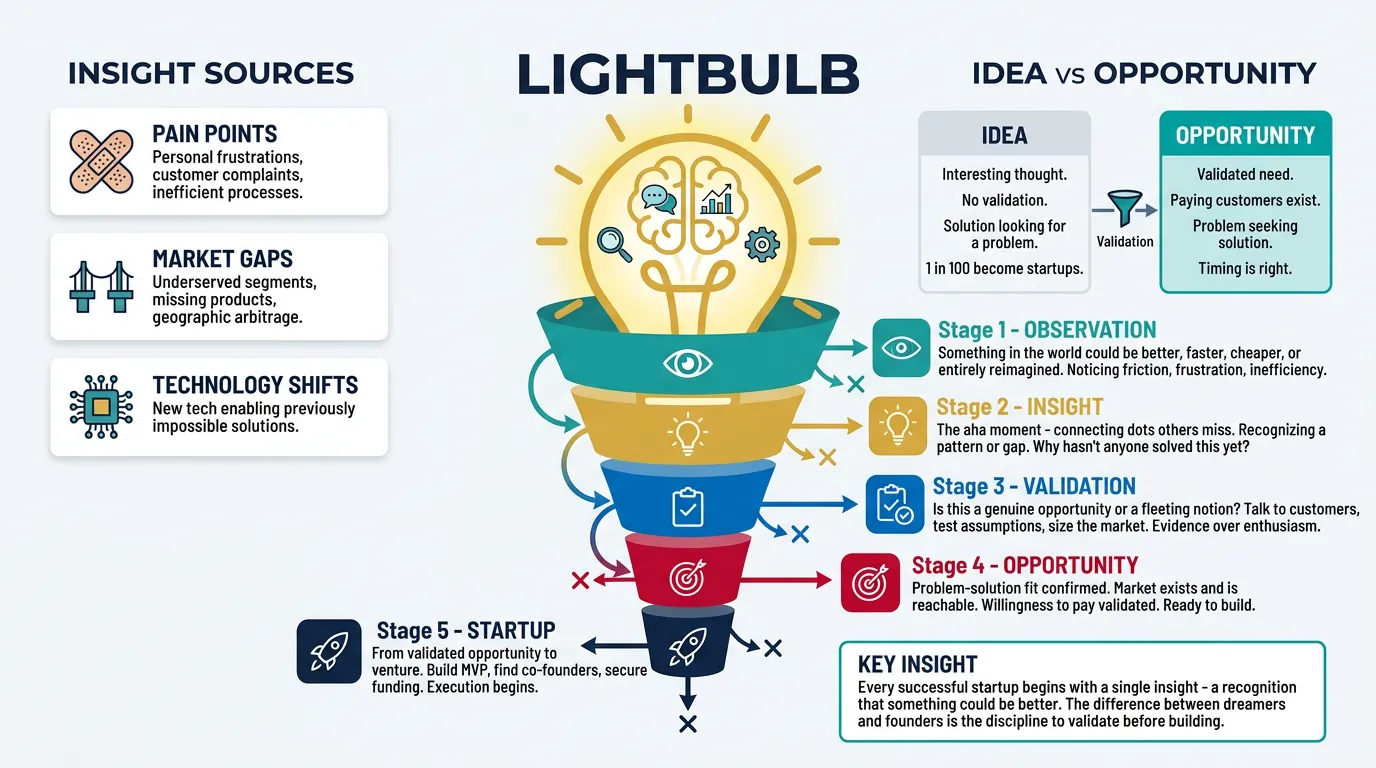
Complete Startup Journey
Ideation & Opportunity Recognition
Problem discovery, market gaps, idea generation frameworksIdea Validation & MVP Prototyping
Customer discovery, landing pages, prototype testingBusiness Models & Canvas
BMC, lean canvas, revenue models, value propositionsLean Startup Methodology
Build-measure-learn, pivoting, validated learningFundraising & Financial Modeling
VC, angels, SAFE notes, cap tables, financial projectionsBuilding Your Founding Team
Co-founder selection, equity splits, team dynamicsHiring & Company Culture
Recruiting, culture building, OKRs, team scalingScaling Operations & Growth Hacking
Growth loops, viral mechanics, operational scalingMarketing Campaigns & Digital Growth
CAC/LTV, digital marketing, positioning, channelsLegal, Financial & Risk Foundations
Entity structure, IP, compliance, burn rate managementData-Driven Decision Making
SaaS metrics, NPS, analytics dashboards, A/B testingExit Strategies & Investor Pitches
Valuations, pitch decks, M&A, IPO preparationStartup Ecosystem & Networking
Accelerators, mentors, communities, ecosystem mappingInnovation, Technology & Future Trends
Emerging tech, AI/ML, deep tech, future marketsCapstone Projects & Portfolio
Comprehensive startup plan, portfolio presentationSources of startup ideas, opportunity recognition frameworks (Problem-Solution Fit, Jobs-to-be-Done), market trend analysis, idea prioritization matrices, and the entrepreneurial mindset required for success.
2. Sources of Entrepreneurial Ideas
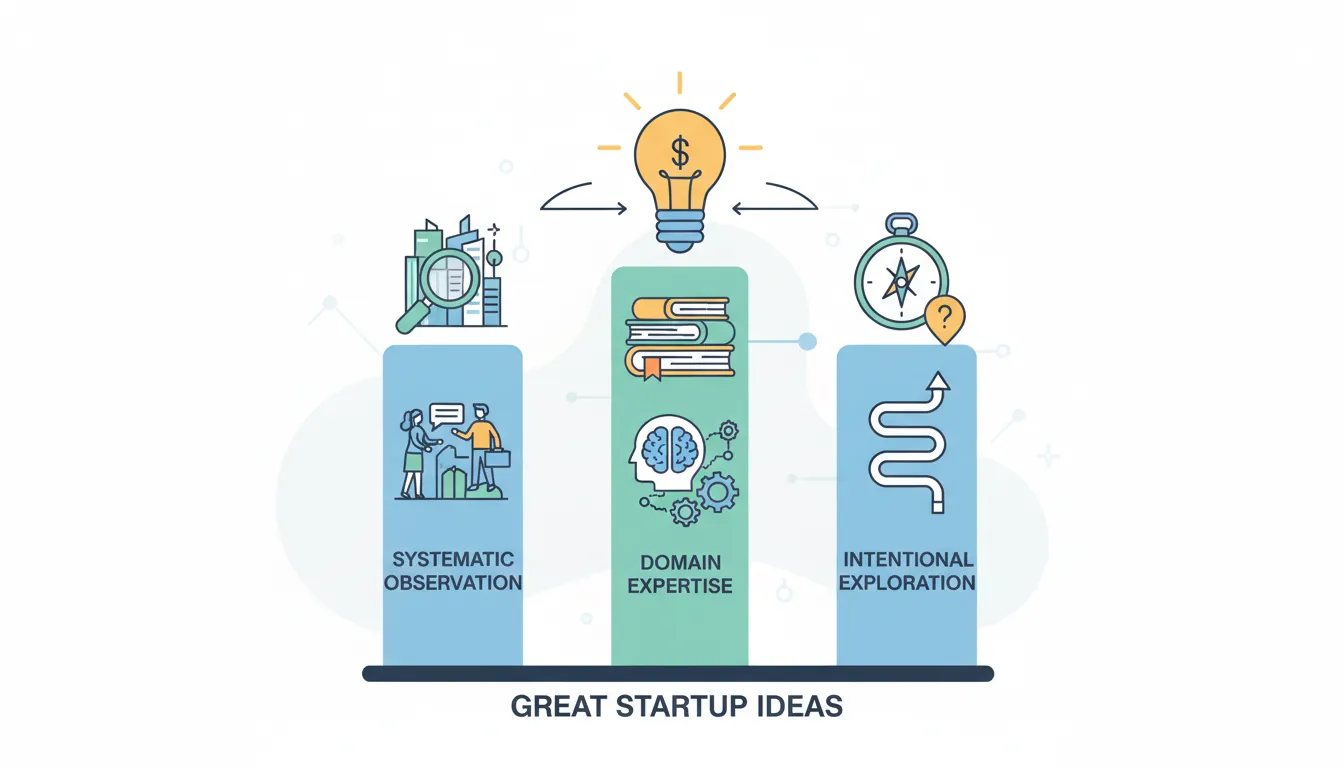
Great startup ideas rarely strike like lightning. Instead, they emerge from systematic observation, deep domain expertise, and intentional exploration. Understanding where ideas come from helps you develop a "founder's lens"—the ability to spot opportunities others miss.
Pain Points & Problems
The most successful startups solve real problems that cause genuine frustration. Pain points are the gold mines of entrepreneurship.
Great businesses are built on solving problems people already have, not problems you think they should have.
Types of Pain Points
| Pain Type | Description | Startup Example |
|---|---|---|
| Financial Pain | Too expensive, hidden fees, wasted money | Robinhood (free stock trading), Wise (cheap international transfers) |
| Time Pain | Takes too long, inefficient processes | Instacart (grocery delivery), Calendly (scheduling automation) |
| Convenience Pain | Hard to access, complicated, fragmented | Uber (on-demand rides), DoorDash (food delivery) |
| Quality Pain | Poor results, unreliable, inconsistent | Warby Parker (better, cheaper glasses), Casper (better mattresses) |
| Emotional Pain | Frustrating, stressful, embarrassing | Headspace (anxiety relief), Talkspace (accessible therapy) |
Finding Pain Points
1. Your Own Frustrations: The best founders build solutions to problems they've personally experienced. Brian Chesky couldn't afford rent, leading to Airbnb. Travis Kalanick couldn't get a cab in Paris, leading to Uber.
2. Complaints & Workarounds: Pay attention when people complain or create makeshift solutions. If someone built a spreadsheet to track something, there's likely a software opportunity.
3. Industry Expertise: Deep knowledge in a field reveals inefficiencies invisible to outsiders. Many B2B startups come from frustrated employees who know exactly what's broken.
Exercise: Pain Point Journal
For one week, carry a notebook and record every moment of friction or frustration:
- What made you wait longer than expected?
- What cost more than it should?
- What required too many steps?
- What made you say "there has to be a better way"?
Review your list weekly—patterns often reveal the best opportunities.
Technology Trends
New technologies unlock previously impossible solutions. When costs drop, capabilities increase, or adoption reaches critical mass, entire new markets emerge.
The Technology Adoption S-Curve
Adoption
    │
100%├───────────────────────────────●●●●● Maturity
    │                            ●●●
    │                         ●●●
    │                       ●●●
    │                     ●●● ← Sweet Spot for Startups
    │                   ●●●      (Early Majority)
    │                 ●●●
    │               ●●●
    │           ●●●●
    │       ●●●●
  0%├●●●●●●●────────────────────────────
    └────────────────────────────────────► Time
       Innovators  Early    Early    Late    Laggards
                  Adopters Majority Majority
Timing is Everything: Enter too early and the market isn't ready. Enter too late and incumbents dominate. The sweet spot is when technology becomes "good enough" and costs drop below critical thresholds.
Technology Enablers to Watch
| Technology | Enables | Startup Examples |
|---|---|---|
| AI/ML | Automation, personalization, prediction | ChatGPT, Jasper, Midjourney, Copy.ai |
| Cloud Computing | Scalable infrastructure, global reach | Snowflake, Databricks, Vercel |
| Mobile Ubiquity | Location, payments, cameras everywhere | Uber, Instagram, TikTok |
| APIs & Integrations | Build on existing platforms | Zapier, Plaid, Twilio |
| Blockchain | Decentralization, transparency, digital ownership | Coinbase, OpenSea, Uniswap |
The best startups use new technology to solve old problems better, not to create solutions looking for problems. Blockchain, AI, and VR have all seen waves of "solutions" that nobody needed.
Industry Gaps
Some of the best opportunities hide in plain sight—industries that haven't been updated in decades, markets served poorly by incumbents, or needs that emerged faster than solutions.
Types of Market Gaps
1. Underserved Segments: Large companies often ignore smaller customer segments because they're not profitable enough. But aggregating these "long tail" customers can build billion-dollar businesses.
- Shopify: Served small merchants that Amazon and eBay ignored
- Stripe: Made payments easy for developers, not just enterprises
- Canva: Design tools for non-designers, not just professionals
2. Geographic Gaps: What works in one market often doesn't exist in another. "X for Y" (Uber for India = Ola) is a proven model.
3. Demographic Shifts: Aging populations, Gen Z preferences, urbanization, and remote work create new needs and invalidate old assumptions.
4. Regulatory Changes: New laws create opportunities. GDPR spawned the privacy tech industry. Healthcare regulations created telemedicine opportunities.
Gap Analysis Framework
For any industry, ask these questions:
- Who is unhappy? Customers, employees, suppliers, partners?
- What hasn't changed? Processes, pricing, business models stuck in the past?
- Where are the spreadsheets? Manual processes = software opportunities
- What's still offline? Industries resistant to digitization
- What takes too long? Multi-week processes that could be minutes
3. Opportunity Recognition Frameworks
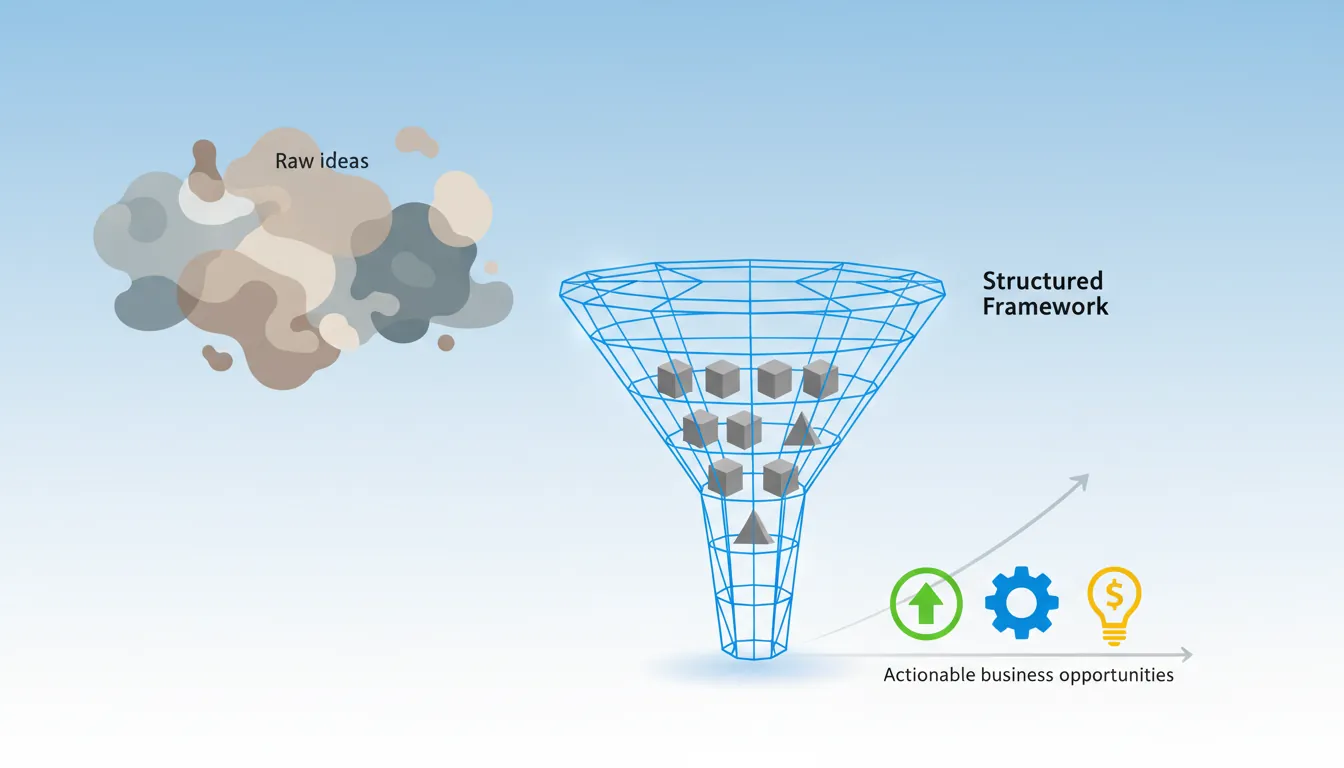
Raw ideas need structure to become actionable opportunities. These frameworks help you analyze, validate, and communicate your thinking.
Problem-Solution Fit
Before you build anything, you need confidence that your solution actually addresses a real problem worth solving. Problem-Solution Fit is the first milestone in your startup journey.
The Problem-Solution Fit Canvas
┌─────────────────────────────────────────────────────────────────┐
│                    PROBLEM-SOLUTION FIT CANVAS                   │
├─────────────────────────────┬───────────────────────────────────┤
│         PROBLEM SIDE        │          SOLUTION SIDE            │
├─────────────────────────────┼───────────────────────────────────┤
│                             │                                   │
│  CUSTOMER SEGMENT           │   VALUE PROPOSITION               │
│  Who has this problem?      │   What do you offer?              │
│  ─────────────────────      │   ─────────────────               │
│  • Demographics             │   • Products/services             │
│  • Psychographics           │   • Key features                  │
│  • Behaviors                │   • Unique differentiators        │
│                             │                                   │
├─────────────────────────────┼───────────────────────────────────┤
│                             │                                   │
│  CUSTOMER JOBS              │   GAIN CREATORS                   │
│  What are they trying to do?│   How do you create benefits?     │
│  ─────────────────────      │   ─────────────────────────       │
│  • Functional jobs          │   • Time savings                  │
│  • Social jobs              │   • Cost savings                  │
│  • Emotional jobs           │   • Better outcomes               │
│                             │                                   │
├─────────────────────────────┼───────────────────────────────────┤
│                             │                                   │
│  PAINS                      │   PAIN RELIEVERS                  │
│  What frustrates them?      │   How do you eliminate pain?      │
│  ───────────────────        │   ────────────────────────        │
│  • Obstacles                │   • Remove friction               │
│  • Risks                    │   • Reduce risks                  │
│  • Negative emotions        │   • Address concerns              │
│                             │                                   │
└─────────────────────────────┴───────────────────────────────────┘
Validating Problem-Solution Fit
You have Problem-Solution Fit when:
- ✅ You can describe the problem in the customer's own words
- ✅ Customers actively look for solutions (not just accept them when offered)
- ✅ The problem is frequent or painful enough to justify behavior change
- ✅ Your solution addresses the core problem, not just symptoms
Is the problem so urgent that customers would use a half-finished solution? If someone's hair is on fire, they'll use any water—even dirty water. Build for hair-on-fire problems.
Map your customer's problems to your solution. Download as Word, Excel, or PDF.
All data stays in your browser. Nothing is sent to or stored on any server.
Jobs-to-be-Done Framework
Developed by Clayton Christensen, the Jobs-to-be-Done (JTBD) framework shifts focus from what customers are to what they're trying to accomplish. People don't buy products—they "hire" them to do a job.
The JTBD Formula
When I [situation], I want to [motivation], so I can [expected outcome].

Example:
"When I'm commuting to work, I want to feel productive,
so I can start my day ahead instead of behind."

→ This job could be hired by: podcasts, audiobooks, email apps,
   meditation apps, or language learning apps.
Types of Jobs
| Job Type | Description | Example |
|---|---|---|
| Functional | Practical tasks to complete | "I need to get from A to B quickly" |
| Social | How we want to be perceived | "I want to look successful to my peers" |
| Emotional | How we want to feel | "I want to feel secure about my finances" |
Case Study: The Milkshake Story
A fast-food chain wanted to increase milkshake sales. Traditional market research (demographics, taste preferences) yielded nothing actionable.
The JTBD approach asked: What job are customers hiring the milkshake to do?
Discovery: 40% of milkshakes were bought before 8am by solo commuters.
The Job: "I have a long, boring commute. I need something that keeps me occupied, can be consumed with one hand, lasts the whole drive, and keeps me full until lunch."
Competition: Not other milkshakes—but bagels (too crumbly), bananas (too fast), donuts (too messy), and boredom itself.
Insight: Make the milkshake thicker (lasts longer), add fruit chunks (interesting texture), and offer a prepaid express lane (speed).
Applying JTBD to Your Idea
- Interview customers about recent "purchases" in your space
- Ask about the timeline: What led up to the decision? What triggered the search?
- Identify the struggling moment: When did they first realize the old way wasn't working?
- Understand the hiring criteria: What made them choose this solution over alternatives?
- Map the competition: What else could do this job? (Usually surprising answers)
4. Market Trends & Megatrends
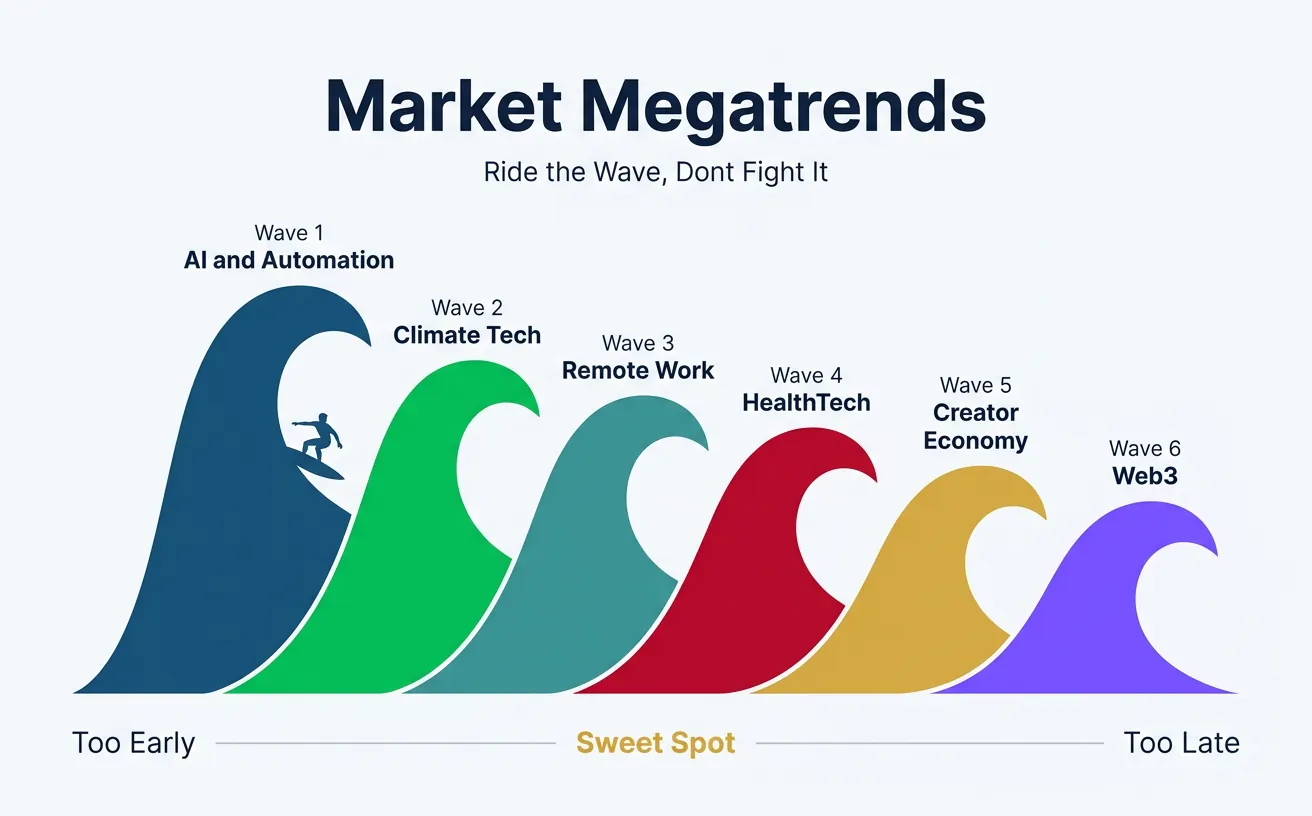
Megatrends are massive, long-term shifts that reshape industries and society. Successful entrepreneurs ride these waves rather than fight against them.
Current Megatrends (2020s-2030s)
| Megatrend | Drivers | Startup Opportunities |
|---|---|---|
| Remote & Distributed Work | COVID acceleration, talent competition, technology maturity | Collaboration tools, virtual offices, async communication, remote hiring |
| AI & Automation | Compute costs falling, data abundance, model improvements | Copilots, automated workflows, personalization, content generation |
| Climate & Sustainability | Regulation, consumer preferences, cost of inaction | Clean tech, carbon tracking, sustainable supply chains, circular economy |
| Aging Population | Demographics, longer lifespans, healthcare costs | Elder care, longevity tech, retirement planning, accessible design |
| Creator Economy | Platform democratization, direct monetization, authenticity preference | Creator tools, monetization platforms, community building, NFTs |
| Healthcare Decentralization | Telehealth adoption, wearables, personalized medicine | Telemedicine, remote monitoring, mental health apps, diagnostics |
How to Ride a Megatrend
- Pick an intersection: Megatrend + specific industry = unique opportunity (AI + legal = contract analysis)
- Focus on enabling infrastructure: During a gold rush, sell shovels (AWS during cloud adoption)
- Look for lagging industries: Every megatrend hits different sectors at different times
- Anticipate second-order effects: Remote work → home office furniture → suburban migration → local commerce revival
"A startup can be thought of as a way to compress a lifetime of work into a few years. Instead of working at an ordinary rate for 40 years, you work like hell for four." — Paul Graham
But timing matters. Working hard against a trend is swimming upstream. Working hard with a trend is surfing—your effort gets multiplied.
5. Idea Prioritization
Most founders have too many ideas, not too few. The key is systematically evaluating and prioritizing to focus on the highest-potential opportunities.
Feasibility vs Impact Matrix
                        IMPACT
                   Low         High
              ┌──────────┬──────────┐
         High │  QUICK   │  SWEET   │
              │  WINS    │  SPOT    │
FEASIBILITY   │  Do Soon │  Do Now  │
              ├──────────┼──────────┤
         Low  │  TIME    │  MOON    │
              │  WASTERS │  SHOTS   │
              │  Avoid   │  Plan    │
              └──────────┴──────────┘
The ICE Scoring Framework
Rate each idea from 1-10 on three dimensions:
- Impact: How big is the opportunity if it succeeds?
- Confidence: How sure are you about your assumptions?
- Ease: How quickly and cheaply can you validate or build it?
ICE Score = Impact × Confidence × Ease / 10
| Idea | Impact | Confidence | Ease | ICE Score | Priority |
|---|---|---|---|---|---|
| AI writing assistant | 8 | 6 | 4 | 19.2 | 2nd |
| Local service marketplace | 7 | 7 | 6 | 29.4 | 1st |
| VR fitness platform | 9 | 4 | 3 | 10.8 | 3rd |
Additional Evaluation Criteria
1. Founder-Market Fit: Do you have unfair advantages in this space?
- Domain expertise (worked in the industry)
- Technical skills (can build the product)
- Network access (know potential customers)
- Personal passion (will persist through difficulty)
2. Market Characteristics:
- Size: Is the market big enough to build a meaningful business?
- Growth: Is it expanding or contracting?
- Accessibility: Can you reach customers efficiently?
- Competition: Is it winner-take-all or room for many?
3. Business Model Viability:
- Can you charge enough to cover costs?
- Is the sales cycle short enough to survive?
- Are there recurring revenue opportunities?
- What are the unit economics (rough estimate)?
Exercise: Idea Scorecard
For your top 3 ideas, rate each criterion 1-5:
                      Idea A  Idea B  Idea C
Problem Severity        ___     ___     ___
Market Size             ___     ___     ___
Competitive Moat        ___     ___     ___
Founder-Market Fit      ___     ___     ___
Revenue Potential       ___     ___     ___
Execution Speed         ___     ___     ___
Personal Passion        ___     ___     ___
─────────────────────────────────────────────
TOTAL (out of 35) ___ ___ ___Rate up to 5 ideas on Impact, Confidence, and Ease (1-10). Ideas are auto-ranked by ICE score. Download as Word, Excel, or PDF.
All data stays in your browser. Nothing is sent to or stored on any server.
6. Entrepreneurial Mindset
Ideas are plentiful; execution is rare. What separates successful entrepreneurs isn't IQ or luck—it's a specific set of mental models and attitudes.
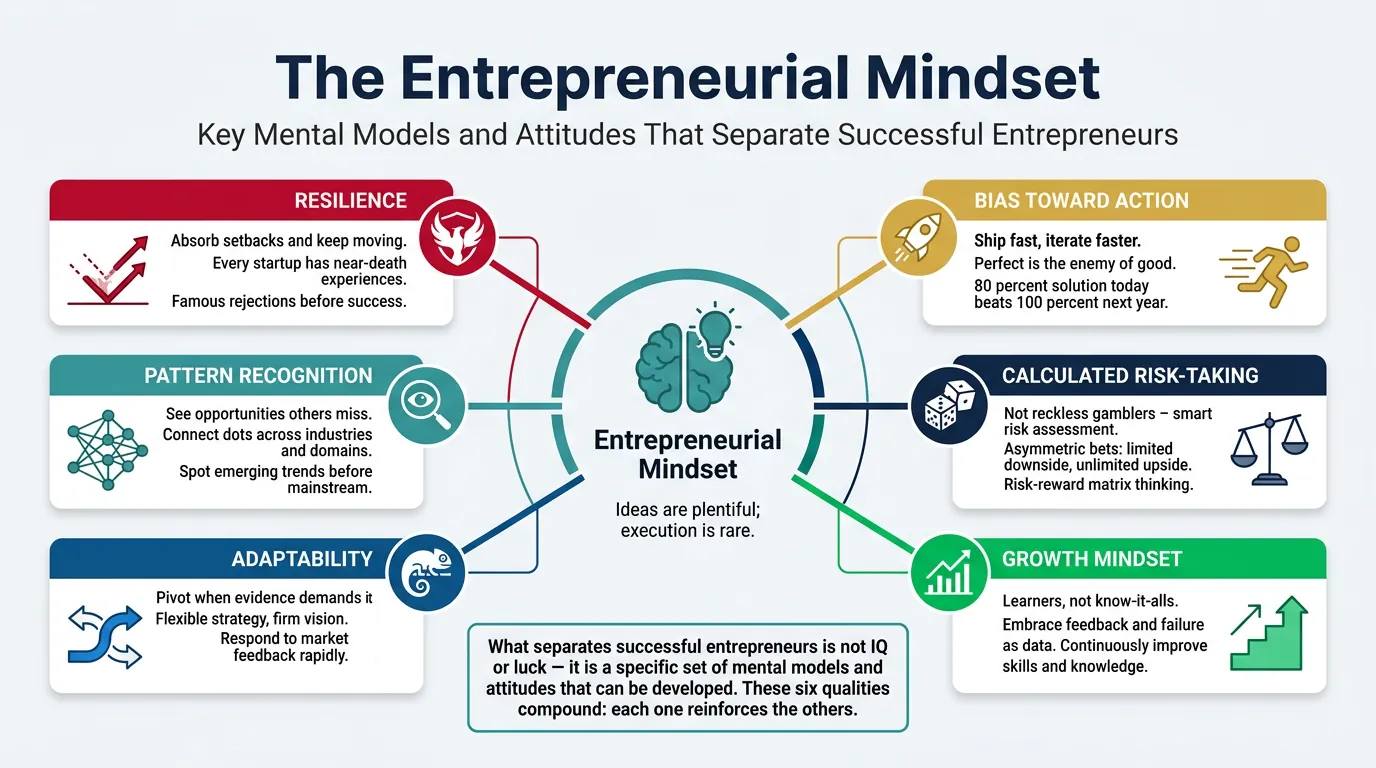
Resilience
Every successful startup story glosses over the dozens of near-death experiences. The ability to absorb setbacks and keep moving is non-negotiable.
Famous Rejections
- Airbnb: Rejected by 7 investors. One email simply said "the potential market opportunity didn't seem large enough."
- Slack: Started as a failed video game. Pivoted to the internal communication tool they'd built for themselves.
- WhatsApp: Rejected by Facebook (who later bought them for $19B) and Twitter for engineering jobs.
- Pandora: Rejected by over 300 VCs over 2 years before getting funding.
Building Resilience
- Reframe failure as data: Every "no" teaches you something. What specifically didn't work?
- Celebrate small wins: Progress happens in inches, not miles. Acknowledge momentum.
- Build a support network: Other founders understand. Find your people.
- Take care of yourself: Burnout kills more startups than competition. Sleep, exercise, relationships matter. (We cover this topic in depth in Part 6: Founding Team — Why Burnout Kills Startups.)
Calculated Risk-Taking
Entrepreneurs aren't reckless gamblers—they're calculated risk-takers who systematically reduce uncertainty.
The Risk Mitigation Ladder
Level 5: All-in (Full commitment, quit job, raise money)
    ↑
Level 4: Serious side project (20+ hrs/week, some investment)
    ↑
Level 3: Active experimentation (landing pages, prototypes, interviews)
    ↑
Level 2: Research mode (market analysis, competitor research)
    ↑
Level 1: Idea stage (napkin sketch, conversations with friends)

→ Validate assumptions at each level before climbing upIdentify the biggest risks to your startup's success (technical feasibility, market demand, unit economics) and systematically test each one with the minimum investment of time and money.
Growth Orientation
A growth mindset treats abilities as developable through dedication and hard work. This is essential for founders who must constantly learn new skills.
Fixed vs Growth Mindset
| Situation | Fixed Mindset | Growth Mindset |
|---|---|---|
| Negative feedback | "They don't understand my vision" | "What can I learn from this?" |
| Competitor launches | "We're doomed, they'll win" | "Validation! Let's differentiate" |
| Skill gap | "I'm not a sales person" | "I haven't learned sales yet" |
| Failed experiment | "This idea is dead" | "Now we know what doesn't work" |
Cultivating Growth Orientation
- Embrace "yet": "I can't code" becomes "I can't code yet"
- Seek disconfirming evidence: Actively look for reasons your idea won't work
- Learn from everyone: Customers, competitors, adjacent industries, other founders
- Document learnings: Keep a "lessons learned" log to compound knowledge
The best founders are learning machines. They read voraciously, ask questions constantly, admit what they don't know, and update their beliefs quickly when evidence contradicts assumptions.
7. Conclusion & Next Steps
Ideation is just the beginning. Once you've identified a promising opportunity, the real work begins—validating your assumptions with real customers and building a minimum viable product.