1. Introduction
Scaling is where most startups fail. This guide covers the operational infrastructure and growth strategies you need to move from early traction to sustainable growth.
Complete Startup Journey
Ideation & Opportunity Recognition
Problem discovery, market gaps, idea generation frameworksIdea Validation & MVP Prototyping
Customer discovery, landing pages, prototype testingBusiness Models & Canvas
BMC, lean canvas, revenue models, value propositionsLean Startup Methodology
Build-measure-learn, pivoting, validated learningFundraising & Financial Modeling
VC, angels, SAFE notes, cap tables, financial projectionsBuilding Your Founding Team
Co-founder selection, equity splits, team dynamicsHiring & Company Culture
Recruiting, culture building, OKRs, team scalingScaling Operations & Growth Hacking
Growth loops, viral mechanics, operational scalingMarketing Campaigns & Digital Growth
CAC/LTV, digital marketing, positioning, channelsLegal, Financial & Risk Foundations
Entity structure, IP, compliance, burn rate managementData-Driven Decision Making
SaaS metrics, NPS, analytics dashboards, A/B testingExit Strategies & Investor Pitches
Valuations, pitch decks, M&A, IPO preparationStartup Ecosystem & Networking
Accelerators, mentors, communities, ecosystem mappingInnovation, Technology & Future Trends
Emerging tech, AI/ML, deep tech, future marketsCapstone Projects & Portfolio
Comprehensive startup plan, portfolio presentation2. Operational Systems, Workflows & SOPs
What got you here won't get you there. The informal processes that worked with 5 people become bottlenecks with 50. Building operational systems is how you scale without chaos.
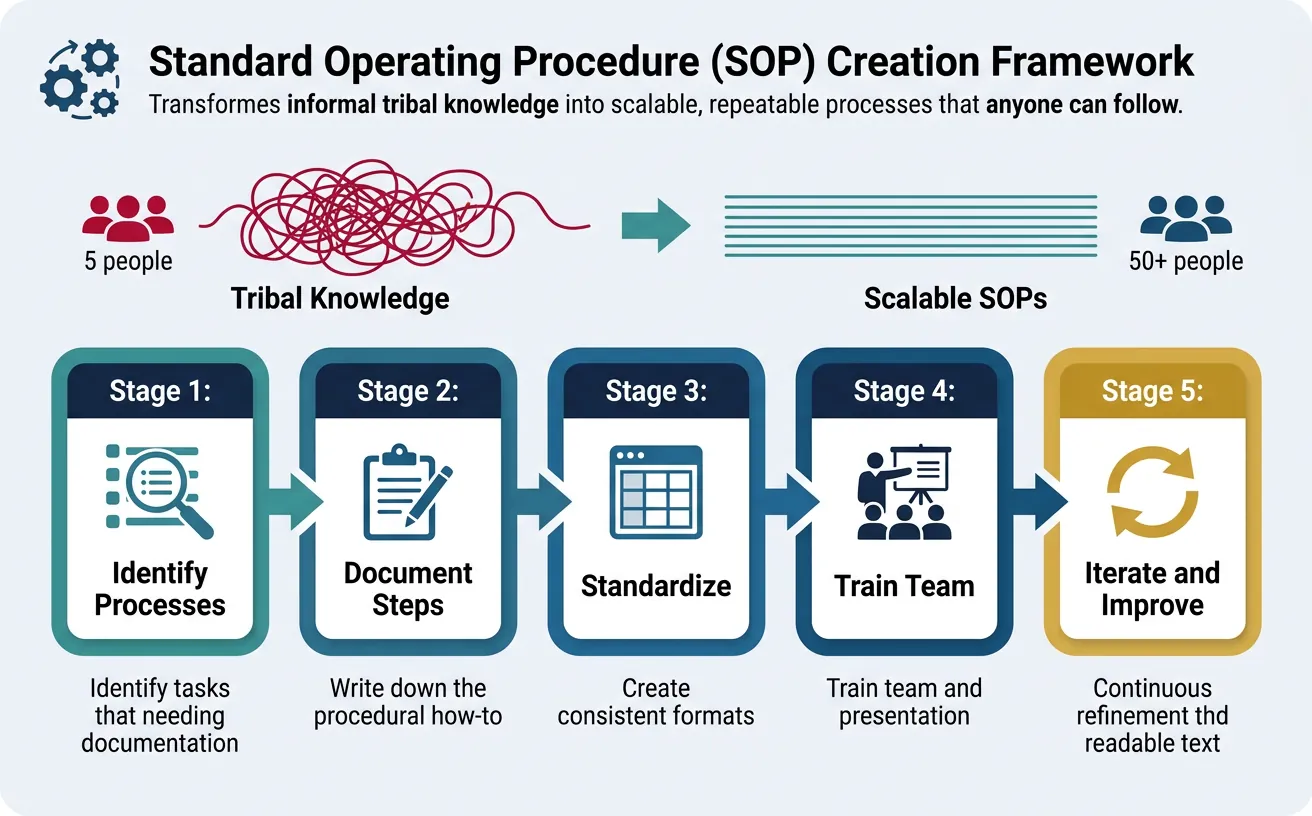
McDonald's isn't successful because they have the best burgers—it's because a 16-year-old can make the same burger in Tokyo, Paris, and Chicago. That's the power of systems. Document how work gets done so anyone can do it consistently.
Building Standard Operating Procedures (SOPs)
SOP Creation Framework:

1. IDENTIFY REPEATABLE PROCESSES
   ├── Customer onboarding
   ├── Bug triage and resolution
   ├── Content publishing
   └── Invoice processing

2. DOCUMENT CURRENT STATE
   ├── Who does what?
   ├── What tools are used?
   ├── What decisions are made?
   └── How long does it take?

3. OPTIMIZE AND STANDARDIZE
   ├── Remove unnecessary steps
   ├── Add checkpoints for quality
   ├── Identify automation opportunities
   └── Define success metrics

4. CREATE SOP DOCUMENT
   ├── Purpose: Why this process exists
   ├── Scope: When to use it
   ├── Steps: Detailed instructions
   ├── Exceptions: What to do when it doesn't fit
   └── Owner: Who maintains this SOP

5. TRAIN AND ITERATE
   ├── Train all relevant team members
   ├── Collect feedback
   ├── Update quarterly
   └── Version control
Process Documentation Template
| Section | Content | Example (Customer Onboarding) |
|---|---|---|
| Trigger | What starts this process | Customer signs contract |
| Owner | Who is responsible | Customer Success Manager |
| Steps | Numbered actions | 1. Send welcome email, 2. Schedule kickoff call... |
| Tools | Systems used | HubSpot, Calendly, Notion |
| SLA | Time expectations | Complete within 7 days of signing |
| Escalation | What if something goes wrong | Escalate to VP of Success if blocked 24+ hours |
3. Technology Stack & Automation
The right technology stack multiplies your team's output. The wrong one creates technical debt that slows you down.
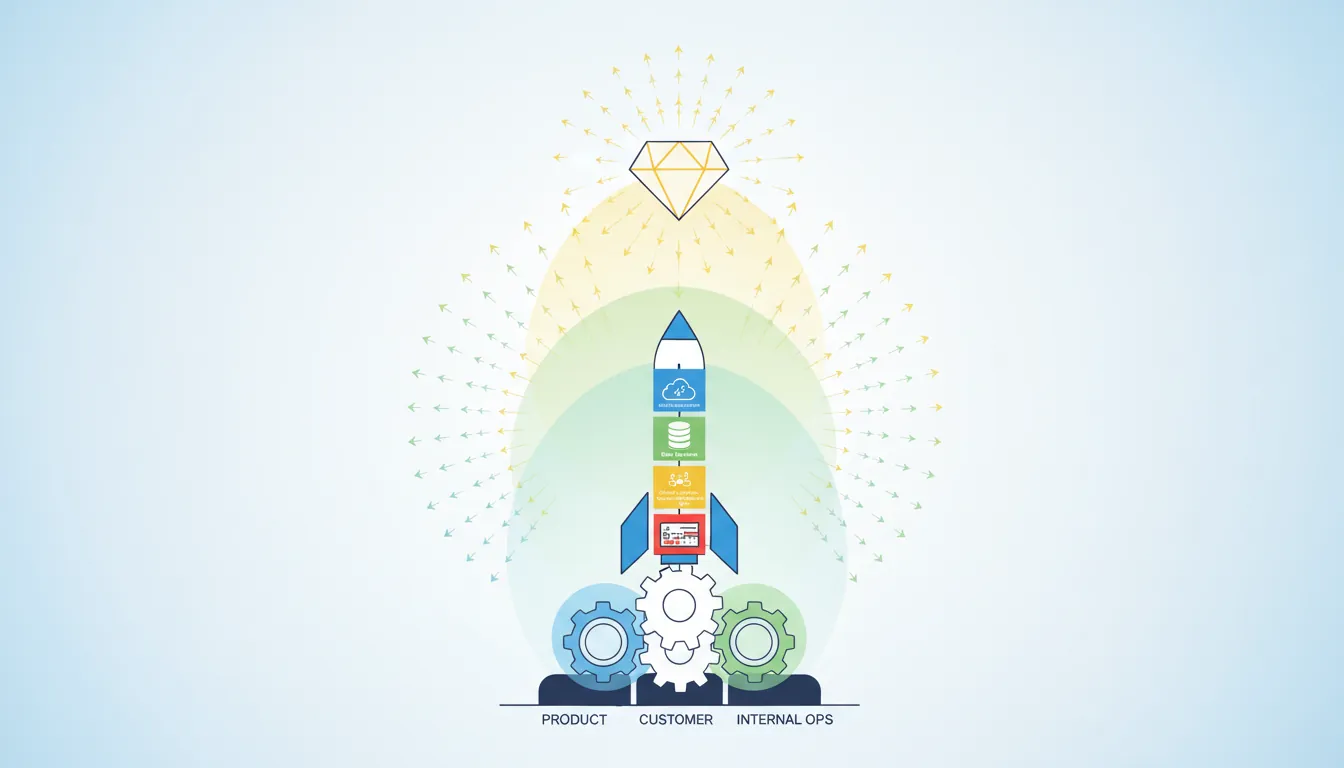
The Modern Startup Tech Stack
Technology Stack by Function:

PRODUCT & ENGINEERING
├── Version Control: GitHub, GitLab
├── CI/CD: GitHub Actions, CircleCI
├── Infrastructure: AWS, GCP, Azure
├── Monitoring: Datadog, New Relic
└── Error Tracking: Sentry, Bugsnag

CUSTOMER-FACING
├── CRM: HubSpot, Salesforce
├── Support: Intercom, Zendesk
├── Email Marketing: Mailchimp, Customer.io
├── Analytics: Amplitude, Mixpanel
└── Payments: Stripe, Braintree

INTERNAL OPERATIONS
├── Communication: Slack, MS Teams
├── Project Management: Linear, Jira, Asana
├── Documentation: Notion, Confluence
├── HR/Payroll: Rippling, Gusto
└── Finance: QuickBooks, Brex

AUTOMATION LAYER
├── Workflow: Zapier, Make (Integromat)
├── Data: Segment, Fivetran
├── BI: Metabase, Tableau
└── AI Assistants: ChatGPT, custom LLMs
Automation Opportunities
| Process | Manual Effort | Automated Solution | Time Saved |
|---|---|---|---|
| Lead qualification | Review each lead manually | Lead scoring + auto-routing in CRM | 10+ hrs/week |
| Customer onboarding | Send emails, schedule calls | Drip campaigns + self-serve scheduling | 5 hrs/week |
| Invoice collection | Chase payments manually | Auto-dunning emails + retry logic | 3 hrs/week |
| Support triage | Read, categorize, assign | AI categorization + auto-assignment | 15+ hrs/week |
| Reporting | Pull data, create charts | Automated dashboards | 5 hrs/week |
• Buy: If it's not core to your business and a good tool exists (e.g., payroll)
• Integrate: If you need multiple tools to work together (e.g., Zapier, custom APIs)
• Build: Only if it's your competitive advantage or no solution exists
4. Scaling Customer Support, Supply Chain & Logistics
As you grow, support volume and operational complexity increase exponentially. Here's how to scale without sacrificing quality.
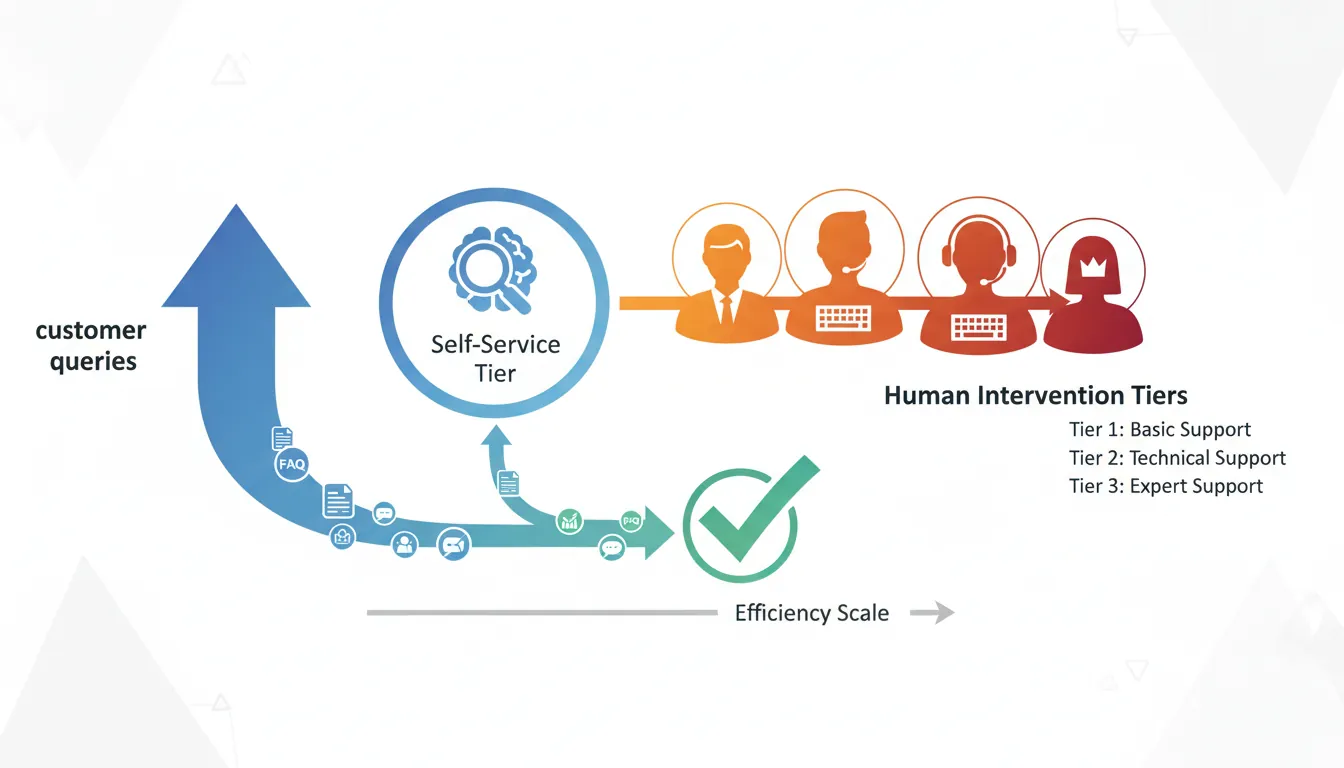
Scaling Customer Support
Support Scaling Framework:

TIER 0: SELF-SERVICE (Handle 60-80% of queries)
├── Knowledge base / FAQ
├── In-app guidance / tooltips
├── Community forums
├── AI chatbot for common questions
└── Video tutorials

TIER 1: FRONTLINE SUPPORT (Handle remaining 80%)
├── Live chat with agents
├── Email support
├── Ticket system
├── Response templates
└── Escalation triggers

TIER 2: SPECIALIST SUPPORT (Handle complex 15%)
├── Technical support engineers
├── Account managers
├── Product specialists
└── Bug escalation path

TIER 3: ENGINEERING (Handle critical 5%)
├── Bug fixes
├── Custom solutions
├── Enterprise integrations
└── Security issues

Support Metrics to Track:
• First Response Time (FRT): < 1 hour for chat, < 4 hours for email
• Resolution Time: < 24 hours for Tier 1
• CSAT: > 90%
• Ticket Volume per Customer: Declining = improving product
Supply Chain & Logistics (Physical Products)
| Stage | Model | Pros | Cons |
|---|---|---|---|
| 0-100 orders/mo | Self-fulfillment | Full control, learn the process | Time-intensive, limited capacity |
| 100-1,000 orders/mo | 3PL (Third-party logistics) | Scalable, professional | Less control, per-unit costs |
| 1,000+ orders/mo | Hybrid or own warehouse | Cost efficiency at scale | High fixed costs, complexity |
5. B2C vs B2B vs B2P Scaling
Your business model fundamentally shapes how you scale. Consumer companies, enterprise businesses, and platform companies each face unique challenges and opportunities when growing.
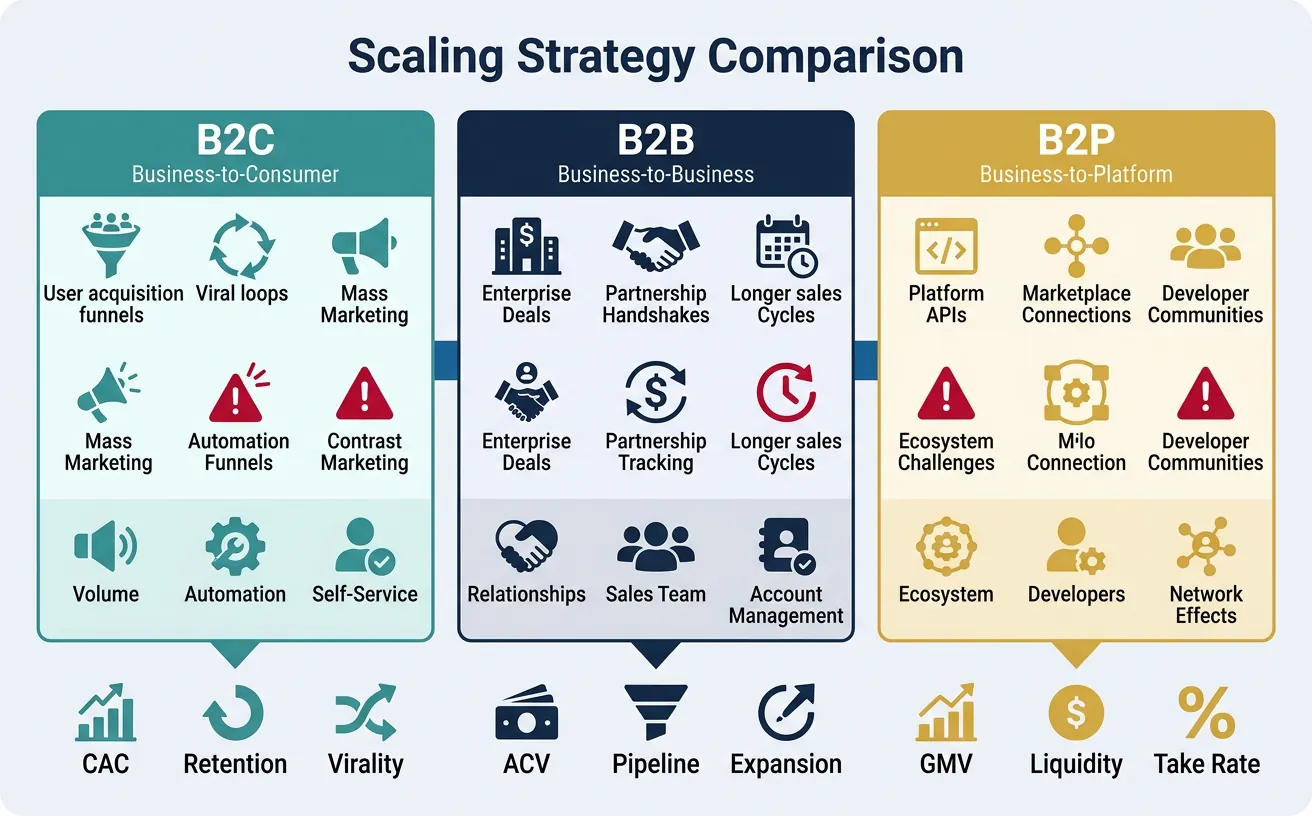
B2C Scaling = More customers, more efficient acquisition — Think volume, automation, self-service
B2B Scaling = Bigger deals, more relationships — Think sales teams, account management, partnerships
B2P Scaling = More partners, more platform value — Think ecosystem, developer success, network effects
B2C (Business-to-Consumer) Scaling
B2C companies scale by serving more customers more efficiently. The key is building systems that allow you to serve 10x customers without 10x costs.
B2C Scaling Priorities
B2C SCALING PLAYBOOK:

1. ACQUISITION EFFICIENCY
   ├── Channel optimization (CAC by channel)
   ├── Viral loops and referrals
   ├── Brand building for organic growth
   └── Influencer and ambassador programs

2. OPERATIONS AUTOMATION
   ├── Self-service everything (signup, purchase, support)
   ├── Automated customer onboarding
   ├── AI-powered customer service
   └── Inventory/fulfillment automation

3. RETENTION & LTV
   ├── Personalization at scale
   ├── Loyalty programs
   ├── Subscription/recurring revenue
   └── Cross-sell/upsell automation

4. INFRASTRUCTURE
   ├── Auto-scaling tech infrastructure
   ├── CDN for global performance
   ├── Payment processing at scale
   └── Fraud detection systems
B2C Scaling Challenges & Solutions
| Challenge | Impact | Solution |
|---|---|---|
| CAC Rising | Margins compress as channels saturate | Diversify channels, build brand, increase LTV |
| Support Volume | 100K customers = massive ticket volume | Self-service, AI chatbots, community support |
| Quality Control | Experience degrades at scale | NPS monitoring, automated QA, feedback loops |
| Competition | Success attracts copycats | Brand moat, network effects, switching costs |
B2C Scaling Case Study: Zappos
Scaling Strategy: Scaling customer service as a competitive advantage.
- Unique Approach: No scripts, unlimited call times, wow experiences
- Culture Scaling: Hired for values, trained for skills
- Warehouse Innovation: 24/7 warehouse operation for fast shipping
- Result: $1.2B acquisition by Amazon, industry-leading customer satisfaction
B2B (Business-to-Business) Scaling
B2B companies typically scale through larger deals, expanded account relationships, and sales team growth. The key is balancing sales efficiency with relationship depth.
B2B Scaling Priorities
B2B SCALING PLAYBOOK:

1. SALES ORGANIZATION
   ├── SDR → AE → AM structure
   ├── Territory and segment specialization
   ├── Sales enablement and training
   └── Commission and quota optimization

2. CUSTOMER SUCCESS
   ├── Named account managers for enterprise
   ├── Digital CS for smaller accounts
   ├── Expansion playbooks (upsell/cross-sell)
   └── Churn prediction and prevention

3. PRODUCT-LED GROWTH
   ├── Freemium for bottom-up adoption
   ├── Self-serve for SMB segment
   ├── Product usage → sales trigger
   └── In-product expansion prompts

4. PARTNER/CHANNEL SCALING
   ├── Reseller and SI partnerships
   ├── Technology integrations (marketplaces)
   ├── Affiliate and referral programs
   └── Consulting partner enablement
B2B Sales Team Scaling Model
| Stage | ARR | Team Structure | Focus |
|---|---|---|---|
| Founder Sales | $0-$1M | Founders only | Product-market fit validation |
| First Sales Hire | $1M-$3M | 1-2 AEs + founder | Repeatable sales process |
| Build Sales Machine | $3M-$10M | VP Sales + SDRs + AEs | Scalable playbook |
| Scale Sales Machine | $10M+ | Segments + specialists | Market expansion, efficiency |
B2B Scaling Case Study: Salesforce
Scaling Strategy: Build the gold standard enterprise sales organization.
- V2MOM System: Vision, Values, Methods, Obstacles, Measures at every level
- Segment Specialization: SMB, Mid-Market, Enterprise, Strategic
- Trailblazer Community: Customer community drives adoption and retention
- Result: $30B+ ARR, 150K+ customers, category-defining company
B2P (Business-to-Platform) Scaling
Platform businesses scale by growing the ecosystem around them. Success comes from enabling partners, developers, and third parties to create value on your platform.
B2P Scaling Priorities
B2P SCALING PLAYBOOK:

1. DEVELOPER/PARTNER SUCCESS
   ├── World-class documentation
   ├── Developer advocates and support
   ├── Partner success managers
   └── Revenue share/incentive programs

2. ECOSYSTEM GROWTH
   ├── SDKs and APIs for easy integration
   ├── App/partner directories
   ├── Certification programs
   └── Marketplace discoverability

3. PLATFORM GOVERNANCE
   ├── Quality standards and review
   ├── Fraud and abuse prevention
   ├── Dispute resolution
   └── Trust and safety teams

4. NETWORK EFFECTS
   ├── Two-sided marketplace dynamics
   ├── Cross-side benefits (more apps = more users)
   ├── Same-side effects (user → user referral)
   └── Winner-take-all positioning
Platform Scaling Flywheel
| Phase | Focus | Challenge | Success Metric |
|---|---|---|---|
| Seed Supply | Get initial partners/developers | Chicken-and-egg problem | # of quality partners |
| Build Demand | Attract users/customers | Empty marketplace | Active users/transactions |
| Enable Success | Help partners succeed | Partner ROI | Partner GMV/revenue |
| Flywheel | Self-sustaining growth | Maintaining quality | Net platform GMV growth |
B2P Scaling Case Study: Shopify
Scaling Strategy: Make merchants successful, and they'll make you successful.
- Partner Program: 42,000+ partners driving referrals and apps
- App Ecosystem: 8,000+ apps extending platform value
- Merchant Success: Tools, education, and capital for merchants
- Result: $5B+ annual revenue, powers millions of merchants globally
Scaling Approach Comparison
Use this comparison to identify the scaling priorities that match your business model:
| Dimension | B2C Scaling | B2B Scaling | B2P Scaling |
|---|---|---|---|
| Primary Lever | Volume efficiency | Sales productivity | Ecosystem value |
| Team Growth | Ops, marketing, engineering | Sales, CS, solutions | DevRel, partner, platform |
| Key Automation | Customer journey, support | Lead scoring, onboarding | Partner onboarding, billing |
| Scaling Moat | Brand, network effects | Relationships, integrations | Ecosystem, switching costs |
| Capital Needs | High (CAC-heavy) | Moderate (sales-heavy) | Variable (depends on subsidies) |
The most common scaling mistake: assuming what worked at small scale will work at large scale. B2C companies try to keep personal service. B2B companies try to avoid hiring salespeople. B2P companies try to onboard partners manually. Scaling requires letting go of what got you here.
6. Growth Hacking Experiments
Growth hacking is the intersection of marketing, product, and data. It's about finding scalable, repeatable ways to acquire and retain users through rapid experimentation.
Designing Viral Loops
A viral loop is a mechanism where using your product naturally leads to new user acquisition. The viral coefficient (K) measures how many new users each existing user brings.
Viral Loop Mechanics:

K = i × c
Where:
• i = invitations sent per user
• c = conversion rate of invitations

Example (Dropbox):
• User gets 500MB free for each referral
• Average user sends 5 invites
• 20% of invites convert
• K = 5 × 0.20 = 1.0 (viral!)

K > 1.0 = Exponential growth (rare)
K = 0.5-1.0 = Good, sustainable growth
K < 0.5 = Need paid acquisition to grow

VIRAL LOOP TYPES:
┌─────────────────────────────────────────────────────────────┐
│ INHERENT VIRALITY        │ Users must share to use         │
│ (Venmo, Calendly)        │ product (highest K)             │
├─────────────────────────────────────────────────────────────┤
│ WORD OF MOUTH            │ Users naturally talk about      │
│ (Slack, Zoom)            │ product (medium K)              │
├─────────────────────────────────────────────────────────────┤
│ INCENTIVIZED             │ Users rewarded for sharing      │
│ (Dropbox, Uber)          │ (medium K, scalable)            │
├─────────────────────────────────────────────────────────────┤
│ EMBEDDED                 │ Product visible when shared     │
│ (Hotmail, Powered by)    │ (low friction, medium K)        │
└─────────────────────────────────────────────────────────────┘
Viral K-Factor Calculator
Calculate your viral coefficient and project organic user growth over time.
All data stays in your browser. Nothing is sent to or stored on any server.
Building Referral Programs
| Company | Referral Incentive | Result |
|---|---|---|
| Dropbox | 500MB free space for referrer and referee | 3,900% growth in 15 months |
| Uber | $20 credit for both parties | 50% of new users from referrals at peak |
| PayPal | $10 cash bonus (early days) | 7-10% daily growth |
| Airbnb | $25 travel credit for both | 25% of bookings from referrals |
Referral Program Design Principles
- Two-sided incentives: Reward both referrer AND referee for higher conversion
- Immediate gratification: Give rewards quickly, not after complex conditions
- Easy sharing: One-click share to email, SMS, social media
- Track everything: Know which channels and users drive the most referrals
- Fraud prevention: Detect and prevent fake referrals
A/B Testing for Growth
Growth happens through systematic experimentation. Run 10-20 experiments per month, learn from each, and double down on winners.
Growth Experiment Template
EXPERIMENT: [Name]
DATE: [Start - End]
OWNER: [Person responsible]

HYPOTHESIS:
If we [make this change], then [metric] will [increase/decrease] by [X%]
because [reasoning].

METRIC TO MOVE:
Primary: [e.g., Sign-up conversion rate]
Secondary: [e.g., Activation rate, LTV]

TEST DESIGN:
Control: [Current experience]
Variant: [New experience]
Sample size needed: [Calculate with significance]
Duration: [Based on traffic volume]

RESULTS:
Control: [X%]
Variant: [Y%]
Lift: [+/- Z%]
Statistical significance: [Yes/No, p-value]

LEARNINGS:
[What did we learn? Even if it failed?]

NEXT STEPS:
[ ] Ship winner
[ ] Iterate and retest
[ ] Document and move on
7. KPI Tracking & Product-Market Fit Optimization
What gets measured gets managed. The right KPIs tell you if you're building a real business or just burning cash.
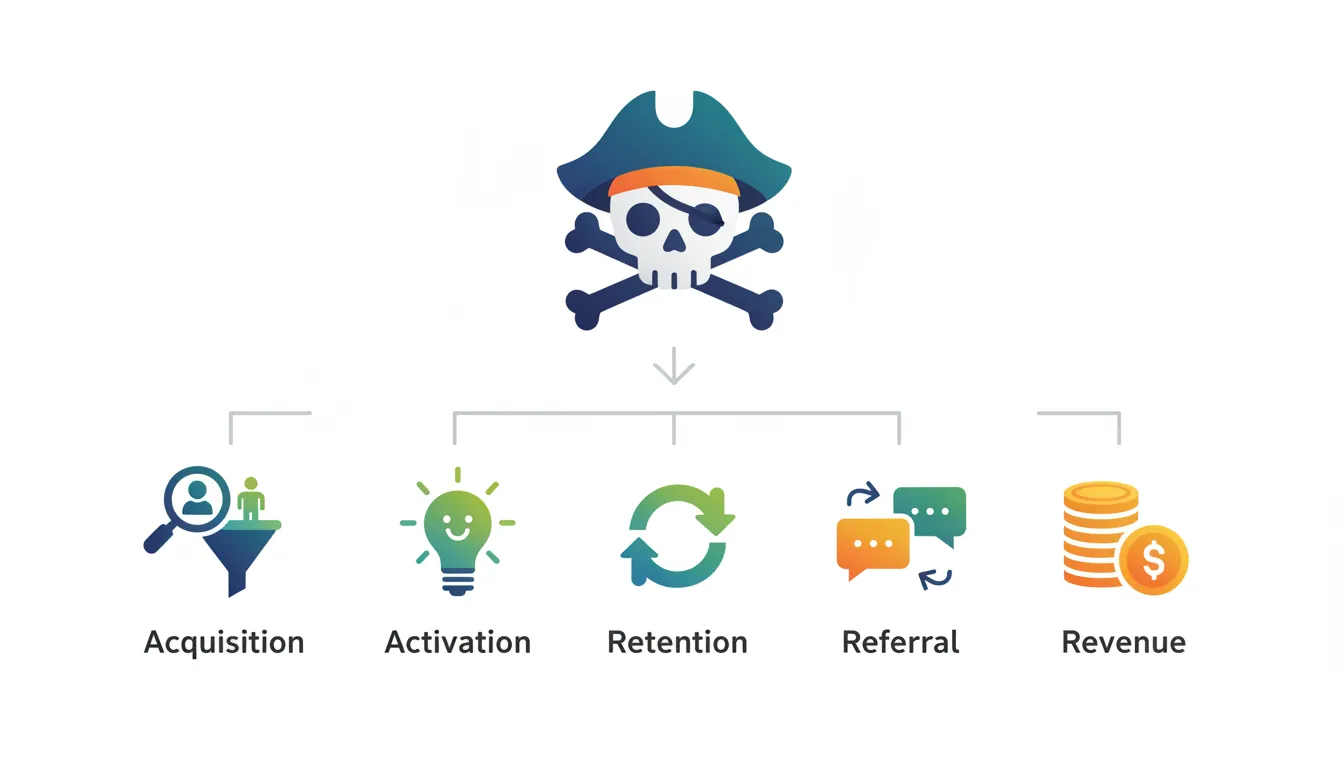
The Pirate Metrics Framework (AARRR)
AARRR Funnel:

┌─────────────────────────────────────────────────────────────┐
│ ACQUISITION        │ How do users find you?                 │
│                    │ Channels, CAC, traffic volume          │
├─────────────────────────────────────────────────────────────┤
│ ACTIVATION         │ Do users have a great first experience?│
│                    │ Sign-up rate, onboarding completion    │
├─────────────────────────────────────────────────────────────┤
│ RETENTION          │ Do users come back?                    │
│                    │ D1/D7/D30 retention, churn rate        │
├─────────────────────────────────────────────────────────────┤
│ REFERRAL           │ Do users tell others?                  │
│                    │ Viral coefficient, NPS, referral rate  │
├─────────────────────────────────────────────────────────────┤
│ REVENUE            │ Can you monetize?                      │
│                    │ ARPU, LTV, conversion to paid          │
└─────────────────────────────────────────────────────────────┘

Focus on ONE metric at a time:
• Pre-PMF: Focus on Retention (do people keep using it?)
• Post-PMF: Focus on Acquisition (scale what works)
• Growth stage: Optimize all (balance the funnel)
Key Metrics by Business Model
| Business Model | North Star Metric | Supporting Metrics |
|---|---|---|
| SaaS | MRR / ARR | Net Revenue Retention, CAC, LTV, Churn |
| Marketplace | GMV (Gross Merchandise Value) | Take rate, liquidity, repeat purchase rate |
| Consumer App | DAU / MAU | Session duration, retention curves, virality |
| E-commerce | Revenue | AOV, conversion rate, cart abandonment, ROAS |
| B2B Enterprise | ACV (Annual Contract Value) | Win rate, sales cycle, expansion revenue |
Product-Market Fit Indicators
• 40%+ of users say they'd be "very disappointed" without your product (Sean Ellis test)
• Organic growth: Users telling others without being asked
• Retention plateaus: Users who stay after week 1 stay for months
• Pull, not push: Sales cycles shorten, customers seek you out
• Unit economics work: LTV > 3× CAC
8. Global Expansion Considerations
Going global opens huge markets but introduces complexity. Expand thoughtfully—many startups have failed by going international too early.
Localization Strategy
| Localization Level | What's Involved | Cost/Complexity |
|---|---|---|
| Language Translation | UI, help docs, marketing | Low ($5-20K per language) |
| Currency & Payments | Local pricing, payment methods | Medium (Stripe handles much) |
| Cultural Adaptation | Imagery, tone, UX patterns | Medium (needs local expertise) |
| Local Operations | Support, sales, legal entity | High (requires on-ground presence) |
| Product Adaptation | Features specific to market | Very High (engineering investment) |
International Compliance & Regulation
Key Regulations by Region:

EUROPE (EU)
├── GDPR: Data privacy, consent, right to deletion
├── PSD2: Payment services regulation
├── VAT: Value-added tax collection
└── Digital Services Act: Content moderation

UNITED STATES
├── CCPA/CPRA: California privacy laws
├── SOC 2: Security compliance for B2B
├── HIPAA: Healthcare data (if applicable)
└── State-specific laws: Varying requirements

ASIA-PACIFIC
├── China: Data localization, ICP license, Great Firewall
├── Japan: APPI (privacy), JCT (consumption tax)
├── India: Data protection bill, GST
└── Singapore: PDPA (data protection)

GENERAL CONSIDERATIONS
├── Tax: Nexus rules, transfer pricing
├── Employment: Local labor laws for hiring
├── Contracts: Jurisdiction, dispute resolution
└── IP: Local trademark registration
Exercise: Market Expansion Scoring
Score each potential market (1-5) on these factors:
| Factor | Market A | Market B | Market C |
|---|---|---|---|
| Market Size (TAM) | |||
| Competition Level | |||
| Regulatory Complexity | |||
| Language/Cultural Fit | |||
| Existing Demand Signals |
Decision: Prioritize market with highest total score and clearest path to entry.
9. Conclusion & Next Steps
With your operations scaled, you're ready to amplify your reach through strategic marketing campaigns and digital growth strategies.