1. Introduction
Great products don't sell themselves. This guide covers the complete marketing toolkit for startups—from positioning and messaging to digital channels and retention strategies.
Complete Startup Journey
Ideation & Opportunity Recognition
Problem discovery, market gaps, idea generation frameworksIdea Validation & MVP Prototyping
Customer discovery, landing pages, prototype testingBusiness Models & Canvas
BMC, lean canvas, revenue models, value propositionsLean Startup Methodology
Build-measure-learn, pivoting, validated learningFundraising & Financial Modeling
VC, angels, SAFE notes, cap tables, financial projectionsBuilding Your Founding Team
Co-founder selection, equity splits, team dynamicsHiring & Company Culture
Recruiting, culture building, OKRs, team scalingScaling Operations & Growth Hacking
Growth loops, viral mechanics, operational scalingMarketing Campaigns & Digital Growth
CAC/LTV, digital marketing, positioning, channelsLegal, Financial & Risk Foundations
Entity structure, IP, compliance, burn rate managementData-Driven Decision Making
SaaS metrics, NPS, analytics dashboards, A/B testingExit Strategies & Investor Pitches
Valuations, pitch decks, M&A, IPO preparationStartup Ecosystem & Networking
Accelerators, mentors, communities, ecosystem mappingInnovation, Technology & Future Trends
Emerging tech, AI/ML, deep tech, future marketsCapstone Projects & Portfolio
Comprehensive startup plan, portfolio presentation2. Go-to-Market Strategy
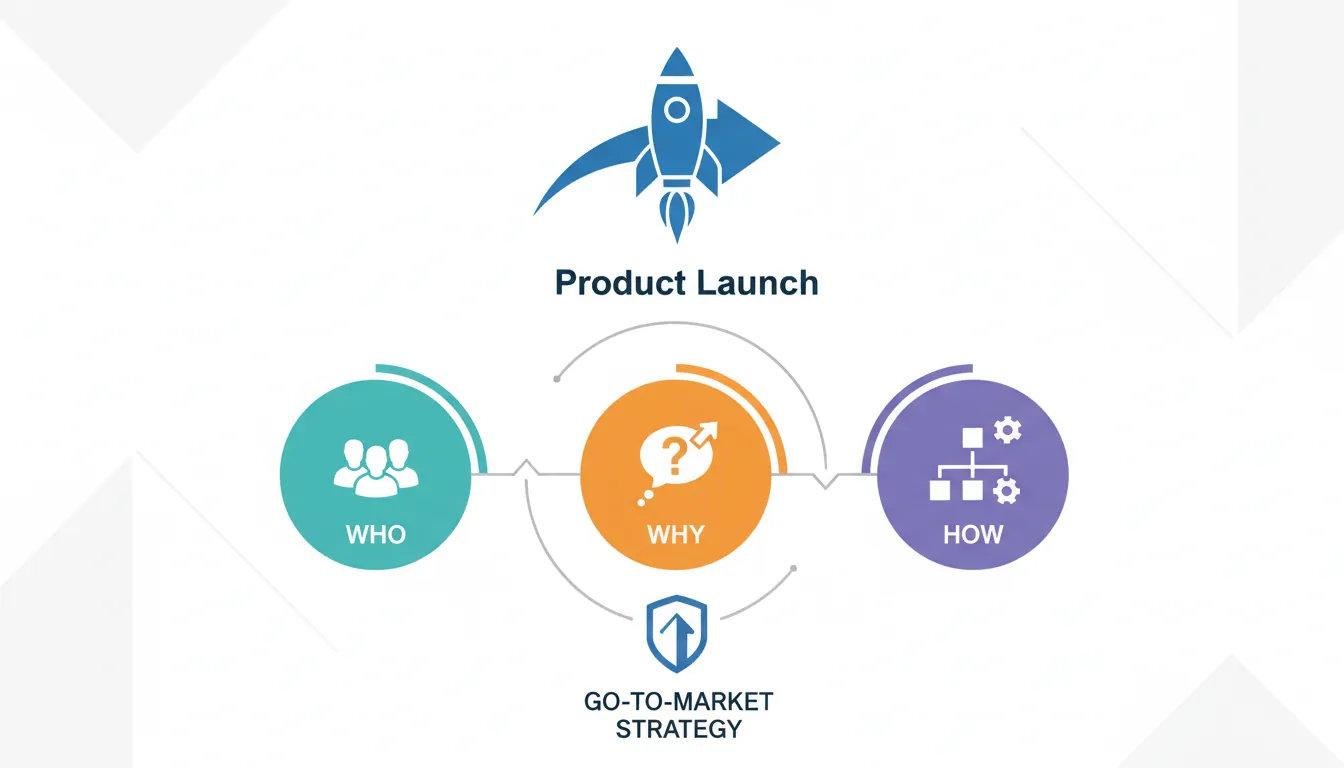
A go-to-market (GTM) strategy is your plan to launch a product into a new market. It answers three questions: Who are you selling to? Why should they buy from you? How will you reach them?
Positioning: Own a Space in the Mind
Positioning is not what you do to the product—it's what you do to the mind of the prospect. Great positioning makes your product the obvious choice for a specific audience.
For [target customer] who [has this problem], [product name] is a [category] that [key benefit]. Unlike [competitors], we [unique differentiator].
Positioning Statement Examples:

SLACK:
For teams who struggle with scattered communication,
Slack is a collaboration platform that brings all your
work together in one place. Unlike email, we make work
communication instant, searchable, and organized.

NOTION:
For knowledge workers who use too many tools,
Notion is an all-in-one workspace that combines notes,
docs, and databases. Unlike specialized tools, we
replace your entire productivity stack.

STRIPE:
For developers who need to accept payments,
Stripe is a payment API that takes minutes to integrate.
Unlike traditional processors, we're built for the internet
with developer-first documentation.
Positioning Statement Builder
Fill in the fields below to generate your positioning statement. Downloads as Word, Excel, or PDF.
All data stays in your browser. Nothing is sent to or stored on any server.
The Positioning Canvas
| Element | Question to Answer | Your Answer |
|---|---|---|
| Target Customer | Who is your ideal buyer? Be specific. | |
| Problem/Need | What urgent problem do they have? | |
| Category | What market do you compete in? | |
| Key Benefit | What's the #1 outcome you deliver? | |
| Competitors | What alternatives exist? | |
| Differentiator | Why are you uniquely better? |
Messaging: Words That Convert
Messaging translates your positioning into the words you use across all touchpoints. Good messaging is clear, benefit-focused, and resonates emotionally.
The Message Hierarchy
Message Hierarchy Framework:

LEVEL 1: TAGLINE (3-7 words)
"Just Do It" (Nike) | "Think Different" (Apple)
→ Captures essence, memorable, emotional

LEVEL 2: VALUE PROPOSITION (1 sentence)
"We help [audience] achieve [outcome] through [method]"
→ Clear benefit, specific audience

LEVEL 3: KEY MESSAGES (3-5 pillars)
├── Message 1: Primary benefit
├── Message 2: Secondary benefit
├── Message 3: Proof/credibility
├── Message 4: Differentiation
└── Message 5: Urgency/call to action

LEVEL 4: PROOF POINTS (supporting evidence)
├── Statistics and data
├── Customer testimonials
├── Case studies
├── Awards and recognition
└── Feature details
Message Testing Framework
The 5-Second Test
Show your homepage to someone for 5 seconds, then ask:
- What does this company do?
- Who is it for?
- What's the main benefit?
- What should you do next?
If they can't answer clearly, your messaging needs work.
Channel Selection: Where to Play
Not all channels work for all businesses. The right channel depends on where your customers are, your budget, and your business model.
| Channel | Best For | Timeline to Results | Cost |
|---|---|---|---|
| SEO/Content | B2B SaaS, info products | 6-12 months | Low-Medium |
| Paid Search (SEM) | High-intent keywords exist | Immediate | Medium-High |
| Paid Social | Consumer, visual products | Immediate | Medium-High |
| Email Marketing | Existing audience, retention | 1-3 months | Low |
| Partnerships | Complementary audiences | 3-6 months | Low-Medium |
| Community | Developer tools, niche markets | 6-18 months | Low (time-intensive) |
| Sales/Outbound | B2B Enterprise, high ACV | 3-9 months | High (headcount) |
| PR/Media | Brand awareness, credibility | 1-3 months | Medium-High |
1. Brainstorm all possible channels (outer ring)
2. Run cheap tests on top 6 (middle ring)
3. Double down on top 1-2 performers (bullseye)
Most startups find 1-2 channels that drive 80%+ of growth. Find yours and dominate it before diversifying.
3. B2C vs B2B vs B2P Marketing
Your business model fundamentally shapes your marketing approach. What works for selling shoes to consumers won't work for selling enterprise software—and vice versa. Understanding these differences is crucial for building an effective marketing strategy.
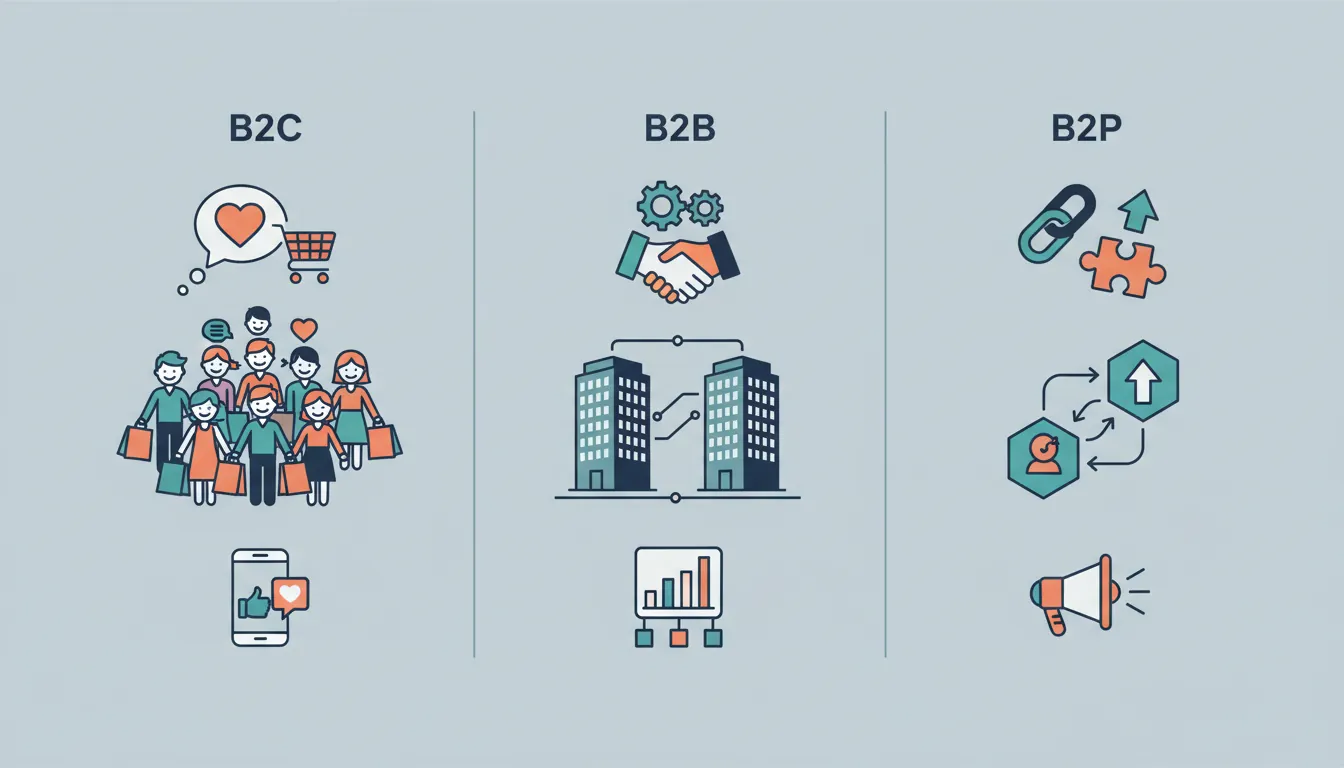
B2C = Marketing to individuals (consumers) — Think emotions, convenience, brand appeal
B2B = Marketing to businesses (companies) — Think ROI, relationships, decision committees
B2P = Marketing to platform users/partners — Think developer experience, documentation, ecosystem value
B2C Marketing Strategy
B2C marketing reaches individual consumers who make quick, often emotional purchasing decisions. Success depends on brand appeal, convenience, and reaching customers where they spend time.
B2C Marketing Channels & Tactics
| Channel | When to Use | Typical CAC | Examples |
|---|---|---|---|
| Social Media Ads | Visual products, lifestyle brands | $5-$50 | Instagram, TikTok, Facebook |
| Influencer Marketing | Products that benefit from social proof | $10-$100 | YouTube reviews, Instagram posts |
| Viral/Referral | Products with natural shareability | $1-$20 | Dropbox, TikTok, WhatsApp |
| Content/SEO | High search volume products | $10-$50 (long-term) | Review sites, how-to guides |
| TV/Video Ads | Mass market, brand building | $50-$200+ | YouTube pre-roll, Connected TV |
B2C Marketing Playbook
B2C MARKETING PRINCIPLES:

1. LEAD WITH EMOTION
   ├── Use storytelling (Nike's athlete stories)
   ├── Show transformation (before/after)
   ├── Create FOMO (limited time offers)
   └── Appeal to identity (community, lifestyle)

2. OPTIMIZE FOR CONVENIENCE
   ├── Frictionless checkout (one-click, saved cards)
   ├── Mobile-first experience
   ├── Fast shipping, easy returns
   └── Multiple payment options

3. BUILD BRAND RECOGNITION
   ├── Consistent visual identity
   ├── Memorable taglines
   ├── Social media presence
   └── User-generated content (UGC)

4. HARNESS SOCIAL PROOF
   ├── Customer reviews & ratings
   ├── Influencer endorsements
   ├── "Best seller" badges
   └── Social media shares

5. CREATE VIRAL LOOPS
   ├── Referral rewards (give $10, get $10)
   ├── Shareable content
   ├── Social sharing incentives
   └── Community challenges
B2C Case Study: Glossier
The Strategy: Build a community before building products.
- Content First: Started as "Into The Gloss" beauty blog
- Community Input: Products designed based on reader feedback
- UGC Focus: Customers become brand ambassadors
- Instagram-Native: Aesthetic designed for sharing
Result: $1.2B valuation with minimal traditional advertising.
B2B Marketing Strategy
B2B marketing reaches business decision-makers who often buy as part of a committee, evaluate ROI carefully, and take weeks or months to decide. Success depends on demonstrating value, building trust, and nurturing relationships.
B2B Marketing Channels & Tactics
| Channel | When to Use | Typical CAC | Examples |
|---|---|---|---|
| Content Marketing | Complex products needing education | $200-$1,000 | Whitepapers, guides, webinars |
| LinkedIn Ads/Outreach | Targeting specific job titles/companies | $200-$2,000 | Sponsored content, InMail |
| Account-Based Marketing | Enterprise deals, named accounts | $5,000-$50,000 | Personalized campaigns per account |
| Events & Conferences | Industry presence, networking | $500-$5,000 | SaaStr, Dreamforce, industry trade shows |
| Partner/Channel Sales | Reaching customers through partners | Variable (rev share) | System integrators, consultants |
B2B Marketing Playbook
B2B MARKETING PRINCIPLES:

1. DEMONSTRATE ROI
   ├── ROI calculators and TCO comparisons
   ├── Case studies with metrics (saved $X, improved Y%)
   ├── Third-party analyst validation
   └── Success stories from recognizable brands

2. EDUCATE BEFORE YOU SELL
   ├── Thought leadership content
   ├── Webinars and workshops
   ├── Industry research and benchmarks
   └── Free tools and templates

3. NURTURE THE LONG SALES CYCLE
   ├── Multi-touch email sequences
   ├── Lead scoring and qualification
   ├── Sales enablement content
   └── Drip campaigns for different buyer personas

4. ENABLE MULTIPLE STAKEHOLDERS
   ├── Technical documentation for IT
   ├── ROI analysis for Finance
   ├── Vision content for Executives
   └── Feature details for End Users

5. BUILD TRUST AND CREDIBILITY
   ├── Security certifications (SOC 2, ISO)
   ├── Customer logos and testimonials
   ├── Analyst reports (Gartner, Forrester)
   └── Long-term partnership positioning
B2B Case Study: HubSpot
The Strategy: Coined "Inbound Marketing" and became synonymous with it.
- Content Machine: Blog, Academy, Certifications, Templates
- Freemium Model: Free CRM drives bottom-up adoption
- Certification Program: Trained marketers become champions
- Community: Inbound conference, user groups
Result: $30B+ market cap, category creator in marketing automation.
B2P (Platform/Partner) Marketing Strategy
B2P marketing reaches developers, technical partners, and businesses who will build on your platform. Success depends on excellent developer experience, documentation, and creating value for the entire ecosystem.
B2P Marketing Channels & Tactics
| Channel | When to Use | Typical CAC | Examples |
|---|---|---|---|
| Developer Documentation | Always (foundation of DX) | Part of product | Stripe, Twilio docs |
| API Quickstarts | Reducing time to first integration | Part of product | "Hello World" in 5 min |
| Developer Communities | Building ecosystem loyalty | $100-$500 | Discord, Stack Overflow, GitHub |
| Hackathons & Events | Driving innovation and awareness | $500-$5,000 | API contests, DevCon |
| Partner Programs | Scaling through partners | Variable | AWS Partner Network, Shopify Partners |
B2P Marketing Playbook
B2P MARKETING PRINCIPLES:

1. DEVELOPER EXPERIENCE IS MARKETING
   ├── Time to "Hello World" < 5 minutes
   ├── Clear, accurate documentation
   ├── Working code samples in multiple languages
   └── Sandbox/test environments

2. DEVELOPER COMMUNITY
   ├── Active forums/Discord for Q&A
   ├── Developer advocates and evangelists
   ├── Open source contributions
   └── Developer conferences and meetups

3. PARTNER ENABLEMENT
   ├── Partner portal with resources
   ├── Co-marketing opportunities
   ├── Revenue sharing models
   └── Certification programs

4. SHOWCASE ECOSYSTEM SUCCESS
   ├── Partner case studies
   ├── App/integration directories
   ├── Developer spotlights
   └── Ecosystem metrics (GMV, API calls)

5. TRANSPARENT ROADMAP
   ├── Public product roadmap
   ├── Beta programs for new features
   ├── Migration guides for changes
   └── Clear deprecation policies
B2P Case Study: Twilio
The Strategy: Make developers fall in love with the product.
- Docs as Product: Best-in-class documentation and quickstarts
- Self-Serve First: Credit card signup, instant access
- Developer Advocates: Engineers who teach and create content
- Twilio Signal: Annual developer conference
Result: $15B+ market cap, powers communications for millions of apps.
Marketing Strategy Comparison
Use this comparison table to select the right marketing approach for your business model:
| Dimension | B2C Marketing | B2B Marketing | B2P Marketing |
|---|---|---|---|
| Primary Goal | Brand awareness, conversions | Lead generation, pipeline | Developer adoption, integrations |
| Decision Timeline | Minutes to days | Weeks to months | Days to weeks (then sticky) |
| Top Channels | Social, influencer, viral | Content, LinkedIn, events | Docs, community, hackathons |
| Messaging Style | Emotional, aspirational | Logical, ROI-focused | Technical, practical |
| Success Metrics | CAC, CVR, viral coefficient | MQLs, SQLs, pipeline value | API calls, integrations, GMV |
| Content Types | Video, UGC, social posts | Whitepapers, webinars, cases | Docs, tutorials, code samples |
| Team Structure | Growth, creative, performance | Demand gen, content, sales ops | DevRel, partner, community |
Many startups apply B2C tactics to B2B products (or vice versa) because founders are more familiar with one approach. Enterprise software rarely goes viral on TikTok. Consumer apps rarely convert from whitepapers. Match your marketing to your model.
4. Digital Marketing Fundamentals
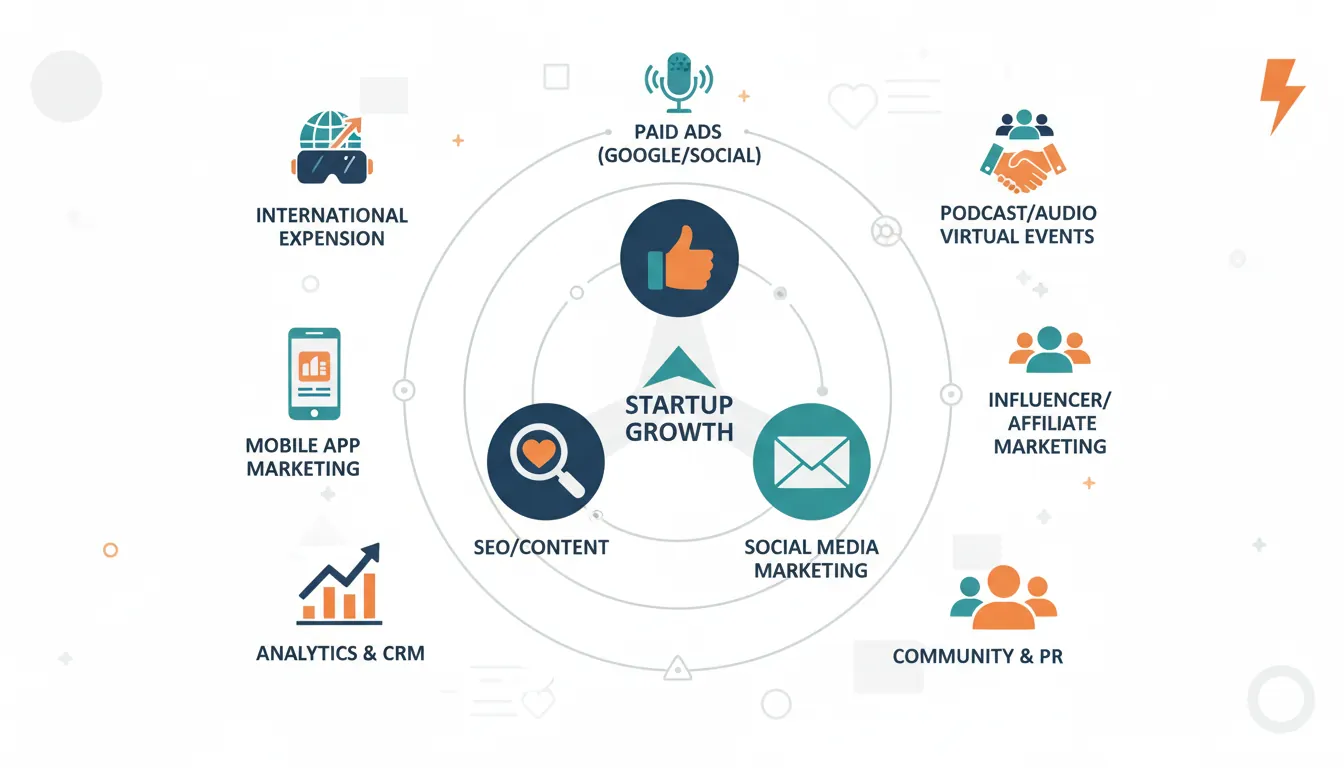
Digital marketing encompasses all marketing efforts using electronic devices or the internet. For startups, it's often the most cost-effective way to reach customers at scale.
Search Engine Optimization (SEO)
SEO is the practice of optimizing your website to rank higher in search engine results. It's a long-term investment that compounds over time.
SEO Strategy Framework:

1. KEYWORD RESEARCH
   ├── Identify target keywords (search volume, intent, difficulty)
   ├── Map keywords to content/pages
   └── Tools: Ahrefs, SEMrush, Google Keyword Planner

2. ON-PAGE SEO
   ├── Title tags (include keyword, <60 chars)
   ├── Meta descriptions (compelling, <160 chars)
   ├── Header structure (H1, H2, H3)
   ├── URL structure (short, descriptive)
   ├── Internal linking
   └── Image alt text

3. TECHNICAL SEO
   ├── Site speed (Core Web Vitals)
   ├── Mobile-friendly design
   ├── XML sitemap
   ├── SSL certificate (HTTPS)
   └── Structured data/Schema markup

4. OFF-PAGE SEO
   ├── Backlink building (quality > quantity)
   ├── Guest posting
   ├── PR and mentions
   └── Social signals

5. CONTENT
   ├── Create content for target keywords
   ├── Match search intent (informational, transactional)
   ├── Update and refresh existing content
   └── Build topical authority (clusters)
Search Engine Marketing (SEM/PPC)
SEM is paid advertising on search engines. You bid on keywords and pay when users click your ads. It's the fastest way to get in front of high-intent searchers.
| Platform | Best For | Avg CPC | Key Metrics |
|---|---|---|---|
| Google Search Ads | High-intent keywords | $1-$50+ | CTR, Conversion Rate, CPA |
| Google Shopping | E-commerce products | $0.50-$5 | ROAS, CTR, Impression Share |
| Microsoft/Bing Ads | B2B, older demographics | 20-40% lower than Google | Same as Google |
| Display Ads | Brand awareness, retargeting | $0.50-$5 CPM | Impressions, Reach, View-through |
Google Ads Campaign Structure
Recommended Account Structure:

CAMPAIGN LEVEL (Budget, targeting)
├── Campaign 1: Brand Keywords
│   └── Exact match brand terms (cheapest, highest intent)
├── Campaign 2: Non-Brand - High Intent
│   └── "Buy", "pricing", "vs competitor"
├── Campaign 3: Non-Brand - Research
│   └── "How to", "best", "reviews"
├── Campaign 4: Competitor Keywords
│   └── Competitor brand names (expensive, aggressive)
└── Campaign 5: Retargeting
    └── Website visitors who didn't convert

AD GROUP LEVEL (Keywords, ads)
├── Tight keyword themes (10-20 keywords)
├── 3-5 ad variations per group
└── Relevant landing pages

Quality Score Factors (affects CPC):
• Ad relevance to keyword
• Expected CTR
• Landing page experience
Social Media Marketing
Each social platform has different user behaviors, content formats, and advertising capabilities. Choose platforms where your audience actually spends time.
| Platform | Best Content | Audience | B2B vs B2C |
|---|---|---|---|
| Thought leadership, industry news | Professionals, decision-makers | B2B ⭐⭐⭐⭐⭐ | |
| Twitter/X | News, commentary, threads | Tech, media, investors | Both ⭐⭐⭐ |
| Visual stories, lifestyle | Millennials, Gen Z | B2C ⭐⭐⭐⭐⭐ | |
| TikTok | Short video, trends, entertainment | Gen Z, younger millennials | B2C ⭐⭐⭐⭐⭐ |
| YouTube | Long-form video, tutorials | All demographics | Both ⭐⭐⭐⭐ |
| Community, groups, local | Older millennials, Gen X | B2C ⭐⭐⭐ |
Content Marketing
Content marketing attracts and retains customers by creating valuable, relevant content. It's the foundation of inbound marketing.
Content Types by Funnel Stage
Content Funnel Mapping:

TOP OF FUNNEL (TOFU) - Awareness
├── Blog posts (SEO-focused)
├── Social media content
├── Podcasts / videos
├── Infographics
└── Goal: Attract traffic, build awareness

MIDDLE OF FUNNEL (MOFU) - Consideration
├── Ebooks / whitepapers
├── Webinars
├── Case studies
├── Comparison guides
├── Email nurture sequences
└── Goal: Capture leads, educate

BOTTOM OF FUNNEL (BOFU) - Decision
├── Product demos
├── Free trials
├── Customer testimonials
├── ROI calculators
├── Pricing pages
└── Goal: Convert to customers
Content Calendar Template
| Week | Blog | Social | Video | |
|---|---|---|---|---|
| 1 | SEO pillar post | 3x LinkedIn posts | Newsletter | - |
| 2 | Guest post | 3x Twitter threads | Nurture email | Tutorial video |
| 3 | Case study | 3x LinkedIn posts | Newsletter | - |
| 4 | Cluster article | 3x repurposed clips | Product update | Webinar |
Email Marketing
Email remains one of the highest ROI marketing channels—$36 return for every $1 spent on average. It's essential for nurturing leads and retaining customers.
Email Marketing Best Practices
| Element | Best Practice | Benchmark |
|---|---|---|
| Subject Line | Clear, compelling, 40-60 chars | Open rate: 20-30% |
| Personalization | Use name, behavior, preferences | +26% higher open rate |
| Send Time | Test! (Tue-Thu morning often works) | Varies by audience |
| CTA | One clear action per email | CTR: 2-5% |
| Mobile | 60%+ opens are mobile—design for it | - |
Essential Email Sequences
Email Automation Sequences:

1. WELCOME SEQUENCE (New subscribers)
   Day 0: Welcome + expectation setting
   Day 2: Best content / quick win
   Day 4: Your story / why we exist
   Day 7: Soft pitch / CTA

2. ONBOARDING SEQUENCE (New customers)
   Day 0: Getting started guide
   Day 1: Key feature tutorial
   Day 3: Check-in + support offer
   Day 7: Success story / inspiration
   Day 14: Feedback request

3. NURTURE SEQUENCE (Leads not ready to buy)
   Weekly: Educational content
   Monthly: Case studies / proof
   Quarterly: Special offers

4. RE-ENGAGEMENT (Inactive users)
   Day 30 inactive: "We miss you"
   Day 45 inactive: Exclusive offer
   Day 60 inactive: Final chance
   Day 90 inactive: Remove from list
5. Marketing Performance Metrics
What gets measured gets managed. These metrics help you understand what's working and where to invest more.
Customer Acquisition Cost (CAC) & Lifetime Value (LTV)
The CAC & LTV Relationship:

CAC = Total Marketing + Sales Cost ÷ New Customers Acquired

Example:
Marketing spend: $50,000
Sales salaries: $30,000
New customers: 100
CAC = $80,000 ÷ 100 = $800 per customer

LTV = Average Revenue per Customer × Average Customer Lifespan

Example (SaaS):
Monthly revenue: $100
Average lifespan: 24 months
LTV = $100 × 24 = $2,400

THE GOLDEN RATIO:
┌─────────────────────────────────────────────────────────────┐
│          LTV : CAC RATIO          │       INTERPRETATION    │
├─────────────────────────────────────────────────────────────┤
│           < 1:1                   │  Losing money (bad)     │
│           1:1 to 3:1              │  Breakeven to okay      │
│           3:1 to 5:1              │  Healthy and scalable   │
│           > 5:1                   │  Under-investing in     │
│                                   │  growth (leave money    │
│                                   │  on table)              │
└─────────────────────────────────────────────────────────────┘

Target: 3:1 ratio with CAC payback < 12 months
CAC/LTV Calculator
Enter your metrics to calculate Customer Acquisition Cost and Lifetime Value.
All data stays in your browser. Nothing is sent to or stored on any server.
Conversion Rate Optimization
| Metric | Formula | Benchmark |
|---|---|---|
| Website Conversion | Conversions ÷ Visitors | 2-5% (varies by industry) |
| Landing Page | Form fills ÷ Page visitors | 10-25% |
| Free-to-Paid | Paid users ÷ Free signups | 2-5% (freemium), 15-25% (trial) |
| MQL to SQL | Sales qualified ÷ Marketing qualified | 20-40% |
| SQL to Close | Closed deals ÷ SQL | 20-30% |
Churn: The Silent Killer
Churn measures how many customers you lose over time. Even small churn rates compound devastatingly.
Churn Impact Analysis:

Monthly Churn    Annual Retention    5-Year Retention
────────────────────────────────────────────────────
    1%               88.6%              54.7%
    2%               78.5%              30.1%
    3%               69.4%              16.5%
    5%               54.0%               5.4%
   10%               28.2%               0.2%

At 5% monthly churn, you lose HALF your customers every year!

CHURN REDUCTION STRATEGIES:
├── Improve onboarding (biggest impact on early churn)
├── Proactive customer success
├── Feature usage monitoring + intervention
├── Feedback loops and NPS tracking
├── Annual contracts (reduces opportunity to churn)
└── Win-back campaigns for churned customers
6. Experimentation in Marketing Campaigns
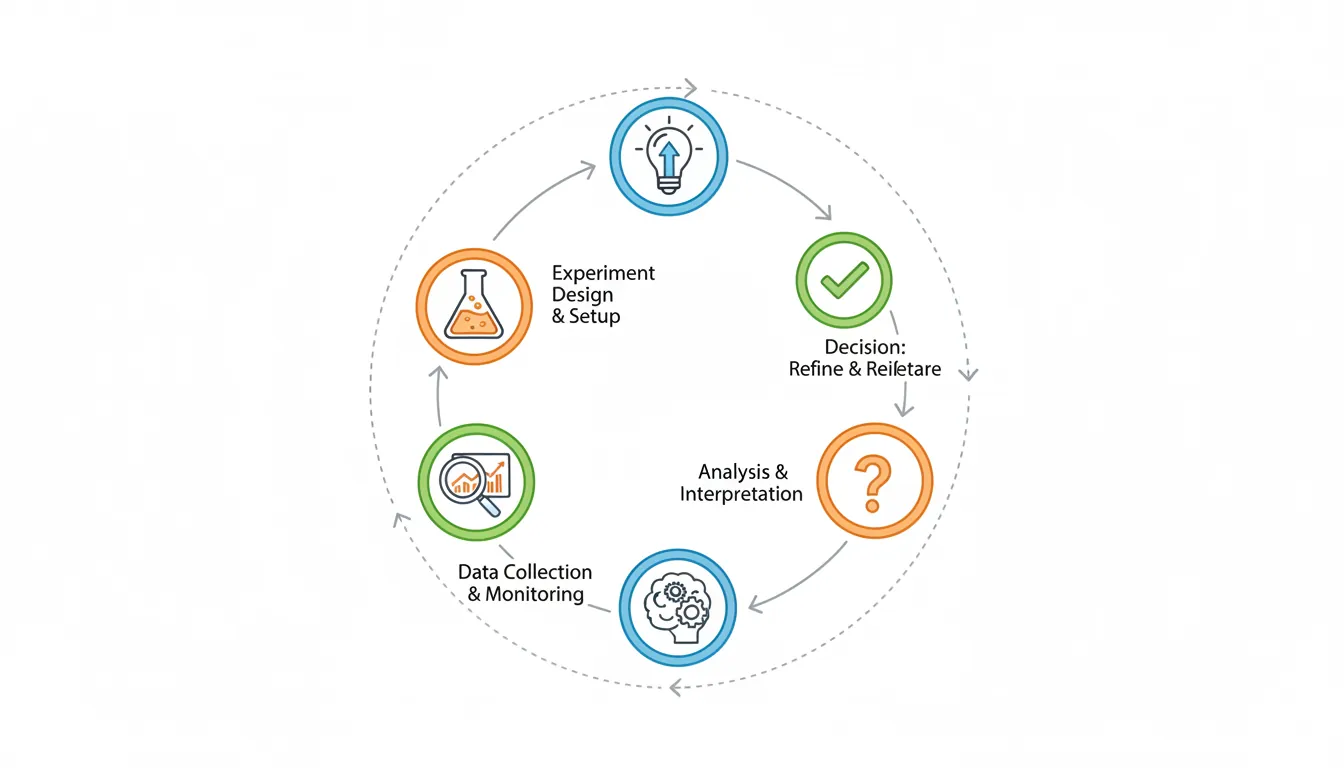
Great marketers are scientists. They form hypotheses, design experiments, measure results, and iterate based on data.
The Marketing Experiment Process
Experiment Lifecycle:

1. HYPOTHESIZE
   "If we change [variable], then [metric] will improve by [X%]
    because [reasoning based on insight]."

2. DESIGN
   ├── Define control and variant(s)
   ├── Calculate required sample size
   ├── Set success criteria in advance
   └── Determine run time (statistical significance)

3. EXECUTE
   ├── Launch A/B test
   ├── Monitor for technical issues
   └── Don't peek at results early!

4. ANALYZE
   ├── Was it statistically significant?
   ├── What was the actual lift?
   └── Any unexpected findings?

5. DECIDE
   ├── Ship winner to 100%
   ├── Iterate with new hypothesis
   └── Document learnings for team
What to Test
| Element | Variables to Test | Expected Impact |
|---|---|---|
| Headlines | Benefit vs. feature, question vs. statement | High (10-30% lift possible) |
| CTAs | Copy, color, placement, size | Medium (5-15%) |
| Images | Product vs. people, lifestyle vs. abstract | Medium (5-20%) |
| Pricing Display | Monthly vs. annual, anchoring, decoy | High (10-50%) |
| Social Proof | Testimonials, logos, numbers | Medium (5-15%) |
| Form Fields | Number of fields, required vs. optional | High (10-25%) |
7. Marketing Funnels & Retention Strategies
A marketing funnel visualizes the customer journey from awareness to purchase. Understanding and optimizing each stage is key to growth.
The Modern Marketing Funnel
Full-Funnel Marketing:

┌─────────────────────────────────────────────────────────────┐
│                      AWARENESS                              │
│     Content, SEO, Social, PR, Ads                          │
│     Metric: Traffic, Impressions, Reach                    │
├─────────────────────────────────────────────────────────────┤
│                      INTEREST                               │
│     Lead magnets, Email signup, Follows                    │
│     Metric: Leads, Subscribers, Engagement                 │
├─────────────────────────────────────────────────────────────┤
│                     CONSIDERATION                           │
│     Nurture emails, Case studies, Webinars                 │
│     Metric: MQLs, Content consumption                      │
├─────────────────────────────────────────────────────────────┤
│                       INTENT                                │
│     Pricing page visits, Demo requests, Free trials        │
│     Metric: SQLs, Trial starts                             │
├─────────────────────────────────────────────────────────────┤
│                      PURCHASE                               │
│     Sales calls, Checkout, Conversion                      │
│     Metric: Customers, Revenue                             │
├─────────────────────────────────────────────────────────────┤
│                      RETENTION                              │
│     Onboarding, Success, Support                           │
│     Metric: Retention, NPS, Expansion revenue              │
├─────────────────────────────────────────────────────────────┤
│                      ADVOCACY                               │
│     Referrals, Reviews, Case studies                       │
│     Metric: NPS, Referral rate, Reviews                    │
└─────────────────────────────────────────────────────────────┘
Retention Marketing Strategies
Acquiring a new customer costs 5-25x more than retaining an existing one. Increasing retention by 5% can increase profits by 25-95%. Yet most startups spend 90% of marketing on acquisition. Balance matters.
| Strategy | Implementation | Impact |
|---|---|---|
| Onboarding Excellence | In-app guidance, welcome emails, success milestones | Reduces early churn 20-40% |
| Proactive Support | Health scores, usage monitoring, check-ins | Catches at-risk customers early |
| Loyalty Programs | Points, tiers, exclusive benefits | Increases purchase frequency |
| Community Building | Forums, events, user groups | Creates switching costs |
| Regular Communication | Newsletters, product updates, education | Keeps brand top of mind |
| Win-Back Campaigns | Targeted re-engagement for churned users | Recovers 5-15% of churned |
Exercise: Marketing Audit Checklist
Evaluate your current marketing using this checklist:
- ☐ Can I clearly articulate my positioning in one sentence?
- ☐ Do I know my CAC and LTV? Is LTV:CAC > 3:1?
- ☐ Do I have at least one channel working profitably?
- ☐ Am I running at least 2 marketing experiments per month?
- ☐ Do I have automated email sequences for key journeys?
- ☐ Am I tracking retention and actively working to improve it?
- ☐ Do I have a content calendar and consistent publishing?
- ☐ Can prospects easily find social proof (testimonials, cases)?
For each "no," create an action item with a deadline.
8. Conclusion & Next Steps
With your marketing engine running, you need to ensure your legal, financial, and risk foundations are solid to protect your growing company.