1. Introduction
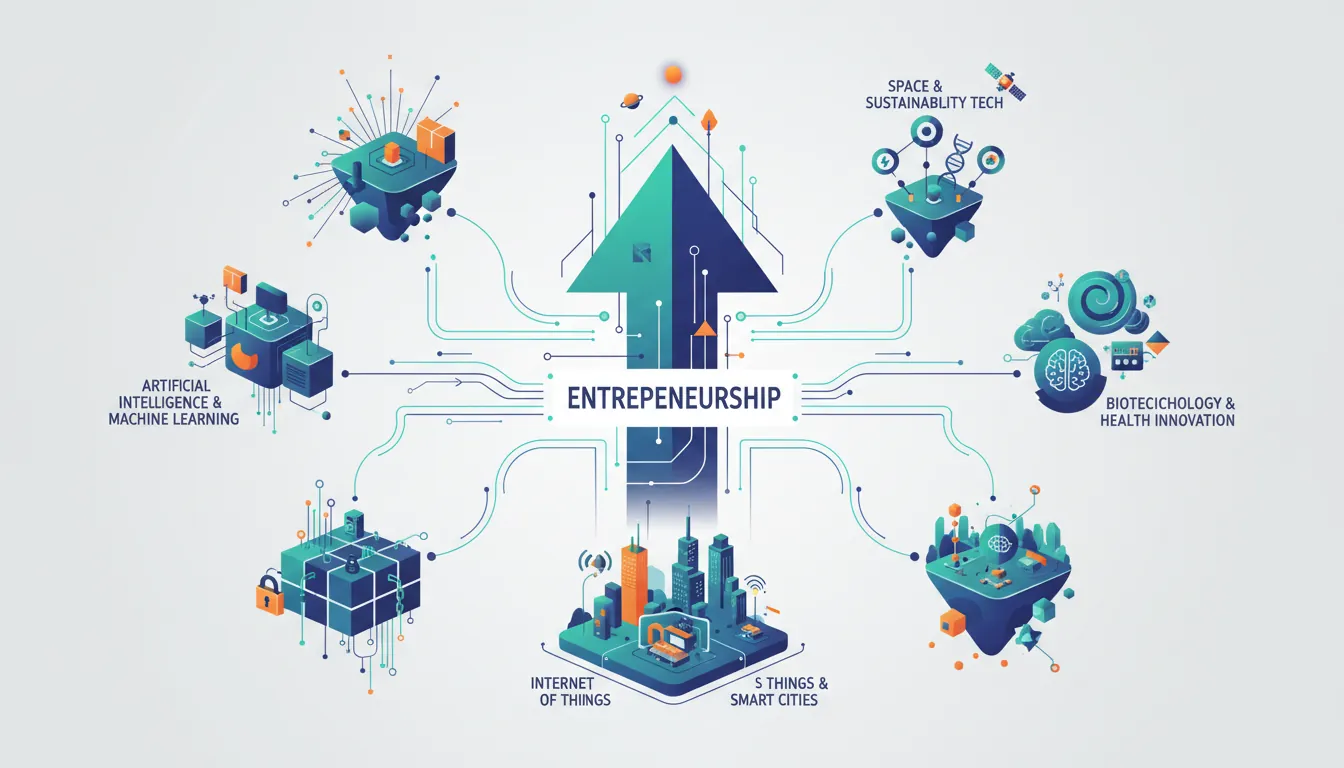
The best entrepreneurs see around corners. This guide explores the technologies and trends that will define the next decade of entrepreneurship.
Complete Startup Journey
Ideation & Opportunity Recognition
Problem discovery, market gaps, idea generation frameworksIdea Validation & MVP Prototyping
Customer discovery, landing pages, prototype testingBusiness Models & Canvas
BMC, lean canvas, revenue models, value propositionsLean Startup Methodology
Build-measure-learn, pivoting, validated learningFundraising & Financial Modeling
VC, angels, SAFE notes, cap tables, financial projectionsBuilding Your Founding Team
Co-founder selection, equity splits, team dynamicsHiring & Company Culture
Recruiting, culture building, OKRs, team scalingScaling Operations & Growth Hacking
Growth loops, viral mechanics, operational scalingMarketing Campaigns & Digital Growth
CAC/LTV, digital marketing, positioning, channelsLegal, Financial & Risk Foundations
Entity structure, IP, compliance, burn rate managementData-Driven Decision Making
SaaS metrics, NPS, analytics dashboards, A/B testingExit Strategies & Investor Pitches
Valuations, pitch decks, M&A, IPO preparationStartup Ecosystem & Networking
Accelerators, mentors, communities, ecosystem mappingInnovation, Technology & Future Trends
Emerging tech, AI/ML, deep tech, future marketsCapstone Projects & Portfolio
Comprehensive startup plan, portfolio presentation2. AI & Machine Learning in Entrepreneurship
AI has shifted from a technical curiosity to a fundamental business tool. Every entrepreneur must understand both the opportunities and limitations.
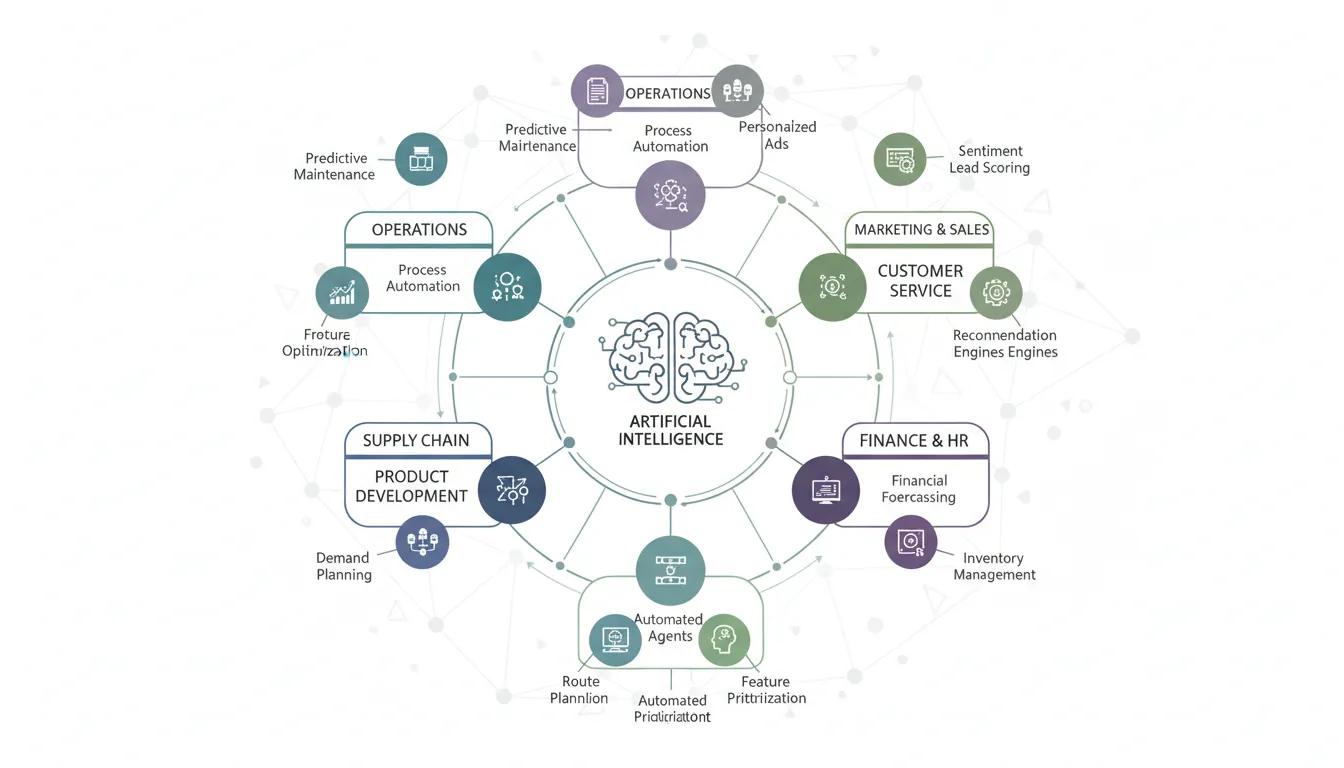
AI Application Landscape
AI Opportunities by Business Function:

PRODUCT
├── Personalization engines (Netflix, Spotify)
├── Search and discovery (Google, Amazon)
├── Content generation (ChatGPT, Midjourney)
├── Voice/image interfaces (Siri, Google Lens)
└── Prediction and recommendations

OPERATIONS
├── Demand forecasting
├── Supply chain optimization
├── Quality control (computer vision)
├── Predictive maintenance
└── Process automation (RPA + AI)

CUSTOMER
├── Chatbots and support automation
├── Sentiment analysis
├── Customer churn prediction
├── Dynamic pricing
└── Hyper-personalized marketing

INTERNAL
├── Recruiting (resume screening)
├── Document processing
├── Code generation (Copilot)
├── Meeting summarization
└── Knowledge management
Technology Readiness Assessment
Rate your startup's readiness across key technology dimensions to identify gaps and strengths.
All data stays in your browser. Nothing is sent to or stored on any server.
Building AI Startups: Approaches
| Approach | Description | Moat | Examples |
|---|---|---|---|
| AI Infrastructure | Build tools for AI developers | Technical depth, ecosystem | Hugging Face, Weights & Biases |
| Vertical AI | AI for specific industry/use case | Domain data, workflows | Harvey (legal), Viz.ai (medical) |
| AI-Native Product | Product impossible without AI | User experience, network effects | Notion AI, GitHub Copilot |
| AI-Enhanced | AI as feature, not core product | Distribution, brand, data | Most SaaS adding AI features |
• Thin wrapper: Just calling an API with no unique value
• No data moat: Competitors can replicate with same foundation model
• Hallucination risk: Use cases where errors are costly
• Platform risk: OpenAI/Google can build your feature overnight
• Margin squeeze: API costs eat into profits at scale
3. Blockchain, Web3 & Decentralization
Despite market volatility, blockchain technology enables new business models around digital ownership, decentralized coordination, and programmable money.
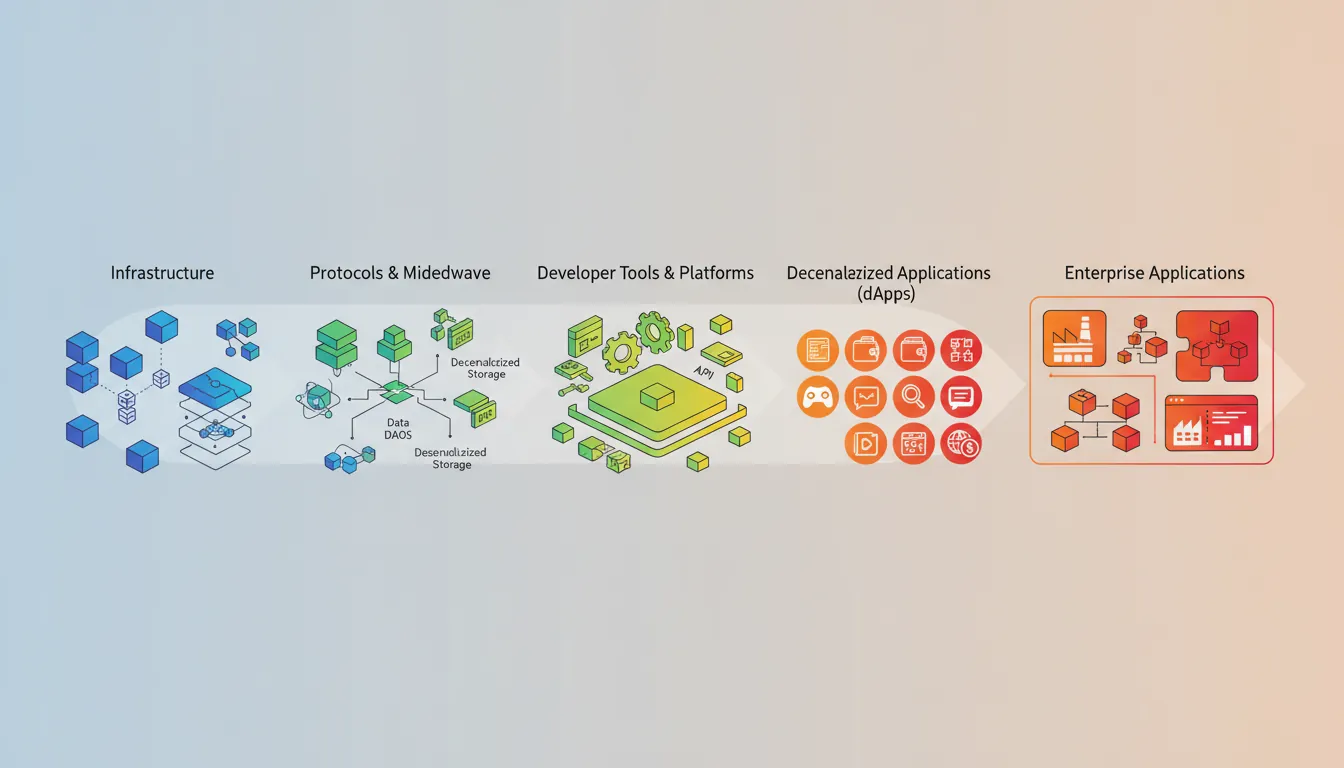
Web3 Opportunity Spectrum:

INFRASTRUCTURE (Lowest Risk, High Technical Bar)
├── Layer 1 & 2 blockchains
├── Developer tools, APIs
├── Wallets, custody solutions
└── Oracle networks

DEFI (High Risk, Regulatory Uncertainty)
├── Decentralized exchanges (DEXs)
├── Lending/borrowing protocols
├── Stablecoins
└── Real-world asset tokenization

NFTs & DIGITAL OWNERSHIP
├── Art, collectibles, gaming
├── Membership/access tokens
├── Royalty mechanisms
└── Identity and credentials

DAOs & COORDINATION
├── Investment DAOs
├── Protocol governance
├── Creator communities
└── Service DAOs

ENTERPRISE BLOCKCHAIN
├── Supply chain tracking
├── Document verification
├── Cross-border payments
└── Tokenized securities
4. Emerging Technologies
Internet of Things (IoT)
IoT connects physical devices to the internet, enabling new data collection, automation, and business models.
| Sector | Applications | Business Model |
|---|---|---|
| Smart Home | Thermostats, security, appliances | Hardware + subscription services |
| Industrial IoT | Predictive maintenance, asset tracking | SaaS platform, outcome-based pricing |
| Healthcare | Wearables, remote monitoring | B2B2C, insurance partnerships |
| Agriculture | Precision farming, livestock monitoring | Hardware + data analytics |
Augmented & Virtual Reality (AR/VR)
AR/VR Opportunity Matrix:

ENTERPRISE (Highest Revenue, Fastest Growth)
├── Training and simulation
├── Remote collaboration
├── Design and prototyping
├── Field service support
└── Examples: Varjo, Matterport, Strivr

CONSUMER (High Volume, Harder Monetization)
├── Gaming and entertainment
├── Social (Metaverse)
├── Fitness (Supernatural, FitXR)
└── E-commerce try-before-buy

INDUSTRIAL
├── Manufacturing inspection
├── Architecture visualization
├── Healthcare (surgery planning)
└── Defense and military

ENABLING TECHNOLOGY
├── 3D capture and scanning
├── Spatial computing SDKs
├── Haptics and peripherals
└── Content creation tools
Quantum Computing
Quantum computing is still early but will eventually transform optimization, simulation, and cryptography.
• Near-term (1-3 years): Quantum consulting, education, workforce training
• Medium-term (3-7 years): Quantum software, algorithms, industry applications
• Long-term (7+ years): Quantum advantage in drug discovery, materials, finance
• Now: Post-quantum cryptography (security that survives quantum computers)
5. Industry Disruption Patterns
Understanding how disruption works helps you spot opportunities and avoid being disrupted.
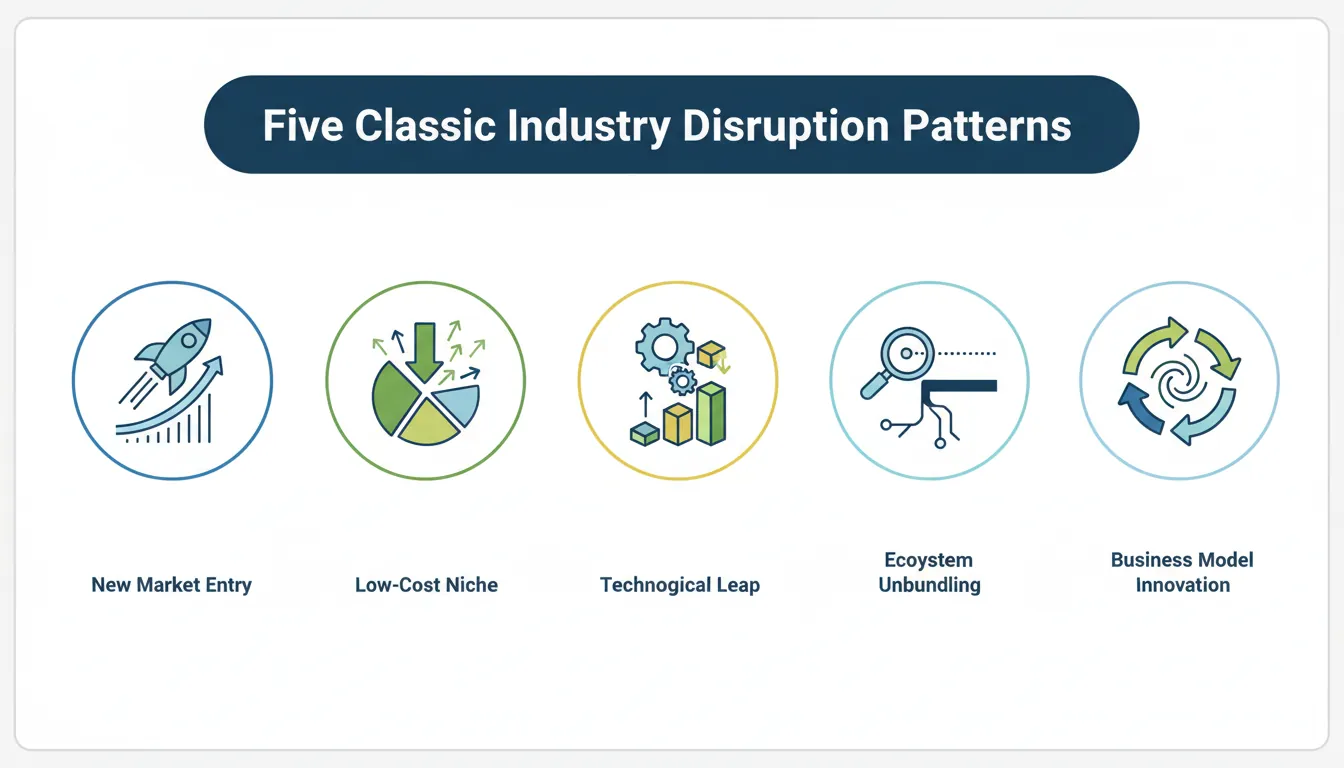
Classic Disruption Patterns:

1. LOW-END DISRUPTION (Christensen)
   ├── New entrant serves overlooked segment
   ├── Incumbents flee upmarket
   ├── Disruptor improves and moves upmarket
   └── Examples: Toyota vs. GM, Netflix vs. Blockbuster

2. NEW-MARKET DISRUPTION
   ├── Create new category/market
   ├── Compete against non-consumption
   ├── Different value metrics
   └── Examples: iPhone (smartphones), Airbnb (lodging)

3. UNBUNDLING
   ├── Break apart integrated offerings
   ├── Best-of-breed point solutions
   └── Examples: Craigslist unbundled (Indeed, Tinder, Zillow)

4. REBUNDLING
   ├── Aggregate fragmented solutions
   ├── Single platform, unified experience
   └── Examples: Salesforce, Microsoft 365

5. PLATFORM DISRUPTION
   ├── Create marketplace, enable others
   ├── Network effects compound
   └── Examples: Amazon Marketplace, Shopify

Industries Ripe for Disruption:
├── Healthcare (regulation easing, consumerization)
├── Education (credentialing, outcomes-based)
├── Construction (productivity lagging)
├── Legal (commoditization, AI tools)
└── Insurance (data-driven underwriting)
6. Sustainability & Social Entrepreneurship
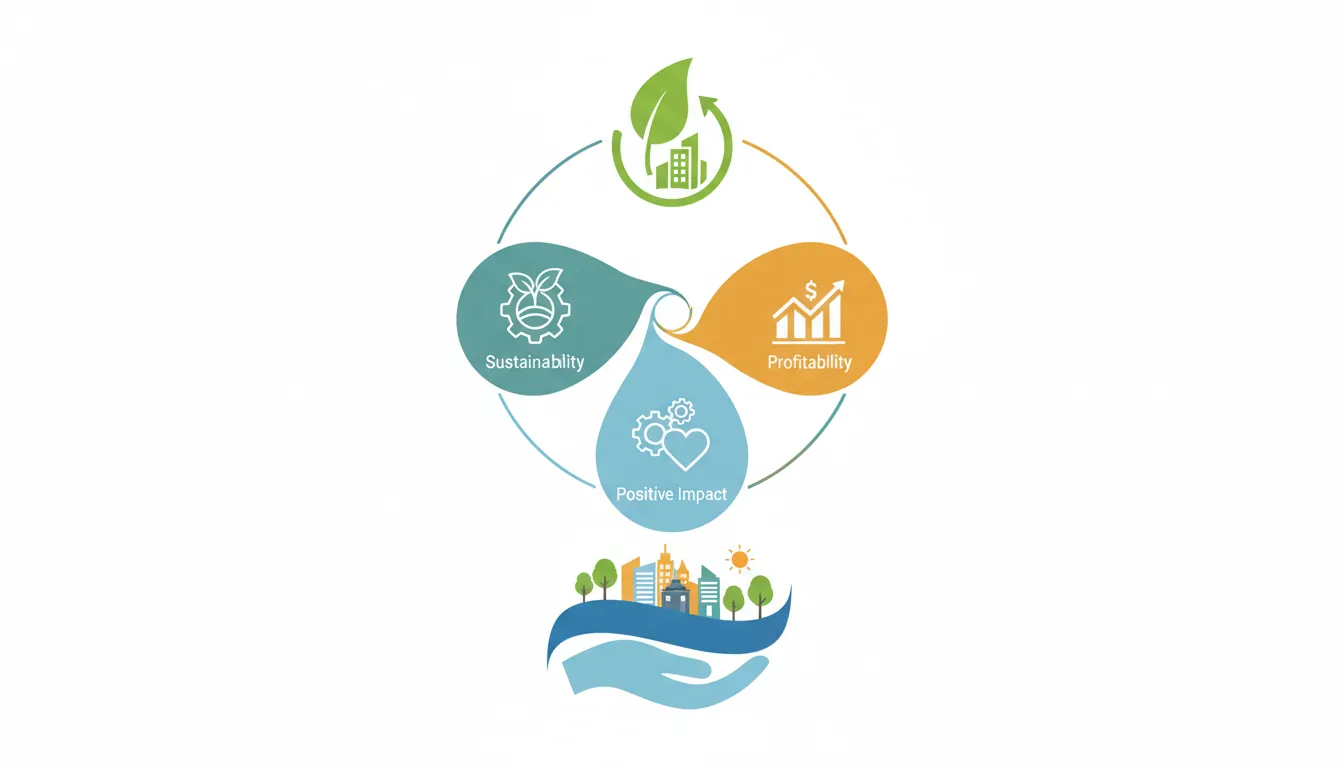
Building businesses that create positive environmental and social impact while generating returns is not just ethical—it's increasingly demanded by customers, employees, and investors.
Climate Tech
| Category | Solutions | Investment Stage |
|---|---|---|
| Energy Generation | Solar, wind, fusion, geothermal | Growth/mature (solar, wind), early (fusion) |
| Energy Storage | Batteries, hydrogen, thermal | Growth stage, heavy R&D |
| Carbon Removal | Direct air capture, biochar, ocean | Early stage, high risk |
| Sustainable Materials | Bio-plastics, alternative proteins | Early to growth |
| Climate Software | Carbon accounting, ESG reporting | Growth, lower capital needs |
Impact Investing Landscape
Impact Investment Spectrum:

TRADITIONAL VC (Returns First)
├── Some ESG considerations
├── Standard return expectations
└── Examples: Most mainstream VCs

IMPACT VENTURES (Returns + Impact)
├── Market-rate returns required
├── Measurable social/environmental outcomes
├── Examples: DBL Partners, Obvious Ventures, Breakthrough Energy

IMPACT-FIRST (Impact Primary)
├── Below-market returns acceptable
├── Maximize social return
├── Examples: Omidyar Network, Skoll Foundation

CONCESSIONARY (Grants/PRI)
├── Return not expected
├── Purely philanthropic
└── Examples: Gates Foundation
Circular Economy Business Models
Circular Economy Strategies:

1. PRODUCT-AS-A-SERVICE
   ├── Own product, sell access
   ├── Incentive to design for durability
   └── Examples: Xerox (leasing), Rent the Runway

2. SHARING PLATFORMS
   ├── Maximize asset utilization
   ├── Community ownership models
   └── Examples: Turo, Airbnb, Tool libraries

3. TAKE-BACK & REFURBISHMENT
   ├── Manufacturer reclaims products
   ├── Refurbish, resell, recycle
   └── Examples: Apple Trade-In, Patagonia Worn Wear

4. INDUSTRIAL SYMBIOSIS
   ├── One company's waste = another's input
   ├── Co-location, material exchanges
   └── Examples: Kalundborg Symbiosis (Denmark)

5. BIOLOGICAL CYCLES
   ├── Bio-based materials
   ├── Composting, regeneration
   └── Examples: Novamont, ecovative
7. Future Entrepreneurship Trends
| Trend | Description | Implications for Founders |
|---|---|---|
| Solo Entrepreneurship | AI enables 1-person billion-dollar companies | Lean operations, focused products |
| Distributed Teams | Remote-first as default, global talent | Async communication, culture intentionality |
| Creator Economy | Individuals as businesses | Build tools for creators, leverage personal brand |
| Micro-SaaS | Small, profitable software businesses | Niche down, bootstrap-friendly |
| Deep Tech Revival | Hardware, biotech, climate getting funded | Longer timelines, larger outcomes |
| Embedded Finance | Financial services in every product | BaaS platforms, new revenue streams |
10-Year Predictions Exercise
Develop your future-sensing muscles:
- List 5 industries that will look completely different in 10 years
- Identify 3 technologies at the "trough of disillusionment" today that will be mainstream
- Predict what new category of startup will be commonplace (like "SaaS" was novel 20 years ago)
- Write a "job posting" for a role that doesn't exist yet
- Design a product that would be impossible to build today but possible in 5 years
Bonus: Review your predictions annually and calibrate your forecasting
8. Conclusion & Next Steps
You now have a comprehensive understanding of entrepreneurship. It's time to put everything together in the capstone projects and build your portfolio.