We use cookies to enhance your browsing experience, serve personalized content, and analyze our traffic.
By clicking "Accept All", you consent to our use of cookies. See our
Privacy Policy
for more information.
Competition & Network Effects: 8 Laws for Sustainable Moats
January 24, 2026Wasil Zafar50 min read
Master the economic laws that determine market structure, competitive positioning, and platform dominance—the foundation of sustainable competitive advantage. Part 3 of our 8-part Economics for Business Strategy series.
Introduction: The Economics of Competitive Advantage
Having mastered market fundamentals (Part 1) and production economics (Part 2), we now turn to the ultimate strategic question: how do you build a business that competitors can't easily replicate? The answer lies in understanding market structure, competitive dynamics, and network effects—the economic forces that create winner-take-most markets and sustainable competitive moats.
These 8 laws explain why Amazon dominates e-commerce despite hundreds of competitors, how Google maintains 90%+ search market share, why Meta's Facebook remains dominant despite declining user sentiment, and how startups can still win in concentrated markets. From barriers to entry that protect incumbents, to network effects that create exponential growth, to power law distributions that concentrate value in a few winners—this is the economics of strategic positioning.
Market Structure: How industry concentration determines profitability and what drives winner-take-most outcomes
Competitive Moats: Building sustainable barriers to entry through scale, network effects, and switching costs
Platform Dynamics: Why network effects create exponential growth and how to overcome the cold-start problem
Strategic Positioning: When to compete on cost leadership versus differentiation based on market structure
Value Distribution: Why power laws concentrate returns and what this means for venture capital and market entry
Let's begin with the fundamental force shaping all markets: competition.
21. Law of Competition: The Invisible Hand That Erodes Profits
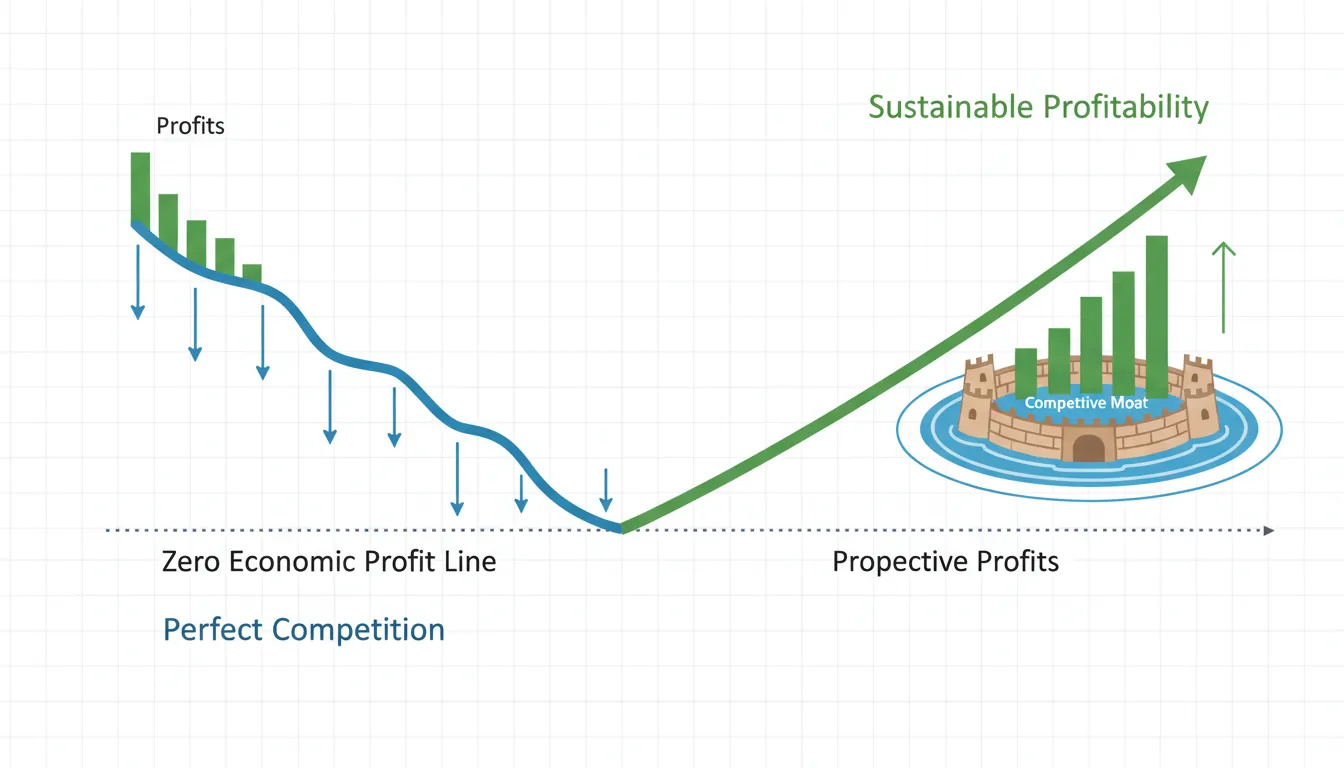
Core Principle: Perfect competition drives profits to zero. Sustainable profitability requires competitive moats—barriers that prevent rivals from eroding your margins.
Figure: Competition dynamics showing how perfect competition erodes profits to zero, and how competitive moats protect sustainable profitability.
Real-World Application: Airline Industry Economics
Industry Analysis
Why Airlines Struggle to Make Money
Perfect Competition Characteristics:
Commodity product: Seat from NYC to LA is identical across carriers
Low switching costs: Customers choose based on price + schedule only
High fixed costs: Planes, gates, staff—costs are same whether full or empty
Easy price comparison: Google Flights shows all options instantly
Result: Competition forces prices down to marginal cost
Industry profit margins: 1-3% (vs. 20-30% for software)
Bankruptcies: Most major airlines filed for Chapter 11 (2000-2010)
Consolidation: Merged down to 4 major carriers to reduce competition
CompetitionEconomies of Scale
Building Competitive Moats
Moat Type
How It Works
Example
Durability
Network Effects
Value increases with users
Facebook, Visa
Very High
Switching Costs
Expensive/painful to leave
SAP, Workday
High
Economies of Scale
Cost advantage from size
Walmart, Amazon
High
Brand/Intangibles
Premium pricing from trust
Apple, Nike
Medium
Regulatory/IP
Legal barriers to entry
Pharma patents, Uber licenses
Medium
Data
Unique dataset others can't replicate
Google Search, Bloomberg
Medium-High
Business Applications
For Strategy Teams: Audit your moats quarterly. Rate each moat 1-10 on strength. If average score < 5, you're vulnerable. Invest aggressively in strengthening moats before competitors erode margins.
For Product Teams: Build features that increase switching costs. Integrations, proprietary data formats, workflows that become muscle memory. Make it painful to leave.
For Sales Teams: In competitive markets, win on relationships and service, not price. Price wars destroy margins. Differentiate on intangibles that justify premium pricing.
Warren Buffett's Moat Test
"The key to investing is determining the competitive advantage of any given company and, above all, the durability of that advantage."
Questions to ask:
If we stopped innovating today, how long until competitors catch up?
What would it cost a new entrant to replicate our position?
Can we raise prices 10% without losing 10% of customers?
How many of our customers would switch if a competitor offered 20% lower prices?
22. Creative Destruction: Innovation That Destroys Incumbents
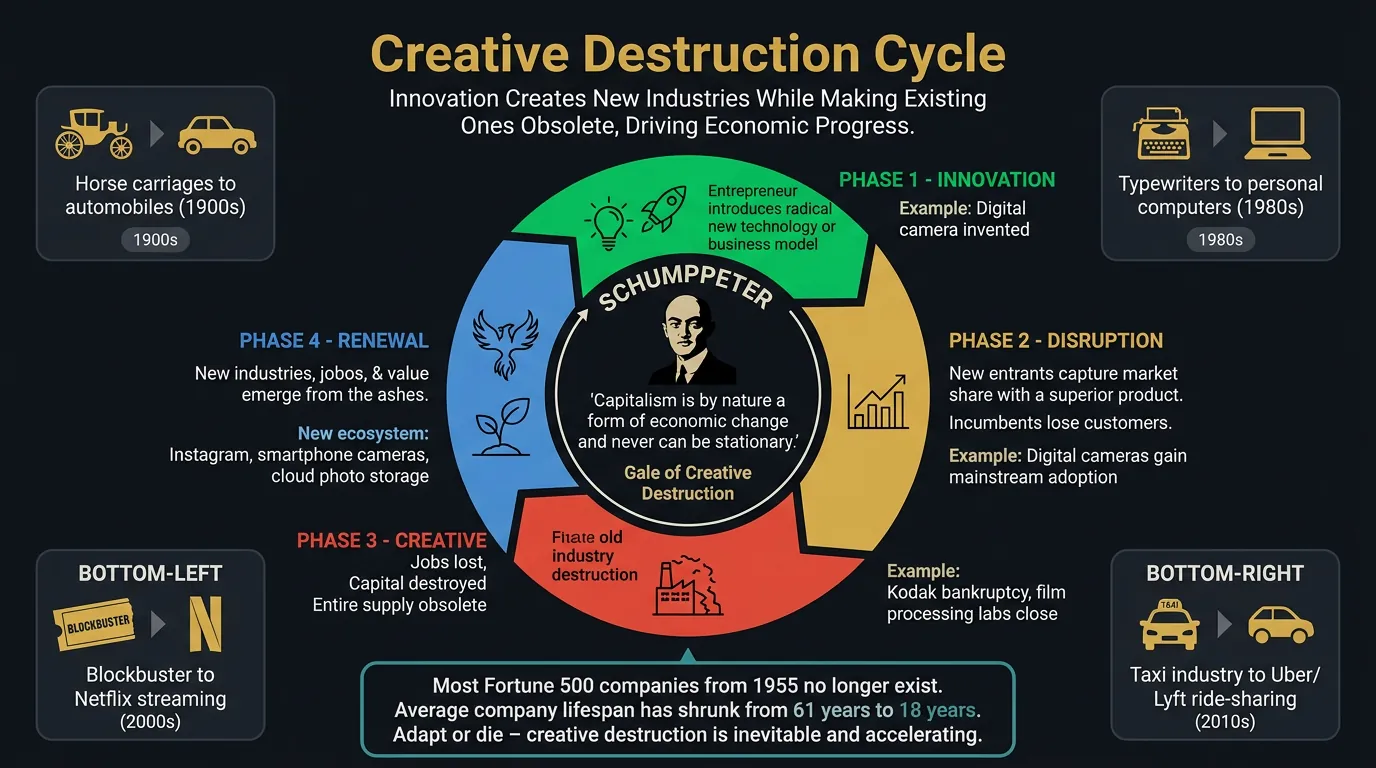
Core Principle: Innovation creates new industries while destroying old ones. Capitalism's "gale of creative destruction" (Schumpeter) drives economic progress but makes most companies obsolete. Adapt or die.
Figure: Schumpeter's creative destruction cycle — innovation creates new industries while making existing ones obsolete, driving economic progress.
Real-World Application: Digital Photography Killed Film
Industry Disruption
Kodak's $28B Evaporation
1996: Kodak at Peak
Market cap: $28B, 145,000 employees
Dominance: 70% US film market share, household name globally
Irony: Kodak invented digital camera in 1975 but buried it (cannibalized film business)
2012: Kodak Bankrupt
Digital photography: Smartphones made cameras ubiquitous (iPhone 4S outsold all Kodak cameras)
Revenue collapse: Film sales fell 90% in 10 years
Creative destruction winner: Canon, Sony, and ultimately Apple/Samsung captured $200B+ camera phone market
Kodak mistake: Protected dying business (film) instead of cannibalizing it with digital
Creative DestructionDisruption
Business Applications
For Strategy Teams: Map your "S-curve" lifecycle. Every technology/business model has growth, maturity, decline phases. Netflix destroyed Blockbuster (DVDs ? streaming), then started destroying itself (streaming ? interactive content). Continually innovate before competitors do.
For R&D Teams: Invest in potentially disruptive technologies even if they cannibalize current revenue. Amazon's AWS cannibalized enterprise software sales—but better to cannibalize yourself than let competitors do it. Intel's "next bench" philosophy: always have team working on technology to replace current products.
For Leadership Teams: Cultural willingness to destroy own products. Steve Jobs killed iPod with iPhone ("If we don't cannibalize, someone else will"). Contrast with Microsoft's delay in mobile—protected Windows at expense of smartphone future.
Creative Destruction Strategy Attacker advantage: Startups have nothing to lose—can pursue disruptive tech aggressively Incumbent disadvantage: Protecting existing revenue streams prevents pivoting to new models Solution: Create separate divisions for disruptive innovations (Amazon's AWS started as skunkworks) Decision Rule: If technology could destroy your business in 5-10 years, invest in it TODAY
23. Barriers to Entry: Moats That Protect Profits
Core Principle: Barriers to entry are factors that make it difficult or expensive for new competitors to enter a market. High barriers = sustainable profits. Low barriers = competition erodes margins.
Fab investment: Each new semiconductor fab costs $20B+
R&D spending: $15B+ annually on next-generation processes
Time to replicate: 5-7 years minimum (Moore's Law advancement)
Knowledge barrier: Decades of accumulated manufacturing expertise
Why Barrier Is Weakening:
TSMC, Samsung: Matched Intel's investment, now ahead on 3nm process
Lesson: Capital barriers only work if you maintain technological lead
2024 status: Intel lost manufacturing advantage—barrier eroded by competitors' equal investment
Barriers to EntryCapital Requirements
Business Applications
For Strategy Teams: Build multiple overlapping barriers. One barrier can be overcome (patents expire, regulations change). Combine barriers for durable moat: network effects + economies of scale + brand (e.g., Amazon).
For Startups: Choose markets with low barriers initially, then build barriers after gaining foothold. Software SaaS has low capital requirements (easy to enter) but can build network effects and switching costs over time (hard to displace).
For Investors: Invest in companies with high, durable barriers. Buffett's "wide moat" investing: businesses where competitive advantages are structural, not temporary. Avoid markets where barriers are eroding (newspapers, retail).
Building Durable Barriers Strongest barriers: Network effects (self-reinforcing), regulatory monopolies (government-enforced) Weakest barriers: First-mover advantage alone (easily copied), proprietary tech (expires, reverse-engineered) Best strategy: Combine 2-3 barrier types for defense in depth
24. Winner-Takes-Most Markets: Power Law Distribution
Core Principle: In winner-takes-most markets, the top player captures disproportionate share of profits. Not linear distribution (everyone gets some)—exponential (leader gets 50-90%, everyone else fights for scraps).
Data network effects: More searches ? better algorithm ? more users ? more searches (flywheel)
Advertiser concentration: Advertisers go where users are ? reinforces Google dominance
Default positioning: Google pays Apple $15B+/year to be default iOS search ? locks in users
Switching costs: Low for users, but why switch if Google works best?
Winner-Takes-MostMarket Concentration
Markets That Exhibit Winner-Takes-Most
Market Characteristic
Winner-Takes-Most?
Example
Network effects
? Yes
Social networks, marketplaces, operating systems
High fixed costs, low marginal costs
? Yes
Software, pharmaceuticals, media
Strong brand effects
? Yes
Search, video streaming, cloud
Commoditized products
? No
Agriculture, raw materials, generic drugs
Fragmented preferences
? No
Restaurants, fashion, consulting
High switching costs
?? Maybe
Enterprise software (winner-takes-most within verticals)
Business Applications
For Startups: In winner-takes-most markets, second place is first loser. Prioritize growth over profitability. Spend aggressively to win—Uber and DoorDash burned billions racing to dominance. If you can't be #1, don't enter market.
For Investors: Power law portfolio construction. Most startups fail, few become unicorns. In winner-takes-most sectors, returns are extreme—invest in 20+ companies, expect 1-2 to return entire fund. Benchmark's $11M Uber investment ? $7B return.
For Strategy Teams: Recognize when you're in winner-takes-most market and act accordingly. Can't compete on features alone—need network effects, scale advantages, or niche dominance. Zoom focused on ease-of-use to beat Cisco WebEx despite fewer features.
Winner-Takes-Most Strategy If you're #1: Defend position aggressively (pay for exclusivity, undercut on price, acquire threats) If you're #2-3: Find defensible niche or merge to achieve scale If you're #4+: Exit market or pivot—long-term viability unlikely Red flag: Raising more funding to compete in winner-takes-most market when already behind
25. Market Power: Pricing Above Marginal Cost
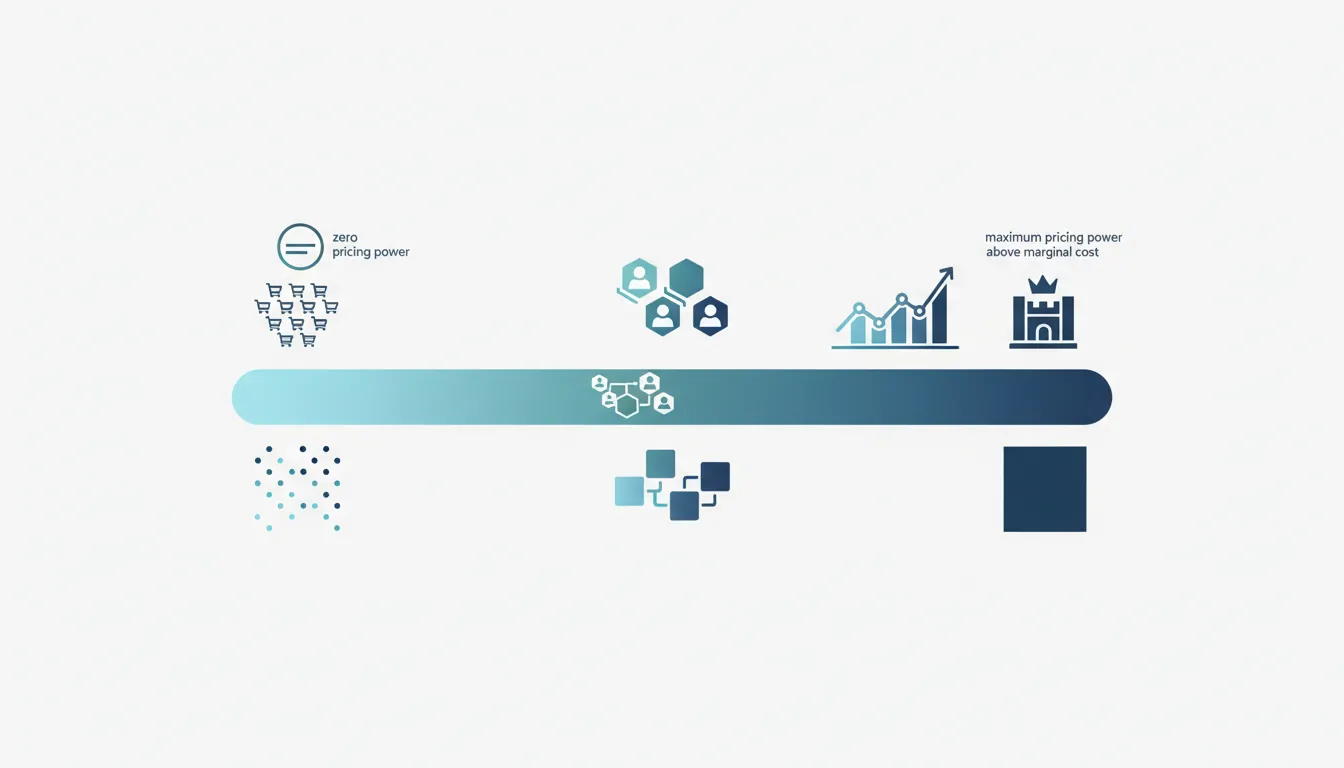
Core Principle: Market power is the ability to raise prices above competitive levels (marginal cost) without losing all customers. Perfect competition = zero market power. Monopoly = maximum market power. Most businesses exist in between.
Figure: Market power spectrum showing the range from perfect competition (zero pricing power) through oligopoly to monopoly (maximum pricing power above marginal cost).
Real-World Application: Apple's iPhone Pricing Power
Pricing Power Analysis
How Apple Captures 85% of Smartphone Industry Profits
Cost Structure: iPhone 15 Pro Max
Manufacturing cost: ~$500
Retail price: $1,199
Gross margin: 58% (vs. 10-20% for Android competitors)
Why Customers Pay Premium:
Brand: Apple = status symbol, quality perception
Ecosystem lock-in: iMessage, AirPods, Mac integration
Quality perception: Customers believe iPhone is worth premium
Sources of Market Power:
Differentiation: iOS ecosystem genuinely different from Android (not perfect substitute)
Switching costs: Moving to Android means losing iMessage, FaceTime, app purchases
Brand premium: Apple logo commands higher price regardless of specs
Network effects: More iPhone users ? more iMessage groups ? more pressure to stay
Contrast: Commoditized Android Market
Samsung, Xiaomi, OnePlus: Compete mainly on price
Low differentiation: All run Android, similar features
Result: Margins compressed to 10-15%, minimal market power
Market PowerPricing Strategy
Business Applications
For Product Teams: Build differentiation to gain market power. Commoditized products = no pricing power = race to bottom. Focus on features competitors can't easily copy: brand, design, integration, customer service.
For Pricing Teams: Test pricing power systematically. Raise prices 5-10% on subset of customers, measure churn. If churn <5%, you have pricing power—keep raising. If churn >15%, you're commoditized—compete on value, not price.
For Strategy Teams: Monitor market power trends. Increasing competitive pressure = eroding market power = margin compression ahead. Netflix's market power declined as Disney+, HBO Max, Apple TV+ launched—had to cut subscription price growth to retain customers.
Measuring Your Market Power High market power signals:
Gross margins >50% sustained over multiple years
Price increases don't trigger significant churn
Customers complain about price but don't leave
You can dictate terms to suppliers/distributors
Low market power signals:
Can't raise prices without losing customers to competitors
Gross margins <20% and compressing
Customers view you as interchangeable with rivals
You must match competitor pricing instantly
26. Economies of Scale: Size as Strategy
Core Principle: As production volume increases, cost per unit decreases. Larger firms achieve lower costs through fixed cost spreading, purchasing power, and operational efficiencies.
Logistics network: $50B invested in distribution centers ? 2% logistics cost vs. 8% for small retailers
Technology amortization: $10B IT investment spread over $600B revenue = 1.7% of sales
Private label brands: Cuts out middleman ? captures 25-40% margin on own brands
Result: 25-30% Cost Advantage vs. Small Competitors
Walmart COGS: 75% of revenue
Small retailers COGS: 80-85% of revenue
Implication: Walmart makes profit at prices that bankrupt competitors
Economies of ScaleCost Leadership
Types of Scale Economies
Type
Mechanism
Example
1. Fixed Cost Spreading
One-time costs amortized over more units
Software: $100M development cost spread over 1M users = $100/user. Over 100M users = $1/user. Marginal cost approaches zero.
2. Purchasing Economies
Volume discounts from suppliers
AWS gets server hardware 40-60% cheaper than small cloud providers due to massive orders
3. Learning Curve Effects
Repetition improves efficiency
Tesla battery cost fell 50% from Model S (2012) to Model 3 (2017) through manufacturing learning
4. Network Density
More customers in same area = lower cost per customer
Uber unit economics improve in dense cities—more riders + more drivers = shorter wait times + higher utilization = lower cost per ride
Diseconomies of Scale (Warning Signs)
When Scale Becomes a Liability Bureaucracy: Large orgs require layers of management ? decision speed slows Coordination costs: Communication overhead grows exponentially with team size Market power limits: Can't raise prices further without triggering anti-trust (Google, Meta) Innovation inertia: Kodak couldn't pivot to digital despite inventing it—too much invested in film Tipping point: When marginal coordination cost > marginal scale benefit ? split into smaller units
Business Applications
For Operations Teams: Track unit economics by volume tier. Model how costs change at 2x, 5x, 10x current scale. Identify which costs are truly fixed (amortize over more units) vs. variable (scale linearly).
For Finance Teams: Build scale scenarios into pro formas. Show board that path to profitability requires achieving X market share to unlock Y% cost advantage. Justify initial losses as investment in scale.
For Strategy Teams: In winner-take-all markets with high fixed costs / low marginal costs, prioritize market share over profitability early on. Uber, Spotify, Netflix spent years unprofitable to achieve scale.
Scale Economics Formula Minimum Efficient Scale (MES): Smallest production volume where cost per unit is minimized Decision rule: If current volume < MES ? prioritize growth. If volume > MES ? prioritize efficiency. Red flag: If market size < 3x your MES ? market may be too small for sustainable profitability
27. Network Effects: Value Grows with Users
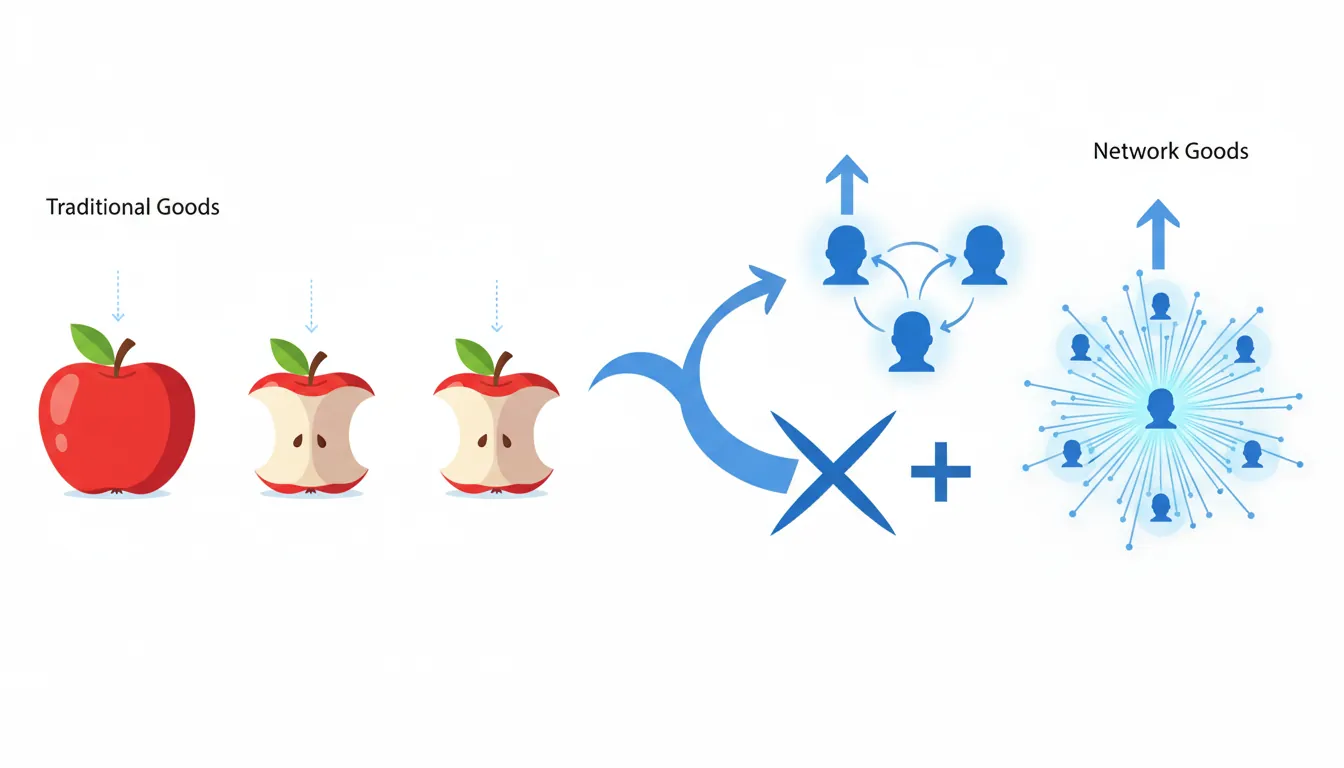
Core Principle: Product becomes more valuable as more people use it. Unlike traditional goods (pie gets smaller when shared), network goods create exponential value with each new user.
Figure: Network effects creating exponential value — unlike traditional goods where sharing reduces value, network goods become more valuable as more people use them.
Types of Network Effects
Type
Mechanism
Example
Strength
Direct Network Effects
More users = more value to each user
WhatsApp, Zoom, Email
Very Strong
Two-Sided Marketplaces
More buyers attract sellers, vice versa
eBay, Airbnb, Uber
Very Strong
Data Network Effects
More usage = better product (ML)
Google Search, Waze, Spotify
Strong
Platform Effects
More apps attract users, more users attract apps
iOS, Windows, PlayStation
Very Strong
Social Network Effects
Value from connections (friends/followers)
Facebook, LinkedIn, Twitter
Very Strong
Real-World Application: Facebook's Dominance
Network Effects Case
Why Facebook Crushed MySpace and Google+
Network Effect Flywheel:
2004-2007: College students join ? their friends must join to connect
Critical mass: At 50M users, new user's friends likely already on platform
Tipping point: At 100M users, NOT being on Facebook means social isolation
Switching costs: Your photos, posts, friend graph = years of data lock-in
Why Competitors Failed:
MySpace (2008): Users left for Facebook ? their friends followed ? MySpace lost critical mass
Google+ (2011): Better product, but no one's friends were there ? dead on arrival
Lesson: Can't beat network effects with features alone—need to solve cold start problem
Network EffectsCompetition
Building Network Effects: The Cold Start Problem
Chicken-and-Egg Challenge: Platforms need both sides (buyers + sellers, users + content creators) but neither will join without the other.
Strategies to Solve Cold Start:
Startup Playbook
How Successful Platforms Bootstrapped
1. Single Side First (Airbnb):
Founders manually recruited hosts by photographing apartments
Built supply (listings) first, then drove demand through Craigslist arbitrage
Once 100+ quality listings in NYC, word-of-mouth took over
2. Fake the Other Side (Reddit):
Founders created fake user accounts to post content
Made site appear active to attract real users
Real users joined, created content, attracted more users
3. Subsidize One Side (Uber):
Paid drivers guaranteed hourly wage to ensure supply
Offered free rides to riders to create demand
Lost money until critical mass achieved, then scaled back subsidies
4. Niche ? Expand (Facebook):
Started at single college (Harvard) ? achieved 100% penetration
Expanded college-by-college ? critical mass in each before moving on
Network effects strong within each college, then interconnected
Business Applications
For Product Teams: If building a marketplace, solve single-side value first. Uber = good for drivers even without riders (reliable taxi business). Airbnb = hosts could list on Craigslist too. Don't build pure platforms without single-player utility.
For Growth Teams: Viral coefficient must be > 1.0 for exponential growth. Measure K-factor: (Invites per user) × (Conversion rate). Dropbox's referral program: 35% of users invited friends, 20% converted = K = 0.07. Needed incentives (free storage) to hit K > 1.
For Strategy Teams: Network effects create winner-take-all markets. Second place gets exponentially less value. Go all-in to achieve critical mass or don't enter at all. Half-measures lose to full commitment.
Network Effect Litmus Test
Ask: "Does the 100th user make the product more valuable to the 1st user?"
Yes: You have network effects (Facebook, Uber, Marketplace)
No: You have scale economies, not network effects (Netflix—more users don't improve my experience)
True network effects are rare but nearly unbeatable when achieved.
28. Power Law Distribution: 80/20 Rule on Steroids
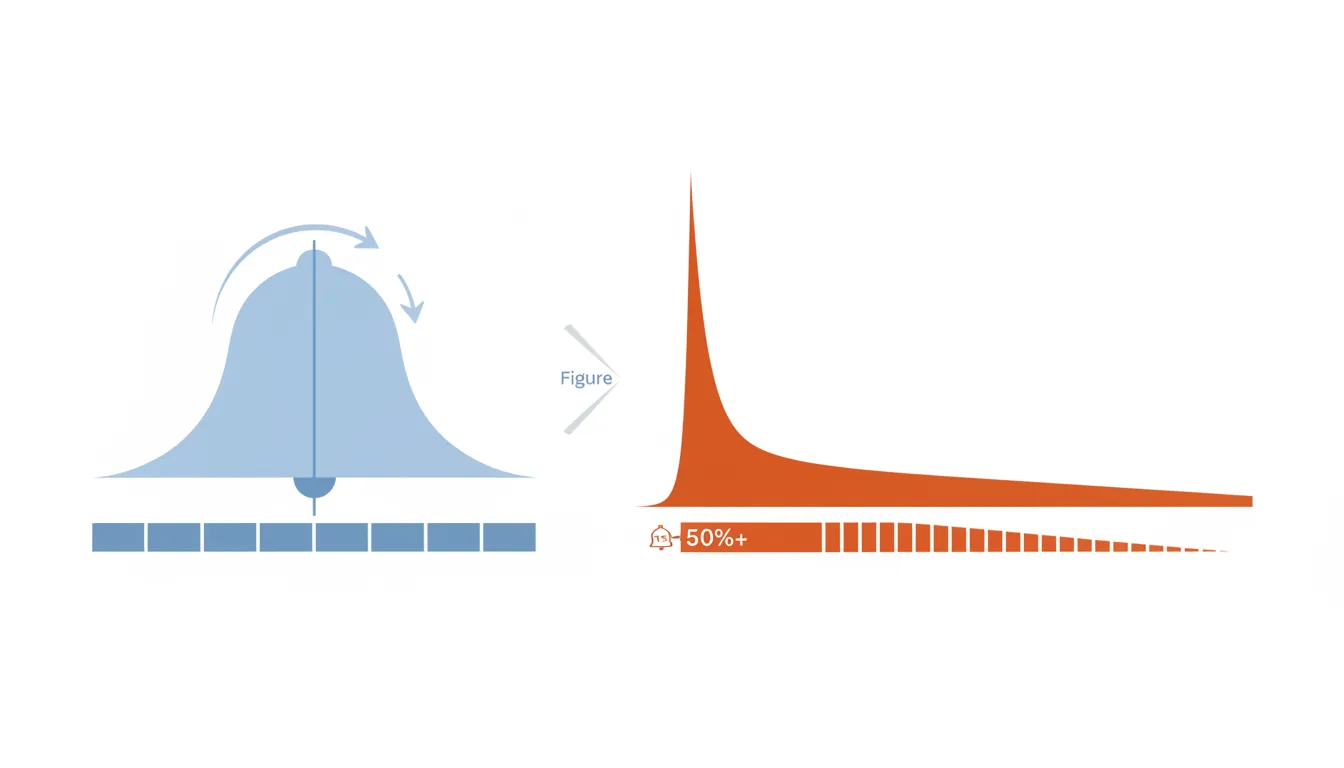
Core Principle: Power law distributions follow the principle that a small number of occurrences account for the majority of outcomes. Unlike normal distributions (bell curve), power laws are heavily skewed—top 1% often captures 50%+ of total value.
Figure: Power law distribution compared to normal distribution — a small number of occurrences account for the majority of outcomes, with the top 1% often capturing 50%+ of total value.
Real-World Application: Venture Capital Returns
Portfolio Analysis
Why VCs Need 100x Winners
Typical VC Fund: 30 Investments
20 investments (67%): Total loss or minimal returns (0-1x)
7 investments (23%): Modest returns (2-5x)
2 investments (7%): Strong returns (10-20x)
1 investment (3%): Home run (50-100x+) — THIS ONE RETURNS THE ENTIRE FUND
Example: Sequoia's WhatsApp Investment
Investment: $60M across multiple rounds
Exit: Facebook acquisition for $19B (Sequoia's share: $3B+)
Return: 50x — one investment returned 3x the entire $1B fund
Power law in action: 1 out of 200+ companies generated 300% of fund's profits
Power LawVenture Capital
Business Applications
For Strategy Teams: Identify which of your activities follow power law distributions. Customer value: 20% of customers generate 80% of revenue (focus retention there). Product features: 20% of features drive 80% of usage (prioritize those). Employee performance: Top 10% generate 50%+ of value (retain/clone them).
For Sales Teams: Account prioritization by power law. Enterprise sales: top 100 accounts may generate more revenue than next 10,000 combined. Allocate sales resources accordingly—dedicated account managers for top 1%, inside sales for the rest.
For Product Teams: Power law of user engagement. Most users are inactive, small percentage are power users. Design for power users (they drive retention/revenue), make product accessible for casual users (they drive acquisition).
Power Law vs. Normal Distribution Normal Distribution: Averages meaningful (height, test scores)—most people near middle Power Law: Averages meaningless (wealth, book sales)—extreme outcomes dominate Implication: In power law domains, focus on outliers, not averages. Median startup outcome = failure. But top 0.1% = trillion-dollar companies. Decision Rule: If power law applies, use portfolio approach—many small bets to find rare winners
Executive Framework: Building Competitive Moats
These 8 laws form the foundation of competitive strategy. Understanding how competition erodes profits, how to build barriers, and how to leverage network effects and scale separates market leaders from also-rans.
The Competitive Moat Framework: 4-Layer Defense Strategy
Law of Competition: Perfect competition drives profits to zero. Your job is to escape perfect competition through differentiation. Airlines (commodity) earn 1-3% margins. Software (differentiated) earns 20-30%+ margins.
Creative Destruction: Innovation destroys incumbents. Kodak invented digital cameras but protected film business—went bankrupt. Netflix cannibalized DVD rentals with streaming—survived. Lesson: Disrupt yourself before competitors do.
Decision rule: If you can't differentiate, exit the market. If you can differentiate, build barriers before competitors catch up.
Layer 2: Build Structural Barriers (Law 23)
Barriers to Entry: Multiple overlapping barriers create durable moats. One barrier can be overcome (patents expire). Combine 2-3 for defense in depth.
Decision rule: Audit barriers quarterly. Rate each 1-10 on strength. If average score < 5, you're vulnerable. Invest aggressively in strengthening moats.
Winner-Takes-Most (Law 24): In markets with network effects or high fixed costs/low marginal costs, leader captures 50-90% of profits. Google has 92% search share, $200B revenue. Bing has 3% share, $12B revenue. If you can't be #1, exit.
Economies of Scale (Law 26): Size reduces cost per unit. Walmart's 25-30% cost advantage from purchasing power, logistics, technology amortization. Makes profit at prices that bankrupt small competitors.
Network Effects (Law 27): Product becomes more valuable as more users join. Facebook crushed MySpace and Google+ through network effects. At 100M users, NOT being on Facebook meant social isolation.
Power Law (Law 28): In winner-takes-most markets, returns follow power law distribution. VC funds: 1 investment (3%) returns entire fund. Top 20% of customers generate 80% of revenue. Focus on outliers, not averages.
Decision rule: If in winner-takes-most market, prioritize growth over profitability. Spend aggressively to achieve scale and network effects. Uber/DoorDash burned billions racing to dominance.
Layer 4: Defend Position Aggressively (Integration)
If you're #1: Pay for exclusivity (Google pays Apple $15B+/year for default search), undercut on price (Amazon retail margins compressed to defend market share), acquire threats (Facebook bought Instagram/WhatsApp)
If you're #2-3: Find defensible niche (Zoom focused on ease-of-use vs. Cisco's feature-heavy WebEx) or merge to achieve scale (airline industry consolidated to 4 major carriers)
If you're #4+: Exit market or pivot. In winner-takes-most markets, long-term viability unlikely unless you can achieve critical mass.
Amazon: All 8 Laws Applied
Integrated Case Study
How Amazon Built an Unassailable Competitive Moat
Law 21 - Competition:
Escaped commodity competition through differentiation: Prime membership, 1-click ordering, personalized recommendations
Built multiple moat types: economies of scale + network effects + switching costs + data
Result: Can sustain lower margins (1-3% retail) because competitors can't match cost structure
Law 22 - Creative Destruction:
Destroyed brick-and-mortar retail (Borders, Toys R Us bankrupted)
Then destroyed itself: AWS cannibalized enterprise software sales, Kindle cannibalized print book sales
Cultural willingness to disrupt own businesses before competitors do—"If we don't, someone else will"
Law 23 - Barriers to Entry:
Capital requirements: $50B+ invested in fulfillment network (200+ warehouses, robots, planes)
Time to replicate: 20+ years to build equivalent logistics network
Economies of scale: Cost per package delivered 50% lower than competitors
Switching costs: Prime members spend 4x non-Prime ($1,400/year vs. $350/year)
Result: New entrants face $50B+ investment and 20-year timeline—nearly impossible barrier
Law 24 - Winner-Takes-Most:
E-commerce market share: Amazon 40% US, next competitor (Walmart) 7%
Cloud market share: AWS 32%, next competitor (Azure) 23%, but AWS still more profitable
Strategy: Spent 20 years unprofitable prioritizing growth over margins to achieve dominant position
Power law in action: Top 1% of products generate 50%+ of revenue, optimizes for hits
Law 25 - Market Power:
Retail: Low margins (1-3%) but volume compensates, can price below competitors' cost
AWS: High margins (30%+) due to scale advantages and switching costs (migrating workloads costs millions)
Prime: $139/year subscription—price increased 40% over 5 years without significant churn (shows pricing power)
Third-party sellers: Amazon extracts 15-45% fees—sellers can't leave because that's where customers are
Law 26 - Economies of Scale:
Purchasing power: Orders 100M+ units—negotiates 20-40% lower wholesale prices than small retailers
Logistics: 2-3% fulfillment cost vs. 8-12% for competitors due to network density and automation
Technology: $75B R&D budget amortized over $575B revenue = 13% of sales (Walmart: 0.2%)
AWS infrastructure: Serves retail, FBA, Prime Video, Alexa—shared costs across 4 businesses
Result: 25-30% cost advantage vs. traditional retailers
Law 27 - Network Effects:
Two-sided marketplace: 2M+ sellers attract 200M+ Prime members, which attracts more sellers (flywheel)
Data network effects: 5B+ products viewed/year—recommendation algorithm improves with more data
Can we escape perfect competition through differentiation?
If no, exit market. If yes, build barriers before competitors catch up.
22. Creative Destruction
Could new technology destroy our business in 5-10 years?
If yes, invest in disruptive tech TODAY. Cannibalize yourself or competitors will.
23. Barriers to Entry
Do we have multiple overlapping barriers (2-3 types)?
If no, vulnerable to competition. Combine barriers for defense in depth.
24. Winner-Takes-Most
Are we in a winner-takes-most market (network effects, high fixed costs)?
If yes, prioritize growth over profitability. Can't be #1? Exit or pivot.
25. Market Power
Can we raise prices 10% without losing 10%+ of customers?
If yes, you have pricing power. If no, you're commoditized—differentiate or exit.
26. Economies of Scale
Are we below minimum efficient scale (MES)?
If below MES, prioritize growth. If above MES, prioritize efficiency. If market < 3x MES, too small for profitability.
27. Network Effects
Does the 100th user make product more valuable to the 1st user?
If yes, go all-in to achieve critical mass. If no, you have scale economies, not network effects.
28. Power Law
Do outcomes follow power law (top 20% generates 80% of value)?
If yes, focus on outliers (top customers, products, initiatives). Allocate resources accordingly.
5 Common Competitive Strategy Mistakes
Mistake 1: Competing in Commoditized Markets Problem: Entering markets where you can't differentiate (airlines, agriculture, generic drugs). Perfect competition drives profits to zero. Example: Most airlines filed bankruptcy 2000-2010. Industry margins 1-3% because product is commodity (seat from NYC to LA identical across carriers). Solution: Differentiate or exit. Southwest differentiated on point-to-point routes and culture. Spirit/Ryanair differentiated on ultra-low-cost. Full-service carriers without differentiation consolidated or died.
Mistake 2: Protecting Dying Businesses Instead of Cannibalizing Problem: Incumbents protect existing revenue streams instead of investing in disruptive technologies (Kodak, Nokia, Blockbuster). Example: Kodak invented digital camera in 1975 but buried it to protect film business. Filed bankruptcy 2012 when smartphones made cameras ubiquitous. Solution: Create separate divisions for disruptive innovations. Amazon's AWS started as skunkworks project. Netflix cannibalized DVD rentals with streaming. "If we don't disrupt ourselves, someone else will."
Mistake 3: Raising Capital to Compete in Winner-Takes-Most Market When Already Behind Problem: In markets with network effects, second place gets exponentially less value. Raising more money to compete when you're already losing is throwing good money after bad. Example: Google+ launched in 2011 with better features than Facebook but failed because no one's friends were there. Network effects made Facebook unbeatable. Solution: If you're #4+ in winner-takes-most market, exit or pivot. Don't waste capital fighting network effects. Find defensible niche or completely different market.
Mistake 4: Building Single Barrier Instead of Multiple Overlapping Barriers Problem: One barrier can be overcome. Patents expire, regulations change, first-mover advantage gets copied. Example: Intel's semiconductor manufacturing moat eroded when TSMC and Samsung matched their $20B+ fab investments and surpassed them on 3nm process. Solution: Combine 2-3 barrier types for defense in depth. Amazon: economies of scale + network effects + switching costs + capital requirements. Can't overcome all simultaneously.
Mistake 5: Treating All Customers/Products Equally Instead of Following Power Law Problem: In power law distributions, top 20% generates 80% of value. Allocating resources equally is inefficient. Example: Enterprise sales: top 100 accounts may generate more revenue than next 10,000 combined. Assigning same sales resources to all accounts wastes talent on low-value customers. Solution: Segment by power law. Dedicated account managers for top 1%, inside sales for next 19%, self-service for bottom 80%. Measure customer lifetime value, allocate retention budget accordingly.
Team Applications: Competitive Strategy in Practice
How different teams apply these 8 competitive laws to build and defend market position.
Product Team Applications
Build Features That Create Switching Costs (Laws 21, 23, 25)
Integrations: Salesforce has 3,000+ AppExchange integrations—migrating to competitor means rebuilding integrations ($500K+ cost). Each integration is a lock-in mechanism.
Proprietary data formats: Adobe Creative Suite uses proprietary file formats (.psd, .ai, .indd)—switching to Figma/Canva means converting years of files or maintaining dual licenses.
Workflows that become muscle memory: Excel users resist Google Sheets not because features are worse, but because keyboard shortcuts and formulas are different. 20+ years of learned behavior creates inertia.
Measure switching costs: Survey churned customers—"What did it cost to switch?" If answer is <$1,000 in time/money, switching costs are too low. Target: 10x annual subscription price.
Design for Network Effects (Law 27)
Single-player utility first: Don't build pure platforms without standalone value. Uber = good for drivers even without riders (reliable taxi business). Airbnb = hosts could list on Craigslist too. Ensures one side joins before network effects kick in.
Solve cold start problem: Options: (1) Single side first (Airbnb photographed apartments manually), (2) Fake other side (Reddit founders posted content), (3) Subsidize one side (Uber guaranteed driver wages), (4) Niche ? expand (Facebook started at Harvard, achieved 100% penetration, then expanded college-by-college).
Viral coefficient (K-factor): Must be >1.0 for exponential growth. K = (Invites per user) × (Conversion rate). Dropbox: 35% invited friends, 20% converted = K = 0.07 (too low). Added incentives (free storage) to hit K >1. Measure monthly—if K <1, growth is paid not viral.
Litmus test: "Does the 100th user make the product more valuable to the 1st user?" If yes, you have network effects. If no, you have scale economies (different dynamics).
Escape Creative Destruction (Law 22)
Continuous innovation roadmap: Map your S-curve lifecycle (introduction ? growth ? maturity ? decline). Start building next-generation product when current product hits maturity, not decline. By decline, too late.
Kill your own products: Apple killed iPod with iPhone ("If we don't cannibalize, someone else will"). Microsoft's failure: protected Windows at expense of mobile—Android/iOS dominated instead. Internal cannibalization > external disruption.
Separate teams for disruptive innovation: Don't ask team optimizing current product to build disruptive replacement—incentives misaligned. Amazon's AWS started as skunkworks. Give new team autonomy, separate P&L, different success metrics (growth not profitability).
Marketing & Growth Team Applications
Winner-Takes-Most Market Strategy (Laws 24, 28)
Identify market type: Winner-takes-most indicators: (1) Network effects present, (2) High fixed costs/low marginal costs, (3) Strong brand effects. Examples: social networks, marketplaces, SaaS platforms, cloud infrastructure. If YES, prioritize growth over profitability.
Growth-at-all-costs if behind leader: Uber and DoorDash burned billions racing to dominance because second place in ride-sharing/delivery is first loser. If you're #2, must outspend #1 on customer acquisition to close gap before they hit escape velocity.
Exit if you're #4+: In winner-takes-most markets, don't waste capital fighting network effects. Google+ had better features than Facebook but failed—couldn't overcome network effects. If you're not top 3, find defensible niche or pivot entirely.
Power law CAC allocation: Top 20% of customers generate 80% of LTV. Allocate CAC budget by power law: spend $10,000 CAC to acquire enterprise customer with $500K LTV, $100 CAC for SMB with $5K LTV. Don't treat all segments equally.
Achieve Critical Mass (Law 27)
Define tipping point: When does NOT using your product mean missing out? Facebook hit critical mass at 100M users—at that point, most people's friends were on platform, so NOT being on Facebook meant social isolation. Identify your critical mass threshold.
Geographic concentration: Uber launched city-by-city, achieved critical mass in each (enough drivers for <5 min wait time) before expanding. Don't spread thin nationally—concentrated liquidity in one market > sparse coverage in many markets.
Subsidize to achieve critical mass: Uber paid drivers guaranteed hourly wage (even when no riders) to ensure supply. Lost money until critical mass achieved, then scaled back subsidies. Temporary losses to achieve permanent network effects.
Measure engagement, not vanity metrics: DAU/MAU ratio (daily active / monthly active users). Healthy network: >30% (users return daily). If <20%, haven't achieved critical mass yet—users don't find enough value to return daily.
Brand as Barrier to Entry (Laws 23, 25)
Premium pricing from brand: Apple logo commands 20-40% price premium regardless of specs. Supreme charges $50 for t-shirt that costs $5 to make—brand creates pricing power. Invest in brand to escape commodity competition.
Consistency over decades: Coca-Cola has maintained brand positioning for 130+ years. Nike "Just Do It" since 1988. Long-term consistency builds brand moat—don't rebrand every 2-3 years chasing trends.
Category creation: Red Bull didn't compete in soda market (Coke/Pepsi dominated)—created "energy drink" category and owned it. Salesforce created "cloud CRM" category. Category kings capture 70%+ of economics. Avoid competing in established categories—create new one.
Strategy Team Applications
Competitive Moat Audit (Laws 21, 23)
Quarterly moat assessment: Rate each moat type 1-10 on strength: (1) Network effects, (2) Switching costs, (3) Economies of scale, (4) Brand/intangibles, (5) Regulatory/IP, (6) Data. If average score <5, you're vulnerable. Competitors are eroding margins.
Competitive response plan: For each major competitor, war-game their strategy. What would they do to erode your moat? How would you respond? Netflix saw Disney+ coming (content library advantage)—responded by investing $15B/year in original content to reduce dependence on licensed shows.
Market Positioning Strategy (Laws 24, 25)
Market share vs. margin trade-off: If in winner-takes-most market (network effects, high fixed costs), prioritize market share even at zero/negative margins. AWS lost money for years—now 32% market share, 30%+ margins, $25B operating income. First to scale wins.
Niche domination strategy: If you can't be #1 overall, dominate defensible niche. Zoom focused on ease-of-use for video calls—beat Cisco WebEx despite fewer features. Became #1 in "easy video calling" niche, then expanded. Better to be #1 in small category than #5 in large category.
Market power indicators: Test pricing power annually: Raise prices 5-10% on subset of customers, measure churn. If churn <5%, you have pricing power—keep raising. If churn >15%, you're commoditized—must differentiate or margins will compress.
Build vs. Buy Using Barrier Economics (Law 23)
Build if creates barrier: Amazon built fulfillment network ($50B+ investment, 20+ years to replicate)—now insurmountable barrier. Tesla built Gigafactory for batteries—cost advantage no competitor can match for 10+ years. Build core competencies that create moats.
Buy if commoditized: Don't build what you can buy cheaper. Tesla outsources chips, sensors, logistics—commodities with minimal differentiation. Saves capital for battery tech (defensible) vs. commodity components (not defensible).
Acquisition to strengthen moat: Facebook bought Instagram ($1B) and WhatsApp ($19B) to strengthen network effects—eliminated threats and captured user growth. Disney bought Marvel/Star Wars/Pixar to strengthen content library moat. Acquisitions should strengthen barriers, not just add revenue.
When to Scale vs. When to Exit (Law 26)
Scale if below minimum efficient scale (MES): Software: MES typically 1M+ users (fixed dev costs amortized). Cloud infrastructure: MES requires $5B+ revenue to achieve cost parity with AWS/Azure. If below MES, prioritize growth—can't compete on cost until you achieve scale.
Exit if market too small: If total addressable market (TAM) < 3x your MES, market is too small for sustainable profitability. Example: If MES requires $100M revenue to be profitable, but TAM is only $200M, two profitable players max. Can't be #1 or #2? Exit.
Scale decision framework: Scale if: (1) Increasing returns to scale, (2) Network effects present, (3) Winner-takes-most market dynamics, (4) You can achieve #1 or #2 position. Exit if: (1) Constant/decreasing returns, (2) No network effects, (3) Fragmented market, (4) Can't reach top 3.
Business Development & Partnerships Team Applications
Leverage Network Effects Through Partnerships (Law 27)
Solve cold start with partners: Uber partnered with car dealerships to lease vehicles to drivers—solved supply-side cold start. Airbnb partnered with Craigslist (cross-posted listings)—solved demand-side cold start. Identify partners who can jump-start one side of marketplace.
Exclusivity to block competitors: Google pays Apple $15B+/year to be default iOS search—locks out Bing/DuckDuckGo from 1B+ users. Spotify pays podcast creators for exclusivity—prevents migration to Apple Podcasts. Exclusivity deals create barriers even without differentiation.
Two-sided platform strategy: OpenTable: Partnered with restaurants (supply) first, then marketed to diners (demand). Built 30,000 restaurant partners before heavy consumer marketing. Ensure one side is onboarded before adding other side—avoid chicken-and-egg problem.
Power Law Partnership Prioritization (Law 28)
Top 20% of partners generate 80% of value: Enterprise: Top 10 channel partners may drive more revenue than next 100 combined. Allocate co-marketing budget, dedicated support, joint roadmap planning to top tier. Don't treat all partners equally.
Portfolio approach to partnerships: In power law domains, most partnerships fail but few become massive wins. Sign 20+ partnerships, expect 1-2 to return 10x value. Example: Salesforce AppExchange—most integrations get <1,000 installs, but top 1% (Mailchimp, DocuSign) drive millions of activations.
Measure partnership ROI quarterly: Kill bottom 20% of partnerships every quarter. Redeploy resources to top performers. Don't keep zombie partnerships alive out of relationship loyalty—power law dynamics mean most partnerships have near-zero value.
Defend Against Creative Destruction (Law 22)
Acquire disruptive threats early: Facebook bought Instagram for $1B when it had 30M users (vs. Facebook's 900M)—eliminated threat before it could achieve escape velocity. Buy threats when they're small, before they build insurmountable network effects.
Partner with potential disruptors: Microsoft partnered with OpenAI (ChatGPT)—integrated into Bing, Office, Azure. If you can't beat emerging technology, partner to capture upside rather than being disrupted. Better to participate in disruption than be victim of it.
Licensing vs. acquiring: If disruptive tech could destroy your business, acquire outright (full control). If complementary, license (lower capital, shared risk). Google bought YouTube for $1.65B (potential threat to search dominance via video). Microsoft licensed OpenAI (complementary to Office/Azure).
Cross-Functional Collaboration
Product + Marketing: Product builds features that create switching costs and network effects. Marketing achieves critical mass through growth campaigns. Together: Product ensures retention (high switching costs), Marketing drives acquisition (critical mass).
Strategy + BD: Strategy identifies which barriers to build (network effects vs. scale vs. brand). BD executes through partnerships, exclusivity deals, acquisitions. Together: Strategy sets direction ("We need network effects"), BD implements ("Partner with X to solve cold start").
Marketing + BD: Marketing identifies power law segments (top 20% of customers generate 80% of value). BD prioritizes partnerships that access those segments. Together: Focus limited resources on highest-value opportunities.
All Teams: Building competitive moats requires cultural alignment. Product can't build switching costs if Sales promises easy migration. Marketing can't achieve critical mass if Product hasn't solved cold start. Strategy can't defend position if teams are optimizing for different metrics. Unified competitive strategy across functions is prerequisite for winning.
Conclusion & Next Steps
Understanding competitive dynamics and network effects is critical for building sustainable advantage. Market structure determines profitability, economies of scale create cost moats, and network effects generate winner-take-most outcomes. But even the strongest competitive position can be undermined by poor strategic interactions with competitors, partners, and customers.
The next guide explores how game theory principles shape competitive strategy, negotiation tactics, and strategic decision-making.