We use cookies to enhance your browsing experience, serve personalized content, and analyze our traffic.
By clicking "Accept All", you consent to our use of cookies. See our
Privacy Policy
for more information.
Game Theory & Strategic Interaction: 10 Principles for Competitive Strategy
January 24, 2026Wasil Zafar55 min read
Master the strategic principles that govern competitive interactions, negotiations, and cooperative opportunities—transforming business decisions from reactive to strategic. Part 4 of our 8-part Economics for Business Strategy series.
Introduction: The Science of Strategic Interaction
You've mastered market fundamentals (Part 1), production economics (Part 2), and competitive positioning (Part 3). Now we turn to perhaps the most powerful analytical framework in business: game theory. This is the mathematics of strategic interaction—how rational players make decisions when the outcome depends not just on your choices, but on your competitors', partners', and customers' choices too.
Game theory explains why price wars erupt, why cooperation is hard to maintain, why first-mover advantages matter, and how to design incentives that align interests. It's the difference between competing on autopilot and thinking several moves ahead. From Apple's ecosystem lock-in to airline pricing dynamics to Microsoft's platform strategy, game theory principles shape every strategic interaction in business.
Strategic Equilibria: How to identify stable competitive positions and predict competitor responses
Cooperation vs Competition: When to cooperate, when to compete, and how repeated interactions change incentives
First-Mover Dynamics: When moving first creates advantage versus when it's better to wait and respond
Credible Commitment: How to make threats and promises believable to shape competitor behavior
Value Creation: Why most business games are non-zero-sum and how to expand the pie
Let's begin with the foundational concept that changed how we think about strategy: Nash equilibrium.
29. Nash Equilibrium: When No One Can Improve by Changing
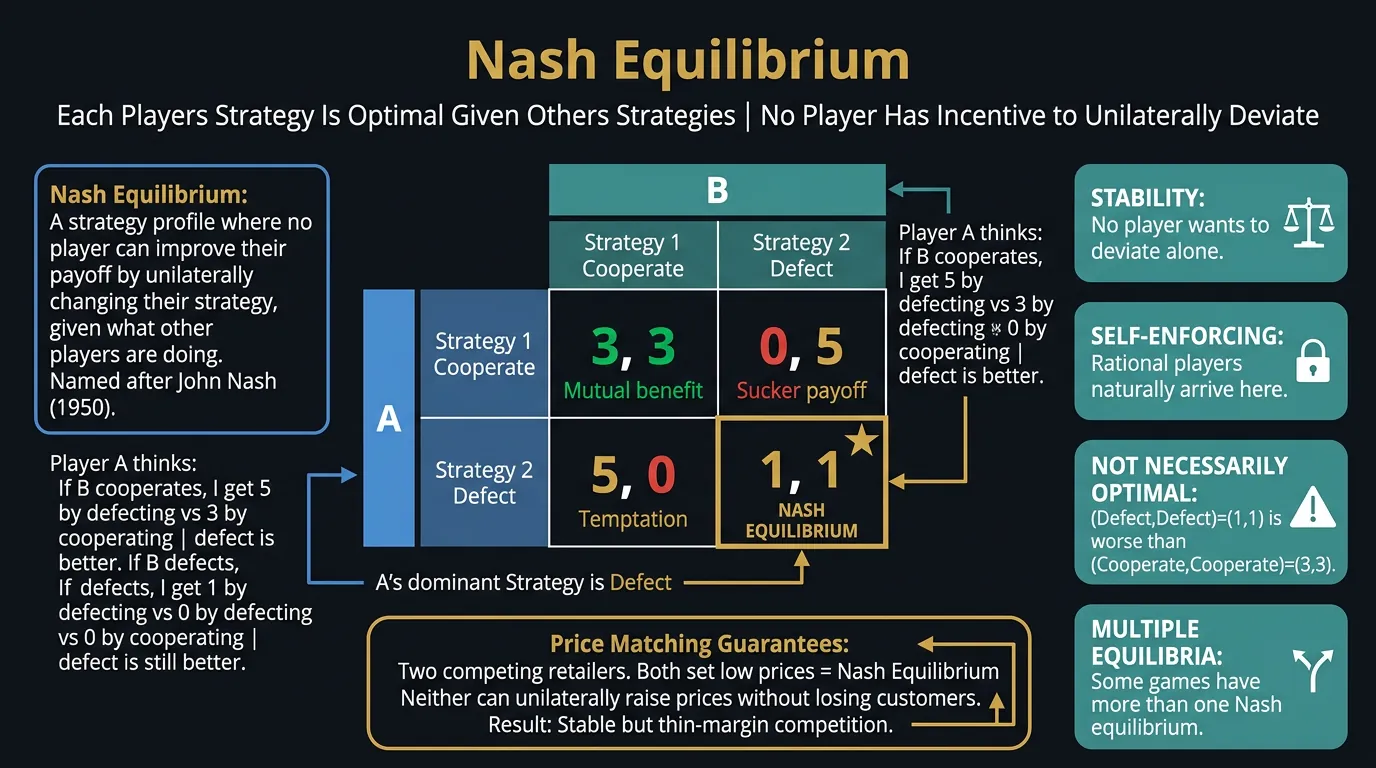
Core Principle: A Nash equilibrium occurs when each player's strategy is optimal given the other players' strategies. No player has incentive to unilaterally change their strategy. Predicts stable outcomes in competitive situations.
Figure: Nash equilibrium state where each player's strategy is optimal given others' strategies — no player has incentive to unilaterally deviate.
Nash Equilibrium Concept
graph TD
    GAME["Two-Player Game
Each player chooses strategy"]

    P1["Player 1
evaluates options"]
    P2["Player 2
evaluates options"]

    GAME --> P1
    GAME --> P2

    P1 -->|"Best response to P2"| BR1["Strategy A*"]
    P2 -->|"Best response to P1"| BR2["Strategy B*"]

    BR1 --> NE["Nash Equilibrium
(A*, B*)
Neither player can improve
by unilaterally changing"]

    BR2 --> NE

    NE -.->|"May not be
socially optimal"| PD["Prisoner's Dilemma:
Both defect = NE
Both cooperate = better"]

    style GAME fill:#132440,stroke:#132440,color:#fff
    style NE fill:#e8f4f4,stroke:#3B9797
    style PD fill:#fff5f5,stroke:#BF092F
Nash equilibrium: Both Best Buy and competitors keep prices high
Why: If Walmart lowers price, Best Buy automatically matches ? Walmart gains no customers ? no incentive to cut price
Result: Prices stabilize at higher level than without price-matching
Nash EquilibriumGame Theory
Business Applications
For Strategy Teams: Map Nash equilibria in your competitive landscape. Understanding stable outcomes helps predict competitor behavior. If price war has no equilibrium (both lose), rational competitors avoid it—unless disrupting incumbent is worth short-term losses.
For Pricing Teams: Find pricing equilibria where no one benefits from changing. Avoid situations where you're incentivized to undercut but so is competitor—leads to margin erosion with no winner.
Identifying Nash Equilibrium Test: Given competitor's current strategy, can I improve my outcome by changing mine? If Yes: Not at equilibrium—expect strategy shifts If No: Nash equilibrium—stable state (for better or worse)
30. Dominant Strategy: The Obvious Best Move
Core Principle: A dominant strategy is optimal regardless of what opponents do. If one exists, rational players will always choose it. Simplifies strategic analysis—no need to predict competitor behavior.
Real-World Application: Always Invest in Cybersecurity
Dominant Strategy
Enterprise Cybersecurity: Dominant Strategy Regardless of Attack Probability
Hackers Attack
Hackers Don't Attack
Invest in Security
Avoid $50M breach cost, spend $5M ? -$5M
No breach, spent $5M ? -$5M
Don't Invest
Suffer $50M breach ? -$50M
No cost ? $0
Analysis: "Invest in Security" dominates "Don't Invest" in both scenarios. Even if no attack occurs, the insurance value justifies cost.
Business Applications
For Strategy Teams: Look for dominant strategies to simplify decisions. Cloud migration often dominates on-prem—better scalability, lower TCO, easier disaster recovery regardless of specific workload. Don't overthink—execute dominant strategy fast.
For Product Teams: Customer-centric design is often dominant strategy. Whether competitors copy or not, better UX wins customers. Contrast with feature races (not dominant—depends on what competitors do).
Dominant Strategy Decision Rule If you find a dominant strategy: Execute immediately—no further analysis needed Red Flag: If "obvious" strategy seems dominant, verify you haven't missed hidden costs/risks
31. Prisoner's Dilemma: When Rational Choices Lead to Bad Outcomes
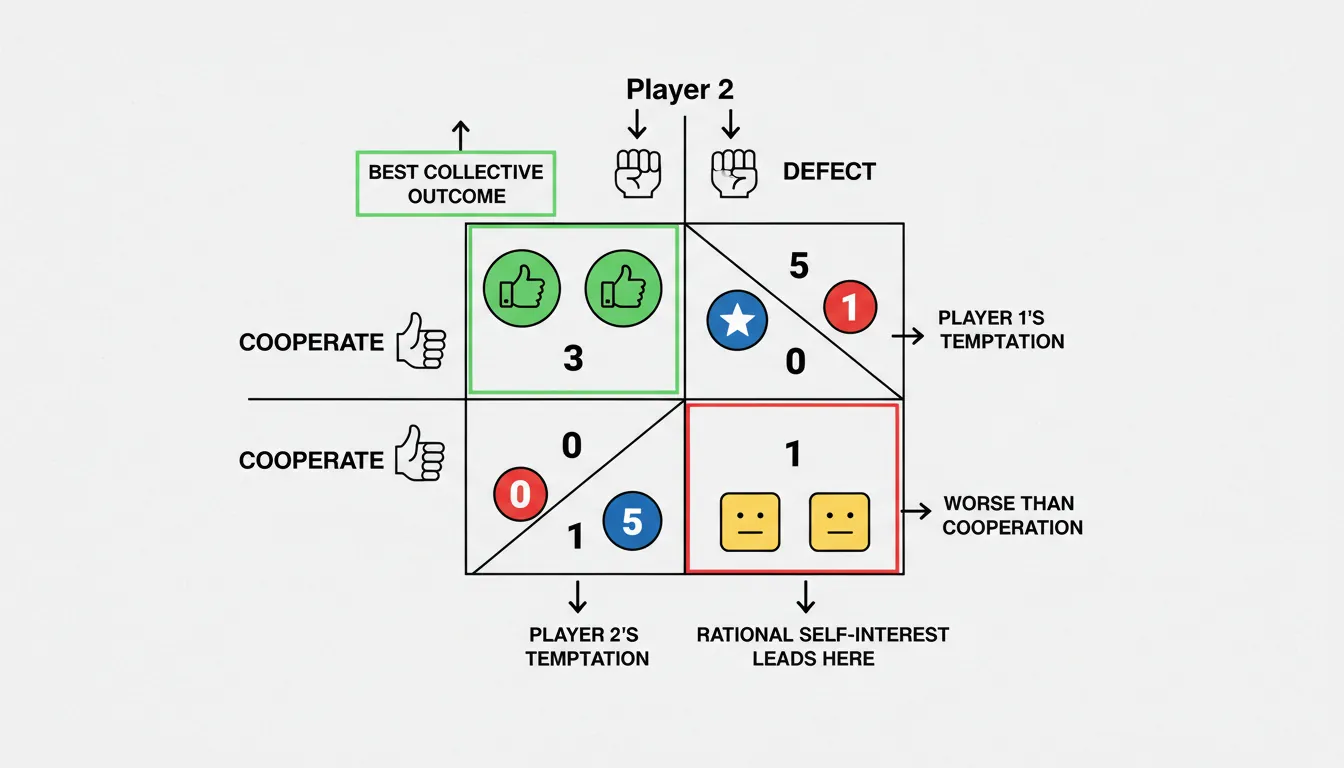
Core Principle: Two players would both benefit from cooperation, but rational self-interest leads both to defect, resulting in worse outcome for both. Classic coordination failure.
Figure: Prisoner's dilemma payoff matrix — rational self-interest leads both players to defect, producing a worse outcome than if both cooperated.
How Airlines All Ended Up Charging Baggage Fees (Despite Hating Them)
Competitor Charges Fees
Competitor Doesn't Charge
You Charge Fees
Both earn fee revenue, neutral competitive position ? +3, +3
You lose customers but gain fee revenue ? +1, +5
You Don't Charge
You gain customers but lose fee revenue ? +5, +1
Neither gains, status quo ? +2, +2
Nash Equilibrium: Both charge fees (+3, +3), even though both not charging (+2, +2) might create better customer loyalty long-term. But unilateral disarmament (you don't charge while competitor does) is worst outcome (+1).
Business Applications
For Strategy Teams: Recognize prisoner's dilemmas to avoid destructive competition. Advertising arms races, price wars, talent bidding wars—all prisoner's dilemmas where cooperation would benefit everyone, but first-mover disadvantage prevents cooperation.
For Industry Leaders: Signal intentions to avoid mutual destruction. Price leadership, industry associations, public commitments—ways to coordinate without explicit collusion. Example: Airlines signal fare changes days in advance, allowing competitors to match without starting price war.
Escaping Prisoner's Dilemmas Repeated interaction: If game played multiple times, cooperation can emerge Communication: If players can credibly commit, cooperation possible Punishment mechanisms: Ability to retaliate against defectors enforces cooperation Third-party enforcement: Contracts, regulations can mandate cooperative outcome
International Trade War: US-China Tariff Escalation (2018-2020)
Trade WarPrisoner's Dilemma
How Rational Tariff Responses Led to Mutual Economic Harm
Game Theory Payoff Matrix:
China Retaliates with Tariffs
China Doesn't Retaliate
US Imposes Tariffs
Both protect industries, both pay higher prices, trade war escalates ? -5, -5
US gains leverage, China loses exports ? +3, -8
US Maintains Free Trade
China gains leverage, US loses exports ? -8, +3
Both benefit from free trade, maximum efficiency ? +10, +10
Nash Equilibrium: Both impose tariffs (-5, -5) even though mutual free trade (+10, +10) would maximize global welfare. Why? Dominant strategy = retaliate. If US imposes tariffs, China's best response is retaliate (-5) rather than accept exploitation (-8). Same logic for US: if China might retaliate, impose tariffs first (+3 or -5) beats being exploited (-8).
Escalation Timeline (2018-2020):
March 2018: US imposes 25% steel tariffs, 10% aluminum tariffs
April 2018: China retaliates with tariffs on $50B US goods (soybeans, aircraft, cars)
June 2018: US escalates to $200B in Chinese goods (consumer electronics, furniture)
September 2018: China retaliates with tariffs on $60B US goods
May 2019: US raises tariffs to 25% on $200B goods
August 2019: China retaliates with 5-10% tariffs on $75B US goods
Economic Damage (Both Sides):
Impact
United States
China
GDP Loss
-0.3% (~$65B)
-0.5% (~$70B)
Trade Volume Drop
Exports to China: -25%
Exports to US: -17%
Consumer Costs
+$1,277/household/year
+$560/household/year
Industry Harm
Agriculture: -$27B (soybean farmers devastated)
Manufacturing: -$35B (export orders declined)
Stock Market
Volatility: ±15% swings on tariff announcements
Shanghai Composite: -20% (2018)
Prisoner's Dilemma Analysis:
Coordination failure: Both countries would gain from cooperation (free trade = +10, +10), but rational self-interest drove mutual defection (tariffs = -5, -5)
First-mover disadvantage: Unilateral disarmament (maintaining free trade while other imposes tariffs) = worst outcome (-8) ? neither willing to back down
Retaliation spiral: Each tariff round triggered counter-tariffs ? escalation trap (wanted to signal strength, ended up in mutually destructive equilibrium)
Missing cooperation mechanisms: No credible commitment device to prevent retaliation ? negotiation failures prolonged trade war
Outcome: Phase One Deal (January 2020) partially de-escalated but kept most tariffs in place. Both countries worse off than pre-2018 baseline. Trade war demonstrated classic prisoner's dilemma: rational individual responses (retaliate to avoid exploitation) created irrational collective outcome (mutual economic harm).
Key Insight: International trade is a repeated game with coordination challenges. Without mechanisms for credible cooperation (trade agreements, WTO dispute resolution), countries fall into prisoner's dilemma ? protectionism spirals. Tariffs as negotiation tools backfire when both sides retaliate. Escaping requires: (1) repeated interaction (builds trust over time), (2) communication (negotiation channels), (3) punishment mechanisms (WTO enforcement), (4) third-party arbitration.
Prisoner's DilemmaTrade WarCoordination FailureGame Theory
32. Repeated Games: How Future Interactions Enable Cooperation
Core Principle: When games are played repeatedly, cooperation can emerge even in prisoner's dilemmas. Threat of future punishment deters short-term defection. "Shadow of the future" makes cooperation rational.
Apple's incentive: Squeeze supplier on price, maximize own margin
Supplier's incentive: Cut corners on quality to hit price
Result: Race to bottom—poor quality, distrust
Repeated Game (Long-Term Partnership):
Apple's strategy: Pay fair prices, provide multi-year contracts, invest in supplier capabilities
Supplier's strategy: Maintain quality, invest in R&D, prioritize Apple's orders
Why it works: Future business worth more than short-term gains from cheating
Enforcement: Apple threatens to drop suppliers who cut quality—credible because they've done it before
Repeated GamesCooperation
Business Applications
For Partnerships: Structure relationships as repeated games. Multi-year contracts, performance bonuses, escalation clauses—all create incentives for cooperation by increasing future interaction value.
For HR Teams: Employee retention creates repeated game dynamics. Short-term employees optimize for current compensation (take shortcuts). Long-term employees optimize for career trajectory (invest in quality).
Repeated Game Strategy Build reputation: Act cooperatively to signal trustworthiness Punish defection: Retaliate against cheaters to enforce norms Forgive strategically: Allow one-time mistakes but punish repeated defection Discount rate matters: If future discounted heavily, cooperation harder (why startups cheat—uncertain future)
33. Tit-for-Tat: The Winning Strategy for Repeated Interactions
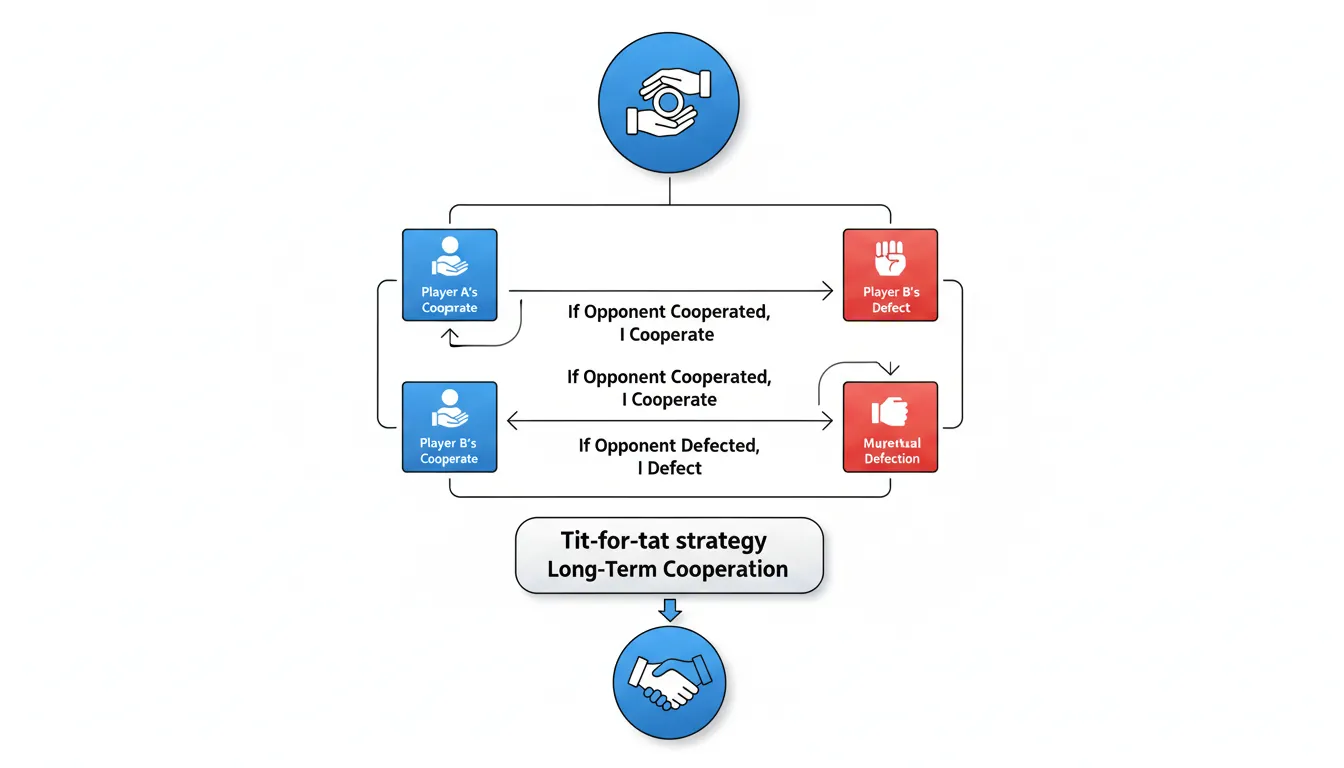
Core Principle: Tit-for-tat is a strategy for repeated games: start cooperative, then mirror opponent's last move. Cooperate if they cooperated, defect if they defected. Remarkably effective at fostering long-term cooperation.
Figure: Tit-for-tat strategy for repeated games — start cooperative, then mirror opponent's last move, fostering long-term cooperation through reciprocity.
Real-World Application: International Trade Relations
Reciprocity Strategy
How WTO Enforces Fair Trade
Tit-for-Tat in Trade Policy:
Round 1: Country A removes tariffs (cooperate)
Round 2: If Country B reciprocates, both benefit from free trade
If Country B defects (keeps tariffs): Country A imposes matching tariffs (tit-for-tat)
Forgiving: Returns to cooperation if opponent does (allows relationship repair)
Clear: Easy to understand strategy (opponent knows what to expect)
Tit-for-TatReciprocity
Business Applications
For Negotiation: Start generous, then mirror counterparty. Make first concession, then only concede when they concede. Builds reciprocity while protecting against exploitation.
For Customer Relations: Reward loyalty with loyalty. Netflix grandfathered early subscribers at lower prices—those customers stayed through price increases because Netflix honored past relationship.
Tit-for-Tat Principles Be nice: Don't defect first—establish cooperative intent Be provokable: Retaliate immediately against defection Be forgiving: Return to cooperation after opponent does Be clear: Make your strategy transparent so opponent can coordinate
34. Stackelberg Leadership: First-Mover Advantage
Core Principle: In sequential games, the first mover (leader) can sometimes secure advantage by committing to a strategy before others, forcing followers to optimize around leader's choice. Credible commitment is key.
Commitment: Invested $billions in cloud infrastructure before market existed
Credibility: Capital expenditure was sunk cost—signal of long-term commitment
Follower response: Microsoft, Google had to decide: build competing infrastructure or cede market
Leader Advantage Secured:
Learning curve: 7-year head start in operational excellence
Customer lock-in: Early enterprise customers built on AWS = switching costs
Ecosystem: Developer tools, integrations, training all AWS-centric
Result: 32% market share vs. 23% Azure, 10% Google Cloud (2024)
Stackelberg LeadershipFirst-Mover
Business Applications
For Strategy Teams: Evaluate when to lead vs. follow. Lead when (1) your commitment is credible, (2) followers must optimize around your choice, (3) first-mover advantages are durable. Follow when leader hasn't secured advantages and you can leapfrog.
For Product Teams: Platform decisions are Stackelberg games. Choose your tech stack (iOS vs. Android) ? ecosystem develops around it ? switching costs lock you in. Make right choice upfront—expensive to change later.
Stackelberg Strategy Requirements Credible commitment: Must be costly to reverse (sunk investment, public announcement) Sequential play: Followers must move after leader's commitment is observable Strategic dependence: Followers' optimal strategy depends on leader's choice Sustainability: First-mover advantage must persist (learning curves, network effects, lock-in)
35. Coordination Games: When Everyone Wants to Align
Core Principle: Coordination games have multiple equilibria where players benefit from choosing the same strategy. Challenge isn't conflict—it's coordination. All players win if they align, all lose if they don't.
Real-World Application: Tech Platform Standards
Standards War
VHS vs. Betamax: Coordination Failure Cost Billions
Equilibrium 2: Everyone adopts Betamax—same outcome, different standard
Actual outcome: Split market (1980s)—consumers/studios divided ? reduced value for everyone
How VHS Won Coordination Game:
Network effects: More VHS users ? more rental titles ? more users (virtuous cycle)
Licensing strategy: JVC licensed VHS to all manufacturers—faster adoption
Tipping point: Once VHS hit 60% market share, rational consumers/studios coordinated on VHS
Coordination GamesNetwork Effects
Business Applications
For Platform Teams: Make coordination easy. Provide clear signals, incentivize early adopters, demonstrate momentum. USB-C adoption: Apple switching iPhones created coordination point—now everyone standardizing.
For Partnerships: Use focal points to coordinate. Industry conferences, standards bodies, dominant platforms—all serve as coordination mechanisms. AWS re:Invent becomes focal point for cloud ecosystem to align roadmaps.
Winning Coordination Games Create focal points: Be the obvious choice (first mover, largest player, backed by leader) Build momentum: Early wins create bandwagon effect Make switching costly: Lock in early adopters to create installed base Signal clearly: Help market coordinate on your standard
36. Zero-Sum Games: Your Gain Is My Loss
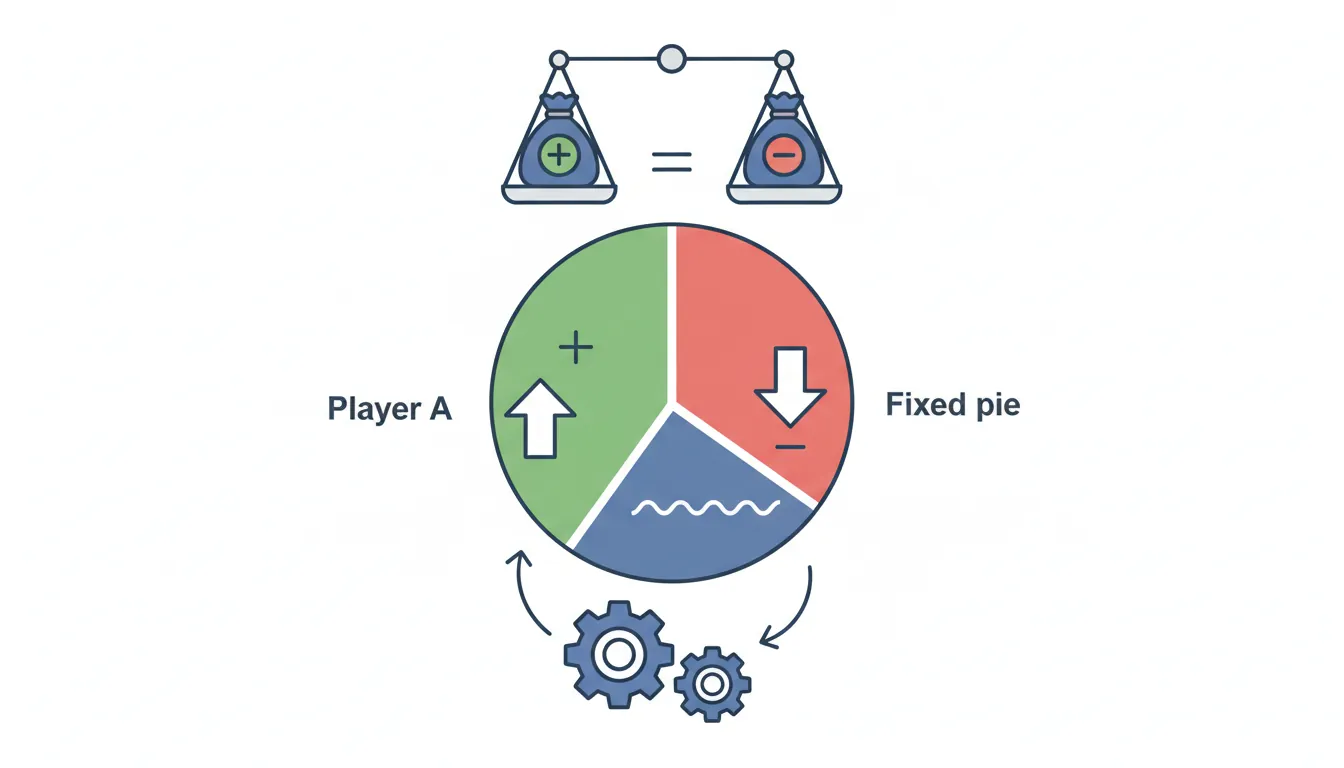
Core Principle: In zero-sum games, total gains equal total losses. One player's win exactly equals another's loss. No possibility of mutual gain—pure competition.
Figure: Zero-sum game dynamics — total gains equal total losses in a fixed-pie scenario, where one player's win is exactly another's loss.
Result: Intense advertising, promotion wars—both spend billions to maintain/gain share
Economic waste: Advertising doesn't grow pie, just redistributes it
Prisoner's dilemma overlay: If both stopped advertising, both would save money with minimal share change
Zero-Sum GamesMarket Share
Business Applications
For Strategy Teams: Avoid zero-sum markets when possible. Growing markets offer positive-sum opportunities (everyone can win). Mature markets become zero-sum (fight over fixed pie). Better to enter growing categories than fight incumbents in stagnant ones.
For Founders: Don't compete in zero-sum games with well-funded incumbents. Find positive-sum opportunities—new markets, different value propositions, underserved segments. Zoom didn't fight Cisco on feature parity (zero-sum)—competed on ease-of-use (new dimension).
Escaping Zero-Sum Dynamics Expand the pie: Grow total market rather than fight for share Differentiate: Compete on different dimensions (premium vs. budget) Change the game: Redefine competition (Tesla competing against gas cars, not just other EVs) Red Flag: If your gain requires competitor's loss, prepare for expensive, protracted battle
37. Non-Zero-Sum Games: Creating Mutual Value
Core Principle: In non-zero-sum games, total gains can exceed or fall short of total losses. Cooperation can create value for all players. Most business is non-zero-sum—trade, partnerships, innovation all create net value.
Real-World Application: Strategic Partnerships
Value Creation
Spotify + Uber Partnership: 1+1=3
Individual Values:
Spotify alone: Music streaming app
Uber alone: Ride-hailing app
Partnership Value Creation:
Spotify gains: Access to Uber's 100M+ users, in-car music control feature (differentiation)
Uber gains: Better rider experience (control music during ride), differentiation from Lyft
Mutual value: Both gain without either losing—classic positive-sum outcome
Why Non-Zero-Sum: Integration creates value neither could achieve alone—enhanced user experience benefits both platforms
Non-Zero-SumPartnerships
Business Applications
For Business Development: Seek non-zero-sum partnerships. Complementary products (not competitors) create mutual value. Salesforce + Slack integration—both benefit from seamless workflow, neither cannibalizes the other.
For Negotiation: Frame discussions as value creation, not value extraction. Find win-win structures—contingent contracts, earn-outs, revenue shares. More value created = bigger pie to split.
Non-Zero-Sum Opportunity Signals Complementary assets: Your strength + their strength = combined advantage Information asymmetry reduction: Sharing data/insights benefits both Risk sharing: Joint ventures split downside while capturing upside Network effects: More participants = more value for everyone (positive feedback)
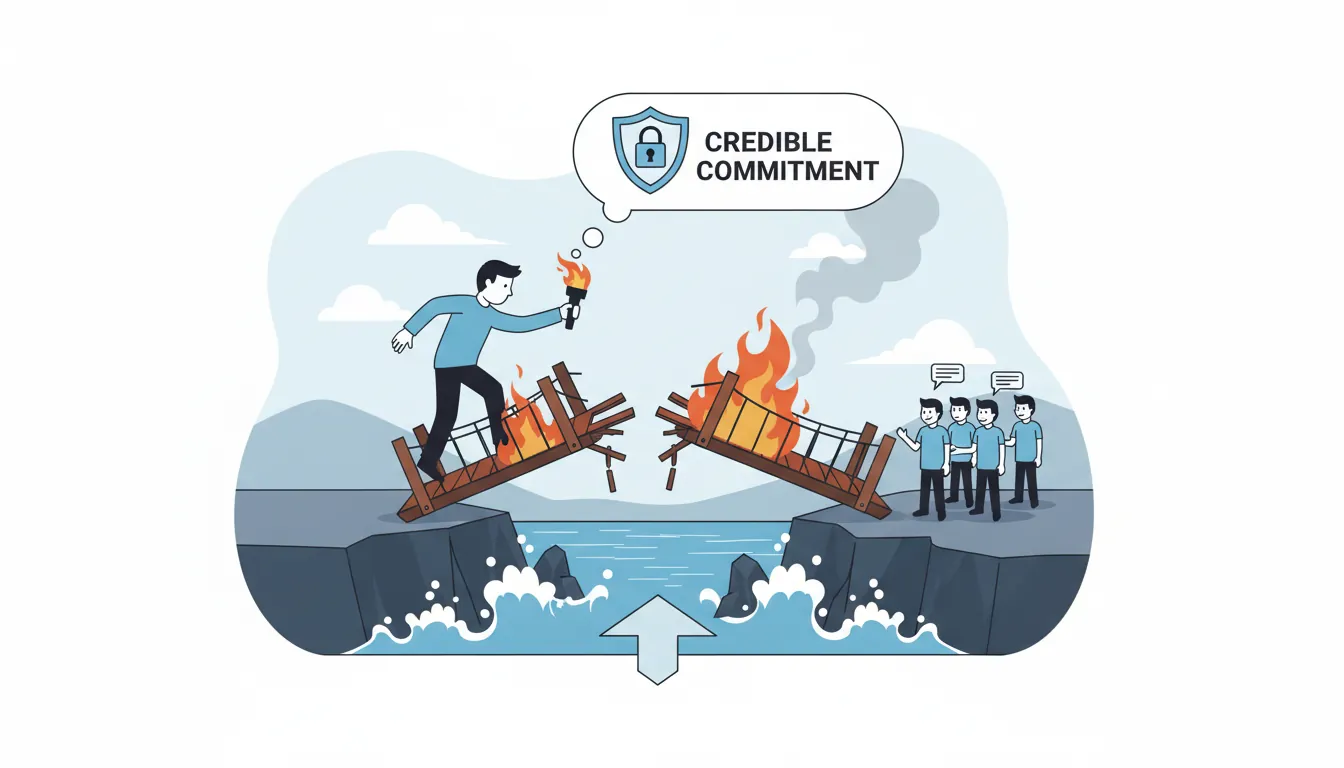
Core Principle: Credible commitment means limiting your own future options to influence others' behavior. By burning bridges, you make threats and promises believable. Cortés burned his ships—retreat impossible, soldiers fought harder.
Figure: Credible commitment strategy — deliberately limiting future options (burning bridges) to make threats and promises believable, influencing others' behavior.
Costco's low-margin, high-volume model—can't easily switch to premium
Business Applications
For Negotiation: Make first offers extreme and credible. Walking away from deals (publicly) builds reputation for toughness. Walmart's negotiating power comes from credible threat to delist suppliers.
For Strategy Teams: Use commitment to shape competition. Tesla's Gigafactory ($5B investment) credibly signals long-term commitment to EVs—forces competitors to commit billions to catch up or cede market.
Making Commitments Credible Irreversibility: Can't easily undo (sunk costs, public statements) Observability: Others must see your commitment Cost if broken: Significant penalty (reputation loss, financial hit) Warning: Commitment reduces flexibility—only use when strategic value > option value
Trade Negotiation: Trump's Tariff Threats as Commitment Devices (2018-2020)
Negotiation StrategyCredible Threats
How Tariffs Created Bargaining Leverage (With Mixed Results)
Strategic Commitment Logic: Trump used tariffs as credible threats in international trade negotiations. Unlike conventional diplomacy (quiet negotiations, face-saving compromises), Trump's approach: (1) public tariff threats, (2) actual implementation if demands unmet, (3) unpredictable escalation. Goal: force trading partners to make concessions (lower trade barriers, buy more US goods, accept enforcement mechanisms).
Commitment Mechanisms:
Mechanism
How It Works
Credibility Effect
Public Announcement
Twitter threats, press conferences
Reputation cost if backs down ? hard to reverse publicly
Actual Implementation
Imposed tariffs on China ($370B), Mexico ($350B threatened)
Demonstrated willingness to accept economic pain ? credible
Unpredictability
Random escalation (25% ? 50% threats), sudden deadlines
Uncertainty made threats more frightening ? partners took seriously
Domestic Support
Political base supported tough trade stance
Low political cost ? could sustain tariffs long-term
Case Studies:
1. USMCA (Replacement for NAFTA) - SUCCESS
Threat: Tariffs on Mexican cars (25%) and Canadian aluminum unless NAFTA renegotiated
Credibility: Trump actually imposed steel/aluminum tariffs on allies (Canada, Mexico, EU) ? showed willingness to harm partners
Outcome: Mexico/Canada agreed to new deal (USMCA) with: higher labor standards (Mexican wages increased), more US auto content (75% vs 62.5%), stronger enforcement mechanisms
Tariff removal: Steel/aluminum tariffs lifted after USMCA ratification
Analysis: Commitment worked—credible threat + actual pain ? concessions extracted. Net benefit debatable (USMCA gains vs. tariff costs), but demonstrated tariffs as negotiation leverage
2. China Trade War - MIXED RESULTS
Threat: Tariffs on all Chinese imports unless structural reforms (end forced tech transfer, IP theft, subsidies)
Credibility: Trump imposed tariffs on $370B Chinese goods (2018-2019), threatened 100% tariffs on remaining imports
China's response: Retaliation ($110B US goods), currency depreciation, long-term supply chain shifts (away from US)
Outcome (Phase One Deal): China agreed to buy $200B more US goods (agriculture, energy), some IP protections. Did NOT agree to end subsidies, state-owned enterprise reforms, structural changes
Analysis: Partial success—credible threat extracted purchases commitment but not structural reforms. Cost: -$65B US GDP, -$27B agriculture exports (before deal), permanent tariffs on $370B goods still in place (Biden kept them). Commitment too costly to sustain for full demands
3. EU Auto Tariffs - FAILURE TO COMMIT
Threat: 25% tariffs on European cars unless EU reduces trade barriers
Credibility problem: Repeated threats (2018-2020) but never implemented ? lost credibility
Outcome: EU didn't make major concessions, Trump didn't impose tariffs (too costly: German brands built in US = 120K jobs, retaliatory tariffs would hit US exports)
Analysis: Commitment failed—threat not believable because cost too high. Unlike China (less integrated, geopolitical rival), EU alliance made follow-through politically impossible ? partners called bluff
Strategic Lessons:
Credibility requires willingness to suffer: China tariffs credible because Trump accepted GDP loss. EU tariffs not credible because cost (ally relationship) too high ? bluffing exposed
Commitment traps: Public threats lock you in—backing down = reputation loss, following through = economic cost. Trump's Twitter diplomacy created many commitment traps (threatened 100% China tariffs, never implemented ? some credibility lost)
Retaliation risk: Credible threats invite retaliation. China didn't fold under pressure—matched tariffs, diversified away from US. Commitment strategy assumes opponent will capitulate, but repeated games (trade relationships) allow counter-threats
Option value loss: Irreversible commitments (public tariff threats) reduce flexibility. Quiet negotiations preserve optionality—can explore compromises without losing face. Trump's public approach burned bridges, made de-escalation harder
Key Insight: Tariffs as commitment devices work ONLY if: (1) credible (willing to accept costs), (2) proportionate (threat not so costly you can't follow through), (3) opponent values relationship enough to concede (USMCA worked, China didn't). Risk: commitment traps (locked into costly threats), retaliation spirals (opponents don't fold), reputation damage if bluffing exposed (EU example). Trade-off: credible threats gain leverage BUT reduce flexibility and invite counter-threats.
Game theory isn't abstract mathematics—it's the operating system for competitive strategy. Every major business decision involves strategic interaction: your competitors respond to your moves, your partners react to your offers, your customers compare you to alternatives. Executives who master game theory principles think three moves ahead, design better incentive structures, and avoid costly strategic mistakes.
The Strategic Decision Framework: 4-Layer Game Theory Analysis
When facing any strategic decision (pricing, partnerships, product launches, negotiations), apply this systematic framework synthesizing all 10 game theory laws:
Layer 1: Identify the Game Type Zero-sum vs. Non-zero-sum (Laws 36-37): Can both players win or is it a fixed pie? Simultaneous vs. Sequential (Law 34): Do you move together or does someone commit first? One-shot vs. Repeated (Law 32): Will you interact again or is this a single transaction? Coordination vs. Conflict (Law 35): Do all players benefit from aligning or are interests opposed?
Layer 2: Find the Equilibrium Check for Nash equilibrium (Law 29): Given others' strategies, can anyone improve by changing? Look for dominant strategies (Law 30): Is one choice optimal regardless of what others do? Identify prisoner's dilemmas (Law 31): Would cooperation benefit all but defection is individually rational?
Layer 3: Design for Cooperation Structure repeated interactions (Law 32): Long-term relationships enable cooperation Apply tit-for-tat principles (Law 33): Start nice, retaliate against defection, forgive cooperation Create focal points (Law 35): Make coordination obvious to align interests
Layer 4: Commit Strategically Evaluate first-mover advantage (Law 34): When does committing early benefit you? Make threats credible (Law 38): Limit your options to influence others' behavior Signal intentions clearly: Help others coordinate on outcomes that benefit you
Integrated Case Study: Microsoft Xbox Game Pass Strategy (Applying All 10 Laws)
Game Theory IntegrationPlatform Strategy
How Microsoft Used Game Theory to Compete with Sony PlayStation
Strategic Challenge (2017): PlayStation dominated console gaming (2:1 market share over Xbox). Traditional competition (exclusive games, better hardware) was zero-sum and expensive. How could Microsoft change the game?
Game Theory Analysis & Execution:
Law 36-37: Zero-Sum ? Non-Zero-Sum Transformation
Traditional console war: Zero-sum (Xbox gains market share = Sony loses market share). Requires spending billions on exclusive titles, selling hardware at loss, outmarketing competitor
Microsoft's pivot: Created non-zero-sum opportunity with Game Pass subscription model ($10/month for 100+ games). Goal: expand gaming market (PC, mobile, cloud) rather than just steal Sony's console customers
Result: Xbox Game Pass 25M subscribers (2024) without significantly harming PlayStation 5 sales. Both platforms thriving because Microsoft expanded pie (cloud gaming, PC gaming) instead of fighting over console pie
Law 34: Stackelberg Leadership (First-Mover Commitment)
2017 commitment: Microsoft publicly announced Game Pass strategy and invested $billions in cloud infrastructure (Azure gaming servers) before market existed
Credibility: Sunk cost (cloud investment), public promise (shareholder presentations), organizational restructure (Gaming division elevated, Phil Spencer promoted)
Follower response: Sony forced to react—launched PlayStation Plus Premium (2022) but 5-year late, smaller game library, weaker cloud infrastructure
First-mover advantage secured: Xbox Game Pass established as the "Netflix of gaming" before Sony could compete. Learning curve (how to run subscription service), customer lock-in (users invested in Game Pass ecosystem), developer relationships (exclusive day-one launches on Game Pass)
Law 38: Credible Commitment (Burning Bridges)
Strategic commitment: Microsoft stopped optimizing for console hardware profits (sell at cost or loss) to maximize Game Pass subscribers. Traditional model: sell console cheap, make money on $60 game sales. New model: give games away ($10/month subscription), make money on subscription volume
Why credible: Organizational structure change (Gaming revenue measured by subscribers, not hardware units), public financial reporting (Game Pass growth highlighted in earnings), can't easily revert (if they canceled Game Pass after 25M subscribers, massive customer backlash)
Strategic effect: Competitors (Sony, Nintendo) know Microsoft will prioritize Game Pass over everything—drives their strategic decisions (Sony can't compete on subscription value, focuses on exclusive AAA titles instead)
Law 32-33: Repeated Games & Tit-for-Tat (Developer Relations)
Repeated game structure: Game developers publish multiple titles over years—relationship is repeated, not one-shot
Microsoft's tit-for-tat strategy: Start cooperative (offer fair revenue share, day-one Game Pass deals), then mirror developer behavior. If developer delivers quality titles, Microsoft promotes them (featured placement, marketing support). If developer underdelivers, Microsoft reduces future deals
Why it works: Developers know future Game Pass opportunities depend on current performance—incentivizes quality, aligns interests. Shadow of future (next game deal) makes cooperation rational
Example: Bethesda acquisition ($7.5B, 2021)—after years of successful Game Pass partnership (Skyrim, Fallout on service), Microsoft secured entire studio. Repeated cooperation built trust ? enabled massive deal
Law 35: Coordination Games (PC + Console + Cloud Alignment)
Coordination challenge: PC gamers, console gamers, and mobile gamers historically separate ecosystems—fragmented market, no standards
Microsoft's focal point: Game Pass as universal platform—buy once, play anywhere (PC, Xbox, cloud). Created coordination point for developers (build for Game Pass = access all platforms) and players (subscribe once, play on all devices)
Network effects: More players on Game Pass ? more developers want in ? more games ? more players (virtuous cycle). Tipping point reached ~15M subscribers—after that, rational for developers to launch day-one on Game Pass regardless of initial payment
Contrast with Sony: PlayStation locked to consoles only—no focal point for cross-platform coordination ? developers must choose (PlayStation exclusive or multi-platform?), reducing value
Law 29-30: Nash Equilibrium & Dominant Strategy (Subscription Stability)
Nash equilibrium analysis: Once Game Pass reached critical mass (100+ games), staying subscribed became dominant strategy for users. Test: Given current game library, does canceling improve my outcome? Answer: No—even if I only play 2-3 games, $10/month cheaper than buying them individually
Competitive equilibrium: Sony PlayStation Plus can't undercut on price ($10/month is near marginal cost for licensing) without bleeding money. Can't match game quantity (Game Pass has Microsoft first-party studios + $billions in licensing deals). Nash equilibrium: Sony focuses on exclusive AAA quality, Xbox focuses on subscription quantity—both stable strategies given the other's position
Why stable: Neither player can improve by unilaterally changing strategy. If Sony drops price, loses money without gaining subscribers (Game Pass still better value). If Xbox raises price, loses subscribers to PlayStation Premium. Current strategies are mutually best responses
Law 31: Escaping Prisoner's Dilemma (Console Wars Détente)
Traditional prisoner's dilemma: Both Microsoft and Sony spending billions on exclusive titles, hardware subsidies, marketing wars—destructive competition where both lose money while gamers benefit
Microsoft's escape strategy: Change the game structure from zero-sum console war to non-zero-sum ecosystem competition. Cooperation mechanisms: (1) Cross-platform multiplayer (Call of Duty on both platforms), (2) Developer partnerships (some games launch on both platforms), (3) Backward compatibility (players keep libraries, reducing switching costs = less aggressive competition)
Outcome: Both companies profitable in gaming (Microsoft Gaming $15B revenue, Sony PlayStation $25B revenue) without price wars or massive hardware losses. Cooperation emerged through repeated interactions—both learned that mutual destruction hurts more than competing on different dimensions
Results (2024):
Metric
Xbox Game Pass Strategy
PlayStation Traditional Model
Subscribers
25M+ (Game Pass Ultimate)
47M (PS Plus all tiers)
Revenue Model
$10/month recurring (predictable)
$60-70/game (volatile)
Platform Reach
PC + Console + Cloud + Mobile
Console only
Market Position
Subscription leader, cloud gaming pioneer
Console hardware leader, exclusive AAA titles
Profitability
$15B annual gaming revenue (2024)
$25B annual gaming revenue (2024)
Key Insights:
Game type transformation: Changed from zero-sum console war to non-zero-sum ecosystem competition—both companies thriving by serving different customer needs
First-mover advantage execution: Credible commitment (cloud infrastructure investment, organizational restructure) ? forced Sony to follow 5 years late ? Xbox established as subscription leader
Dominant strategy for users: Once Game Pass reached 100+ games, staying subscribed became rational regardless of alternatives—created sticky customer base
Repeated game dynamics: Long-term developer relationships (tit-for-tat cooperation) built ecosystem that competitors can't easily replicate
Equilibrium stability: Both Microsoft (subscription/cloud) and Sony (console/exclusives) strategies are Nash equilibria—neither can improve by switching to other's model given current positions
Nash EquilibriumStackelberg LeadershipCredible CommitmentNon-Zero-SumRepeated GamesCoordination Games
Executive Decision-Making Framework: Game Theory Quick Reference
When facing strategic decisions, use this table to apply the right game theory principle:
Situation
Applicable Law
Key Question
Strategic Implication
Competitor pricing decision
Nash Equilibrium (29)
Given their price, is my current price optimal?
Don't start price war unless you can reach better equilibrium
Strategic investment with clear ROI
Dominant Strategy (30)
Is this beneficial regardless of what competitors do?
If yes, execute immediately—no need to analyze competition
Industry-wide competitive behavior
Prisoner's Dilemma (31)
Would everyone benefit from cooperation but individually rational to defect?
Look for mechanisms to enforce cooperation (contracts, reputation, punishment)
Supplier/partner negotiations
Repeated Games (32)
Will we interact again in the future?
If yes, structure long-term incentives for cooperation over short-term exploitation
Trade negotiations/partnerships
Tit-for-Tat (33)
How do I build trust while protecting against exploitation?
Start cooperative, mirror their behavior, punish defection, forgive cooperation
Platform launch/infrastructure investment
Stackelberg Leadership (34)
Does moving first create durable advantage?
If yes, commit early and credibly to force competitors to optimize around you
Standards/ecosystem alignment
Coordination Games (35)
Do all players benefit from choosing the same standard?
Create focal points, build momentum, lock in early adopters to win coordination race
Market share battles in mature markets
Zero-Sum (36)
Is your gain necessarily your competitor's loss?
If yes, avoid expensive battles—look for new markets or exit
Partnership/collaboration opportunities
Non-Zero-Sum (37)
Can cooperation create value for both parties?
Frame as value creation, not value extraction—bigger pie means more for everyone
Competitive threats/market entry
Commitment (38)
How do I make my strategy credible to influence competitor behavior?
Limit your options strategically (sunk costs, public promises) to signal intentions
5 Common Strategic Mistakes (Game Theory Perspective)
Mistake #1: Competing in Zero-Sum Games Against Well-Funded Incumbents
Example: New soda brand trying to steal Coca-Cola market share with advertising wars
Why it fails: Mature markets are zero-sum (fixed pie), incumbents have deeper pockets for prolonged battles, your gain requires their loss = expensive fight
Game theory fix: Find non-zero-sum opportunities—new segments (health drinks), different dimensions (local craft sodas), expanding pie (international markets)
Mistake #2: Making Threats You Can't Credibly Execute
Example: Threatening to drop major supplier over minor price disagreement when you have no alternatives
Why it fails: Commitment without credibility = bluffing. If opponent calls bluff and you back down, future threats worthless (Law 38)
Game theory fix: Only threaten what you can execute. Develop alternatives (credibility), make commitment observable (public stance), accept cost if they test you
Mistake #3: Defecting in Repeated Games for Short-Term Gains
Example: Squeezing long-term supplier on price once, destroying relationship for minor margin improvement
Why it fails: Shadow of future makes cooperation rational. Short-term defection triggers retaliation (tit-for-tat), losing future gains worth more than immediate savings (Law 32-33)
Game theory fix: Calculate lifetime value of relationship versus one-time gain. If repeated interaction, cooperate—reputation is strategic asset
Mistake #4: Trying to Move First Without Securing Advantage
Example: Launching platform before market ready, failing to lock in users, allowing fast follower to leapfrog with better product
Why it fails: First-mover advantage requires credible commitment + sustainable barriers (Law 34). If followers can copy without disadvantage, you just paid for their market research
Game theory fix: Only move first if you can create switching costs, learning curves, network effects, or lock-in. Otherwise wait, learn from others' mistakes, enter with superior product
Mistake #5: Ignoring Coordination Game Dynamics in Multi-Sided Markets
Example: Launching marketplace platform without solving cold-start problem—no buyers without sellers, no sellers without buyers
Why it fails: Coordination games require focal point (Law 35). If multiple equilibria exist (everyone on your platform vs. everyone on competitor's), you need mechanism to coordinate—first mover, subsidies, exclusive partnerships
Game theory fix: Create focal point (be obvious choice), subsidize one side (solve chicken-and-egg), demonstrate momentum (early wins create bandwagon), make switching costly once users coordinate on you
Team Applications: Strategy, Sales, Product & Negotiation
Game theory isn't just for executives—it's a practical toolkit for every business function. Strategy teams predict competitor responses. Sales teams navigate complex negotiations. Product teams design platforms with network effects. Here's how each team can apply these 10 principles to their day-to-day work.
Practical Application: Before launching strategy, war-game competitor responses to find stable outcomes (Nash equilibria) and identify dominant strategies.
Example: Entering Cloud Storage Market
Scenario: You're launching cloud storage service competing with Dropbox, Google Drive, Microsoft OneDrive
Nash equilibrium analysis: Current equilibrium: Dropbox charges $10/month for 2TB, Google/Microsoft bundle with productivity suites. If you launch at $5/month, what's Nash equilibrium?
Dropbox response: Match your price (has to—otherwise loses customers) ? new equilibrium at $5/month, lower margins for everyone
Google/Microsoft response: Don't change bundle price (storage is small part of value prop) ? you gain some customers but not Google/Microsoft's
Predicted equilibrium: You and Dropbox at $5/month (worse than current $10), Google/Microsoft unchanged ? price war benefits no one
Dominant strategy insight: Competing on price isn't dominant (outcome depends on competitor response). Dominant strategy: differentiate on dimension incumbents can't match—privacy (end-to-end encryption Dropbox lacks), integration (niche industry like healthcare), or customer service (white-glove for enterprises)
Action Items:
Quarterly war games: Map all competitor strategies, identify Nash equilibria for key decisions (pricing, product launches, M&A)
Dominant strategy checklist: For every major initiative, ask "Is this optimal regardless of what competitors do?" If yes, execute fast. If no, analyze equilibria before committing resources
Avoid Nash traps: Some equilibria are stable but terrible (prisoner's dilemma). Identify these before entering—if price war has no good equilibrium, don't start it
2. Evaluate First-Mover vs. Fast-Follower Strategies (Law 34: Stackelberg Leadership)
Practical Application: Decide when to lead (commit first) versus follow (optimize around leader's choice) based on whether first-mover advantages are durable.
When to Lead (First-Mover Advantages Exist):
Network effects markets: Uber city-by-city expansion—first mover gets drivers + riders, hard for Lyft to displace
Learning curve industries: Tesla battery manufacturing—7-year head start in production efficiency
Switching cost platforms: Salesforce—early enterprise customers built integrations, CRM workflows ? locked in
Regulation/licensing: Marijuana dispensary licenses—first movers in legal states secured scarce permits
When to Follow (First-Mover Disadvantages Dominate):
1. Apply Tit-for-Tat in Negotiations (Law 33: Tit-for-Tat Strategy)
Practical Application: Build trust while protecting against exploitation—start generous, mirror counterparty behavior, punish defection, forgive cooperation.
Enterprise Sales Negotiation Example:
Round 1 (Start nice): Offer value upfront—free extended trial, dedicated support engineer, first concession on price ($100K ? $90K) without asking for anything in return
Round 2 (Mirror behavior):
If buyer reciprocates: Make second concession ($90K ? $85K), offer additional services (training, integration support)
If buyer defects: Retract concessions, hold firm at $90K, introduce alternative higher-priced tier to anchor expectations
Round 3 (Forgive cooperation): If buyer returns to good faith, return to cooperative stance—meet at $87K, include some services
Differentiation features: Non-zero-sum (new value) — offensive, attracts new users, expands market
Integration features: Non-zero-sum (partnerships) — both products better together
Platform features: Non-zero-sum (network effects) — third parties create value
Zoom Case Study: Created NEW market—consumer video calls (family, education) while WebEx targeted enterprises ? expanded pie rather than fought over enterprise share ? both thriving
Shared metrics: Compensate Sales on Net Dollar Retention (renewals + expansion) not just new ARR ? aligns with Product's quality focus
Joint planning: Quarterly business reviews with Sales + Product + Customer Success ? coordination on realistic commitments
Tit-for-tat culture: Sales delivers accurate feedback ? Product prioritizes sales-requested features. Sales overpromises ? Product stops custom work
Strategic Decision Escalation Framework
Game Theory Decision Flowchart 1. Is this a dominant strategy? (Law 30) ? If yes, execute immediately. If no, continue. 2. Is this a repeated interaction? (Law 32) ? If yes, optimize for long-term cooperation. If no, continue. 3. Is this zero-sum or non-zero-sum? (Laws 36-37) ? If zero-sum, avoid or differentiate. If non-zero-sum, pursue partnerships. 4. Should we move first or follow? (Law 34) ? If first-mover advantages exist, commit early. If not, fast-follow. 5. How do we make commitments credible? (Law 38) ? Public announcements, sunk costs, organizational design.
Conclusion & Next Steps
Game theory transforms strategic decision-making from intuition to rigorous analysis. Understanding Nash equilibria, commitment strategies, and cooperation dynamics allows you to predict competitor responses, design incentive structures, and identify win-win opportunities. But even the best strategic framework can be undermined by irrational behavior, cognitive biases, and psychological factors.
The next guide explores how behavioral economics and consumer psychology shape real-world decisions and market outcomes.