Introduction to RTOS
Embedded Systems Mastery
Fundamentals & Architecture
Microcontrollers, memory, interruptsSTM32 & ARM Cortex-M Development
ARM architecture, peripherals, HALRTOS Fundamentals
FreeRTOS, Zephyr, task managementCommunication Protocols Deep Dive
UART, SPI, I2C, CAN, USBEmbedded Linux Fundamentals
Linux kernel, userspace, filesystemU-Boot Bootloader Mastery
Boot process, configuration, customizationLinux Device Drivers
Character, block, network driversLinux Kernel Customization
Kernel configuration, modules, debuggingAndroid System Architecture
Android layers, services, frameworkAndroid HAL & Native Development
HAL interfaces, NDK, JNIAndroid BSP & Kernel
BSP development, kernel integrationDebugging & Optimization
JTAG, GDB, profiling, optimizationAUTOSAR & EB Tresos
AUTOSAR architecture, MCAL, MPU protectionA Real-Time Operating System (RTOS) provides deterministic, time-bounded response to events. Unlike general-purpose OSes (Windows, Linux), an RTOS guarantees that tasks complete within specified deadlines—critical for motor control, medical devices, and automotive systems.
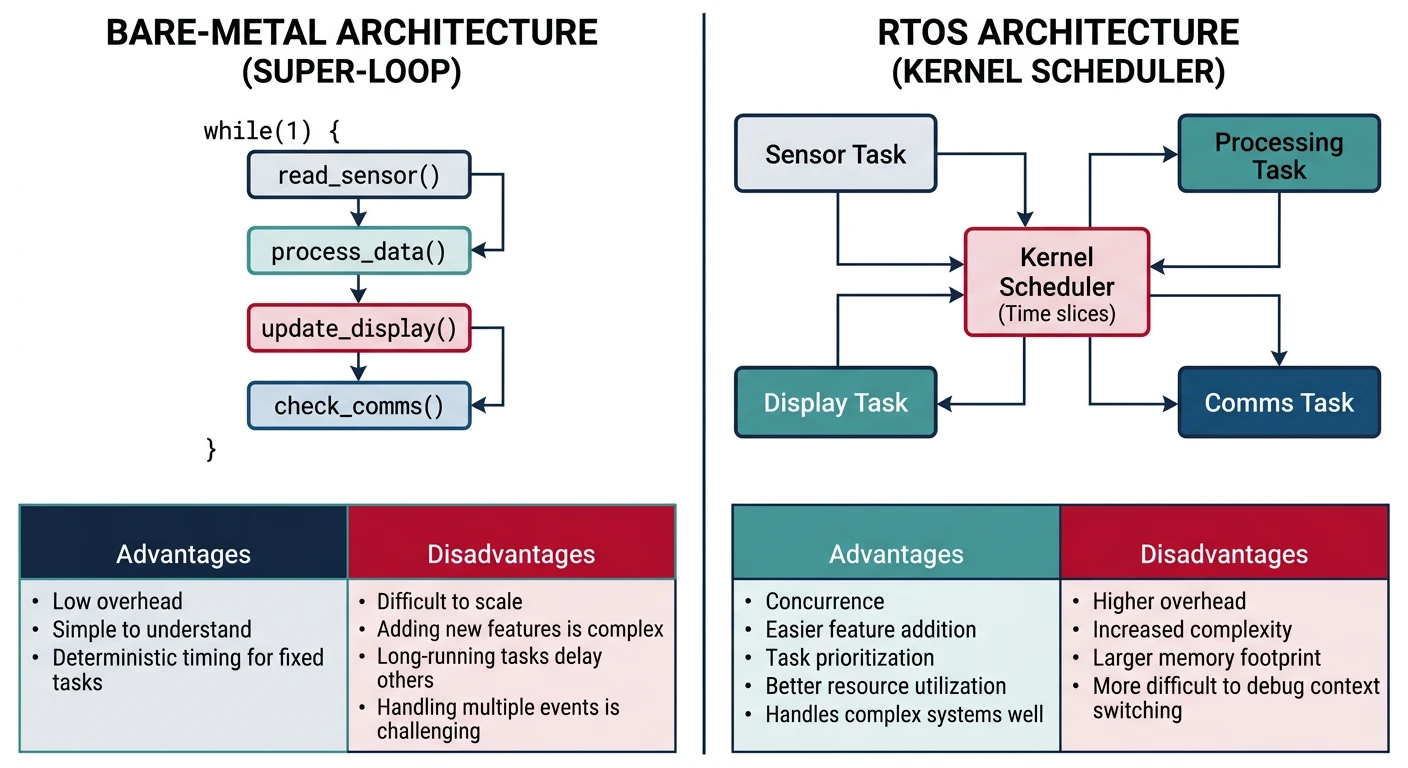
When to Use an RTOS vs. Bare-Metal
RTOS vs. Bare-Metal Decision Matrix
| Factor | Bare-Metal | RTOS |
|---|---|---|
| Complexity | Simple state machine | Multiple concurrent tasks |
| Timing | Super loops, manual timing | Preemptive scheduling |
| Memory | Minimal overhead | 2-10KB+ kernel |
| Debugging | Simpler | Task visualization tools |
| Scalability | Hard to add features | Easy to add tasks |
| Power | Fine-grained control | Tickless idle modes |
FreeRTOS Deep Dive
FreeRTOS is the most popular RTOS, running on 40%+ of embedded devices. It's open-source (MIT license), supports 35+ architectures, and integrates with AWS IoT.
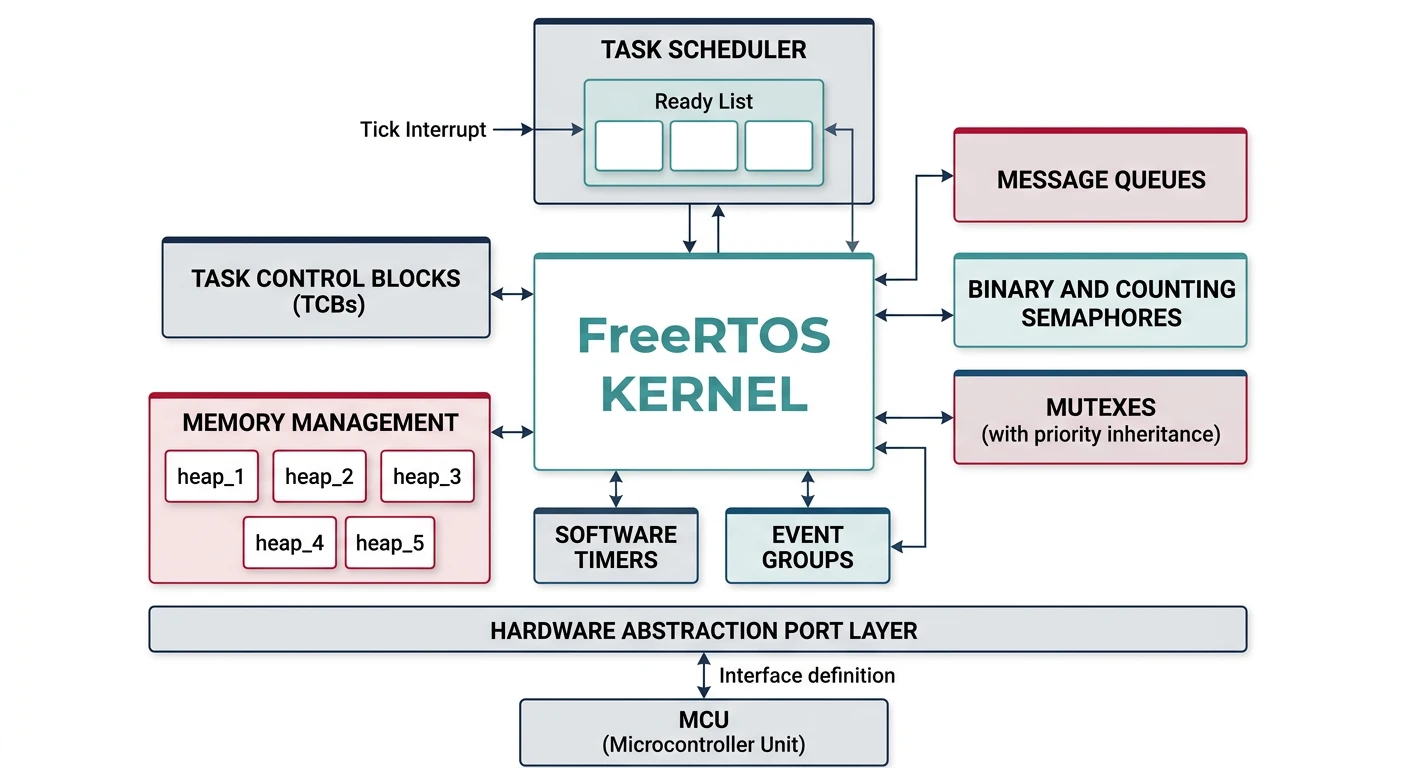
FreeRTOS Project Setup
// FreeRTOS configuration (FreeRTOSConfig.h)
#define configUSE_PREEMPTION            1
#define configUSE_PORT_OPTIMISED_TASK_SELECTION 1
#define configUSE_TICKLESS_IDLE         0
#define configCPU_CLOCK_HZ              84000000  // STM32F4 @ 84MHz
#define configTICK_RATE_HZ              1000      // 1ms tick
#define configMAX_PRIORITIES            5
#define configMINIMAL_STACK_SIZE        128       // words (512 bytes)
#define configTOTAL_HEAP_SIZE           (15 * 1024)
#define configMAX_TASK_NAME_LEN         16

// Feature enables
#define configUSE_MUTEXES               1
#define configUSE_COUNTING_SEMAPHORES   1
#define configUSE_QUEUE_SETS            1
#define configUSE_TASK_NOTIFICATIONS    1
#define configUSE_TRACE_FACILITY        1
#define configUSE_STATS_FORMATTING_FUNCTIONS 1

// Hook functions for debugging
#define configUSE_MALLOC_FAILED_HOOK    1
#define configCHECK_FOR_STACK_OVERFLOW  2
Creating Your First Tasks
#include "FreeRTOS.h"
#include "task.h"

// Task function prototype
void vLedTask(void *pvParameters);
void vSensorTask(void *pvParameters);

int main(void) {
    // Hardware initialization
    HAL_Init();
    SystemClock_Config();
    MX_GPIO_Init();

    // Create tasks
    xTaskCreate(
        vLedTask,           // Task function
        "LED",              // Task name (debugging)
        128,                // Stack size (words)
        NULL,               // Parameters
        1,                  // Priority (1 = low)
        NULL                // Task handle (optional)
    );

    xTaskCreate(
        vSensorTask,
        "Sensor",
        256,                // Larger stack for complex tasks
        (void*)42,          // Pass parameter
        2,                  // Higher priority
        NULL
    );

    // Start the scheduler (never returns)
    vTaskStartScheduler();

    // Should never reach here
    while(1);
}

// LED blink task
void vLedTask(void *pvParameters) {
    const TickType_t xDelay = pdMS_TO_TICKS(500);  // 500ms delay

    for(;;) {
        HAL_GPIO_TogglePin(LED_GPIO_Port, LED_Pin);
        vTaskDelay(xDelay);  // Block, allowing other tasks to run
    }
}

// Sensor reading task
void vSensorTask(void *pvParameters) {
    int param = (int)pvParameters;  // 42

    for(;;) {
        // Read sensor
        uint16_t value = read_adc();

        // Process data
        if (value > THRESHOLD) {
            // Alert condition
        }

        vTaskDelay(pdMS_TO_TICKS(100));  // 10Hz sampling
    }
}
Zephyr RTOS Overview
Zephyr is a modern, scalable RTOS backed by the Linux Foundation. It's gaining traction for IoT devices with its excellent Bluetooth/networking stack and device tree configuration.
FreeRTOS vs. Zephyr Comparison
| Aspect | FreeRTOS | Zephyr |
|---|---|---|
| Learning Curve | Easier | Steeper (cmake, devicetree) |
| Footprint | 6-10KB | 8-20KB+ |
| Networking | FreeRTOS+TCP or lwIP | Built-in (excellent BLE) |
| Configuration | Header file | Kconfig + Devicetree |
| Vendors | Universal support | Nordic, Intel, NXP focus |
| Certification | IEC 61508, MISRA | Growing safety portfolio |
// Zephyr task (thread) example
#include <zephyr/kernel.h>
#include <zephyr/drivers/gpio.h>

#define LED0_NODE DT_ALIAS(led0)
static const struct gpio_dt_spec led = GPIO_DT_SPEC_GET(LED0_NODE, gpios);

// Define thread stack
K_THREAD_STACK_DEFINE(blink_stack, 512);
struct k_thread blink_thread_data;

void blink_thread(void *p1, void *p2, void *p3) {
    gpio_pin_configure_dt(&led, GPIO_OUTPUT_ACTIVE);

    while (1) {
        gpio_pin_toggle_dt(&led);
        k_msleep(1000);  // Sleep 1 second
    }
}

int main(void) {
    // Create thread
    k_thread_create(&blink_thread_data, blink_stack,
                    K_THREAD_STACK_SIZEOF(blink_stack),
                    blink_thread, NULL, NULL, NULL,
                    5,     // Priority (lower = higher priority in Zephyr)
                    0,     // Options
                    K_NO_WAIT);  // Start immediately

    return 0;  // Main can return in Zephyr
}
Task Management
Task States
FreeRTOS tasks cycle through four states:
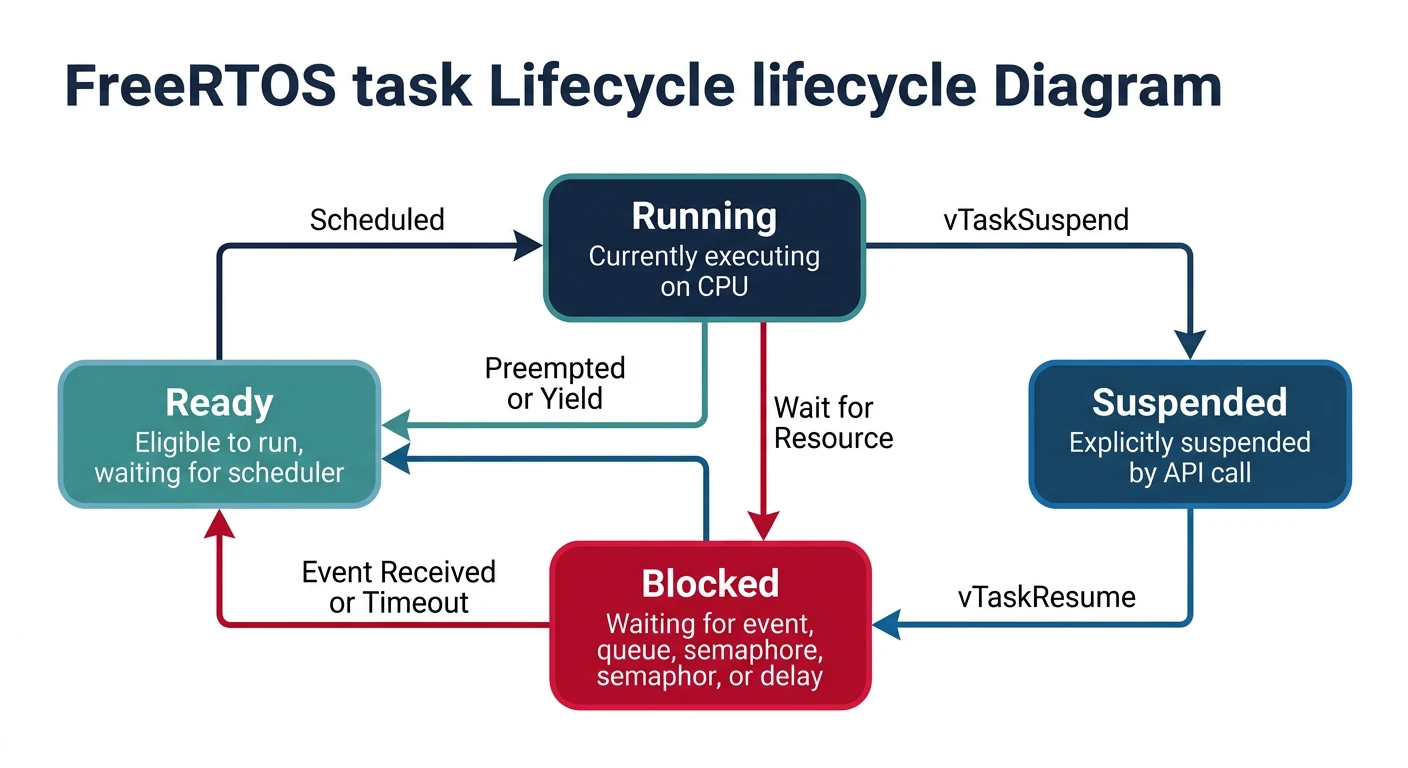
stateDiagram-v2
    [*] --> Ready : xTaskCreate()
    Ready --> Running : Scheduler Dispatch
    Running --> Ready : Preempted / Yield
    Running --> Blocked : Wait (Queue/Semaphore/Delay)
    Blocked --> Ready : Event / Timeout
    Running --> Suspended : vTaskSuspend()
    Suspended --> Ready : vTaskResume()
    Running --> Deleted : vTaskDelete()
    Deleted --> [*]

    note right of Running : Highest priority\nready task runs
    note right of Blocked : Waiting for event\nor timeout
- Running: Currently executing on CPU
- Ready: Able to run, waiting for CPU time
- Blocked: Waiting for event (delay, semaphore, queue)
- Suspended: Explicitly paused by
vTaskSuspend()
// Task control functions
TaskHandle_t xSensorHandle = NULL;

// Create with handle
xTaskCreate(vSensorTask, "Sensor", 256, NULL, 2, &xSensorHandle);

// Suspend task (from another task or ISR)
vTaskSuspend(xSensorHandle);

// Resume task
vTaskResume(xSensorHandle);

// Delete task (NULL = self)
vTaskDelete(xSensorHandle);
// vTaskDelete(NULL);  // Delete calling task

// Get task state
eTaskState state = eTaskGetState(xSensorHandle);
// Running, Ready, Blocked, Suspended, Deleted

// Get high water mark (minimum free stack)
UBaseType_t stackLeft = uxTaskGetStackHighWaterMark(xSensorHandle);
Scheduling Algorithms
Priority-Based Preemptive Scheduling
FreeRTOS uses fixed-priority preemptive scheduling—the highest priority ready task always runs. When priorities are equal, tasks share time via round-robin.
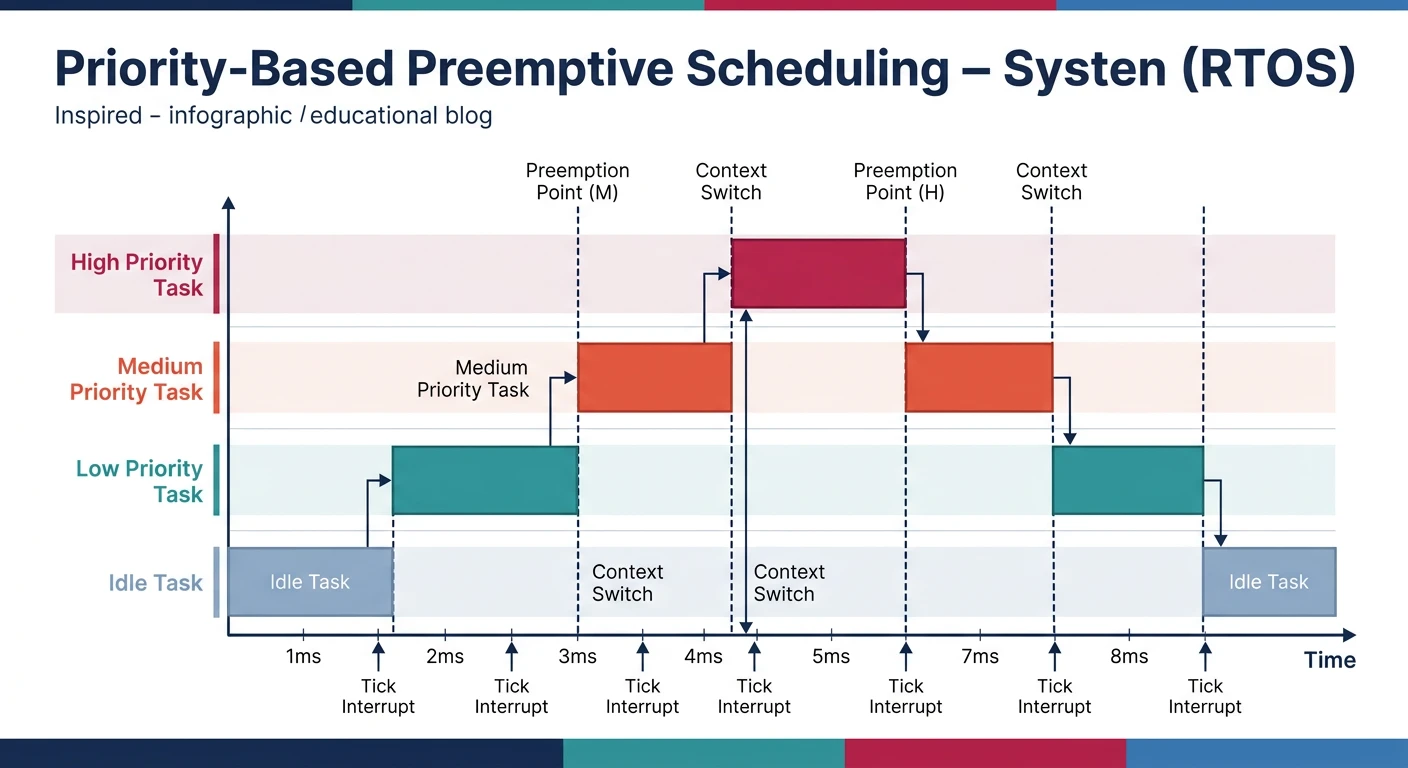
- Highest: Hardware interrupt handlers (ISR)
- High: Safety-critical, deadline-driven tasks
- Medium: Communication, sensor processing
- Low: Logging, display updates, background work
- Idle: System cleanup, power management
// Priority management
#define PRIORITY_CRITICAL   (configMAX_PRIORITIES - 1)  // 4
#define PRIORITY_HIGH       3
#define PRIORITY_MEDIUM     2
#define PRIORITY_LOW        1
#define PRIORITY_IDLE       0  // tskIDLE_PRIORITY

// Change priority at runtime
vTaskPrioritySet(xSensorHandle, PRIORITY_HIGH);

// Get current priority
UBaseType_t prio = uxTaskPriorityGet(xSensorHandle);

// Yield to other same-priority tasks
taskYIELD();
Synchronization Primitives
Semaphores
Semaphores signal events between tasks or from ISRs to tasks.
#include "semphr.h"

// Binary semaphore (signal events)
SemaphoreHandle_t xButtonSemaphore;

void setup(void) {
    xButtonSemaphore = xSemaphoreCreateBinary();
}

// ISR signals the semaphore
void EXTI15_10_IRQHandler(void) {
    BaseType_t xHigherPriorityTaskWoken = pdFALSE;

    HAL_GPIO_EXTI_IRQHandler(GPIO_PIN_13);

    xSemaphoreGiveFromISR(xButtonSemaphore, &xHigherPriorityTaskWoken);
    portYIELD_FROM_ISR(xHigherPriorityTaskWoken);
}

// Task waits for semaphore
void vButtonTask(void *pvParameters) {
    for(;;) {
        // Block until button pressed (or timeout)
        if (xSemaphoreTake(xButtonSemaphore, portMAX_DELAY) == pdTRUE) {
            // Handle button press
            HAL_GPIO_TogglePin(LED_GPIO_Port, LED_Pin);
        }
    }
}

// Counting semaphore (resource pool)
SemaphoreHandle_t xPoolSemaphore = xSemaphoreCreateCounting(5, 5);
// Max 5, initial 5
Mutexes (Mutual Exclusion)
Mutexes protect shared resources from concurrent access. Unlike semaphores, mutexes support priority inheritance to prevent priority inversion.
SemaphoreHandle_t xUartMutex;

void setup(void) {
    xUartMutex = xSemaphoreCreateMutex();
}

// Thread-safe UART write
void safe_uart_print(const char *msg) {
    // Acquire mutex (block if held by another task)
    if (xSemaphoreTake(xUartMutex, pdMS_TO_TICKS(100)) == pdTRUE) {
        HAL_UART_Transmit(&huart2, (uint8_t*)msg, strlen(msg), HAL_MAX_DELAY);
        xSemaphoreGive(xUartMutex);  // Release
    } else {
        // Timeout - handle error
    }
}
Priority Inversion Problem
Scenario: Low-priority task holds mutex. High-priority task blocks waiting. Medium-priority task preempts low ? high-priority task starves.
Solution: FreeRTOS mutexes implement priority inheritance—low-priority task temporarily inherits high priority while holding the mutex.
Inter-Task Communication
Queues
Queues pass data between tasks safely. They're the primary mechanism for producer-consumer patterns.
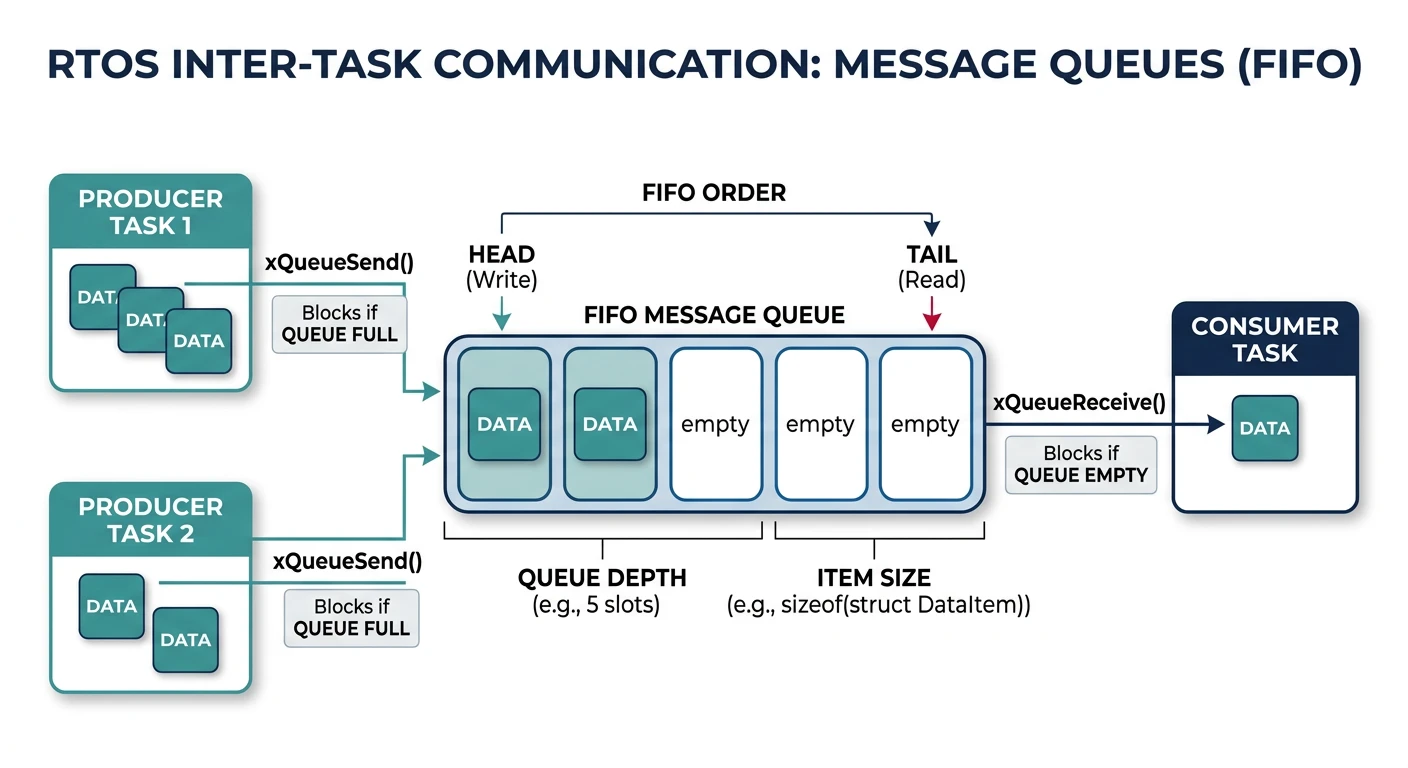
#include "queue.h"

typedef struct {
    uint16_t sensor_id;
    float value;
    uint32_t timestamp;
} SensorData_t;

QueueHandle_t xSensorQueue;

void setup(void) {
    // Queue of 10 SensorData_t items
    xSensorQueue = xQueueCreate(10, sizeof(SensorData_t));
}

// Producer task
void vSensorTask(void *pvParameters) {
    SensorData_t data;

    for(;;) {
        data.sensor_id = 1;
        data.value = read_temperature();
        data.timestamp = xTaskGetTickCount();

        // Send to queue (block if full for 100ms)
        if (xQueueSend(xSensorQueue, &data, pdMS_TO_TICKS(100)) != pdPASS) {
            // Queue full - handle overflow
        }

        vTaskDelay(pdMS_TO_TICKS(100));
    }
}

// Consumer task
void vProcessingTask(void *pvParameters) {
    SensorData_t received;

    for(;;) {
        // Block until data available
        if (xQueueReceive(xSensorQueue, &received, portMAX_DELAY) == pdPASS) {
            printf("Sensor %d: %.2f at %lu\n",
                   received.sensor_id, received.value, received.timestamp);
        }
    }
}
Task Notifications (Lightweight)
Task notifications are faster than semaphores for simple signaling—no separate object needed.
TaskHandle_t xReceiverHandle;

// ISR sends notification
void UART_RxCallback(void) {
    BaseType_t xHigherPriorityTaskWoken = pdFALSE;
    vTaskNotifyGiveFromISR(xReceiverHandle, &xHigherPriorityTaskWoken);
    portYIELD_FROM_ISR(xHigherPriorityTaskWoken);
}

// Task waits for notification
void vReceiverTask(void *pvParameters) {
    for(;;) {
        ulTaskNotifyTake(pdTRUE, portMAX_DELAY);  // Clear on exit
        process_uart_data();
    }
}
Memory Management
FreeRTOS provides 5 heap implementations:
- heap_1: Allocate only (no free) - simplest, deterministic
- heap_2: Best fit, no coalescence - fragmentation risk
- heap_3: Wraps standard malloc/free - thread-safe wrapper
- heap_4: Best fit with coalescence - recommended
- heap_5: heap_4 + non-contiguous regions
// Dynamic allocation
void *ptr = pvPortMalloc(256);
if (ptr != NULL) {
    // Use memory
    vPortFree(ptr);
}

// Check available heap
size_t freeHeap = xPortGetFreeHeapSize();
size_t minEverFreeHeap = xPortGetMinimumEverFreeHeapSize();

// Malloc failed hook (debugging)
void vApplicationMallocFailedHook(void) {
    taskDISABLE_INTERRUPTS();
    for(;;);  // Halt on allocation failure
}
Timing & Deadlines
Software Timers
#include "timers.h"

TimerHandle_t xHeartbeatTimer;

void vHeartbeatCallback(TimerHandle_t xTimer) {
    HAL_GPIO_TogglePin(LED_GPIO_Port, LED_Pin);
}

void setup(void) {
    // Create periodic timer (1 second)
    xHeartbeatTimer = xTimerCreate(
        "Heartbeat",
        pdMS_TO_TICKS(1000),
        pdTRUE,             // Auto-reload (periodic)
        NULL,               // Timer ID
        vHeartbeatCallback
    );

    xTimerStart(xHeartbeatTimer, 0);
}

// One-shot timer
xTimerCreate("Timeout", pdMS_TO_TICKS(5000), pdFALSE, NULL, vTimeoutCallback);
Deadline-Driven Design
// Periodic task with deadline monitoring
void vCriticalTask(void *pvParameters) {
    TickType_t xLastWakeTime = xTaskGetTickCount();
    const TickType_t xPeriod = pdMS_TO_TICKS(10);  // 10ms period

    for(;;) {
        TickType_t xStart = xTaskGetTickCount();

        // Do critical work
        process_motor_control();

        // Check if we missed deadline
        TickType_t xElapsed = xTaskGetTickCount() - xStart;
        if (xElapsed > pdMS_TO_TICKS(8)) {  // 80% threshold
            log_warning("Near deadline miss!");
        }

        // Sleep until next period (precise timing)
        vTaskDelayUntil(&xLastWakeTime, xPeriod);
    }
}
Conclusion & What's Next
You've learned the core RTOS concepts—task creation, scheduling, synchronization primitives, queues, and timing. FreeRTOS and Zephyr are production-ready choices for embedded multi-tasking.
- Use RTOS for 3+ concurrent activities with timing requirements
- FreeRTOS: Universal, lightweight, AWS IoT integration
- Zephyr: Modern, excellent networking, Linux Foundation backed
- Mutexes prevent priority inversion; semaphores signal events
- Queues are the safest way to pass data between tasks
In Part 4, we'll deep dive into communication protocols—UART, SPI, I2C, CAN, and USB—the backbone of embedded connectivity.