We use cookies to enhance your browsing experience, serve personalized content, and analyze our traffic.
By clicking "Accept All", you consent to our use of cookies. See our
Privacy Policy
for more information.
Channel sales multiply your reach without multiplying your headcount. Top software companies generate 60-80% of revenue through partners. But a channel program is a business within your business—it requires strategy, investment, and operational discipline.
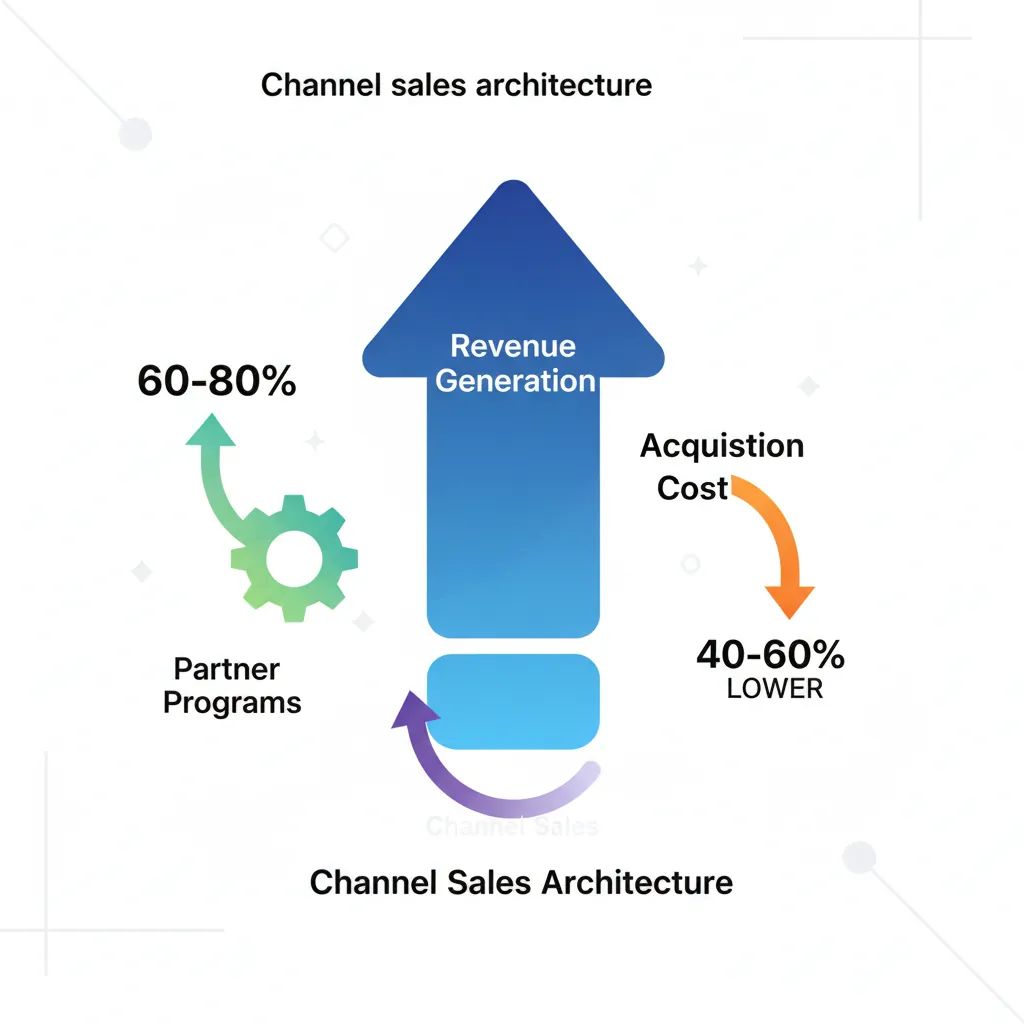
Figure 1: Channel sales architecture — partner programs generate 60-80% of revenue at 40-60% lower acquisition cost
Channel Economics: Partner-sourced deals typically cost 40-60% less in customer acquisition than direct sales. However, building a functional channel program takes 12-18 months before generating meaningful pipeline.
When to Build a Channel
Signal
Go Channel
Stay Direct
Market Coverage
Can't reach all segments/geographies directly
Target market is narrow and well-defined
Product Complexity
Product can be sold with partner training
Requires deep technical pre-sales expertise
Deal Size
Average deal <$50K (economics support margin sharing)
Average deal >$500K (justify dedicated AE)
Implementation
Partners add value through services/customization
Self-serve or simple onboarding
Channel Types
Channel Architecture
Channel Type
Role
Revenue Model
Best For
Reseller / VAR
Buys and resells your product (often with services)
Margin: 20-40%
SMB market, regional coverage
Distributor
Sells to resellers, manages logistics
Margin: 5-15%
Large reseller networks, global reach
System Integrator
Implements complex solutions using your product
Referral fee or embedded licensing
Enterprise, complex deployments
Technology Partner
Integrates with your product, co-sells
Revenue share or co-selling
Platform ecosystem plays
Affiliate / Referral
Sends leads, doesn't own the sale
Commission: 10-30% of first year
Volume, low-touch products
MSP (Managed Service)
Bundles your product into managed services
Wholesale pricing or embed
IT/SaaS products, sticky relationships
Direct vs Indirect
The Hybrid Model
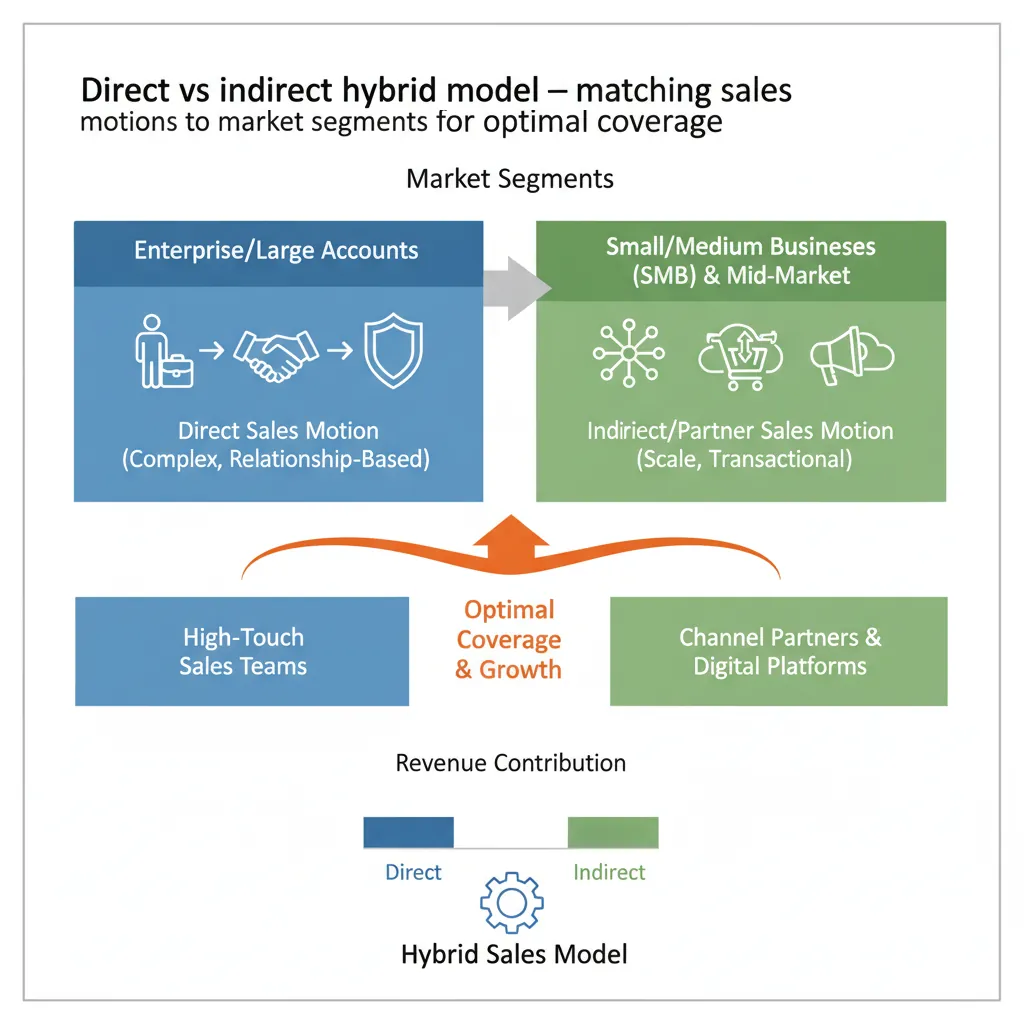
Most successful companies use a hybrid approach, combining direct and indirect motions:
Figure 2: Direct vs indirect hybrid model — matching sales motions to market segments for optimal coverage
Segment
Motion
Rationale
Enterprise (>$100K)
Direct + SI partner for implementation
High deal value justifies direct AE; partner adds services
Mid-Market ($25-100K)
Channel-led with direct overlay
Partner sells and implements; direct team supports complex deals
SMB (<$25K)
Channel-only or self-serve
Unit economics don't support direct sales
New Geographies
Channel-first, add direct later
Partners provide local knowledge, language, compliance
Partner Models
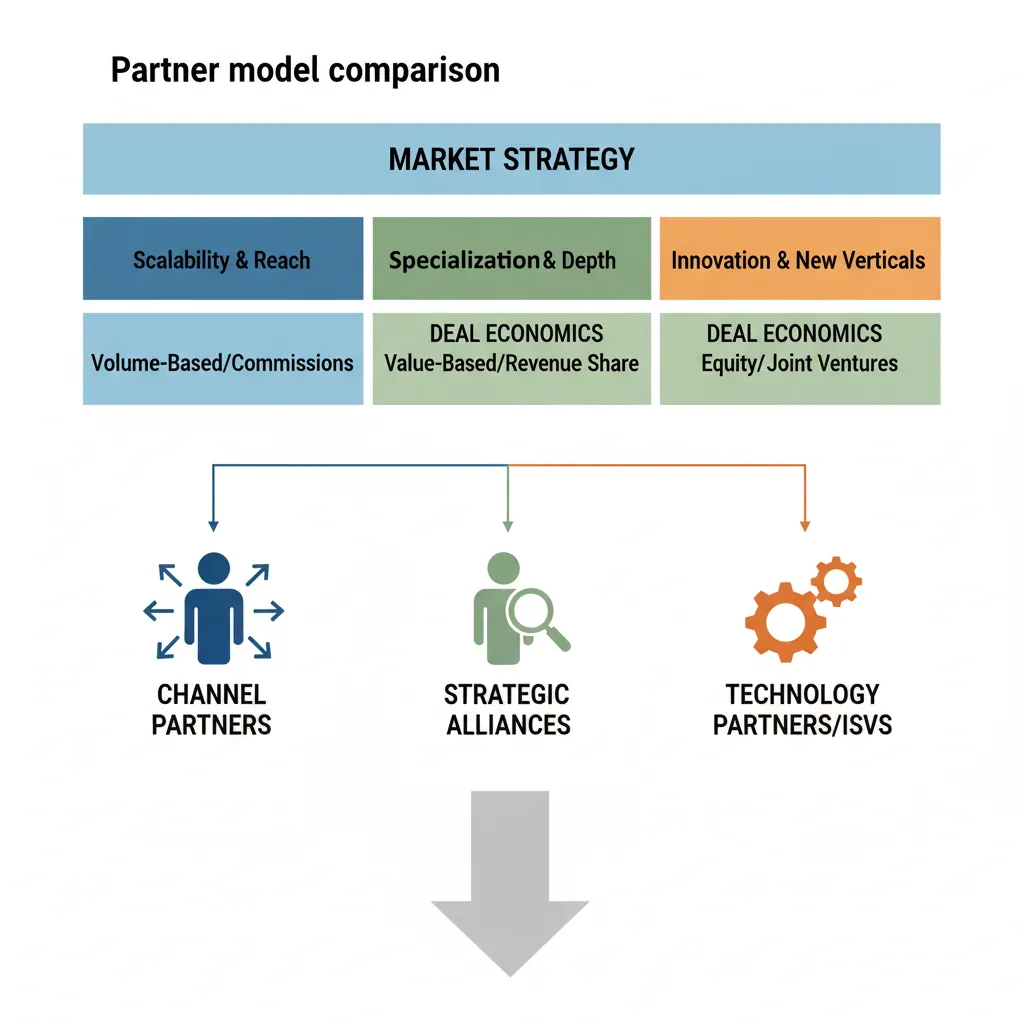
Different partner models serve different strategic purposes. The key is matching the model to your market, product complexity, and growth goals.
Figure 3: Partner model comparison — matching partner types to market strategy and deal economics
Distributor & VAR Economics
Model
Your Revenue
Partner Motivation
Management Effort
1-Tier (Direct to VAR)
70-80% of list price
Margin + services revenue
High (manage many VARs)
2-Tier (Via Distributor)
55-70% of list price
Distributor margin + VAR margin
Lower (distributor manages VARs)
Referral Only
85-90% of list price
Referral fee (one-time or recurring)
Lowest (no enablement needed)
Affiliate Programs
Affiliate Program Design
Component
Decision
Best Practice
Commission Structure
Flat fee vs. percentage vs. recurring
Use recurring commissions (15-30%) for SaaS to align with retention
Attribution
First-touch, last-touch, or multi-touch
30-90 day cookie window with last-touch attribution
Tiers
Flat vs. tiered commission rates
3 tiers (Bronze/Silver/Gold) with escalating commissions
Payment
Net-30, net-60, or milestone-based
Net-30 after customer pays; clawback for early churn
Strategic Alliances
Alliance Types
Alliance Type
Structure
Example
Technology Integration
Build native integrations, co-market
CRM integrates with email platform
Go-to-Market
Joint sales plays, co-branded campaigns
Cloud provider + SaaS vendor bundle
OEM / Embedded
Partner embeds your technology in their product
Analytics engine inside ERP system
Co-Innovation
Joint development of new capabilities
AI startup + enterprise platform
Alliance Success Factor: The best alliances solve a customer problem that neither partner can solve alone. Start by mapping "together we can do X that neither of us can do independently."
Partner Enablement
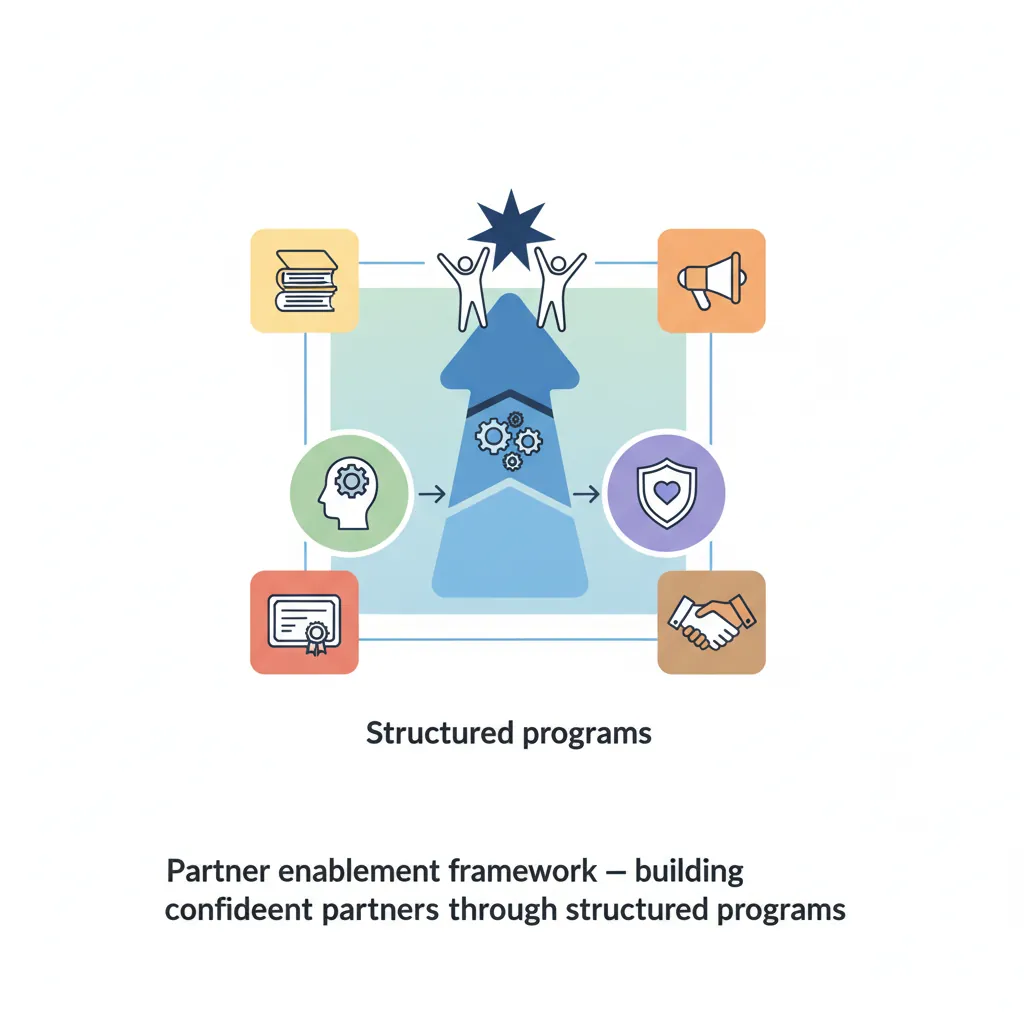
Partners can't sell what they don't understand. Enablement is the number one predictor of channel success. Invest heavily in making partners confident, competent, and self-sufficient.
Figure 4: Partner enablement framework — building confident, competent partners through structured programs
Top margins (+10%), dedicated channel manager, lead sharing
Platinum
10+ certified, $2M+ revenue, joint business plan
Best margins (+15%), exec sponsorship, product roadmap access
Deal Registration
Deal Registration Rules of Engagement: Clear rules prevent channel conflict. Registered deals get 90-day protection, additional margin (5-10%), and priority on RFPs. First-to-register wins, but only if the partner is actively working the deal.
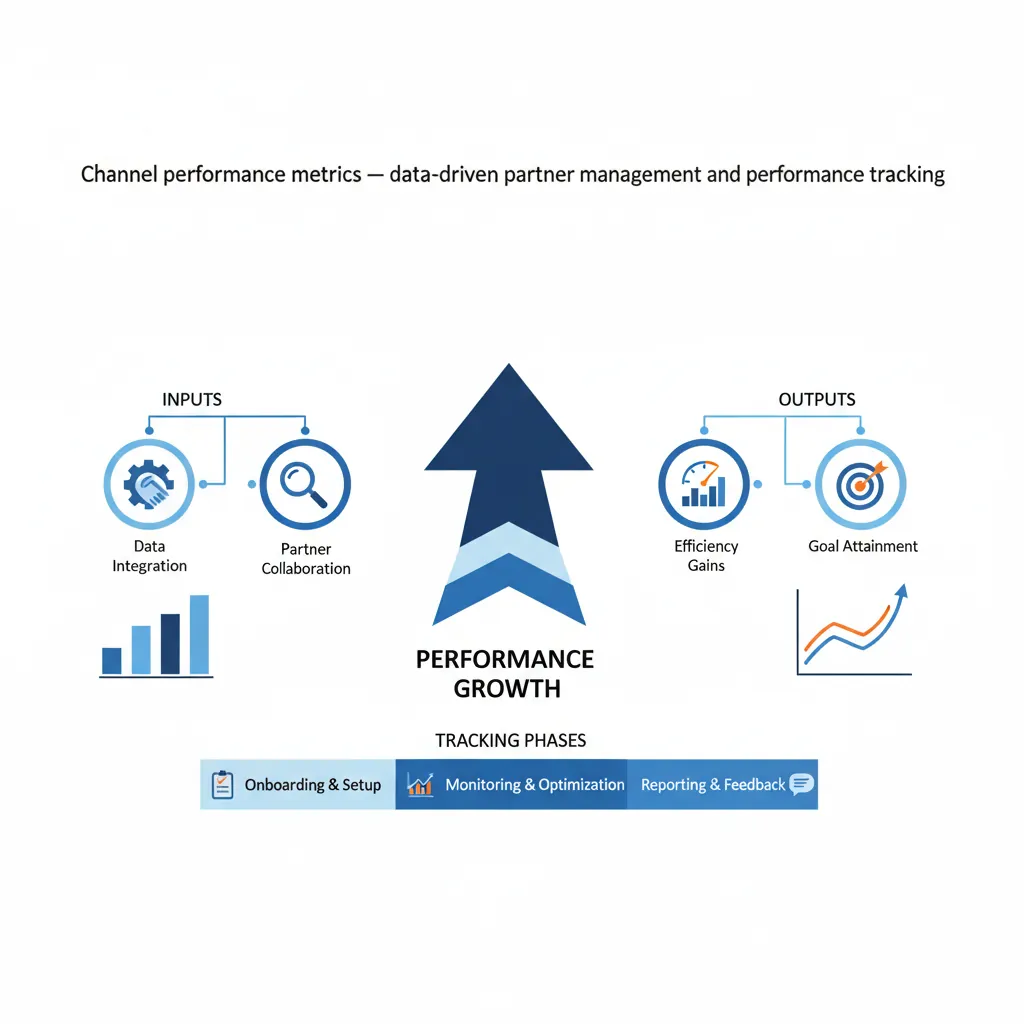
What gets measured gets managed. Track partner performance rigorously and use data to invest in winners, coach middle performers, and exit non-performers.
Global Channel Considerations: Local partners understand culture, regulations, and business practices that direct teams cannot easily learn. In markets like Japan, Korea, and the Middle East, a local partner is often essential—not optional.
Channel Strategy Canvas
Document your channel and partnership strategy:
Channel Strategy Canvas
Build your channel strategy. Download as Word, Excel, PDF, or PowerPoint.
Draft auto-saved
All data stays in your browser. Nothing is sent to or stored on any server.
Exercises
Exercise 145 min
Channel Strategy Design
For your product, evaluate which channel types (VAR, distributor, affiliate, SI, tech partner) would work best for each market segment. Create a coverage model showing which segments are direct-only, channel-assisted, or channel-only. Calculate expected economics for each model.
Exercise 230 min
Partner Scorecard
Design a quarterly partner scorecard with 5-7 metrics across revenue, pipeline, enablement, and customer satisfaction. Weight each metric by importance. Apply it to your top 5 partners and rank them. What actions would you take for each tier?
Exercise 320 min
Conflict Resolution Scenario
Scenario: Your top direct AE is pursuing a $200K deal at a company where a Gold-tier partner has an existing relationship and registered the deal 2 weeks ago. The partner has done limited work on the deal. Design a fair resolution process and write the communication to both parties.
Key Takeaways
Channels multiply reach: 60-80% of top software revenue comes through partners at maturity
Match model to segment: Direct for enterprise, channel for SMB/mid-market, hybrid for volume