We use cookies to enhance your browsing experience, serve personalized content, and analyze our traffic.
By clicking "Accept All", you consent to our use of cookies. See our
Privacy Policy
for more information.
Part 7 of 18: Building on objection handling from Part 6, this article teaches you negotiation tactics and closing frameworks to win deals consistently.
Negotiation isn't about winning—it's about creating agreements that work for both parties. Harvard's Principled Negotiation framework (from "Getting to Yes") focuses on interests over positions, creating value before claiming it, and building relationships that lead to repeat business.
Harvard's Principled Negotiation focuses on interests over positions to create mutual value
Negotiation Mindset: The best negotiators see themselves as problem-solvers, not adversaries. A deal where the other party feels they won is a deal that actually closes.
The Four Principles of Principled Negotiation
Principle
Description
Sales Application
Separate People from Problems
Address emotions and relationships separately from substantive issues
If procurement is aggressive, don't take it personally—address their underlying concerns
Focus on Interests, Not Positions
Understand WHY they want something, not just WHAT they demand
When they demand 20% discount, their interest may be justifying ROI to their boss
Generate Options for Mutual Gain
Brainstorm creative solutions before deciding
Instead of just price cuts, offer phased implementation, extended payment terms, or added services
Insist on Objective Criteria
Use external standards, precedents, or fair procedures
Reference industry benchmarks, published ROI studies, or competitor pricing
BATNA & ZOPA
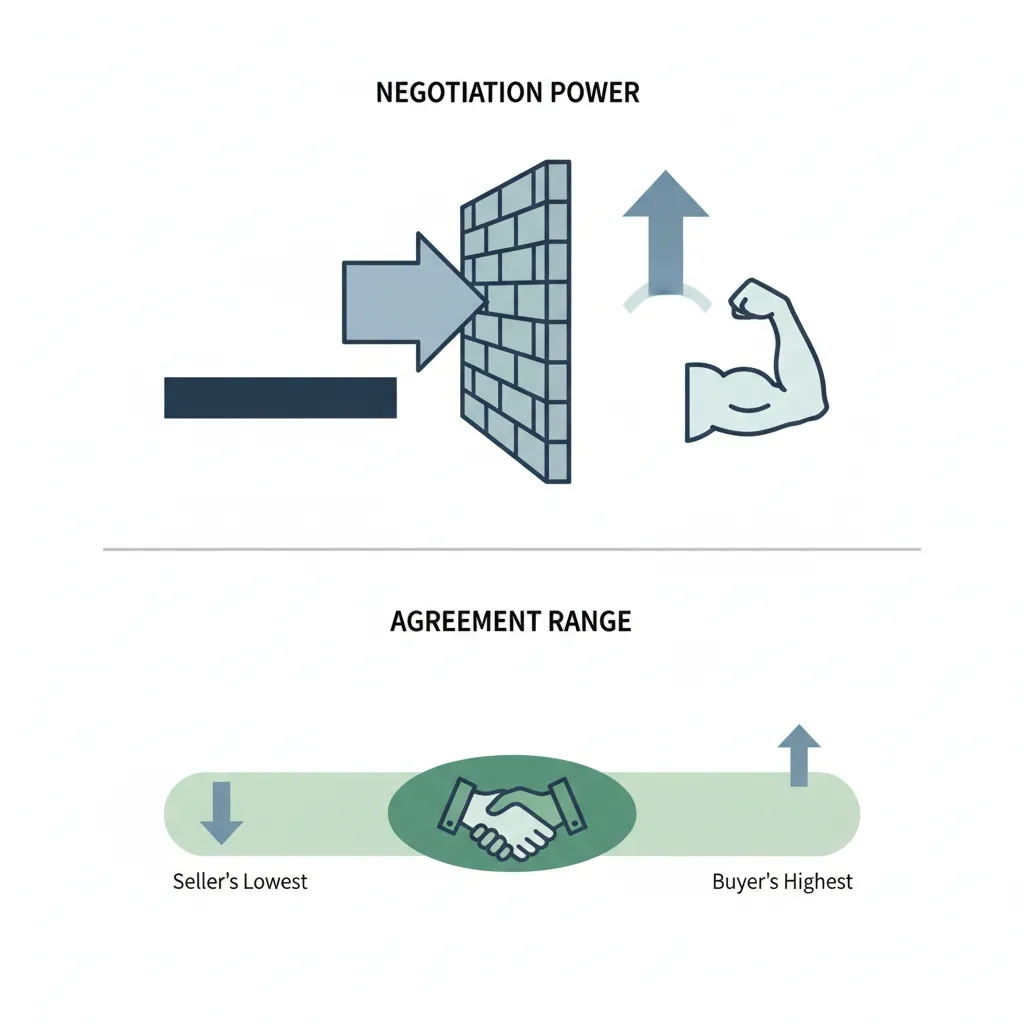
Your BATNA (Best Alternative to Negotiated Agreement) is your power. It's what happens if you walk away. The stronger your BATNA, the more confidently you can negotiate.
BATNA determines negotiation power while ZOPA defines the range where agreement is possible
BATNA & ZOPA Negotiation Range
graph LR
    SB["Seller BATNA\n(Walk Away: $80K)"]
    SA["Seller\nAnchor: $120K"]
    ZOPA["ZOPA\n(Zone of Possible\nAgreement)"]
    BA["Buyer\nAnchor: $70K"]
    BB["Buyer BATNA\n(Walk Away: $100K)"]

    SB ---|"$80K ─── $100K"| ZOPA
    ZOPA ---|"$100K"| BB
    SA -.-> ZOPA
    BA -.-> ZOPA
Understanding BATNA & ZOPA
Negotiation PowerHarvard Framework
BATNA (Best Alternative to Negotiated Agreement)
Your BATNA: What you'll do if this deal doesn't close. Strong BATNAs include:
Pipeline full of similar opportunities at similar or higher values
Another prospect ready to sign at full price
Existing business is profitable—you don't need this deal
Their BATNA: What they'll do without you. Weak BATNAs (favorable to you):
No real alternative exists (you're the only solution)
Switching costs to competitors are high
Time pressure from internal deadlines
ZOPA (Zone of Possible Agreement)
The range between your minimum acceptable price and their maximum willingness to pay. No ZOPA = no deal possible.
Example: Your minimum is $80K. Their maximum is $100K. ZOPA = $80K-$100K. Your goal is to close closer to $100K while making them feel they got a good deal.
Improving Your BATNA Position
Always have pipeline: The worst negotiating position is desperation from an empty pipeline
Research their BATNA: Know their alternatives and their weaknesses
Never reveal a weak BATNA: "We really need this deal" destroys your leverage
Improve during negotiation: Continue prospecting even during active negotiations
Anchoring Techniques
The first number mentioned in a negotiation creates a psychological anchor that influences all subsequent discussions. Strategic anchoring is one of the most powerful negotiation techniques.
Anchoring Research: Studies show that even obviously extreme anchors influence final outcomes. A $1M anchor leads to higher settlements than a $100K anchor, even when the $1M is clearly unreasonable.
Setting Your Anchor
Strategy
When to Use
Example
Anchor High
When you have strong value evidence and they have weak alternatives
Start at premium tier price even if you expect mid-tier close
"Companies similar to yours typically invest $150K-$200K annually"
Consequence Anchor
When cost of inaction is significant
"Your current process costs you $50K/month in inefficiency"
Responding to Their Anchors
Ignore it: "Let me understand your needs better before discussing pricing"
Counter-anchor immediately: Set your own anchor to cancel theirs
Reframe the anchor: "That price point would only cover our basic tier—let me show you what full value looks like"
Question the basis: "Help me understand how you arrived at that number"
Closing Frameworks
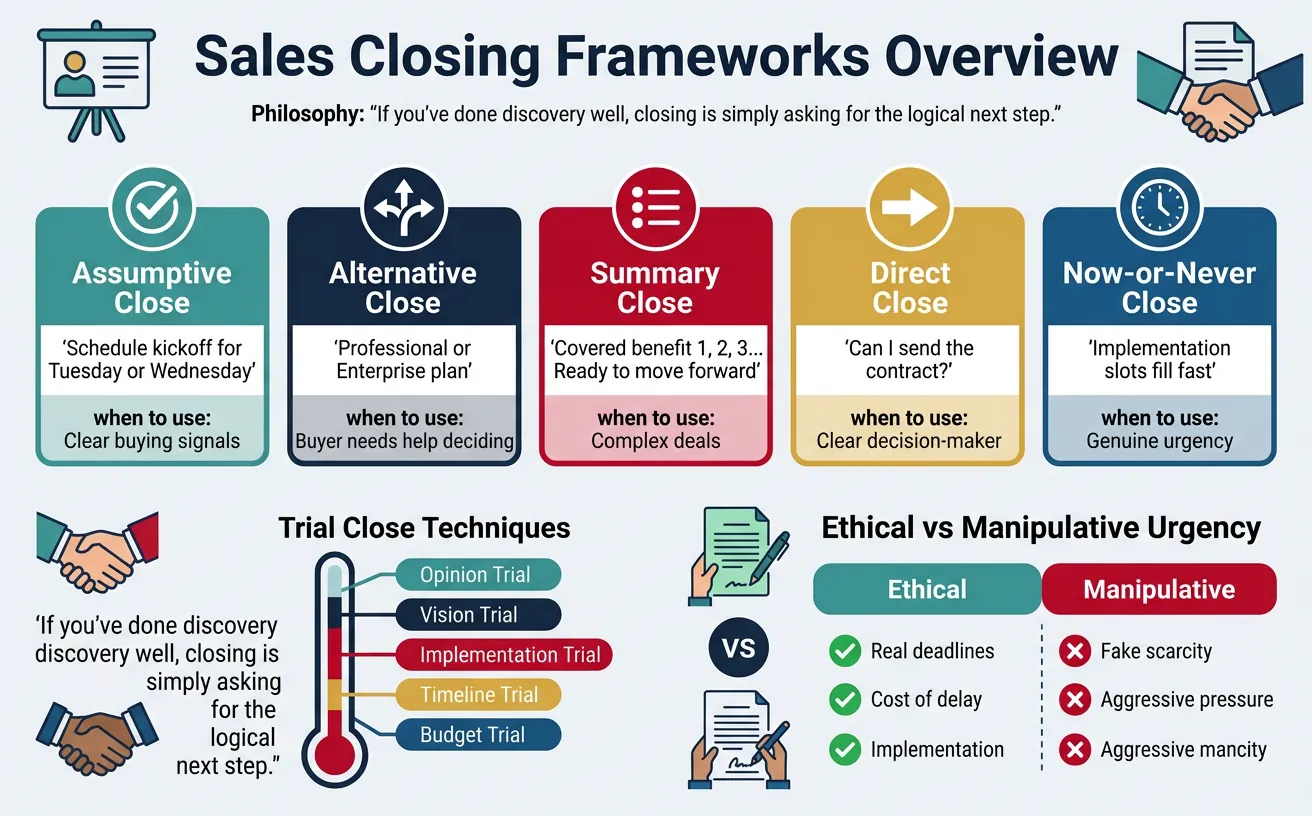
Closing isn't a moment—it's a process that happens throughout the sales conversation. The best closers don't use manipulative tricks; they create clear paths to decision and help buyers take the natural next step.
Effective closing frameworks create clear paths to decision rather than relying on manipulative tactics
Closing Philosophy: If you've done discovery well, handled objections effectively, and demonstrated clear value, closing is simply asking for the logical next step.
The Assumptive Close
Act as though the sale has already been made and discuss implementation details. This works because it helps buyers visualize ownership and shifts mental state from "should I?" to "how will I?"
Close Type
When to Use
Example Script
Assumptive Close
Clear buying signals, all objections addressed
"Should we schedule the kickoff call for next Tuesday or Wednesday?"
Alternative Close
Buyer needs help deciding between options
"Would the Professional or Enterprise plan work better for your team?"
Summary Close
Complex deals with multiple value points
"So we've covered [benefit 1], [benefit 2], and [benefit 3]. Ready to move forward?"
Direct Close
Confident relationship, clear decision-maker
"Based on everything we've discussed, I recommend we start. Can I send the contract?"
Now-or-Never Close
Genuine urgency exists (use ethically)
"Implementation slots for Q1 fill up fast. Should I reserve your spot?"
Trial Close
Trial closes test buying temperature throughout the conversation without the pressure of a final commitment. They reveal objections early and build momentum toward the final close.
Trial Close Techniques
Temperature CheckThroughout Conversation
Types of Trial Closes
Opinion Trial: "How does this solution compare to what you're using now?"
Vision Trial: "Can you see your team using this?"
Implementation Trial: "Who else would need to be involved in rolling this out?"
Timeline Trial: "If we moved forward, when would you want to be live?"
Budget Trial: "Does this investment level fit within your planning?"
Interpreting Responses
Positive signals: Asks implementation questions, discusses team rollout, mentions specific timelines
Neutral signals: Generic responses, "sounds good," no engagement with details
Negative signals: Deflection, vague objections, "we need to think about it"
Creating Urgency Ethically
Real urgency accelerates decisions. Fake urgency damages trust. Focus on genuine business reasons for acting now.
Ethical vs. Manipulative Urgency
Ethical Urgency (Use)
Manipulative Urgency (Avoid)
Real deadline: "Our team is fully booked for Q2—Q1 is the last opening"
Fake scarcity: "This price expires at midnight!" (then same price next day)
Business event: "You mentioned the product launch in March—we need 6 weeks for implementation"
Aggressive pressure: "My manager is making me close this today"
Cost of delay: "Each month of delay costs $15K in inefficiency"
Fear tactics: "If you don't act now, you'll fall behind competitors"
Genuine price change: "Our new pricing goes into effect next month"
Lie about availability: "We only have 3 seats left" (unlimited)
Cost of Delay Framework: Help buyers calculate what waiting actually costs. "You mentioned spending 20 hours/week on manual processes. At $50/hour, that's $4,000/month. Every month we delay is another $4,000 lost."
Contract Negotiation
In enterprise sales, the deal isn't done until the contract is signed. Contract negotiation introduces new stakeholders (legal, procurement) with their own objectives, often different from your champion's goals.
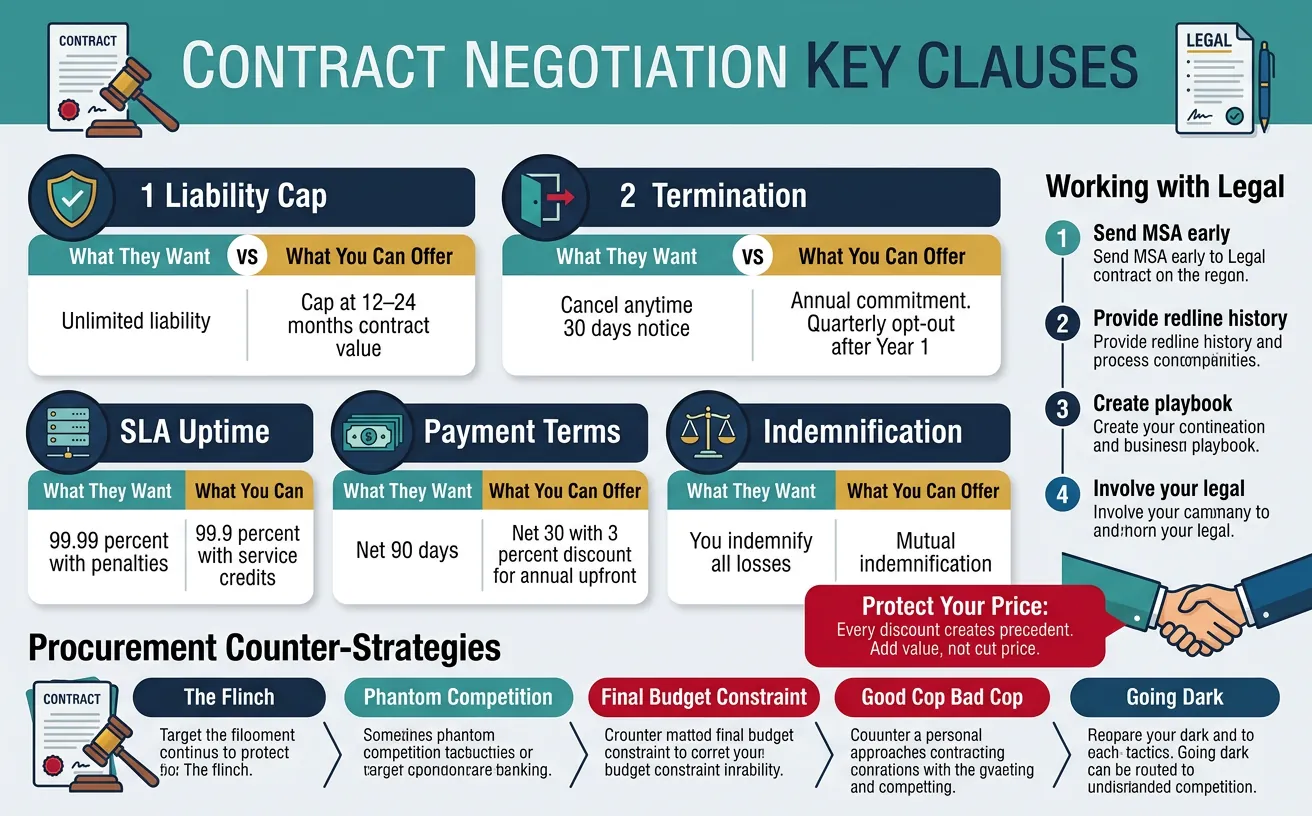
Contract negotiation involves navigating legal and procurement stakeholders across multiple clause types
Contract Reality: Legal and procurement teams are measured on protecting the company and reducing costs—not on helping your deal close. Understand their incentives to navigate effectively.
Common Contract Negotiation Points
Clause Type
What They Want
What You Can Offer
Liability Cap
Unlimited liability for your errors
Cap at 12-24 months of contract value; higher for gross negligence
Termination
Terminate anytime with 30 days notice
Annual commitment with quarterly opt-out after Year 1
SLA/Uptime
99.99% uptime with penalties
99.9% with service credits; exclude scheduled maintenance
Payment Terms
Net 90 days
Net 30 with 3% discount for upfront annual payment
Indemnification
You indemnify against all losses
Mutual indemnification; carve out third-party claims
Legal Navigation
Legal teams slow deals. Your job is to make their review easier while protecting your company's interests.
"That's interesting. What's included in that offer?" Often it's not apples-to-apples.
Final Budget Constraint: "We only have $X budget"
"Let's design a solution that fits $X" (reduce scope, not price per unit)
Good Cop/Bad Cop: Champion wants deal, procurement blocks
Engage your champion: "Can you help procurement understand the business case?"
Going Dark: No response to follow-ups
Use your champion or create a deadline: "Our Q1 capacity is filling up"
Protect Your Price: Every discount creates a precedent. Instead of cutting price, add value: extended support, additional users, training sessions, strategic review calls.
Deal Acceleration
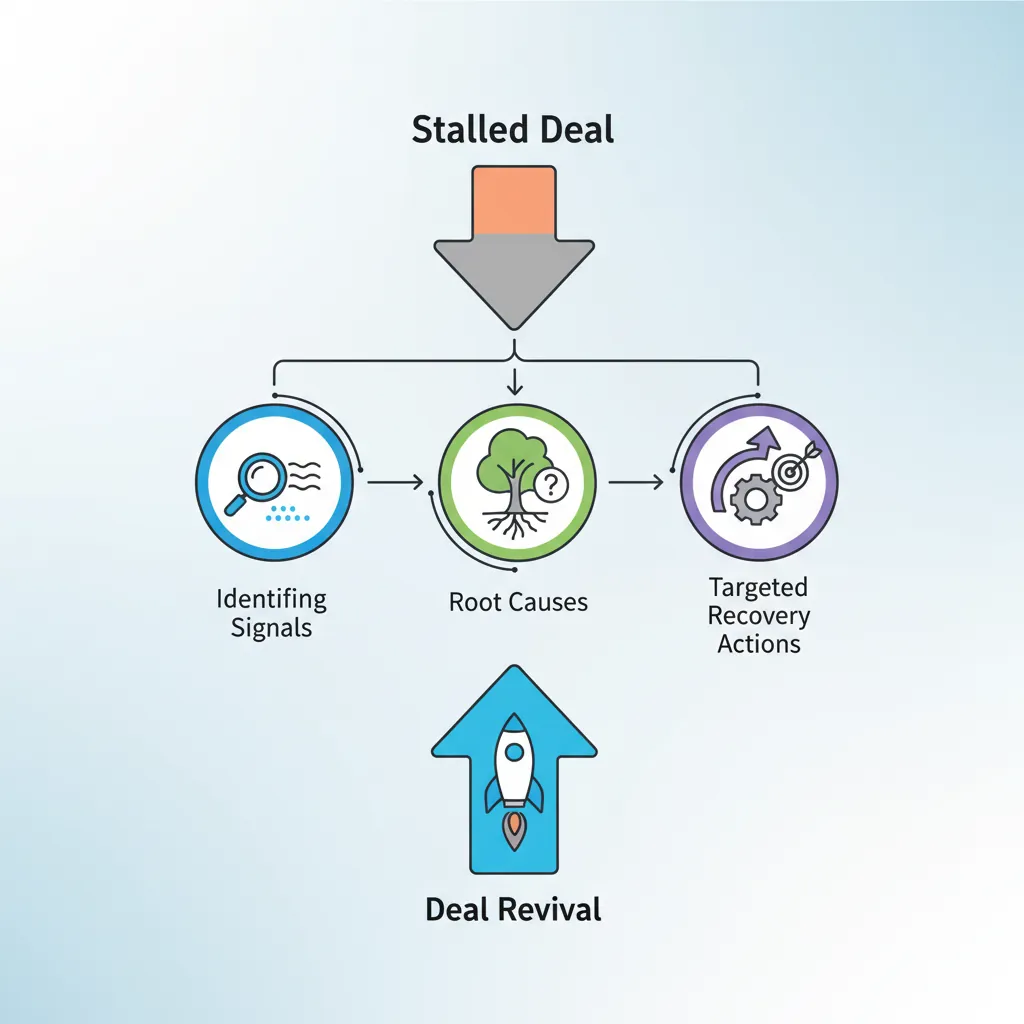
Stalled deals are the biggest pipeline killer. Learning to recognize stall patterns and recover momentum is essential for consistent quota attainment.