We use cookies to enhance your browsing experience, serve personalized content, and analyze our traffic.
By clicking "Accept All", you consent to our use of cookies. See our
Privacy Policy
for more information.
Art of Selling Mastery Part 1: Sales Fundamentals & Psychology
February 12, 2026Wasil Zafar36 min read
Master the foundation of professional selling—value transfer, trust building, buyer psychology, ethical persuasion, and the mindset that separates top performers.
Part 1 of 18: This foundational article establishes the psychology and principles that underpin all sales methodologies covered in subsequent parts—from prospecting to enterprise deals to high-ticket consulting.
Art of Selling Mastery
Your 18-step learning path • Currently on Step 1
1
Sales Fundamentals & Psychology
Value transfer, trust, ethical persuasion, buyer psychology
Before exploring tactics and techniques, we must establish what selling fundamentally is. Strip away the stereotypes, ignore the sleazy car salesman caricatures, and look at the core activity: selling is the facilitation of value transfer through trust.
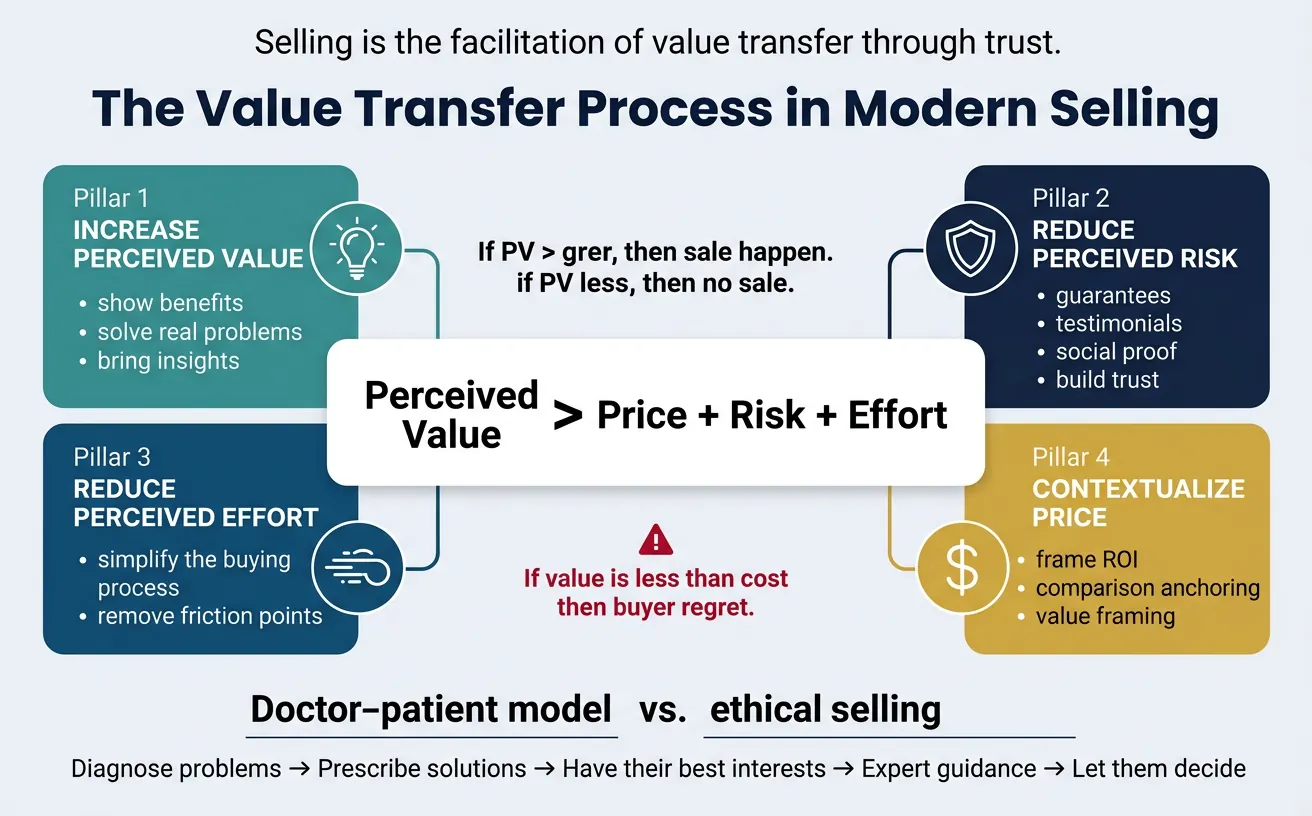
The modern sales process centers on facilitating value transfer through trust
The Value Transfer Equation
Every sale involves an exchange where the buyer perceives they're receiving more value than they're giving up (money, time, commitment). The salesperson's job is to help the buyer see this value clearly—not to create value that doesn't exist.
The Three Components of a Sale
┌─────────────────────────────────────────────────────────────────┐
│                    THE SALES EQUATION                           │
├─────────────────────────────────────────────────────────────────┤
│                                                                 │
│   PERCEIVED VALUE  >  PRICE  +  RISK  +  EFFORT                │
│        (PV)            ($)      (R)       (E)                   │
│                                                                 │
│   If PV > $ + R + E → Sale happens                              │
│   If PV < $ + R + E → No sale (or regret)                       │
│                                                                 │
├─────────────────────────────────────────────────────────────────┤
│   Your Job as a Salesperson:                                    │
│   1. Increase Perceived Value (show benefits, solve problems)   │
│   2. Reduce Perceived Risk (guarantees, testimonials, trust)    │
│   3. Reduce Perceived Effort (simplify process, remove friction)│
│   4. Contextualize Price (ROI, comparison, value framing)       │
└─────────────────────────────────────────────────────────────────┘
Think of a doctor recommending surgery. They're "selling" you on a procedure, but you don't feel manipulated because:
You believe they have your best interests at heart
They have expertise you lack
They explain options and let you decide
Their recommendation matches your situation
This is ethical selling. The best salespeople operate like consultants or doctors—diagnosing problems and prescribing solutions, not pushing products.
Case Study: The Challenger Sale Research
CEB/Gartner Study6,000+ Sales Reps Analyzed
In one of the largest studies of B2B sales effectiveness, researchers identified five distinct sales rep profiles:
The Hard Worker: Always willing to go the extra mile
The Relationship Builder: Focuses on rapport and likeability
The Lone Wolf: Self-confident, follows own instincts
The Problem Solver: Reliable, detail-oriented, responsive
The Challenger: Teaches, tailors, takes control
Finding: While 40% of high performers were Challengers, only 7% were Relationship Builders—despite conventional wisdom that relationships drive sales.
Key Insight: Top performers teach customers something new about their business, not just build relationships. They bring insights, challenge assumptions, and create value through the sales process itself.
Sales vs Marketing: The Symbiotic Relationship
Sales and marketing are often confused or conflated, but understanding their distinct roles is crucial for both personal effectiveness and organizational alignment.
Dimension
Marketing
Sales
Primary Function
Create awareness and generate leads
Convert leads into customers
Communication
One-to-many (broadcasts to segments)
One-to-one (personal conversations)
Timeframe
Long-term brand building
Short-term revenue generation
Metrics
Reach, engagement, MQLs, brand sentiment
Revenue, close rate, deal size, cycle time
Primary Skill
Storytelling, creativity, data analysis
Listening, empathy, negotiation, persistence
Customer Stage
Awareness → Interest → Consideration
Consideration → Intent → Purchase → Loyalty
The Handoff: Where Marketing Ends and Sales Begins
Dr. Robert Cialdini's research, published in Influence: The Psychology of Persuasion, identified six universal principles that drive human decision-making. These aren't manipulation tricks—they're fundamental human tendencies that ethical salespeople work with, not against.
Principle
Psychology
Ethical Application
Manipulative Misuse
Reciprocity
We feel obligated to return favors
Provide genuine value first (insights, advice, resources)
Giving "free" gifts with strings attached
Commitment/Consistency
We want to act consistently with past behavior
Start with small asks that align with customer goals
"Foot in the door" bait-and-switch tactics
Social Proof
We look to others to guide decisions
Share relevant case studies and testimonials
Fake reviews, manufactured popularity
Authority
We defer to experts
Demonstrate genuine expertise and credentials
False credentials, inflated claims
Liking
We buy from people we like
Find genuine common ground, be personable
Fake flattery, insincere interest
Scarcity
We value what's rare or diminishing
Communicate genuine constraints honestly
Fake urgency, artificial scarcity
The Ethics Test
Before using any persuasion technique, ask yourself: "Would I be comfortable if the customer knew exactly what I was doing and why?" If the answer is no, it's manipulation, not persuasion. Ethical influence creates win-win outcomes; manipulation creates temporary wins that destroy long-term relationships.
Applying Cialdini's Principles: A Real Example
Scenario: Selling Enterprise Software
B2B SaaS$50K Deal
Reciprocity: Before the sales call, send a customized industry report showing how companies in their sector are solving the problem you address.
Social Proof: "Three of your competitors—Company A, B, and C—implemented this last quarter. I can share their results anonymized if helpful."
Authority: "Our CTO worked at Google's ML team and designed our core algorithm. Here's a technical whitepaper she authored."
Scarcity: "Our implementation team is booking into Q3. If you want Q2 launch, we'd need to finalize by the 15th." (Only if genuinely true)
Consistency: "You mentioned digital transformation is a 2024 priority. This directly supports that initiative."
Liking: "I noticed you went to Michigan—I grew up in Ann Arbor! Miss Zingerman's deli."
Buyer Psychology
Understanding how buyers think, decide, and act is the foundation of sales effectiveness. This isn't about manipulation—it's about meeting buyers where they are psychologically and helping them make good decisions.
Traditional economics assumed buyers are rational actors who weigh costs and benefits to maximize utility. Behavioral economics—pioneered by Kahneman, Tversky, and Thaler—revealed that human decision-making is far more complex, emotional, and predictably irrational.
System 1 vs System 2 Thinking
Nobel laureate Daniel Kahneman's dual-process theory explains most buyer behavior:
System 1 (Fast)
System 2 (Slow)
Automatic, intuitive
Deliberate, analytical
Effortless, always running
Requires focus, easily fatigued
Emotional, associative
Logical, rule-following
Makes 95% of decisions
Only engaged when necessary
"I like this" / "This feels right"
"Let me calculate the ROI"
Sales Implication
System 1 decides; System 2 justifies. Buyers make emotional decisions and then construct rational explanations. This is why focusing only on features and specs rarely works—you must engage emotions first, then provide logical backup.
The Buying Decision Process
┌─────────────────────────────────────────────────────────────────┐
│              THE BUYER'S PSYCHOLOGICAL JOURNEY                  │
├─────────────────────────────────────────────────────────────────┤
│                                                                 │
│  TRIGGER          STATUS QUO         DECISION          ACTION  │
│   EVENT              BIAS             FRICTION         BARRIER │
│     │                 │                  │                │    │
│     ▼                 ▼                  ▼                ▼    │
│  Problem ──► Resistance ──► Evaluation ──► Commitment ──► Buy  │
│  Awareness   to Change     of Options     to Change           │
│                                                                 │
├─────────────────────────────────────────────────────────────────┤
│  Your role at each stage:                                       │
│                                                                 │
│  TRIGGER: Help them recognize the problem's urgency             │
│  STATUS QUO: Make the cost of inaction visible                  │
│  DECISION: Simplify choices, reduce cognitive load              │
│  ACTION: Remove friction, provide implementation support        │
└─────────────────────────────────────────────────────────────────┘
The 12 Cognitive Biases Every Salesperson Must Know
Cognitive biases are systematic patterns of deviation from rational judgment. They're not flaws—they're mental shortcuts that usually serve us well. Understanding them helps you communicate more effectively and avoid triggering defensive reactions.
Bias #1: Anchoring
PricingNegotiation
Definition: The first number mentioned disproportionately influences all subsequent judgments.
Example: If you show a $10,000 option first, a $5,000 option seems reasonable. If you show $2,000 first, $5,000 seems expensive.
Ethical Application: Present your premium option first (if genuinely available and appropriate) to establish a value anchor. This is why restaurants put expensive items at the top of menus.
Script: "Our enterprise package at $15,000 includes everything including 24/7 support. Most mid-market companies find our professional tier at $8,000 hits the sweet spot."
Bias #2: Loss Aversion
Most PowerfulUrgency
Definition: Losses feel roughly twice as painful as equivalent gains feel pleasurable.
Research: Kahneman and Tversky found that losing $100 creates about the same emotional intensity as gaining $200.
Ethical Application: Frame benefits in terms of what they might lose by not acting, not just what they gain. "You're currently losing $40,000/month in preventable churn" hits harder than "You could gain $40,000/month in retained revenue."
Warning: Overusing fear creates defensive reactions. Balance loss framing with positive possibility.
Bias #3: Social Proof
Trust BuildingCredibility
Definition: When uncertain, we look to similar others to determine correct behavior.
Key Insight: Social proof works best when the "others" are similar to the buyer. A Fortune 500 testimonial doesn't help sell to startups.
Ethical Application: "Companies in your exact situation—mid-market manufacturing with 200-500 employees—typically see 30% improvement in the first quarter."
Tactics: Case studies, customer logos, specific testimonials, industry benchmarks, "customers like you" comparisons.
Bias #4: Status Quo Bias
Sales KillerChange Management
Definition: We disproportionately prefer the current state of affairs, even when change would benefit us.
Reality: Your biggest competitor isn't another vendor—it's "do nothing." Most deals are lost to inaction, not competitors.
How to Overcome:
Make the cost of inaction concrete and visible
Reduce the perceived risk of change (guarantees, pilots, references)
Show a clear implementation path with minimal disruption
Create a compelling "burning platform" (urgent reason to change now)
More Critical Biases: Quick Reference
Bias
Description
Sales Application
Confirmation Bias
We seek information confirming existing beliefs
Discover their beliefs first, then align your pitch
Availability Heuristic
Recent/vivid events seem more likely
Share recent, relevant stories they'll remember
Bandwagon Effect
We follow trends, especially in uncertainty
"70% of companies in your industry adopted this in 2025"
Sunk Cost Fallacy
We continue investments to justify past spending
Acknowledge past investments; show how new solution builds on them
Framing Effect
How you present info changes perception
"95% uptime" vs "5% downtime" (same thing, different feel)
Choice Overload
Too many options cause decision paralysis
Present 3 options maximum; make one the clear recommendation
Peak-End Rule
We judge experiences by peaks and endings
Create memorable high points and strong finishes in meetings
Authority Bias
We defer to perceived experts
Establish your expertise early; cite credible sources
Emotional vs Rational Buying Triggers
The emotional/rational divide isn't either/or—it's a spectrum that shifts based on the purchase type, the buyer's personality, and the organizational context.
Regardless of B2B or B2C, humans are motivated by a consistent set of emotional needs:
Emotional Driver
What It Sounds Like
How to Address
Fear (of loss, failure, embarrassment)
"What if this doesn't work?" "What will my boss think?"
Risk reversal, guarantees, social proof, pilot programs
Greed (desire for more)
"We need to grow faster" "I want to get promoted"
ROI calculations, success stories, aspiration painting
Pride (status, recognition)
"We want to be industry leaders" "I need a win"
Position as competitive advantage, exclusive/premium framing
Guilt (obligation)
"We've been putting this off" "My team deserves better tools"
Make the cost of inaction to others visible
Love (caring for others)
"This will help my family" "My employees will benefit"
Show impact on the people they care about
B2B Buyers Are Still Human
Corporate buyers face professional consequences for decisions. A VP who champions a failed software implementation risks their reputation, bonus, and even job. Understand and address these personal stakes—not just business ROI—to truly connect with B2B buyers.
The Rational Justification Layer
Once emotional interest is established, buyers need rational reasons to justify their decision—to themselves and to others (bosses, procurement, spouses).
Provide ammunition for internal selling:
ROI calculations they can present to finance
Competitive comparisons for procurement
Risk assessments for legal/compliance
Implementation timelines for operations
Success metrics for executives
Trust & Rapport Building
People buy from those they know, like, and trust. While transactional selling can succeed without deep trust (commodity purchases), relationship-based selling—the kind that builds careers—requires genuine connection.
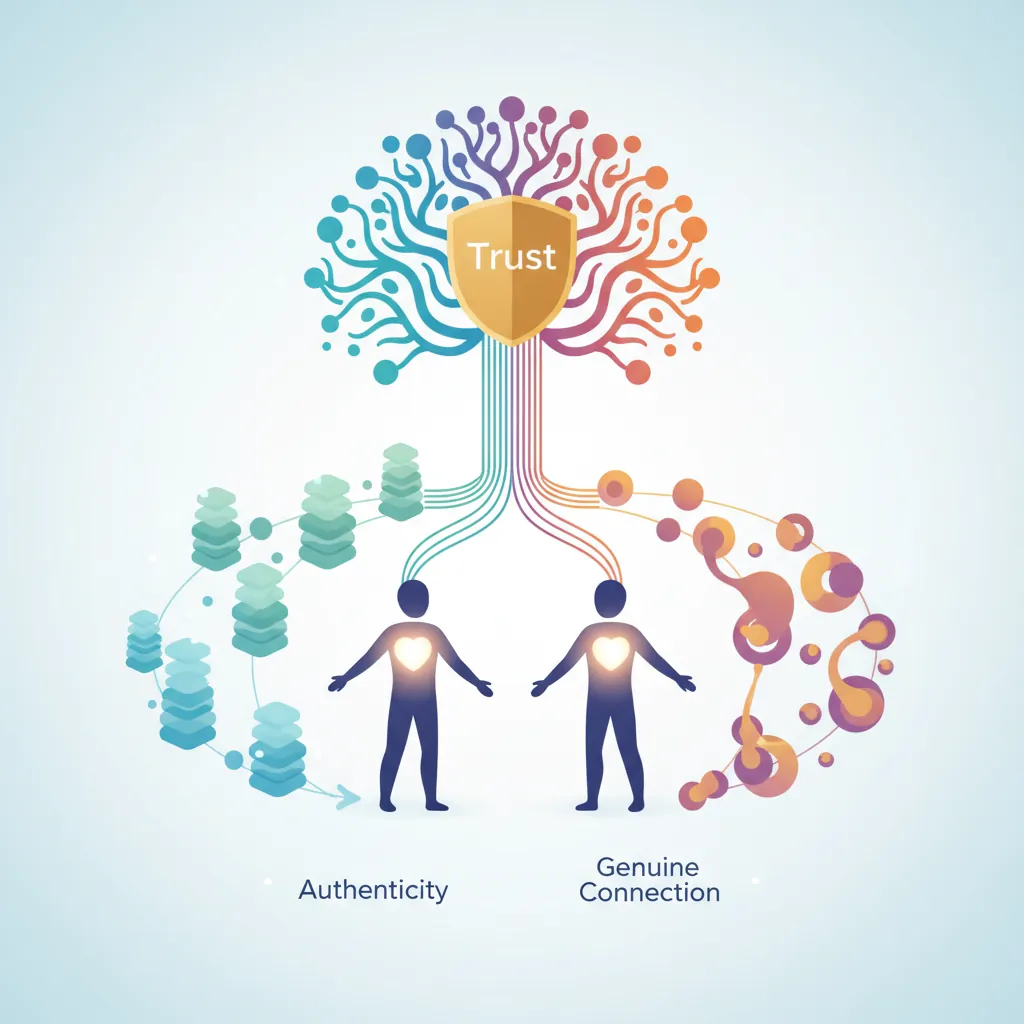
Trust develops through consistent authenticity and genuine connection
The Trust Equation
Charles H. Green, author of The Trusted Advisor, developed a formula that breaks down the components of trust:
                    Credibility + Reliability + Intimacy
          Trust  =  ────────────────────────────────────────
                            Self-Orientation

Where:
• Credibility: Your expertise and credentials
• Reliability: Consistency between words and actions
• Intimacy: Safety people feel sharing information with you
• Self-Orientation: How much you seem focused on yourself vs. them

                              →               →
                          Numerator      Denominator
                          (maximize)     (minimize)
Overstating capabilities; saying "I don't know" too often; poor preparation
Reliability
Do what you say; follow up promptly; underpromise/overdeliver; be consistent
Missed commitments; late responses; inconsistent messaging
Intimacy
Keep confidences; acknowledge emotions; share appropriate vulnerability; active listening
Sharing confidential info; dismissing concerns; being purely transactional
Self-Orientation (↓)
Focus on their needs; admit when you're not the right fit; ask about their success metrics
Talking about yourself; pushing products; ignoring their stated needs
Exercise: Trust Killer Audit
Self-Assessment
Review your last 10 sales conversations. How often did you:
❌ Talk about yourself or your company before asking about their situation?
❌ Push a solution before fully understanding the problem?
❌ Avoid saying "I don't know—let me find out"?
❌ Fail to follow up on a commitment within 24 hours?
❌ Dismiss or minimize a concern they raised?
Each "yes" is a trust leak. Identify your patterns and create specific fixes.
The Science of Rapport
Rapport isn't mystical chemistry—it's a learnable skill based on observable behaviors. The foundations come from psychology research and FBI hostage negotiation techniques (popularized by Chris Voss in Never Split the Difference).
Technique #1: Mirroring
Subtle matching of body language, speech patterns, and emotional tone. This happens naturally when people connect, but can be practiced consciously.
How to Mirror Effectively
Body: Match their posture, energy level, and gestures (subtly, with 2-3 second delay)
Voice: Match pace, volume, and tone (fast talker? Speed up. Quiet? Lower your voice)
Words: Use their vocabulary (they say "team"? Don't say "staff")
Last Three Words: Repeat the last 1-3 words as a question to encourage elaboration
Technique #2: Labeling
Verbally identifying emotions you observe. This validates feelings and creates connection.
Format: "It sounds like..." / "It seems like..." / "It looks like..."

Examples:
• "It sounds like this has been frustrating for a while."
• "It seems like timeline is the biggest concern right now."
• "It looks like you've already tried several solutions without success."

Why it works:
- Shows you're listening and understanding
- Gives them permission to elaborate or correct
- Defuses negative emotions by acknowledging them
- Creates openness for deeper conversation
Technique #3: Active Listening (The 80/20 Rule)
In discovery conversations, top salespeople listen 80% and talk 20%. This requires discipline—our natural instinct is to fill silence and demonstrate expertise.
Passive Listening
Active Listening
Waiting for your turn to talk
Genuinely curious about their answer
Thinking about your next point
Following their train of thought
"Uh-huh" without engagement
Verbal and non-verbal confirmation
Moving to next question immediately
Following up on interesting threads
Taking notes on your pitch
Taking notes on their words (exact phrases)
Authority Without Arrogance
Buyers want to work with experts—but they don't want to be talked down to. The key is demonstrating expertise through questions and insights, not lectures.
The Expert Question Technique
Expert questions simultaneously:
Show you understand their world
Uncover valuable information
Position you as a peer, not a vendor
Weak: "What are your biggest challenges?"
Expert: "We've seen companies in your space struggle with compliance timelines
        since the new regulations dropped in Q2. How has that impacted your team?"

Weak: "What software do you currently use?"
Expert: "Most manufacturing companies your size have either legacy MRP systems
        from the 2010s or have partially migrated to cloud ERP. Where are you
        in that journey?"

Weak: "What's your budget?"
Expert: "Implementations like this typically run $50-150K depending on
        complexity. Has leadership allocated resources at that level?"
Authority Positioning Formula
Briefly establish credibility: "We've worked with 50+ companies in your industry..."
Share a relevant insight: "...and the biggest pattern we see is X."
Ask an expert question: "How does that resonate with what you're experiencing?"
This demonstrates expertise without lecturing and immediately pivots back to them.
Trust Building Scorecard
Evaluate your trust-building effectiveness using the Trust Equation framework. Rate each component for a specific client relationship.
Draft auto-saved
All data stays in your browser. Nothing is sent to or stored on any server.
The Sales Mindset
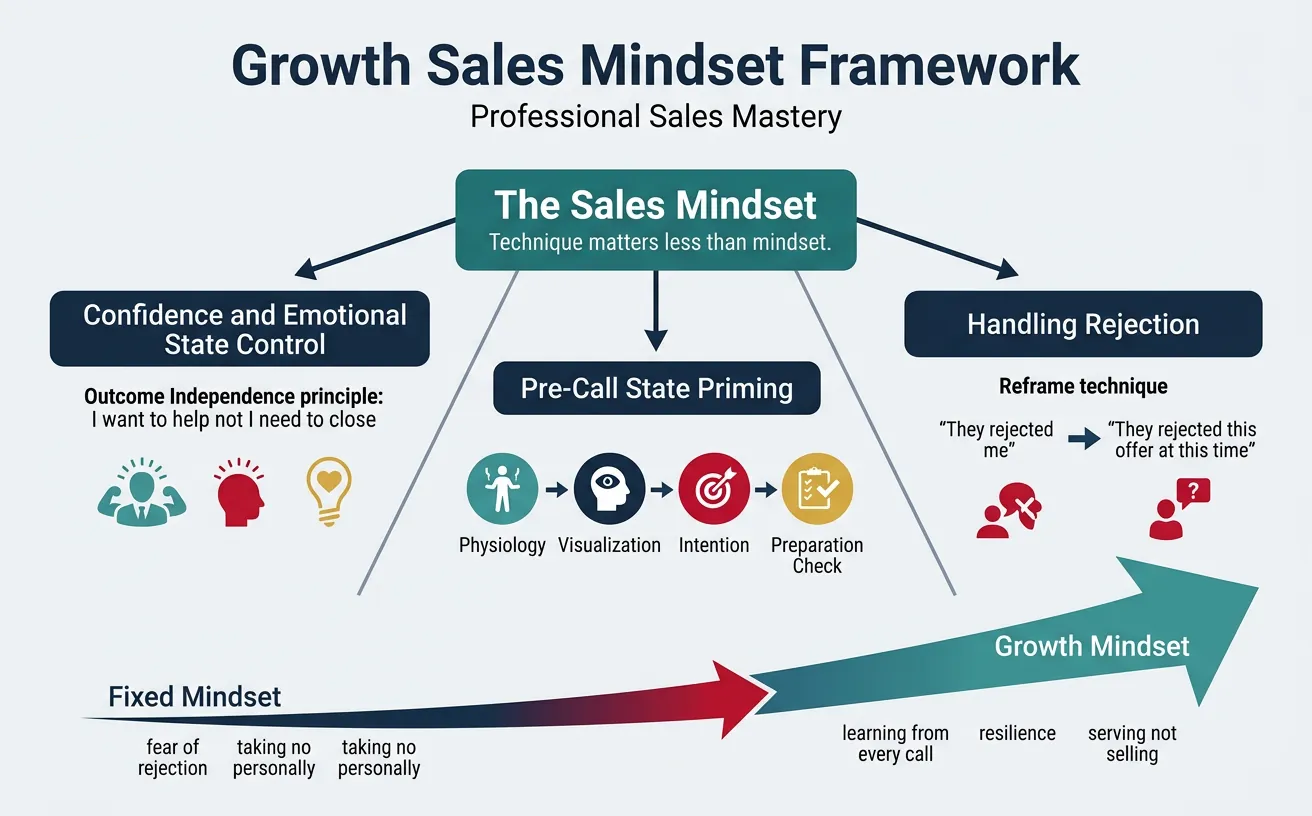
Technique matters less than mindset. The best salespeople share psychological traits that can be developed with deliberate practice.
A growth-oriented sales mindset develops with deliberate practice
Confidence & Emotional State Control
Sales is an emotional rollercoaster. In a single day, you might hear three "no"s, get ghosted by a champion, lose a deal at the finish line, and close a major account. Managing your emotional state is a core competency.
The Outcome Independence Principle
Paradoxically, the more attached you are to closing a specific deal, the less likely you are to close it. Desperation creates pressure that buyers feel and resist.
Outcome Independence
"I want to help this person. If our solution is right for them, great. If not, I'll help them find what is right and move on. My value doesn't depend on this deal."
This isn't apathy—it's confidence. It comes from having a full pipeline and genuine belief that you're offering value, not asking for charity.
Pre-Call Rituals: State Priming
Elite athletes have pre-game routines. Elite salespeople should too.
5-Minute Pre-Call State Prime:

1. PHYSIOLOGY (1 min)
   - Stand or power pose
   - Deep breaths (4-7-8 pattern)
   - Smile (triggers positive neurotransmitters)

2. VISUALIZATION (2 min)
   - Picture the conversation going well
   - Imagine confident body language
   - Visualize them saying "yes"

3. INTENTION (1 min)
   - "My goal is to understand their situation and help"
   - "I'm here to serve, not to sell"
   - "I offer real value; they're lucky to talk to me"

4. PREPARATION CHECK (1 min)
   - Review key research points
   - Have questions ready
   - Know your agenda
Handling Rejection: The Reframe
Limiting Belief
Empowering Reframe
"They rejected me"
"They rejected this offer at this time. It's not personal."
"I'm not good at sales"
"I'm developing sales skills with every conversation."
"That was a waste of time"
"I learned X, Y, Z that I'll apply next time."
"They'll never buy from us"
"Not today—but circumstances change. Stay in touch."
"I'm bothering them"
"I'm offering value. They can say no."
Relationship-Based Selling
Transactional selling treats each deal as isolated. Relationship selling plays the infinite game—building connections that compound over time.
Year 2: 7.6 retained + 2 referrals + $24K upsell = starts at $120K base
Year 5: Relationship seller is at 3x the transactional seller's revenue—with less effort.
Principles of Long-Term Sales Success
What separates salespeople who sustain excellence for decades from those who burn out or plateau?
The 7 Principles of Sales Longevity
Ruthless Prioritization
Time is your only truly limited resource. Top performers spend 80% of their time on the 20% of activities that generate results—and guard their time ferociously.
Continuous Learning
Markets shift, buyer expectations evolve, new tools emerge. The best salespeople read, take courses, get coached, and experiment constantly.
Genuine Curiosity
Curiosity about buyers, industries, problems, and solutions creates energy that's contagious. Bored salespeople bore their buyers.
Resilience Routines
Exercise, sleep, relationships outside work, hobbies—these aren't optional luxuries. They're the foundation that enables sustained high performance.
Playing for the Long Game
Every interaction is a deposit or withdrawal from your reputation bank. The deals you walk away from build more trust than the deals you close.
Systematization
Processes and templates free up mental energy for high-value activities. Don't reinvent the wheel for every email, call, or proposal.
Contribution Mindset
Top sellers ask "How can I help?" more than "How can I sell?" The paradox: focusing on contribution produces more sales than focusing on sales.
The Ultimate Test
Would your customers enthusiastically recommend you—not just your product—to their peers? If yes, you've mastered relationship selling. If not, there's work to do.
Sales Psychology Self-Assessment
Evaluate your sales mindset and identify areas for growth. Rate yourself honestly on each dimension.
Draft auto-saved
All data stays in your browser. Nothing is sent to or stored on any server.
Essential Sales Rules & Principles
Beyond frameworks and psychology, experienced salespeople rely on time-tested rules and principles that provide quick mental shortcuts for everyday selling situations. These rules are easy to remember, simple to apply, and remarkably effective when practised consistently.
The 5 P's of Sales
The 5 P's form the foundation of any sales strategy. Originally rooted in marketing mix theory, the modern sales version emphasises People as the decisive fifth element that transforms the traditional 4 P's into a complete selling framework.
P
Definition
Sales Application
Key Question
Product
What you're selling—features, benefits, outcomes
Know your product deeply enough to map features to buyer-specific outcomes
"What problem does this solve for this buyer?"
Price
What the buyer pays—money, time, switching cost
Position price relative to the cost of inaction, not just competitor pricing
"What is the cost of not solving this problem?"
Place
Where and how the buyer can purchase
Make purchasing frictionless—remove barriers in contracting, onboarding, and delivery
"How easy is it for the buyer to say yes?"
Promotion
How you communicate value
Tailor your messaging to the buyer's role, pain, and language—not generic pitches
"Am I speaking their language or mine?"
People
Everyone involved—buyer, champion, decision-maker, you
Map the entire buying committee and build multi-threaded relationships
"Who else needs to be convinced?"
Beginner Tip: Before any sales conversation, run through the 5 P's mentally. "Do I understand their problem (Product fit)? Can I justify the investment (Price)? Is the buying process clear (Place)? Am I speaking their language (Promotion)? Do I know everyone involved (People)?" If you can't answer all five, you're not ready for the meeting.
The 6 C's of Sales
The 6 C's describe the core personal qualities and behaviours that distinguish top performers from average salespeople. Think of them as the character traits you need to cultivate.
C
What It Means
How to Develop It
Confidence
Belief in yourself, your product, and the value you deliver
Preparation, product mastery, and tracking your wins
Credibility
Being seen as a trusted authority by your buyers
Share case studies, industry knowledge, and data-backed insights
Contact
Consistent, persistent outreach without being pushy
Follow structured cadences with value in every touchpoint
Communication
Saying the right thing, at the right time, in the right way
Active listening (80/20 rule), mirroring, and labelling emotions
Customisation
Tailoring your approach to each buyer's unique situation
Pre-call research, persona-based messaging, and industry context
Collaboration
Working with the buyer, not at them
Co-create solutions, share mutual action plans, and align on outcomes
The Pillars of Sales
While rules and mnemonics provide quick guidance, the pillars of sales represent the structural foundations that support every other technique. Remove any pillar and your selling approach becomes unstable.
Prospecting
Consistently filling the top of your pipeline with qualified potential buyers. Without prospecting, everything else grinds to a halt—no matter how good your closing skills are.
Key metric: Number of qualified conversations started per week
Discovery
Asking the right questions to deeply understand the buyer's pain, goals, timeline, and decision process. Poor discovery leads to misaligned proposals and wasted effort.
Key metric: Ratio of questions asked vs. statements made
Presentation
Articulating your value proposition in terms that resonate with the specific buyer's needs—not a generic pitch deck, but a tailored business case.
Key metric: Buyer engagement during presentation (questions asked, follow-up requested)
Closing
Guiding the buyer to a decision—whether that's a "yes" or a clear "no." The best closers don't use tricks; they summarise value and remove remaining obstacles.
Key metric: Win rate and average deal cycle length
Follow-Up
Post-sale relationship management that drives renewals, upsells, and referrals. The sale doesn't end at the signature—it's the beginning of the relationship.
Key metric: Net Revenue Retention (NRR) and referral rate
Self-Improvement
Continuously developing skills, studying buyers, and refining your approach. Markets evolve, buyer expectations shift, and yesterday's top performer can become today's average one.
Key metric: Hours invested in learning per month
The 70/30 Rule
One of the simplest yet most powerful rules in sales: listen 70% of the time, talk 30%. This ratio is the hallmark of consultative selling and directly correlates with higher win rates.
Why Most Salespeople Fail at 70/30: Studies by Gong.io analysing over 25,000 sales calls found that top performers maintain a ~54:46 listen-to-talk ratio on discovery calls, while average reps talk 65-75% of the time. The natural instinct is to "pitch" and demonstrate expertise—but buyers feel unheard, and deals stall.
Applying the 70/30 Rule in Practice
Ask open-ended questions: "Tell me about..." and "Walk me through..." prompts generate longer, information-rich answers
Pause after questions: Count to 3 in your head before speaking. Silence is uncomfortable but creates space for deeper answers
Summarise and confirm: "So what I'm hearing is..." uses their words to show you listened and lets them correct misunderstandings
Take notes on their exact phrases: Using the buyer's own language in proposals and follow-ups massively increases relevance
Resist the urge to solve immediately: When you hear a pain point, ask "Tell me more about that" instead of jumping to your solution
The 80/20 Rule (Pareto Principle)
The Pareto Principle states that roughly 80% of results come from 20% of efforts. In sales, this pattern appears everywhere and should deeply influence how you prioritise your time and energy.
80/20 Application
What It Means
Action Step
Revenue
~20% of your accounts generate ~80% of your revenue
Identify and protect your top accounts with strategic account plans
Pipeline
~20% of your deals will close—the rest will fall out
Qualify ruthlessly and invest time in deals with strong buying signals
Activities
~20% of your daily activities produce ~80% of your results
Time-block your highest-impact activities (discovery calls, proposals) and batch admin work
Objections
~20% of objection types account for ~80% of pushback
Master the top 5 objections cold and you'll handle most resistance
Content
~20% of your sales materials drive ~80% of prospect engagement
Identify your top-performing case studies and reuse them relentlessly
Weekly Exercise: Every Friday, list your week's activities. Circle the 3–4 that actually moved deals forward. Next week, do more of those and less of everything else. Over time, this compounds into dramatically higher productivity.
The KISS Rule
Keep It Simple, Salesperson. The KISS principle reminds you that complexity kills deals. The simpler your message, your proposal, and your buying process, the more likely the buyer is to move forward.
KISS in Action: Where Complexity Hides
CommunicationProcess
Area
Complex (Bad)
KISS (Good)
Email
500-word email covering 6 topics
3 sentences, 1 clear question
Proposal
40-page document with jargon
1-page executive summary + appendix
Pricing
Custom quote with 12 line items
3 clear tiers: Good / Better / Best
Pitch
45-minute product demo of all features
15-minute demo of 3 features that solve their problem
Next Steps
"Let me know what you think"
"I'll send the contract Tuesday—does 3 PM work to review together?"
SimplicityClarityFriction Removal
The 7 Habits of Highly Effective Salespeople
Inspired by Stephen Covey's The 7 Habits of Highly Effective People, these habits are adapted specifically for sales professionals. They move from dependency ("the market is bad") to independence ("I control my outcomes") to interdependence ("we win together").
Be Proactive
Don't wait for leads to come to you. Proactive salespeople generate their own pipeline through outreach, networking, and referral asks—regardless of market conditions.
Begin with the End in Mind
Before every call, define your desired outcome. "After this meeting, I want the buyer to agree to a technical evaluation with their IT team by next Friday." Clear outcomes prevent aimless conversations.
Put First Things First
Revenue-generating activities (discovery calls, proposals, follow-ups) come before admin tasks. Use time-blocking to protect your selling hours from internal meetings and email.
Think Win-Win
Sustainable sales careers are built on mutual value. If a deal isn't right for the buyer, say so. The trust you build today becomes revenue tomorrow—through referrals, reputation, and repeat business.
Seek First to Understand, Then to Be Understood
This is the 70/30 rule in action. Listen deeply, understand the buyer's world, and only then present your solution. Premature pitching is the #1 sales mistake.
Synergise
Collaborate with marketing, customer success, product, and your sales team. Multi-threaded deals involving solution architects, executives, and customer references close at 2-3x the rate of solo efforts.
Sharpen the Saw
Invest in yourself daily. Read industry publications, practise objection handling, review call recordings, and seek coaching. The best salespeople never stop developing their craft.
Self-Check: Rate yourself 1–10 on each habit weekly. Focus improvement efforts on your lowest score. Improvement in your weakest habit typically produces the largest overall performance gain.
PACT in Sales
PACT stands for Purpose, Agenda, Commitment, Timeline—a framework for structuring every sales interaction so it ends with clear forward momentum rather than vague "let's circle back" promises.
Element
What You Say
Why It Matters
Purpose
"The purpose of today's call is to understand if there's a fit between your workflow challenges and our solution."
Sets expectations and signals professionalism—buyers appreciate clarity
Agenda
"I'll ask a few questions, share a quick demo, and if there's a fit we'll discuss next steps. Sound good?"
Gives the buyer a roadmap—reduces anxiety and increases engagement
Commitment
"If what you see aligns with your needs, would you be open to a follow-up with your team next week?"
Pre-closes for the next step before the meeting—dramatically increases conversion to next stage
Timeline
"When would you ideally want this implemented? That helps me tailor the timeline to your schedule."
Pro Tip: Use PACT at the start of every meeting. It takes 60 seconds but transforms unstructured conversations into focused, outcome-oriented selling. Buyers respect salespeople who value their time.
Exercises & Applications
Knowledge without application fades quickly. Use these exercises to internalize the concepts covered in this article.
Exercise 1: Bias Identification Audit
30 minutesSelf-Analysis
Objective: Identify which cognitive biases are most present in your recent sales conversations.
Instructions:
Review your last 5 sales conversations (calls, emails, meetings)
For each conversation, identify which biases you observed in the buyer
Note which biases you may have triggered unintentionally
Write down one way you could have used each bias ethically
Deliverable: A one-page analysis of your bias patterns and 3 specific improvements for your next conversations.
Exercise 2: Mirroring Practice Session
15 minutesPartner Required
Objective: Practice the mirroring technique in a low-stakes environment.
Instructions:
Find a partner (colleague, friend, family member)
Have them describe a recent frustrating experience for 3 minutes
Objective: Practice framing your offering in terms of buyer value, not features.
Instructions:
Write down 5 features of your product/service
For each feature, answer: "So what? Why does the buyer care?"
Keep asking "so what?" until you reach an emotional benefit (fear avoided, goal achieved, status gained)
Craft a one-sentence value statement for each
Example:
Feature: "24/7 support"
So what?: "Issues get resolved anytime"
So what?: "Business never stops"
So what?: "You look reliable to your customers"
Value statement: "Never worry about downtime embarrassing you in front of your biggest clients."
Key Takeaways
Part 1 Core Concepts
Selling = Value Transfer + Trust. When buyers perceive more value than cost (money + risk + effort), sales happen naturally.
System 1 Decides, System 2 Justifies. Engage emotions first, then provide rational backup for the decision.
Ethical Persuasion vs Manipulation. If you wouldn't be comfortable with the buyer knowing your technique, don't use it.
The Trust Equation. Trust = (Credibility + Reliability + Intimacy) / Self-Orientation. Minimize the denominator.
Top Competitors: Inaction > Other Vendors. Most deals are lost to "do nothing," not to alternatives.
Loss Aversion > Gain Seeking. Frame benefits in terms of what they'll lose by not acting—2x more powerful than gains.
Relationship Selling Compounds. Referrals, upsells, and lower churn create a flywheel that outperforms transaction focus over time.
Outcome Independence Creates Confidence. The less attached you are to any single deal, the more likely you are to close it.
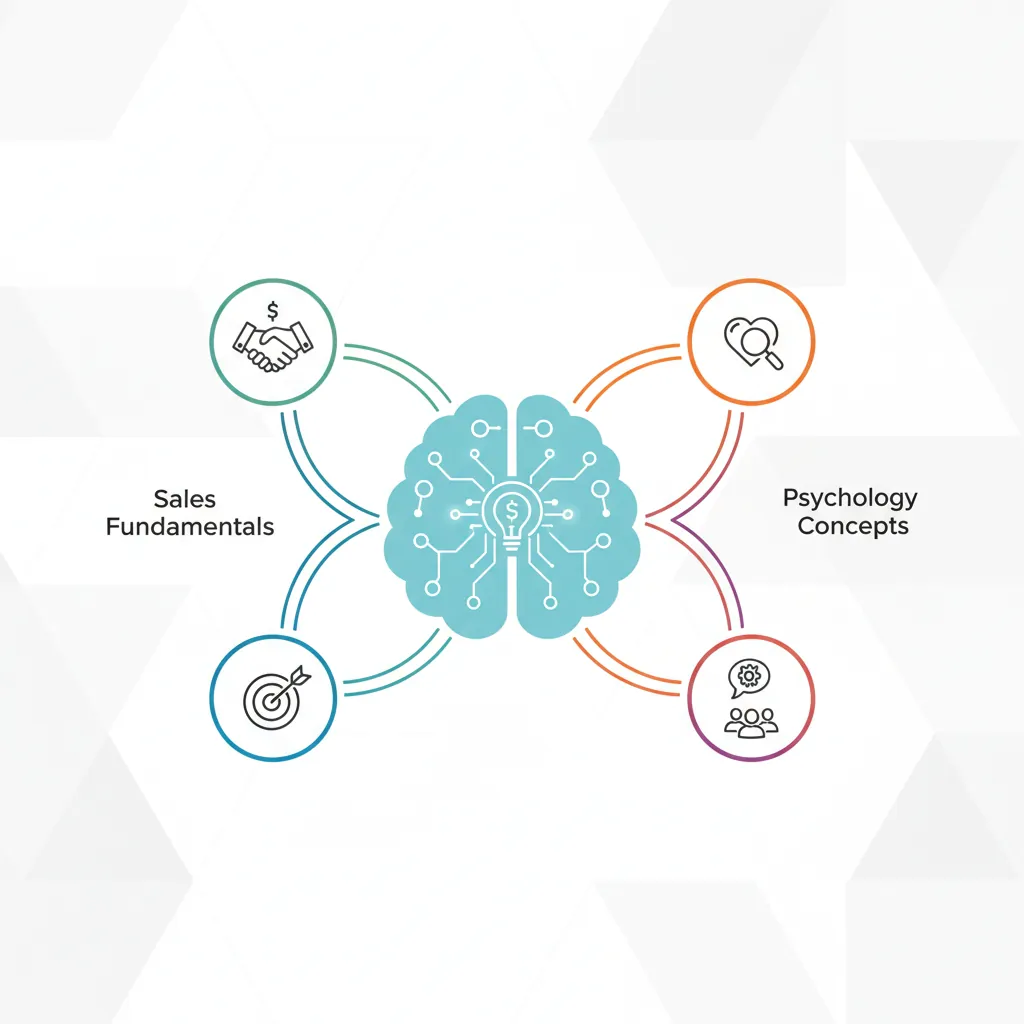
Key concepts bridging sales fundamentals with psychology
Recommended Reading
Influence: The Psychology of Persuasion by Robert Cialdini — The foundational text on ethical influence
Never Split the Difference by Chris Voss — FBI negotiation techniques adapted for business
The Challenger Sale by Matthew Dixon & Brent Adamson — Data-driven sales methodology
Thinking, Fast and Slow by Daniel Kahneman — Deep dive into System 1/System 2 thinking
The Trusted Advisor by David Maister et al. — The Trust Equation and relationship building
Continue the Series
Part 2: Prospecting & Lead Generation
ICP development, cold outreach, social selling, and pipeline creation.