We use cookies to enhance your browsing experience, serve personalized content, and analyze our traffic.
By clicking "Accept All", you consent to our use of cookies. See our
Privacy Policy
for more information.
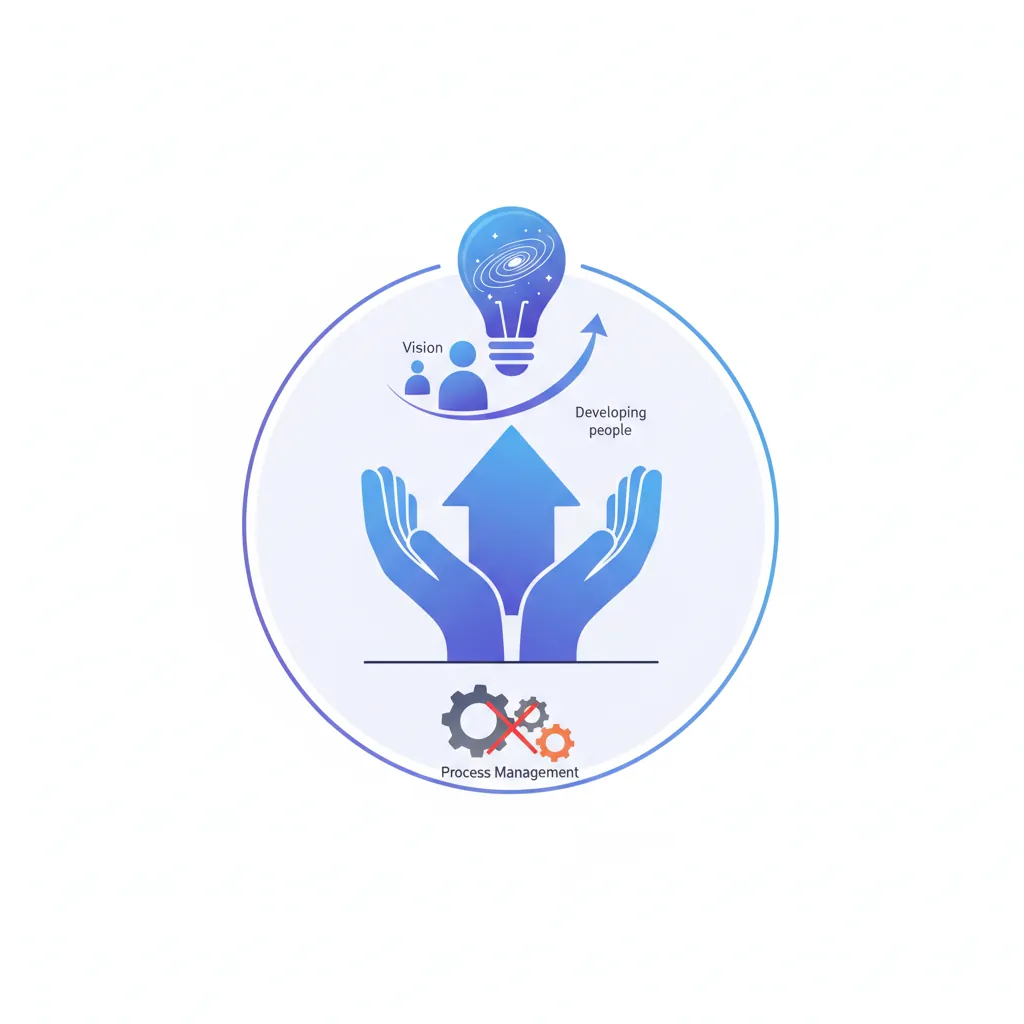
Sales management focuses on process, metrics, and accountability. Sales leadership creates vision, develops people, and builds culture. The best sales leaders do both—but those who only manage rarely build great teams.
Figure 1: Sales leadership framework — creating vision and developing people beyond process management
Dimension
Sales Manager
Sales Leader
Focus
Hitting numbers this quarter
Building a team that consistently hits numbers
Method
Process compliance, deal reviews
Vision, coaching, development
Meetings
"Where are we on pipeline?"
"What's blocking you and how can I help?"
Reaction to Misses
More reporting, more tracking
Root cause analysis, skill development
Talent Strategy
Replace underperformers
Develop B-players into A-players
Sales Culture
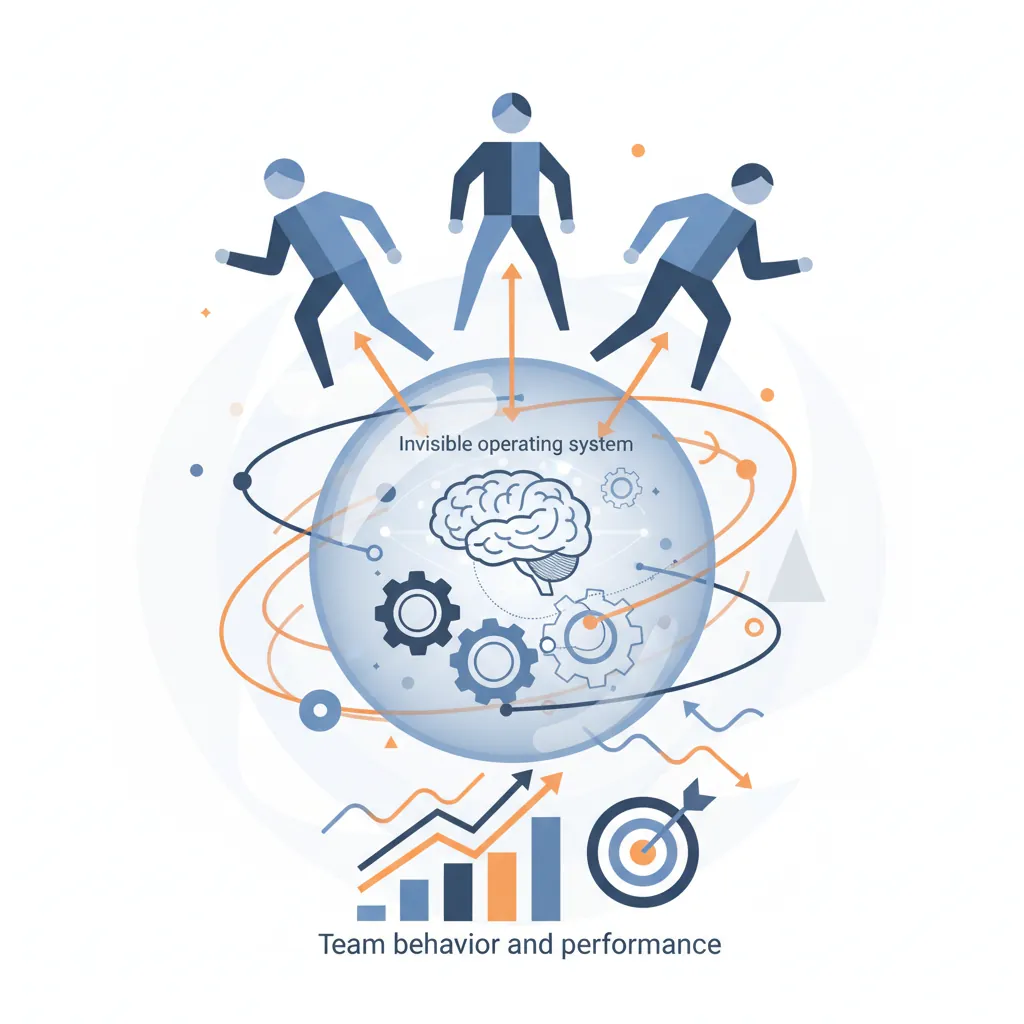
Culture is the invisible operating system of your sales team. It determines how reps behave when no one is watching.
Figure 2: Sales team culture — the invisible operating system driving team behavior and performance
Elements of High-Performance Sales Culture
Element
What It Looks Like
Warning Signs of Dysfunction
Accountability
Reps own their numbers and commitments
Excuse-making, blame-shifting
Transparency
Open pipeline reviews, honest forecasts
Sandbagging, hidden deals, inflated pipelines
Collaboration
Reps share wins, strategies, and learnings
Hoarding knowledge, internal competition
Growth Mindset
Failures are learning opportunities
Fear of failure, risk avoidance
Customer-Centricity
Solving customer problems drives behavior
Pressure to close regardless of fit
Culture Is Set by What Leaders Tolerate
If a top performer cuts ethical corners and leadership looks away, that becomes the culture. Culture is defined not by what you say, but by what behavior you allow.
Vision Alignment
Great sales leaders connect daily activities to a larger purpose. Reps who understand why outperform those who only know what.
Vision Cascade Framework
Company Mission: Why the company exists and the problem it solves
Sales Team Vision: What world-class looks like for your team specifically
Quarterly Objectives: Concrete milestones that advance the vision
Individual Goals: Each rep's contribution tied to team objectives
Daily Activities: Specific behaviors that drive individual goals
Hiring & Onboarding
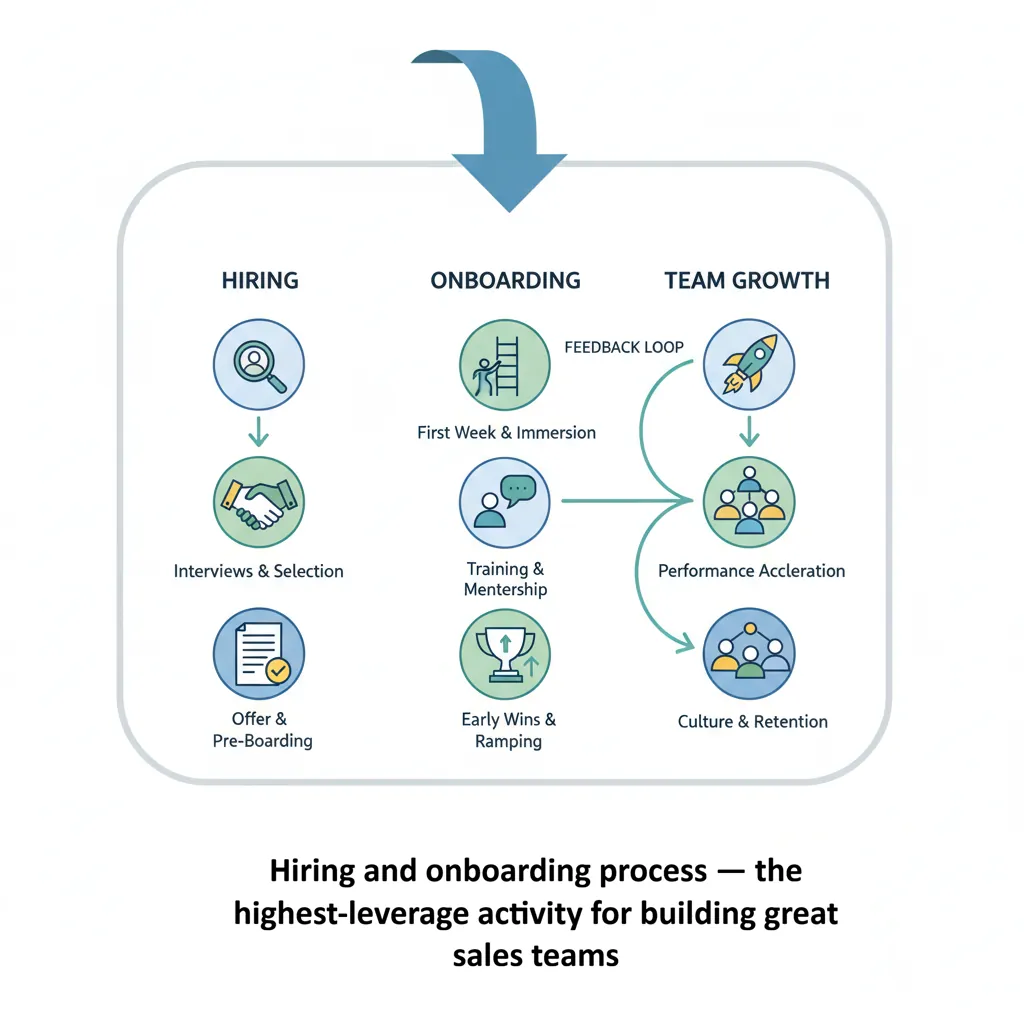
Your team is only as good as the people on it. Hiring is the highest-leverage activity a sales leader performs—one great hire can transform a team, one bad hire can poison it.
Figure 3: Hiring and onboarding process — the highest-leverage activity for building great sales teams
What to Hire For
Trait
Why It Matters
How to Assess
Coachability
Skills can be taught; attitude can't
Give feedback in the interview—watch response
Curiosity
Drives discovery and problem-solving
Quality of questions asked during interview
Resilience
Sales involves constant rejection
Stories of overcoming adversity
Work Ethic
Activity drives results
Track record, examples of going above and beyond
Intelligence
Complex deals require sharp thinking
Live problem-solving exercise
The Cost of a Bad Hire
A bad sales hire costs 6-10 months of salary when you factor in recruiting, training, ramp time, lost deals, and team morale impact. Hire slow, fire fast.
Interview Process
Structured interviews predict success far better than unstructured conversations. Use a consistent process for every candidate.
Most sales reps don't fail because they lack talent—they fail because they were poorly onboarded. A structured ramp plan sets new hires up for success.
30-60-90 Day Onboarding Plan
Phase
Focus
Key Activities
Success Metrics
Days 1-30 Learn
Product, market, process
Product training, shadow calls, CRM setup, ICP study
Pass product certification, complete CRM training
Days 31-60 Practice
Apply skills with support
Co-sell with buddy, own discovery calls, build pipeline
5+ discovery calls, pipeline creation started
Days 61-90 Perform
Independent execution
Full cycle ownership, first closes, quota ramp begins
First deal closed, 50%+ ramp quota
Buddy System
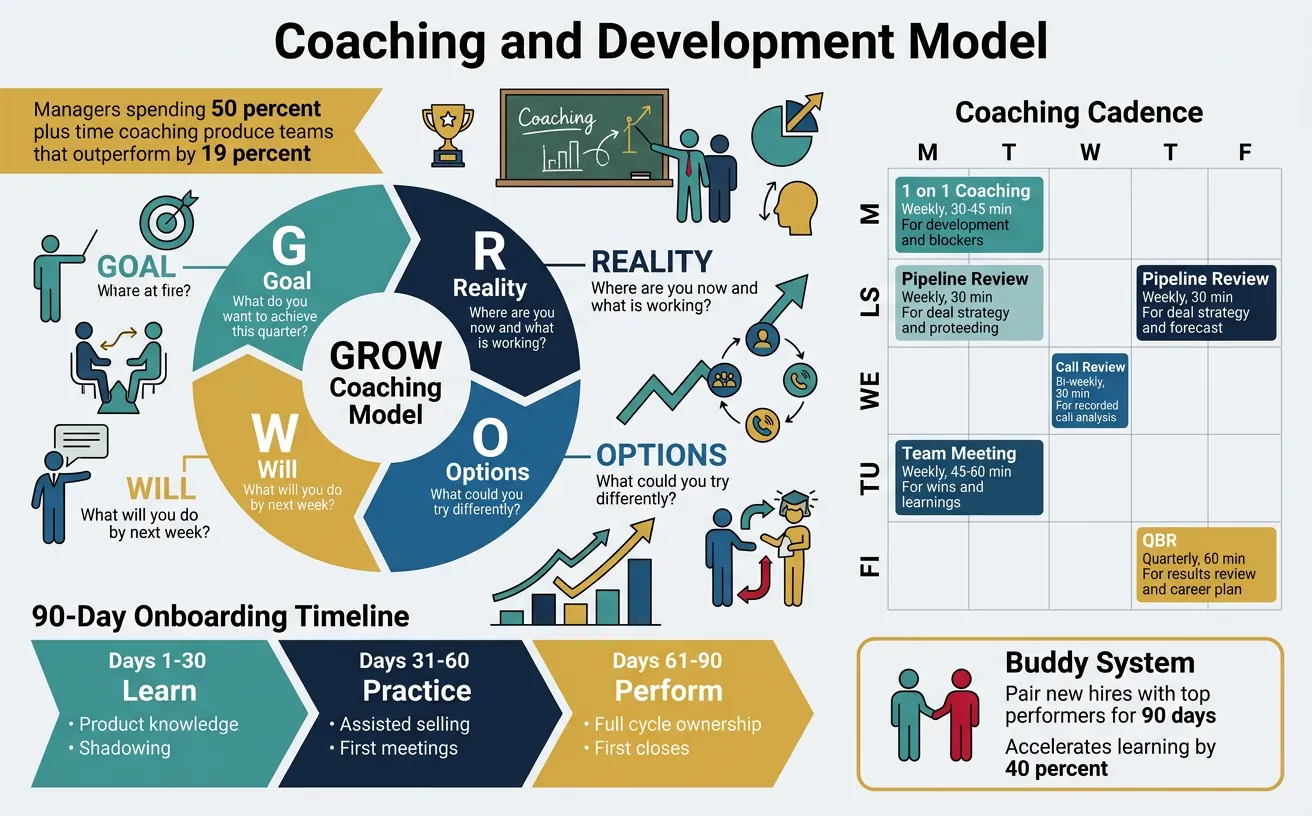
Pair every new hire with a top-performing peer for 90 days. Buddies accelerate learning by 40% vs. manager-only onboarding. Choose buddies who are patient teachers, not just top closers.
Coaching & Development
Coaching is the single highest-impact activity a sales leader can perform. Research shows that managers who spend 50%+ of their time coaching produce teams that outperform by 19% on average.
Figure 4: Coaching and development model — the single highest-impact activity for sales leadership
The GROW Coaching Model
Step
Purpose
Example Questions
G — Goal
Define the desired outcome
"What do you want to achieve this quarter?"
R — Reality
Assess current situation honestly
"Where are you now? What's working? What isn't?"
O — Options
Brainstorm possible approaches
"What could you try differently? What else?"
W — Will
Commit to specific actions
"What will you do by next week? How committed are you?"
Coaching Cadence
Meeting
Frequency
Duration
Focus
1:1 Coaching
Weekly
30-45 min
Development, blockers, career growth
Pipeline Review
Weekly
30 min
Deal strategy, next steps, forecast
Call Review
Bi-weekly
30 min
Recorded call analysis, skill feedback
Team Meeting
Weekly
45-60 min
Wins, learnings, strategies, announcements
QBR
Quarterly
60 min
Results review, goal setting, career plan
Deal Coaching
Deal coaching helps reps strategize on specific opportunities. The goal is to ask questions that help the rep think more deeply—not to take over the deal.
Deal Coaching Questions
Area
Coaching Questions
Champion
Who is your champion? How do you know? What happens if they leave?
Decision Process
Walk me through how they'll make this decision. Who has veto power?
Competition
Who else are they evaluating? What's their differentiation?
Timeline
Why must they make a decision by that date? What happens if they don't?
Risk
What's the biggest risk to this deal? What's your plan to mitigate it?
Coaching Anti-Patterns
Telling, not asking: "Here's what you should do" vs. "What options do you see?"
Swooping in: Taking over calls instead of coaching prep and debrief
Only coaching deals: Ignoring skill development and career growth
Coaching everyone the same: A-players need different coaching than B-players
Skill Development
Continuous development keeps your team sharp. Build a culture of learning where improvement is constant.
Development Methods
Method
Best For
Frequency
Role Playing
Objection handling, discovery, negotiation
Weekly in team meetings
Call Recording Review
Self-awareness, specific technique improvement
Bi-weekly with manager
Peer Shadowing
Learning from top performers
Monthly ride-alongs
External Training
New frameworks, industry knowledge
Quarterly workshops
Book/Content Club
Mindset, strategy, industry awareness
Monthly discussions
Scaling Performance
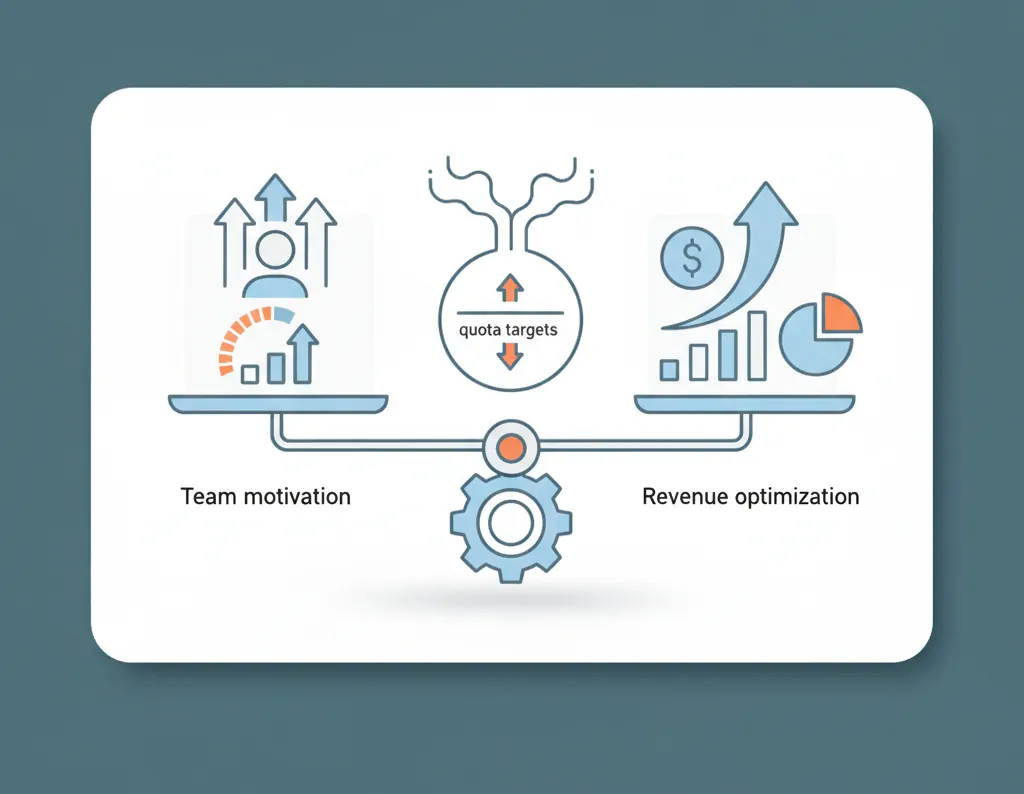
Quota setting is both art and science. Set quotas too high and you demoralize the team; set them too low and you leave money on the table.
Figure 5: Performance scaling strategy — balancing quota targets for team motivation and revenue optimization
Quota Setting Approaches
Approach
Method
Best When
Top-Down
Revenue target ÷ number of reps
First year, limited data
Bottom-Up
Territory potential × expected capture rate
Mature teams with territory data
Historical
Prior year + growth rate
Stable markets with consistent growth
Hybrid
Top-down target allocated by territory potential
Most common enterprise approach
The 60-70% Rule
A well-set quota means 60-70% of reps hit 100%+. If <50% hit quota, it's too high (or you have a hiring/enablement problem). If >80% hit, it's too low and you're leaving growth on the table.
Compensation Plans
Compensation drives behavior. Design your plan to reward the behaviors and outcomes you want.
Compensation Design Principles
Component
Purpose
Typical Range
Base / Variable Split
Balance between security and motivation
50/50 (hunters) to 70/30 (farmers)
Accelerators
Reward exceeding quota
1.5-3x rate above 100% attainment
Decelerators
Reduce payout below threshold
0.5x rate below 50% attainment
SPIFs
Short-term behavior incentives
$500-$5,000 per behavior/milestone
Multi-Year Component
Retention and long-term thinking
Equity, deferred comp, President's Club
Team Scaling
Scaling a sales team requires systematic thinking. What works with 5 reps breaks with 50.
Scaling Stages
Stage
Team Size
Key Challenges
Required Actions
Founder-Led
1-3 reps
No playbook, founder sells best
Document what works, codify process
First Manager
4-8 reps
Founder can't manage everyone
Hire player-coach manager, build playbook
Specialization
9-20 reps
Generalists can't scale
SDR/AE/CS split, segment by market
Multi-Team
21-50 reps
Consistency across teams
Director layer, enablement function, RevOps
Enterprise
50+ reps
Culture preservation, regional differences
VP+ leadership, formal training, career paths
Sales Leadership Canvas
Document your leadership approach, team structure, and development plan:
Sales Leadership Canvas
Map your leadership strategy. Download as Word, Excel, PDF, or PowerPoint.
Draft auto-saved
All data stays in your browser. Nothing is sent to or stored on any server.
Exercises
Exercise 140 min
Culture Audit
Assess your current team culture against the 5 elements: accountability, transparency, collaboration, growth mindset, and customer-centricity. Rate each 1-5 and identify 2 specific actions to improve the lowest-rated element.
Exercise 230 min
Coaching Skills Practice
Run a 15-minute GROW coaching session with a peer. Record it and review: How many questions vs. statements did you make? Did you let them arrive at their own solutions? Aim for 80%+ questions.
Exercise 345 min
Compensation Plan Design
Design a compensation plan for a team of 10 AEs selling $50K average deals. Define: base/variable split, quota, accelerators/decelerators, and one SPIF for the quarter. Calculate total cost at 100% attainment.
Key Takeaways
Lead, don't just manage: Vision and development outperform process and reporting alone
Culture is set by what you tolerate: Not by what you say in all-hands meetings
Hire for traits, train for skills: Coachability, curiosity, and resilience are non-negotiable
Structured interviews predict success: Role plays and case studies beat unstructured conversations
30-60-90 onboarding: Learn → Practice → Perform with clear milestones at each stage
GROW coaching model: Goal → Reality → Options → Will for every coaching conversation
Coaching > telling: Ask questions that help reps think—don't solve problems for them
60-70% quota attainment rule: If fewer than 60% hit, quotas are wrong or enablement is broken