We use cookies to enhance your browsing experience, serve personalized content, and analyze our traffic.
By clicking "Accept All", you consent to our use of cookies. See our
Privacy Policy
for more information.
Part 3 of 21: Building on the psychological principles from Part 2, this article explores how to create and position brands that resonate deeply with your target audience—transforming marketing from transactional to relational.
A brand is not a logo. A brand is not a color palette. A brand is a promise made and a promise kept. It's the sum of every interaction, perception, and emotion a customer associates with your organization. Jeff Bezos put it simply: "Your brand is what people say about you when you're not in the room."
Think of a brand like a person's reputation. You can influence it through consistent actions, but you can't dictate it. Every email, support ticket, packaging choice, and social post either reinforces or undermines that reputation.
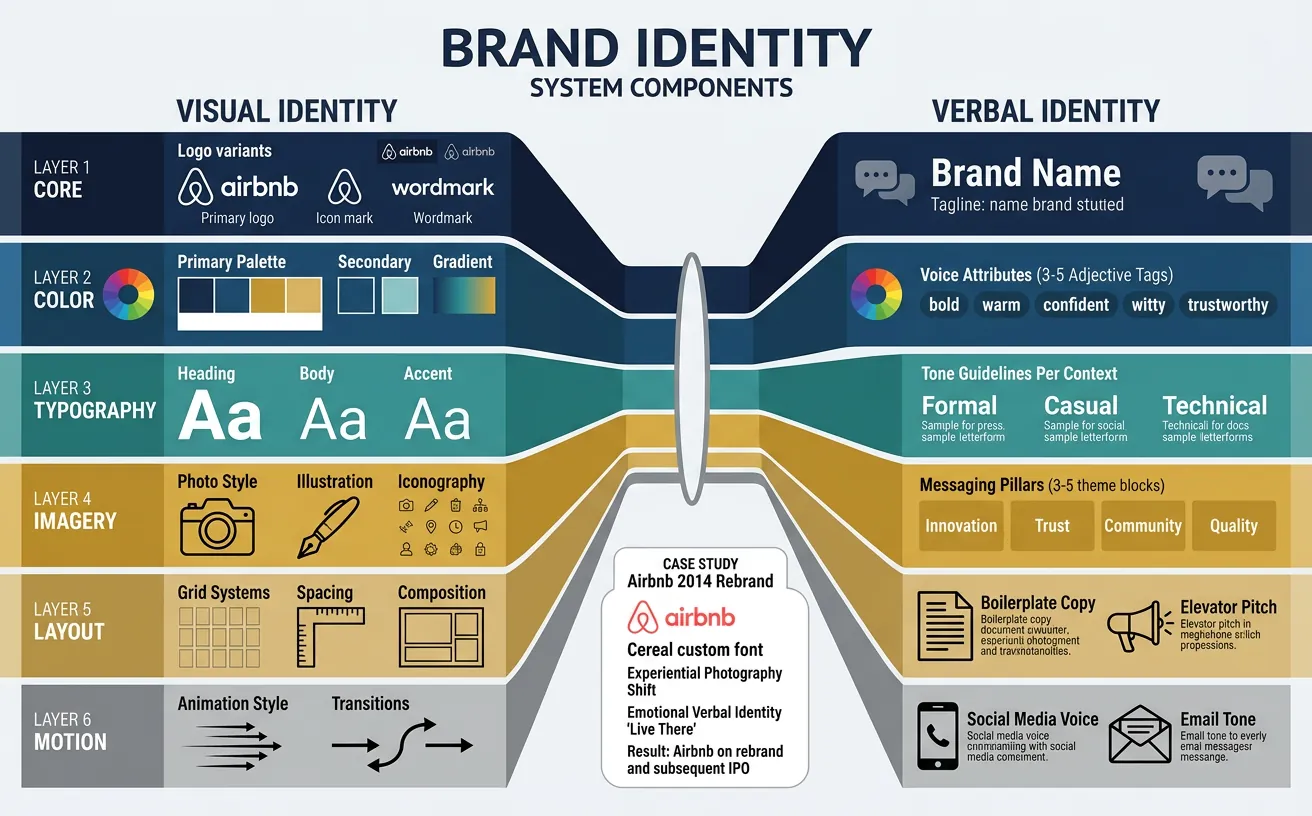
A brand identity system encompasses both visual and verbal elements that make your brand recognizable across every touchpoint
Brand Identity Systems
A brand identity system is the visual and verbal toolkit that makes your brand recognizable and consistent across every touchpoint. It contains two interlocking systems:
Layer
Visual Identity
Verbal Identity
Core
Logo (primary, icon, wordmark)
Brand name, tagline
Color
Primary palette, secondary, gradients
Voice attributes (3-5 adjectives)
Typography
Heading, body, accent fonts
Tone guidelines per context
Imagery
Photo style, illustration, iconography
Messaging pillars (3-5 themes)
Layout
Grid systems, spacing, composition
Boilerplate copy, elevator pitch
Motion
Animation style, transitions
Social media voice, email tone
Case Study: Airbnb's 2014 Rebrand
Brand Identity$31B → $75B+ Value Impact
In 2014, Airbnb transformed from a "cheap alternative to hotels" into a "belonging anywhere" brand through a comprehensive identity overhaul:
Bélo symbol: A universal mark representing people, places, love, and Airbnb simultaneously
Custom typography (Cereal): A warm, rounded font reflecting approachability
Photography shift: From property photos to experiential, human-centered imagery
Verbal identity: From transactional language ("Book a room") to emotional ("Live there")
Result: The rebrand unified a fragmented brand, enabled the expansion from rooms to Experiences and beyond, and played a role in Airbnb's eventual $75B+ IPO valuation.
Brand Equity Models
Brand equity is the commercial value derived from customer perception of a brand name, beyond the objective value of the product itself. Two foundational models help measure and build it:
Keller's Brand Equity Pyramid (CBBE Model):
Build brand equity from the bottom up, layer by layer:
Identity (Who are you?): Deep, broad brand awareness — customers can recall and recognize you
Meaning (What are you?): Performance (functional benefits) + Imagery (psychological benefits)
Resonance (What about you and me?): Deep loyalty, community, active engagement — the pinnacle of brand equity
Aaker's Five Dimensions of Brand Equity:
Dimension
What It Measures
Example
Brand Awareness
Recognition and recall depth
Google = search (category ownership)
Brand Associations
Mental links to the brand
Volvo = safety, Red Bull = energy
Perceived Quality
Customer quality assessment vs competitors
Apple = premium quality perception
Brand Loyalty
Repeat purchase and advocacy likelihood
Harley-Davidson tattoo club (ultimate loyalty)
Proprietary Assets
Patents, trademarks, channel relationships
Coca-Cola's bottle shape trademark
Brand Architecture
Architecture Models
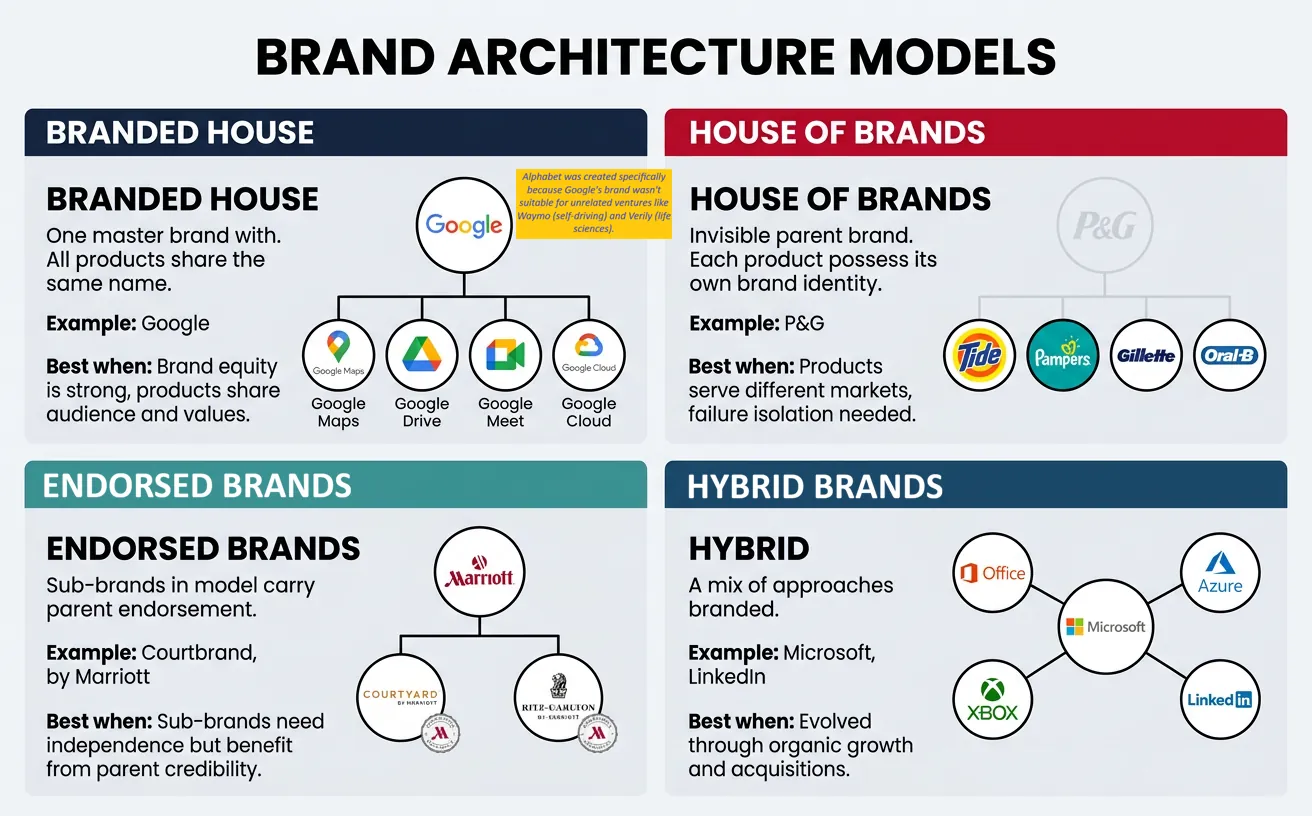
Brand architecture defines how brands within a company relate to each other. Think of it as the family tree of your brand portfolio. There are four primary models:
Four primary brand architecture models — from Google branded house to P and G house of brands
Model
Structure
Example
Best When
Branded House
One master brand, all products share the name
Google (Maps, Drive, Meet, Cloud)
Brand equity is strong; products share audience and values
House of Brands
Parent company invisible; each product has own brand
P&G (Tide, Pampers, Gillette, Oral-B)
Products serve different markets; failure isolation needed
Endorsed Brands
Sub-brands carry parent endorsement
Marriott (Courtyard by Marriott, Ritz-Carlton by Marriott)
Sub-brands need independence but benefit from parent credibility
Hybrid
Mix of above based on context
Microsoft (Office, Azure, Xbox, LinkedIn)
Company has evolved through both organic growth and acquisitions
The Architecture Decision: Choosing the right model is one of the most consequential strategic decisions a company makes. Get it wrong, and you waste marketing spend, confuse customers, and limit growth. Alphabet was created specifically because Google's brand wasn't suitable for unrelated ventures like Waymo (self-driving) and Verily (life sciences).
Portfolio Strategy
Managing a brand portfolio is like managing an investment portfolio — each brand should have a strategic role and contribute to the overall company value:
Flagship Brand: The premium, aspirational brand that sets quality perception for the portfolio (e.g., iPhone for Apple)
Cash Cow Brand: Established brands generating reliable revenue with minimal investment (e.g., Cheerios for General Mills)
Fighter/Flanker Brand: Lower-priced brand to protect market share from competitors (e.g., Celeron protects Intel from AMD at the low end)
Growth Brand: Newer brand targeting emerging segments or trends (e.g., YouTube for Google in video)
Harvest Brand: Declining brand that's milked for remaining profits before retirement (e.g., BlackBerry handsets post-iPhone era)
Sub-brands & Extensions
Brand extension leverages existing brand equity to enter new categories. The key question: does the parent brand's promise transfer credibly?
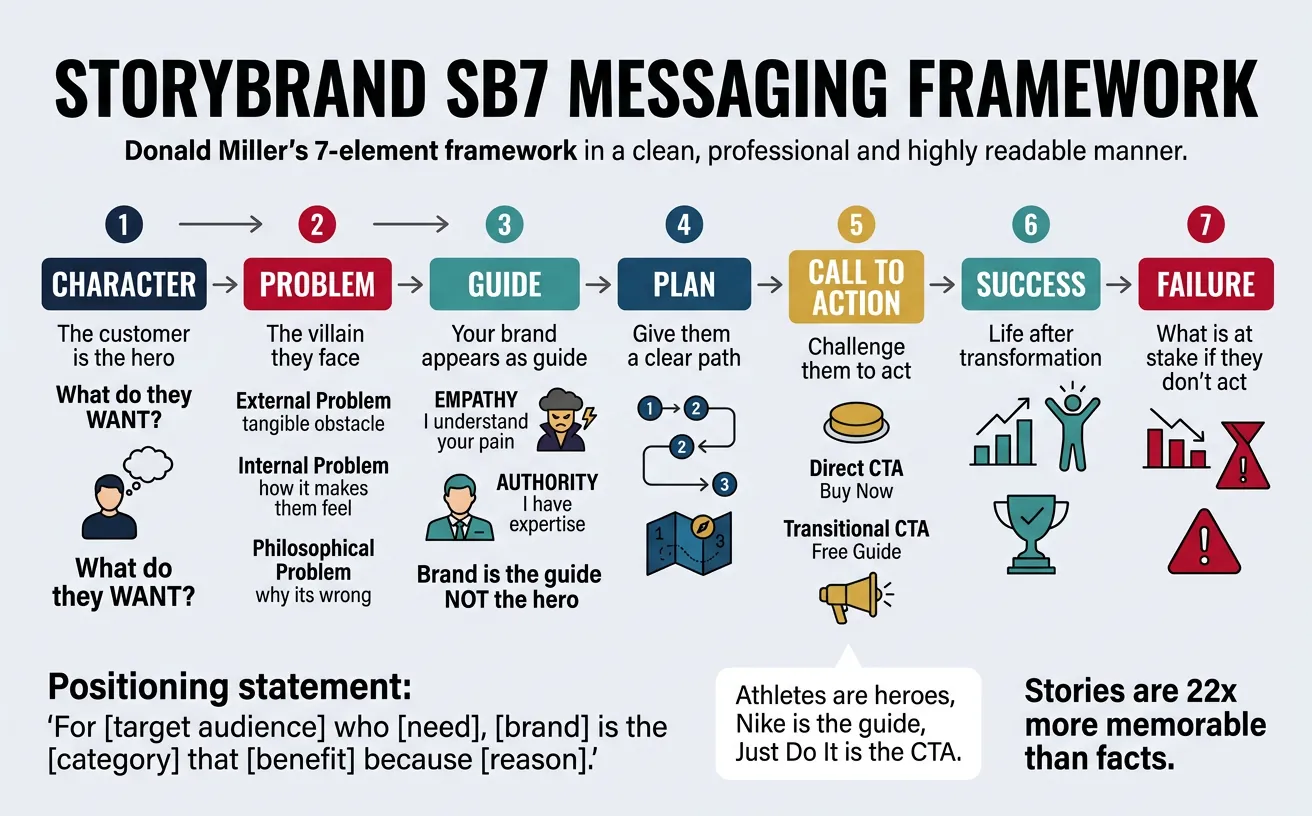
A messaging framework turns brand strategy into words that sell. The most effective framework in modern marketing is Donald Miller's StoryBrand, which positions the customer as the hero and the brand as the guide:
The StoryBrand SB7 framework positions the customer as the hero and the brand as the trusted guide
The StoryBrand Framework (SB7):
Character: Your customer is the hero, not your brand. What do they want?
Problem: The villain they face (external, internal, and philosophical problems)
Guide: Your brand appears as the trusted guide with empathy and authority
Plan: Give them a clear 3-step plan to follow
Call to Action: Challenge them to take action (direct CTA + transitional CTA)
Success: Paint the picture of their life after success
Failure: Show what's at stake if they don't act
The Positioning Statement Template:
For [target audience] who [need/want], [brand name] is the [category] that [key benefit] because [reason to believe].
Example: For busy professionals who want to eat healthy, HelloFresh is the meal kit service that makes home cooking effortless because fresh, pre-portioned ingredients and chef-designed recipes eliminate planning, shopping, and waste.
Brand Storytelling
Stories are the most powerful communication technology humans have invented — they're 22x more memorable than facts alone (Stanford research). Effective brand stories follow the Hero's Journey adapted for business:
Case Study: Nike's Storytelling Mastery
Brand Storytelling$50B+ Brand
Nike rarely talks about shoe technology. Instead, they tell stories where athletes are the heroes and Nike is the enabler:
"Just Do It" (1988): The tagline was inspired by the last words of a convicted murderer, but became the universal call to overcome self-doubt
Dream Crazy (2018): Featured Colin Kaepernick — "Believe in something. Even if it means sacrificing everything." Despite initial boycott threats, Nike's stock hit an all-time high within months
You Can't Stop Us (2020): Split-screen video connecting 36 different athletes — showing the human spirit uniting through sport
Pattern: Nike doesn't say "Buy our shoes." They say "You have greatness inside you. We'll help you unlock it." The customer is always the hero. Nike is always the guide.
Three types of brand stories every company needs:
Origin Story: Why the company exists beyond making money. Patagonia's Yvon Chouinard started as a climber who made his own gear; that authenticity drives everything
Customer Success Stories: How real customers transformed using your product — the most powerful sales tool available
Vision Story: Where the brand is leading the industry — Tesla's "mission to accelerate the world's transition to sustainable energy" gives meaning to every product
Voice & Tone Guidelines
Voice is who you are (consistent). Tone is how you adapt to context (situational). Think of voice as your personality and tone as your mood:
Brand
Voice Attributes
Error Message Tone
Social Media Tone
Customer Win Tone
Slack
Friendly, clear, helpful
"Something went wrong. We're on it! Here's what to try..."
"Uh oh! That didn't work. Let's try something else."
Playful, irreverent, punny
"You just sent your best campaign yet! 🎉"
The Voice Consistency Test: Cover the logo on any piece of your marketing. Can someone identify that it's your brand just from the writing style? If not, your voice isn't distinctive enough. Mailchimp's writing is so recognizable that you'd know it without the chimp logo.
Strategic Positioning
Positioning Strategies
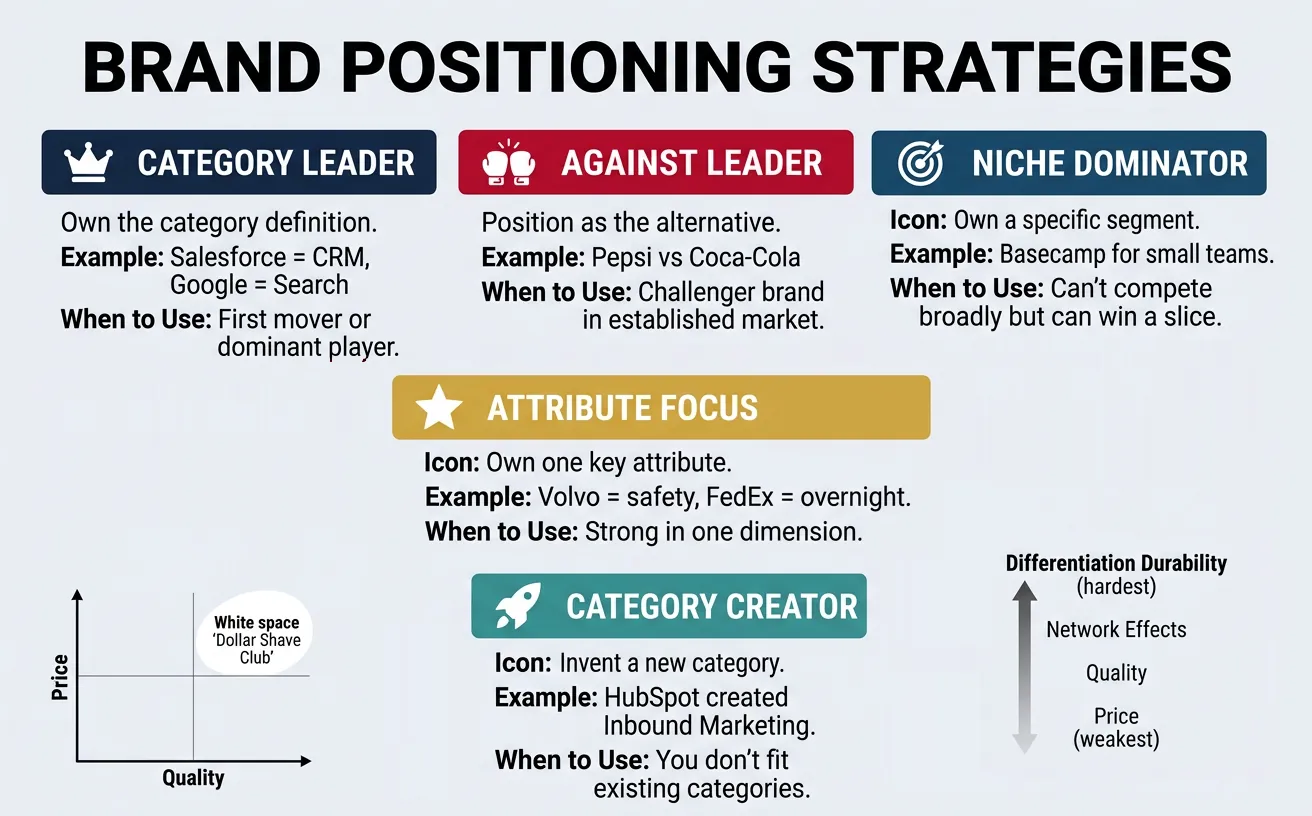
Brand positioning is about owning a specific place in your customer's mind. Al Ries and Jack Trout's foundational "Positioning" framework identified that in any category, customers can typically remember only 2-3 brands. Your goal is to be one of them:
Five brand positioning strategies — from owning the category definition to creating an entirely new market category
Strategy
Approach
When to Use
Example
Category Leader
Own the category definition
First mover or dominant player
Salesforce = CRM, Google = Search
Against Leader
Position as the alternative
Challenger brand in established market
Pepsi "The Choice of a New Generation" vs Coca-Cola
Category Creator
Invent a new category to lead
You don't fit existing categories well
HubSpot created "Inbound Marketing," Drift created "Revenue Acceleration"
Perceptual Mapping: Plot competitors on a 2D graph using the two attributes most important to your customers (e.g., price vs quality, speed vs customization). Find the white space — the position no competitor owns — and claim it. This is how Dollar Shave Club found the "affordable + convenient" space that Gillette (premium + retail) had ignored.
Differentiation Tactics
True differentiation requires being meaningfully different, not just different. Keller's framework distinguishes:
Points of Parity (POPs): Where you must match competitors to be considered at all. A CRM without contact management isn't a CRM. These are table stakes.
Points of Difference (PODs): Where you're demonstrably better than competitors. These must be desirable (customers care), deliverable (you can actually do it), and differentiating (competitors can't easily copy).
Sustainable differentiation sources (hardest to copy → easiest to copy):
Network effects: More users = more value (LinkedIn, Uber) — nearly impossible to replicate
Culture & brand: Company DNA and reputation (Apple's design culture) — takes decades to build
Data & algorithms: Proprietary data that improves with scale (Google's search algorithm) — years to accumulate
Switching costs: Deep integration into customer workflow (Salesforce's ecosystem) — months to replicate
Features: Product capabilities (any new feature) — weeks to months to copy
Price: Lower pricing — hours to match (weakest differentiation)
Thought Leadership
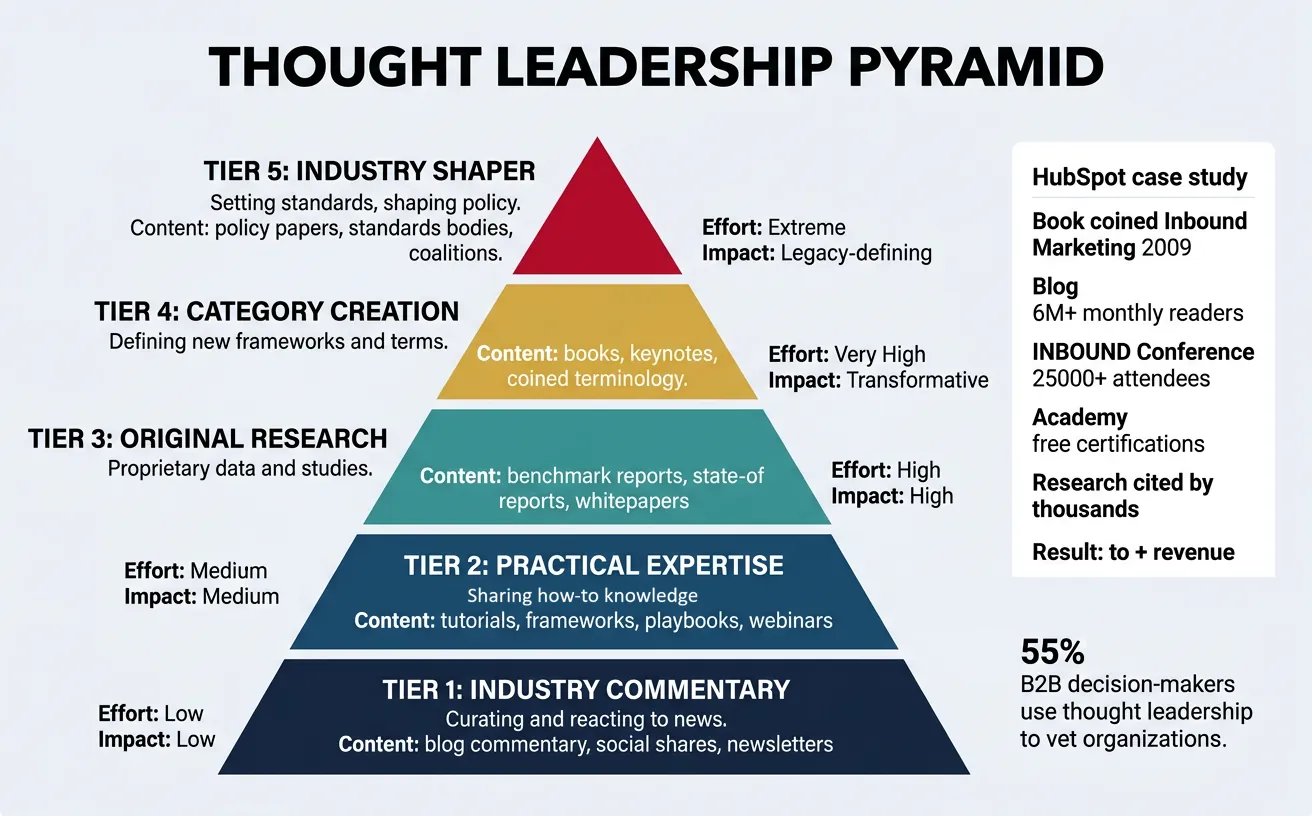
Thought leadership positions your brand as the intellectual authority in your category — the brand that shapes industry thinking rather than following it. Edelman's research found that 55% of B2B decision-makers use thought leadership to vet organizations they're considering working with.
The thought leadership pyramid — progressing from industry commentary to original research that shapes category thinking
Case Study: HubSpot's Category Creation Through Thought Leadership
Thought Leadership$0 → $2B+ Revenue
HubSpot didn't just build a marketing platform — they invented an entire category ("Inbound Marketing") and built thought leadership around it:
Book: "Inbound Marketing" (2009) coined the term and established the philosophy
Blog: 6M+ monthly readers — the most-read marketing blog in the world
INBOUND Conference: Annual event with 25,000+ attendees becoming the industry's flagship
HubSpot Academy: Free certifications that became industry-standard credentials
Research: State of Marketing reports cited by thousands of articles
Result: HubSpot doesn't compete in an existing market — they created the market, defined its rules, and positioned themselves as the default choice. From $0 to $2B+ annual revenue by being the guide, not just the vendor.
Brand Building Canvas
Use this interactive canvas to define your brand's strategic foundation — from identity to positioning. This becomes your living brand strategy document:
Brand Building Canvas
Define your brand strategy. Download as Word, Excel, PDF, or PPTX.
Draft auto-saved
All data stays in your browser. Nothing is sent to or stored on any server.
Exercises
Exercise 1: Brand Identity Teardown
45 minutesBrand Analysis
Choose 3 brands you admire. For each, document: (1) their visual identity elements, (2) their verbal identity and voice, (3) their positioning statement (infer if not stated), (4) Keller's equity pyramid assessment. Compare patterns — what do strong brands have in common?
Exercise 2: StoryBrand One-Liner
30 minutesMessaging
Write a StoryBrand one-liner for your brand: "[Problem] → [Solution] → [Result]". Example: "Most businesses waste 40% of their marketing budget on channels that don't convert. Our analytics platform identifies exactly what works. You'll double ROI within 90 days." Test it on 3 people who don't know your product.
Exercise 3: Perceptual Mapping
60 minutesCompetitive Strategy
Create a perceptual map for your category. Choose the two attributes most important to customers (e.g., ease-of-use vs power, price vs quality). Plot all competitors. Identify the white space — an unoccupied position — and write a positioning statement for that space.
Key Takeaways
A brand is a promise — the sum of every perception, interaction, and emotion customers associate with you, not just your logo or colors
Brand identity has two halves — visual identity (logo, color, typography) and verbal identity (voice, messaging, story) must work in harmony
Build equity bottom-up using Keller's pyramid: Identity → Meaning → Response → Resonance (deep loyalty)
Choose architecture carefully — Branded House (Google), House of Brands (P&G), Endorsed (Marriott), or Hybrid (Microsoft) each fits different strategic contexts
The customer is the hero — StoryBrand's framework positions your brand as the trusted guide, not the protagonist of your marketing
Stories are 22x more memorable than facts — invest in origin stories, customer success narratives, and vision stories
Differentiate sustainably — network effects and culture are nearly impossible to copy; features and price are trivial to match
Thought leadership creates categories — HubSpot invented "Inbound Marketing" and became the $2B+ default choice by being the guide, not just the tool
Continue the Series
Part 2: Consumer & Buyer Psychology
Master behavioral economics, cognitive biases, trust-building mechanisms, and pricing psychology.