Back to Business

Marketing & Strategy Series Part 13: Pricing Strategy & Revenue Models

February 12, 2026 Wasil Zafar 26 min read

Master value-based pricing, pricing psychology, SaaS tier design, bundling strategies, and revenue model architecture for sustainable profitability.

Table of Contents

  1. Pricing Fundamentals
  2. Revenue Models
  3. SaaS Pricing
  4. Price Optimization
  5. Tools & Practice

Pricing Fundamentals

Part 13 of 21: Building on B2B marketing from Part 12, this article explores pricing strategy—arguably the most powerful lever for profitability and growth.

Marketing & Strategy Mastery

Your 21-step learning path • Currently on Step 13
Marketing Fundamentals & Strategic Foundations
Value creation, evolution, STP, 4Ps/7Ps, PMF
Consumer & Buyer Psychology
Behavioral economics, cognitive biases, trust
Brand Building & Positioning
Identity, architecture, storytelling, thought leadership
SEO & Search Marketing
Technical SEO, intent mapping, AI search
Content Marketing Mastery
Strategy, editorial systems, content ROI
Social Media & Community Strategy
Platform strategies, influencer partnerships
Email Marketing & Automation
Lifecycle, nurturing, CRM integration
Paid Advertising Systems
PPC, social ads, account-based advertising
Analytics, Attribution & Marketing Science
Funnel analytics, attribution models
Conversion Rate Optimization (CRO)
Landing pages, A/B testing, UX
Growth Hacking & Experimentation
Growth loops, viral systems, PLG
B2B Marketing & Enterprise Strategy
ABM, demand gen, sales enablement
13
Pricing Strategy & Revenue Models
Value-based pricing, SaaS tiers, bundling
You Are Here
14
Distribution Strategy
Channel strategy, affiliates, ecosystem positioning
15
Consulting-Level Strategic Analysis
Porter's 5 Forces, SWOT, PESTLE
16
Product Marketing & Go-To-Market
Launch strategy, GTM frameworks, PMM
17
Marketing Finance & Planning
Budget, CAC payback, ROI modeling
18
Personal Branding & Thought Leadership (B2P)
Authority, monetization, creator economics
19
Offline & Traditional Marketing
Events, PR, broadcast, direct mail
20
Scaling & Strategic Leadership
Global expansion, organizational design
21
Integrated Marketing Strategy Capstone
Full-stack case studies, playbooks

Pricing is the most powerful yet underutilized lever in business. If marketing is like a megaphone and product is like a magnet, pricing is like a thermostat — small adjustments create massive changes in the entire system's temperature (profitability).
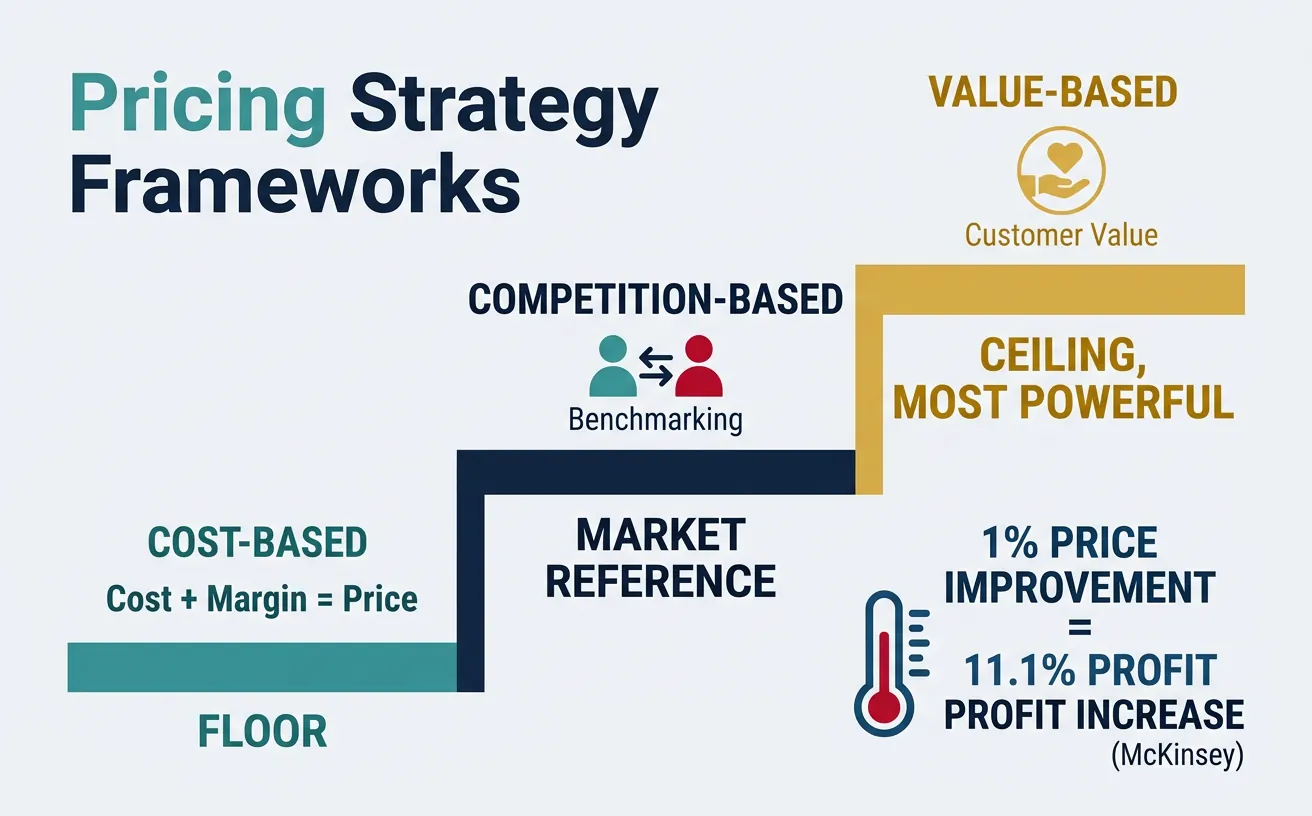
The 1% Pricing Power: A McKinsey study of Global 1200 companies found that a 1% improvement in price (without losing volume) increases operating profit by 11.1%. Compare this to a 1% improvement in volume (3.3% profit increase), variable cost (7.8%), or fixed cost (2.3%). Pricing is the single highest-leverage variable in business, yet most companies spend less than 10 hours per year on pricing strategy.
Pricing Framework How It Works Best For Risk
Cost-Plus Cost + target margin % = price Commodities, manufacturing, government Ignores customer value and willingness to pay
Competitive Match or undercut competitor prices Crowded markets, undifferentiated products Race to the bottom, margin compression
Value-Based Price based on customer's perceived value Differentiated products, B2B, SaaS Requires deep customer research
Dynamic Adjust prices in real-time based on demand Airlines, hotels, ride-sharing, e-commerce Customer backlash if perceived as unfair
Penetration Launch at low price to gain market share New markets, network effects, marketplaces Hard to raise prices later
Skimming Launch at high price, reduce over time Innovation, luxury, tech hardware Attracts competitors at lower price points

Value-Based Pricing

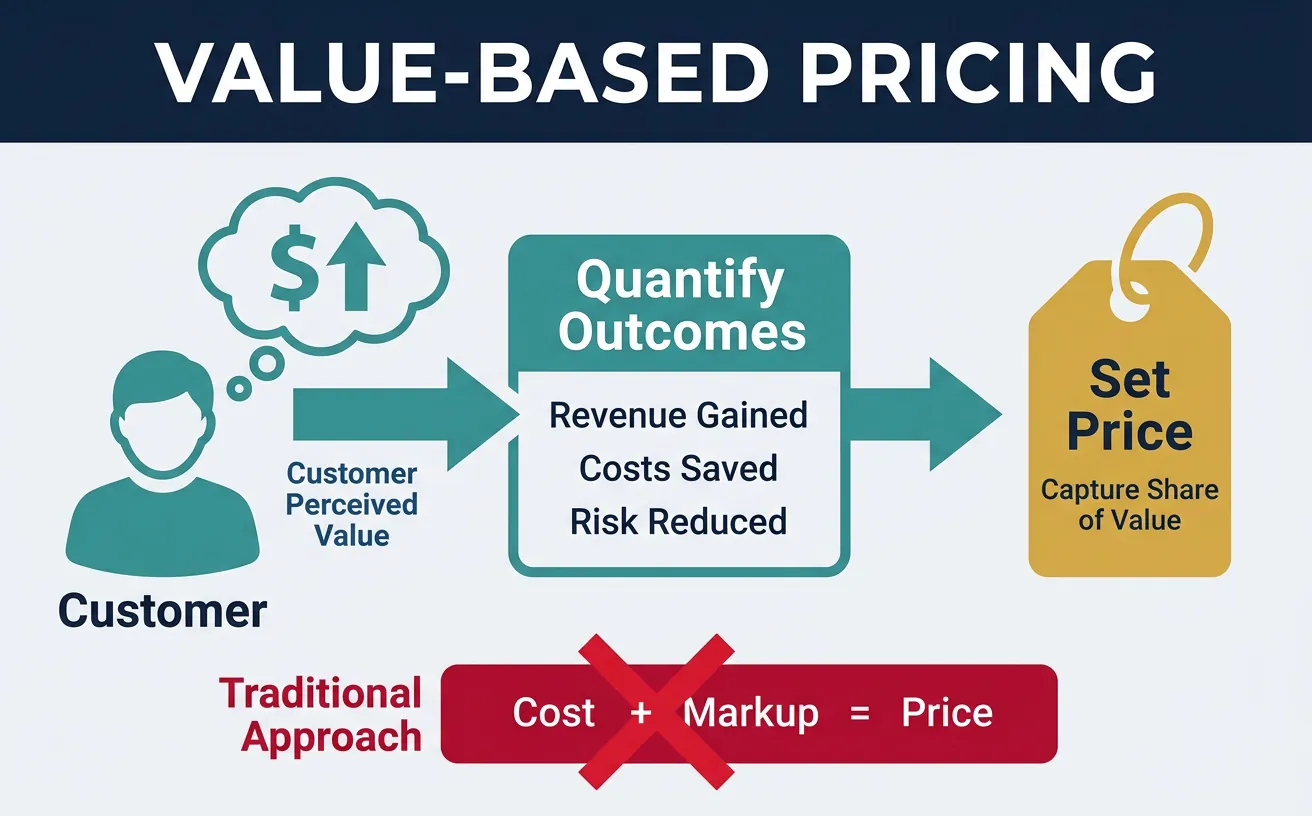
Value-based pricing flips the traditional approach: instead of asking "what does it cost us to make this?" you ask "what is this worth to the customer?" — then capture a share of that value. The key insight is that customers don't buy products; they buy outcomes.
Case Study: Salesforce's Value-Based Pricing Revolution

Value-Based Pricing $34.9B Revenue

The Innovation: When Salesforce launched in 1999, the standard for CRM was $150,000+ for Siebel licenses plus $500K+ implementation. Salesforce didn't price based on cost (their cloud cost per user was pennies) or competition (undercut Siebel). Instead, they priced based on value per user per month — $50-$300/user/month.

The Value Metric: By choosing "per user" as the value metric, Salesforce aligned price with value: more users = more value from CRM = more revenue. This was brilliant because the metric scales naturally with company size and the value they receive.

The Result: The "No Software" model at $50/user/month made enterprise CRM accessible to SMBs while enterprise deals scaled to $1M+ ARR with 1,000+ users. Average ACV grew from $8K to $250K+ as they moved upmarket — all on the same per-user model.

Pricing Psychology

Psychology Principle How It Works Example Impact
Anchoring First number seen becomes reference point Show enterprise plan first ($999), making pro ($199) feel cheap 20-30% increase in plan selection
Charm Pricing Ending in 9 signals deal/value $49 vs $50 — left-digit effect 8-24% increase in conversions
Decoy Effect Add an inferior option to make target look better Small $5, Medium $7.50, Large $8 (medium = decoy) 40-60% shift toward target option
Price Partitioning Split price into smaller components "Just $3.30/day" instead of "$99/month" 15-25% higher conversion
Round vs Precise Round for emotional, precise for rational Luxury: $500. B2B: $497.50 Precise prices feel more researched
Free (Zero Price Effect) Free creates irrational demand Freemium tiers drive adoption 10x adoption vs $1 price
The Economist Decoy: Dan Ariely's famous experiment — The Economist offered: (A) Web-only $59, (B) Print-only $125, (C) Print + Web $125. Options B and C cost the same, making C an obvious choice. 84% chose C. When option B was removed, 68% chose A instead. The "useless" option B was a decoy that shifted $12,000 in revenue per 100 subscribers — 43% more revenue from a single pricing structure change.

Revenue Models

Subscription Models

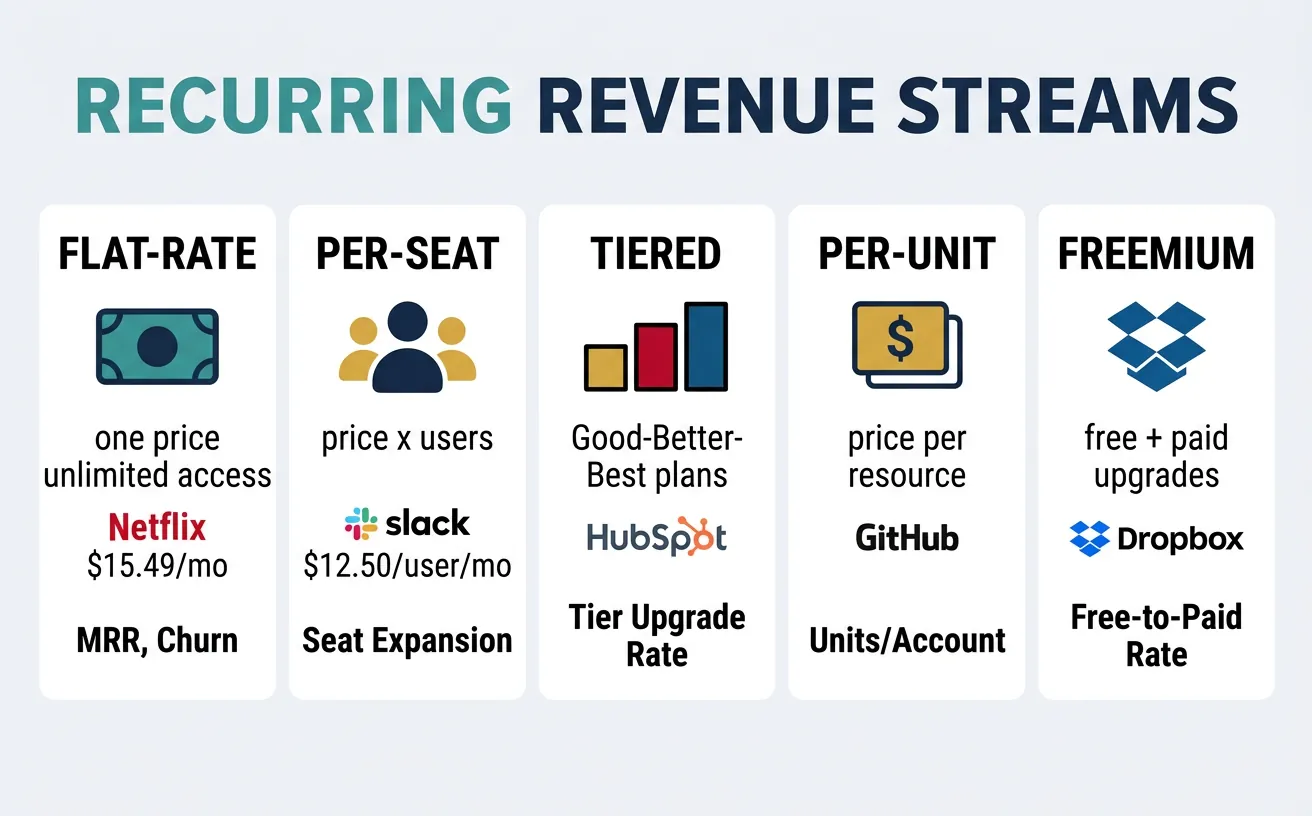
Subscriptions transform one-time purchases into recurring revenue streams — like converting a water sale into a utility. The model creates predictable revenue, higher LTV, and a continuous relationship with the customer.

Subscription Type Model Key Metric Example
Flat-Rate One price, unlimited access MRR, churn rate Netflix ($15.49/mo), Basecamp ($99/mo flat)
Per-Seat Price × number of users Seat expansion rate Slack ($12.50/user/mo), Salesforce
Tiered Good-Better-Best plans Tier upgrade rate HubSpot (Starter/Pro/Enterprise)
Per-Unit Price per resource/project/item Units per account GitHub ($4/user for private repos)
Freemium Free tier + paid upgrades Free-to-paid conversion rate Dropbox, Notion, Canva
Annual vs Monthly Trade-off: Offering annual billing at 16-20% discount (equivalent to 2 months free) is the standard approach. The math: if monthly churn is 3%, a monthly subscriber has ~64% probability of still paying after 12 months. An annual subscriber has 100% probability of those 12 months. Annual billing reduces churn impact by 36%, funds growth with upfront cash, and simplifies revenue forecasting.

Usage-Based Pricing

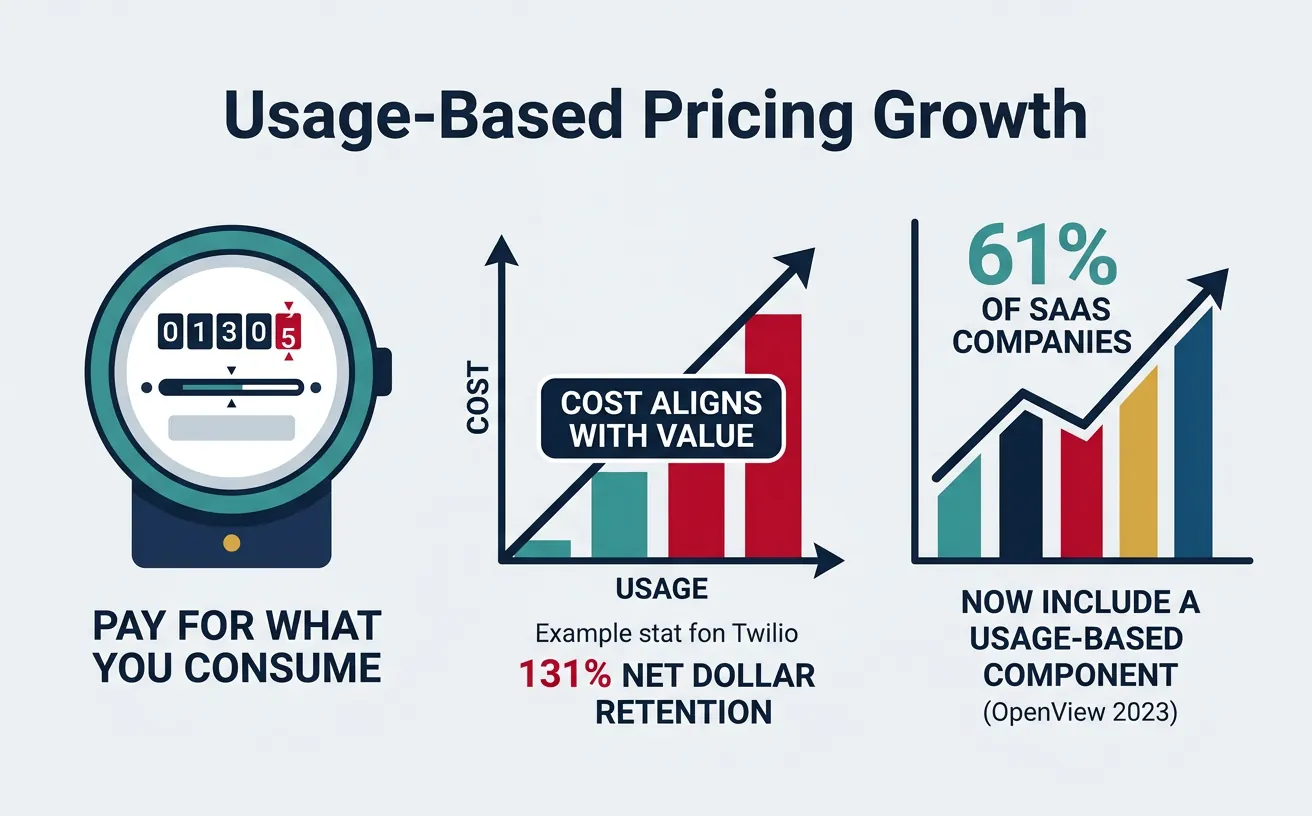
Usage-based pricing (UBP) aligns cost with value — customers pay for what they consume, like electricity. This model is growing rapidly: 61% of SaaS companies now have a usage-based component (OpenView 2023).

Case Study: Twilio's Usage-Based Growth Engine

Usage-Based Pricing $4B+ Revenue

Model: Twilio charges per API call — $0.0075 per SMS, $0.013 per minute for voice. No monthly minimums, no seat licenses, no contracts required. Developers start for free ($15 trial credit) and scale to millions of API calls.

Value Alignment: The pricing scales perfectly with customer value — a startup sending 1,000 SMS pays $7.50. An enterprise sending 10M SMS pays $75,000. Same product, 10,000x price range, both feel the price is fair because they pay for what they use.

Dollar-Based Net Retention: Twilio's usage model generated 131% Net Dollar Retention — meaning existing customers spent 31% more each year without any upselling effort. Usage naturally grows as customers scale their applications.

Hybrid Revenue Models

Hybrid Model Structure Advantage Example
Platform + Transaction Subscription fee + per-transaction % Predictable base + growth upside Shopify ($39/mo + 2.9% per sale)
Subscription + Usage Base plan + overage charges Predictable revenue + expansion Snowflake (storage sub + compute credits)
Freemium + Enterprise Free users + sales-led enterprise PLG adoption + high-value deals Slack (free → $12.50/user → custom)
Marketplace + SaaS Marketplace take rate + vendor tools Two revenue streams, network effects Amazon (15% commission + FBA fees)

SaaS Pricing

Pricing Tier Design

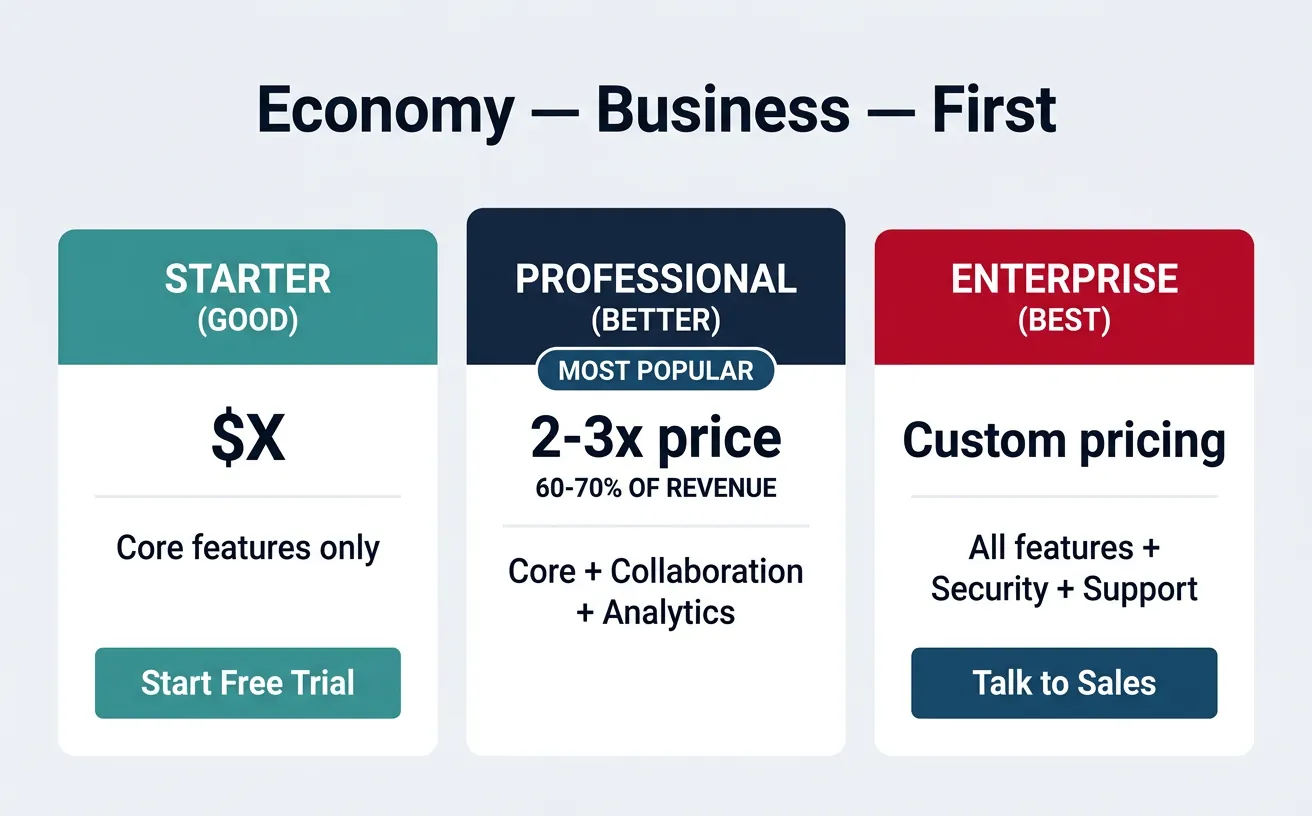
The Good-Better-Best (GBB) framework is the gold standard for SaaS pricing. Think of it like airline classes — Economy, Business, First — each designed for a different customer segment with different willingness to pay.

Tier Element Good (Starter) Better (Professional) Best (Enterprise)
Target Individual / small team Growing teams (main target) Large orgs, complex needs
Price Role Entry point, low friction Revenue driver (60-70% of revenue) High-value anchor
Features Core functionality only Core + collaboration + analytics All features + security + support
Pricing $X (reference point) 2-3x Good price Custom / "Contact Sales"
CTA Style "Start Free Trial" "Most Popular" badge, highlighted "Talk to Sales"
The Rule of 10x Value: Each tier should deliver at least 10x the price differential in perceived value. If Professional costs $50 more than Starter, the additional features should feel worth $500. This is why the "Best" plan works as a decoy anchor — its high price makes the "Better" plan feel like a steal, driving 60-70% of signups to the middle tier.

Packaging & Bundling

Case Study: Microsoft 365 Bundling Strategy

Bundling $63B Commercial Cloud

Strategy: Microsoft transformed from selling individual products (Word $139, Excel $139, PowerPoint $139 = $417 unbundled) to a bundled subscription at $12.50/user/month ($150/year). The bundle included 10+ applications that individually would cost $1,000+.

Bundling Psychology: By including Teams, SharePoint, OneDrive, and security tools alongside Office apps, Microsoft made it nearly impossible for competitors to compete on individual features. The bundle creates switching cost moats — replacing any single app means leaving the entire ecosystem.

Results: Microsoft 365 has 382M paid seats. The bundling strategy increased ARPU by making customers adopt more products (average customer uses 5.2 of the bundled apps). Revenue per user grew 3x compared to perpetual license revenue, and churn dropped to ~2% annually.

Bundling Strategy How It Works When to Use
Pure Bundling Only sold together, no individual purchase Products are complementary, value is in the combination
Mixed Bundling Available individually and as bundle at discount Some customers want only specific products
Add-On Model Base product + optional premium add-ons Feature adoption varies widely across segments
Unbundling Break existing bundle into individual products Disrupting incumbent bundlers (e.g., fintech unbundling banks)

Pricing Page Design

Pricing Page Element Best Practice Why It Works
Number of Plans 3-4 (max) — fewer is better Choice overload reduces conversions; 3 activates the decoy effect
Highlighted Plan Middle tier with "Most Popular" badge Social proof + anchoring steers 60-70% of selections
Feature Comparison Show value differences, not just checkmarks "5 projects" vs "unlimited projects" shows clear value gap
Annual Toggle Default to annual, show monthly price with savings Annual default increases LTV 30-40%
Enterprise CTA "Contact Sales" with phone/chat option Self-serve buyers choose lower tiers; high-value needs human touch

Price Optimization

Price Testing

Method How It Works Accuracy Cost/Effort
Van Westendorp 4 questions: too cheap, cheap, expensive, too expensive Good for ranges, not optimal points Low (survey, 200+ respondents)
Conjoint Analysis Trade-offs between features and price levels High — measures relative value of each feature High (requires 300+ respondents, $10K+)
Gabor-Granger Sequential price points — "would you buy at $X?" Good for price elasticity curves Medium (surveys)
A/B Testing Show different prices to different cohorts Highest — real purchase behavior Medium, but ethical concerns with price discrimination
Price Laddering Interview customers to understand value breakdown Qualitative, directional Low (10-20 interviews)

Discounting Strategy

The Discounting Trap: Every 1% discount given requires an average of 3.3% more volume to maintain the same profit (at 30% margins). A 10% discount requires 50% more volume. Most companies discount reflexively without calculating this. Discounting trains customers to wait for deals, erodes brand value, and creates a race to the bottom. Discount strategically, not habitually.
Discount Type When to Use When to Avoid
Annual Prepay (16-20% off) Always — reduces churn, improves cash flow Never avoid; this is strategic, not a discount
Volume / Commit Deals Enterprise with guaranteed usage growth When customer can't commit to minimum spend
New Logo Discount Strategic accounts with high expansion potential If it sets precedent for future renewals
End-of-Quarter Deals Pipeline acceleration when deal is stuck If buyers learn to wait for quarter-end
Competitive Displacement Winning accounts from named competitors If it creates price floor you can't sustain

International Pricing

Case Study: Spotify's PPP Pricing

International Pricing 626M Users Globally

Challenge: Spotify needed to serve 180+ markets with wildly different purchasing power. $9.99/month is affordable in the US but equals a day's wages in Nigeria.

Strategy: They implemented Purchasing Power Parity (PPP) pricing with dramatic regional variation: $9.99 in the US, $2.99 in India, $1.58 in Nigeria. The premium service is identical in every country — only the price differs.

Results: PPP pricing drove 42% of premium subscribers from emerging markets that would have been $0 revenue at US prices. India alone contributed 40M subscribers. The lower prices still generate positive margin because marginal cost per stream is near-zero. Total subscribers grew from 100M to 626M, with premium subscribers reaching 246M.

Tools & Practice

Pricing Strategy Canvas

Use this canvas to design your pricing architecture. Download as Word, Excel, PDF, or PowerPoint for your pricing toolkit.

Pricing Strategy Canvas

Design your pricing model, tier structure, and revenue architecture. Download as Word, Excel, PDF, or PowerPoint.

Draft auto-saved

All data stays in your browser. Nothing is sent to or stored on any server.

Practice Exercises

Exercise 1: Pricing Tier Design

Design a 3-tier pricing page for a project management SaaS tool:

  • Choose a value metric (per user, per project, per workspace)
  • Define 3 tiers with specific features, limits, and prices
  • Apply 3 pricing psychology principles (anchoring, decoy, charm pricing)
  • Set the annual discount rate and calculate the LTV impact
  • Predict which tier will generate the most revenue and why

Exercise 2: Value Quantification

For a cybersecurity product that prevents data breaches (average breach costs $4.45M per IBM):

  • Calculate the economic value to a 500-person company
  • Determine the maximum price using the value-based approach (capture 10-30% of value created)
  • Design a Van Westendorp survey with 4 questions
  • Compare your value-based price to cost-plus (if product costs $50K to serve) and competitive (competitors charge $80K-$150K)

Exercise 3: International Pricing Strategy

You run a SaaS tool priced at $99/month in the US. Design an international pricing strategy for 5 markets:

  • Research PPP ratios for India, Brazil, Germany, Japan, and Nigeria
  • Set localized prices for each market with rationale
  • Decide: local currency or USD billing for each market?
  • Address the arbitrage risk (customers using VPNs to get cheaper prices)
  • Calculate the expected revenue impact of PPP pricing vs uniform pricing

Key Takeaways

  1. Pricing is the #1 profit lever — a 1% price improvement increases operating profit by 11.1%, more than any other variable
  2. Value-based pricing outperforms cost-plus — price based on customer outcomes, not your costs. 10x value delivery justifies premium pricing
  3. Psychology drives purchasing decisions — anchoring, decoy effects, and charm pricing can shift revenue 20-40% without changing the product
  4. The middle tier wins — Good-Better-Best design drives 60-70% of revenue to the middle tier through anchoring and social proof
  5. Usage-based pricing aligns incentives — 61% of SaaS now has a usage component because it creates natural expansion revenue
  6. Bundling creates switching cost moats — Microsoft 365 proves that bundles increase ARPU, reduce churn, and lock out competitors
  7. Discounting destroys value — a 10% discount requires 50% more volume at 30% margins. Discount strategically, not habitually
  8. PPP unlocks global markets — Spotify's regional pricing turned emerging markets from $0 revenue to 42% of premium subscribers
Business