We use cookies to enhance your browsing experience, serve personalized content, and analyze our traffic.
By clicking "Accept All", you consent to our use of cookies. See our
Privacy Policy
for more information.
Part 16 of 21: Building on strategic analysis frameworks from Part 15, this article covers the art and science of bringing products to market effectively.
Think of a Go-To-Market (GTM) strategy as a military campaign plan. You don't just build a great weapon and hope the enemy notices — you choose your battlefield (target market), position your forces (messaging), supply your troops (sales enablement), and coordinate your attack (launch). Without a GTM strategy, even the best product becomes just another option nobody knows about.
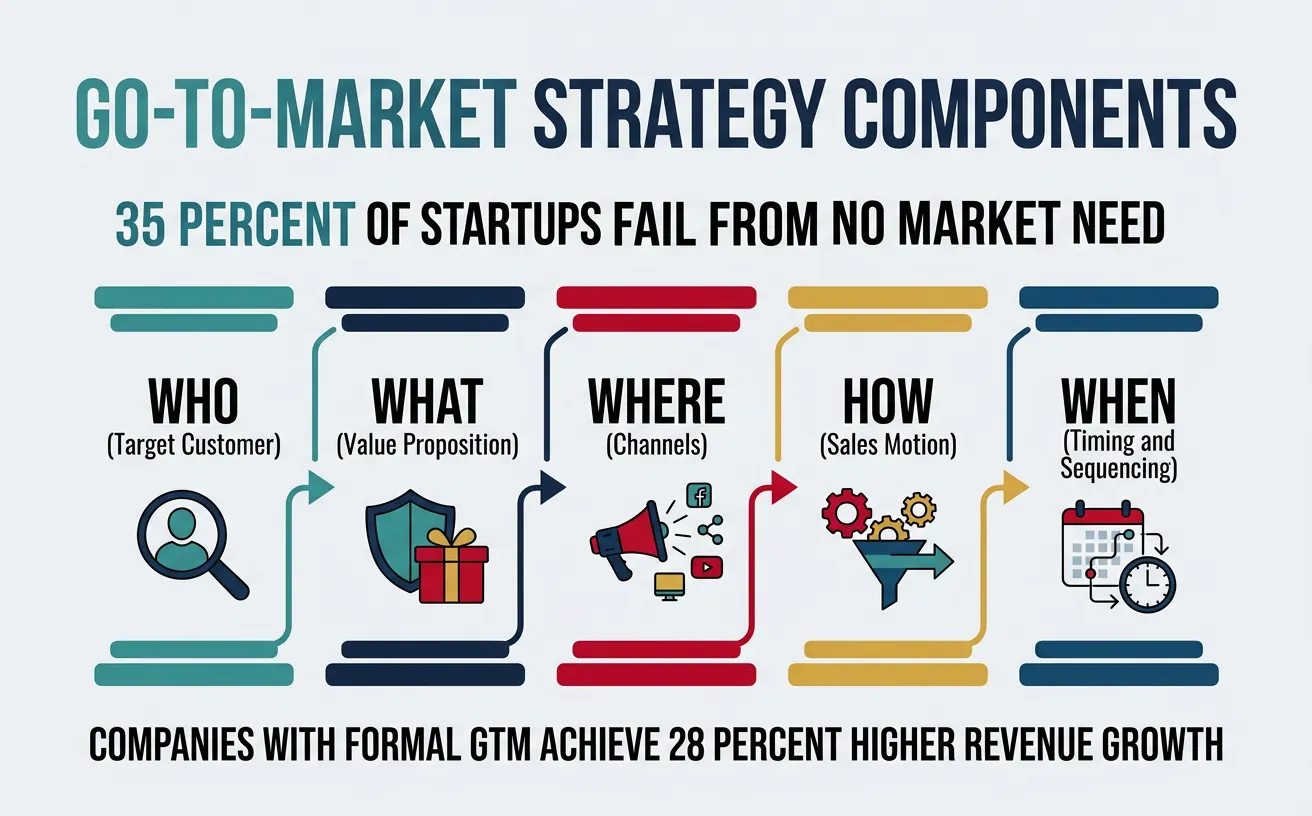
A Go-To-Market strategy answers five fundamental questions that determine how your product reaches and wins customers
Why GTM Matters: According to CB Insights, 35% of startups fail because there's no market need — a problem GTM strategy directly addresses. Companies with formal GTM processes achieve 28% higher revenue growth than those launching ad hoc.
A GTM strategy answers five fundamental questions:
Only platform with native Salesforce + HubSpot + Zendesk integration
WHEN do we launch?
Launch Timeline
Soft launch Q1, full launch Q2, scale Q3-Q4
Three GTM Motions
Modern companies use three primary GTM motions — often in combination:
GTM Motion
How It Works
Best For
Example
Sales-Led
AEs drive deals through demos, proposals, negotiation
Enterprise, high ACV ($50K+)
Salesforce, Workday, Palantir
Marketing-Led
Inbound content attracts leads, MQLs routed to sales
Mid-market, education-heavy
HubSpot, Moz, Drift
Product-Led (PLG)
Free product adoption converts to paid
High-volume, low-friction
Slack, Zoom, Notion, Figma
Product-Led Growth Benchmark: PLG companies trade at a 2x revenue multiple premium over sales-led peers. Datadog, Twilio, and Atlassian all achieved $1B+ revenue with PLG-first models, then layered enterprise sales on top.
Case Study: Figma's PLG-to-Enterprise GTM ($20B Acquisition)
Product-Led GrowthBottom-Up Adoption
The Challenge: Enter a market dominated by Adobe (90%+ market share in design tools) with a browser-based design tool.
GTM Strategy:
Free tier for individuals — removed all barriers to trial
Collaborative by default — every shared file became a growth vector (viral coefficient 1.3+)
Bottom-up adoption — designers adopted personally, then brought Figma to their companies
Enterprise layer added later — SSO, admin controls, analytics for organizations
Results: 4M+ users, $400M+ ARR growing 100%+ YoY, $20B Adobe acquisition offer (2022). Figma captured 45%+ market share in collaborative design — without a traditional sales team for its first 5 years.
Market Entry Strategy
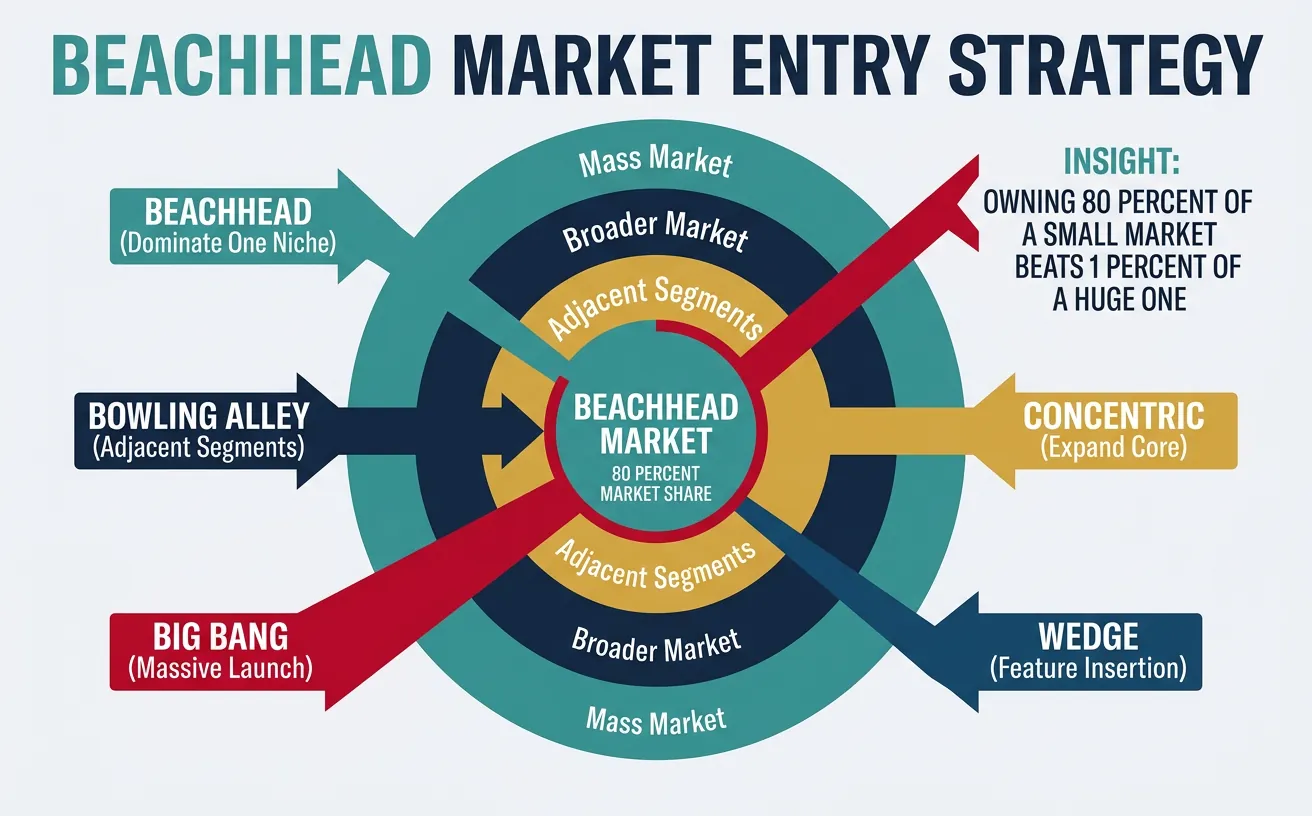
Entering a new market is like amphibious warfare — you need a beachhead before conquering the mainland. Geoffrey Moore's Crossing the Chasm framework teaches that you should dominate one niche before expanding:
The Beachhead strategy: dominate one narrow segment first, then expand outward — a company owning 80% of a small market beats 1% of a huge one
Entry Strategy
Approach
Risk Level
Example
Beachhead
Dominate one narrow segment, then expand
Low
Facebook: Harvard → Ivy League → all colleges → everyone
Bowling Alley
Win adjacent segments like bowling pins
Medium
Salesforce: CRM → Service → Marketing → Commerce → Platform
Big Bang
Launch broadly with massive awareness
High
Apple iPhone: Global launch with carrier partnerships
Concentric
Expand outward from core use case
Medium
Amazon: Books → Music → Everything → AWS → Alexa
Wedge
Enter with a narrow, critical-path feature
Low
Stripe: Just payments API → full financial platform
The Beachhead Principle: A company that owns 80% of a $10M market is more valuable than one with 1% of a $10B market. Dominance creates word-of-mouth, reference customers, and credibility that fuels expansion. Win the niche, then cross the chasm.
Launch Planning
Not all launches are created equal. Use a tiered launch framework to match effort to impact:
Use this framework to ensure no launch component is missed:
Category
Checklist Items
Owner
Product
Feature complete, QA passed, docs updated, known issues documented
Product/Engineering
Messaging
Positioning doc, key messages, elevator pitch, FAQ
Product Marketing
Content
Blog post, landing page, demo video, case study
Content/PMM
Sales
Battlecard, sales deck, pricing sheet, objection guide, training complete
Sales Enablement
Demand Gen
Email sequences, ad campaigns, social posts scheduled
Marketing Ops
Support
Help articles, internal KB, escalation plan, known issues brief
Customer Success
Case Study: Slack's Masterful Launch Strategy
Preview ReleaseWord-of-Mouth
The Strategy: Slack didn't launch publicly. They used a "preview release" model:
Step 1: Internal dogfooding — used Slack internally for 6 months, refining based on team feedback
Step 2: Friendly beta — invited 8 companies to use it free, collected feedback
Step 3: Preview release — opened to limited public with friction (had to request access)
Step 4: Growth amplification — media coverage of the waitlist itself generated 8,000 signups day 1, 15,000 by week 2
Results: $1B+ in ARR within 5.5 years, $27.7B Salesforce acquisition. The preview release created artificial scarcity while ensuring product quality — Slack's NPS score was 55+ at launch, far above industry average of 30.
Product Positioning
Positioning Frameworks
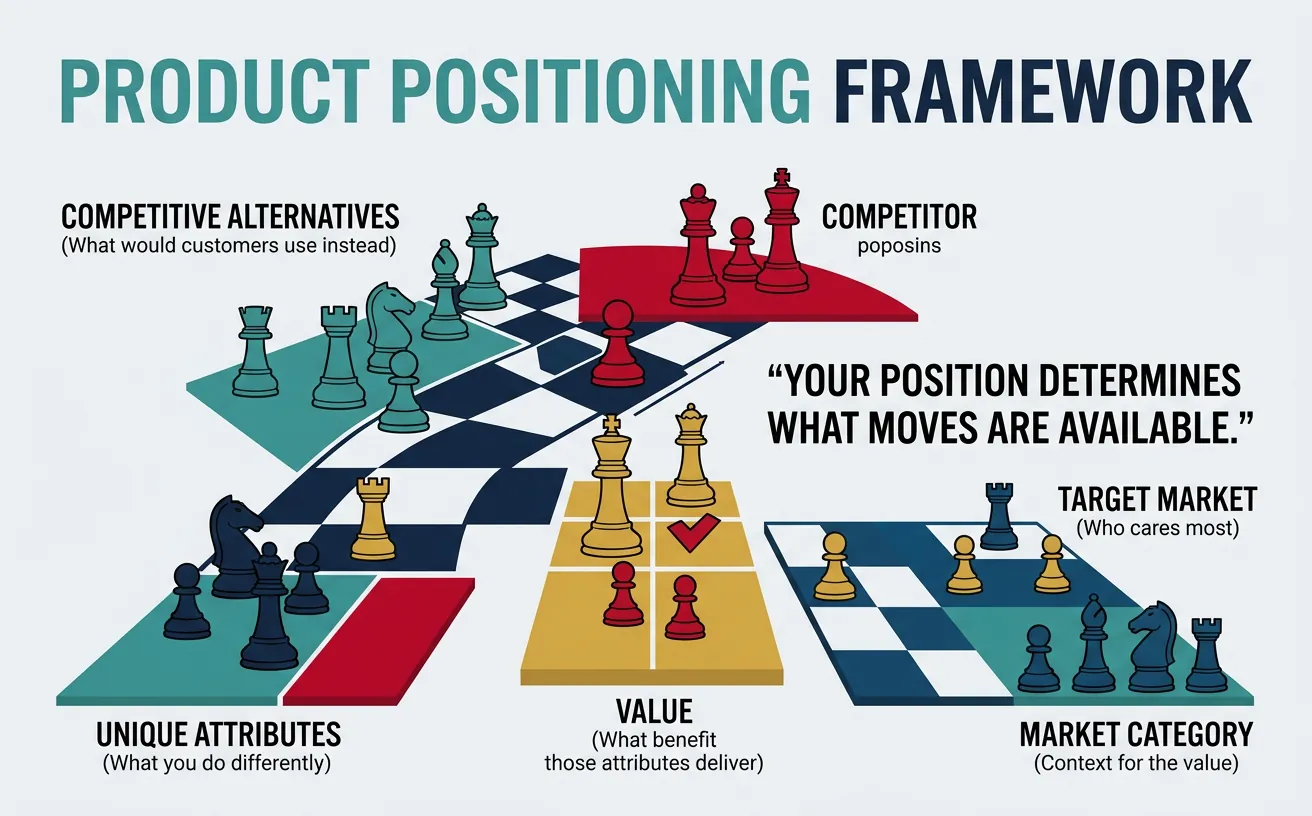
Product positioning is like choosing where to place yourself on a chess board — your position determines what moves are available and how competitors must react. April Dunford, author of Obviously Awesome, defines positioning as: "How your product is the best in the world at providing some kind of value to a well-defined set of customers."
Product positioning determines which competitive moves are available — April Dunford's framework identifies five key components
April Dunford's Positioning Framework
This 5-component framework is the gold standard for B2B positioning:
Shopify: "E-commerce for small businesses" vs Oracle Commerce
Category Creation
No existing category fits, novel solution
Define an entirely new market category
Drift: "Conversational Marketing" (not just live chat)
Category Creation Warning: Creating a new category costs 3-5x more than positioning in an existing one. You must educate the market on why the category exists before they'll consider your solution. Only attempt this when existing categories genuinely mislead buyers about your value.
Messaging Architecture
Think of messaging architecture as a pyramid — one core message at the top, supported by pillars, each backed by proof points:
Messaging Hierarchy: Level 1 — Core Narrative: Your overarching story and mission (why you exist)
Level 2 — Pillar Messages (3-4): Key theme areas that support the narrative
Level 3 — Proof Points: Data, case studies, features that validate each pillar
Level 4 — Persona Adaptations: How each pillar translates for different buyer personas
Persona-Based Messaging Matrix
Persona
Primary Concern
Message Focus
Proof Point
C-Suite (CEO/CRO)
Revenue growth, competitive advantage
Business outcomes, ROI, market share
"Companies using X generate 40% more pipeline"
VP/Director
Team productivity, strategic alignment
Efficiency gains, team impact, roadmap
"Teams report 3x faster project delivery"
End User
Daily workflow, ease of use
Time saved, frustration reduced, delight
"Reduces manual data entry by 85%"
IT/Security
Compliance, integration, reliability
SOC 2, SSO, API-first, uptime SLA
"99.99% uptime, SOC 2 Type II certified"
Finance/Procurement
Cost, contract terms, TCO
Total cost of ownership, payback period
"6-month payback, 320% 3-year ROI"
Value Propositions
A value proposition is a promise of value to be delivered. The best value propositions follow a simple formula:
Value Proposition Formula: "For [target customer] who [need/problem], [product name] is a [category] that [key benefit]. Unlike [alternatives], we [differentiator]."
Example:"For mid-market sales teams who struggle with forecasting accuracy, Clari is a revenue operations platform that uses AI to predict pipeline outcomes within 5%. Unlike manual spreadsheet forecasting, we analyze every buyer signal automatically."
Case Study: Notion's Repositioning ($10B Valuation)
Category ExpansionPositioning Evolution
The Evolution: Notion repositioned three times as it grew:
2016:"A note-taking app" — competed with Evernote, lost on features
2022:"Connected workspace for teams" — enterprise collaboration platform
2023:"AI-powered connected workspace" — added Notion AI as differentiator
Key Insight: Each repositioning expanded the Total Addressable Market without losing the existing base. "Note-taking app" was a $5B market. "Connected workspace" is a $50B+ market. Same product, 10x bigger opportunity through positioning alone.
Results: 30M+ users, $10B valuation, 100M+ pages created monthly, successful category expansion from individual productivity → team collaboration → enterprise platform.
Competitive Intelligence
Competitive Battlecards
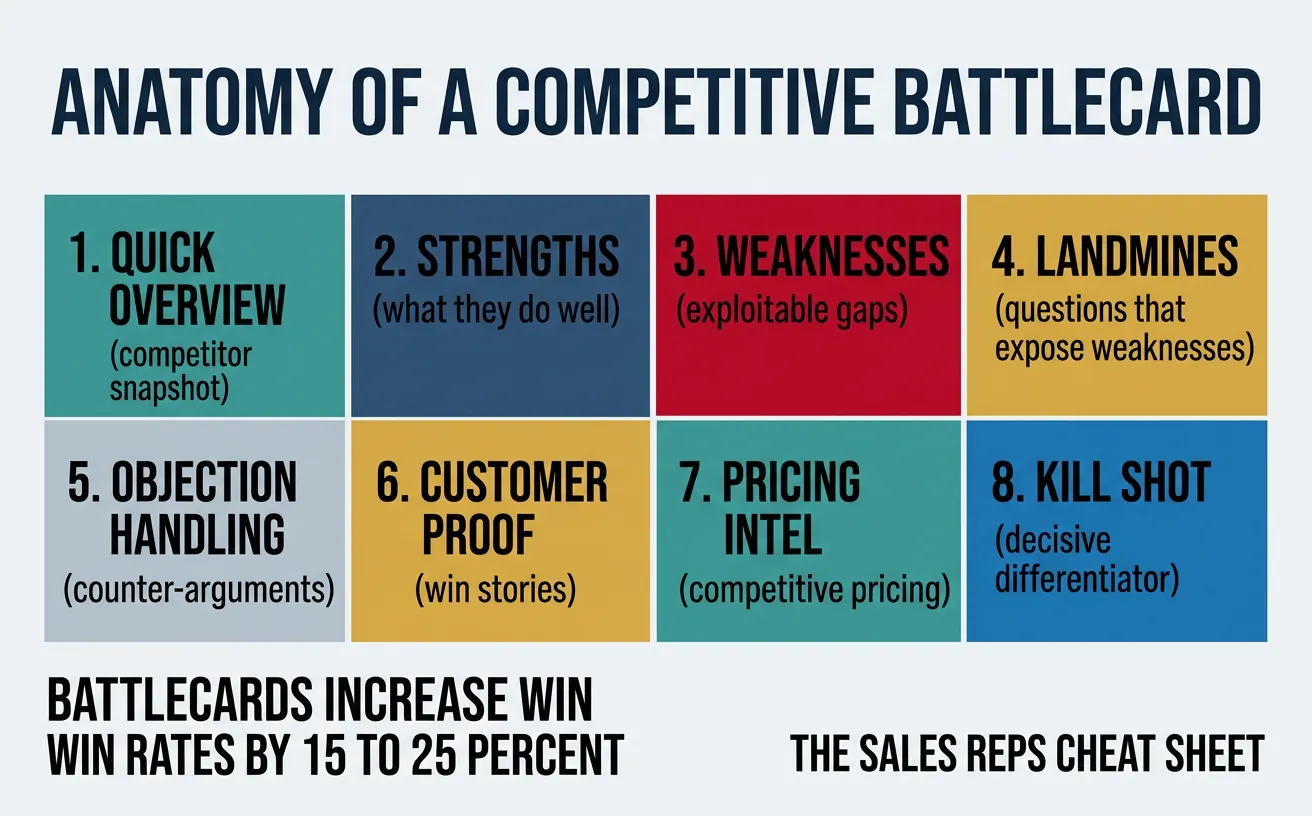
A battlecard is the sales rep's cheat sheet for winning against a specific competitor. Think of it as a pilot's quick reference card — concise, actionable, and available at a moment's notice when the competition comes up on a sales call.
A well-structured battlecard arms sales reps with competitive intelligence that increases win rates by 15-25%
Questions to ask that expose competitor weaknesses
"Ask them about scalability above 10K users..."
Objection Handling
Common objections + proven responses
"They say X. Here's how to respond..."
Customer Proof
Win stories against this competitor
"Customer Y switched from them because..."
Pricing Intel
Known pricing, discounting patterns
Prepare for price objections
Kill Shot
The single strongest differentiator
The one thing that wins deals consistently
Battlecard Impact: Companies that provide competitive battlecards see win rates increase 15-25% against named competitors. Gong research shows reps who reference competitor weaknesses at the right moment close deals at 2.3x the rate of those who avoid competitive discussions.
The "Trap Question" Technique
The most powerful battlecard element is the landmine question — questions your sales rep asks the prospect that subtly expose a competitor's weakness:
Competitor Weakness
Landmine Question
Why It Works
Poor scalability
"How many concurrent users do you anticipate at peak?"
Forces them to reveal a use case where the competitor breaks
No API/integrations
"Walk me through your current data flow between systems."
Highlights integration pain the competitor can't solve
Complex implementation
"What's your timeline expectation for going live?"
Sets urgency that the competitor's 6-month deploy can't match
Weak customer support
"What does your team's vendor support experience look like?"
Opens door for support horror stories about the competitor
Win/Loss Analysis
Win/loss analysis is the post-game film review of sales. You interview prospects (whether they bought from you or not) to understand the real reasons behind their decisions — not what CRM disposition codes say.
Component
Win Interview
Loss Interview
Timing
Within 2 weeks of close
Within 30 days of loss
Interviewer
PMM or neutral 3rd party
Always neutral 3rd party (not the AE)
Key Questions
Evaluation criteria, decision factors, what tipped the scale
What fell short, competitor strengths, what would change your mind
Sample Size
20+ interviews per quarter
20+ interviews per quarter
Output
Reinforcing messages, proof points
Product gaps, messaging fixes, process improvements
The Win/Loss Truth Gap: Sales reps attribute 70%+ of losses to "price". Win/loss interviews reveal price is the primary factor in only 15-20% of losses. The real reasons: product gaps, poor discovery, weak business case, and faster competitor response times.
Market Intelligence
Market intelligence is the radar system that tracks competitor movements, market shifts, and emerging threats before they impact your business:
Intelligence Source
What to Track
Tools
Frequency
Product Changes
Feature releases, pricing changes, integrations
G2, Capterra, competitor blogs, Product Hunt
Weekly
Content & SEO
New content themes, keyword targeting shifts
Semrush, Ahrefs, BuzzSumo
Monthly
Hiring Signals
New roles = new priorities (AI hires, sales expansion)
LinkedIn, Glassdoor, job boards
Monthly
Financial & Funding
Revenue, fundraising, M&A, layoffs
Crunchbase, SEC filings, press releases
As needed
Customer Signals
Review trends, NPS changes, support complaints
G2, Trustpilot, Reddit, Twitter
Weekly
Case Study: Gong's Competitive Intelligence Engine ($7.2B Valuation)
Revenue IntelligenceCompetitive Moat
The Approach: Gong didn't just sell revenue intelligence — they used their own product as a competitive intelligence machine:
Call analysis: Tracked how often competitors were mentioned in customer discovery calls — revealing market perception shifts in real-time
Win pattern analysis: Identified the exact talk tracks, questions, and proof points that predicted wins vs. losses against each competitor
Content machine: Published data-backed research ("Gong Labs") using anonymized conversation data — 20M+ analyzed calls became thought leadership content
"Reality vs. Marketing" positioning: Used actual call data to contrast what competitors say vs. what customers experience
Results: $250M+ ARR, $7.2B valuation, 4,000+ customers. Gong's competitive intelligence approach achieved a 70%+ win rate against direct competitors in deals where battlecards were used.
PMM Function
PMM Skills & Career
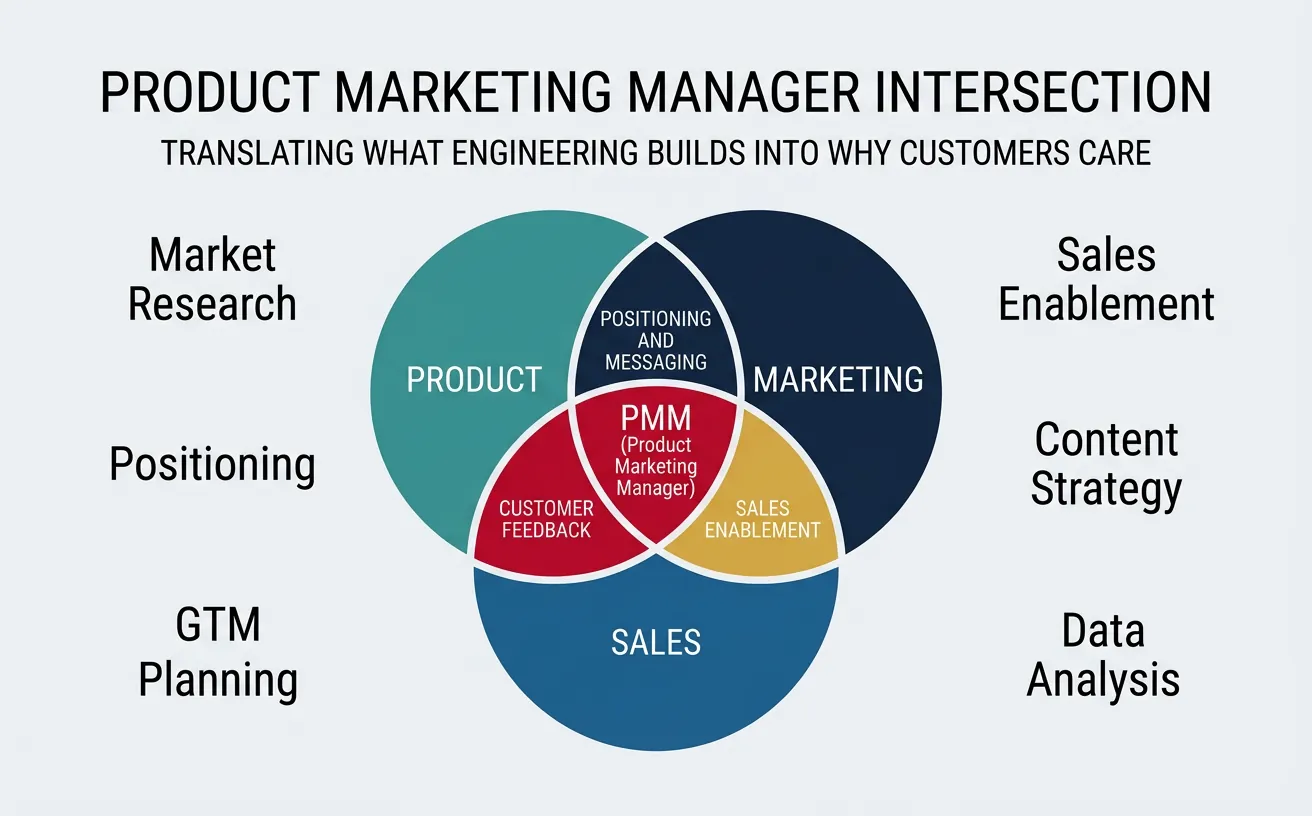
A Product Marketing Manager (PMM) is the translator between product and market — they understand what engineering builds, why customers care, and how sales should position it. PMM sits at the intersection of product, marketing, and sales:
The PMM sits at the intersection of product, marketing, and sales — translating what engineering builds into why customers should care
PMM Competency
What It Involves
How It's Measured
Market Research
Customer interviews, competitive analysis, TAM sizing
Sales enablement is the ammunition supply chain for your sales force. It ensures reps have the right content, training, and tools at every stage of the buyer's journey:
Sales Stage
Content Needed
PMM Deliverable
Purpose
Prospecting
Outreach templates, value hooks
Email sequences, social selling guides
Book meetings with tailored relevance
Discovery
Industry insights, pain point maps
Discovery question guide, industry briefs
Diagnose problems and establish authority
Demo/Evaluation
Demo scripts, product tours
Demo playbook, interactive product tour
Show relevant value in 15-20 minutes
Business Case
ROI calculators, case studies
ROI model, customer success stories
Justify investment to economic buyer
Negotiation
Competitive positioning, pricing guides
Battlecards, pricing comparison sheet
Win against alternatives and justify premium
Close
Implementation plans, security docs
Security questionnaire, onboarding plan
Remove final barriers to signing
Sales Enablement ROI: CSO Insights research shows organizations with a dedicated sales enablement function achieve 49% win rate on forecasted deals vs. 42.5% without. That 6.5-point improvement translates to millions in incremental revenue for most companies.
Product Launches
The PMM owns the launch playbook — the master orchestration document that coordinates dozens of activities across 6+ teams. Here's the comprehensive launch framework used by top PMMs:
Case studies published, competitive updates, ongoing enablement
Steady-state adoption rate, competitive win rate
Case Study: HubSpot's Product Marketing Machine ($30B+ Market Cap)
PMM ExcellenceInbound Flywheel
The PMM Structure: HubSpot's product marketing team is considered the gold standard in B2B SaaS:
PMM-to-Product ratio: 1 PMM per product manager — ensuring every feature has a launch plan
Category creation: Invented "Inbound Marketing" as a category, then rode the wave as it became a $20B+ market
Content-first enablement: HubSpot Academy (500,000+ certifications) doubled as both customer education and sales enablement
Data-driven messaging: Every positioning statement A/B tested across email, ads, and landing pages before adoption
Results: $2.17B revenue (2023), 194,000+ customers, 30%+ of customers acquired through educational content rather than traditional sales. HubSpot's PMM team directly influences 60%+ of pipeline through content, sales enablement, and product-led features.
Tools & Practice
Product GTM Canvas
Build your go-to-market strategy. Download as Word, Excel, PDF, or PowerPoint.
Draft auto-saved
All data stays in your browser. Nothing is sent to or stored on any server.
Practice Exercises
Exercise 1: Position Your Product
Using April Dunford's 5-component framework, write a complete positioning statement for your product or a product you admire:
List 5 competitive alternatives (including "do nothing")
Identify 3 unique attributes your product has
Translate each attribute into a customer benefit
Define your ideal customer who values those benefits most
Choose your market category and positioning strategy (head-to-head, niche, or category creation)
Exercise 2: Build a Competitive Battlecard
Pick a competitor in your market and create a one-page battlecard:
Research their product, pricing, and recent news
List 3 honest strengths they have
List 3 genuine weaknesses or gaps
Write 3 "landmine questions" that reveal those weaknesses
Prepare responses for the top 3 objections they'll raise about you
Exercise 3: Plan a Tiered Launch
Design a launch plan for a Tier 2 (Major) product release:
Define the launch timeline (12-week countdown)
List all required assets by category (messaging, content, sales, support)
Assign owners for each asset
Create a launch readiness checklist with go/no-go criteria
Define 5 measurable success metrics for Day 1, Week 1, and Month 1
Key Takeaways
8 Product Marketing & GTM Essentials:
GTM is not launch — it's the complete strategy from market identification to post-launch optimization
Choose your GTM motion — PLG, marketing-led, or sales-led (or a hybrid) based on ACV and complexity
Win the beachhead first — dominate a niche before expanding to adjacent markets
Positioning is your #1 lever — the same product repositioned can unlock a 10x larger market
Build messaging for every persona — C-suite cares about ROI; end users care about saving 10 minutes daily
Battlecards win deals — 15-25% win rate improvement when reps use competitive intelligence
Win/loss analysis reveals truth — price is rarely the real reason you lose (only 15-20% of losses)
Sales enablement is a force multiplier — the right content at the right stage compounds rep effectiveness