We use cookies to enhance your browsing experience, serve personalized content, and analyze our traffic.
By clicking "Accept All", you consent to our use of cookies. See our
Privacy Policy
for more information.
Part 7 of 21: Building on social media strategies from Part 6, this article explores email marketing—the highest-ROI digital channel for nurturing relationships, driving conversions, and building customer lifetime value.
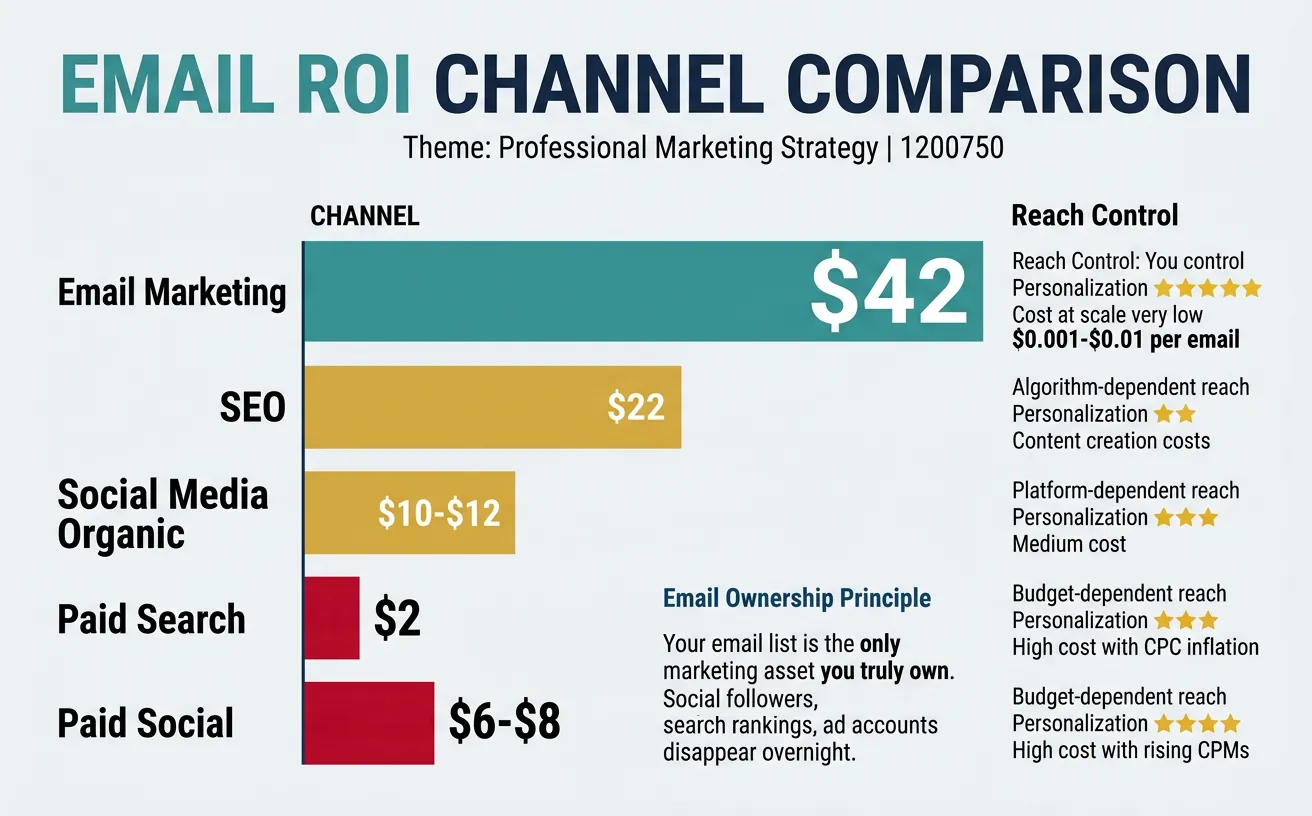
Email marketing consistently delivers the highest ROI of any digital channel—$36 for every $1 spent (DMA, 2024). While social media algorithms change constantly and paid ads get more expensive, email gives you a direct, owned relationship with your audience that no platform can take away.
Email consistently delivers the highest ROI among digital channels at $36 for every $1 spent
The Email Ownership Principle: Your email list is the only marketing asset you truly own. Social media followers, search rankings, and ad accounts can disappear overnight due to algorithm changes, policy updates, or account bans. An email list is your insurance policy—a direct line to your audience that doesn't require paying a gatekeeper for access.
Email Marketing vs. Other Channels
Channel
Avg. ROI
Reach Control
Personalization
Cost at Scale
Email
$36:$1
You control (owned list)
★★★★★
Very low ($0.001-0.01/email)
SEO
$22:$1
Algorithm-dependent
★★☆☆☆
Content creation costs
Social Media
$5-12:$1
Platform-dependent
★★★☆☆
Medium (content + tools)
Paid Search
$8:$1
Budget-dependent
★★★☆☆
High (CPC inflation)
Paid Social
$4-8:$1
Budget-dependent
★★★★☆
High (rising CPMs)
List Building
Your email list is only as valuable as the quality of subscribers on it. A list of 5,000 engaged subscribers who open every email is worth more than 50,000 disengaged contacts who never interact. The key is attraction-based list building—offering something so valuable that the right people willingly give you their email.
The Lead Magnet Framework
A lead magnet is a free resource offered in exchange for an email address. The best lead magnets solve a specific, immediate problem for your target audience. Think of it as a "free sample" that demonstrates your expertise.
Lead Magnet Type
Conversion Rate
Best For
Example
Templates & tools
15-30%
B2B, SaaS, professional services
"Free Marketing Budget Template (Excel)"
Checklists
12-25%
How-to content, processes
"The Ultimate SEO Audit Checklist (47 items)"
Mini-courses
10-20%
Education, coaching, complex topics
"5-Day Email Copywriting Crash Course"
Reports & research
8-15%
B2B, enterprise, thought leadership
"2026 State of SaaS Marketing Report"
Free trials
5-15%
SaaS, software products
"14-day free trial, no credit card required"
Quizzes & assessments
20-40% (highest)
DTC, health, personality-driven
"What's Your Marketing Style? Take the Quiz"
Case Study: HubSpot's List Building Machine
B2B SaaS11M+ Contacts
HubSpot built an email list of 11 million+ contacts by mastering the lead magnet strategy:
Content upgrade strategy: Every blog post has a relevant downloadable resource (blog-specific, not generic)
Free tools: Website Grader, Email Signature Generator, Make My Persona—useful tools that capture leads
Smart forms: Progressive profiling asks one new question each time, building rich profiles over multiple interactions
Key lesson: Don't create one lead magnet—create a system. Match lead magnets to the content topic so the exchange feels natural, not forced.
Segmentation & Personalization
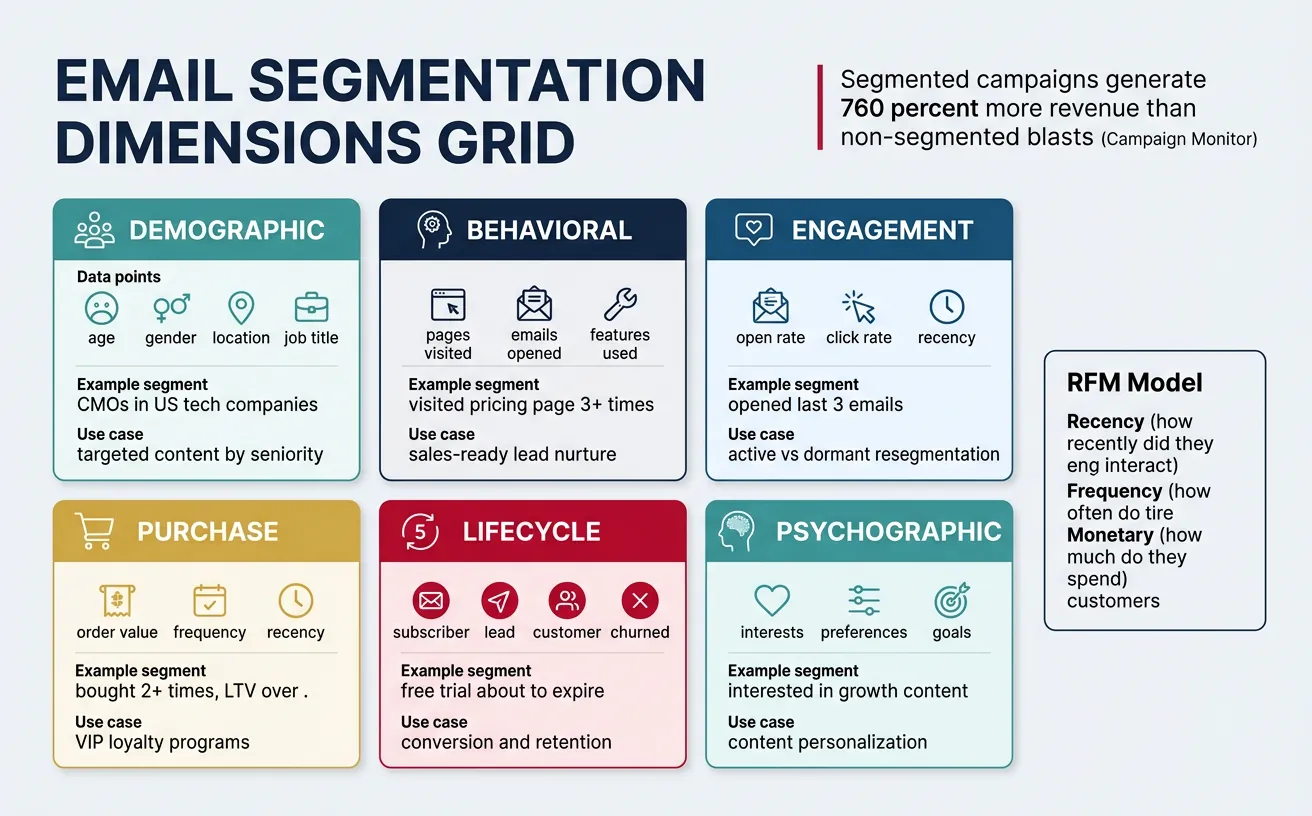
Segmentation is the art of sending the right message to the right person at the right time. Segmented email campaigns generate 760% more revenue than non-segmented blasts (Campaign Monitor). Think of it like a restaurant: instead of serving everyone the same dish, you create a tailored menu based on dietary preferences.
Six segmentation dimensions enable personalized campaigns: demographic, behavioral, engagement, purchase, lifecycle, and psychographic
Segmentation Dimensions
Dimension
Data Points
Example Segment
Use Case
Demographic
Age, gender, location, job title
CMOs in US tech companies
Targeted content by seniority
Behavioral
Pages visited, emails opened, features used
Visited pricing page 3+ times
Sales-ready lead nurture
Engagement
Open rate, click rate, recency
Opened last 3 emails
Active vs. dormant resegmentation
Purchase
Order value, frequency, recency
Bought 2+ times, LTV >$500
VIP loyalty programs
Lifecycle
Subscriber, lead, customer, churned
Free trial about to expire
Conversion and retention
Psychographic
Interests, preferences, goals
Interested in "growth" content
Content personalization
The RFM Segmentation Model: One of the most powerful segmentation frameworks comes from direct mail marketing. Score each customer on three dimensions: Recency (How recently did they interact?), Frequency (How often do they engage?), and Monetary (How much do they spend?). Your highest RFM scores are your best customers—treat them like gold. Your lowest scores need re-engagement or removal.
Marketing Automation
Automation Workflows
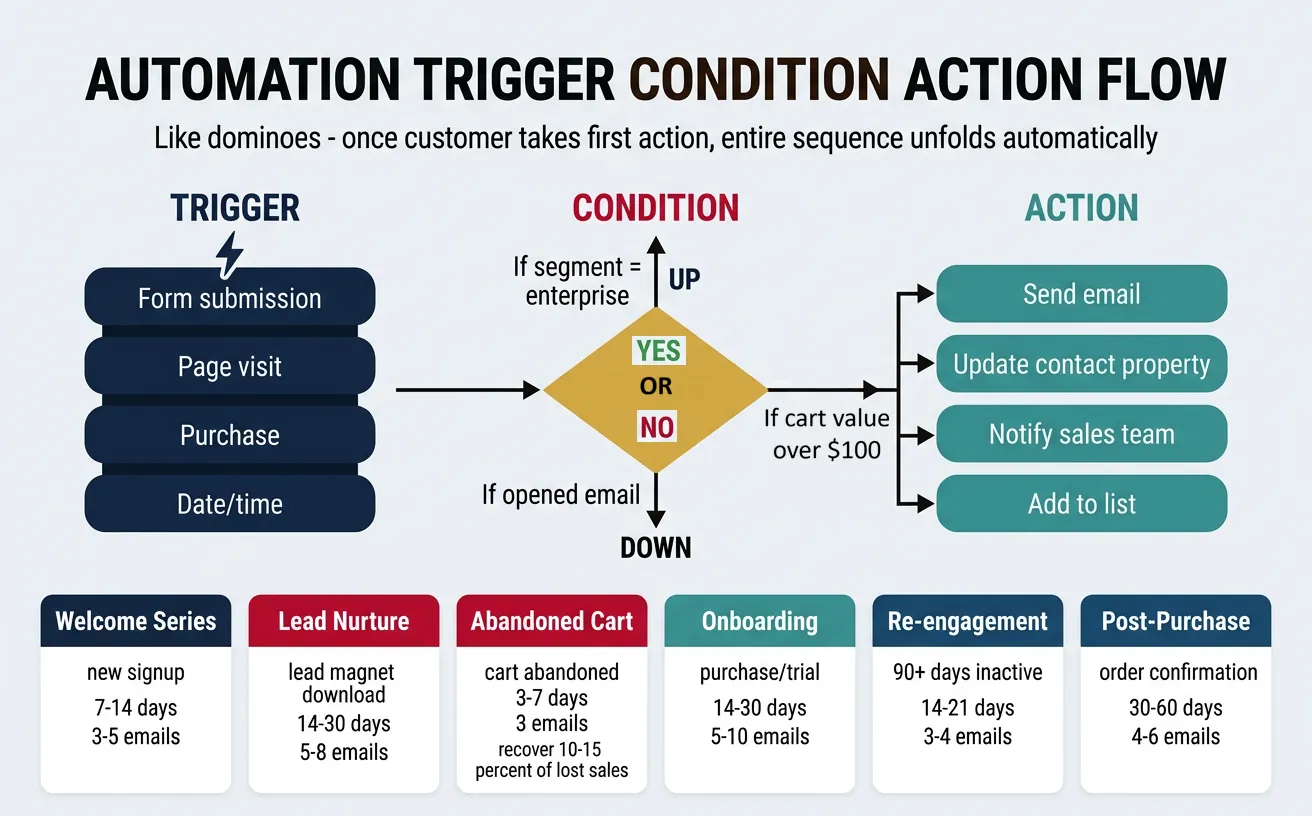
Marketing automation is the practice of using software to execute repetitive marketing tasks automatically based on triggers, conditions, and actions. Think of it like setting up a series of dominoes—once a customer takes the first action (the trigger), the entire sequence unfolds without manual intervention.
Trigger: What starts the workflow? (e.g., form submission, page visit, purchase, date/time)
Condition: What determines the path? (e.g., if segment = enterprise, if opened email, if cart value > $100)
Action: What happens? (e.g., send email, update contact property, notify sales, add to list)
Workflow Type
Trigger
Duration
Emails
Goal
Welcome Series
New subscriber signup
7-14 days
3-5
Build relationship, set expectations
Lead Nurture
Lead magnet download
14-30 days
5-8
Educate and qualify for sales
Abandoned Cart
Cart abandoned without purchase
3-7 days
3
Recover 10-15% of lost sales
Onboarding
Product purchase or trial start
14-30 days
5-10
Drive product adoption
Re-engagement
90+ days of no activity
14-21 days
3-4
Win back or clean list
Post-Purchase
Order confirmation
30-60 days
4-6
Reviews, cross-sell, loyalty
Drip Campaigns
A drip campaign is a pre-written series of emails sent automatically on a schedule. Unlike one-off email blasts, drip campaigns tell a story over time, gradually moving the subscriber toward a desired action. Think of it like a TV series—each episode builds on the last, and there's always a reason to tune in next time.
The Perfect Welcome Sequence (5 Emails)
The Welcome Sequence Blueprint:
Email 1 (Immediately): Deliver the promised lead magnet + set expectations. "Here's your [resource]. Over the next week, I'll share the 3 biggest mistakes I see in [topic]."
Email 2 (Day 2): Share your story and establish credibility. Why should they listen to you? Include a personal anecdote.
Email 3 (Day 4): Deliver high-value content—your best blog post, case study, or insight. No selling.
Email 4 (Day 6): Address the #1 objection or myth in your industry. Show contrarian thinking.
Email 5 (Day 8): Soft CTA—introduce your product/service as the solution to the pain points discussed in emails 1-4.
Key metric: A well-crafted welcome series has 50-80% open rates on Email 1 and 3-5x higher revenue per email than regular campaigns.
Case Study: Basecamp's Anti-Marketing Drip Campaign
SaaS3.5M+ Accounts
Basecamp's onboarding email sequence is a masterclass in educational drip campaigns:
No hard selling: Every email teaches a productivity concept, not product features
Personal from the CEO: Emails come from Jason Fried personally, building parasocial trust
Story-driven: Each email tells a real customer story showing transformation (before/after)
Strategic timing: Emails align with likely usage milestones (day 1, 3, 7, 14 of trial)
Result: Trial-to-paid conversion rate 40% higher than industry average. The sequence feels like advice from a friend, not marketing from a company.
Lifecycle Marketing
Lifecycle marketing maps your email strategy to the customer's journey from stranger to raving fan. Instead of sending the same emails to everyone, each stage has its own set of messages, cadence, and goals.
Stage
Goal
Email Types
Frequency
Key Metric
Awareness
Capture interest
Lead magnets, opt-in incentives
One-time
Opt-in rate
Consideration
Educate & nurture
Drip sequences, case studies
2-3x/week
Click-through rate
Decision
Convert to customer
Offers, trials, demos, urgency
Daily during window
Conversion rate
Onboarding
Drive first value
Setup guides, tips, milestones
3-4x in first week
Activation rate
Retention
Expand & deepen
Cross-sell, upsell, loyalty
Weekly-biweekly
Repeat purchase rate
Advocacy
Generate referrals
Referral programs, reviews, NPS
Quarterly
Referral rate
Win-Back
Re-engage churned
Incentives, "we miss you"
3-4 emails, then stop
Reactivation rate
Email Execution
Design & Copywriting
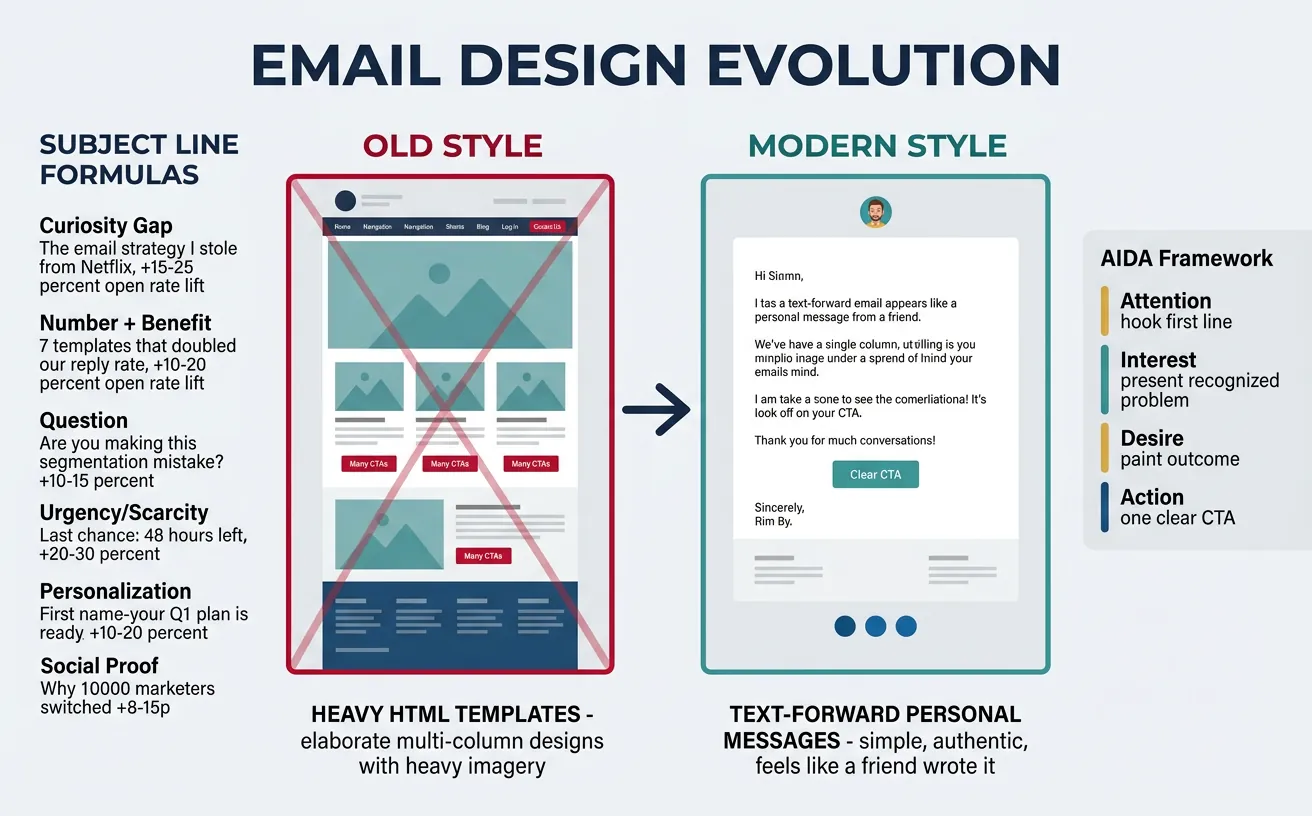
Email design has shifted dramatically. The days of elaborate HTML templates with multiple columns and heavy imagery are over. The highest-performing emails today look like messages from a friend—simple, personal, and text-forward.
Email design has evolved from elaborate HTML templates to simple, text-forward messages that feel personal and authentic
Subject Line Formulas That Convert
Your subject line determines whether your email gets opened. It's the most important line of copy you'll ever write—50% of email success is decided before the email is even opened.
Formula
Example
Why It Works
Open Rate Lift
Curiosity Gap
"The email strategy I stole from Netflix"
Creates information gap brain wants to close
+15-25%
Number + Benefit
"7 email templates that doubled our reply rate"
Specific, scannable, promising value
+10-20%
Question
"Are you making this segmentation mistake?"
Triggers self-reflection, must open to find out
+10-15%
Urgency/Scarcity
"Last chance: 48 hours left for early access"
Loss aversion drives immediate action
+20-30%
Personalization
"[First name], your Q1 marketing plan is ready"
Personal relevance stands out in inbox
+10-20%
Social Proof
"Why 10,000 marketers switched to this tool"
Bandwagon effect reduces risk perception
+8-15%
The AIDA Email Copy Framework:
Attention: Hook in the first line—don't waste it on "Hope you're doing well"
Interest: Present a problem they recognize. "You're sending 10,000 emails a month but only 200 people click. Here's why..."
Desire: Paint the outcome. Show what success looks like with specifics and social proof
Action: One clear CTA. Not three links—one button, one action, one outcome
Deliverability Optimization
Deliverability is the invisible foundation of email marketing. You can write the perfect email, but if it lands in spam, nobody sees it. Email deliverability is like having a good credit score—it takes months to build and seconds to destroy.
The Email Authentication Stack
Protocol
What It Does
Why It Matters
Setup Difficulty
SPF
Declares which servers can send email for your domain
Prevents spoofing, improves trust
Easy (DNS record)
DKIM
Adds cryptographic signature to verify email wasn't altered
Proves authenticity, prevents tampering
Medium (key pair setup)
DMARC
Policy for handling SPF/DKIM failures
Full protection + reporting on abuse
Medium (requires monitoring)
BIMI
Displays brand logo in inbox next to your emails
Visual trust signal, higher open rates
Hard (requires VMC cert)
The Deliverability Checklist (10 Rules):
Authenticate everything: SPF + DKIM + DMARC must be configured
Warm up new domains/IPs: Start with 50 emails/day, increase 20% daily for 4 weeks
Clean your list quarterly: Remove bounces, unsubscribes, and 6-month inactive contacts
Use double opt-in: Confirm subscriptions to prevent spam traps and fake emails
Monitor sender reputation: Check Google Postmaster Tools and SenderScore weekly
Include easy unsubscribe: Required by CAN-SPAM/GDPR, also improves engagement metrics
Text-to-image ratio: Keep at least 60% text, 40% images
Test before sending: Use tools like Mail-Tester or Litmus to preview deliverability
Testing & Optimization
Email A/B testing is the most accessible form of conversion optimization. With large enough lists, you can test multiple variables simultaneously and see results within hours—unlike website tests that might take weeks.
Test Element
Impact Level
Min. Sample Size
What to Measure
Subject line
★★★★★ (highest)
1,000+ per variant
Open rate
Send time
★★★★☆
2,000+ per variant
Open rate, click rate
CTA button
★★★★☆
500+ clicks
Click-through rate
From name
★★★☆☆
1,000+ per variant
Open rate
Email length
★★★☆☆
1,000+ per variant
CTR, conversions
Personalization
★★★☆☆
1,000+ per variant
Open rate, CTR
CRM & Tech Stack
CRM Systems
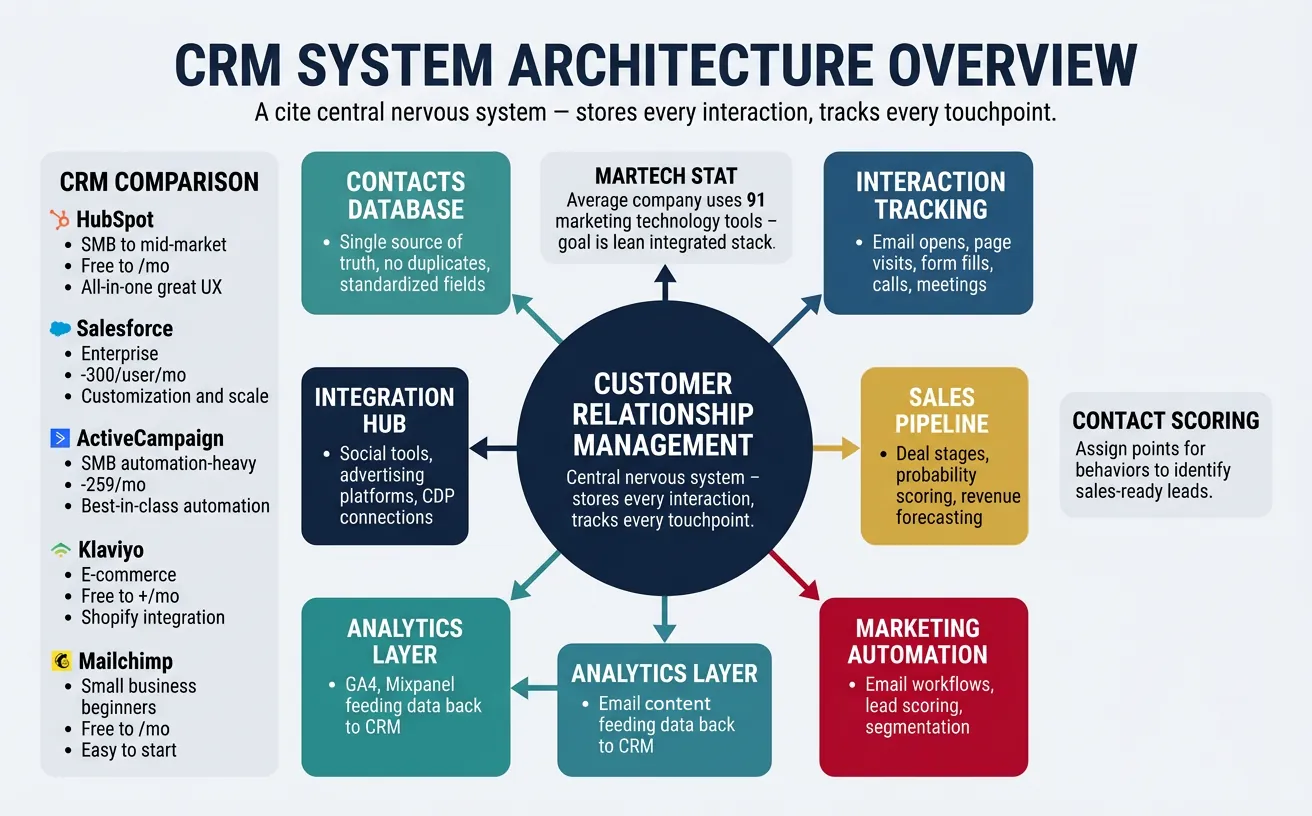
A CRM (Customer Relationship Management) system is the central nervous system of your marketing and sales operations. It stores every interaction, tracks every touchpoint, and enables personalization at scale. Think of a CRM as the "memory" of your business—it remembers every conversation so your team doesn't have to.
A CRM serves as the central nervous system connecting contacts, interactions, pipelines, and marketing automation
CRM Platform
Best For
Email Built-In?
Starting Price
Strengths
HubSpot
SMB to mid-market
Yes (full suite)
Free-$890/mo
All-in-one, great UX, free tier
Salesforce
Enterprise
Via Pardot/Marketing Cloud
$25-$300/user/mo
Customization, ecosystem, scale
ActiveCampaign
SMB, automation-heavy
Yes (best-in-class)
$29-$259/mo
Advanced automation, value
Klaviyo
E-commerce
Yes (e-commerce focused)
Free-$60+/mo
Shopify integration, predictive analytics
Mailchimp
Small business, beginners
Yes
Free-$350/mo
Easy to start, good templates
CRM Data Architecture Best Practices:
Single source of truth: Every contact has one master record—no duplicates
Standardized fields: Use dropdowns over free text for key fields (industry, role, lifecycle stage)
Contact scoring: Assign points for behaviors (email opens, page visits, form fills) to identify sales-ready leads
Property hygiene: Review and clean custom properties quarterly—delete what nobody uses
Integration mapping: Document data flows between CRM, email, website, and sales tools
MarTech Stack
The average company uses 91 marketing technology tools (ChiefMartec, 2024). Most of them overlap, don't integrate well, and create data silos. The goal is a lean, integrated stack—not the most tools, but the right tools connected properly.
Layer
Purpose
Key Tools
Integration Priority
CRM (Core)
Customer data foundation
HubSpot, Salesforce
★★★★★ (everything connects here)
Email/Automation
Communication engine
ActiveCampaign, Klaviyo
★★★★★ (CRM bi-directional)
Analytics
Measurement layer
GA4, Mixpanel
★★★★☆ (feeds CRM)
CDP
Unified customer profiles
Segment, mParticle
★★★★☆ (connects all data)
Social
Social management
Sprout Social, Buffer
★★★☆☆ (CRM sync)
Advertising
Paid channel management
Google Ads, Meta Business
★★★☆☆ (audience sync)
Email Analytics
Email analytics tells you not just what happened, but why it happened and what to do about it. Understanding your metrics in context is the difference between guessing and knowing.
Metric
Good Benchmark
Great Benchmark
If Below Average, Fix
Open Rate
20-25%
30%+
Subject lines, sender name, send time
Click-Through Rate
2.5-3.5%
5%+
CTA clarity, content relevance, design
Click-to-Open Rate
10-15%
20%+
Email body content, CTA placement
Unsubscribe Rate
<0.5%
<0.2%
Frequency, relevance, segmentation
Bounce Rate
<2%
<0.5%
List hygiene, verification, double opt-in
Spam Complaint Rate
<0.1%
<0.05%
Permission practices, easy unsubscribe
Revenue Per Email
Varies by industry
Trending up
Segmentation, offers, timing
The Email Health Dashboard (Track Weekly): Create a simple dashboard tracking 6 key metrics: (1) List growth rate (net new subscribers minus unsubscribes), (2) Average open rate (trending 4-week average), (3) Average CTR, (4) Revenue per email sent, (5) List health score (% of active contacts in last 90 days), (6) Automation performance (conversion rate per workflow).
Email Strategy Canvas
Email Marketing Strategy Canvas
Build your comprehensive email marketing strategy. Download as Word, Excel, PDF, or PowerPoint.
Draft auto-saved
All data stays in your browser. Nothing is sent to or stored on any server.
Practice Exercises
Exercise 1: Welcome Sequence Design
Design a 5-email welcome sequence for a SaaS product targeting marketing managers. For each email, write: (1) the subject line, (2) the opening hook (first 2 sentences), (3) the core message, (4) the CTA, and (5) the timing (when it sends relative to signup).
Exercise 2: Segmentation Strategy
Take an email list of 10,000 subscribers and design 5 meaningful segments based on behavioral and demographic data. For each segment, specify: (a) the segment criteria, (b) estimated size, (c) content preferences, (d) sending frequency, (e) unique email type this segment gets that others don't.
Exercise 3: Automation Workflow Map
Map out a complete abandoned cart automation workflow. Include: (a) trigger event, (b) wait times between emails, (c) conditional branches (e.g., if cart value > $100 vs. < $100), (d) subject lines for each email, (e) escalation rules (when to offer a discount vs. just reminding), (f) exit conditions.
Key Takeaways
8 Essential Email Marketing Principles:
Email delivers $36 for every $1 spent—the highest ROI of any digital marketing channel
Your email list is your only owned asset—unlike social followers, no platform can take it away
Quality over quantity in list building—5,000 engaged subscribers beat 50,000 disengaged contacts
Segmented campaigns generate 760% more revenue—send the right message to the right person
Welcome sequences have 50-80% open rates—they're your highest-impact automation
Deliverability is the invisible foundation—SPF, DKIM, and DMARC are non-negotiable
Subject lines determine 50% of success—test them relentlessly using A/B splits
Your CRM is your business memory—invest in clean data architecture from day one
Continue the Series
Part 6: Social Media & Community Strategy
Master platform strategies, community building, and influencer partnerships.