We use cookies to enhance your browsing experience, serve personalized content, and analyze our traffic.
By clicking "Accept All", you consent to our use of cookies. See our
Privacy Policy
for more information.
Part 18 of 21: Building on marketing finance from Part 17, this article explores the growing intersection of personal branding, thought leadership, and business marketing.
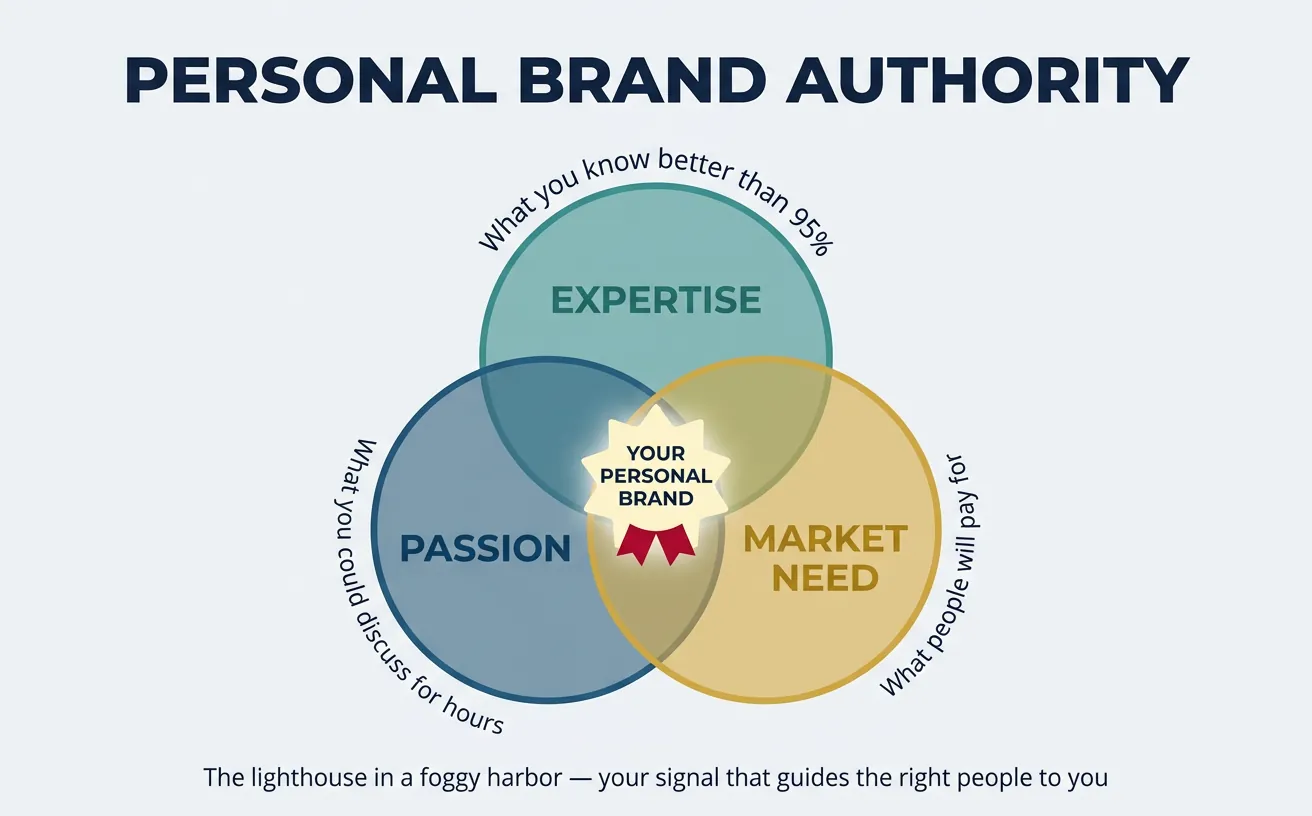
A personal brand is like a lighthouse in a foggy harbor — in a world flooded with content and noise, your brand is the signal that guides the right people to you. While companies can rebrand overnight, personal brands are built on authentic reputation, accumulated over years of consistent value creation.
Personal brand authority building — the intersection of expertise, passion, and market need
B2P (Business-to-Person) Shift: 92% of people trust recommendations from individuals over brands. LinkedIn reports that employee-shared content generates 8× more engagement than company-shared content. The era of faceless corporate marketing is ending — decision-makers follow people, not logos.
Personal Brand Positioning Framework
Your personal brand sits at the intersection of three circles — what you're expert at, what you're passionate about, and what the market needs:
Component
Question to Answer
Example (Marketing Professional)
Expertise
What do you know better than 95% of people?
B2B SaaS growth marketing
Passion
What could you talk about for hours unpaid?
Data-driven decision making
Market Need
What will people pay you or follow you for?
Scaling from $1M to $10M ARR
Unique Angle
What's your contrarian or differentiated take?
"Growth without paid ads — organic-first playbooks"
Proof
What results prove you can deliver?
Scaled 3 SaaS companies past $5M ARR organically
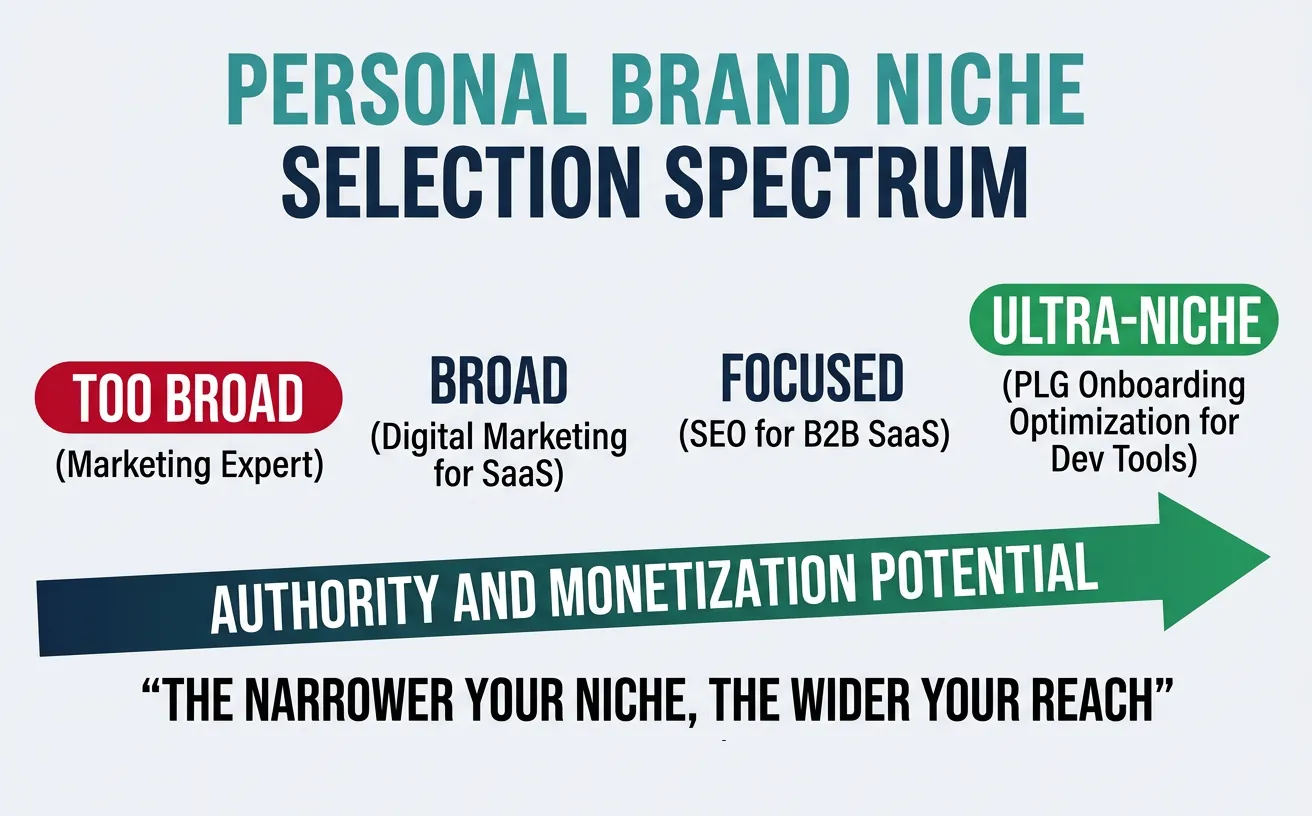
Niche Selection
The paradox of personal branding: the narrower your niche, the wider your reach. General experts attract nobody; specific experts attract everyone in that category:
The Niche Expansion Path: Start niche, expand later. James Clear started as a "habits and behavioral psychology" writer — extremely niche. After building authority, he expanded to productivity, decision-making, and life philosophy. His book Atomic Habits sold 15M+ copies. He couldn't have started broad and achieved that result.
Credibility Building
Authority is built through a credibility stack — each layer reinforces the others:
Credibility Layer
Activities
Impact
Time to Build
1. Results
Case studies, portfolio, revenue numbers
Highest credibility signal
Ongoing
2. Published Work
Books, research papers, original frameworks
Perceived expertise multiplier
6-18 months
3. Speaking
Conferences, podcasts, webinars, panels
Authority by association
3-12 months
4. Teaching
Courses, workshops, mentoring, guest lectures
Deepens expertise perception
3-6 months
5. Community
Active engagement, helping others, answers
Social proof from advocates
6-24 months
6. Media
Press quotes, features, industry awards
Third-party validation
12-36 months
Case Study: Sahil Bloom's Authority Acceleration ($10M+ Creator Business)
Speed to AuthorityMulti-Platform Strategy
The Build (2020-2024): Sahil Bloom went from unknown private equity analyst to one of the most-followed business creators in 4 years:
Niche start: Began with "mental models for investing" — extremely specific, credibility-backed by PE career
Thread mastery: Built 1M+ Twitter following through visual threads on frameworks and mental models
Platform expansion: Newsletter (500K+ subscribers), podcast, Instagram — each reinforcing the others
Credential evolution: The personal brand itself became the credential (speaking fees: $50K-$100K)
Key Lesson: Bloom's strategy shows the flywheel effect — credibility on one platform creates demand on others. His PE background gave initial credibility; consistent content creation multiplied it exponentially.
Content Strategy
Platform Selection
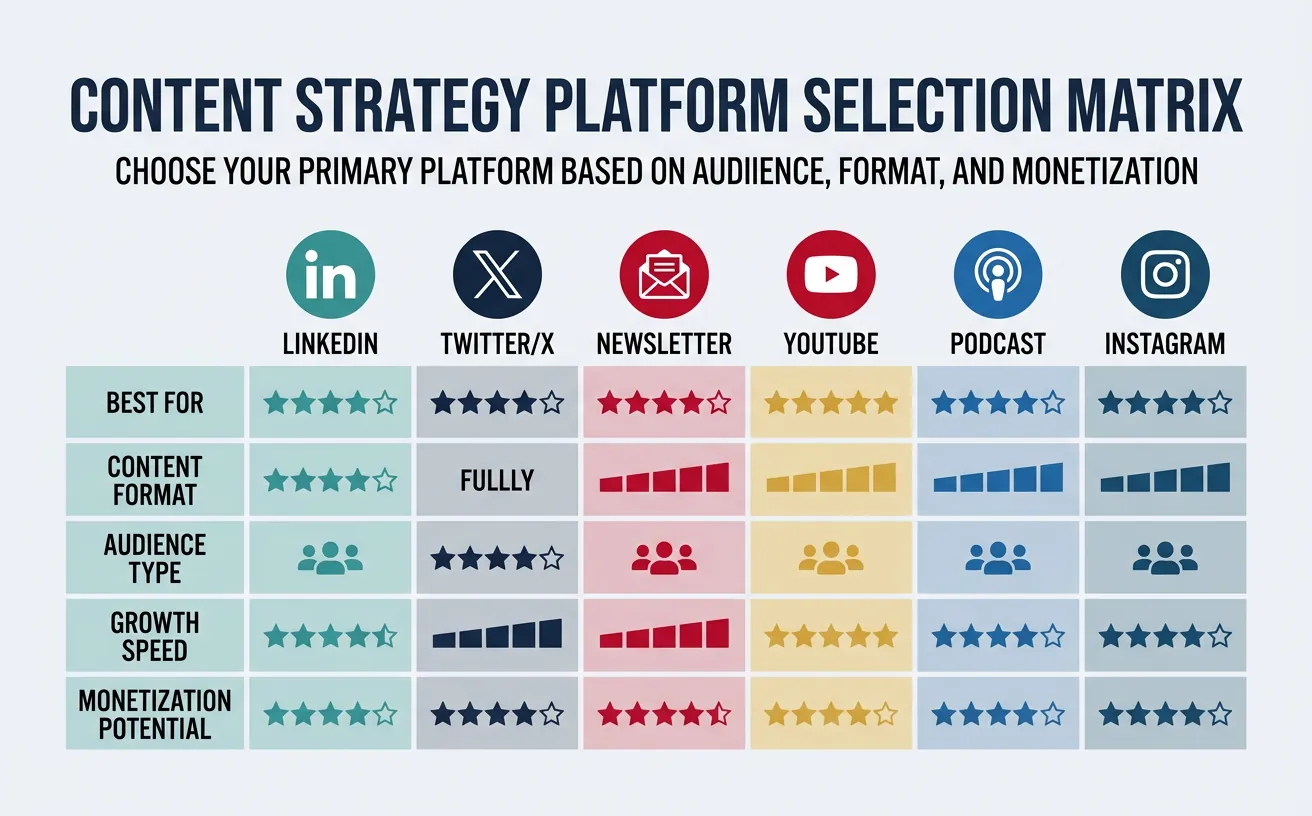
Each platform rewards different content formats and attracts different audiences. Choose your primary platform (80% of effort), then syndicate to secondary platforms:
Platform selection matrix — choose your primary platform based on audience, content format, and monetization potential
Platform
Best For
Content Format
Audience Type
Growth Speed
Monetization
LinkedIn
B2B thought leadership
Text posts, carousels, articles
Professionals, decision-makers
Medium (6-12 months)
Very High (consulting, B2B)
Twitter/X
Real-time insights, threads
Short-form, threads, replies
Tech, finance, media
Fast (3-6 months)
High (sponsorships, products)
Newsletter
Deep content, owned audience
Long-form essays, analysis
Engaged, high-intent readers
Slow (12-24 months)
Very High (sponsorships, products)
YouTube
Educational content
Tutorials, interviews, vlogs
Learners, skill-builders
Slow (12-18 months)
High (AdSense, courses)
Podcast
Conversations, interviews
Audio, 30-60 min episodes
Commuters, multitaskers
Very Slow (18-36 months)
Medium (sponsorships)
Instagram
Visual storytelling
Reels, carousels, stories
Lifestyle, consumer brands
Medium (6-12 months)
Medium (brand deals)
The "Owned Media First" Principle: Social platforms are rented land — algorithms change, accounts get banned, reach gets throttled. Your newsletter/email list is owned real estate. Every creator who's built a sustainable business has an email list. Start building yours from day one, even if you only have 50 subscribers.
Content Pillars
Content pillars are the 3-5 recurring themes that define what you're known for. They create predictability and reinforce positioning:
Pillar Type
Purpose
Example (B2B Growth Expert)
Frequency
Educational (Teaching)
Demonstrate expertise, attract searches
"How to calculate CAC payback period"
2-3× per week
Opinion (Point of View)
Differentiate, spark engagement
"Hot take: Most ABM programs are just targeted spam"
1-2× per week
Story (Personal)
Build connection, humanize brand
"I got fired from my first marketing job. Here's what I learned."
1× per week
Curation (Industry)
Save time for audience, show awareness
"5 marketing reports from this week you should read"
1× per week
Promotion (Products)
Drive revenue, conversions
"My new course on growth strategy is live — here's what's inside"
1× per 2 weeks
The 80/20 Content Rule: 80% of your content should provide value (educate, entertain, inspire) and 20% should promote your products/services. Creators who invert this ratio — 80% selling, 20% value — burn out their audience within 6 months. The value-first approach builds trust that converts at 3-5× higher rates than direct selling.
Audience Growth
Growth Tactic
Mechanism
Expected Impact
Effort Level
Consistent Posting
Algorithm rewards frequency and engagement
Base growth (10-20%/month)
Medium (daily commitment)
Collaboration
Guest appearances, co-created content
Audience crossover (100-1000 per collab)
Medium
Viral Hooks
Contrarian takes, data reveals, trend-jacking
Spikes (10K-100K impressions)
Low (creativity-dependent)
Community Engagement
Reply to comments, engage in conversations
Retention + word-of-mouth
High (time-intensive)
Lead Magnets
Free templates, guides, tools
Email list growth (5-15% conversion)
High (upfront creation)
Cross-Platform Syndication
Repurpose content across platforms
Multi-platform reach at low incremental cost
Low
Case Study: Justin Welsh's One-Person Business ($5M+/yr Revenue)
Solo CreatorLinkedIn-First Strategy
The Model (2019-2024): Justin Welsh built a $5M+/year one-person business with zero employees using just LinkedIn and a newsletter:
Content system: 1 LinkedIn post/day using the "hook → story → lesson" framework, written in 30-minute batches
Niche: "Building a one-person internet business" — specific enough to own, broad enough to monetize
Monetization: Two digital products ($150 course + $750 operating system), newsletter sponsorships ($10K+/week)
Key metric: >90% profit margin (no team, no office, minimal tools — ~$100K/year in expenses on $5M+ revenue)
Key Lesson: Welsh proves that consistency beats creativity. He posts every single day, uses proven frameworks (not inspiration), and treats content creation as a system, not an art form.
Monetization
Business Models
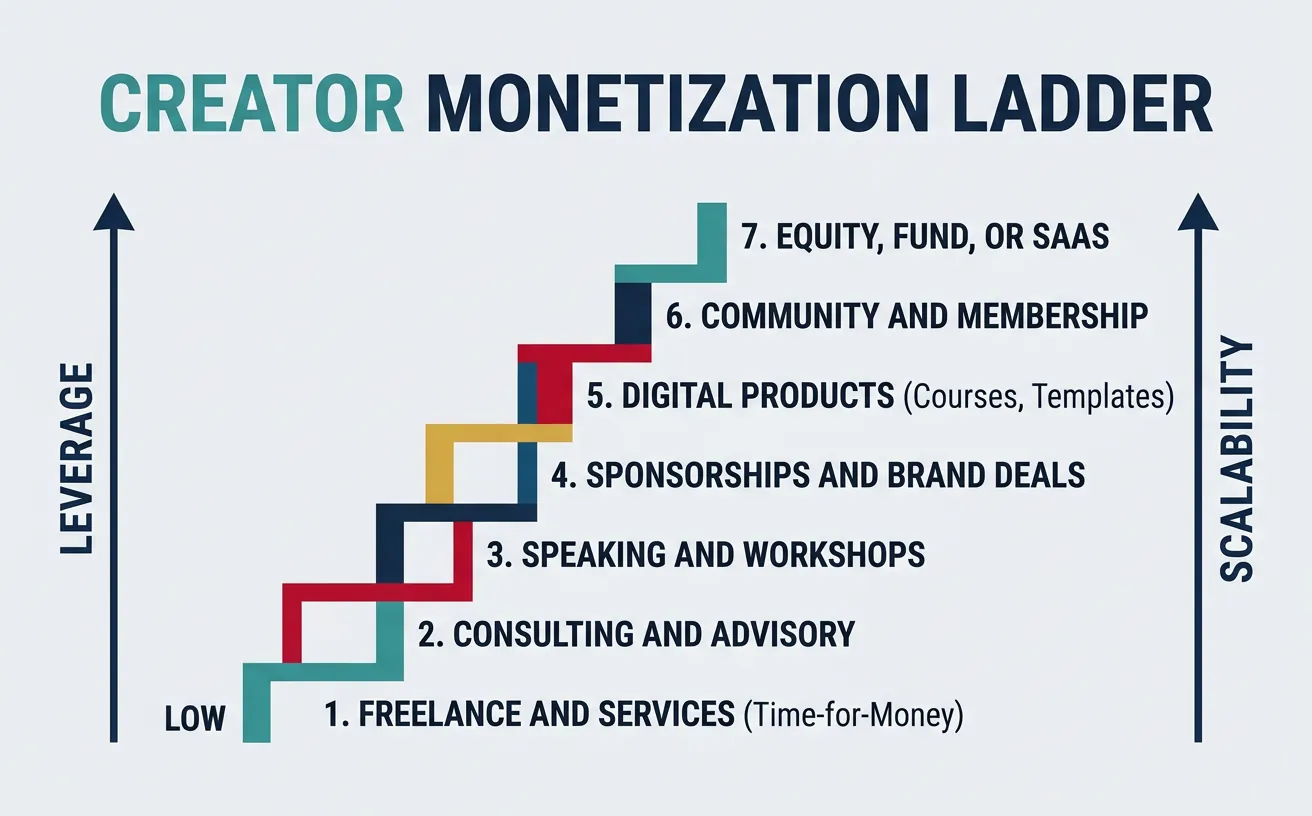
The monetization ladder shows how creators progress from low-leverage to high-leverage revenue — each step up increases income while reducing time per dollar earned:
Creator monetization ladder — progressing from time-for-money to leveraged revenue streams
Rung
Revenue Model
Leverage
Revenue Potential
Time per $ Earned
1 (Bottom)
Freelance/Services
Very Low
$50K-$200K/yr
High (trading time for money)
2
Consulting/Advisory
Low
$150K-$500K/yr
Medium-High
3
Speaking & Workshops
Medium
$100K-$500K/yr
Medium
4
Sponsorships & Brand Deals
Medium-High
$200K-$1M/yr
Medium-Low
5
Digital Products (courses, templates)
High
$500K-$5M/yr
Low (create once, sell forever)
6
Community/Membership
High
$500K-$5M/yr
Low-Medium (ongoing hosting)
7 (Top)
Equity/Fund/SaaS
Very High
$1M-$50M+/yr
Very Low (compounding)
Revenue Stacking: The most successful creators don't choose one model — they stack 3-4 layers simultaneously. A typical $2M/year creator business might look like: Newsletter sponsorships ($600K) + Course sales ($800K) + Advisory/consulting ($400K) + Speaking ($200K). Each layer reinforces the others.
Products & Services
Product Type
Price Range
Creation Effort
Margin
Key Success Factor
E-Book / Guide
$9-$49
2-4 weeks
95%+
Lead magnet → paid upgrade path
Templates / Playbooks
$29-$199
1-2 weeks
95%+
Solve specific workflow problem
Self-Paced Course
$99-$997
4-8 weeks
90%+
Transformation promise + social proof
Cohort-Based Course
$500-$5,000
6-12 weeks prep
60-80%
Community + accountability + live teaching
Coaching (1:1)
$200-$1,000/hr
Ongoing
85%+
Personalized attention + proven results
Membership Community
$29-$199/month
Ongoing hosting
70-85%
Peer network + exclusive content
SaaS Tool
$29-$499/month
6-12 months dev
60-80%
Solves problem your audience has
Sponsorships & Brand Deals
Sponsorships become viable at 5,000+ newsletter subscribers or 10,000+ social followers in a B2B niche (consumer niches require 10×-50× more audience).
Sponsorship Type
Pricing Model
Typical Rate (B2B)
Pros
Cons
Newsletter Sponsor
CPM ($30-$60 B2B) or flat fee
$1K-$20K per issue
Predictable, scalable with list size
Need consistent send schedule
Social Post Sponsor
Flat fee per post
$500-$10K per post
Quick to produce
One-time exposure, low shelf life
Podcast Sponsor
CPM ($25-$50) or flat
$1K-$15K per episode
High trust, host-read >> pre-roll
Need 1K+ downloads/episode
YouTube Integration
Flat fee or revenue share
$2K-$50K per video
Long shelf life (evergreen content)
High production expectations
Long-Term Ambassador
Monthly retainer + equity/commission
$5K-$50K/month
Stable income, deeper relationship
Exclusivity limits, brand dilution risk
The 3-Question Sponsorship Filter: Before accepting any sponsor, ask: (1) Would I recommend this product even without payment? (2) Does this brand serve my audience's needs? (3) Does the deal value reflect my actual influence? If any answer is "no," decline. Your audience's trust is worth more than any single sponsorship check — lose it, and no brand will want you.
Case Study: The Hustle → HubSpot Acquisition ($27M Exit)
Newsletter EmpireCreator Exit
The Journey (2016-2021): Sam Parr built The Hustle from a side project to a $27M acquisition by HubSpot:
Content-first: Daily business newsletter written in a conversational, entertaining style — differentiated from dry business news
Growth hacking: Used referral programs (refer friends → unlock rewards) to grow to 1.5M+ subscribers
Revenue diversification: Newsletter sponsorships ($5M+/yr) + Trends (paid research subscription, $299/yr) + Hustle Con (events)
Acquisition logic: HubSpot acquired audience attention because building their own media brand organically would cost 5-10× more
Post-acquisition: Newsletter grew to 2.5M+ subscribers under HubSpot, proving the brand's durability beyond the founder
Key Lesson: Media assets powered by personal brand can become acquirable businesses. The audience relationship — not the content itself — is the valuable asset.
Creator Economics
Creator Unit Economics
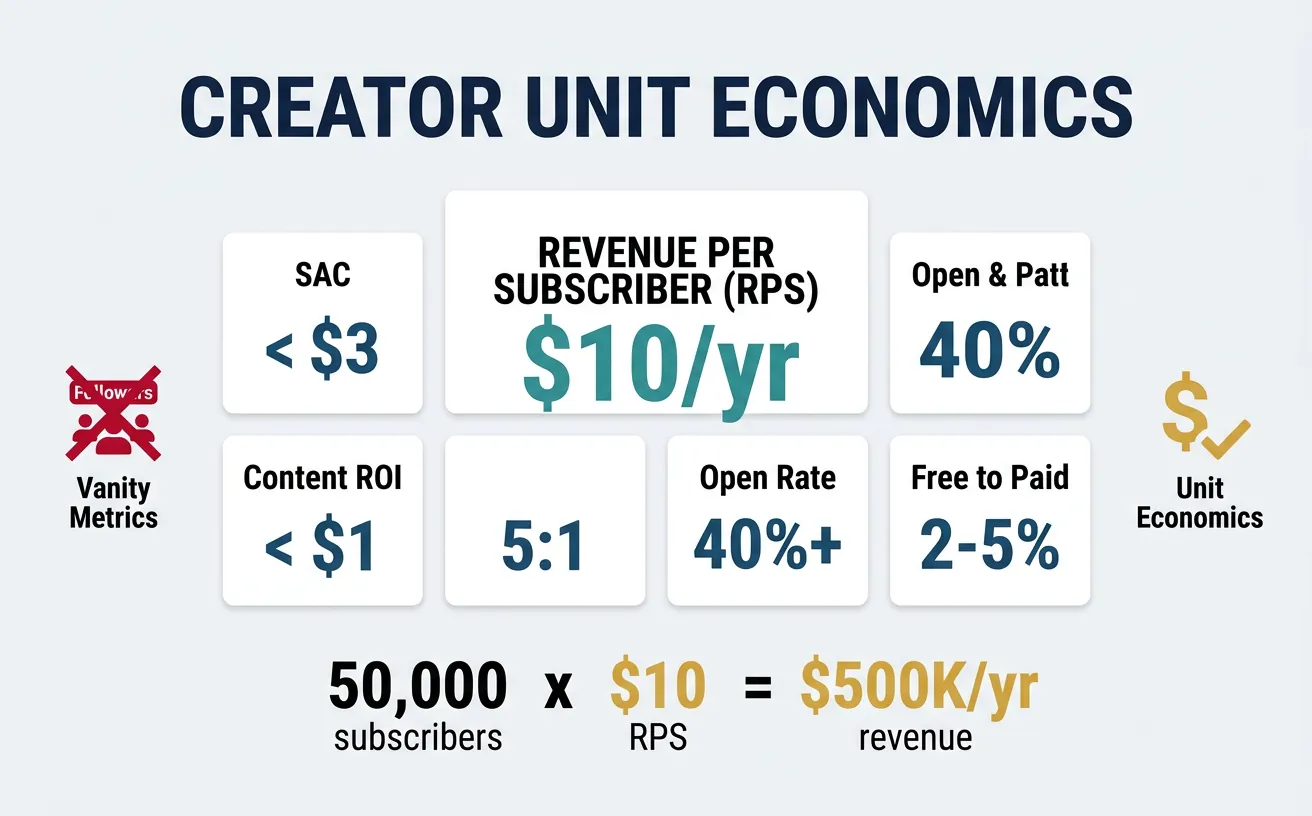
Most creators think in follower counts. Successful creator-entrepreneurs think in revenue per subscriber (RPS) — the single most important metric for a creator business:
Creator unit economics — revenue per subscriber is the most important metric for a creator business
Delegate operations, focus on high-leverage creation
$1M-$5M
3-8 team members
Head of content, marketing, sales/partnerships
Scale products, diversify revenue streams
$5M+
8-20+ team
COO, full content team, product team
Build media company, multiple verticals
Business Sustainability
Risk
Mitigation Strategy
Priority
Platform Dependency
Build email list (owned audience), multi-platform presence
Critical
Creator Burnout
Batch content creation, hire team, take scheduled breaks
Critical
Revenue Concentration
No single revenue stream > 40% of total income
High
Audience Fatigue
Evolve content pillars, launch new formats, refresh positioning
Medium
Reputational Risk
Content review process, clear values/boundaries, crisis response plan
High
Algorithm Changes
Diversified distribution, SEO-driven content, owned media
Medium
Case Study: Ali Abdaal — From Doctor to $5M+/yr Creator ($100M+ Media Company Vision)
YouTube-FirstMedia Company Scale
The Evolution (2017-2024): Ali Abdaal built one of the most successful creator businesses, transitioning from NHS doctor to full-time creator to media CEO:
Platform mastery: 5M+ YouTube subscribers built through study tips → productivity → entrepreneurship → creative business advice
Team scaling: Grew from solo creator to 15+ person team (editors, producers, operations, marketing)
Niche evolution: Started niche (med student study tips) → expanded (productivity) → expanded again (building a creative business) — each evolution retained 60%+ of existing audience
Key decision: Left medicine at ~$2M/yr creator revenue — proving the risk/reward calculation for niche career transitions
Key Lesson: Abdaal demonstrates the creator scaling path: solo → team → media company. His willingness to evolve niches (while maintaining core positioning around "making life better") kept growth compounding over 7 years.
Tools & Practice
Personal Brand Canvas
Map your personal brand strategy. Download as Word, Excel, PDF, or PowerPoint.
Draft auto-saved
All data stays in your browser. Nothing is sent to or stored on any server.
Practice Exercises
Exercise 1: Define Your Positioning
Create your personal brand positioning statement:
List your top 3 areas of expertise (what you know better than 95% of people)
Identify the specific audience who would benefit most from your knowledge
Define your unique angle (what makes your perspective different from existing voices)
Write a positioning statement: "I help [audience] achieve [outcome] by [unique method]"
Test it: Can a stranger understand in 10 seconds what you do and for whom?
Exercise 2: Build Your Content System
Design your weekly content production system:
Choose your primary platform and posting frequency (start with 3-5 posts/week minimum)
Define 3-4 content pillars with example topics for each
Create a one-week content calendar with specific topics mapped to pillars
Design your repurposing workflow (e.g., long-form → social posts → newsletter)
Set up tracking: follower growth rate, engagement rate, and email subscribers added/week
Exercise 3: Plan Your Monetization Stack
Design a revenue model for your personal brand:
Map your monetization ladder (which rungs are accessible now vs. in 12 months?)
Calculate your revenue per subscriber target: Annual revenue goal ÷ Expected subscribers
Design your first paid product (course, template, consulting package) with pricing
Identify 3 potential sponsors who serve your audience and estimate CPM rates
Build a 12-month revenue forecast with bull/base/bear scenarios
Key Takeaways
8 Personal Branding Essentials:
Start niche, expand later — the narrower your focus, the faster you build authority and the higher you can charge
Build on owned media — grow your email list from day one; social platforms are rented land with algorithm risk
Follow 80/20 content rule — 80% value (teach, inspire, entertain), 20% promotion for sustainable audience growth
Consistency beats creativity — post daily, use proven frameworks, treat content as a system not an art
Stack revenue streams — combine 3-4 monetization layers; no single stream should exceed 40% of total income
Track revenue per subscriber — the most important creator metric; target $5-$15/yr RPS as a starting goal
Build your credibility stack — results → published work → speaking → teaching → community → media coverage
Scale intentionally — hire for leverage (editor, VA, ops), keep the founder's voice authentic as you grow the team