We use cookies to enhance your browsing experience, serve personalized content, and analyze our traffic.
By clicking "Accept All", you consent to our use of cookies. See our
Privacy Policy
for more information.
Part 14 of 21: Building on pricing strategy from Part 13, this article explores distribution—how to get your product into the hands of customers through the right channels and partnerships.
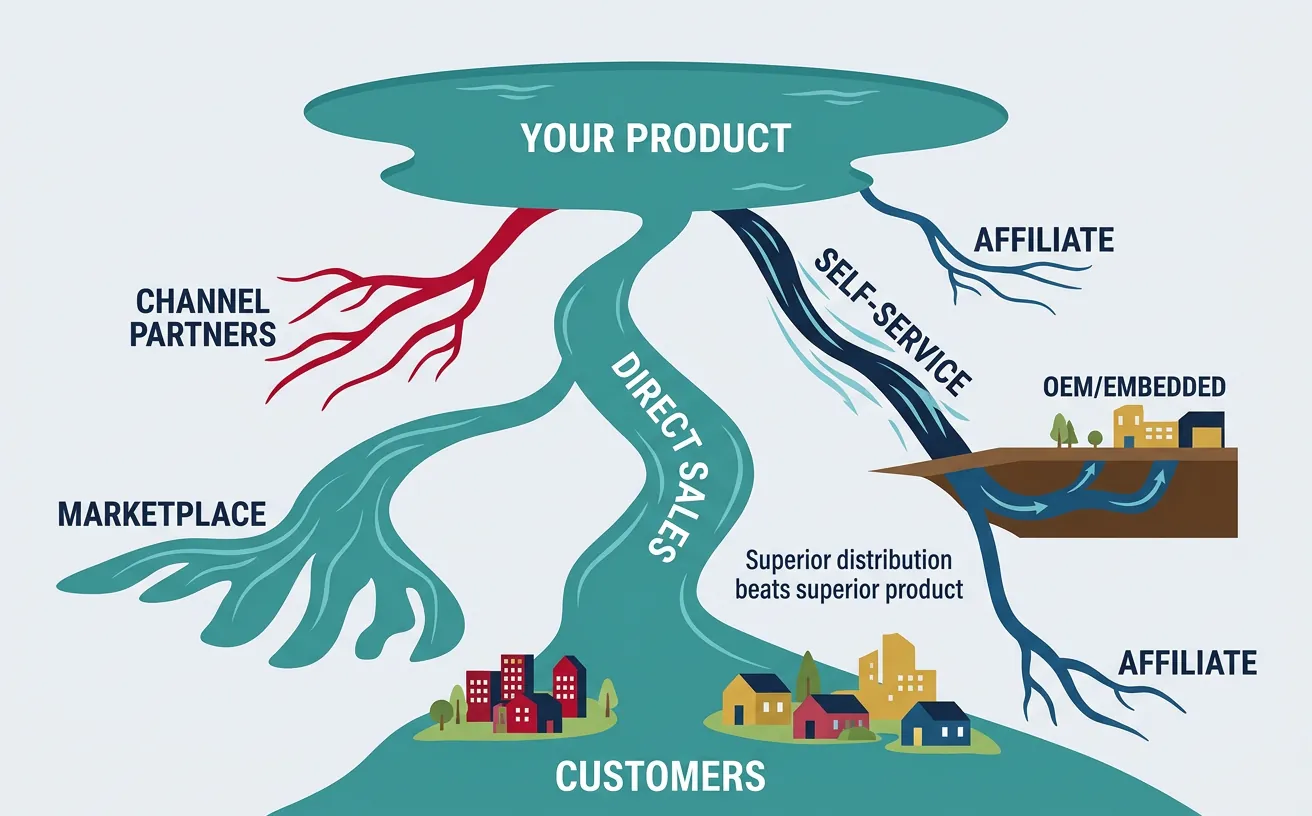
Distribution is the bridge between your product and your customer. Think of it like a river system: your product is the water source, channels are the rivers and tributaries, and customers are the communities that need the water. A brilliant product with poor distribution is like a pristine lake with no outflow — all that value just sits there while customers go thirsty downstream.
Distribution channels act like a river system, carrying your product's value from source to the customers who need it
The Distribution Advantage: Peter Thiel noted that most startups fail because of distribution, not product. Superior distribution routinely beats superior product. Microsoft didn't have the best spreadsheet — Excel won because it came bundled with Office. Google Chrome wasn't the first browser — it won because Google distributed it through 1 billion search pages. The product that reaches the customer wins.
Channel Type
How It Works
Best For
Example
Direct Sales
Your team sells directly to end customers
High-ACV enterprise ($50K+)
Salesforce field sales team
Self-Service
Customers buy online, no human interaction
SMB/PLG with low-touch onboarding
Slack, Canva, Notion free tiers
Channel Partners
Resellers/VARs add your product to their bundle
Geographic/vertical expansion
Microsoft partner network (400K+)
Marketplace
Listing on platform marketplaces (AWS, Shopify)
SaaS products with platform dependencies
Datadog on AWS Marketplace
Affiliate
Third parties drive traffic for commission
Consumer/prosumer with clear attribution
Amazon Associates, HubSpot affiliates
OEM/Embedded
Your tech is white-labeled inside another product
Infrastructure/API products
Stripe powering Shopify Payments
Direct vs Indirect Distribution
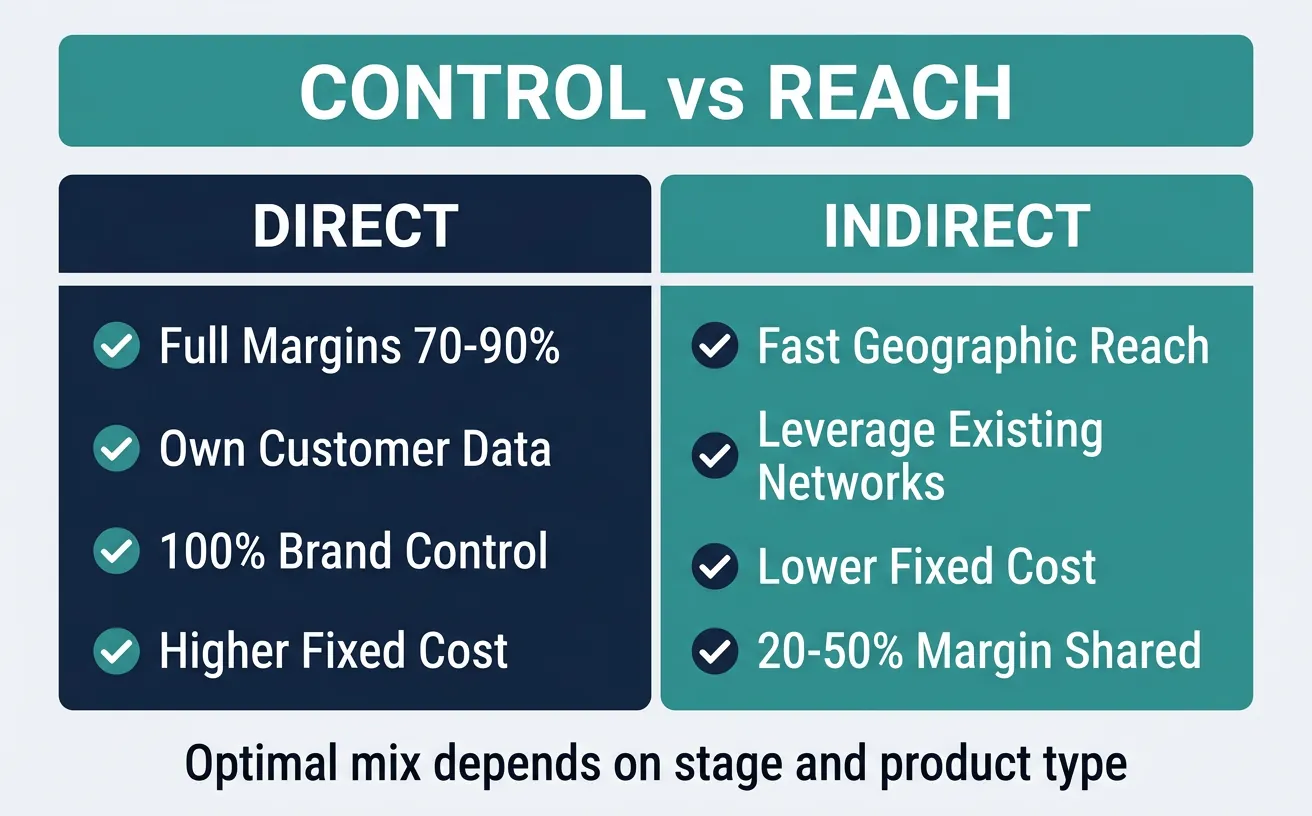
The decision between direct and indirect distribution is fundamentally about control vs. reach. Direct channels give you control over pricing, messaging, and customer relationships — but they're expensive and slow to scale. Indirect channels give you instant reach through existing networks — but you surrender margins and customer intimacy.
Direct distribution offers control and margins while indirect distribution provides reach and speed — the optimal mix depends on your stage and product
Dimension
Direct Distribution
Indirect Distribution
Customer Relationship
You own it — data, feedback, renewals
Partner owns it — limited visibility
Margins
Full margin retained (70-90%)
20-50% margin shared with partners
Scale Speed
Slow — requires hiring + training
Fast — leverage existing networks
Geographic Reach
Limited to where you have presence
Global through local partners
Brand Control
100% control over messaging
Variable — depends on partner quality
CAC
Higher fixed cost, lower variable cost at scale
Lower fixed cost, higher variable (commissions)
Channel Economics
The Channel Economics Formula: Net Channel Revenue = Gross Revenue − Partner Margin − Channel Management Cost − Support Escalation Cost. A channel partner selling a $100K deal at 30% margin with $5K management overhead and $3K support cost delivers $62K net revenue. Compare this to a direct AE selling the same deal at $80K fully-loaded cost (salary + commission + overhead) — the direct sale delivers only $20K contribution. Channel wins when volume compensates for margin compression.
Case Study: Shopify's Channel-First Distribution
Multi-Channel$7.1B Revenue
Challenge: Shopify needed to reach millions of small merchants worldwide without building a massive direct sales force.
Strategy: They built the most powerful partner ecosystem in e-commerce. Shopify Partners (agencies, developers, designers) earn revenue by building stores, creating themes, and referring merchants. The app marketplace has 8,000+ apps from independent developers. Shopify Collabs connects merchants with influencers for distribution.
Results: Partners referred 30%+ of all new merchants. The partner ecosystem generated $4.4B in partner revenue (more than Shopify's own subscription revenue). Over 1.2M+ developers use Shopify APIs. Merchant count grew to 4.6M+ stores globally, with Shopify powering 10% of all US e-commerce.
Affiliate Marketing
Program Design
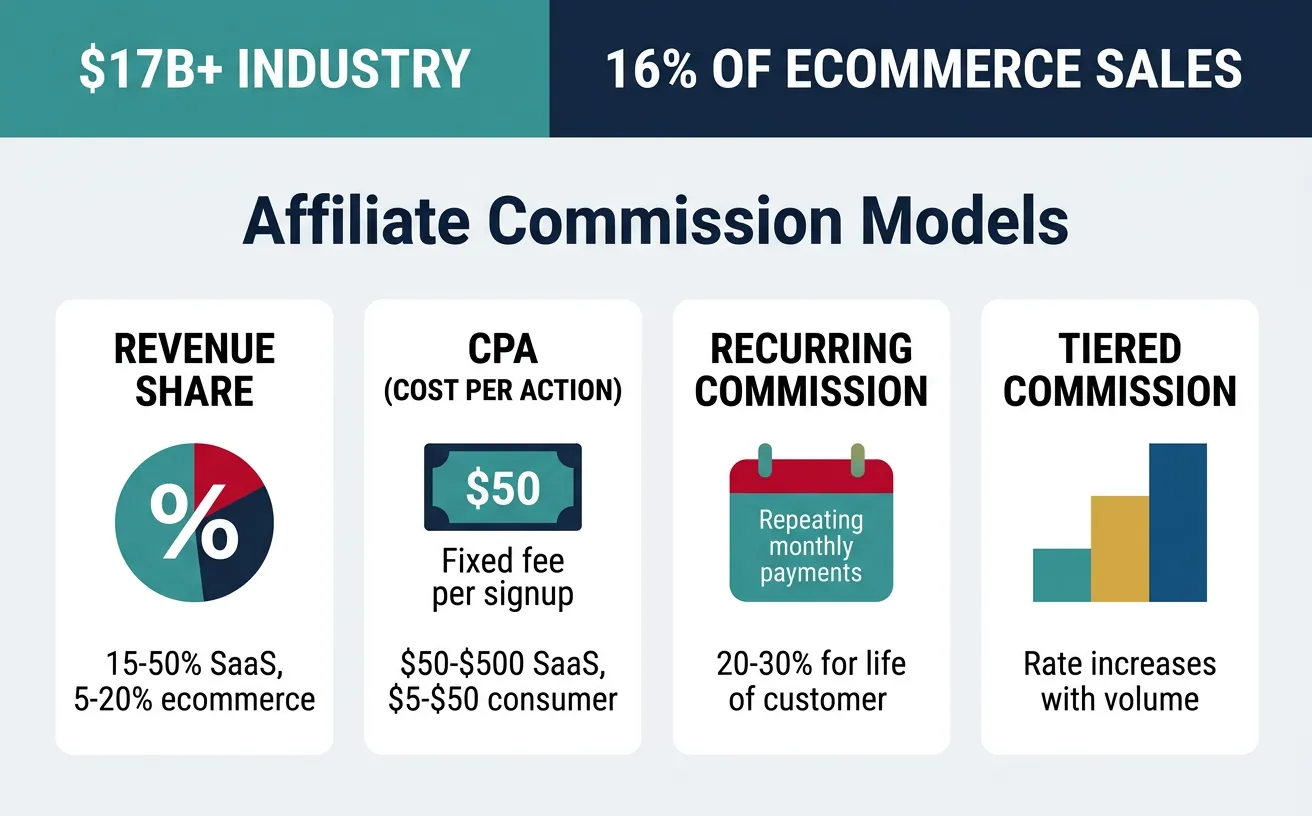
Think of affiliate marketing as hiring a commission-only sales force that costs nothing until they produce results. Unlike paid advertising where you pay upfront and hope for conversions, affiliates bear the risk of customer acquisition. You only pay when they deliver a qualified lead or sale. The affiliate industry is worth $17B+ globally (Statista 2024) and drives 16% of all e-commerce sales in the US.
The four primary affiliate commission models, each suited to different product types and growth objectives
Commission Model
How It Works
Typical Rate
Best For
Revenue Share
% of sale price for each referral
15-50% for SaaS, 5-20% for e-commerce
Subscription products, recurring revenue
CPA (Cost Per Action)
Fixed fee for each signup/purchase
$50-$500 for SaaS, $5-$50 for consumer
Transactional products, clear conversion point
Recurring Commission
% of subscription revenue every month
20-30% for life of customer
High-LTV SaaS with low churn
Tiered Commission
Rate increases with volume milestones
20% base → 30% at 50+ referrals/month
Scaling programs with power-law affiliates
Hybrid
Upfront CPA + recurring % afterward
$100 CPA + 15% recurring
Attracting affiliates with immediate reward + long-term income
Affiliate Recruitment
The 80/20 Rule of Affiliates: In most programs, 5% of affiliates drive 90%+ of revenue. The key isn't recruiting more affiliates — it's finding and nurturing "super affiliates" who have large, engaged audiences in your target market. One tech blogger with 500K monthly readers outperforms 1,000 casual bloggers combined. Focus your recruitment on quality, not quantity.
Program Management
Case Study: HubSpot's Affiliate Program
Affiliate Marketing$2.17B Revenue
Challenge: HubSpot needed to reach SMBs globally without scaling their direct sales team proportionally.
Strategy: They built one of the most successful B2B affiliate programs by combining 30% recurring commission for up to 1 year with exceptional affiliate enablement. Affiliates receive custom landing pages, content templates, demo videos, and dedicated partner managers. The program spans marketing bloggers, business coaches, and digital agencies.
Results: HubSpot's affiliate and partner channels drive 40%+ of new customer acquisition. Top affiliates earn $50K+/month in recurring commissions. The program's success helped HubSpot scale from $883M to $2.17B revenue while keeping CAC payback period under 16 months. Partner-sourced deals also showed 35% higher retention than direct acquisition.
Strategic Partnerships
Partner Types
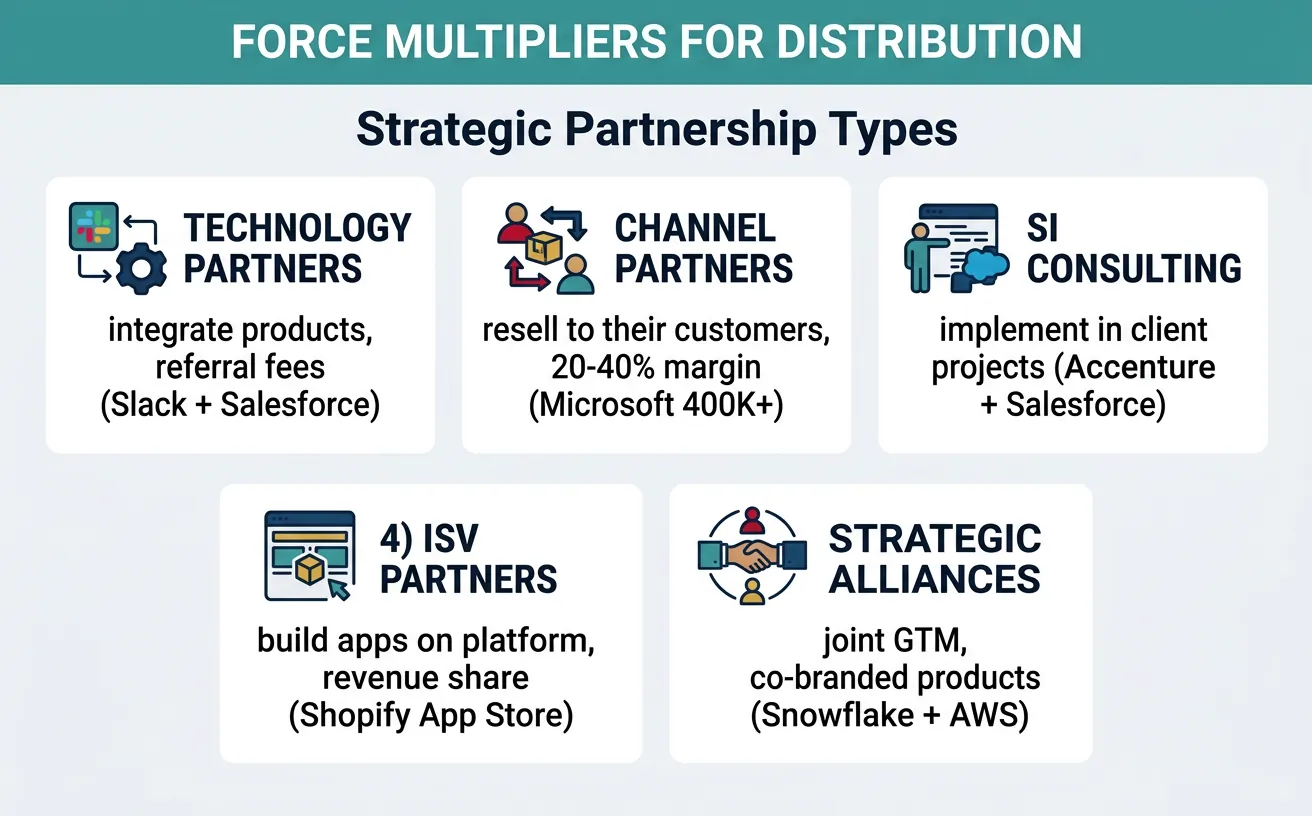
Strategic partnerships are force multipliers for distribution. Think of them like alliances in chess — each partner brings pieces you don't have, and together you control more of the board than either could alone. The right partnership can deliver 10x the reach of any organic growth effort.
Strategic partnerships act as force multipliers — each partner type brings unique distribution value to the relationship
Partner Type
Value Exchange
Revenue Model
Example
Technology Partners
Integrate products for mutual value
Referral fees, co-sell revenue share
Slack + Salesforce integration
Channel/Reseller Partners
Sell your product to their customer base
20-40% margin on resold deals
Microsoft partner network (400K+ partners)
SI / Consulting Partners
Implement your product as part of client projects
Referral fee + implementation revenue
Accenture implementing Salesforce
ISV Partners
Build applications on your platform
Revenue share on app sales, ecosystem lock-in
Apps built on Shopify, Salesforce AppExchange
Strategic Alliances
Joint GTM for shared market opportunity
Joint deals, co-branded products
Snowflake + AWS co-sell program
Partner Programs
The Partner Tier Framework: Most successful partner programs use 3-4 tiers (e.g., Silver/Gold/Platinum/Diamond) based on revenue contribution, certifications, and customer satisfaction. Each tier unlocks more benefits — higher margins, leads, co-marketing funds, dedicated partner managers, and logo placement. Salesforce's partner program generates $6.19 of partner ecosystem revenue for every $1 of Salesforce cloud revenue — a 6.19:1 ecosystem multiplier that makes their platform irreplaceable.
Co-Marketing
Case Study: Snowflake + AWS Partnership
Strategic Alliance$2.8B Revenue
Challenge: Snowflake needed rapid enterprise distribution but competed with AWS's own data warehouse (Redshift). How do you partner with your competitor?
Strategy: Snowflake embraced "co-opetition" — partnering with AWS while competing against Redshift. They listed on AWS Marketplace, enabling customers to use existing AWS commits for Snowflake purchases. They co-sold with AWS sales teams, sharing pipeline data. AWS earned marketplace commissions, and Snowflake got access to AWS's 100K+ enterprise accounts.
Results: AWS Marketplace became Snowflake's fastest-growing channel, contributing 20%+ of new bookings. Marketplace deals closed 40% faster because they used existing AWS budgets. Snowflake scaled to $2.8B revenue with 573 customers spending $1M+, largely powered by cloud marketplace distribution.
Ecosystem Positioning
Marketplace Strategy
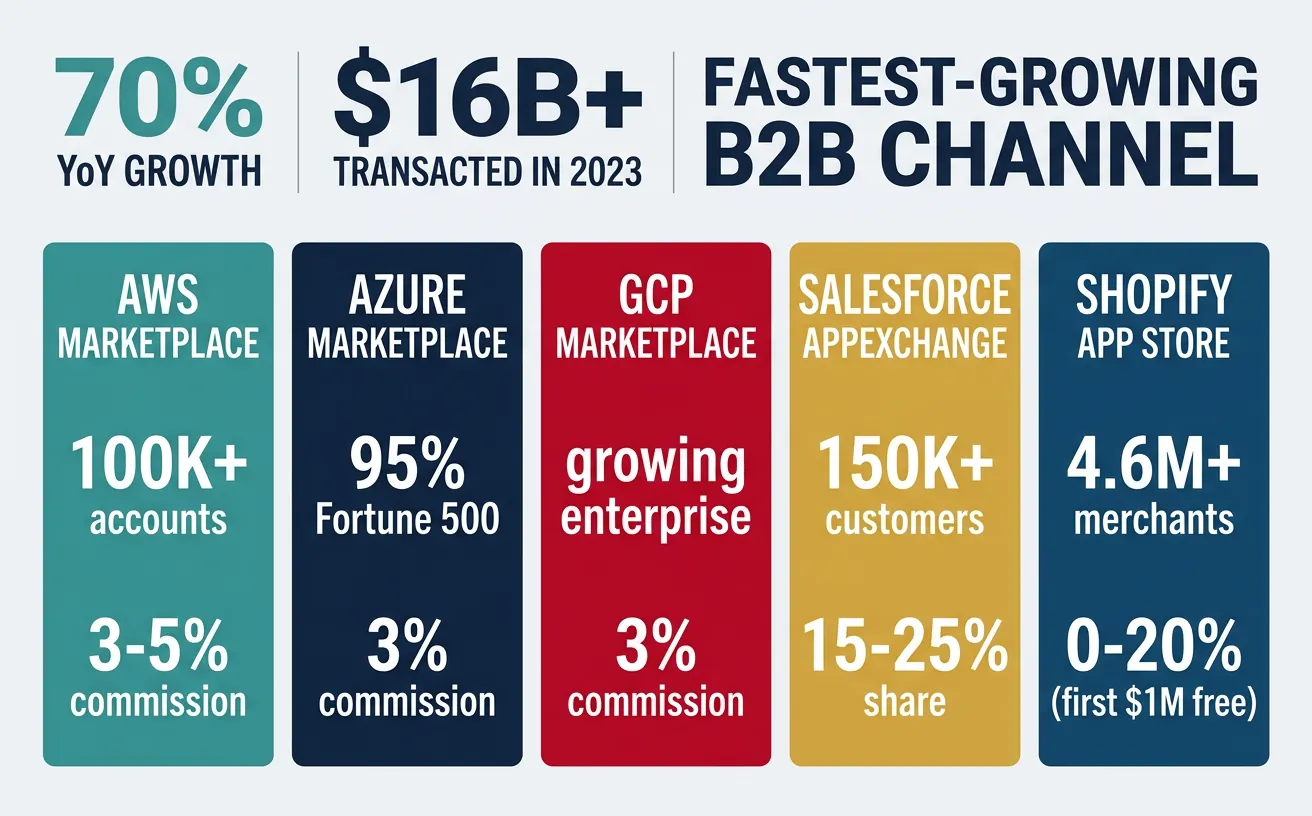
Cloud marketplaces are the fastest-growing distribution channel in B2B SaaS. Think of them as the Amazon of enterprise software — buyers can discover, trial, and purchase software using pre-committed cloud budgets. Tackle.io reports that marketplace transactions grew 70% YoY and $16B+ in software was transacted through cloud marketplaces in 2023.
Cloud marketplaces have become the fastest-growing B2B distribution channel, enabling procurement through pre-committed budgets
The Integration Moat: Products with 7+ active integrations have 3x lower churn than standalone products (Crossbeam data). Each integration is a switching cost — customers won't leave because they'd have to rebuild all their connected workflows. Zapier processes 2.2B+ tasks per month connecting 6,000+ apps, demonstrating that integration itself is a distribution strategy. Build your product into the customer's daily workflow stack, and you become infrastructure — invisible but indispensable.
Platform Positioning
Case Study: Salesforce AppExchange Ecosystem
Platform Ecosystem$34.9B Revenue
Challenge: Salesforce needed to become the indispensable operating system of business — not just a CRM, but a platform that companies build their entire operation on.
Strategy: They created AppExchange (the "App Store for enterprise") with 7,000+ apps, and invested billions in the partner ecosystem. The key insight was the platform gravity model: every app that integrates with Salesforce makes Salesforce harder to leave. They created Trailhead (4M+ learners) to build a workforce certified in Salesforce, making it the safe choice for every enterprise. Partners earn $6.19 for every $1 of Salesforce revenue.
Results: Salesforce became the #1 CRM globally with 150K+ customers. The ecosystem employs 9.4M+ people. AppExchange surpassed 10M total installs. Switching costs are so high (data, workflows, trained staff, integrations) that enterprise churn is under 8%. Revenue grew to $34.9B with 90% coming from subscriptions — powered by ecosystem lock-in rather than product superiority alone.
Tools & Practice
Distribution Strategy Canvas
Use this canvas to design your distribution architecture across channels, partners, and ecosystem. Download as Word, Excel, PDF, or PowerPoint.
Distribution Strategy Canvas
Design your channel mix, partner programs, and ecosystem strategy. Download as Word, Excel, PDF, or PowerPoint.
Draft auto-saved
All data stays in your browser. Nothing is sent to or stored on any server.
Practice Exercises
Exercise 1: Channel Mix Design
You're launching a project management SaaS ($29-$199/user/month). Design your distribution strategy:
Allocate % of revenue target across: direct self-service, inside sales, channel partners, marketplace, and affiliate
Calculate the fully-loaded CAC for each channel
Define which customer segments each channel targets (SMB/mid-market/enterprise)
Design the handoff process between self-service and sales-assisted when a free user hits the enterprise threshold
Exercise 2: Partner Program Architecture
Design a 3-tier partner program for a cybersecurity product:
Define qualification criteria for each tier (revenue, certifications, customer satisfaction)
Set margin structures that increase with tier level (20%/30%/40%)
Create a co-selling motion where your sales team assists partner-led deals on complex enterprise opportunities
Exercise 3: Marketplace Go-To-Market
You're listing a data analytics product on AWS Marketplace. Plan the launch:
Research how AWS EDP (Enterprise Discount Program) commits work and why buyers prefer marketplace procurement
Design your marketplace listing — pricing model (PAYG vs annual), product description, customer reviews strategy
Plan the co-sell motion with AWS sales teams — how will you share pipeline, provide SPIFFs, and do joint account mapping?
Set targets: listings viewed, trials started, paid conversions, and marketplace revenue as % of total at 6, 12, 18 months
Key Takeaways
Distribution beats product — most startups fail because of distribution, not product quality. The product that reaches customers wins
Direct vs indirect is about control vs reach — direct gives you margins and customer ownership, indirect gives you speed and geographic scale
Channel economics determine sustainability — calculate net channel revenue after partner margins, management costs, and support escalation before committing to a channel
5% of affiliates drive 90% of revenue — focus on recruiting and nurturing super affiliates rather than accumulating thousands of inactive ones
Cloud marketplaces are the fastest-growing B2B channel — $16B+ transacted annually, with deals closing 40% faster because they use existing cloud budgets
Integrations create switching cost moats — products with 7+ active integrations have 3x lower churn than standalone solutions
Platform ecosystems generate multiplier revenue — Salesforce partners earn $6.19 for every $1 of Salesforce revenue, creating an irreplaceable ecosystem gravity
Co-opetition is the new partnership model — Snowflake partners with AWS despite competing with Redshift, because marketplace distribution outweighs competitive concerns