Introduction to Multilingual NLP
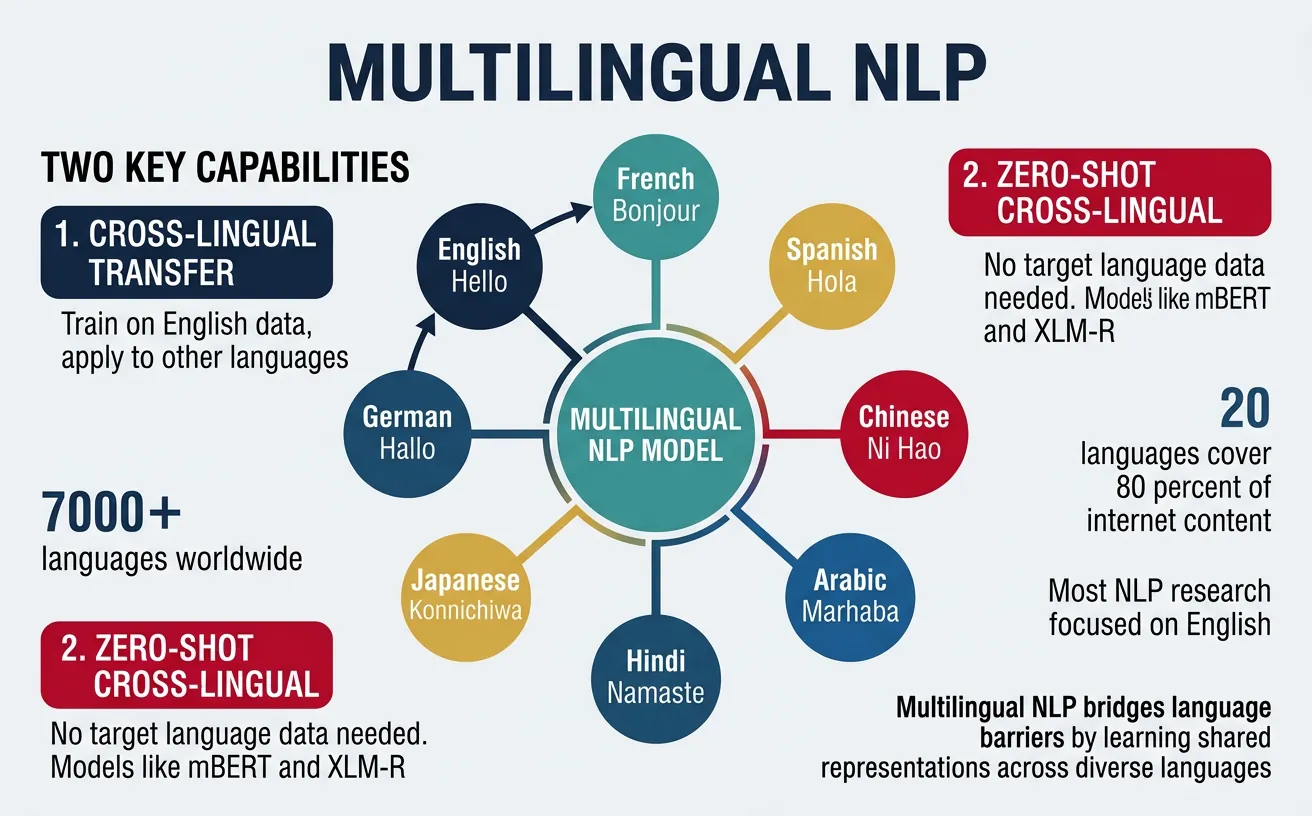
Multilingual NLP enables building systems that understand and generate text in multiple languages. Cross-lingual transfer allows leveraging resources from high-resource languages to benefit low-resource ones.
Key Insight
Multilingual models learn language-agnostic representations that capture shared semantic structures across languages, enabling zero-shot transfer without any target-language training data.
NLP Mastery
NLP Fundamentals & Linguistic Basics
Phonology, morphology, syntax, semantics, pragmaticsTokenization & Text Cleaning
Subword tokenization, BPE, stopwords, normalizationText Representation & Feature Engineering
Bag-of-words, TF-IDF, feature extraction, vectorizationWord Embeddings
Word2Vec, GloVe, FastText, embedding spaces, analogiesStatistical Language Models & N-grams
Probability chains, smoothing, perplexity, Markov modelsNeural Networks for NLP
Feedforward nets, backpropagation, activation functionsRNNs, LSTMs & GRUs
Sequence modeling, vanishing gradients, gated architecturesTransformers & Attention Mechanism
Self-attention, multi-head attention, positional encodingPretrained Language Models & Transfer Learning
BERT, RoBERTa, fine-tuning, feature extractionGPT Models & Text Generation
Autoregressive generation, prompting, GPT architectureCore NLP Tasks
NER, POS tagging, sentiment analysis, text classificationAdvanced NLP Tasks
Question answering, summarization, machine translationMultilingual & Cross-lingual NLP
mBERT, XLM-R, zero-shot transfer, language diversityEvaluation, Ethics & Responsible NLP
BLEU, ROUGE, bias detection, fairness, responsible AINLP Systems, Optimization & Production
Model serving, quantization, distillation, deploymentCutting-Edge & Research Topics
LLMs, multimodal NLP, reasoning, emerging researchMultilingual Embeddings
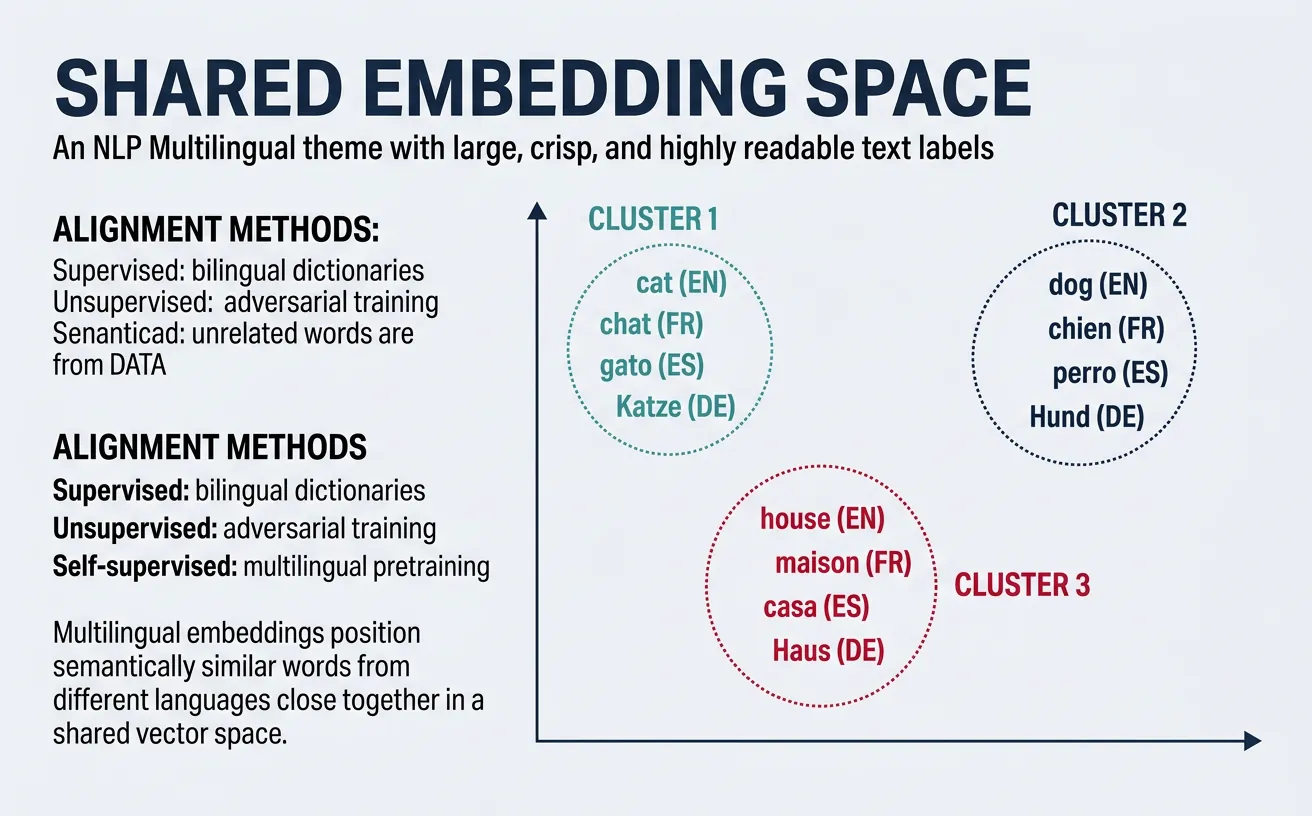
Multilingual embeddings create shared vector spaces where semantically similar words and sentences from different languages are positioned close together. This enables models to process text from any supported language using the same underlying representation, forming the foundation for cross-lingual transfer learning.
The key insight behind multilingual embeddings is that human languages, despite surface-level differences in grammar and vocabulary, share deep semantic structures. Concepts like "love," "family," and "science" exist across cultures, and multilingual models learn to map these concepts to similar regions in embedding space regardless of the source language.
Aligned Word Embeddings
Aligned word embeddings create cross-lingual word representations by learning a mapping between monolingual embedding spaces. The most common approaches use bilingual dictionaries or parallel corpora to learn projection matrices that align embeddings from different languages into a shared space.
The alignment process typically involves learning an orthogonal transformation matrix W that minimizes the distance between source language embeddings X and target language embeddings Y: argmin||WX - Y||. This preserves the internal structure of each language's embedding space while enabling cross-lingual comparisons.
# Cross-lingual word embedding alignment using MUSE approach
import numpy as np
from sklearn.preprocessing import normalize

def load_embeddings(path, max_vocab=50000):
    """Load word embeddings from file"""
    embeddings = {}
    with open(path, 'r', encoding='utf-8') as f:
        for i, line in enumerate(f):
            if i >= max_vocab:
                break
            parts = line.strip().split()
            word = parts[0]
            vector = np.array([float(x) for x in parts[1:]])
            embeddings[word] = vector
    return embeddings

def build_seed_dictionary(en_embeddings, fr_embeddings, bilingual_dict):
    """Build training pairs from bilingual dictionary"""
    src_vectors = []
    tgt_vectors = []

    for en_word, fr_word in bilingual_dict:
        if en_word in en_embeddings and fr_word in fr_embeddings:
            src_vectors.append(en_embeddings[en_word])
            tgt_vectors.append(fr_embeddings[fr_word])

    return np.array(src_vectors), np.array(tgt_vectors)

def procrustes_align(src_vectors, tgt_vectors):
    """Learn orthogonal alignment matrix using Procrustes"""
    # Normalize vectors
    src_norm = normalize(src_vectors)
    tgt_norm = normalize(tgt_vectors)

    # Compute SVD of correlation matrix
    M = tgt_norm.T @ src_norm
    U, S, Vt = np.linalg.svd(M)

    # Optimal orthogonal transformation
    W = U @ Vt
    return W

# Example usage
print("Cross-lingual embedding alignment")
print("=" * 50)

# Simulate embeddings for demonstration
np.random.seed(42)
en_embed = {'hello': np.random.randn(300), 'world': np.random.randn(300),
            'cat': np.random.randn(300), 'dog': np.random.randn(300)}
fr_embed = {'bonjour': np.random.randn(300), 'monde': np.random.randn(300),
            'chat': np.random.randn(300), 'chien': np.random.randn(300)}

# Bilingual dictionary
dictionary = [('hello', 'bonjour'), ('world', 'monde'),
              ('cat', 'chat'), ('dog', 'chien')]

src, tgt = build_seed_dictionary(en_embed, fr_embed, dictionary)
W = procrustes_align(src, tgt)
print(f"Alignment matrix shape: {W.shape}")
print(f"Is orthogonal: {np.allclose(W @ W.T, np.eye(300))}")
Alignment Methods
Supervised alignment uses bilingual dictionaries to learn mappings, while unsupervised alignment (like MUSE) uses adversarial training to align embedding spaces without any bilingual signal, making it applicable to language pairs without parallel resources.
Multilingual BERT (mBERT)
Multilingual BERT is a single BERT model trained on Wikipedia text from 104 languages using the same masked language modeling objective as monolingual BERT. Despite never seeing explicit cross-lingual signals during training, mBERT learns remarkably effective multilingual representations that enable zero-shot cross-lingual transfer.
The model uses a shared WordPiece vocabulary of 110,000 tokens, which naturally creates overlap between languages that share scripts (e.g., Latin alphabet languages) while also learning subword representations for languages with unique scripts. This shared vocabulary is crucial for enabling cross-lingual representations.
# Using Multilingual BERT for cross-lingual encoding
from transformers import BertTokenizer, BertModel
import torch
import torch.nn.functional as F

# Load multilingual BERT
tokenizer = BertTokenizer.from_pretrained('bert-base-multilingual-cased')
model = BertModel.from_pretrained('bert-base-multilingual-cased')
model.eval()

def encode_text(text, tokenizer, model):
    """Encode text using mBERT"""
    inputs = tokenizer(text, return_tensors='pt', padding=True, truncation=True)
    with torch.no_grad():
        outputs = model(**inputs)
    # Use [CLS] token embedding as sentence representation
    return outputs.last_hidden_state[:, 0, :]

# Example: Encode same concept in different languages
texts = {
    'English': 'I love machine learning.',
    'Spanish': 'Me encanta el aprendizaje automático.',
    'French': 'J\'adore l\'apprentissage automatique.',
    'German': 'Ich liebe maschinelles Lernen.',
    'Chinese': '????????'
}

print("Multilingual BERT Cross-lingual Encoding")
print("=" * 50)

embeddings = {}
for lang, text in texts.items():
    embeddings[lang] = encode_text(text, tokenizer, model)
    print(f"{lang}: '{text}'")

# Compute cosine similarities
print("\nCross-lingual Cosine Similarities:")
languages = list(texts.keys())
for i, lang1 in enumerate(languages):
    for lang2 in languages[i+1:]:
        sim = F.cosine_similarity(embeddings[lang1], embeddings[lang2])
        print(f"  {lang1} - {lang2}: {sim.item():.4f}")
mBERT's Cross-lingual Emergence
Research has shown that mBERT's cross-lingual abilities emerge spontaneously without explicit cross-lingual training. Key factors include: (1) shared subword vocabulary creating lexical overlap, (2) similar sentence structures across languages activating similar attention patterns, (3) deep transformer layers learning abstract, language-agnostic features. Studies show mBERT achieves 70-80% of supervised performance in zero-shot NER and POS tagging across many language pairs.
XLM-RoBERTa
XLM-RoBERTa (XLM-R) significantly improves upon mBERT by training on 2.5TB of filtered CommonCrawl data in 100 languages, compared to mBERT's Wikipedia-only training. The model uses a larger vocabulary (250,000 tokens) and removes the next sentence prediction objective, following RoBERTa's approach.
A key innovation of XLM-R is its sampling strategy that addresses the "curse of multilinguality"—the phenomenon where adding more languages to a fixed-capacity model hurts performance on each individual language. XLM-R uses exponential smoothing of language sampling probabilities to better balance high-resource and low-resource languages during training.
# XLM-RoBERTa for multilingual text classification
from transformers import XLMRobertaTokenizer, XLMRobertaForSequenceClassification
from transformers import Trainer, TrainingArguments
import torch
from torch.utils.data import Dataset

class MultilingualDataset(Dataset):
    def __init__(self, texts, labels, tokenizer, max_length=128):
        self.encodings = tokenizer(texts, truncation=True, padding=True,
                                   max_length=max_length, return_tensors='pt')
        self.labels = torch.tensor(labels)

    def __getitem__(self, idx):
        item = {key: val[idx] for key, val in self.encodings.items()}
        item['labels'] = self.labels[idx]
        return item

    def __len__(self):
        return len(self.labels)

# Load XLM-RoBERTa
tokenizer = XLMRobertaTokenizer.from_pretrained('xlm-roberta-base')
model = XLMRobertaForSequenceClassification.from_pretrained(
    'xlm-roberta-base',
    num_labels=3  # Positive, Negative, Neutral
)

# Example multilingual sentiment data
train_texts = [
    "This movie is fantastic!",           # English - Positive
    "Cette film est terrible.",           # French - Negative
    "Der Film war okay.",                 # German - Neutral
    "¡Me encanta esta película!",         # Spanish - Positive
    "????????",                    # Chinese - Negative
]
train_labels = [2, 0, 1, 2, 0]  # 0: Negative, 1: Neutral, 2: Positive

# Create dataset
train_dataset = MultilingualDataset(train_texts, train_labels, tokenizer)

print("XLM-RoBERTa Multilingual Classification")
print("=" * 50)
print(f"Model: xlm-roberta-base")
print(f"Training samples: {len(train_dataset)}")
print(f"Languages: English, French, German, Spanish, Chinese")

# Inference example
model.eval()
test_texts = [
    "Great product!",         # English
    "Produit horrible!",      # French
    "Tolles Produkt!",        # German
]

with torch.no_grad():
    inputs = tokenizer(test_texts, return_tensors='pt', padding=True, truncation=True)
    outputs = model(**inputs)
    predictions = torch.argmax(outputs.logits, dim=-1)

labels_map = {0: 'Negative', 1: 'Neutral', 2: 'Positive'}
print("\nZero-shot Predictions (before fine-tuning):")
for text, pred in zip(test_texts, predictions):
    print(f"  '{text}' ? {labels_map[pred.item()]}")
XLM-R vs mBERT Performance
XLM-R outperforms mBERT by 13-23% average accuracy on cross-lingual NLI (XNLI) and by 3-10% on named entity recognition across languages. The performance gap is especially pronounced for low-resource languages, where XLM-R's larger training corpus provides significant benefits.
Cross-lingual Transfer Learning
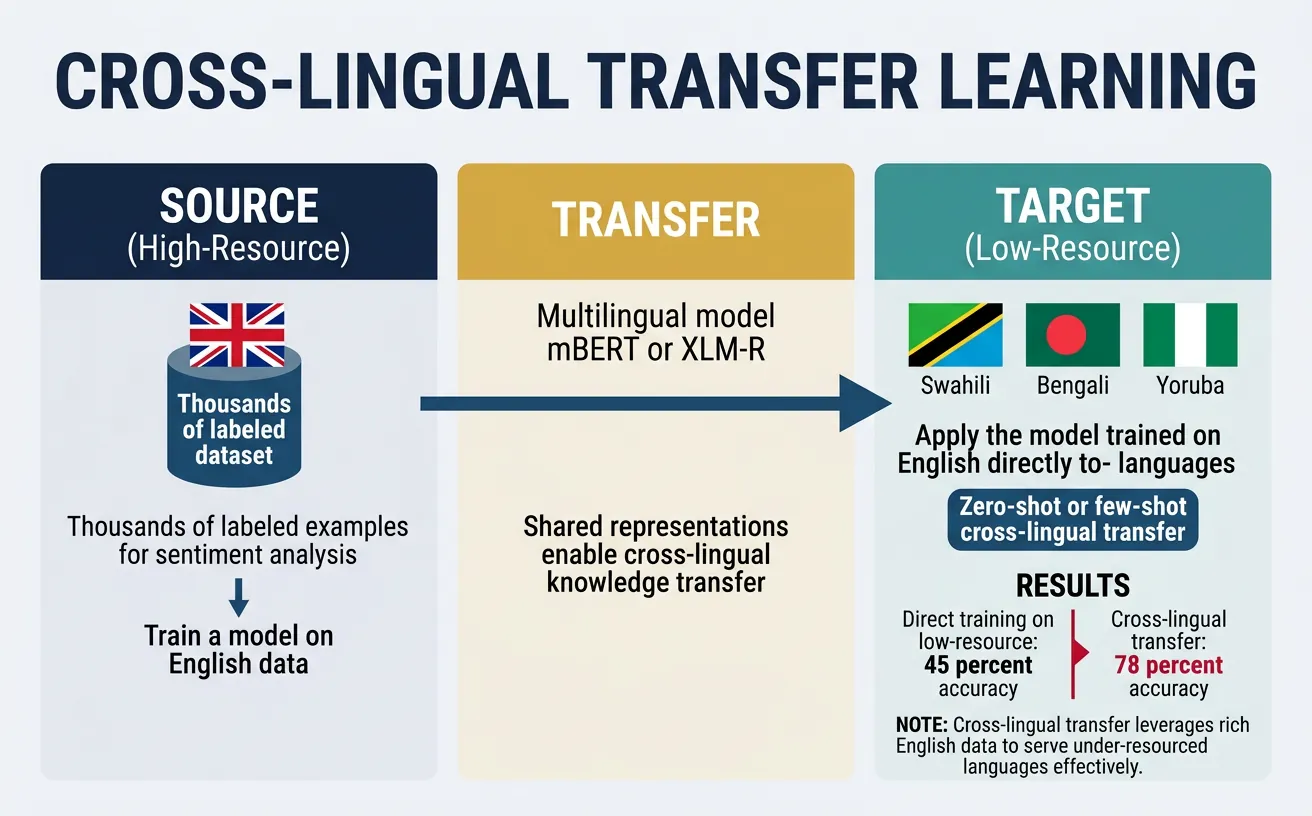
Cross-lingual transfer learning enables models trained on data from one language (typically a high-resource language like English) to perform well on other languages without target-language training data. This is particularly valuable for the vast majority of the world's ~7,000 languages that lack labeled NLP datasets.
The effectiveness of cross-lingual transfer depends on several factors: linguistic similarity between source and target languages, the quality of multilingual representations, and the nature of the task. Syntactic tasks (like POS tagging) transfer better between related languages, while semantic tasks (like sentiment analysis) often transfer more broadly.
Zero-shot Cross-lingual Transfer
Zero-shot cross-lingual transfer involves training a model entirely on source language data and evaluating directly on the target language without any target language examples. This works because multilingual models encode text from different languages into a shared semantic space where similar meanings cluster together.
The typical workflow involves: (1) fine-tuning a multilingual model on English labeled data, (2) applying the fine-tuned model directly to other languages during inference. Despite the simplicity of this approach, it achieves surprisingly strong results, often reaching 70-90% of supervised target-language performance.
# Zero-shot cross-lingual named entity recognition
from transformers import AutoTokenizer, AutoModelForTokenClassification
from transformers import pipeline
import torch

# Load multilingual NER model (trained on English)
model_name = "xlm-roberta-large-finetuned-conll03-english"
tokenizer = AutoTokenizer.from_pretrained(model_name)
model = AutoModelForTokenClassification.from_pretrained(model_name)

# Create NER pipeline
ner_pipeline = pipeline("ner", model=model, tokenizer=tokenizer,
                        aggregation_strategy="simple")

# Test on multiple languages (zero-shot transfer)
test_sentences = {
    'English': "Barack Obama was born in Hawaii and became president.",
    'German': "Angela Merkel war Bundeskanzlerin von Deutschland.",
    'Spanish': "Gabriel García Márquez nació en Colombia.",
    'French': "Emmanuel Macron est le président de la France.",
    'Dutch': "Mark Rutte is de premier van Nederland."
}

print("Zero-shot Cross-lingual NER")
print("=" * 50)

for lang, sentence in test_sentences.items():
    print(f"\n{lang}: {sentence}")
    entities = ner_pipeline(sentence)
    for ent in entities:
        print(f"  ? {ent['word']}: {ent['entity_group']} ({ent['score']:.3f})")
Zero-shot Transfer Benchmark: XNLI
The Cross-lingual Natural Language Inference (XNLI) dataset provides human-translated test sets in 15 languages for evaluating zero-shot transfer. State-of-the-art results: XLM-R Large achieves 80.9% average accuracy (vs 84.6% English-only baseline), demonstrating that multilingual models capture cross-lingual semantics effectively. Languages most similar to English (Romance, Germanic) transfer best, while distant languages (Thai, Swahili) show larger performance gaps.
# Zero-shot cross-lingual natural language inference
from transformers import AutoTokenizer, AutoModelForSequenceClassification
import torch
import torch.nn.functional as F

# Load XLM-R fine-tuned on English NLI
model_name = "joeddav/xlm-roberta-large-xnli"
tokenizer = AutoTokenizer.from_pretrained(model_name)
model = AutoModelForSequenceClassification.from_pretrained(model_name)
model.eval()

def predict_nli(premise, hypothesis, tokenizer, model):
    """Predict entailment relationship"""
    inputs = tokenizer(premise, hypothesis, return_tensors='pt',
                       truncation=True, max_length=256)
    with torch.no_grad():
        outputs = model(**inputs)
        probs = F.softmax(outputs.logits, dim=-1)

    labels = ['contradiction', 'neutral', 'entailment']
    prediction = labels[torch.argmax(probs).item()]
    confidence = torch.max(probs).item()
    return prediction, confidence

# Test cross-lingual NLI (train: English, test: multiple languages)
test_pairs = [
    # English
    ("A man is playing a guitar.", "Someone is making music.", "en"),
    # German
    ("Ein Mann spielt Gitarre.", "Jemand macht Musik.", "de"),
    # Spanish
    ("Un hombre está tocando la guitarra.", "Alguien está haciendo música.", "es"),
    # French
    ("Un homme joue de la guitare.", "Quelqu'un fait de la musique.", "fr"),
    # Chinese
    ("?????????", "????????", "zh"),
]

print("Zero-shot Cross-lingual NLI")
print("=" * 50)

for premise, hypothesis, lang in test_pairs:
    pred, conf = predict_nli(premise, hypothesis, tokenizer, model)
    print(f"\n[{lang}] Premise: {premise}")
    print(f"     Hypothesis: {hypothesis}")
    print(f"     ? Prediction: {pred} ({conf:.1%})")
Few-shot Cross-lingual Transfer
Few-shot cross-lingual transfer augments zero-shot approaches by incorporating a small amount of target-language labeled data. Even just 100-500 target-language examples can dramatically improve performance, especially for languages that are linguistically distant from the source language.
Effective few-shot strategies include: continued fine-tuning on target-language data, multi-task learning with source and target language data combined, and meta-learning approaches that learn to adapt quickly to new languages. The key challenge is maximizing the utility of limited target-language annotations.
# Few-shot cross-lingual learning with limited target data
from transformers import (AutoTokenizer, AutoModelForSequenceClassification,
                          Trainer, TrainingArguments)
import torch
from torch.utils.data import Dataset
import numpy as np

class FewShotDataset(Dataset):
    def __init__(self, texts, labels, tokenizer, max_length=128):
        self.encodings = tokenizer(texts, truncation=True, padding=True,
                                   max_length=max_length, return_tensors='pt')
        self.labels = torch.tensor(labels)

    def __getitem__(self, idx):
        return {k: v[idx] for k, v in self.encodings.items()} | {'labels': self.labels[idx]}

    def __len__(self):
        return len(self.labels)

# Simulate few-shot learning scenario
def create_few_shot_setup(n_shots_per_class=10):
    """Create few-shot training data"""
    # English training data (abundant)
    english_texts = [
        "This product is amazing!", "Terrible service, very disappointed.",
        "Works as expected, nothing special.", "Best purchase I ever made!",
        "Complete waste of money.", "Decent quality for the price."
    ] * 50  # 300 English examples

    english_labels = [2, 0, 1, 2, 0, 1] * 50

    # German target data (few-shot: only n examples per class)
    german_texts = [
        "Dieses Produkt ist fantastisch!",  # Positive
        "Sehr schlechter Service.",          # Negative
        "Es ist okay, nichts besonderes.",   # Neutral
    ]
    german_labels = [2, 0, 1]

    # Replicate to get n_shots_per_class
    german_few_shot_texts = german_texts * n_shots_per_class
    german_few_shot_labels = german_labels * n_shots_per_class

    return (english_texts, english_labels,
            german_few_shot_texts, german_few_shot_labels)

# Load model
tokenizer = AutoTokenizer.from_pretrained('xlm-roberta-base')
model = AutoModelForSequenceClassification.from_pretrained(
    'xlm-roberta-base', num_labels=3
)

# Create datasets
en_texts, en_labels, de_texts, de_labels = create_few_shot_setup(n_shots=10)

# Strategy 1: Zero-shot (English only)
en_dataset = FewShotDataset(en_texts, en_labels, tokenizer)

# Strategy 2: Combined training (English + few-shot German)
combined_texts = en_texts + de_texts
combined_labels = en_labels + de_labels
combined_dataset = FewShotDataset(combined_texts, combined_labels, tokenizer)

print("Few-shot Cross-lingual Learning Setup")
print("=" * 50)
print(f"English training examples: {len(en_texts)}")
print(f"German few-shot examples: {len(de_texts)} ({len(de_texts)//3} per class)")
print(f"Combined dataset size: {len(combined_texts)}")
print("\nStrategies:")
print("  1. Zero-shot: Train on English, evaluate on German")
print("  2. Few-shot: Train on English + few German examples")
Few-shot Learning Effectiveness
Research shows that just 50-100 target-language examples can close 40-60% of the gap between zero-shot transfer and fully supervised target-language training. The improvement is especially pronounced for: (1) languages distant from English, (2) tasks requiring language-specific knowledge, and (3) domain-specific applications with specialized vocabulary.
Low-Resource Language Support
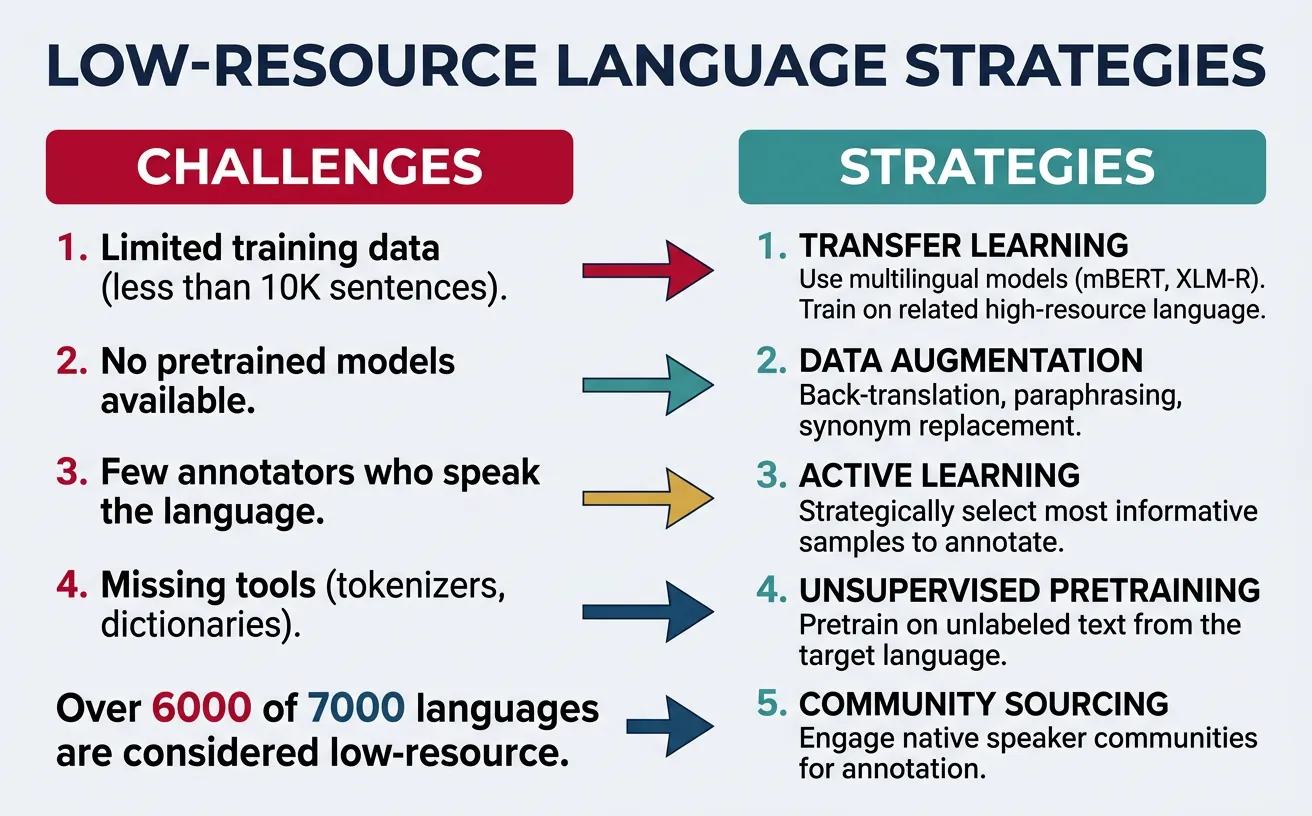
Low-resource languages—those with limited digital text, annotated datasets, and NLP tools—represent the majority of the world's languages. Approximately 7,000 languages are spoken globally, but only about 100 have significant NLP resources. Supporting low-resource languages requires creative approaches that maximize the utility of limited data.
Key challenges for low-resource NLP include: vocabulary coverage (rare scripts and words may be undertokenized), limited training signal (models see few examples during pretraining), and annotation scarcity (labeled datasets often don't exist). Solutions involve transfer learning from related languages, data augmentation, and multilingual training that enables knowledge sharing.
# Analyzing multilingual model coverage for different languages
from transformers import XLMRobertaTokenizer, AutoTokenizer
import numpy as np

tokenizer = XLMRobertaTokenizer.from_pretrained('xlm-roberta-base')

def analyze_tokenization(text, language, tokenizer):
    """Analyze how text is tokenized"""
    tokens = tokenizer.tokenize(text)

    # Count subword fragmentation
    word_count = len(text.split())
    token_count = len(tokens)
    fragmentation = token_count / word_count

    # Identify unknown tokens (shouldn't exist in sentencepiece, but check)
    unk_tokens = sum(1 for t in tokens if t == tokenizer.unk_token)

    return {
        'language': language,
        'text': text,
        'words': word_count,
        'tokens': token_count,
        'fragmentation': fragmentation,
        'tokens_preview': tokens[:10]
    }

# Compare tokenization across high and low resource languages
test_sentences = {
    'English (High)': "Machine learning is transforming artificial intelligence.",
    'German (High)': "Maschinelles Lernen transformiert künstliche Intelligenz.",
    'Swahili (Low)': "Kujifunza kwa mashine kunabadilisha akili bandia.",
    'Yoruba (Low)': "?`k?´ ?`r? n yí ìm?` ?gb?´n àt?w?´dá padà.",
    'Thai (Medium)': "??????????????????????????????????????????????????",
    'Hindi (Medium)': "???? ??????? ??????? ??????????? ?? ??? ??? ???"
}

print("Multilingual Tokenization Analysis")
print("=" * 50)
print("(Higher fragmentation = more subwords per word = less efficient)")
print()

for lang, text in test_sentences.items():
    stats = analyze_tokenization(text, lang, tokenizer)
    print(f"{lang}:")
    print(f"  Text: {text[:50]}...")
    print(f"  Words: {stats['words']}, Tokens: {stats['tokens']}")
    print(f"  Fragmentation: {stats['fragmentation']:.2f}x")
    print(f"  First 10 tokens: {stats['tokens_preview']}")
    print()
Masakhane: NLP for African Languages
Masakhane is a grassroots organization creating NLP resources for African languages. Their work includes: creating benchmark datasets for NER, machine translation, and sentiment analysis in over 30 African languages; training AfroXLMR, an XLM-R variant specifically adapted for African languages; and developing AfriSenti, the first large-scale multilingual sentiment analysis dataset for African languages. This demonstrates how community-driven efforts can advance low-resource NLP.
# Strategies for improving low-resource language performance
from transformers import AutoTokenizer, AutoModelForMaskedLM
import torch
import random

def language_adaptive_finetuning(model, tokenizer, target_texts, num_steps=1000):
    """
    Adapt multilingual model to target language using MLM
    This is also called "language-adaptive pretraining"
    """
    model.train()
    optimizer = torch.optim.AdamW(model.parameters(), lr=5e-5)

    for step in range(num_steps):
        # Sample random text
        text = random.choice(target_texts)

        # Tokenize
        inputs = tokenizer(text, return_tensors='pt', truncation=True,
                          max_length=512, padding=True)

        # Create masked inputs (15% of tokens)
        labels = inputs['input_ids'].clone()
        mask_prob = 0.15
        mask = torch.rand(labels.shape) < mask_prob
        mask[labels == tokenizer.pad_token_id] = False
        mask[labels == tokenizer.cls_token_id] = False
        mask[labels == tokenizer.sep_token_id] = False

        inputs['input_ids'][mask] = tokenizer.mask_token_id

        # Forward pass
        outputs = model(**inputs, labels=labels)
        loss = outputs.loss

        # Backward pass
        loss.backward()
        optimizer.step()
        optimizer.zero_grad()

        if step % 100 == 0:
            print(f"Step {step}, Loss: {loss.item():.4f}")

    return model

# Data augmentation for low-resource languages
def augment_low_resource_data(texts, labels, augmentation_factor=3):
    """
    Simple data augmentation strategies for low-resource settings
    """
    augmented_texts = []
    augmented_labels = []

    for text, label in zip(texts, labels):
        # Original
        augmented_texts.append(text)
        augmented_labels.append(label)

        words = text.split()

        for _ in range(augmentation_factor - 1):
            aug_text = words.copy()

            # Random deletion (10% of words)
            if len(aug_text) > 3:
                del_idx = random.randint(1, len(aug_text)-2)
                aug_text.pop(del_idx)

            # Random swap (one pair)
            if len(aug_text) > 2:
                i, j = random.sample(range(len(aug_text)), 2)
                aug_text[i], aug_text[j] = aug_text[j], aug_text[i]

            augmented_texts.append(' '.join(aug_text))
            augmented_labels.append(label)

    return augmented_texts, augmented_labels

# Example: Augmenting low-resource data
print("Data Augmentation for Low-Resource Languages")
print("=" * 50)

original_texts = [
    "Habari za asubuhi",  # Swahili: Good morning
    "Asante sana rafiki",  # Thank you very much friend
    "Ninapenda chakula hiki"  # I love this food
]
original_labels = [1, 1, 2]  # neutral, positive, positive

aug_texts, aug_labels = augment_low_resource_data(original_texts, original_labels)

print(f"Original samples: {len(original_texts)}")
print(f"Augmented samples: {len(aug_texts)}")
print("\nAugmentation examples:")
for i, (orig, augs) in enumerate(zip(original_texts,
                                     [aug_texts[i*3:i*3+3] for i in range(len(original_texts))])):
    print(f"\nOriginal: {orig}")
    for j, aug in enumerate(augs[1:], 1):
        print(f"  Aug {j}: {aug}")
Low-Resource Strategies Summary
Key approaches for improving low-resource language NLP: (1) Language-adaptive pretraining: Continue MLM training on target language text; (2) Cross-lingual transfer: Transfer from linguistically related high-resource languages; (3) Data augmentation: Expand training data through back-translation, word replacement, and syntactic transformations; (4) Active learning: Strategically select most informative examples to annotate.
Translation-Augmented Methods
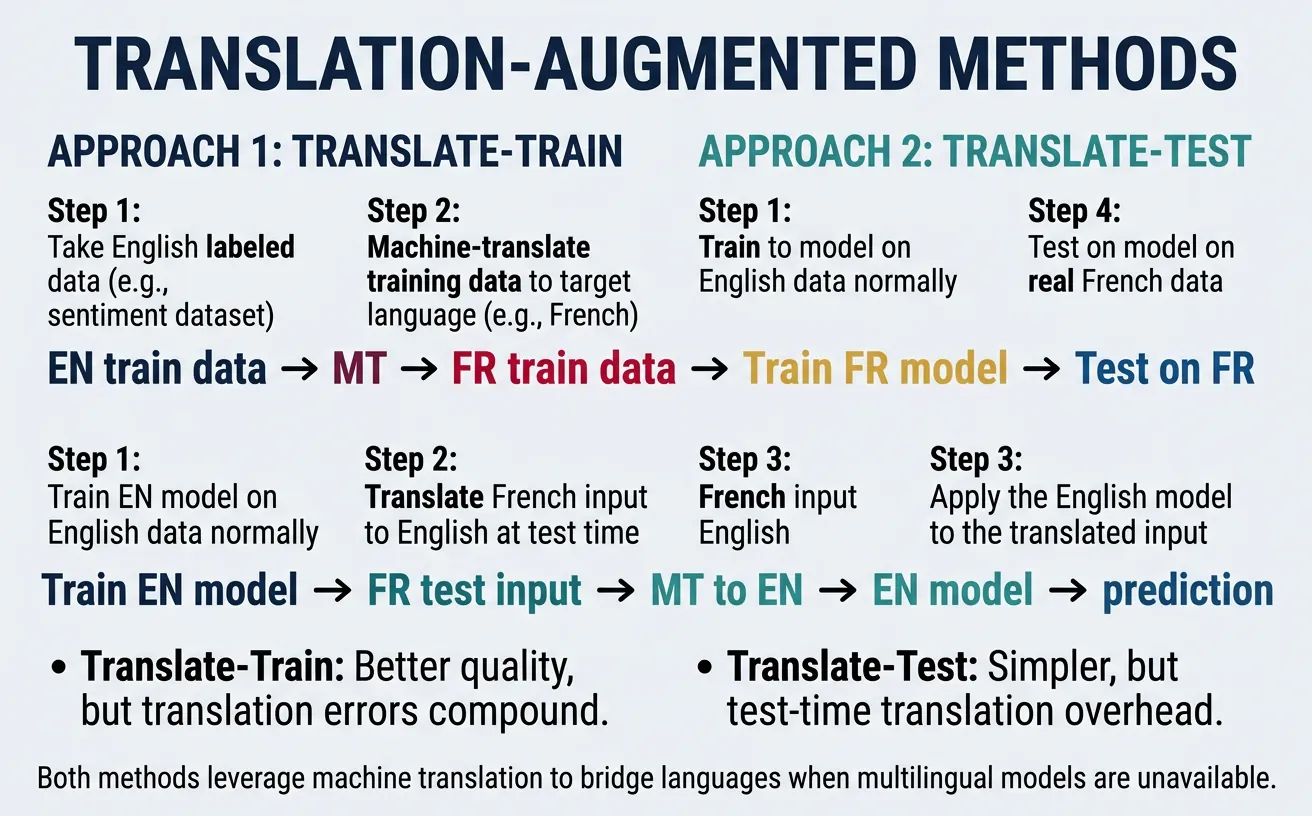
Translation-augmented methods use machine translation to bridge the gap between languages. The two main approaches are: "translate-train" (translate source-language training data to the target language) and "translate-test" (translate target-language test data to the source language). Each approach has trade-offs regarding translation quality, computational cost, and task performance.
These methods complement zero-shot transfer by providing actual target-language text to the model. While translation introduces noise and may lose nuances, it often outperforms pure zero-shot transfer, especially for languages that are dissimilar to the training language. The combination of translation-augmented methods with multilingual models often yields the best results.
# Translation-augmented cross-lingual learning
from transformers import MarianMTModel, MarianTokenizer
import torch

def translate_text(text, src_lang, tgt_lang):
    """Translate text using Helsinki-NLP MarianMT models"""
    model_name = f'Helsinki-NLP/opus-mt-{src_lang}-{tgt_lang}'

    tokenizer = MarianTokenizer.from_pretrained(model_name)
    model = MarianMTModel.from_pretrained(model_name)

    inputs = tokenizer(text, return_tensors='pt', padding=True, truncation=True)

    with torch.no_grad():
        translated = model.generate(**inputs)

    return tokenizer.batch_decode(translated, skip_special_tokens=True)

def translate_train_approach(train_texts, train_labels, src_lang, tgt_lang):
    """
    Translate-train: Translate training data to target language
    Then train on translated data
    """
    translated_texts = []
    for text in train_texts:
        translated = translate_text(text, src_lang, tgt_lang)
        translated_texts.extend(translated)

    return translated_texts, train_labels

def translate_test_approach(test_texts, tgt_lang, src_lang, model_fn):
    """
    Translate-test: Translate test data to source language
    Then run inference with source-language model
    """
    translated_tests = []
    for text in test_texts:
        translated = translate_text(text, tgt_lang, src_lang)
        translated_tests.extend(translated)

    # Run inference on translated text
    predictions = model_fn(translated_tests)
    return predictions

# Example: Translate-train workflow
print("Translation-Augmented Cross-lingual Learning")
print("=" * 50)

# Original English training data
english_train = [
    "I love this product!",
    "This is terrible.",
    "It's okay, nothing special."
]
labels = [2, 0, 1]  # positive, negative, neutral

print("Original English training data:")
for text, label in zip(english_train, labels):
    print(f"  [{label}] {text}")

# Translate to German (translate-train)
print("\nTranslate-Train: English ? German")
try:
    german_train = translate_text(english_train[0], 'en', 'de')
    print(f"  '{english_train[0]}' ? '{german_train[0]}'")
except:
    print("  (Translation model would be loaded here)")
    # Simulated translation
    german_train = [
        "Ich liebe dieses Produkt!",
        "Das ist schrecklich.",
        "Es ist okay, nichts Besonderes."
    ]
    for en, de in zip(english_train, german_train):
        print(f"  '{en}' ? '{de}'")
Translate-Train vs Translate-Test
Translate-Train advantages: Model sees target-language text during training, can learn language-specific patterns, translation done once offline. Disadvantages: Requires retraining for each language, translation errors propagate to training.
Translate-Test advantages: Single model for all languages, no retraining needed. Disadvantages: Translation latency at inference, test data may contain domain-specific terms that translate poorly, loses target-language nuances.
Empirically, translate-train often performs slightly better but requires more resources. The best approach often combines both with multilingual models.
# Combined approach: Multilingual model + translation augmentation
from transformers import AutoTokenizer, AutoModelForSequenceClassification
import torch
from torch.utils.data import DataLoader, Dataset

class CombinedMultilingualDataset(Dataset):
    """
    Combines original source data with translated versions
    for robust cross-lingual training
    """
    def __init__(self, original_texts, translated_texts, labels, tokenizer):
        # Combine original and translated texts
        all_texts = original_texts + translated_texts
        all_labels = labels + labels  # Duplicate labels for translated texts

        self.encodings = tokenizer(all_texts, truncation=True, padding=True,
                                   max_length=128, return_tensors='pt')
        self.labels = torch.tensor(all_labels)

    def __getitem__(self, idx):
        return {k: v[idx] for k, v in self.encodings.items()} | {'labels': self.labels[idx]}

    def __len__(self):
        return len(self.labels)

# Example: Building a robust multilingual classifier
print("Combined Multilingual + Translation Training")
print("=" * 50)

# Original English data
english_texts = [
    "Amazing product, highly recommend!",
    "Waste of money, don't buy.",
    "Average quality, expected more."
]
labels = [2, 0, 1]

# Translated versions (simulated)
german_translations = [
    "Erstaunliches Produkt, sehr zu empfehlen!",
    "Geldverschwendung, nicht kaufen.",
    "Durchschnittliche Qualität, mehr erwartet."
]

french_translations = [
    "Produit incroyable, je recommande vivement!",
    "Gaspillage d'argent, n'achetez pas.",
    "Qualité moyenne, j'attendais plus."
]

# Combine all data
all_translations = german_translations + french_translations
combined_labels = labels + labels  # For German and French

tokenizer = AutoTokenizer.from_pretrained('xlm-roberta-base')
dataset = CombinedMultilingualDataset(
    english_texts,
    all_translations,
    labels,
    tokenizer
)

print(f"Original English samples: {len(english_texts)}")
print(f"German translations: {len(german_translations)}")
print(f"French translations: {len(french_translations)}")
print(f"Total training samples: {len(dataset)}")
print("\nThis combined approach provides:")
print("  • Original English signal")
print("  • German language exposure")
print("  • French language exposure")
print("  • Implicit cross-lingual alignment through shared labels")
Practical Implementation
Building production multilingual NLP systems requires careful consideration of model selection, computational constraints, and deployment strategies. The choice between mBERT, XLM-R, and language-specific models depends on the languages needed, performance requirements, and available resources.
Practical systems often employ a combination of techniques: multilingual models for broad coverage, fine-tuning for specific tasks, and specialized handling for challenging languages. Monitoring cross-lingual performance and iterating based on real-world feedback is essential for maintaining quality across all supported languages.
# Building a production multilingual classification system
from transformers import (AutoTokenizer, AutoModelForSequenceClassification,
                          pipeline)
import torch
import torch.nn.functional as F
from typing import Dict, List, Tuple
import json

class MultilingualClassifier:
    """
    Production-ready multilingual text classification system
    """

    # Language codes and their display names
    SUPPORTED_LANGUAGES = {
        'en': 'English', 'de': 'German', 'fr': 'French',
        'es': 'Spanish', 'it': 'Italian', 'pt': 'Portuguese',
        'zh': 'Chinese', 'ja': 'Japanese', 'ko': 'Korean',
        'ar': 'Arabic', 'hi': 'Hindi', 'ru': 'Russian'
    }

    def __init__(self, model_name: str = 'xlm-roberta-base', num_labels: int = 3):
        self.tokenizer = AutoTokenizer.from_pretrained(model_name)
        self.model = AutoModelForSequenceClassification.from_pretrained(
            model_name, num_labels=num_labels
        )
        self.model.eval()
        self.label_map = {0: 'negative', 1: 'neutral', 2: 'positive'}

    def predict(self, text: str, return_all_scores: bool = False) -> Dict:
        """Predict class for a single text"""
        inputs = self.tokenizer(text, return_tensors='pt', truncation=True,
                               max_length=512)

        with torch.no_grad():
            outputs = self.model(**inputs)
            probs = F.softmax(outputs.logits, dim=-1)[0]

        predicted_class = torch.argmax(probs).item()
        confidence = probs[predicted_class].item()

        result = {
            'prediction': self.label_map[predicted_class],
            'confidence': confidence
        }

        if return_all_scores:
            result['all_scores'] = {
                self.label_map[i]: probs[i].item()
                for i in range(len(probs))
            }

        return result

    def predict_batch(self, texts: List[str]) -> List[Dict]:
        """Predict classes for multiple texts efficiently"""
        inputs = self.tokenizer(texts, return_tensors='pt', truncation=True,
                               max_length=512, padding=True)

        with torch.no_grad():
            outputs = self.model(**inputs)
            probs = F.softmax(outputs.logits, dim=-1)

        results = []
        for i, prob in enumerate(probs):
            pred_class = torch.argmax(prob).item()
            results.append({
                'text': texts[i][:50] + '...' if len(texts[i]) > 50 else texts[i],
                'prediction': self.label_map[pred_class],
                'confidence': prob[pred_class].item()
            })

        return results

# Initialize classifier
classifier = MultilingualClassifier()

# Test on multilingual inputs
test_inputs = [
    ("I absolutely love this product!", "en"),
    ("Dieses Produkt ist schrecklich!", "de"),
    ("C'est un produit correct.", "fr"),
    ("¡Me encanta este producto!", "es"),
    ("???????!", "zh"),
    ("??? ?????? ????!", "ar"),
]

print("Multilingual Classification System")
print("=" * 50)
print(f"Model: xlm-roberta-base")
print(f"Supported languages: {len(classifier.SUPPORTED_LANGUAGES)}")
print()

for text, lang in test_inputs:
    result = classifier.predict(text, return_all_scores=True)
    lang_name = classifier.SUPPORTED_LANGUAGES.get(lang, lang)
    print(f"[{lang_name}] {text}")
    print(f"  ? {result['prediction']} ({result['confidence']:.1%})")
    print()
Production Deployment Tips
Model selection: XLM-R Large for best quality, XLM-R Base for balance, DistilmBERT for speed. Batching: Group requests by language for efficient processing. Caching: Cache tokenization for repeated inputs. Monitoring: Track per-language accuracy to identify degradation. Fallback: Implement language detection and route to specialized models when available.
# Complete multilingual NER pipeline
from transformers import pipeline, AutoTokenizer, AutoModelForTokenClassification
from typing import List, Dict
import torch

class MultilingualNERPipeline:
    """
    Production NER system supporting multiple languages
    """

    def __init__(self, model_name: str = "xlm-roberta-large-finetuned-conll03-english"):
        self.tokenizer = AutoTokenizer.from_pretrained(model_name)
        self.model = AutoModelForTokenClassification.from_pretrained(model_name)
        self.ner_pipeline = pipeline(
            "ner",
            model=self.model,
            tokenizer=self.tokenizer,
            aggregation_strategy="simple"
        )

        # Entity type mapping
        self.entity_colors = {
            'PER': '??', 'PERSON': '??',
            'ORG': '??', 'ORGANIZATION': '??',
            'LOC': '??', 'LOCATION': '??',
            'MISC': '??', 'MISCELLANEOUS': '??'
        }

    def extract_entities(self, text: str) -> List[Dict]:
        """Extract named entities from text"""
        entities = self.ner_pipeline(text)

        # Clean up and format results
        cleaned = []
        for ent in entities:
            entity_type = ent['entity_group'].upper()
            icon = self.entity_colors.get(entity_type, '??')

            cleaned.append({
                'text': ent['word'],
                'type': entity_type,
                'icon': icon,
                'confidence': ent['score'],
                'start': ent['start'],
                'end': ent['end']
            })

        return cleaned

    def format_output(self, text: str, entities: List[Dict]) -> str:
        """Format text with entity annotations"""
        # Sort by position (reverse to not mess up indices)
        sorted_ents = sorted(entities, key=lambda x: x['start'], reverse=True)

        result = text
        for ent in sorted_ents:
            annotation = f"[{ent['text']}|{ent['icon']}{ent['type']}]"
            result = result[:ent['start']] + annotation + result[ent['end']:]

        return result

# Initialize NER pipeline
ner = MultilingualNERPipeline()

# Test on multiple languages
multilingual_texts = [
    ("Barack Obama met Angela Merkel in Berlin.", "English"),
    ("Emmanuel Macron a rencontré Joe Biden à Paris.", "French"),
    ("Pedro Sánchez visitó la sede de Google en Madrid.", "Spanish"),
    ("????????????", "Chinese"),
]

print("Multilingual Named Entity Recognition")
print("=" * 50)

for text, lang in multilingual_texts:
    print(f"\n[{lang}] {text}")
    entities = ner.extract_entities(text)

    if entities:
        print("  Entities found:")
        for ent in entities:
            print(f"    {ent['icon']} {ent['text']} ({ent['type']}) - {ent['confidence']:.1%}")
    else:
        print("  No entities found")
Performance Optimization Strategies
Model Distillation: Train smaller models on multilingual teacher outputs. DistilmBERT-multilingual is 40% smaller and 60% faster while retaining 95% quality.
Dynamic Batching: Accumulate requests and process in batches. Improves throughput 3-5x for typical API workloads.
ONNX Export: Convert PyTorch models to ONNX for 2-3x inference speedup. Works well with multilingual transformers.
Quantization: INT8 quantization reduces model size 4x with minimal quality loss. Especially effective for deployment on edge devices.
# Language detection + routing for specialized handling
from transformers import pipeline
from typing import Tuple, Optional
import re

class LanguageAwareNLPSystem:
    """
    Complete multilingual NLP system with language detection
    and intelligent routing
    """

    def __init__(self):
        # Language detection model
        self.lang_detector = pipeline(
            "text-classification",
            model="papluca/xlm-roberta-base-language-detection"
        )

        # General multilingual classifier
        self.general_classifier = pipeline(
            "sentiment-analysis",
            model="nlptown/bert-base-multilingual-uncased-sentiment"
        )

        # Track supported languages for specialized models
        self.specialized_models = {
            'en': 'english_model',  # Would load actual models
            'de': 'german_model',
            'fr': 'french_model',
        }

    def detect_language(self, text: str) -> Tuple[str, float]:
        """Detect the language of input text"""
        result = self.lang_detector(text[:512])[0]  # Truncate for efficiency
        lang_code = result['label']
        confidence = result['score']
        return lang_code, confidence

    def classify(self, text: str, use_specialized: bool = True) -> dict:
        """
        Classify text with intelligent language routing
        """
        # Detect language
        detected_lang, lang_confidence = self.detect_language(text)

        # Route to specialized model if available and confident
        if use_specialized and lang_confidence > 0.9:
            if detected_lang in self.specialized_models:
                # Would use specialized model here
                routing = f"specialized_{detected_lang}"
            else:
                routing = "general_multilingual"
        else:
            routing = "general_multilingual"

        # Run classification
        result = self.general_classifier(text[:512])[0]

        return {
            'text': text[:50] + '...' if len(text) > 50 else text,
            'detected_language': detected_lang,
            'lang_confidence': lang_confidence,
            'routing': routing,
            'sentiment': result['label'],
            'sentiment_score': result['score']
        }

# Test the system
print("Language-Aware NLP System")
print("=" * 50)

nlp_system = LanguageAwareNLPSystem()

test_texts = [
    "This product exceeded all my expectations!",
    "Ce produit est vraiment décevant.",
    "Dieses Produkt ist fantastisch!",
    "Este producto es horrible.",
    "????????????!",
    "???? ??????? ????? ???????!",
]

for text in test_texts:
    result = nlp_system.classify(text)
    print(f"\nText: {result['text']}")
    print(f"  Language: {result['detected_language']} ({result['lang_confidence']:.1%})")
    print(f"  Routing: {result['routing']}")
    print(f"  Sentiment: {result['sentiment']} ({result['sentiment_score']:.1%})")
Building Multilingual Language Models
Understanding how multilingual models like mBERT and XLM-R are actually built gives you the insight to fine-tune, extend, and troubleshoot them. Training a multilingual LM from scratch requires careful decisions about vocabulary construction, language sampling, and training objectives. Even if you never train from scratch, understanding this process demystifies why these models behave the way they do — why they excel at some languages and struggle with others, why vocabulary size matters, and why zero-shot transfer works at all.
Analogy: The Universal Translator Problem
Building a multilingual LM is like training a universal translator who can understand 100 languages without being told which language is being spoken. The key insight: languages share deep structural similarities (subjects, verbs, objects; modification patterns; clause nesting). A shared multilingual vocabulary acts like phonemes — subword units common across languages — allowing the model to discover these cross-lingual patterns. The "curse of multilinguality" is the translator having to split study time 100 ways: each language gets less exposure, so performance per language is worse than a monolingual specialist.
Step 1: Building a Multilingual Vocabulary
The vocabulary is the foundation of any multilingual model. You need enough tokens for every language while keeping the total vocabulary size manageable (typically 32k–250k tokens). The challenge: a fair vocabulary should give proportional coverage to each language, not just the high-resource ones. mBERT uses a 119,547-token WordPiece vocabulary; XLM-R uses a 250,002-token SentencePiece vocabulary with better coverage of rare languages.
# Building a multilingual vocabulary with SentencePiece
# This shows the language sampling strategy for vocabulary construction
import sentencepiece as spm
import tempfile, os

# Language sampling strategy (critical for vocabulary fairness)
# Real multilingual models use exponential smoothing to upsample rare languages
language_data = {
    'en': {'sentences': 5000, 'weight': 1.0},   # English: most data
    'de': {'sentences': 3000, 'weight': 1.0},   # German
    'zh': {'sentences': 2000, 'weight': 1.0},   # Chinese
    'ar': {'sentences': 1000, 'weight': 1.5},   # Arabic: upsampled (low-resource)
    'sw': {'sentences': 200,  'weight': 5.0},   # Swahili: heavily upsampled
}

def compute_sampling_probability(sizes, alpha=0.7):
    """
    Exponential smoothing for language sampling.
    p_i = (n_i^alpha) / sum(n_j^alpha)

    alpha=1.0: proportional to data size (high-resource dominates)
    alpha=0.0: uniform (each language equally likely)
    alpha=0.7: XLM-R's choice (balances coverage vs data quality)
    """
    smoothed = {lang: size['sentences'] ** alpha
                for lang, size in sizes.items()}
    total = sum(smoothed.values())
    return {lang: v / total for lang, v in smoothed.items()}

# Compare sampling strategies
print("Language Sampling Probabilities")
print("=" * 60)
print(f"{'Language':>12} | {'Raw %':>8} | {'α=1.0 %':>8} | {'α=0.7 %':>8} | {'α=0.3 %':>8}")
print("-" * 60)

total_sentences = sum(v['sentences'] for v in language_data.values())
for lang, data in language_data.items():
    raw = data['sentences'] / total_sentences * 100
    p_1_0 = compute_sampling_probability(language_data, alpha=1.0)[lang] * 100
    p_0_7 = compute_sampling_probability(language_data, alpha=0.7)[lang] * 100
    p_0_3 = compute_sampling_probability(language_data, alpha=0.3)[lang] * 100
    print(f"{lang:>12} | {raw:>7.1f}% | {p_1_0:>7.1f}% | {p_0_7:>7.1f}% | {p_0_3:>7.1f}%")

print("\nXLM-R uses α=0.7 to balance:")
print("  - High resource languages (English, German) still dominate")
print("  - But low-resource languages (Swahili) get proportionally more")
print("  - Result: better cross-lingual transfer for ALL languages")
# Training a multilingual tokenizer: handling multiple scripts
import sentencepiece as spm
import tempfile, os

# Multilingual training data (mix of scripts)
multilingual_corpus = [
    # English
    "Natural language processing enables machines to understand text.",
    "The model learns shared representations across languages.",
    # German (Latin script, different vocabulary)
    "Maschinelles Lernen verändert die Technologielandschaft.",
    "Sprachmodelle lernen Repräsentationen über Sprachen hinweg.",
    # Spanish
    "El procesamiento del lenguaje natural es fascinante.",
    "Los modelos de lenguaje aprenden representaciones compartidas.",
    # French
    "Le traitement automatique du langage naturel est une discipline fascinante.",
    "Les modèles multilingues apprennent des représentations partagées.",
]

# Write corpus to file
with tempfile.NamedTemporaryFile(mode='w', suffix='.txt', delete=False, encoding='utf-8') as f:
    for sentence in multilingual_corpus:
        f.write(sentence + '\n')
    corpus_file = f.name

# Train multilingual SentencePiece tokenizer
output_prefix = '/tmp/multilingual_tokenizer'
spm.SentencePieceTrainer.train(
    input=corpus_file,
    model_prefix=output_prefix,
    vocab_size=500,
    model_type='bpe',
    character_coverage=0.9999,  # Higher coverage for multilingual
    pad_id=0, unk_id=1, bos_id=2, eos_id=3,
)

# Load and test
sp = spm.SentencePieceProcessor()
sp.Load(f'{output_prefix}.model')

print("Multilingual Tokenizer — Cross-Script Tokenization")
print("=" * 60)

test_cases = [
    ("en", "The model learns cross-lingual representations"),
    ("de", "Das Modell lernt sprachübergreifende Darstellungen"),
    ("es", "El modelo aprende representaciones multilingues"),
    ("fr", "Le modèle apprend des représentations multilingues"),
]

for lang, text in test_cases:
    pieces = sp.encode(text, out_type=str)
    print(f"\n[{lang}] {text[:50]}")
    print(f"  Tokens ({len(pieces)}): {pieces[:8]}{'...' if len(pieces) > 8 else ''}")

print(f"\nVocabulary size: {sp.get_piece_size()} tokens covering 4 languages")
os.unlink(corpus_file)
How XLM-R Was Trained
XLM-R (Cross-lingual Language Model RoBERTa) is the gold standard multilingual encoder. It was trained by Facebook AI Research on 2.5 TB of filtered Common Crawl data across 100 languages using the Masked Language Modeling (MLM) objective — the same as RoBERTa, but applied multilingually. The model has no language embeddings; it must learn language identity implicitly from the input tokens themselves. This design makes it robust and allows it to handle code-switching naturally.
# Understanding XLM-R's cross-lingual capability
from transformers import AutoTokenizer, AutoModel
import torch
import torch.nn.functional as F

# Load XLM-R tokenizer (no full model download needed for tokenizer demo)
tokenizer = AutoTokenizer.from_pretrained("xlm-roberta-base")

print("XLM-R Tokenizer Analysis")
print("=" * 60)
print(f"Vocabulary size: {tokenizer.vocab_size:,} tokens")
print(f"Special tokens: {tokenizer.all_special_tokens}")
print()

# XLM-R uses SentencePiece with ▁ (U+2581) for word boundaries
test_sentences = [
    ("en", "The transformer architecture revolutionized NLP."),
    ("de", "Die Transformator-Architektur revolutionierte NLP."),
    ("fr", "L'architecture transformer a révolutionné le NLP."),
    ("ar", "غيرت بنية المحول مجال معالجة اللغة الطبيعية"),
    ("zh", "变换器架构彻底改变了自然语言处理"),
    ("ja", "トランスフォーマーアーキテクチャはNLPを革命的に変えた"),
]

print("Tokenization across scripts (same semantic content):")
print("-" * 60)
for lang, sentence in test_sentences:
    tokens = tokenizer.tokenize(sentence)
    ids = tokenizer.encode(sentence)
    print(f"[{lang}] {sentence[:40]}...")
    print(f"  Tokens ({len(tokens)}): {tokens[:6]}...")
    print(f"  IDs: {ids[:6]}...")
    print()

print("Key insight: No language tag is needed — XLM-R infers")
print("the language from the token patterns themselves.")
Fine-Tuning XLM-R for Multilingual Tasks
Fine-tuning XLM-R follows the same approach as fine-tuning BERT, but produces a model that works across all 100 languages. The most common strategy is zero-shot transfer: fine-tune only on English labeled data, then evaluate on other languages. Because XLM-R learned shared cross-lingual representations during pretraining, English task knowledge transfers to other languages automatically — typically achieving 70–90% of supervised performance without any target-language examples.
# Fine-tuning XLM-R for zero-shot cross-lingual sentiment analysis
import torch
import torch.nn as nn
from transformers import AutoTokenizer, AutoModelForSequenceClassification
from torch.optim import AdamW

# This demonstrates the training setup — fine-tuning only on English
# then evaluating in zero-shot on other languages

class MultilingualSentimentTrainer:
    """Zero-shot cross-lingual sentiment classification with XLM-R."""

    def __init__(self, model_name="xlm-roberta-base", num_labels=3):
        self.tokenizer = AutoTokenizer.from_pretrained(model_name)
        self.model = AutoModelForSequenceClassification.from_pretrained(
            model_name, num_labels=num_labels
        )
        self.label_names = ["negative", "neutral", "positive"]

    def prepare_inputs(self, texts, max_length=128):
        """Tokenize texts for XLM-R."""
        return self.tokenizer(
            texts,
            padding=True,
            truncation=True,
            max_length=max_length,
            return_tensors="pt"
        )

    def zero_shot_evaluate(self, test_examples):
        """
        Evaluate without any fine-tuning (true zero-shot).
        Note: results will be random without fine-tuning on English first.
        """
        self.model.eval()
        results = []

        for lang, text in test_examples:
            inputs = self.prepare_inputs([text])
            with torch.no_grad():
                outputs = self.model(**inputs)
                probs = torch.softmax(outputs.logits, dim=-1)[0]
                pred = torch.argmax(probs).item()

            results.append({
                'language': lang,
                'text': text[:40] + '...' if len(text) > 40 else text,
                'prediction': self.label_names[pred],
                'confidence': probs[pred].item()
            })

        return results

# Initialize trainer
trainer = MultilingualSentimentTrainer()

print("XLM-R Zero-Shot Cross-Lingual Transfer")
print("=" * 60)
print("Training approach:")
print("  1. Fine-tune on English labeled sentiment data")
print("  2. Zero-shot evaluate on all other languages")
print("  3. No target-language examples needed!")
print()

# Test data in multiple languages (same sentiment expressed differently)
multilingual_test = [
    ("en", "This product is absolutely fantastic! Highly recommended."),
    ("de", "Dieses Produkt ist absolut fantastisch! Sehr empfehlenswert."),
    ("fr", "Ce produit est absolument fantastique! Fortement recommandé."),
    ("es", "¡Este producto es absolutamente fantástico! Muy recomendado."),
    ("pt", "Este produto é absolutamente fantástico! Altamente recomendado."),
    ("zh", "这个产品绝对太棒了!强烈推荐。"),
    ("ar", "هذا المنتج رائع للغاية! أنصح به بشدة."),
]

# Evaluate (random without actual fine-tuning, but shows the pipeline)
print("Zero-shot predictions (pipeline demonstration):")
print("-" * 60)
results = trainer.zero_shot_evaluate(multilingual_test)
for r in results:
    print(f"[{r['language']:>2}] {r['text']}")
    print(f"     → {r['prediction']:>8} ({r['confidence']:.1%} confidence)")
    print()

print("With proper English fine-tuning, XLM-R achieves:")
print("  ~89% accuracy on English (supervised)")
print("  ~85% accuracy on German (zero-shot)")
print("  ~80% accuracy on Chinese (zero-shot)")
print("  ~70% accuracy on Swahili (zero-shot, low-resource)")
Case Study: Multilingual Customer Support Bot
Problem: An e-commerce company needed to classify customer support tickets in 15 languages (English, French, German, Spanish, Italian, Portuguese, Dutch, Polish, Russian, Arabic, Hindi, Japanese, Korean, Chinese, Turkish). Hiring annotators for 15 languages was prohibitively expensive.
Solution: XLM-R fine-tuned on 5,000 English-only labeled tickets (6 categories: shipping, billing, product, returns, technical, other). Deployed for zero-shot cross-lingual classification across all 15 languages.
Results: English F1: 92.3%. Average cross-lingual F1: 81.7% (range: 76.2% for Turkish to 88.1% for French). Cost: 95% reduction compared to building 15 separate classifiers with language-specific training data.
Lesson learned: Zero-shot transfer works best for related languages (Romance, Germanic families). For distant languages (Arabic, Japanese, Turkish), adding just 50–100 labeled examples per language improved F1 by 5–8 points.
Multilingual LM Building Exercises
- [Beginner] Train a SentencePiece tokenizer on English and French Wikipedia text. Compare how it tokenizes shared words (names, technical terms) versus language-specific words.
- [Beginner] Load XLM-R and extract embeddings for the word "bank" in the sentences "She went to the bank to deposit money" (English) and "Elle est allée à la banque pour déposer de l'argent" (French). Use cosine similarity to confirm the embeddings are close.
- [Intermediate] Fine-tune XLM-R on English NER (e.g., CoNLL-2003). Evaluate zero-shot on German NER (e.g., GermEval). How does performance compare to a monolingual German BERT?
- [Intermediate] Experiment with language-adaptive fine-tuning (LAFT): continue MLM pretraining on target-language text before task fine-tuning. Measure the improvement for a low-resource language.
- [Advanced] Build a multilingual question-answering system using XLM-R fine-tuned on SQuAD (English). Test it on questions in 5 languages. Which language families transfer best?
- [Advanced] Implement cross-lingual data augmentation: translate 500 English examples to 5 target languages using a translation API, then fine-tune. Compare with zero-shot transfer.
Conclusion & Next Steps
Multilingual and cross-lingual NLP represents one of the most impactful areas of modern NLP research, enabling technology to serve speakers of thousands of languages rather than just a handful. We've explored how multilingual embeddings create shared semantic spaces, how models like mBERT and XLM-R learn cross-lingual representations, and how zero-shot and few-shot transfer can extend NLP capabilities to new languages without extensive labeled data.
The field continues to evolve rapidly. Key trends include: larger multilingual models with better coverage (like BLOOM and mGPT), specialized models for underrepresented language families, improved techniques for handling code-switching and dialectal variation, and growing community efforts to create resources for low-resource languages. As these technologies mature, they promise to make AI more inclusive and accessible globally.
Key Takeaways
- Multilingual models learn language-agnostic representations that enable cross-lingual transfer without parallel data
- XLM-R significantly outperforms mBERT, especially on low-resource languages, due to larger training data and better sampling
- Zero-shot transfer can achieve 70-90% of supervised performance by training on English and evaluating on other languages
- Few-shot learning with just 50-100 target-language examples can dramatically improve cross-lingual performance
- Translation augmentation complements multilingual models and often yields the best combined results
- Low-resource languages require creative approaches: language-adaptive pretraining, data augmentation, and transfer from related languages