Series Navigation: This is Part 14 of the 17-part API Development Series. Review Part 13: Performance & Rate Limiting first.
API Development Mastery
Your 17-step learning path • Currently on Step 14
Backend API Fundamentals
REST, HTTP, status codes, URI designData Layer & Persistence
Database integration, CRUD, transactions, RedisOpenAPI Specification
Contract-first design, OpenAPI 3.0/3.1Documentation & DX
Swagger UI, Redoc, developer portalsAuthentication & Authorization
OAuth 2.0, JWT, RBAC, ABACSecurity Hardening
OWASP Top 10, input validation, CORSAWS API Gateway
REST/HTTP APIs, Lambda integration, WAFAzure API Management
Policies, products, developer portalGCP Apigee
API proxies, monetization, analyticsArchitecture Patterns
Gateway, BFF, microservices, DDDVersioning & Governance
SemVer, deprecation, lifecycleMonitoring & Analytics
Observability, tracing, SLIs/SLOsPerformance & Rate Limiting
Caching, throttling, load testing14
GraphQL & gRPC
Alternative API styles, Protocol Buffers15
Testing & Contracts
Contract testing, Pact, Postman/Newman16
CI/CD & Automation
Spectral, GitHub Actions, Terraform17
API Product Management
API as Product, monetization, ecosystemsGraphQL Fundamentals
What is GraphQL?
GraphQL is a query language and runtime for APIs that allows clients to request exactly the data they need. Developed by Facebook, it solves over-fetching and under-fetching problems common in REST.
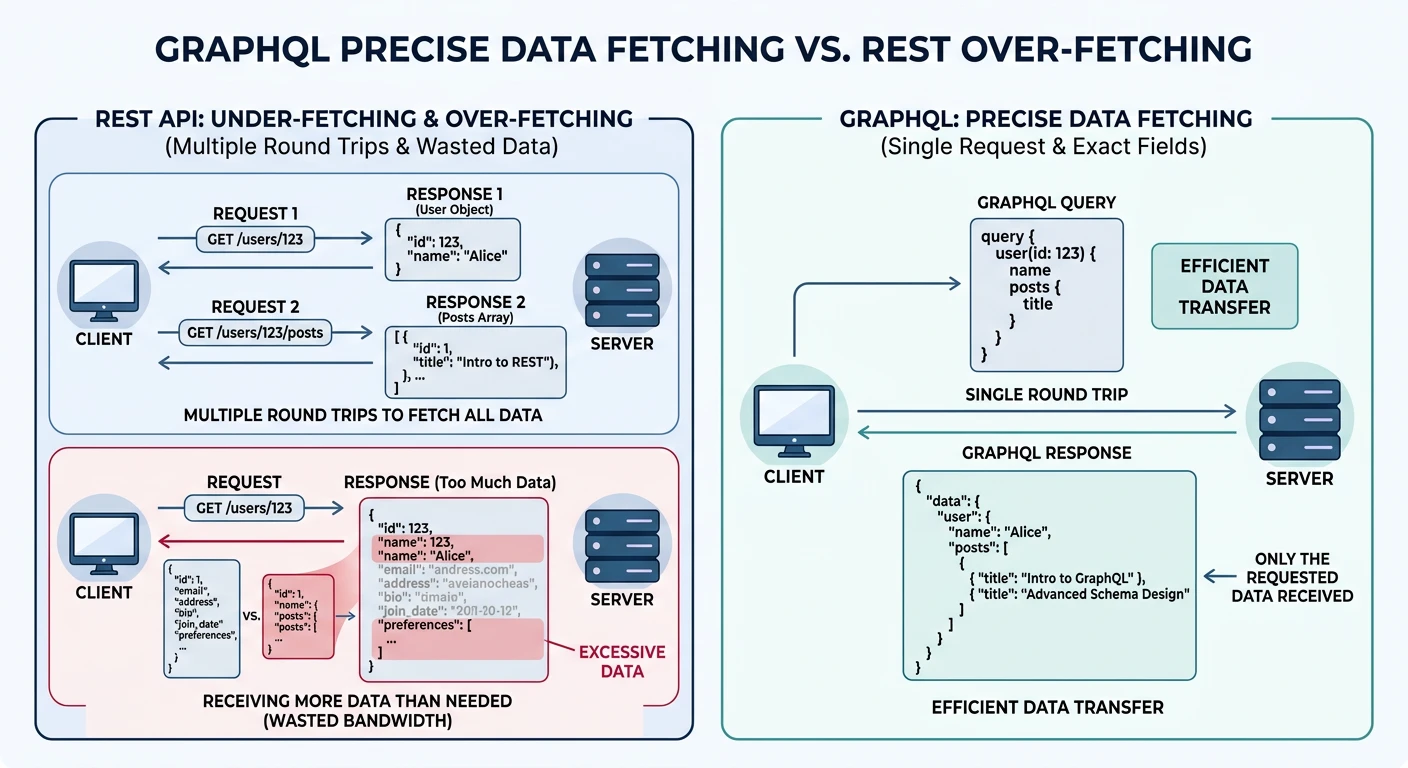
GraphQL Core Concepts
| Concept | Description |
|---|---|
| Schema | Type definitions describing available data |
| Query | Read operations - fetch data |
| Mutation | Write operations - create/update/delete |
| Subscription | Real-time updates via WebSocket |
| Resolver | Functions that return data for fields |
Schemas & Types
# schema.graphql - Type definitions
type Query {
  tasks(status: TaskStatus, limit: Int = 20, cursor: String): TaskConnection!
  task(id: ID!): Task
  me: User!
}

type Mutation {
  createTask(input: CreateTaskInput!): Task!
  updateTask(id: ID!, input: UpdateTaskInput!): Task!
  deleteTask(id: ID!): Boolean!
}

type Subscription {
  taskUpdated(userId: ID!): Task!
}

type Task {
  id: ID!
  title: String!
  description: String
  status: TaskStatus!
  priority: Priority!
  dueDate: DateTime
  createdAt: DateTime!
  updatedAt: DateTime!
  owner: User!
  tags: [Tag!]!
}

type User {
  id: ID!
  email: String!
  name: String!
  tasks(status: TaskStatus): [Task!]!
}

type TaskConnection {
  edges: [TaskEdge!]!
  pageInfo: PageInfo!
}

type TaskEdge {
  node: Task!
  cursor: String!
}

type PageInfo {
  hasNextPage: Boolean!
  endCursor: String
}

enum TaskStatus {
  PENDING
  IN_PROGRESS
  COMPLETED
  CANCELLED
}

enum Priority {
  LOW
  MEDIUM
  HIGH
  URGENT
}

input CreateTaskInput {
  title: String!
  description: String
  priority: Priority = MEDIUM
  dueDate: DateTime
  tagIds: [ID!]
}

input UpdateTaskInput {
  title: String
  description: String
  status: TaskStatus
  priority: Priority
  dueDate: DateTime
}

scalar DateTime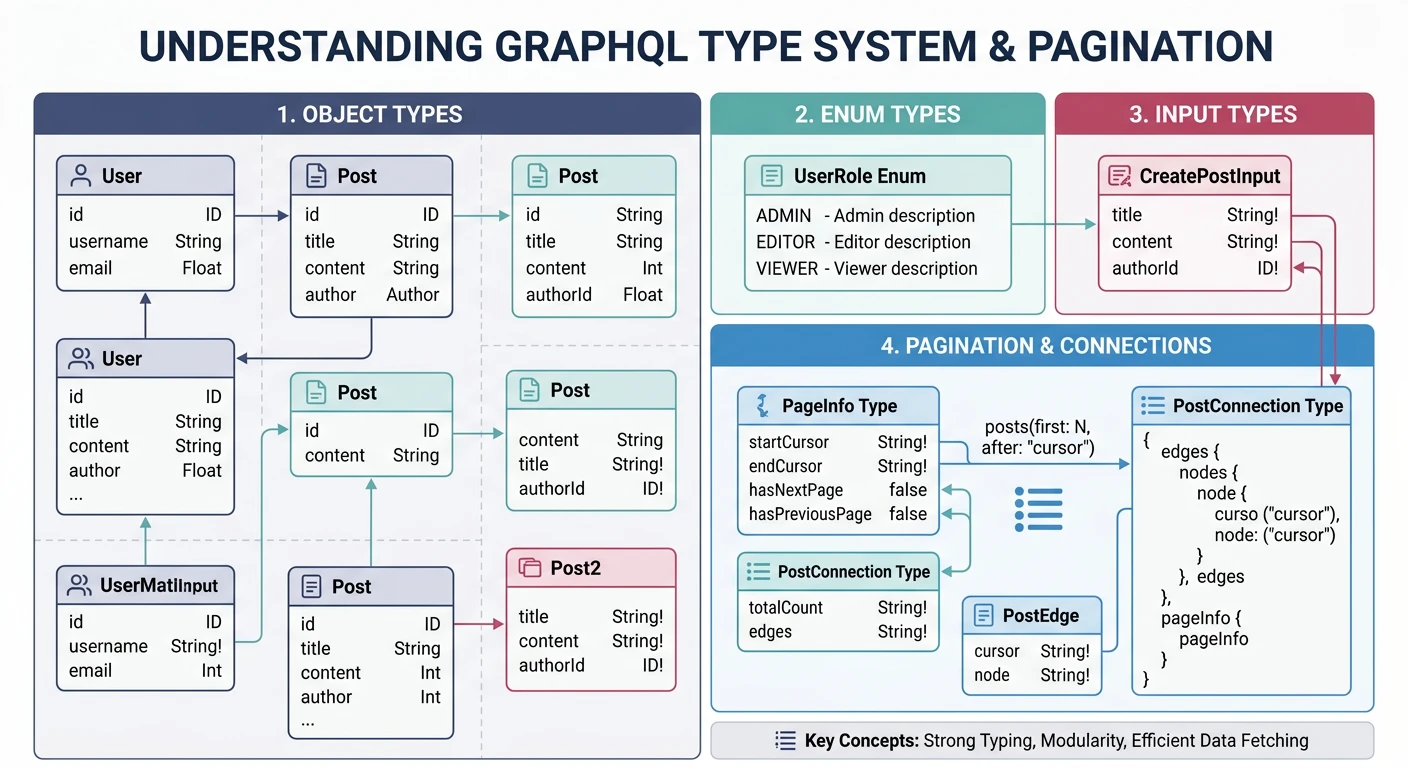
Queries & Mutations
// Apollo Server setup
const { ApolloServer, gql } = require('apollo-server-express');
const { makeExecutableSchema } = require('@graphql-tools/schema');

// Resolvers
const resolvers = {
  Query: {
    tasks: async (_, { status, limit, cursor }, { dataSources, user }) => {
      return dataSources.taskAPI.getTasks({ userId: user.id, status, limit, cursor });
    },
    task: async (_, { id }, { dataSources }) => {
      return dataSources.taskAPI.getTask(id);
    },
    me: (_, __, { user }) => user
  },

  Mutation: {
    createTask: async (_, { input }, { dataSources, user }) => {
      return dataSources.taskAPI.createTask({ ...input, userId: user.id });
    },
    updateTask: async (_, { id, input }, { dataSources, user }) => {
      // Authorization check
      const task = await dataSources.taskAPI.getTask(id);
      if (task.userId !== user.id) {
        throw new ForbiddenError('Not authorized');
      }
      return dataSources.taskAPI.updateTask(id, input);
    },
    deleteTask: async (_, { id }, { dataSources, user }) => {
      const task = await dataSources.taskAPI.getTask(id);
      if (task.userId !== user.id) {
        throw new ForbiddenError('Not authorized');
      }
      return dataSources.taskAPI.deleteTask(id);
    }
  },

  // Field resolver for nested data
  Task: {
    owner: (task, _, { dataSources }) => {
      return dataSources.userAPI.getUser(task.userId);
    },
    tags: (task, _, { dataSources }) => {
      return dataSources.tagAPI.getTagsByTask(task.id);
    }
  }
};

// Create server
const server = new ApolloServer({
  typeDefs,
  resolvers,
  context: ({ req }) => ({
    user: req.user,
    dataSources: {
      taskAPI: new TaskAPI(),
      userAPI: new UserAPI(),
      tagAPI: new TagAPI()
    }
  })
});
Client Query Examples
# Query: Get tasks with owner info
query GetMyTasks($status: TaskStatus, $limit: Int) {
  tasks(status: $status, limit: $limit) {
    edges {
      node {
        id
        title
        status
        priority
        dueDate
        owner {
          name
          email
        }
        tags {
          name
          color
        }
      }
      cursor
    }
    pageInfo {
      hasNextPage
      endCursor
    }
  }
}

# Mutation: Create task
mutation CreateTask($input: CreateTaskInput!) {
  createTask(input: $input) {
    id
    title
    status
    createdAt
  }
}
gRPC Fundamentals
What is gRPC?
gRPC is a high-performance RPC framework using Protocol Buffers for serialization. It's ideal for microservice communication with features like streaming and strong typing.
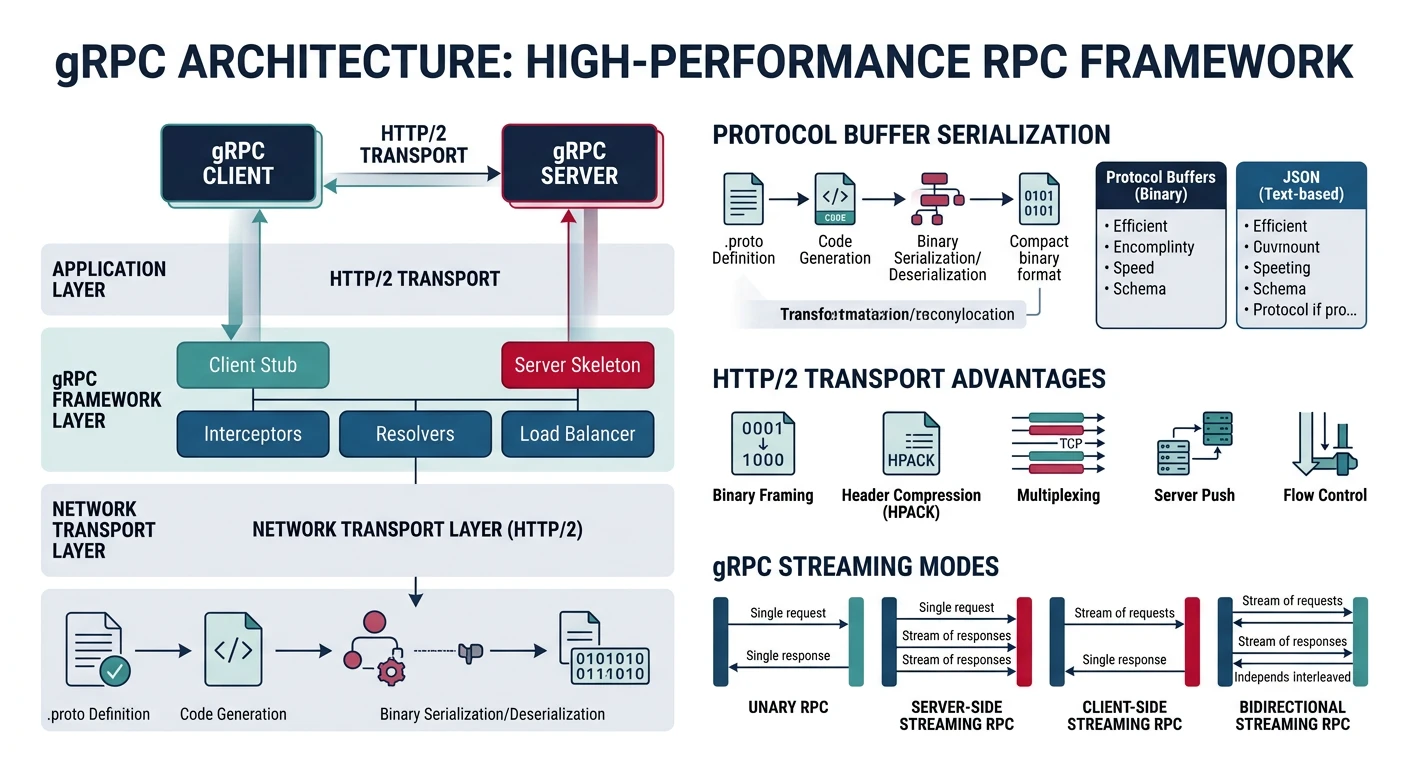
gRPC Advantages:
- Performance: Binary serialization (10x smaller than JSON)
- Streaming: Client, server, and bidirectional streams
- Code Generation: Typed clients in 10+ languages
- HTTP/2: Multiplexing, header compression
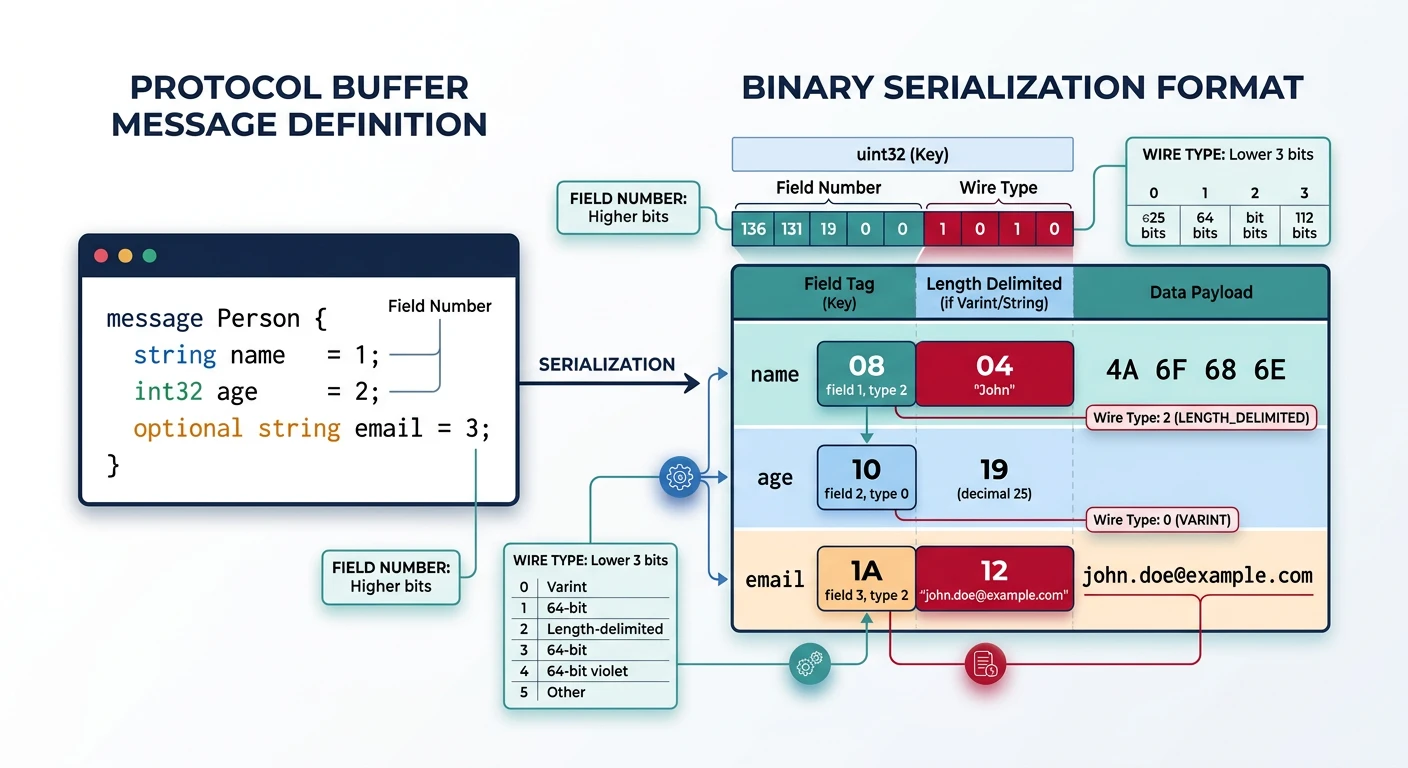
Protocol Buffers
// task.proto - Protocol Buffer definitions
syntax = "proto3";

package taskapi.v1;

import "google/protobuf/timestamp.proto";
import "google/protobuf/empty.proto";

service TaskService {
  // Unary RPCs
  rpc GetTask(GetTaskRequest) returns (Task);
  rpc CreateTask(CreateTaskRequest) returns (Task);
  rpc UpdateTask(UpdateTaskRequest) returns (Task);
  rpc DeleteTask(DeleteTaskRequest) returns (google.protobuf.Empty);

  // Server streaming
  rpc ListTasks(ListTasksRequest) returns (stream Task);

  // Bidirectional streaming
  rpc SyncTasks(stream TaskUpdate) returns (stream Task);
}

message Task {
  string id = 1;
  string title = 2;
  string description = 3;
  TaskStatus status = 4;
  Priority priority = 5;
  google.protobuf.Timestamp due_date = 6;
  google.protobuf.Timestamp created_at = 7;
  google.protobuf.Timestamp updated_at = 8;
  string user_id = 9;
}

enum TaskStatus {
  TASK_STATUS_UNSPECIFIED = 0;
  TASK_STATUS_PENDING = 1;
  TASK_STATUS_IN_PROGRESS = 2;
  TASK_STATUS_COMPLETED = 3;
  TASK_STATUS_CANCELLED = 4;
}

enum Priority {
  PRIORITY_UNSPECIFIED = 0;
  PRIORITY_LOW = 1;
  PRIORITY_MEDIUM = 2;
  PRIORITY_HIGH = 3;
  PRIORITY_URGENT = 4;
}

message GetTaskRequest {
  string id = 1;
}

message CreateTaskRequest {
  string title = 1;
  string description = 2;
  Priority priority = 3;
  google.protobuf.Timestamp due_date = 4;
}

message UpdateTaskRequest {
  string id = 1;
  optional string title = 2;
  optional string description = 3;
  optional TaskStatus status = 4;
  optional Priority priority = 5;
}

message DeleteTaskRequest {
  string id = 1;
}

message ListTasksRequest {
  optional TaskStatus status = 1;
  int32 limit = 2;
}

message TaskUpdate {
  string id = 1;
  Task task = 2;
}
gRPC Server Implementation
// grpc-server.js - Node.js gRPC server
const grpc = require('@grpc/grpc-js');
const protoLoader = require('@grpc/proto-loader');

const packageDefinition = protoLoader.loadSync('task.proto', {
  keepCase: true,
  longs: String,
  enums: String,
  defaults: true,
  oneofs: true
});

const taskProto = grpc.loadPackageDefinition(packageDefinition).taskapi.v1;

// Service implementation
const taskService = {
  getTask: async (call, callback) => {
    try {
      const task = await db.tasks.findById(call.request.id);
      callback(null, task);
    } catch (error) {
      callback({ code: grpc.status.NOT_FOUND, message: 'Task not found' });
    }
  },

  createTask: async (call, callback) => {
    const task = await db.tasks.create(call.request);
    callback(null, task);
  },

  // Server streaming - sends multiple responses
  listTasks: async (call) => {
    const { status, limit } = call.request;
    const cursor = db.tasks.find({ status }).limit(limit).cursor();

    for await (const task of cursor) {
      call.write(task);
    }
    call.end();
  },

  // Bidirectional streaming
  syncTasks: (call) => {
    call.on('data', async (update) => {
      const task = await db.tasks.upsert(update.id, update.task);
      call.write(task);
    });

    call.on('end', () => call.end());
  }
};

// Start server
const server = new grpc.Server();
server.addService(taskProto.TaskService.service, taskService);
server.bindAsync('0.0.0.0:50051', grpc.ServerCredentials.createInsecure(), () => {
  console.log('gRPC server running on port 50051');
});
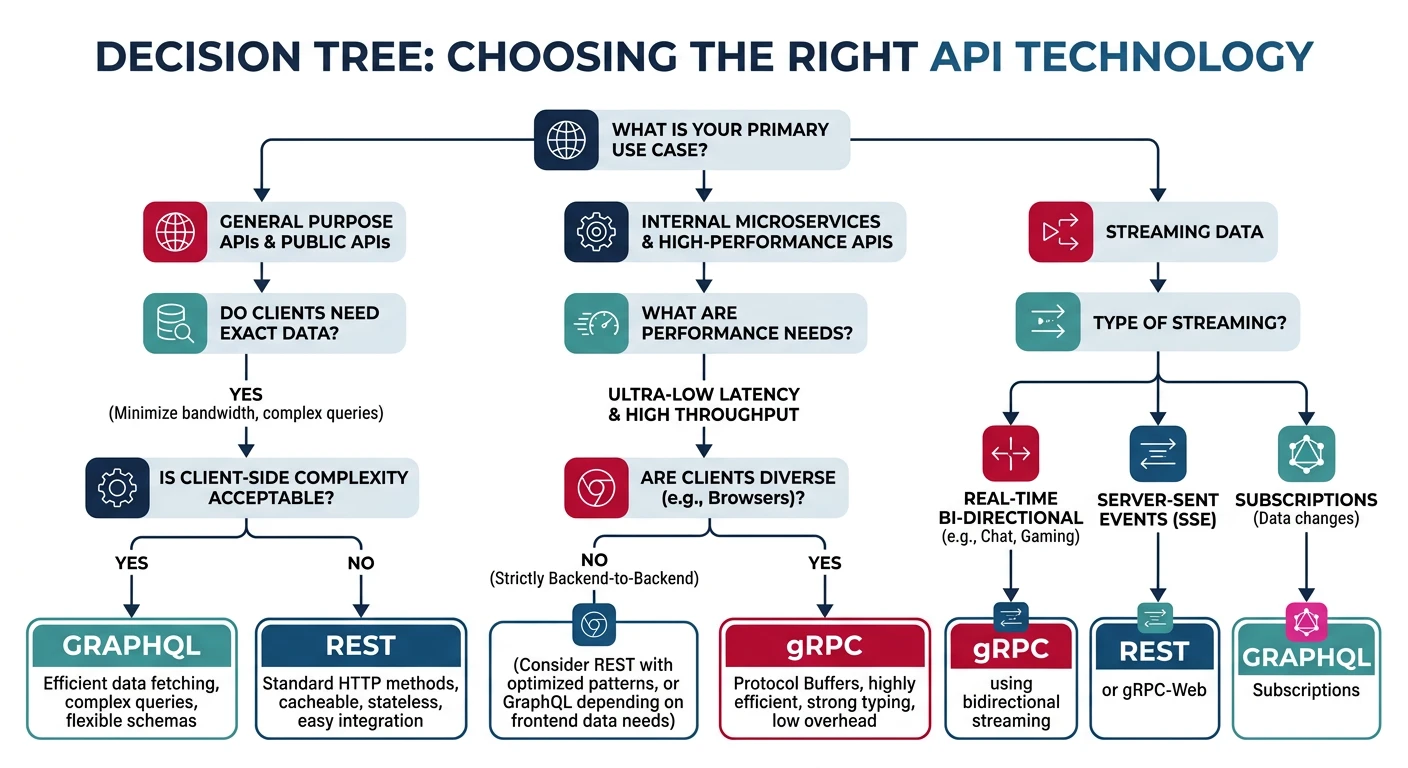
REST vs GraphQL vs gRPC
When to Use Each
| Aspect | REST | GraphQL | gRPC |
|---|---|---|---|
| Best For | Public APIs, CRUD | Complex frontends, BFF | Microservices, real-time |
| Data Format | JSON | JSON | Binary (Protobuf) |
| Performance | Good | Good (can optimize) | Excellent |
| Browser Support | Native | Native | Requires grpc-web |
| Learning Curve | Low | Medium | Medium-High |
Practice Exercises
Exercise 1: GraphQL API
- Create GraphQL schema for tasks
- Implement Query and Mutation resolvers
- Test with Apollo Studio
Exercise 2: gRPC Service
- Define Protocol Buffer schema
- Generate server and client code
- Implement server streaming RPC
Exercise 3: API Gateway with Multiple Backends
- GraphQL gateway federating multiple services
- REST and gRPC backends
- Protocol translation layer