x86 Assembly Series Part 17: C & Assembly Interoperability
February 6, 2026Wasil Zafar30 min read
Master C and assembly integration: call C library functions from assembly, write assembly functions callable from C, use GCC inline assembly, and understand ABI compliance for seamless interop.
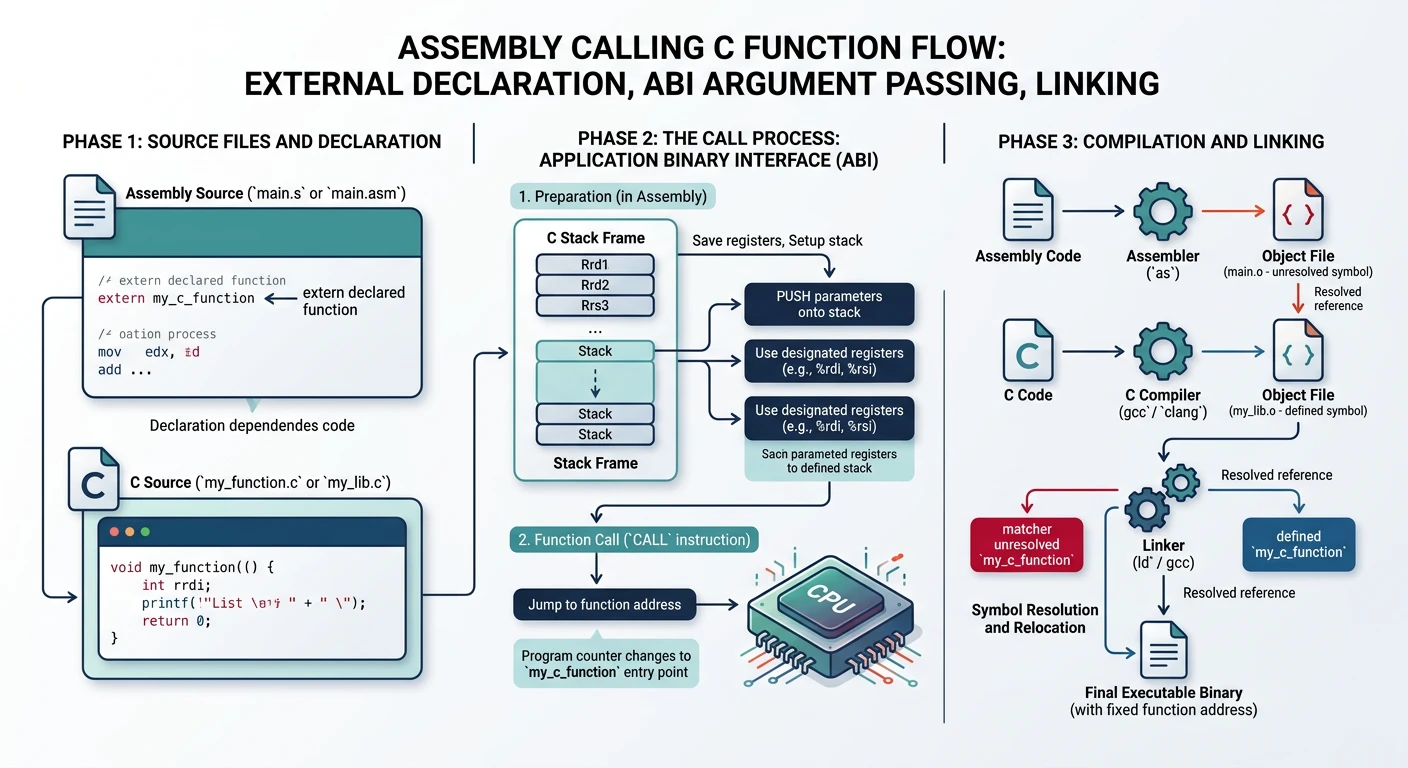
Why Interop? Combine C's productivity with assembly's performance. Use C for complex logic, assembly for hot loops. Access libc (printf, malloc) from assembly.
# Compile and link with libc
nasm -f elf64 program.asm -o program.o
gcc -no-pie program.o -o program
C Calling Assembly Functions
global Exports
; asm_add.asm - Assembly function callable from C
section .text
global asm_add          ; Export symbol

; int asm_add(int a, int b)
; Args: RDI = a, RSI = b (System V ABI)
; Returns: RAX
asm_add:
    mov rax, rdi        ; RAX = a
    add rax, rsi        ; RAX = a + b
    ret
// main.c - C code calling assembly
#include <stdio.h>

extern int asm_add(int a, int b);

int main() {
    int result = asm_add(10, 20);
    printf("Result: %d\n", result);  // Output: 30
    return 0;
}
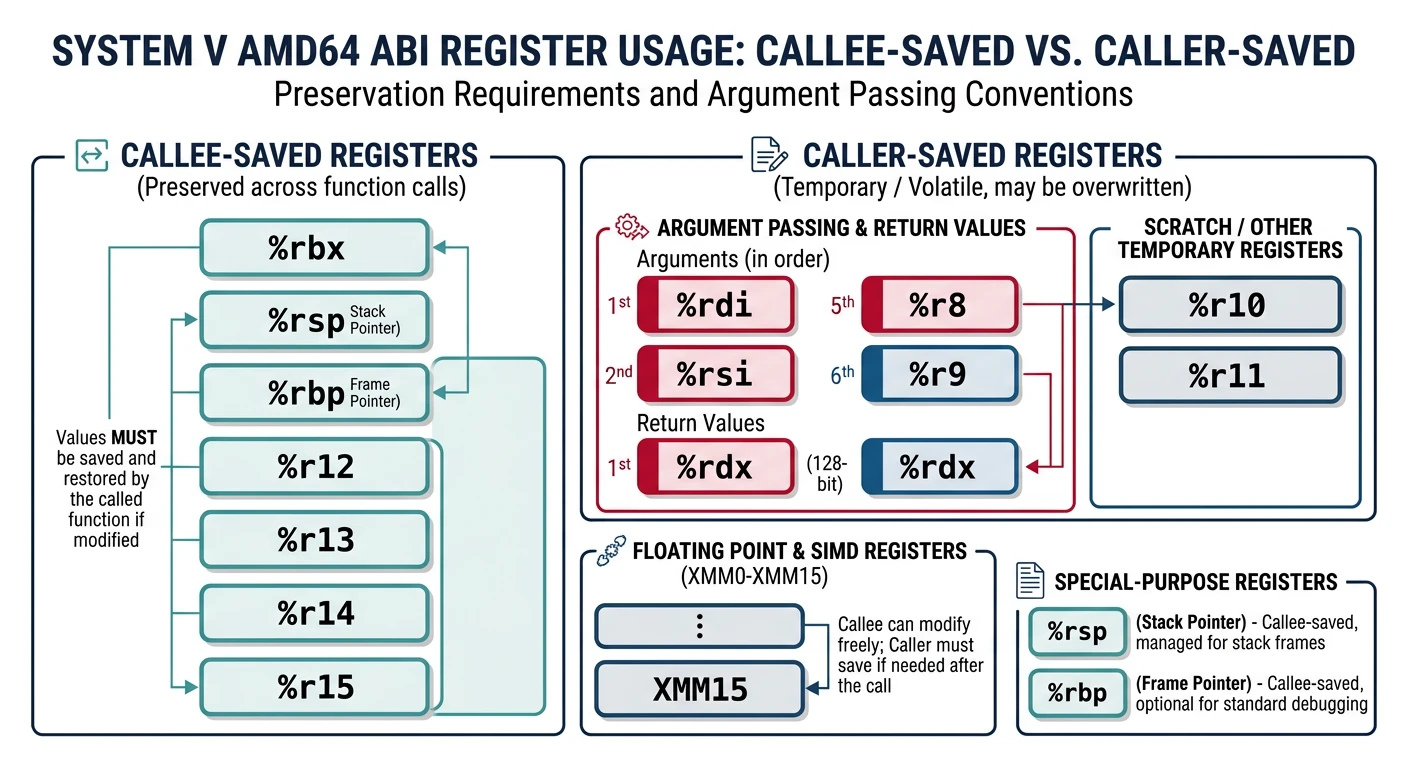
When your assembly function is called from C, you must follow the ABI rules or risk corrupting the caller's state. Think of it like a hotel room—you can rearrange furniture, but put everything back before checkout.
System V AMD64 ABI: callee-saved registers (RBX, RBP, R12–R15) vs caller-saved scratch registers
Callee-Saved Registers (System V AMD64)
These registers must have the same value when your function returns:
Register
Must Preserve?
Common Use
RBX
Yes
General callee-saved
RBP
Yes
Frame pointer
R12-R15
Yes
General callee-saved
RSP
Yes
Stack pointer (critical!)
RAX, RCX, RDX
No
Return value / scratch
RDI, RSI
No
Arguments / scratch
R8-R11
No
Arguments / scratch
; Proper callee-saved register handling
global my_function
my_function:
    ; Save callee-saved registers we'll use
    push rbx
    push r12
    push r13
    push rbp

    ; Now we can freely use RBX, R12, R13, RBP
    mov rbx, rdi
    mov r12, rsi
    ; ... do work ...

    ; Restore in reverse order
    pop rbp
    pop r13
    pop r12
    pop rbx
    ret
Stack Alignment Rule
Critical: The stack must be 16-byte aligned BEFORE the call instruction. Since call pushes an 8-byte return address, RSP is misaligned upon function entry. If you push an odd number of 8-byte values, you realign it.
; Stack alignment examples

; BAD: Calling printf with misaligned stack
my_func:
    ; RSP is 8-byte misaligned after call instruction
    mov rdi, format_str
    call printf         ; CRASH! Stack not 16-byte aligned
    ret

; GOOD: Align stack before calling
my_func:
    sub rsp, 8          ; Realign to 16 bytes
    mov rdi, format_str
    call printf
    add rsp, 8
    ret

; ALTERNATIVE: Use push for alignment
my_func:
    push rbx            ; Align + save callee-saved register
    mov rdi, format_str
    call printf
    pop rbx
    ret
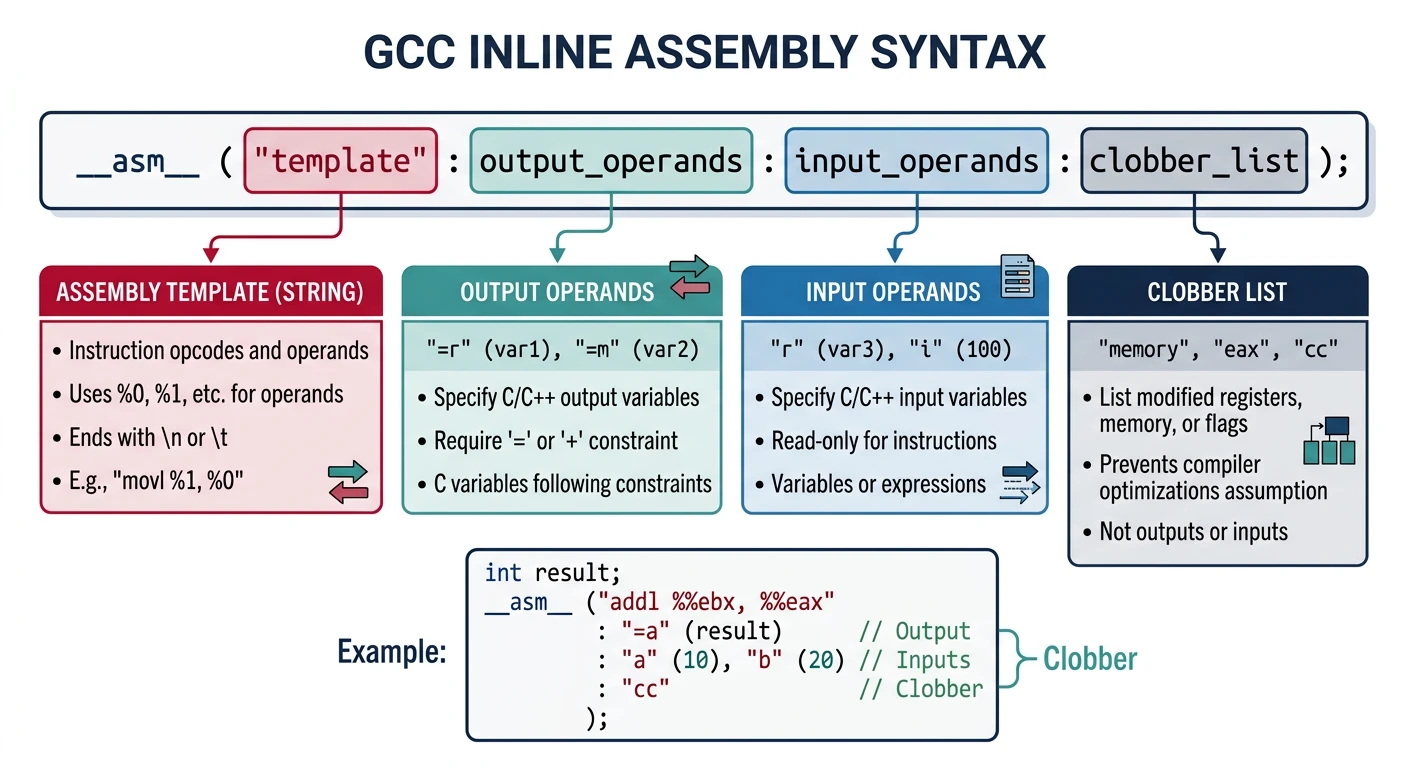
GCC Inline Assembly
GCC extended inline assembly syntax: template string, output/input operands, and clobber list
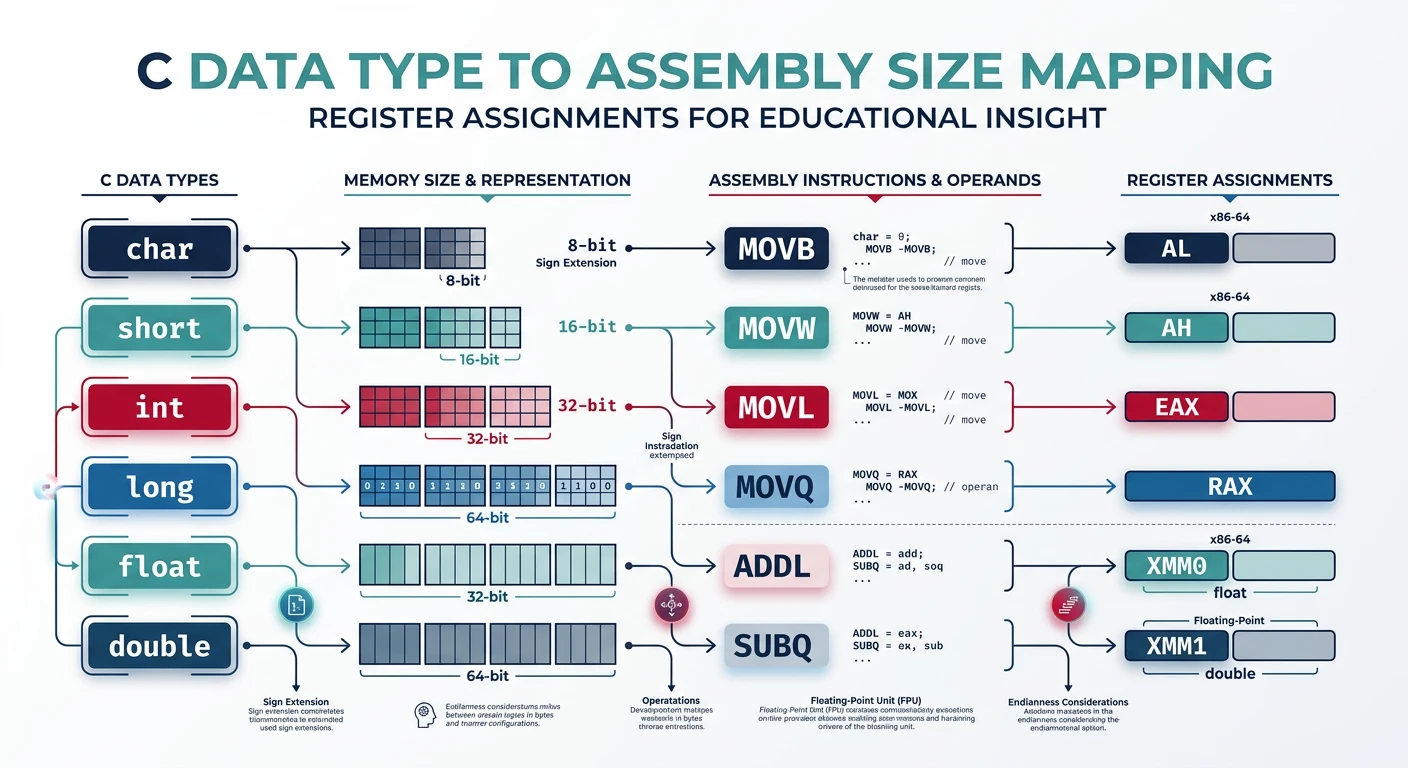
Understanding how C types map to assembly sizes and registers is essential for correct interop. Here's the complete mapping for x86-64 Linux (System V ABI):
C data types mapped to x86-64 assembly: sizes, NASM directives, and register assignments
Integer Types
C Type
Size
NASM Equivalent
Register
Access
char
1 byte
db
AL, DIL
byte [addr]
short
2 bytes
dw
AX, DI
word [addr]
int
4 bytes
dd
EAX, EDI
dword [addr]
long
8 bytes
dq
RAX, RDI
qword [addr]
long long
8 bytes
dq
RAX, RDI
qword [addr]
void*
8 bytes
dq
RAX, RDI
qword [addr]
Floating Point Types
C Type
Size
Register
Instructions
float
4 bytes
XMM0-XMM7
movss, addss, mulss
double
8 bytes
XMM0-XMM7
movsd, addsd, mulsd
long double
16 bytes*
ST(0) (x87)
fld, fstp
*long double is 80-bit internally, padded to 16 bytes for alignment
Passing Floats and Doubles
; float add_floats(float a, float b)
; Arguments: XMM0 = a, XMM1 = b
; Return: XMM0
global add_floats
add_floats:
    addss xmm0, xmm1    ; XMM0 = a + b
    ret

; double multiply(double x, double y)
; Arguments: XMM0 = x, XMM1 = y
global multiply
multiply:
    mulsd xmm0, xmm1    ; XMM0 = x * y
    ret
Mixed Integer and Float Arguments
Integer arguments use RDI, RSI, RDX, RCX, R8, R9. Float arguments use XMM0-XMM7. They have separate counters!
// C function with mixed types
void mixed(int a, double b, int c, float d);
// a → EDI (integer slot 1)
// b → XMM0 (float slot 1)
// c → ESI (integer slot 2)
// d → XMM1 (float slot 2)
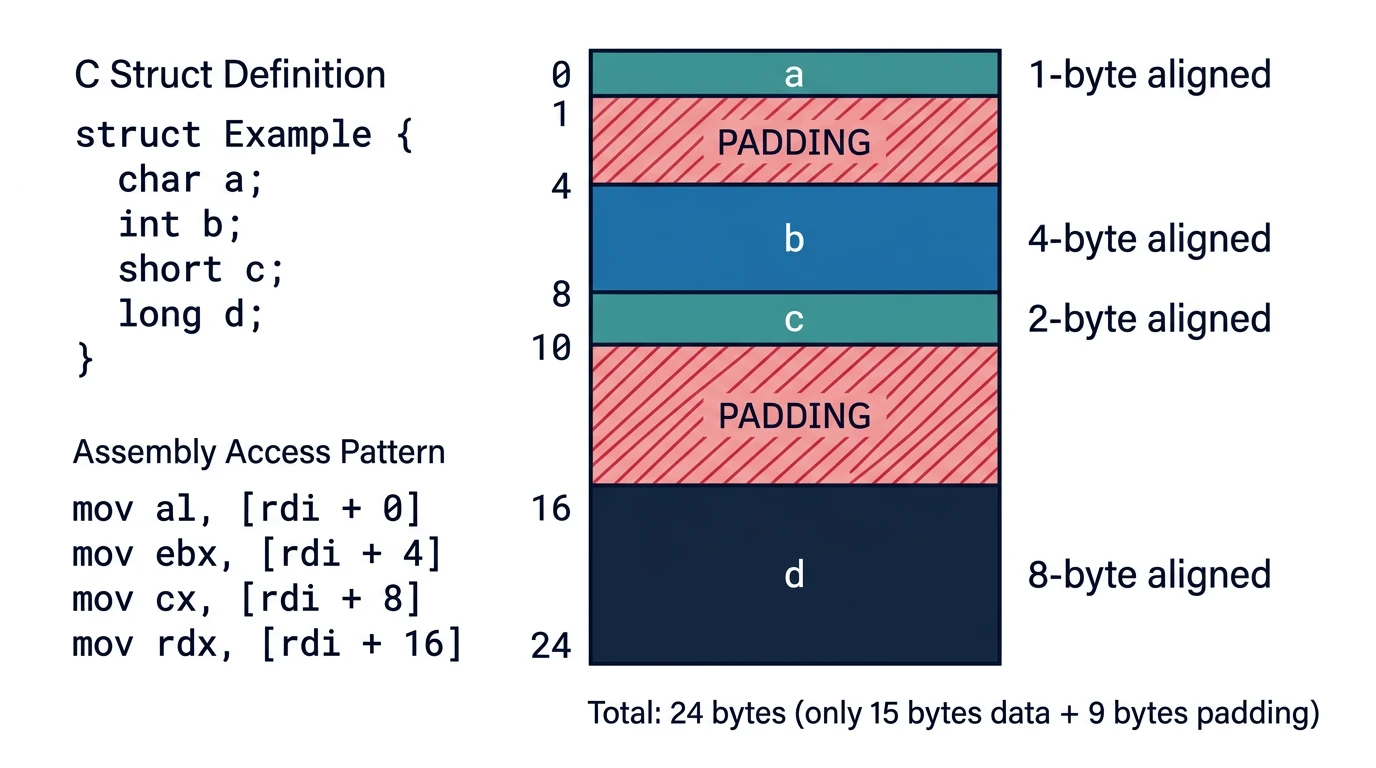
C structures are laid out in memory with specific alignment rules. Understanding padding and offsets is crucial for accessing struct members from assembly.
C struct memory layout with alignment padding: field offsets and total size as seen from assembly
Structure Layout & Padding
// C struct definition
typedef struct {
    char  a;      // Offset 0, 1 byte
    // 3 bytes padding
    int   b;      // Offset 4, 4 bytes (aligned to 4)
    short c;      // Offset 8, 2 bytes
    // 6 bytes padding
    long  d;      // Offset 16, 8 bytes (aligned to 8)
} Example;        // Total: 24 bytes

// To check: printf("Size: %zu\n", sizeof(Example));
Memory Layout:
┌────────┬────────┬────────┬────────┐
│   a    │ pad[3] │    b     │ (4B)   │  Bytes 0-7
└────────┴────────┴────────┴────────┘
┌────────┬──────────────────────────┐
│   c    │       padding        │  Bytes 8-15
└────────┴──────────────────────────┘
┌───────────────────────────────────┐
│              d                  │  Bytes 16-23
└───────────────────────────────────┘
Accessing Struct Members from Assembly
; void process_struct(Example* ptr)
; Argument: RDI = pointer to Example struct
global process_struct
process_struct:
    ; Define offsets (match C struct layout)
    %define OFFSET_A  0
    %define OFFSET_B  4
    %define OFFSET_C  8
    %define OFFSET_D  16

    ; Read members
    movzx eax, byte [rdi + OFFSET_A]   ; Load char a (zero-extend)
    mov   ebx, [rdi + OFFSET_B]         ; Load int b
    movsx ecx, word [rdi + OFFSET_C]    ; Load short c (sign-extend)
    mov   rdx, [rdi + OFFSET_D]         ; Load long d

    ; Modify members
    mov   byte [rdi + OFFSET_A], 'X'    ; Set a = 'X'
    add   dword [rdi + OFFSET_B], 100   ; b += 100

    ret
Using NASM Structs (Cleaner Approach)
; Define struct in NASM
struc Example
    .a:     resb 1
            resb 3      ; Explicit padding
    .b:     resd 1
    .c:     resw 1
            resb 6      ; Padding
    .d:     resq 1
endstruc

; Now use struct offsets
process_struct:
    mov al, [rdi + Example.a]      ; Load a
    mov ebx, [rdi + Example.b]     ; Load b
    mov rcx, [rdi + Example.d]     ; Load d
    ret
Arrays
; int sum_array(int* arr, int len)
; RDI = array pointer, ESI = length
global sum_array
sum_array:
    xor eax, eax            ; sum = 0
    test esi, esi
    jz .done

.loop:
    add eax, [rdi]          ; sum += arr[i]
    add rdi, 4              ; Move to next int (4 bytes)
    dec esi
    jnz .loop

.done:
    ret                     ; Return sum in EAX
Exercise
Struct Sum Challenge
Write an assembly function that takes a pointer to this C struct and returns the sum of all numeric members: