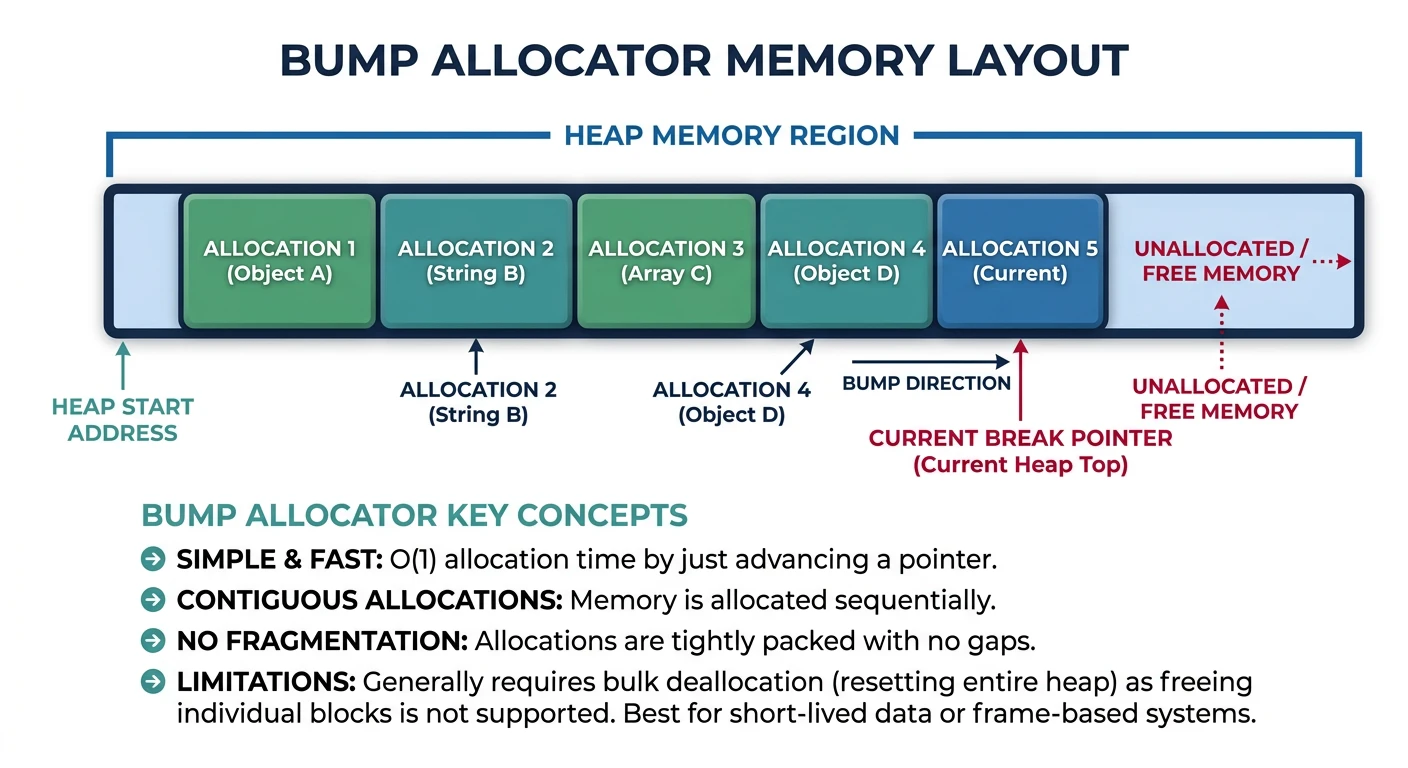
A bump allocator is the simplest dynamic memory allocator—it just keeps incrementing a pointer. Think of it like a notepad: you keep writing at the next available line, never erasing.
Figure: Bump allocator layout – sequential allocations advance a pointer through the heap, with brk syscall expanding available memory.
Limitation: Bump allocators can't free individual allocations. Use alloc_reset() to free everything at once—perfect for arena/pool-style memory management.
Project 3: XOR Encryption
; XOR cipher - encrypt/decrypt buffer
; Input:  RDI = buffer, RSI = length, RDX = key (single byte)
global xor_cipher
xor_cipher:
    test rsi, rsi
    jz .done
    movzx eax, dl           ; Key byte in AL
.loop:
    xor [rdi], al           ; XOR byte with key
    inc rdi
    dec rsi
    jnz .loop
.done:
    ret
Link with C: gcc main.c xor_cipher.o -o cipher_demo
Project 4: Image Grayscale
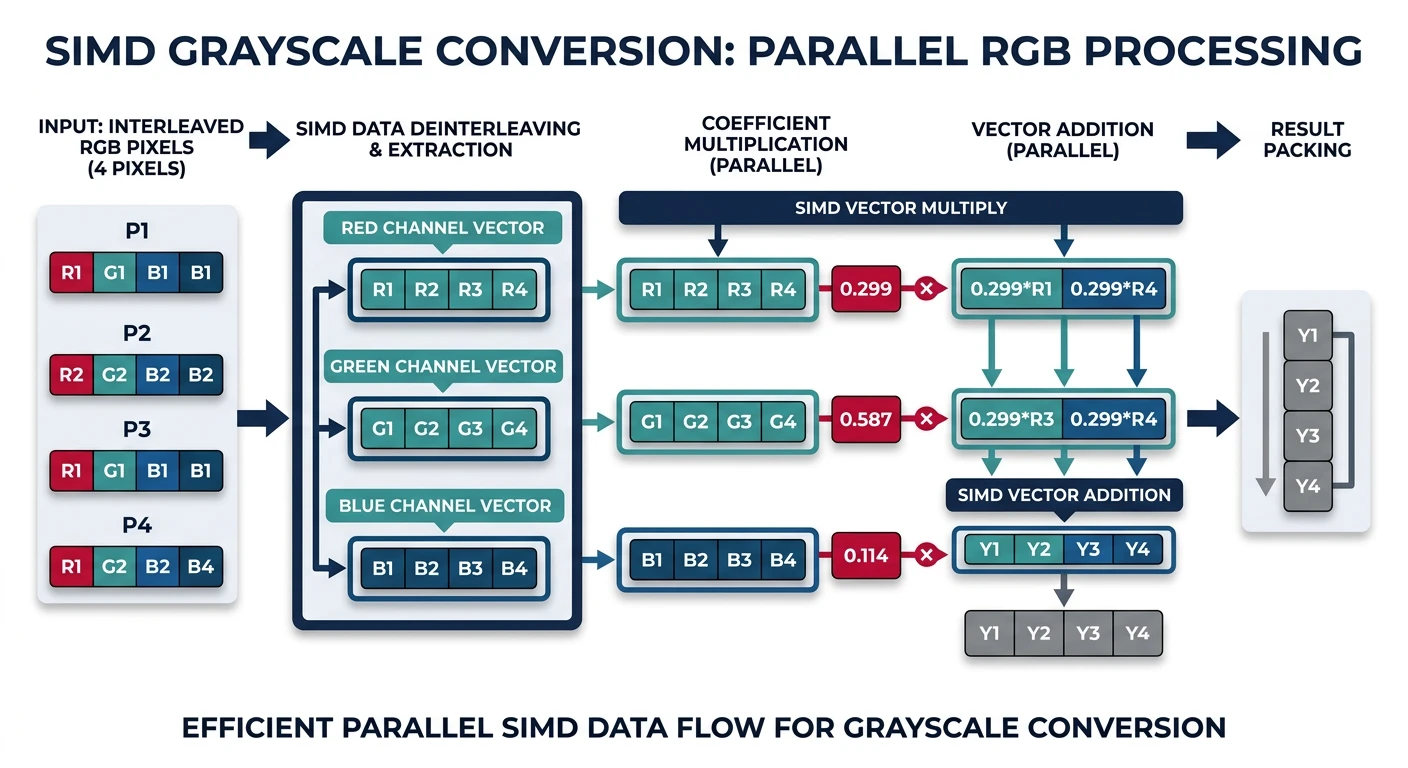
Convert RGB images to grayscale using SIMD. The standard formula is: Gray = 0.299*R + 0.587*G + 0.114*B
Figure: SIMD grayscale pipeline – SSE processes 4 RGBA pixels simultaneously by extracting channels, multiplying by luminance coefficients, and repacking results.
RGB Pixel Format (24-bit):
┌─────┬─────┬─────┐
│  R  │  G  │  B  │  x 4 pixels = 12 bytes
└─────┴─────┴─────┘

RGBA Pixel Format (32-bit) - easier for SIMD:
┌─────┬─────┬─────┬─────┐
│  R  │  G  │  B  │  A  │  x 4 pixels = 16 bytes = 1 XMM
└─────┴─────┴─────┴─────┘
section .data
align 16
    ; Grayscale coefficients (fixed-point: value * 256)
    coeff_r:    times 16 db 77     ; 0.299 * 256 ≈ 77
    coeff_g:    times 16 db 150    ; 0.587 * 256 ≈ 150
    coeff_b:    times 16 db 29     ; 0.114 * 256 ≈ 29

section .text

; void grayscale_sse(uint8_t* pixels, int count)
; Input: RDI = RGBA pixel array, RSI = pixel count
; Output: Modifies pixels in-place (R=G=B=gray, A unchanged)
global grayscale_sse
grayscale_sse:
    shr rsi, 2              ; Process 4 pixels per iteration
    jz .done

    movdqa xmm4, [rel coeff_r]
    movdqa xmm5, [rel coeff_g]
    movdqa xmm6, [rel coeff_b]

.loop:
    ; Load 4 RGBA pixels (16 bytes)
    movdqu xmm0, [rdi]      ; [R0 G0 B0 A0 | R1 G1 B1 A1 | ...]

    ; Extract R, G, B channels
    movdqa xmm1, xmm0       ; Copy for R
    movdqa xmm2, xmm0       ; Copy for G
    movdqa xmm3, xmm0       ; Copy for B

    ; Mask to extract each channel (every 4th byte starting at offset)
    pand xmm1, [rel mask_r] ; Keep R bytes
    pand xmm2, [rel mask_g] ; Keep G bytes
    pand xmm3, [rel mask_b] ; Keep B bytes

    ; Shift G and B to align with R position for calculation
    psrld xmm2, 8           ; G >> 8
    psrld xmm3, 16          ; B >> 16

    ; Multiply by coefficients (8-bit)
    pmullw xmm1, xmm4       ; R * 77
    pmullw xmm2, xmm5       ; G * 150
    pmullw xmm3, xmm6       ; B * 29

    ; Sum and divide by 256 (shift right 8)
    paddw xmm1, xmm2
    paddw xmm1, xmm3
    psrlw xmm1, 8           ; gray = (R*77 + G*150 + B*29) / 256

    ; Pack gray value to all RGB channels
    ; Result: [gray gray gray A0 | gray gray gray A1 | ...]
    movdqa xmm2, xmm1
    pslld xmm1, 8           ; gray << 8 (to G position)
    por xmm2, xmm1
    pslld xmm1, 8           ; gray << 16 (to B position)
    por xmm2, xmm1
    pand xmm0, [rel mask_a] ; Keep original alpha
    por xmm2, xmm0          ; Combine gray RGB + original A

    movdqu [rdi], xmm2      ; Store result

    add rdi, 16
    dec rsi
    jnz .loop

.done:
    ret

section .rodata
align 16
    mask_r: times 4 dd 0x000000FF
    mask_g: times 4 dd 0x0000FF00
    mask_b: times 4 dd 0x00FF0000
    mask_a: times 4 dd 0xFF000000
Link with C: gcc main.c grayscale_sse.o -o grayscale_demo
Project 5: Math Functions
Fast Integer Square Root
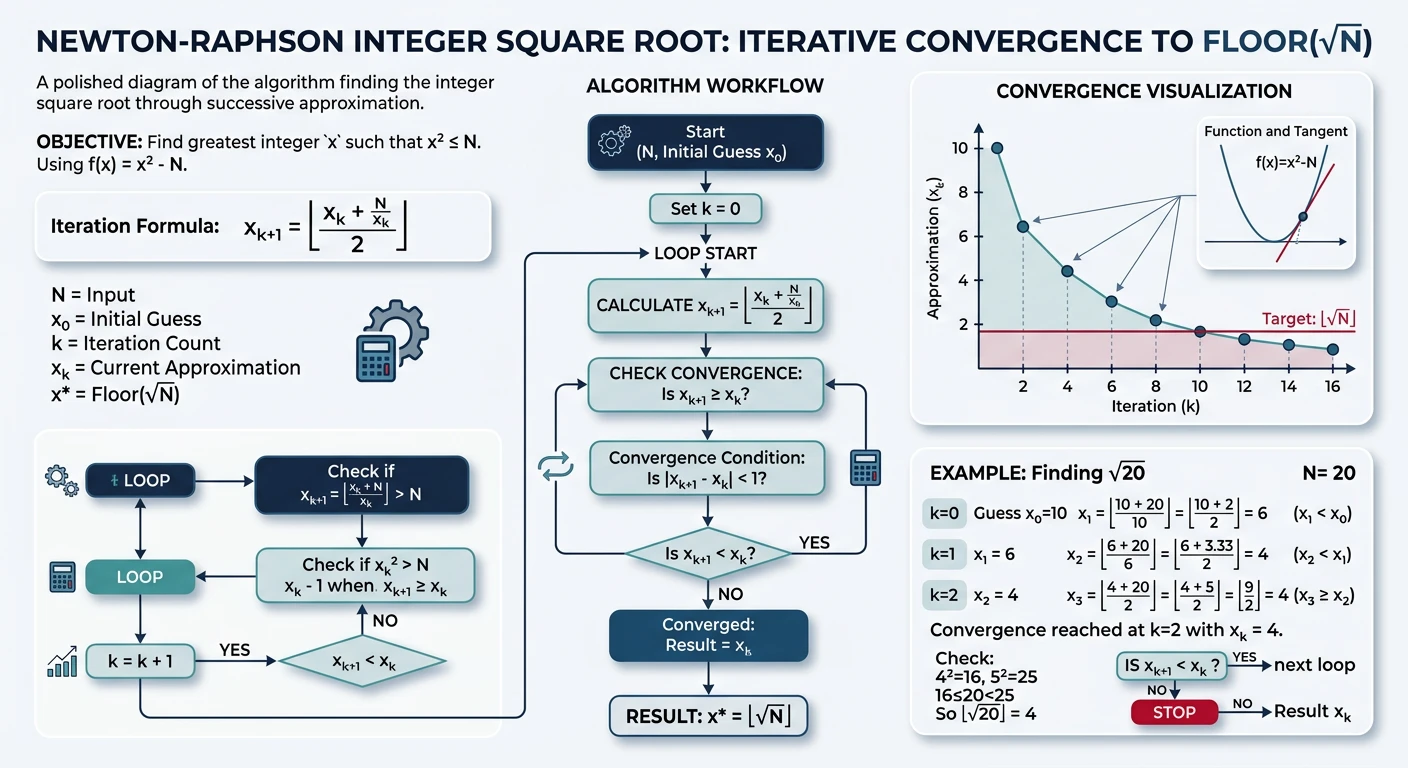
Newton-Raphson method for integer square root—useful in graphics and game dev where floating point is too slow.
Figure: Newton-Raphson isqrt – iterative refinement converges to floor(√n) by repeatedly computing x = (x + n/x) / 2.
; uint32_t isqrt(uint32_t n)
; Input: EDI = n
; Output: EAX = floor(sqrt(n))
global isqrt
isqrt:
    test edi, edi
    jz .zero                ; sqrt(0) = 0

    ; Initial guess: highest set bit / 2
    bsr eax, edi            ; Find highest set bit
    shr eax, 1              ; Divide position by 2
    mov ecx, 1
    shl ecx, cl             ; Initial guess = 2^(bit_pos/2)
    mov eax, ecx

.newton_loop:
    ; x_new = (x + n/x) / 2
    mov edx, edi
    xor ecx, ecx
    div eax                 ; EDX:EAX = n / x
    add eax, ecx            ; x + n/x (ECX held old x)
    shr eax, 1              ; / 2

    ; Check convergence
    mov ecx, eax            ; Save for next iteration
    cmp eax, edx
    ja .newton_loop         ; Keep iterating if not converged

    ret

.zero:
    xor eax, eax
    ret

; Simpler version using bit manipulation
global isqrt_bit
isqrt_bit:
    xor eax, eax            ; Result = 0
    mov ecx, 1 << 30        ; Start with highest power of 4 <= 2^30

.bit_loop:
    test ecx, ecx
    jz .done

    mov edx, eax
    add edx, ecx            ; result + bit
    cmp edi, edx
    jb .shift

    sub edi, edx            ; n -= (result + bit)
    shr eax, 1
    add eax, ecx            ; result = result/2 + bit
    shr ecx, 2              ; bit /= 4
    jmp .bit_loop

.shift:
    shr eax, 1              ; result /= 2
    shr ecx, 2              ; bit /= 4
    jmp .bit_loop

.done:
    ret
Save & Compile: isqrt.asm
Linuxnasm -f elf64 isqrt.asm -o isqrt.o
macOSnasm -f macho64 isqrt.asm -o isqrt.o
Windowsnasm -f win64 isqrt.asm -o isqrt.obj
Link with C: gcc main.c isqrt.o -o isqrt_demo
Factorial
; uint64_t factorial(uint32_t n)
; Input: EDI = n (max 20 for 64-bit result)
; Output: RAX = n!
global factorial
factorial:
    mov eax, 1              ; result = 1
    test edi, edi
    jz .done                ; 0! = 1

    cmp edi, 20
    ja .overflow            ; 21! > 2^64

.loop:
    imul rax, rdi           ; result *= n
    dec edi
    jnz .loop

.done:
    ret

.overflow:
    mov rax, -1             ; Return max value on overflow
    ret

; Lookup table version (fastest for small n)
section .rodata
align 8
factorial_table:
    dq 1                    ; 0!
    dq 1                    ; 1!
    dq 2                    ; 2!
    dq 6                    ; 3!
    dq 24                   ; 4!
    dq 120                  ; 5!
    dq 720                  ; 6!
    dq 5040                 ; 7!
    dq 40320                ; 8!
    dq 362880               ; 9!
    dq 3628800              ; 10!
    ; ... up to 20!

section .text
global factorial_lookup
factorial_lookup:
    cmp edi, 20
    ja .overflow
    mov rax, [rel factorial_table + rdi*8]
    ret
.overflow:
    mov rax, -1
    ret