Master the four major API paradigms: REST's resource-oriented simplicity, GraphQL's flexible queries, gRPC's high-performance streaming, and SOAP's enterprise reliability. Learn when to use each and how to design robust APIs.
APIs (Application Programming Interfaces) are the contracts that allow software systems to communicate. In Part 6, we explored HTTP—the transport layer for most APIs. Now we examine the architectural styles built on top of HTTP (and beyond).
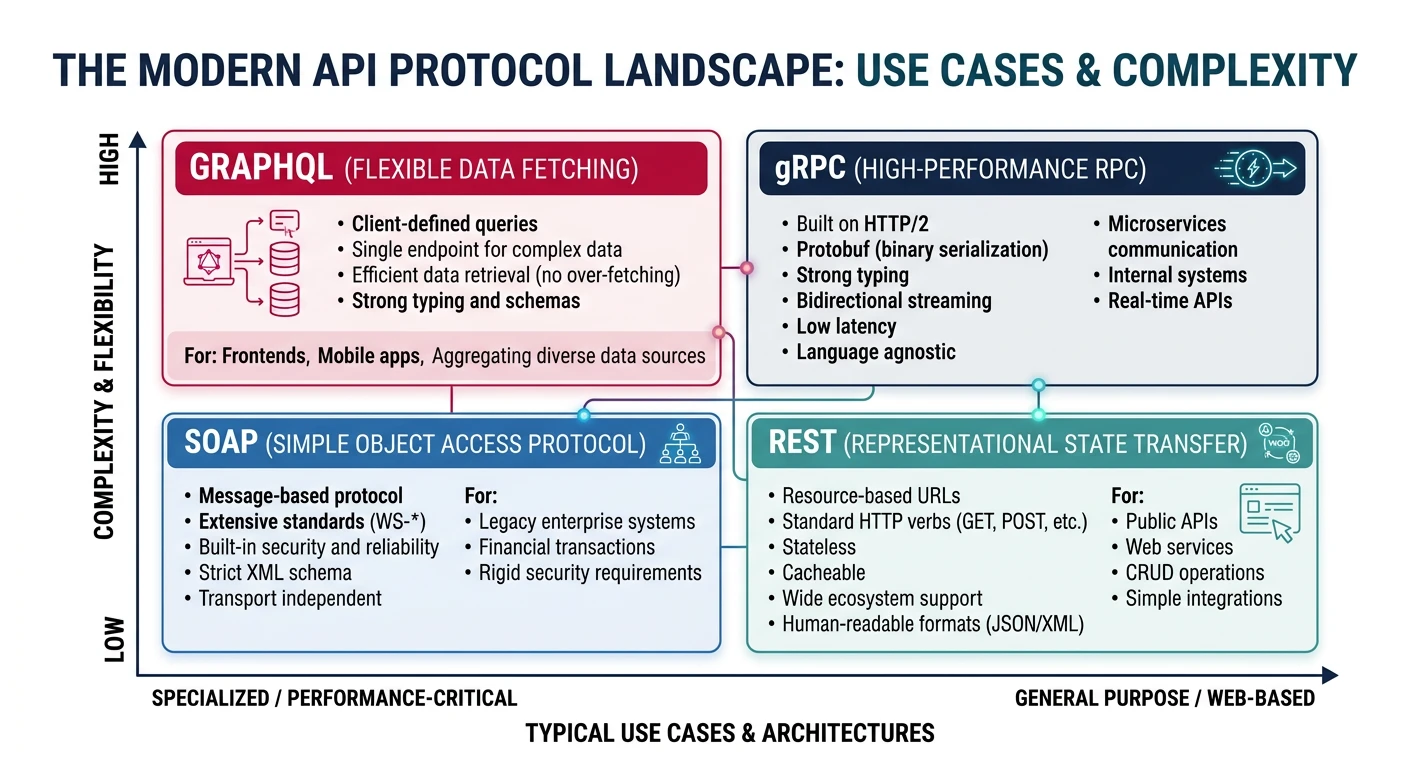
The modern API landscape — REST dominates web APIs, GraphQL enables flexible queries, gRPC powers microservices, and SOAP remains in enterprise integrations
Series Context: This is Part 7 of 20 in the Complete Protocols Master series. We're diving deep into application-layer protocols that power modern distributed systems.
API Protocol Decision Tree:

Start
│
├── Need real-time bidirectional streaming?
│   ├── Yes → gRPC (or WebSockets for browser)
│   └── No ↓
│
├── Internal microservices communication?
│   ├── Yes → gRPC (best performance)
│   └── No ↓
│
├── Multiple clients with different data needs?
│   ├── Yes → GraphQL (flexible queries)
│   └── No ↓
│
├── Simple CRUD with caching?
│   ├── Yes → REST (simplest, most tooling)
│   └── No ↓
│
├── Enterprise with WS-Security, transactions?
│   ├── Yes → SOAP (built-in standards)
│   └── No → REST (default choice)

Reality:
┌─────────────────────────────────────────────────────────┐
│ Most organizations use multiple protocols:              │
│                                                         │
│ • REST for public APIs and web frontends               │
│ • GraphQL for mobile apps with varied data needs       │
│ • gRPC for internal service-to-service communication   │
│ • SOAP for legacy integrations and B2B                 │
└─────────────────────────────────────────────────────────┘
REST APIs
REST (Representational State Transfer) is an architectural style, not a protocol. It uses HTTP verbs and URLs to model resources and operations. REST is the most common API style on the web.
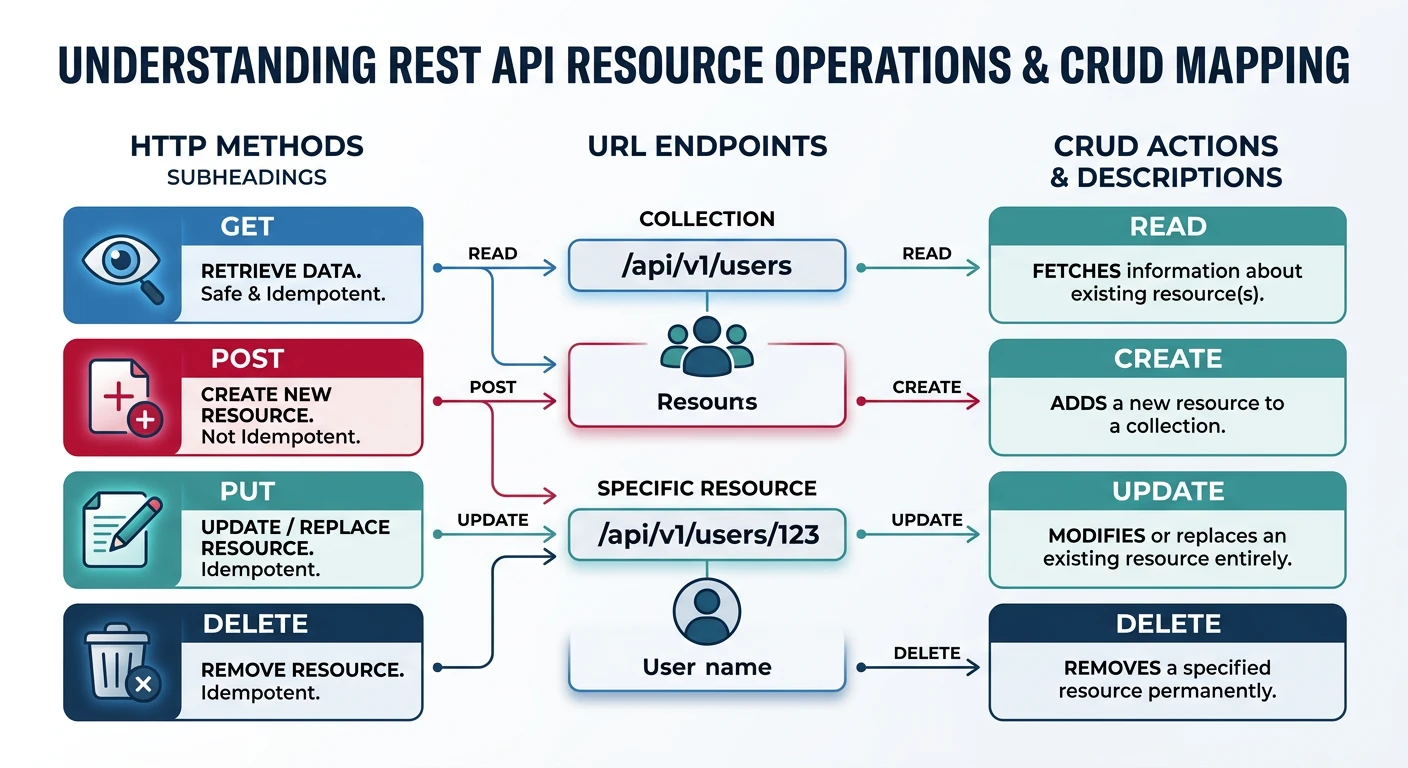
REST maps HTTP methods to resource operations — GET retrieves, POST creates, PUT updates, and DELETE removes resources at structured URL endpoints
REST Constraints
The Six REST Constraints
REST Architectural Constraints (Roy Fielding, 2000):

1. CLIENT-SERVER
   Separation of concerns: UI and data storage

2. STATELESS
   Each request contains all info needed
   No server-side session state

3. CACHEABLE
   Responses must define cacheability
   Improves scalability and performance

4. LAYERED SYSTEM
   Client doesn't know if talking to server or intermediary
   Enables load balancers, proxies, CDNs

5. UNIFORM INTERFACE
   - Resource identification (URLs)
   - Resource manipulation through representations
   - Self-descriptive messages (Content-Type)
   - HATEOAS (Hypermedia as the Engine of Application State)

6. CODE ON DEMAND (Optional)
   Server can send executable code (JavaScript)

Note: Most "REST" APIs are actually "RESTful" or "REST-like"
      True REST with HATEOAS is rare in practice
RESTful URL Design
URL Design
REST URL Patterns
REST URL Design Best Practices:

# Resources are NOUNS (not verbs!)
✅ /users
❌ /getUsers
❌ /createUser

# Collection vs. Item
GET    /users          → List all users
POST   /users          → Create user
GET    /users/123      → Get user 123
PUT    /users/123      → Replace user 123
PATCH  /users/123      → Update user 123
DELETE /users/123      → Delete user 123

# Nested Resources
GET    /users/123/posts        → Posts by user 123
POST   /users/123/posts        → Create post for user 123
GET    /users/123/posts/456    → Get specific post

# Filtering, Sorting, Pagination
GET /users?status=active       → Filter by status
GET /users?sort=created_at     → Sort by field
GET /users?sort=-name          → Descending sort
GET /users?page=2&limit=20     → Pagination
GET /users?fields=id,name      → Sparse fieldsets

# Search
GET /users/search?q=john       → Search users

# Actions (when CRUD doesn't fit)
POST /users/123/activate       → Activate user
POST /orders/456/cancel        → Cancel order
REST API Examples
# RESTful API client example
import json
from urllib.request import Request, urlopen
from urllib.parse import urlencode

class RESTClient:
    """Simple REST API client demonstration"""

    def __init__(self, base_url):
        self.base_url = base_url.rstrip('/')

    def _request(self, method, endpoint, data=None, params=None):
        """Make HTTP request"""
        url = f"{self.base_url}{endpoint}"

        if params:
            url += '?' + urlencode(params)

        headers = {
            'Content-Type': 'application/json',
            'Accept': 'application/json'
        }

        body = json.dumps(data).encode() if data else None

        # Return simulated response for demonstration
        return {
            'method': method,
            'url': url,
            'headers': headers,
            'body': data
        }

    def get(self, endpoint, params=None):
        return self._request('GET', endpoint, params=params)

    def post(self, endpoint, data):
        return self._request('POST', endpoint, data=data)

    def put(self, endpoint, data):
        return self._request('PUT', endpoint, data=data)

    def patch(self, endpoint, data):
        return self._request('PATCH', endpoint, data=data)

    def delete(self, endpoint):
        return self._request('DELETE', endpoint)

# Demonstrate REST patterns
api = RESTClient('https://api.example.com/v1')

print("REST API Patterns Demo")
print("=" * 60)

# List users (GET /users)
result = api.get('/users', params={'status': 'active', 'limit': 10})
print(f"\n1. List users: {result['method']} {result['url']}")

# Create user (POST /users)
new_user = {'name': 'Alice', 'email': 'alice@example.com'}
result = api.post('/users', data=new_user)
print(f"\n2. Create user: {result['method']} {result['url']}")
print(f"   Body: {result['body']}")

# Get user (GET /users/123)
result = api.get('/users/123')
print(f"\n3. Get user: {result['method']} {result['url']}")

# Update user (PATCH /users/123)
updates = {'name': 'Alice Smith'}
result = api.patch('/users/123', data=updates)
print(f"\n4. Update user: {result['method']} {result['url']}")
print(f"   Body: {result['body']}")

# Delete user (DELETE /users/123)
result = api.delete('/users/123')
print(f"\n5. Delete user: {result['method']} {result['url']}")

# Nested resource
result = api.get('/users/123/posts')
print(f"\n6. User's posts: {result['method']} {result['url']}")
OpenAPI (Swagger): Document REST APIs with OpenAPI specification. It enables automatic client generation, interactive documentation (Swagger UI), and API testing. Most REST APIs should have an OpenAPI spec.
GraphQL
GraphQL (Facebook, 2015) is a query language for APIs. Clients specify exactly what data they need, solving REST's over-fetching and under-fetching problems.
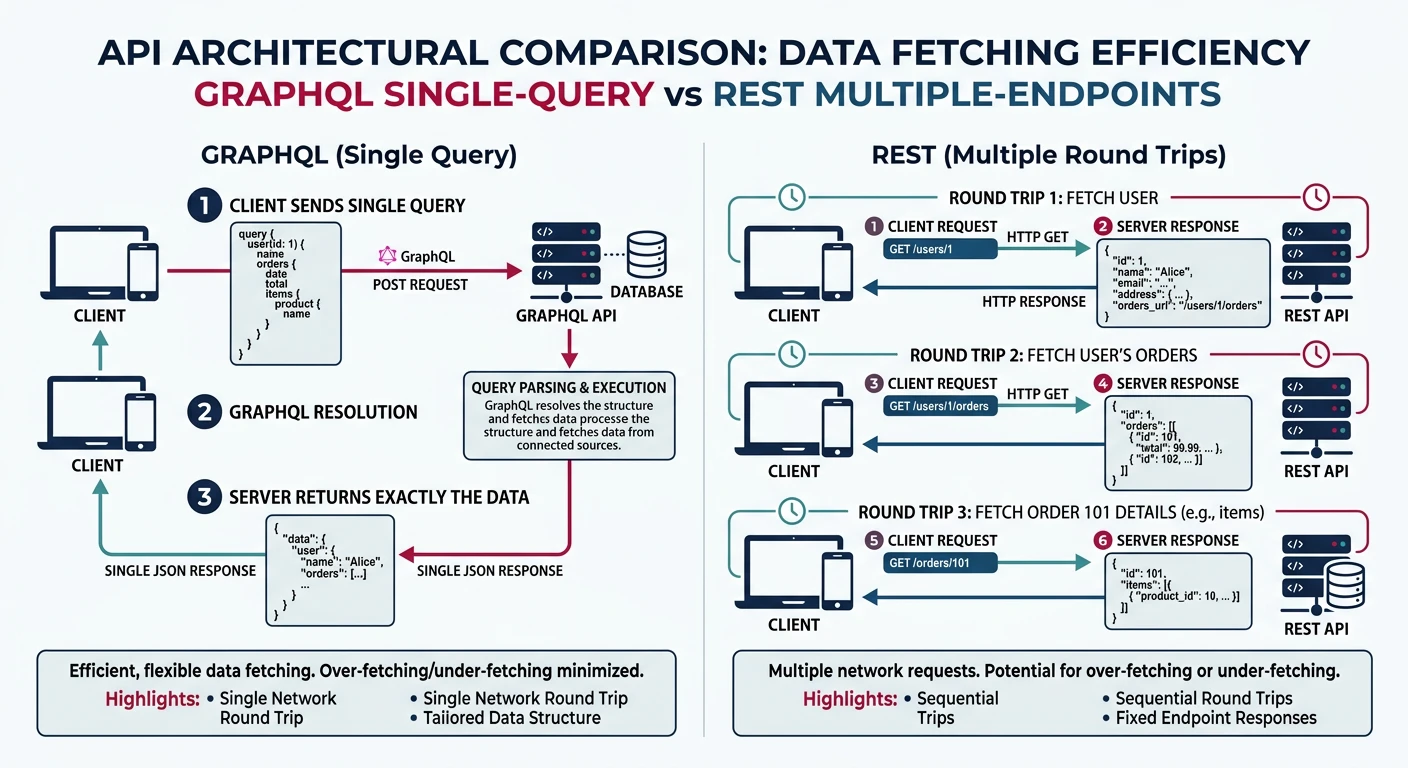
GraphQL resolves nested data in a single request, eliminating the over-fetching and N+1 query problems common in REST APIs
GraphQL vs REST
The Problem GraphQL Solves
REST Over-fetching and Under-fetching:

Scenario: Mobile app needs user name and their posts' titles

REST Approach (multiple requests, extra data):
GET /users/123
→ {id, name, email, avatar, bio, created_at, ...}  # Too much data!

GET /users/123/posts
→ [{id, title, body, author_id, created_at, ...}, ...] # Too much again!

GET /users/123/posts/1/comments
GET /users/123/posts/2/comments  # N+1 problem!


GraphQL Approach (single request, exact data):
POST /graphql
query {
  user(id: 123) {
    name
    posts {
      title
    }
  }
}

→ {
    "user": {
      "name": "Alice",
      "posts": [
        {"title": "First Post"},
        {"title": "Second Post"}
      ]
    }
  }

Benefits:
• Single round trip
• Only requested fields returned
• Strongly typed schema
• Introspection (self-documenting)
GraphQL Schema
Schema
GraphQL Type System
# GraphQL Schema Definition Language (SDL)

# Scalar types: Int, Float, String, Boolean, ID

# Object types
type User {
  id: ID!           # ! = non-nullable
  name: String!
  email: String!
  posts: [Post!]!   # List of non-null Posts
  friends: [User!]
}

type Post {
  id: ID!
  title: String!
  body: String
  author: User!
  comments: [Comment!]!
  createdAt: String!
}

type Comment {
  id: ID!
  text: String!
  author: User!
}

# Input types (for mutations)
input CreateUserInput {
  name: String!
  email: String!
}

input UpdateUserInput {
  name: String
  email: String
}

# Query type (read operations)
type Query {
  user(id: ID!): User
  users(limit: Int, offset: Int): [User!]!
  post(id: ID!): Post
  searchPosts(query: String!): [Post!]!
}

# Mutation type (write operations)
type Mutation {
  createUser(input: CreateUserInput!): User!
  updateUser(id: ID!, input: UpdateUserInput!): User
  deleteUser(id: ID!): Boolean!
  createPost(title: String!, body: String): Post!
}

# Subscription type (real-time)
type Subscription {
  postCreated: Post!
  userOnline(userId: ID!): User!
}
GraphQL Operations
# GraphQL Query Examples

# Simple query
query {
  user(id: "123") {
    name
    email
  }
}

# Query with variables
query GetUser($userId: ID!) {
  user(id: $userId) {
    name
    email
    posts {
      title
    }
  }
}
# Variables: {"userId": "123"}

# Aliases (request same field multiple times)
query {
  alice: user(id: "1") { name }
  bob: user(id: "2") { name }
}

# Fragments (reusable field sets)
fragment UserFields on User {
  id
  name
  email
}

query {
  user(id: "123") {
    ...UserFields
    posts { title }
  }
}

# Mutation
mutation CreateUser($input: CreateUserInput!) {
  createUser(input: $input) {
    id
    name
    email
  }
}
# Variables: {"input": {"name": "Alice", "email": "alice@example.com"}}

# Subscription (WebSocket)
subscription {
  postCreated {
    id
    title
    author { name }
  }
}
# GraphQL client example
import json

def graphql_request(query, variables=None):
    """Demonstrate GraphQL request structure"""
    request = {
        'query': query,
        'variables': variables or {}
    }

    # In real usage, POST to /graphql endpoint
    return request

# Example queries
print("GraphQL Request Examples")
print("=" * 60)

# Simple query
query1 = """
query {
  user(id: "123") {
    name
    email
    posts {
      title
    }
  }
}
"""
print("\n1. Simple query:")
print(json.dumps(graphql_request(query1), indent=2))

# Query with variables
query2 = """
query GetUserPosts($userId: ID!, $limit: Int) {
  user(id: $userId) {
    name
    posts(limit: $limit) {
      title
      createdAt
    }
  }
}
"""
variables = {"userId": "123", "limit": 5}
print("\n2. Query with variables:")
print(json.dumps(graphql_request(query2, variables), indent=2))

# Mutation
mutation = """
mutation CreatePost($title: String!, $body: String) {
  createPost(title: $title, body: $body) {
    id
    title
  }
}
"""
variables = {"title": "My New Post", "body": "Post content here"}
print("\n3. Mutation:")
print(json.dumps(graphql_request(mutation, variables), indent=2))
GraphQL Challenges:
N+1 queries: Solved with DataLoader batching
No HTTP caching: All requests are POST (use persisted queries)
Complexity attacks: Limit query depth and complexity
Learning curve: More complex than REST for simple APIs
gRPC
gRPC (Google Remote Procedure Call) is a high-performance RPC framework using HTTP/2 and Protocol Buffers. It's ideal for microservices communication where performance matters.
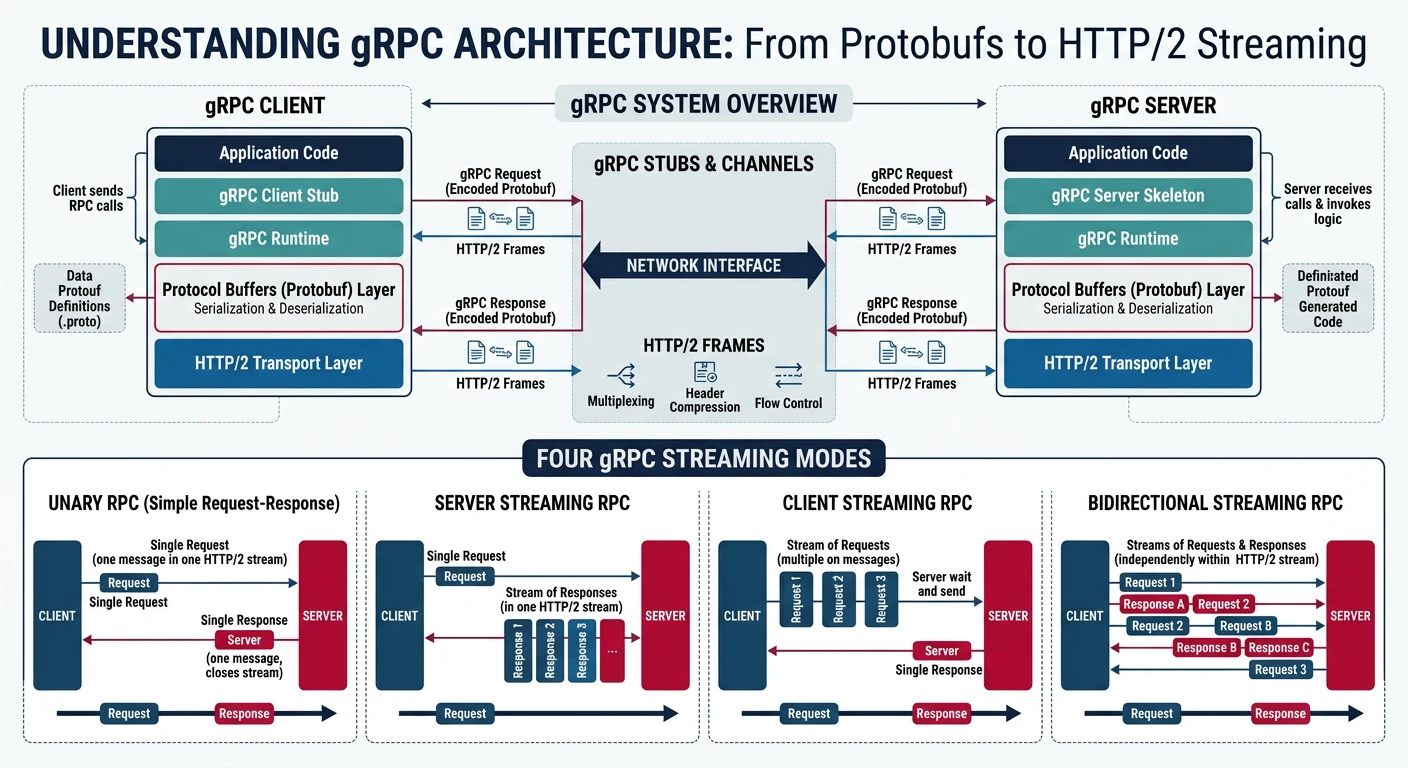
gRPC combines Protocol Buffers binary serialization with HTTP/2 multiplexing, supporting unary, server streaming, client streaming, and bidirectional communication
gRPC Features
Why gRPC is Fast
gRPC Performance Advantages:

1. PROTOCOL BUFFERS (Binary serialization)
   JSON: {"name":"Alice","age":30}  → 26 bytes + parsing
   Protobuf: [binary data]         → ~10 bytes, faster parsing

   Typical savings: 3-10x smaller, 5-100x faster parsing

2. HTTP/2 TRANSPORT
   • Multiplexing (parallel requests)
   • Header compression
   • Single TCP connection

3. STREAMING (4 modes)
   • Unary: Request → Response
   • Server streaming: Request → Stream of responses
   • Client streaming: Stream of requests → Response
   • Bidirectional: Stream ←→ Stream

4. CODE GENERATION
   • Define service in .proto file
   • Generate client/server code in any language
   • Type-safe, no manual serialization

Languages Supported:
C++, Java, Python, Go, Ruby, C#, Node.js, Dart, Kotlin, Swift...
# gRPC streaming concepts demonstration
# Note: Actual gRPC requires generated code from proto file

print("gRPC Streaming Modes")
print("=" * 60)

# 1. Unary RPC (like regular HTTP)
print("""
1. UNARY RPC
   Client ─── Request ───> Server
   Client <── Response ─── Server

   Example: GetUser(user_id) → User
""")

# 2. Server Streaming
print("""
2. SERVER STREAMING
   Client ─── Request ─────────────> Server
   Client <── Response 1 ─────────── Server
   Client <── Response 2 ─────────── Server
   Client <── Response 3 ─────────── Server
   Client <── [Stream End] ───────── Server

   Example: ListUsers(filter) → stream of Users
   Use case: Large result sets, real-time updates
""")

# 3. Client Streaming
print("""
3. CLIENT STREAMING
   Client ─── Request 1 ──────────> Server
   Client ─── Request 2 ──────────> Server
   Client ─── Request 3 ──────────> Server
   Client ─── [Stream End] ───────> Server
   Client <── Response ─────────── Server

   Example: UploadUsers(stream of Users) → UploadResult
   Use case: File upload, batch operations
""")

# 4. Bidirectional Streaming
print("""
4. BIDIRECTIONAL STREAMING
   Client <─── Messages ───> Server
   (Full duplex, independent streams)

   Example: Chat(stream Messages) ↔ stream Messages
   Use case: Chat, collaborative editing, gaming
""")

# gRPC vs REST comparison
print("\ngRPC vs REST Performance:")
print("  Payload size: gRPC is 3-10x smaller")
print("  Latency: gRPC is 5-10x faster")
print("  Throughput: gRPC handles more requests/second")
print("  Browser support: REST (gRPC needs grpc-web proxy)")
gRPC-Web: Browsers can't use native gRPC (no HTTP/2 trailers access). gRPC-Web is a JavaScript client that works through a proxy (Envoy). For browser clients, consider REST or GraphQL.
SOAP
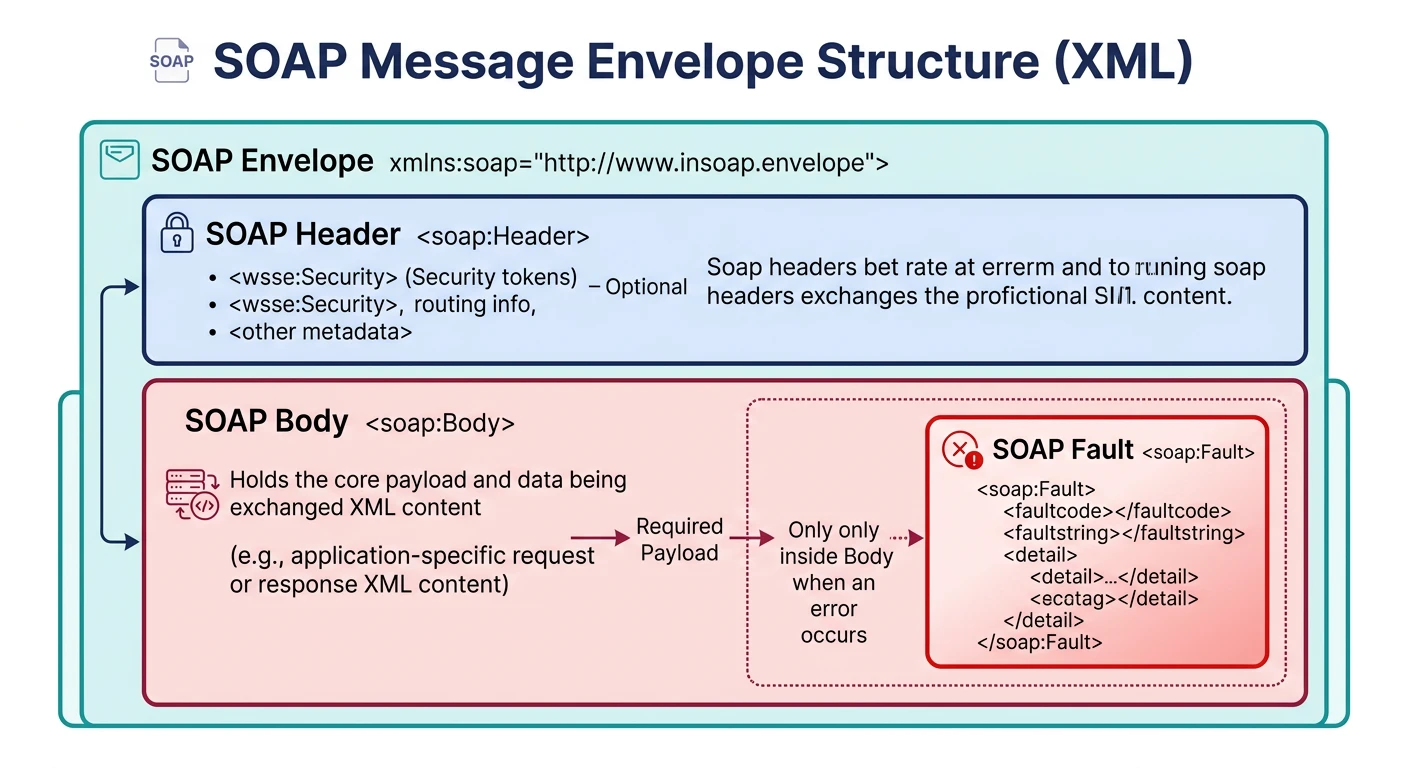
SOAP (Simple Object Access Protocol) is a mature, XML-based protocol with built-in standards for security, transactions, and reliability. It's common in enterprise and B2B integrations.
SOAP messages use a strict XML envelope structure with optional Header for metadata, required Body for payload, and Fault for error reporting
Web Services Description Language - service contract
WS-Security
Message-level encryption and signing
WS-ReliableMessaging
Guaranteed message delivery
WS-AtomicTransaction
Distributed transactions
WS-Addressing
Transport-independent addressing
WS-Policy
Service policies and requirements
When to Use SOAP: SOAP is verbose and complex, but valuable when you need: enterprise security (WS-Security), ACID transactions across services, formal contracts (WSDL), or integration with legacy systems. For new projects, prefer REST or gRPC.
API Authentication
Auth Methods
API Authentication Patterns
API Authentication Methods:

1. API KEYS
   Authorization: Api-Key abc123def456

   Pros: Simple, good for server-to-server
   Cons: No user identity, easy to leak

2. BASIC AUTH (HTTP Basic)
   Authorization: Basic base64(username:password)

   Pros: Simple, universal support
   Cons: Credentials in every request (use HTTPS!)

3. BEARER TOKENS (JWT)
   Authorization: Bearer eyJhbGciOiJIUzI1NiIs...

   JWT Structure:
   Header.Payload.Signature

   Payload: {
     "sub": "user123",
     "name": "Alice",
     "exp": 1735689600,
     "iat": 1735603200
   }

   Pros: Stateless, contains user info
   Cons: Can't revoke (until expiry)

4. OAUTH 2.0 (Delegated authorization)
   Flows:
   - Authorization Code (web apps)
   - Client Credentials (machine-to-machine)
   - Implicit (deprecated for SPAs)
   - PKCE (mobile/SPA)

   Pros: Industry standard, delegated access
   Cons: Complex to implement correctly

5. MUTUAL TLS (mTLS)
   Both client and server present certificates

   Pros: Very secure, no shared secrets
   Cons: Complex certificate management